Nervous System Recovery After Abuse: Why Safety Takes Time
Why Your Body Still Feels Unsafe

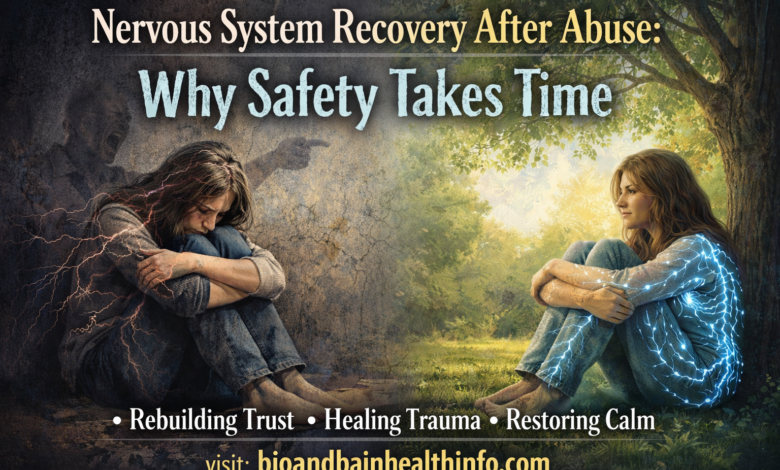
Nervous system recovery after abuse involves trauma physiology, cortisol stress, and emotional regulation as healing unfolds gradually rather than immediately.
Thank you for reading this post, don't forget to subscribe!Leaving ends the harm, but the body does not instantly recognize safety.
Stillness can feel uneasy because alertness lasted longer than danger.
Even after leaving, the nervous system can stay on alert because it learned unpredictability as normal. Regulation returns through consistency, not force.
INTRODUCTION
Nervous System Recovery After Abuse often begins with a confusing fear: “Why does my body still feel unsafe?”
Many people notice lingering tension, sudden alertness, or emotional flatness even after the situation has ended.
The misunderstanding is assuming this reaction means something is wrong with who you are. In reality, trauma physiology shapes how cortisol stress and emotional regulation operate long after threat is removed.
This experience is not a loss of identity; it is a protective response completing its cycle. The nervous system adjusts through timing and repetition, not logic or willpower.
Nothing here signals failure or weakness. It reflects adaptation, not damage.
This article will help you understand what’s happening — without labels, blame, or self-attack.
REASON FOR THIS BLOG
To explain why the body can remain alert after abuse and to separate trauma-based nervous system responses from personal identity — with clarity, care, and no diagnosis.
Please Explore This Blog learning-to-trust-again-after-abuse
INNER SEARCH MIRROR
Many people quietly wonder things like:
Why does my body still feel tense?
Why don’t I feel safe yet?
Am I stuck like this?
Why am I always on edge?
Why does calm feel unfamiliar?
Is my body overreacting?
Did the abuse change me permanently?
If these questions echo inside you, you are not isolated in this experience.
PSYCHOLOGICAL EXPLANATION – Nervous System Recovery After Abuse
Nervous System Recovery After Abuse is rooted in psychological adaptation, not personal weakness. When threat persists, the mind learns to anticipate danger as a way to survive.
Trauma physiology shapes attention, memory, and expectation, while cortisol stress reinforces vigilance even after the threat ends.
Emotional regulation does not immediately reset because the system learned caution through repetition.
Healing begins when the mind slowly updates what is safe, not when it is forced to relax.
This distinction matters: the reaction was never intentional. It was learned protection completing its cycle.
| Survival Learning | Purpose |
|---|---|
| Hyper-alert focus | Detect danger |
| Cautious interpretation | Avoid harm |
| Reduced trust | Preserve safety |
Personal note: Understanding adaptation helped me stop blaming my reactions.
NERVOUS SYSTEM EXPLANATION – How the Body Stays Alert Before the Mind Feels Ready
Nervous System Recovery After Abuse also unfolds biologically. Fight, flight, or freeze responses activate before conscious thought.
Trauma physiology teaches the body to react automatically, while cortisol stress keeps arousal systems primed. Emotional regulation returns only after repeated experiences of predictability.
Healing is paced by the body, not logic.
Common warning signs include:
Sudden startle responses
Muscle tension
Shallow breathing
Sleep disruption
Difficulty relaxing
These reactions are not choices; they are reflexes that once kept you safe.
Personal note: My body released tension long before my thoughts felt calm.
Identity vs Survival Responses
This distinction anchors Nervous System Recovery After Abuse.
Survival responses exist to protect. They narrow focus, heighten alertness, and limit vulnerability.
Identity reflects values, conscience, and meaning — who you are when safety is present.
Survival reactions can feel overwhelming, but they do not redefine identity. Protection is temporary; values endure.
When safety stabilizes, identity naturally reappears without effort. Confusing survival with self creates unnecessary fear. Separating them restores trust.
You are not your nervous system’s alarm.
You are the person it worked to protect.
This clarity is where calm authority replaces self-doubt.
Please Explore This Blog self-worth-recovery-after-narcissist
Nervous System Recovery After Abuse Is Not Narcissism
A common fear during Nervous System Recovery After Abuse is, “What if this change means something is wrong with me?”
This fear comes from confusing behavior with motivation. Trauma physiology shapes temporary responses, while cortisol stress sustains alertness.
Emotional regulation may narrow during healing, but motivation tells the truth. Trauma responses include concern, reflection, and discomfort about distance.
Narcissism avoids remorse and accountability to protect ego, not safety.
| Trauma Response | Narcissistic Pattern |
|---|---|
| Reflects on impact | Deflects responsibility |
| Feels remorse | Lacks concern |
| Seeks repair | Avoids accountability |
| Withdraws to recover | Withdraws to control |
Personal note: Recognizing motivation ended my fear of self-labeling.
Orienting Gently During Nervous System Recovery After Abuse
Nervous System Recovery After Abuse unfolds through orientation, not fixing. Trauma physiology recalibrates slowly as cortisol stress reduces and emotional regulation regains range.
Growth often appears quietly: less urgency, softer reactions, and a growing preference for peace over explanation.
Slowing down is not avoidance; it is cooperation with healing. When pressure eases, the system learns safety through consistency rather than effort.
Choosing calm environments and allowing rhythm to stabilize restores agency without force.
Progress is measured by ease, not intensity.
Personal note: Healing became visible when I stopped pushing myself forward and allowed steadiness to lead.
HEALING COMPASS / ORIENTATION TABLE
Healing after abuse follows a predictable but non-linear sequence. This compass offers orientation without urgency.
| Stage | Experience | Gentle Affirmation |
|---|---|---|
| Safety | Reduced exposure to threat | “I am allowed to rest.” |
| Stabilization | Alertness softens | “Stillness is protective.” |
| Integration | Clarity returns | “This response is temporary.” |
| Reconnection | Energy slowly rises | “I move at my own pace.” |
| Protection | Boundaries feel natural | “Peace guides my choices.” |
This map is not a timeline. It is a reminder that stability comes before change — and that healing follows safety, not pressure.
Safety Returns to the Body Before the Mind Understands
Nervous System Recovery After Abuse begins below awareness. Trauma physiology teaches the body to stay alert long after danger ends, while cortisol stress keeps threat-detection active even in safe environments.
Emotional regulation does not reset through insight; it returns through repeated experiences of predictability.
Healing often feels delayed because the body updates more slowly than thought. This lag is not resistance or failure—it is biological sequencing.
The system must feel safety before it can interpret it. When this order is respected, fear softens naturally.
What looks like being “stuck” is often the body finishing work the mind could not do under pressure.
Ongoing Tension Is Not a Sign of Weakness
During Nervous System Recovery After Abuse, lingering tension is frequently misread as fragility.
Trauma physiology adapts to unpredictability by increasing vigilance, and cortisol stress reinforces this pattern over time.
Emotional regulation narrows to protect capacity, not because resilience is lost. Healing begins when tension is seen as a residue of strength, not a lack of it.
The body learned endurance first; relaxation comes later. Understanding this reframes self-judgment into respect.
What remains tense is not broken—it is cautious. With consistency, caution releases without force.
Calm Can Feel Unsafe Before It Feels Restful
A paradox of Nervous System Recovery After Abuse is that calm may initially feel unsettling.
Trauma physiology associates stillness with unpredictability, while cortisol stress keeps alertness online even in quiet moments.
Emotional regulation has not yet relearned safety cues, so peace feels unfamiliar. Healing requires exposure to calm without demand.
Over time, the body updates its expectations. The discomfort is not rejection of peace—it is unfamiliarity with it.
When calm becomes predictable, it becomes restorative.
Regulation Returns Through Rhythm, Not Effort
Nervous System Recovery After Abuse does not accelerate through willpower. Trauma physiology responds to rhythm, repetition, and consistency, not urgency.
Cortisol stress decreases when the system experiences regular patterns it can trust. Emotional regulation expands naturally as predictability replaces threat.
Healing unfolds when effort is replaced with allowance. This is why pressure often delays recovery.
Regulation is learned again through lived stability, not self-correction.
The nervous system follows experience, not instruction.
Identity Was Never Lost—It Was Sheltered
One of the quiet truths of Nervous System Recovery After Abuse is that identity remains intact beneath adaptation.
Trauma physiology narrows expression to protect safety, while cortisol stress limits access to emotional range. Emotional regulation pauses, but values and conscience stay present.
Healing allows expression to return once protection is no longer required. Nothing essential disappeared.
What withdrew did so intelligently. When safety stabilizes, identity re-emerges without reconstruction.
Trust returns when this distinction becomes clear.
Closing Note
Clarity came when I stopped asking why my body hadn’t recovered yet and started respecting what it had been protecting.
Please Explore This Blog identity-loss-after-abusive-relationship
Medical / Ethical Positioning — Nervous System Recovery After Abuse
From a medical-ethical lens, Nervous System Recovery After Abuse is understood as a meaning-processing response rather than a disorder.
Trauma physiology influences how the mind interprets threat, confusion, and coherence after prolonged harm.
Ethical care avoids urgency, labels, or corrective pressure, focusing instead on informed understanding and consent-based pacing.
Healing is framed as a process of restoring interpretive clarity rather than eliminating symptoms.
This protects dignity and prevents secondary harm caused by misinterpretation.
| Ethical Focus | Role |
|---|---|
| Meaning | Clarify experience |
| Safety | Prevent harm |
| Autonomy | Respect timing |
| Care | Explain, not label |
Personal note: Ethical framing helped me feel safe enough to stay curious.
Psychological Layer — Nervous System Recovery After Abuse
Psychologically, Nervous System Recovery After Abuse reflects how the mind organizes meaning after prolonged cortisol stress.
Threat is no longer external, yet interpretation remains cautious. Confusion appears when old predictive models no longer match present reality.
The mind temporarily simplifies emotional input to reduce overload while rebuilding trust in interpretation. Healing here is about restoring accurate meaning, not correcting emotion.
When interpretation stabilizes, emotional clarity follows naturally.
| Mental Process | Effect |
|---|---|
| Threat prediction | Over-caution |
| Meaning framing | Narrowed |
| Interpretation | Slowed |
| Re-alignment | Gradual |
Personal note: I noticed clarity returned when meaning felt safer than certainty.
Nervous System Layer — Nervous System Recovery After Abuse
At the biological level, Nervous System Recovery After Abuse shows how the body protects safety automatically.
Emotional regulation shifts without conscious input, reducing reactivity while recalibrating thresholds. This layer operates beneath thought, prioritizing survival over expression.
Healing progresses as bodily signals regain flexibility through repeated safety, not instruction.
The body’s responses are protective reflexes completing their task.
| Body Response | Purpose |
|---|---|
| Tension | Guard safety |
| Reduced sensation | Prevent overload |
| Delayed response | Assess risk |
| Rhythm repair | Restore balance |
Personal note: My body softened before my thoughts understood why.
Mental Health Layer — Nervous System Recovery After Abuse
Within mental health, Nervous System Recovery After Abuse explains how prolonged stress reshapes clarity, energy, and self-trust during healing.
Cognitive fatigue and reduced motivation are not deficits but conservation strategies. Mental capacity rebuilds once internal safety is re-established.
Healing here emphasizes restoring confidence in one’s internal signals rather than analyzing every symptom.
Stability precedes insight.
| Capacity | Impact |
|---|---|
| Focus | Temporarily reduced |
| Energy | Conserved |
| Confidence | Rebuilding |
| Self-trust | Returning |
Personal note: I stopped demanding answers and noticed trust returning.
Identity Layer (Inner Continuity & Meaning) — Nervous System Recovery After Abuse
The identity layer clarifies that Nervous System Recovery After Abuse does not disrupt core values.
Trauma physiology may restrict expression, but conscience and meaning remain intact beneath survival responses.
Identity is sheltered, not altered. Healing allows expression to re-emerge once protection is no longer required.
What persists quietly is who you have always been.
| Identity Element | Status |
|---|---|
| Values | Intact |
| Conscience | Present |
| Meaning | Dormant |
| Continuity | Preserved |
Personal note: Remembering my values restored my sense of self.
Reflective Support Layer (Including AI) — Nervous System Recovery After Abuse
Reflective supports assist Nervous System Recovery After Abuse by mirroring thought patterns without directing outcomes.
Emotional regulation improves when experiences are externalized safely through journaling, conversation, or AI-based reflection.
These tools do not instruct; they clarify. Reflection creates space for insight without pressure, allowing meaning to reorganize organically.
| Support Tool | Function |
|---|---|
| Journaling | Externalize thoughts |
| Dialogue | Normalize experience |
| AI reflection | Pattern mirroring |
| Prompts | Gentle clarity |
Personal note: Reflection helped me hear myself again.
Environmental & Rhythm Layer — Nervous System Recovery After Abuse
Daily environment plays a quiet role in Nervous System Recovery After Abuse. Cortisol stress reduces when surroundings become predictable and low-demand.
This layer focuses on rhythm rather than insight — how repeated, neutral experiences teach safety over time.
Healing is reinforced through consistency, not intensity.
| Element | Effect |
|---|---|
| Routine | Predictability |
| Space | Calm signaling |
| Pace | Reduced demand |
| Consistency | Regulation |
Personal note: Stability returned when my days became predictable.
PERSONAL NOTE — Nervous System Recovery After Abuse
There was a time when Nervous System Recovery After Abuse made me doubt my own stability. My mind understood that harm had ended, yet my body stayed alert.
What clarified this experience was recognizing emotional regulation as a process that unfolds through safety, not insight.
I stopped interpreting tension as failure and began seeing it as unfinished protection. I didn’t push calm or demand clarity.
I focused on consistency and let the system adjust on its own timeline. Gradually, reactions softened without effort.
The most important shift was internal: I stopped measuring recovery and started respecting it. That respect changed everything.
Please Explore This Blog confidence-after-narcissistic-abuse
COSMIC / PHILOSOPHICAL TAKEAWAY — Nervous System Recovery After Abuse
Nature restores balance quietly, without instruction.
In Nervous System Recovery After Abuse, trauma physiology, cortisol stress, emotional regulation, and healing follow an ancient order.
Systems withdraw before they renew. What pauses is not life, but overload. The body does not argue with experience; it responds to it.
When force is removed, equilibrium returns on its own terms. Meaning reappears when struggle ends.
This phase is not a void — it is a recalibration. Just as the night prepares the ground for morning, stillness prepares the system for reconnection.
Nothing essential is missing; it is simply resting.
FINAL CLOSING — Nervous System Recovery After Abuse
If you are moving through Nervous System Recovery After Abuse, nothing about your experience means you are broken or delayed.
Trauma physiology can keep cortisol stress elevated even after danger ends, and emotional regulation returns gradually through predictability, not effort.
Healing does not require urgency, confrontation, or self-correction. It unfolds as safety becomes familiar again.
You are allowed to move slowly, to choose peace over explanation, and to trust timing rather than judge it.
Nothing is wrong with you for reacting to harm. With safety and understanding, what adapted can soften again.
Please Explore This Blog rebuilding-self-trust-after-narcissist
FAQ SECTION
1. Why does my body still feel unsafe after abuse ends?
Because the nervous system updates safety through repetition, not logic.
2. Is this a sign of permanent damage?
No. It reflects adaptation, not injury.
3. Why do I feel tense even in calm situations?
Your system learned vigilance during unpredictability.
4. How long does nervous system recovery take?
There is no fixed timeline; safety determines pace.
5. Am I failing at healing if symptoms linger?
No. Lingering responses are common and protective.
6. Should I force myself to relax?
Forcing often delays regulation rather than supporting it.
7. Does this mean I have a disorder?
No diagnosis is implied by nervous system adaptation.
8. When will my sense of ease return?
Ease usually returns gradually as consistency builds.
9. Do I need immediate therapy?
Support can help, but urgency is not required for healing to begin.
🌿 Final Blog Footer — Bio & Brain Health Info
Written by Lex, founder of Bio & Brain Health Info — exploring the intersections of psychology, spirituality, and emotional recovery through calm, trauma-aware understanding.
✨ Insight & Reflection
Healing does not begin when answers arrive — it begins when self-attack stops.
Clarity grows in spaces where safety is restored.
🧠 Learn
Narcissism • Emotional Healing • Spiritual Psychology
🌍 A Moment for You
💡 Pause for two minutes. Let your body settle before moving on.
🧭 If This Article Helped, Your Next Questions Might Be:
These questions are natural continuations — not obligations.
✨ Cosmic Family Invitation
You are not here by accident. If these words reached you, clarity was already beginning.
We rise together — different souls, one journey. 🕊️
📩 Connect with us
info@bioandbrainhealthinfo.com
Telegram: @bioandbrainhealthinfo
WhatsApp Channel: Punehealth
Lex | Bio & Brain Health Info
Cosmic Family — Different Souls, One Journey.
REFERENCES & CITATION
National Institute of Mental Health (NIMH) — Stress & trauma
https://www.nimh.nih.gov/health/topics/post-traumatic-stress-disorder-ptsdHarvard Health Publishing — Stress response
https://www.health.harvard.edu/staying-healthy/understanding-the-stress-responseCleveland Clinic — Emotional regulation & stress
https://my.clevelandclinic.org/health/articles/21561-emotional-regulationAmerican Psychological Association (APA) — Trauma overview
https://www.apa.org/topics/traumaNICABM — Trauma & nervous system
https://www.nicabm.com/trauma-how-it-affects-the-nervous-system/Polyvagal Institute — Nervous system safety
https://www.polyvagalinstitute.org/what-is-the-polyvagal-theoryFrontiers in Psychology — Stress & regulation (peer-reviewed)
https://www.frontiersin.org/articles/10.3389/fpsyg.2018.01548/fullWorld Health Organization (WHO) — Mental health & stress
https://www.who.int/teams/mental-health-and-substance-use