NarcissismNarcissism Identity

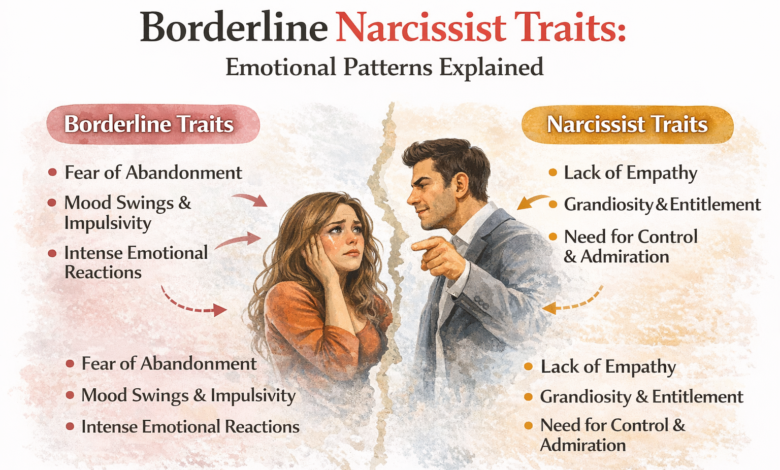
Borderline Narcissist Traits: Emotional Patterns Explained

Overlap Between BPD and Narcissism

A borderline narcissist pattern may involve BPD vs narcissism overlap, personality disorder traits, emotional dysregulation, and identity instability that create confusion about emotional reactions and relational behavior.

Thank you for reading this post, don't forget to subscribe!

Sometimes what looks like the same behavior comes from very different emotional needs — and clarity begins when we understand the motivation beneath the reaction.

Sometimes two emotional patterns can look similar on the surface, yet carry completely different inner experiences.

Confusion often comes not from lack of awareness, but from trying to understand behavior without seeing the emotional need underneath.

Even after leaving, the nervous system can stay on alert because it learned unpredictability as normal. Regulation returns through consistency, not force.

INTRODUCTION -Borderline Narcissist Traits

A borderline narcissist pattern may include BPD vs narcissism overlap, personality disorder traits, emotional dysregulation, and identity instability that make people question, “Am I losing myself or misunderstanding the situation?”

The confusion often arises when trauma responses are mistaken for identity rather than adaptive survival strategies.

Emotional intensity does not automatically define character or intention.

If you feel uncertain about emotional patterns or relational behavior, you are not alone — these experiences reflect complex dynamics, not personal failure.

This article will help you understand what’s happening — without labels, blame, or self-attack.


REASON FOR THIS BLOG -Borderline Narcissist Traits

To help readers understand the overlap and differences between emotional patterns often described as borderline or narcissistic, while separating trauma-based reactions from identity — offering clarity without diagnosis or judgment.


INNER SEARCH MIRROR – Borderline Narcissist Traits

You may be asking yourself:

  • Am I dealing with borderline traits or narcissistic behavior?

  • Why do emotional reactions feel so intense?

  • Is this emotional dysregulation or personality difference?

  • Why does identity feel unstable in relationships?

  • Am I overreacting or missing something deeper?

  • Why does confusion remain even after distance?

Please Explore This Blog borderline-or-narcissist-psychological-differences


PSYCHOLOGICAL EXPLANATION -Borderline Narcissist Traits

Borderline Narcissist Emotional Adaptation Patterns

A borderline narcissist dynamic involving BPD vs narcissism overlap, personality disorder traits, emotional dysregulation, and identity instability can develop through different emotional needs that appear similar externally.

Survival conditioning may shape reactions toward seeking reassurance or protecting self-image, creating overlapping behaviors without identical motivations.

Understanding adaptation reduces self-blame and clarifies that intent and emotional regulation challenges are not the same.

Psychological PatternInternal Function
Emotional intensityConnection seeking
Self-protectionAvoid perceived threat
Identity shiftsMaintain stability

Personal note: Observing patterns rather than personalities often brings the first sense of relief.


NERVOUS SYSTEM EXPLANATION – Borderline Narcissist Traits

Borderline Narcissist Patterns Through the Nervous System

Within a borderline narcissist dynamic shaped by BPD vs narcissism overlap, personality disorder traits, emotional dysregulation, and identity instability, the nervous system may respond rapidly to perceived rejection or threat.

Fight, flight, freeze, or fawn responses activate before conscious reasoning, which explains sudden emotional escalation.

These reactions are biological safety mechanisms rather than deliberate choices, helping reduce shame around emotional reactivity.

Common warning signs:

  • Sudden emotional overwhelm

  • Fear of abandonment or criticism

  • Rapid mood shifts

  • Physical tension during conflict

  • Emotional exhaustion afterward

Personal note: Many people feel calmer when they understand reactions begin in the body before thought.


CORE DISTINCTION -Borderline Narcissist Traits

Identity vs Survival Responses

Survival responses protect emotional safety; identity reflects deeper values, conscience, and long-term self-direction.

In a borderline narcissist dynamic involving BPD vs narcissism overlap, personality disorder traits, emotional dysregulation, and identity instability, survival strategies may resemble personality traits.

However, protection is not identity.  Emotional reactions shaped by past experiences do not define character or worth.

Authority emerges when this distinction becomes clear: survival adapts to circumstances, while identity remains stable beneath emotional fluctuation.

Please Explore This Blog borderline-vs-narcissist-clinical-comparison

TRAUMA VS NARCISSISM  – Borderline Narcissist Traits

Borderline Narcissist: Trauma Responses vs Control Motivation

In a borderline narcissist dynamic involving BPD vs narcissism overlap, personality disorder traits, emotional dysregulation, and identity instability, behaviors may look similar but motivation differs.

Trauma responses often include remorse and reflection, while control-based patterns avoid accountability.

Understanding motivation reduces self-labeling and supports clearer emotional interpretation without diagnosis.

Trauma ResponseControl Pattern
Reflects afterwardDeflects responsibility
Shows remorseMinimizes impact
Seeks repairProtects self-image

Personal note: Relief often begins when we compare intentions instead of judging behavior alone.


GROWTH DIRECTION -Borderline Narcissist Traits

Borderline Narcissist Patterns and Gentle Growth Orientation

Healing within a borderline narcissist dynamic shaped by BPD vs narcissism overlap, personality disorder traits, emotional dysregulation, and identity instability often unfolds quietly.

Signs include slower emotional reactions, increased inner space, and choosing peace over intensity.

Growth becomes less about fixing and more about noticing patterns with gentleness.

Personal note: Progress sometimes appears as calm pauses where strong reactions once lived.


HEALING COMPASS / ORIENTATION TABLE -Borderline Narcissist Traits

Healing moves through gradual stages that restore internal steadiness.

StageGentle Orientation
Awareness“I notice patterns clearly.”
UnderstandingEmotions begin making sense
RegulationNervous system settles more often
BoundariesEnergy feels safer
IntegrationSelf-trust grows steadily

Insight becomes stability when understanding is allowed to deepen at a natural pace.

Please Explore This Blog bpd-and-narcissism-psychological-overlap

🌿 10 Signs — Borderline Narcissist Traits


Emotional Intensity Feels Both Connecting and Overwhelming

In borderline narcissist traits, BPD vs narcissism overlap may show personality disorder traits shaped by emotional dysregulation and identity instability, creating powerful emotional engagement that feels meaningful yet difficult to regulate consistently.


Rapid Shifts in Emotional Reactions

Emotional dysregulation within borderline narcissist traits can involve identity instability and personality disorder traits, where BPD vs narcissism overlap creates sudden emotional transitions between closeness and distance.


Fear of Rejection Mixed With Self-Protection

Borderline narcissist traits may reflect BPD vs narcissism overlap through emotional dysregulation and identity instability, blending attachment fears with protective responses linked to personality disorder traits.


Idealization Followed by Emotional Withdrawal

Personality disorder traits associated with borderline narcissist traits may include cycles where admiration shifts into distance, influenced by emotional dysregulation, identity instability, and BPD vs narcissism overlap.


Strong Emotional Responses to Perceived Criticism

Borderline narcissist traits shaped by emotional dysregulation and identity instability may amplify reactions to feedback, reflecting personality disorder traits within BPD vs narcissism overlap patterns.


Self-Image Fluctuates Depending on Relationships

Identity instability within borderline narcissist traits may cause self-perception to shift rapidly, influenced by emotional dysregulation, personality disorder traits, and BPD vs narcissism overlap dynamics.


Emotional Connection Feels Urgent or Intense

BPD vs narcissism overlap may create urgency in emotional bonding, where borderline narcissist traits involve emotional dysregulation and identity instability tied to personality disorder traits.


Difficulty Maintaining Emotional Boundaries

Borderline narcissist traits may include blurred emotional boundaries, shaped by identity instability and emotional dysregulation, reflecting personality disorder traits seen in BPD vs narcissism overlap.


Confusion About Responsibility in Conflict

Emotional dysregulation and identity instability may lead to unclear responsibility during disagreements, often appearing within borderline narcissist traits connected to BPD vs narcissism overlap.


Emotional Highs and Lows Feel Deeply Personal

Borderline narcissist traits involving personality disorder traits, emotional dysregulation, identity instability, and BPD vs narcissism overlap can create emotional extremes that feel deeply meaningful yet exhausting.


🌱 CLOSING NOTE

Recognizing borderline narcissist traits is not about labeling individuals but about understanding patterns shaped by BPD vs narcissism overlap, personality disorder traits, emotional dysregulation, and identity instability. Awareness helps reduce self-criticism and restore perspective. Healing begins when emotional intensity is viewed as a learned response rather than a personal flaw, allowing calmer understanding to gradually replace confusion.

Please Explore This Blog bpd-and-narcissist-couple-relationship-cycle-explained


🌿 A Whole-System View of the Human Healing Process


Medical / Ethical Positioning – Borderline Narcissist Traits

Within borderline narcissist traits, emotional dysregulation can influence how meaning is assigned to conflict, especially when identity instability interacts with perceived threat.

Ethical positioning avoids diagnosis and instead examines patterns that shape interpretation.

Confusion often arises when emotional intensity is mistaken for danger rather than communication, highlighting the need for slow, compassionate meaning-making.

Ethical LensInterpretation Shift
Pattern awarenessReduces self-judgment
Contextual thinkingClarifies confusion
Non-labeling stanceMaintains safety
Gradual insightSupports stability

Personal note: Ethical clarity often creates emotional space before deeper understanding arrives.


Psychological Layer – Borderline Narcissist Traits

In borderline narcissist traits, BPD vs narcissism overlap may influence internal narratives, where personality disorder traits shape how emotional events are interpreted.

Emotional dysregulation can cause the mind to search for immediate meaning, reinforcing identity instability when emotional signals feel overwhelming.

Understanding psychological adaptation reframes confusion as survival logic rather than failure.

Psychological ProcessInternal Effect
Meaning amplificationEmotional intensity rises
Self-protection thinkingDefensive reactions
Attachment focusConnection seeking
Narrative shiftsIdentity confusion

Personal note: The mind often prioritizes emotional safety over logical consistency during stress.


Nervous System Layer – Borderline Narcissist Traits

Within borderline narcissist traits involving emotional dysregulation, the nervous system responds quickly to perceived rejection or threat.

Fight, flight, freeze, or fawn responses activate before conscious awareness, influencing communication and emotional expression.

These biological responses aim to protect safety rather than control others.

Nervous ResponseProtective Function
FightRegain emotional control
FlightReduce overwhelm
FreezeAvoid escalation
FawnPreserve connection

Personal note: Understanding body responses often transforms shame into compassion.


Mental Health Layer – Borderline Narcissist Traits

Long-term exposure to identity instability and emotional dysregulation within borderline narcissist traits may affect concentration, emotional energy, and self-confidence.

Prolonged stress reshapes attention patterns, increasing rumination and reducing clarity.

Recognizing these shifts separates temporary mental strain from core personality.

Mental ImpactExperience
Cognitive fatigueSlower thinking
Emotional depletionReduced resilience
Self-doubt loopsUncertainty increases
Attention fragmentationDifficulty focusing

Personal note: Mental fatigue often signals sustained emotional load rather than weakness.


Identity Layer (Inner Continuity & Meaning)

Even when emotional dysregulation creates intense reactions, identity remains deeper than temporary adaptation.

In borderline narcissist traits, values and conscience often remain stable beneath identity instability.

Healing involves reconnecting with this inner continuity rather than redefining oneself entirely.

Identity AnchorInner Stability
Core valuesDirection remains
ConscienceMoral awareness persists
Self-reflectionGrowth continues
Meaning-makingPurpose evolves

Personal note: Identity often survives emotional storms even when behavior changes.


Reflective Support Layer (Including AI)

Reflective tools such as journaling, supportive dialogue, or AI conversations can help externalize thoughts during borderline narcissist traits involving emotional dysregulation.

These tools provide mirrors rather than instructions, allowing patterns to become visible without pressure or judgment.

Reflective ToolFunction
JournalingOrganizes internal dialogue
Calm conversationClarifies emotion
AI reflectionPattern recognition
Structured promptsSlow awareness

Personal note: Reflection becomes powerful when it invites curiosity rather than solutions.


Integration Layer — Whole-System Healing Orientation

Healing within borderline narcissist traits emerges when emotional dysregulation, identity instability, and psychological interpretation are understood together.

The mind seeks meaning, the body seeks safety, and identity maintains continuity beneath adaptation.

Whole-system awareness encourages gradual integration rather than sudden change, helping patterns soften naturally.

Reflective tools support insight without directing action, allowing recovery to unfold gently.

When awareness includes biological, psychological, and existential layers simultaneously, clarity grows steadily and self-trust returns without force.

Integration FocusResult
AwarenessReduced confusion
RegulationEmotional steadiness
ReflectionClear perspective
ContinuityRestored self-trust

Personal note: Healing often feels like remembering stability rather than creating something new.

Please Explore This Blog bpd-and-npd-explained-differences-overlap

PERSONAL NOTE – Borderline Narcissist Traits

While exploring borderline narcissist traits, including BPD vs narcissism overlap, personality disorder traits, emotional dysregulation, and identity instability, I noticed how easy it is to become confused by surface similarities between emotional patterns.

What helped most was shifting focus away from labels and toward understanding motivation and adaptation.

Emotional intensity often felt overwhelming until I realized that many reactions were survival responses rather than reflections of character.

Observing patterns calmly allowed space for compassion — both toward self and others — without needing immediate conclusions.

Clarity arrived slowly, not through certainty, but through recognizing that emotional complexity does not remove the possibility of stability or growth.

COSMIC / PHILOSOPHICAL TAKEAWAY  – Borderline Narcissist Traits

“What appears chaotic on the surface may simply be a nervous system trying to find safety through familiar movement.”

Within borderline narcissist traits shaped by BPD vs narcissism overlap, personality disorder traits, emotional dysregulation, and identity instability, human experience reveals how deeply the need for connection shapes behavior.

Emotional reactions are often misunderstood because they carry echoes of past adaptation rather than present intention.

Growth begins when awareness softens the urge to categorize and instead allows observation without judgment.

Healing becomes less about correcting identity and more about understanding emotional rhythms with gentleness.

When clarity replaces self-criticism, emotional complexity transforms into deeper self-knowledge rather than confusion.

Please Explore This Blog bpd-and-narcissist-relationship-dynamics-explained


FINAL CLOSING – Borderline Narcissist Traits

Understanding borderline narcissist traits, including BPD vs narcissism overlap, personality disorder traits, emotional dysregulation, and identity instability, is not about deciding who fits a label or finding a definitive explanation.

It is about restoring calm awareness and reducing unnecessary self-attack. Nothing is wrong with you for feeling affected by emotional intensity or relational confusion; many reactions emerge from a nervous system seeking safety.

Healing unfolds gradually when pressure to resolve everything immediately is replaced with patience and observation.

If this article felt meaningful, allow clarity to develop gently — stability often grows quietly through consistent awareness rather than force.


FAQ SECTION -Borderline Narcissist Traits

❓ What are borderline narcissist traits?

They describe overlapping emotional patterns where behaviors may resemble both borderline and narcissistic tendencies, often involving emotional intensity and self-protection.

❓ Is borderline narcissist a diagnosis?

No. It is a descriptive term sometimes used to discuss overlapping traits, not a formal clinical diagnosis.

❓ How is BPD vs narcissism different?

Motivations differ: one may focus on fear of abandonment and emotional regulation challenges, while the other may involve self-image protection and validation needs.

❓ Why do emotional reactions feel extreme?

Emotional dysregulation can amplify responses, especially when attachment or identity concerns feel threatened.

❓ What is identity instability?

It refers to fluctuating self-perception or emotional self-understanding, often influenced by relational dynamics.

❓ Can trauma influence these patterns?

Yes. Past experiences may shape emotional responses and attachment styles.

❓ Does understanding require labeling people?

No. Understanding patterns focuses on emotional dynamics rather than diagnosis.

❓ Why does confusion remain after conflict?

Nervous system activation can delay clarity until emotional intensity settles.

❓ Is healing about changing personality?

Healing often focuses on regulation, awareness, and stability rather than changing identity.

❓ Can awareness improve relationships?

Recognizing patterns can reduce misunderstanding and support healthier communication over time.


🌿 Final Blog Footer — Bio & Brain Health Info

Written by Lex, founder of Bio & Brain Health Info — exploring the intersections of psychology, spirituality, and emotional recovery through calm, trauma-aware understanding.

Insight & Reflection
Healing does not begin when answers arrive — it begins when self-attack stops.
Clarity grows in spaces where safety is restored.

🧠 Learn
Narcissism • Emotional Healing • Spiritual Psychology

🌍 A Moment for You
💡 Pause for two minutes. Let your body settle before moving on.

🧭 If This Article Helped, Your Next Questions Might Be:
These questions are natural continuations — not obligations.

Cosmic Family Invitation
You are not here by accident. If these words reached you, clarity was already beginning.
We rise together — different souls, one journey. 🕊️

📩 Connect with us
info@bioandbrainhealthinfo.com
Telegram: @bioandbrainhealthinfo
WhatsApp Channel: Punehealth

Lex | Bio & Brain Health Info
Cosmic Family — Different Souls, One Journey.


REFERENCES & CITATIONS -Borderline Narcissist Traits

  1. American Psychiatric Association — Personality Disorders Overview
    https://www.psychiatry.org/patients-families/personality-disorders

  2. National Institute of Mental Health — Borderline Personality Disorder
    https://www.nimh.nih.gov/health/topics/borderline-personality-disorder

  3. Psychology Today — Narcissism Basics
    https://www.psychologytoday.com/us/basics/narcissism

  4. Cleveland Clinic — Emotional Dysregulation Overview
    https://health.clevelandclinic.org/emotional-dysregulation/

  5. Harvard Health Publishing — Stress Response & Emotional Regulation
    https://www.health.harvard.edu

  6. Polyvagal Institute — Nervous System Regulation
    https://www.polyvagalinstitute.org

  7. Verywell Mind — Personality Disorder Traits Explained
    https://www.verywellmind.com

  8. Mind.org.uk — Emotional Health & Relationship Patterns
    https://www.mind.org.uk

  9. Greater Good Science Center — Emotional Regulation Research
    https://greatergood.berkeley.edu

  10. APA Dictionary of Psychology
    https://dictionary.apa.org


Cosmica Family Invitation from bioandbrainhealthinfo

Related Articles

Back to top button