Codependent Narcissist Relationship Patterns
Love or Trauma Bond? Understanding the Dynamic

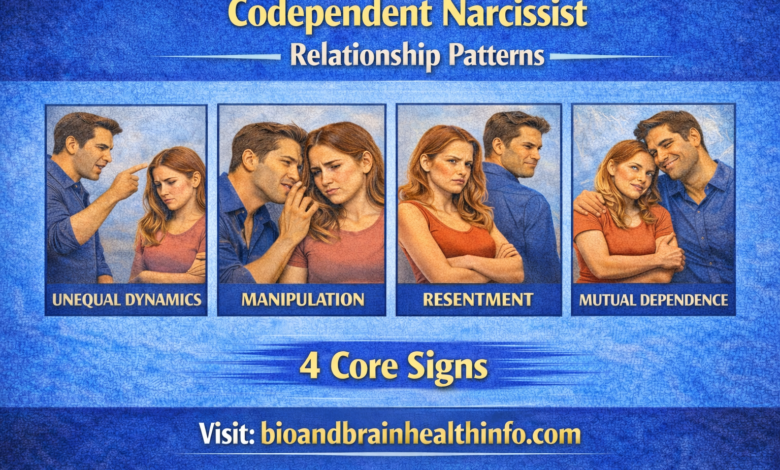
The codependent narcissist relationship often develops through a dependency cycle shaped by narcissistic validation needs, emotional instability, and repeating conflict cycles that create strong emotional attachment while increasing confusion about whether the connection is love or trauma bonding.
Thank you for reading this post, don't forget to subscribe!“Sometimes what feels like intense love is actually two nervous systems trying to regulate through each other rather than growing together.”
“Sometimes the bond feels unbreakable not because it is healthy — but because emotional intensity trained the nervous system to equate unpredictability with connection.
The body remembers rhythms long after the mind begins to question them.”
Even after leaving, the nervous system can stay on alert because it learned unpredictability as normal. Regulation returns through consistency, not force.
INTRODUCTION -Codependent Narcissist Relationship Patterns
The codependent narcissist relationship often forms through a dependency cycle where narcissistic validation patterns, emotional instability, and recurring conflict cycles create powerful attachment that can feel confusing or addictive.
Many people fear: “Is this love, or am I losing myself?”
The misunderstanding comes from confusing trauma-based adaptation with identity itself. Emotional intensity may reflect learned relational survival, not personal weakness.
This article will help you understand what’s happening — without labels, blame, or self-attack.
REASON FOR THIS BLOG – Codependent Narcissist Relationship Patterns
This article exists to clarify why dependency cycles and emotional instability appear within a codependent narcissist relationship, helping readers understand relational patterns without diagnosis, blame, or pressure to change immediately.
INNER SEARCH MIRROR -Codependent Narcissist Relationship Patterns
You may recognize yourself if you’ve wondered:
Why does the relationship feel intense but unstable?
Is this emotional connection or trauma bonding?
Why do conflict cycles repeat even after resolution?
Why does validation feel necessary for calm?
Am I responsible for fixing emotional instability?
Why does separation feel physically uncomfortable?
Why do I return even when I understand the pattern?
Please Explore This Blog communal-narcissism-explained-helping-behavior-hidden-ego
PSYCHOLOGICAL EXPLANATION -Codependent Narcissist Relationship Patterns
The codependent narcissist relationship often develops through a dependency cycle where narcissistic validation needs and emotional instability reinforce repeated conflict cycles.
Psychological adaptation occurs when one partner seeks connection through reassurance while the other maintains emotional control, creating patterns that feel familiar rather than balanced.
These dynamics form through learned relational conditioning rather than deliberate intention.
| Psychological Adaptation | Purpose |
|---|---|
| Seeking reassurance | Regulating emotional safety |
| Emotional withdrawal | Protecting vulnerability |
Personal note: Many people interpret adaptation as failure when it is actually learned survival.
NERVOUS SYSTEM EXPLANATION – Codependent Narcissist Relationship Patterns
In a codependent narcissist relationship, dependency cycle intensity activates the nervous system before conscious awareness.
Emotional instability and conflict cycles trigger fight, flight, freeze, or fawn responses that shape relational behavior automatically.
The body reacts to perceived relational threat faster than logical thinking.
Common warning signs:
Sudden emotional spikes
Difficulty calming after conflict
Hyper-focus on validation
Emotional exhaustion
Rapid mood shifts
Personal note: The nervous system prioritizes safety over clarity.
Identity vs Survival Responses
The codependent narcissist relationship becomes clearer when separating survival responses from identity.
Dependency cycles and emotional instability represent protective adaptations shaped by relational experience, while identity reflects deeper values and conscience.
Conflict cycles do not define who someone is; they show how the nervous system learned to maintain connection.
Survival = protection.
Identity = inner truth.
Authority emerges when this distinction is recognized, allowing awareness without self-blame.
Please Explore This Blog codependent-relationship-with-narcissist-psychology-behind
Codependent Narcissist Relationship: Trauma vs Narcissism Motivation
In a codependent narcissist relationship, behavior may look similar but motivation differs.
Dependency cycle patterns often come from attachment wounds, while narcissistic validation may resist reflection.
Emotional instability can still include remorse and accountability, whereas control patterns tend to avoid self-examination.
| Trauma Response | Narcissistic Pattern |
|---|---|
| Reflection present | Reflection avoided |
| Accountability possible | Responsibility redirected |
Personal note: motivation reveals more than outward behavior.
Codependent Narcissist Relationship: Gentle Growth Direction
Healing within a codependent narcissist relationship often begins when dependency cycle intensity softens and emotional instability reduces naturally.
Signs include slower reactions, less need for constant narcissistic validation, and calmer responses during conflict cycles.
Growth is not forced change — it is quiet movement toward stability, self-trust, and choosing peace without urgency.
Personal note: gentle awareness creates more change than pressure.
HEALING COMPASS / ORIENTATION TABLE – Codependent Narcissist Relationship Patterns
Understanding a codependent narcissist relationship becomes clearer when viewed as stages rather than problems to fix. This map offers orientation without pressure.
| Stage | Orientation |
|---|---|
| Awareness | I notice patterns without blame |
| Regulation | I slow reactions gently |
| Clarity | I see dependency cycle dynamics |
| Boundaries | I honor emotional stability |
| Integration | I choose peace consistently |
Please Explore This Blog bpd-and-narcissist-couple-relationship-cycle-explained
10 Signs Codependent Narcissist Relationship Patterns
Emotional Highs and Lows
In codependent narcissist relationship patterns, emotional highs feel intense and meaningful while lows feel destabilizing. The dependency cycle reinforces bonding through contrast — affection followed by withdrawal — creating attachment confusion that strengthens emotional investment despite conflict cycles or emotional instability.
Validation-Seeking Loop
Narcissistic validation becomes central. One partner seeks approval while the other regulates self-worth through external admiration. This relational imbalance can feel like connection but actually maintains control patterns through subtle reinforcement and emotional dependency.
Rescue Role Activation
Attachment wounds drive rescue behaviors. One partner tries to fix emotional instability, believing care will restore balance. Over time, this strengthens dependency cycle dynamics instead of resolving deeper emotional needs.
Conflict Without Resolution
Repeated conflict cycles occur where arguments repeat but clarity never emerges. Emotional instability increases, reinforcing narcissistic validation needs while dependency patterns prevent true disengagement or closure.
Boundary Confusion
Relationship imbalance appears when personal limits become unclear. Codependent responses prioritize harmony, while control patterns subtly shift responsibility, reinforcing dependency cycle attachment.
Emotional Responsibility Shift
One partner absorbs emotional responsibility for both individuals. Emotional instability increases because narcissistic validation discourages equal accountability, sustaining relational tension.
Idealization and Disappointment
Toxic bonding develops through cycles of admiration followed by disappointment. Dependency cycle reinforcement makes separation feel threatening despite conflict cycles.
Identity Blurring
Relational identity becomes fused with the relationship itself. Attachment wounds create fear of independence, while narcissistic validation keeps emotional focus externally directed.
Silent Control Patterns
Control patterns may appear subtle — withdrawal, passive pressure, or emotional withholding. These behaviors maintain imbalance without overt dominance.
Difficulty Leaving Despite Awareness
Trauma bond intensity makes leaving feel emotionally unsafe. Emotional instability and dependency cycle conditioning create internal conflict between awareness and attachment.
Closing Note
Recognizing codependent narcissist relationship patterns is not about labeling people but understanding dynamics. Awareness reduces self-blame and restores perspective. Patterns formed through attachment wounds and emotional conditioning can shift gradually when clarity replaces confusion and stability replaces reactive cycles.
Please Explore This Blog bpd-and-narcissist-relationship-dynamics-explained
A Whole-System View of the Human Healing Process
Medical / Ethical Positioning – Codependent Narcissist Relationship Patterns
Healing must respect biological reality and ethical complexity. In codependent narcissist relationship patterns, the brain does not simply react to events but assigns meaning based on perceived safety and unpredictability.
Ethical understanding recognizes adaptive survival responses without pathologizing identity.
Healing requires separating symptom expression from moral judgment.
| Aspect | Interpretation |
|---|---|
| Threat perception | Brain scans for unpredictability signals |
| Meaning-making | Past experience shapes present interpretation |
| Ethical lens | Behavior ≠ character |
| Clinical caution | Support without over-labeling |
Personal Note: Healing becomes safer when interpretation shifts from “What is wrong?” to “What adapted to survive?”
Psychological Layer – Codependent Narcissist Relationship Patterns
Psychologically, the mind organizes experience through narrative coherence. Within codependent narcissist relationship patterns, confusion arises when emotional signals contradict cognitive expectations.
The psyche attempts to reduce uncertainty by rationalizing patterns, even harmful ones.
Understanding this meaning-making process reduces shame and clarifies why insight alone may not change behavior immediately.
| Psychological Process | Role |
|---|---|
| Cognitive framing | Creates internal story |
| Emotional bias | Prioritizes familiar patterns |
| Attachment memory | Influences trust responses |
| Defense mechanisms | Maintain perceived stability |
Personal Note: Psychological clarity often arrives gradually, not through sudden realization.
Nervous System Layer – Codependent Narcissist Relationship Patterns
The nervous system responds before conscious interpretation. In codependent narcissist relationship patterns, automatic safety responses like freeze, appease, or hyper-vigilance emerge to maintain relational connection.
These reactions are not decisions but biological protections shaped by repeated emotional environments.
Regulation involves creating predictable signals of safety rather than forcing emotional control.
| Body Response | Function |
|---|---|
| Freeze response | Avoid perceived conflict risk |
| Appease behavior | Preserve attachment safety |
| Hyper-alertness | Monitor emotional shifts |
| Emotional shutdown | Reduce overload |
Personal Note: When the body reacts quickly, it is protecting continuity, not resisting healing.
Mental Health Layer –Codependent Narcissist Relationship Patterns
Prolonged relational stress affects cognitive clarity, emotional energy, and self-trust.
Inside codependent narcissist relationship patterns, repeated unpredictability can narrow attention toward survival priorities rather than long-term reasoning.
Mental fatigue may appear as indecision or self-doubt, but these often reflect energy depletion rather than identity weakness.
| Impact Area | Result |
|---|---|
| Cognitive focus | Reduced clarity |
| Emotional regulation | Increased sensitivity |
| Self-trust | Questioning decisions |
| Motivation | Energy conservation mode |
Personal Note: Exhaustion often signals overload, not failure.
Identity Layer (Inner Continuity & Meaning)
Identity remains deeper than survival behavior. Even within codependent narcissist relationship patterns, core values persist beneath adaptive responses.
People may feel disconnected from themselves, yet conscience and ethical awareness remain intact.
Healing reconnects behavior with values rather than creating a new identity.
| Identity Element | Role |
|---|---|
| Values | Provide internal compass |
| Conscience | Guides relational choices |
| Self-narrative | Maintains continuity |
| Meaning-making | Integrates past experience |
Personal Note: Identity is rarely lost — it is often temporarily overshadowed by survival strategies.
Reflective Support Layer (Including AI)
Reflective tools such as journaling, structured dialogue, or AI-based reflection help externalize thoughts without directing outcomes.
Within codependent narcissist relationship patterns, structured reflection creates distance between emotional reaction and interpretation.
This allows pattern recognition while maintaining autonomy in decision-making.
| Tool | Function |
|---|---|
| Journaling | Clarifies internal dialogue |
| Guided questions | Reveal hidden assumptions |
| AI reflection | Mirrors thought patterns neutrally |
| Conversation | Builds relational perspective |
Personal Note: Reflection works best when it observes rather than instructs.
Please Explore This Blog bpd-and-npd-explained-differences-overlap
Integrated Whole-System Reflection – Codependent Narcissist Relationship Patterns
A whole-system view recognizes that healing emerges from interaction between mind, body, identity, and supportive reflection.
In codependent narcissist relationship patterns, progress rarely follows linear steps; instead, small shifts across layers gradually restore coherence.
When safety increases — biologically, psychologically, and relationally — clarity strengthens naturally.
Tools like journaling or AI do not change identity but help reveal existing insight already present beneath confusion.
| System Layer | Contribution |
|---|---|
| Biology | Stabilizes reactions |
| Psychology | Reframes meaning |
| Identity | Anchors direction |
| Reflection tools | Support awareness |
Personal Note: Healing often feels subtle because integration happens quietly before visible change appears.
PERSONAL NOTE – Codependent Narcissist Relationship Patterns
Writing about codependent narcissist relationship patterns does not come from observing others alone but from noticing how human survival adapts inside connection.
Many people assume confusion means weakness, yet often it reflects loyalty, empathy, or a nervous system trying to maintain safety within emotional complexity.
When dependency cycle or narcissistic validation becomes familiar, clarity may feel distant, but awareness itself is already movement toward stability.
The most important realization is that relational identity evolves — it is not fixed by past dynamics.
Healing is rarely dramatic; it is usually quiet recognition that safety can exist without constant emotional instability. “Clarity returned for me when I stopped asking what was wrong with me.”
COSMIC / PHILOSOPHICAL TAKEAWAY
“Human growth does not erase experience; it integrates it into wisdom.”
Within codependent narcissist relationship patterns, people often believe they must completely change who they are to find peace. Yet healing is less about transformation and more about alignment.
Attachment wounds, emotional cycle patterns, toxic bonding, and control patterns reveal how deeply humans seek connection and meaning.
From a broader perspective, these experiences are not mistakes but signals guiding consciousness toward balance between independence and connection. Life invites awareness rather than perfection.
As understanding deepens, relational identity becomes less reactive and more intentional.
Healing is not a race away from the past; it is a gradual return toward authenticity where compassion replaces self-judgment and stability grows through understanding rather than force.
Please Explore This Blog relationship-cycles-bpd-and-npd-relationship-dynamics
FAQ SECTION – Codependent Narcissist Relationship Patterns
1. What are codependent narcissist relationship patterns?
They describe dynamics where emotional dependency and validation-seeking reinforce each other, creating repetitive interaction cycles.
2. Why do these relationships feel addictive?
Intermittent emotional rewards activate attachment systems, strengthening the emotional cycle despite distress.
3. Is this a trauma bond?
Sometimes, but not always. Trauma bond refers specifically to attachment reinforced through emotional intensity and unpredictability.
4. Can both partners change?
Change depends on awareness, accountability, and consistent behavioral shifts over time.
5. Does emotional dependency mean weakness?
No. It often reflects learned relational survival strategies.
6. Why does leaving not immediately bring relief?
The nervous system needs time to adjust to new safety signals.
7. Are conflict cycles normal in these relationships?
Repeated conflict patterns often reflect attachment wounds rather than intentional harm alone.
8. How do attachment wounds influence behavior?
They shape expectations of closeness, safety, and emotional regulation.
9. Is emotional instability permanent?
No. Stability grows gradually through safe relational experiences.
10. What is the first sign of healing?
Increased self-awareness without harsh self-judgment.
FINAL CLOSING -Codependent Narcissist Relationship Patterns
Understanding codependent narcissist relationship patterns does not mean labeling yourself or others; it means recognizing how dependency cycle, narcissistic validation, emotional instability, and control patterns form adaptive responses to connection.
Nothing is wrong with you for reacting to complex emotional environments. With safety and understanding, what adapted can soften again.
Healing is not about forcing distance or creating perfection but allowing clarity to emerge slowly. You are allowed to move at your own pace, to observe without pressure, and to choose peace without urgency.
Let this understanding become a gentle invitation toward stability — not a demand for immediate change.
Please Explore This Blog bpd-narcissism-overlap-psychology-explained
🌿 Final Blog Footer — Bio & Brain Health Info
Written by Lex, founder of Bio & Brain Health Info — exploring the intersections of psychology, spirituality, and emotional recovery through calm, trauma-aware understanding.
✨ Insight & Reflection
Healing does not begin when answers arrive — it begins when self-attack stops.
Clarity grows in spaces where safety is restored.
🧠 Learn
Narcissism • Emotional Healing • Spiritual Psychology
🌍 A Moment for You
💡 Pause for two minutes. Let your body settle before moving on.
🧭 If This Article Helped, Your Next Questions Might Be:
These questions are natural continuations — not obligations.
✨ Cosmic Family Invitation
You are not here by accident. If these words reached you, clarity was already beginning.
We rise together — different souls, one journey. 🕊️
📩 Connect with us
info@bioandbrainhealthinfo.com
Telegram: @bioandbrainhealthinfo
WhatsApp Channel: Punehealth
Lex | Bio & Brain Health Info
Cosmic Family — Different Souls, One Journey.
REFERENCES & CITATION – Codependent Narcissist Relationship Patterns
American Psychological Association — Narcissistic Personality Traits
https://www.apa.orgDSM-5-TR Diagnostic Criteria Overview
https://www.psychiatry.orgBowlby, J. — Attachment and Loss Theory
https://www.simplypsychology.org/attachment.htmlBessel van der Kolk — Trauma and Body Connection
https://www.besselvanderkolk.comNational Institute of Mental Health — Emotional Regulation
https://www.nimh.nih.govHarvard Health Publishing — Relationship Patterns
https://www.health.harvard.eduPsychology Today — Codependency Explained
https://www.psychologytoday.comCleveland Clinic — Trauma Bonding Overview
https://my.clevelandclinic.orgStanford Encyclopedia of Philosophy — Identity & Self
https://plato.stanford.eduGottman Institute — Relationship Dynamics
https://www.gottman.com