BPD and Narcissist Couple: Relationship Cycle Explained
Love or Chaos? Understanding BPD and Narcissist Pairing

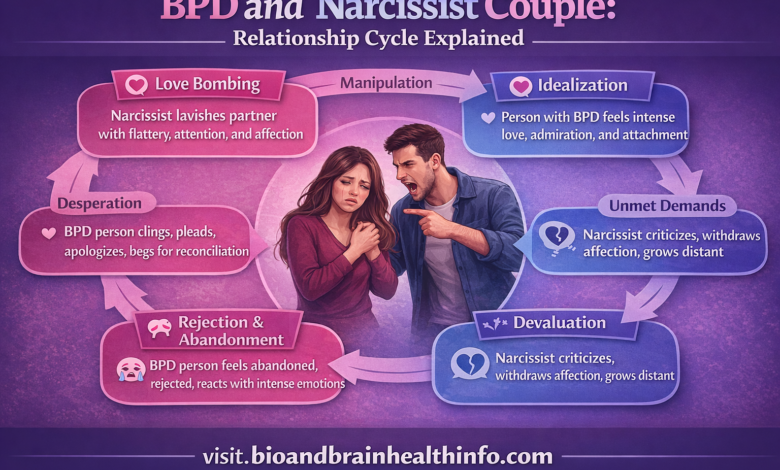
A BPD and narcissist couple often experiences trauma bond cycles shaped by push pull dynamics, emotional intensity, and conflict cycles, creating relationships that feel deeply connected yet emotionally unstable beneath the surface.
“Sometimes relationships feel powerful not because they are safe — but because they activate wounds that mistake intensity for connection.”
Sometimes a relationship feels powerful not because it is peaceful, but because it activates deep emotional patterns that mistake intensity for connection.
What looks like love on the surface may actually be two nervous systems trying to feel safe at the same time.
Even after leaving, the nervous system can stay on alert because it learned unpredictability as normal. Regulation returns through consistency, not force.
BPD and Narcissist Couple
A BPD and narcissist couple often moves through trauma bond cycles shaped by push pull dynamics, emotional intensity, and conflict cycles, leaving many people wondering, “Am I losing myself in this relationship?”
Confusion arises when trauma responses are mistaken for identity rather than adaptive survival patterns.
Emotional highs and lows can feel meaningful yet destabilizing, making it difficult to separate connection from reactivity.
If you feel overwhelmed or uncertain, you are not alone — these experiences reflect relational dynamics, not personal flaws.
This article will help you understand what’s happening — without labels, blame, or self-attack.
REASON FOR THIS BLOG – BPD and Narcissist Couple
To clarify how BPD and narcissist couple dynamics develop through emotional patterns rather than blame, helping readers understand relationship cycles while separating trauma responses from identity — without diagnosis or judgment.
INNER SEARCH MIRROR -BPD and Narcissist Couple
You may be asking:
-
Why does this relationship feel intense but unstable?
-
Is this love or trauma bonding?
-
Why do push pull dynamics keep repeating?
-
Why do conflict cycles escalate quickly?
-
Why do I feel deeply connected yet emotionally exhausted?
-
Is emotional intensity the same as emotional safety?
Please Explore This Blog bpd-vs-narcissist-clinical-differences-explained
PSYCHOLOGICAL EXPLANATION – BPD and Narcissist Couple
BPD and Narcissist Couple Dynamics: Emotional Adaptation
A BPD and narcissist couple shaped by trauma bond cycles, push pull dynamics, emotional intensity, and conflict cycles often develops through complementary emotional adaptations.
One partner may seek closeness to reduce abandonment fear, while the other protects identity through emotional distance or control.
These reactions are survival conditioning rather than intentional harm.
Understanding psychological motivation reduces self-blame and helps explain why the relationship feels powerful yet unstable.
| Psychological Pattern | Emotional Motivation |
|---|---|
| Intense closeness | Attachment reassurance |
| Emotional distancing | Identity protection |
| Conflict escalation | Safety response |
Personal note: Understanding motivation often softens confusion about repeated relational patterns.
NERVOUS SYSTEM EXPLANATION – BPD and Narcissist Couple
Within a BPD and narcissist couple, trauma bond cycles and push pull dynamics often activate nervous system responses before conscious thought.
Emotional intensity and conflict cycles may reflect fight, flight, freeze, or fawn reactions triggered by perceived rejection or threat.
These biological responses explain why reactions feel automatic rather than chosen.
Common warning signs:
-
Rapid emotional escalation
-
Fear of abandonment or criticism
-
Emotional withdrawal during conflict
-
Physical tension or shutdown
-
Emotional exhaustion afterward
Personal note: Realizing reactions begin in the body can reduce shame and self-blame.
CORE DISTINCTION – BPD and Narcissist Couple
Identity vs Survival Responses
Survival responses exist to protect emotional safety; identity reflects deeper values and conscience.
In a BPD and narcissist couple dynamic involving trauma bond cycles, push pull dynamics, emotional intensity, and conflict cycles, survival strategies can resemble personality traits but do not define identity.
Emotional reactions shaped by past adaptation are protective responses, not permanent character definitions.
Authority emerges when this distinction becomes clear: survival seeks immediate safety, while identity remains steady beneath emotional fluctuation.
Please Explore This Blog bpd-npd-relationship-patterns-and-psychology
TRAUMA VS NARCISSISM -BPD and Narcissist Couple
In a BPD and narcissist couple, trauma bond cycles, push pull dynamics, emotional intensity, and conflict cycles may look similar externally but differ internally through motivation rather than labels.
| Trauma-Based Response | Narcissistic Protection Pattern |
|---|---|
| Remorse after conflict | Limited reflection on impact |
| Fear-driven reactions | Identity defense focus |
| Desire for repair | Desire for control or validation |
Personal note: Motivation often explains confusion more than behavior alone.
GROWTH DIRECTION -BPD and Narcissist Couple
Healing within a BPD and narcissist couple dynamic involving trauma bond cycles, push pull dynamics, emotional intensity, and conflict cycles begins with gentle awareness rather than force.
Signs of growth include slowing reactions, noticing emotional patterns without judgment, and choosing peace over urgency.
Progress often looks like increased emotional space, calmer reflection, and reduced internal pressure to resolve everything immediately.
Personal note: Healing frequently begins with understanding, not action.
HEALING COMPASS / ORIENTATION TABLE
Understanding creates stability when direction feels unclear.
| Stage | Orientation |
|---|---|
| Awareness | “I can observe patterns calmly.” |
| Separation of Identity | “My reactions are not my identity.” |
| Regulation | “Slowing down restores clarity.” |
| Boundary Recognition | “Safety matters as much as connection.” |
| Integration | “Growth happens through consistency.” |
Please Explore This Blog bpd-narcissism-overlap-psychology-explained
🌿 10 Signs — BPD and Narcissist Couple: Relationship Cycle Explained
Emotional Highs Followed by Sudden Distance
In a BPD and narcissist couple, trauma bond cycles often create intense closeness followed by withdrawal. Push pull dynamics increase emotional intensity, making conflict cycles feel confusing and emotionally destabilizing rather than predictable.
Push Pull Dynamics Drive Connection and Separation
Push pull dynamics within a BPD and narcissist couple may feel magnetic yet exhausting. Trauma bond cycles sustain emotional intensity, while recurring conflict cycles reinforce attachment even when emotional safety feels uncertain.
Conflict Cycles Repeat Without Clear Resolution
Recurring conflict cycles in a BPD and narcissist couple may escalate emotional intensity quickly. Trauma bond cycles reinforce connection through emotional highs and lows, while push pull dynamics prevent lasting emotional stability.
Emotional Intensity Creates Deep Attachment
Emotional intensity within a BPD and narcissist couple can feel meaningful but overwhelming. Trauma bond cycles and push pull dynamics reinforce closeness, yet repeated conflict cycles may prevent calm resolution.
Idealization and Devaluation Patterns
Trauma bond cycles within a BPD and narcissist couple often include idealization followed by disappointment. Push pull dynamics amplify emotional intensity, while conflict cycles emerge when expectations and emotional needs collide.
Communication Shifts Between Closeness and Defense
Push pull dynamics affect communication style in a BPD and narcissist couple. Emotional intensity rises quickly, trauma bond cycles deepen attachment, and conflict cycles emerge when misunderstandings trigger protective responses.
Emotional Regulation Feels Uneven
Within a BPD and narcissist couple, trauma bond cycles may amplify emotional intensity. Push pull dynamics can create emotional unpredictability, while repeated conflict cycles reinforce stress responses rather than calm regulation.
Fear of Loss vs Fear of Vulnerability
Push pull dynamics in a BPD and narcissist couple may reflect competing emotional fears. Trauma bond cycles maintain connection through emotional intensity, while conflict cycles emerge when safety needs differ.
Boundaries Become Difficult to Maintain
Emotional intensity and trauma bond cycles within a BPD and narcissist couple may blur boundaries. Push pull dynamics reinforce closeness, yet ongoing conflict cycles can create confusion about emotional responsibility.
Healing Requires Understanding Motivation
Understanding trauma bond cycles and push pull dynamics helps clarify emotional intensity within a BPD and narcissist couple. Recognizing conflict cycles allows awareness to replace self-blame, supporting calmer reflection rather than reactive interpretation.
🌱 Closing Note
Understanding a BPD and narcissist couple through trauma bond cycles, push pull dynamics, emotional intensity, and conflict cycles helps reduce confusion without labeling individuals. Awareness shifts focus from blame to understanding emotional motivations beneath behavior. When patterns become visible, emotional clarity increases, allowing safer boundaries, calmer responses, and deeper self-trust to develop gradually.
Please Explore This Blog relationship-cycles-bpd-and-npd-relationship-dynamics
🧠 A Whole-System View of the Human Healing Process
Medical / Ethical Positioning – BPD and Narcissist Couple
Understanding a BPD and narcissist couple dynamic ethically means focusing on patterns rather than diagnosing individuals.
Trauma bond cycles can influence how the mind interprets threat, confusion, and meaning.
Ethical education avoids labels and instead clarifies emotional processes so readers regain self-trust without reinforcing fear or blame.
| Ethical Focus | Meaning |
|---|---|
| Pattern awareness | Observing dynamics without judgment |
| Safety priority | Emotional stability before insight |
| Non-diagnostic stance | Education, not labeling |
| Context sensitivity | Behavior shaped by history |
Personal note: Ethical clarity protects both understanding and compassion.
Psychological Layer – BPD and Narcissist Couple
In a BPD and narcissist couple, psychological interpretation shapes how emotional intensity is experienced internally.
Trauma bond cycles may create meaning through attachment patterns, while push pull dynamics reflect attempts to regulate emotional closeness.
The mind organizes experience through narrative, often seeking coherence even within confusing relational cycles.
| Psychological Process | Interpretation |
|---|---|
| Meaning-making | Searching for emotional explanation |
| Attachment narratives | Linking past and present reactions |
| Cognitive framing | Assigning intention to behavior |
| Pattern recognition | Predicting emotional outcomes |
Personal note: The brain prefers familiar patterns even when they feel painful.
Nervous System Layer – BPD and Narcissist Couple
Within a BPD and narcissist couple, the nervous system reacts automatically to perceived safety or threat.
Emotional intensity activates fight, flight, freeze, or fawn responses before conscious thought appears.
Trauma bond cycles may reinforce physiological conditioning, meaning reactions arise from learned protection rather than deliberate emotional choice.
| Body Response | Protective Function |
|---|---|
| Fight | Restoring control |
| Flight | Creating distance from threat |
| Freeze | Minimizing overwhelm |
| Fawn | Maintaining connection for safety |
Personal note: Many reactions are biological reflexes, not personal failures.
Mental Health Layer – BPD and Narcissist Couple
Long-term exposure to emotional unpredictability in a BPD and narcissist couple dynamic can influence clarity, energy, and self-trust.
Conflict cycles may increase cognitive fatigue, reduce emotional tolerance, and create internal doubt about perception.
Understanding this impact helps normalize exhaustion without reinforcing identity-based self-criticism.
| Impact Area | Possible Experience |
|---|---|
| Cognitive clarity | Difficulty making decisions |
| Emotional energy | Rapid depletion |
| Self-trust | Increased self-questioning |
| Stress load | Persistent mental tension |
Personal note: Mental fatigue often reflects adaptation rather than weakness.
Identity Layer (Inner Continuity & Meaning)
Despite survival responses, identity remains deeper than emotional reactions within a BPD and narcissist couple context.
Values, conscience, and personal meaning persist beneath adaptive behavior. Healing includes rediscovering internal continuity — recognizing that survival strategies protected connection without defining the self permanently.
| Identity Aspect | Inner Stability |
|---|---|
| Core values | Remain consistent beneath stress |
| Moral awareness | Reflects authentic self |
| Personal meaning | Guides future choices |
| Inner continuity | Connects past, present, future self |
Personal note: Identity often becomes clearer after survival patterns soften.
Reflective Support Layer (Including AI)
Reflection tools — journaling, dialogue, or AI support — help individuals observe patterns in a BPD and narcissist couple dynamic without directing decisions.
Trauma bond cycles can feel overwhelming internally; reflective processes create distance between thought and reaction, allowing curiosity instead of immediate judgment.
| Support Tool | Function |
|---|---|
| Journaling | Externalizes internal dialogue |
| Conversation | Provides emotional mirroring |
| AI reflection | Neutral perspective |
| Structured questioning | Encourages clarity |
Personal note: Being witnessed without pressure often reduces emotional intensity.
Integrated Whole-System Understanding – BPD and Narcissist Couple
Healing within a BPD and narcissist couple context becomes clearer when multiple layers are considered together rather than separately.
Trauma bond cycles may affect psychological interpretation, nervous system regulation, and identity stability simultaneously.
Whole-system awareness shifts focus from “what is wrong” toward understanding adaptive responses shaped by emotional learning.
Integration allows gradual movement from survival-driven reactions toward grounded choice, where awareness replaces confusion and emotional safety becomes the foundation for change.
| Integration Layer | Role |
|---|---|
| Mind | Interprets meaning |
| Body | Signals safety or threat |
| Identity | Holds core values |
| Reflection | Supports integration |
Personal note: Healing often feels less like fixing and more like remembering stability already present inside.
Please Explore This Blog bpd-and-npd-explained-differences-overlap
PERSONAL NOTE — BPD and Narcissist Couple
Understanding the BPD and narcissist couple dynamic often shifts perspective from blame toward recognition of patterns that once felt personal.
Many individuals discover that trauma bond cycles can create emotional confusion not because connection is false, but because intensity masks underlying survival responses.
When I began observing relational patterns through nervous system awareness rather than emotional judgment, the experience felt less like failure and more like learning.
Relationships shaped by push pull dynamics frequently reveal unmet emotional needs seeking safety rather than control. A
wareness does not remove emotion; it softens self-attack and restores clarity.
Growth begins quietly — when understanding replaces urgency and when individuals realize that emotional reactions may reflect adaptation rather than identity.
COSMIC / PHILOSOPHICAL TAKEAWAY — BPD and Narcissist Couple
“Not every strong feeling is a sign to stay; sometimes it is a signal to understand.”
Within a BPD and narcissist couple dynamic, trauma bond cycles, push pull dynamics, emotional intensity, and conflict cycles may feel deeply meaningful because human beings are wired to seek connection even in uncertainty.
The universe of human relationships teaches through contrast — closeness reveals vulnerability, and conflict reveals unhealed spaces asking for awareness.
Emotional experiences are not mistakes; they are information guiding growth toward deeper alignment with safety and truth.
When intensity is understood rather than feared, individuals begin to recognize that healing is not about rejecting connection but about learning which connections allow calm presence.
Meaning emerges when emotional storms become teachers rather than definitions of identity.
FAQ SECTION — BPD and Narcissist Couple
1. Why does a BPD and narcissist couple feel so intense at the beginning?
Early emotional resonance and complementary needs can create strong connection quickly.
2. Is emotional intensity the same as true love?
Intensity may feel powerful but does not always indicate emotional safety or compatibility.
3. What are trauma bond cycles?
Patterns where emotional highs and lows reinforce attachment despite distress.
4. Why do push pull dynamics keep repeating?
Different emotional regulation strategies can trigger closeness and distancing cycles.
5. Can these relationships become healthier?
Growth is possible with awareness, emotional regulation, and clear boundaries.
6. Why do conflicts escalate quickly?
Unconscious triggers and nervous system activation can accelerate emotional responses.
7. Is it wrong to still feel attached after separation?
No. Emotional conditioning and bonding take time to settle naturally.
8. How can someone regain clarity?
Slowing reactions, observing patterns, and prioritizing emotional safety help restore perspective.
9. Does understanding patterns mean blaming one person?
No. The focus is on relational dynamics rather than individual fault.
10. What is the first step toward healing?
Recognizing patterns without self-judgment or urgency.
FINAL CLOSING — BPD and Narcissist Couple
Understanding a BPD and narcissist couple dynamic invites a gentler relationship with your own experience.
Trauma bond cycles, emotional intensity, and conflict patterns can feel overwhelming, yet they often reflect learned attempts to create safety rather than personal failure.
Nothing is wrong with you for reacting strongly to relationships that felt meaningful. With awareness, reactions begin to slow, clarity returns gradually, and emotional space opens for healthier choices.
Healing does not require immediate decisions — only compassionate observation of what is present now. If something within this article resonated, allow that recognition to be enough for today.
Growth unfolds quietly when self-understanding replaces pressure and when safety becomes more important than intensity.
Please Explore This Blog bpd-and-narcissist-relationship-dynamics-explained
🌿 Final Blog Footer — Bio & Brain Health Info
Written by Lex, founder of Bio & Brain Health Info — exploring the intersections of psychology, spirituality, and emotional recovery through calm, trauma-aware understanding.
✨ Insight & Reflection
Healing does not begin when answers arrive — it begins when self-attack stops.
Clarity grows in spaces where safety is restored.
🧠 Learn
Narcissism • Emotional Healing • Spiritual Psychology
🌍 A Moment for You
💡 Pause for two minutes. Let your body settle before moving on.
🧭 If This Article Helped, Your Next Questions Might Be:
These questions are natural continuations — not obligations.
✨ Cosmic Family Invitation
You are not here by accident. If these words reached you, clarity was already beginning.
We rise together — different souls, one journey. 🕊️
📩 Connect with us
info@bioandbrainhealthinfo.com
Telegram: @bioandbrainhealthinfo
WhatsApp Channel: Punehealth
Lex | Bio & Brain Health Info
Cosmic Family — Different Souls, One Journey.
REFERENCES & CITATION
Trusted Clinical & Psychological Sources
-
American Psychiatric Association — Diagnostic and Statistical Manual of Mental Disorders (DSM-5 Overview)
https://www.psychiatry.org/psychiatrists/practice/dsm -
National Institute of Mental Health (NIMH) — Borderline Personality Disorder Overview
https://www.nimh.nih.gov/health/topics/borderline-personality-disorder -
Cleveland Clinic — Narcissistic Personality Disorder Explained
https://my.clevelandclinic.org/health/diseases/9742-narcissistic-personality-disorder -
Psychology Today — Trauma Bonding: Understanding Emotional Attachment Cycles
https://www.psychologytoday.com/us/basics/trauma-bonding -
Harvard Health Publishing — Understanding Emotional Regulation and Relationships
https://www.health.harvard.edu -
National Library of Medicine (PubMed) — Attachment Patterns and Relationship Dynamics Research
https://pubmed.ncbi.nlm.nih.gov -
The Gottman Institute — Relationship Conflict Patterns and Emotional Interaction
https://www.gottman.com -
Verywell Mind — Borderline Personality Disorder Relationship Patterns
https://www.verywellmind.com -
National Alliance on Mental Illness (NAMI) — Personality Disorders Education
https://www.nami.org/About-Mental-Illness/Mental-Health-Conditions -
Polyvagal Theory Institute — Nervous System Regulation and Safety Response
https://www.polyvagalinstitute.org