BPD and Narcissist Relationship: Emotional Patterns Explained
Why BPD and Narcissist Relationships Feel Addictive

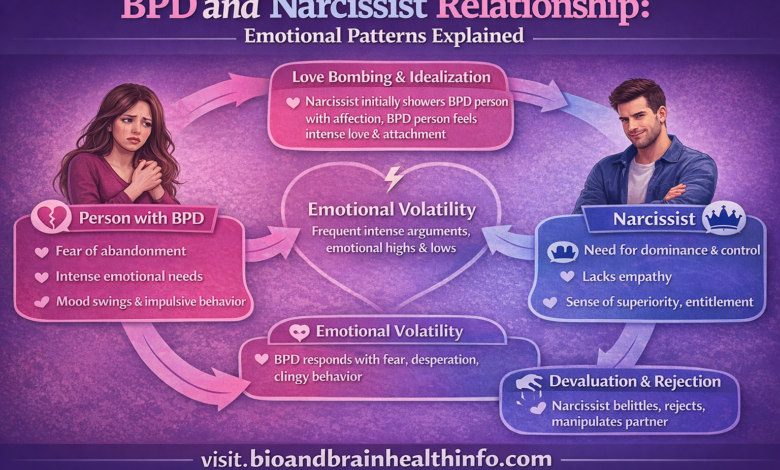
A bpd and narcissist relationship often involves relationship instability, attachment wounds, emotional dependency, and conflict escalation that create intense emotional cycles many people struggle to understand.
“Understanding patterns is not about blaming people — it is about reducing confusion so healing becomes possible.”
Sometimes a relationship ends, but the emotional echo remains because the nervous system remembers patterns long after logic understands the truth.
Even after leaving, the nervous system can stay on alert because it learned unpredictability as normal. Regulation returns through consistency, not force.
BPD and Narcissist Relationship
A bpd and narcissist relationship can feel confusing because relationship instability, attachment wounds, emotional dependency, and conflict escalation often create intense emotional loops that blur identity with survival responses.
Many people silently wonder, “Am I losing myself?” when reactions begin to feel unfamiliar or overwhelming.
The fear is real, but it does not mean something is wrong with who you are — it often reflects learned emotional patterns rather than identity itself.
This article will help you understand what’s happening — without labels, blame, or self-attack.
REASON FOR THIS BLOG – BPD and Narcissist Relationship
This article exists to help readers understand emotional patterns that arise in intense relationships and to separate trauma-based reactions from identity — without judgment, diagnosis, or pressure to act quickly.
INNER SEARCH MIRROR – BPD and Narcissist Relationship
You may recognize yourself if you quietly ask:
-
Why do intense relationships feel impossible to leave?
-
Why does emotional closeness also feel unsafe?
-
Why does conflict escalate so quickly?
-
Why do I feel responsible for emotional stability?
-
Why do calm moments feel unfamiliar or empty?
-
Why do attachment fears feel stronger than logic?
Please Explore This Blog bpd-and-npd-explained-differences-overlap
PSYCHOLOGICAL EXPLANATION – BPD and Narcissist Relationship
In a bpd and narcissist relationship, relationship instability can arise when attachment wounds and emotional dependency interact with different emotional coping styles.
Conflict escalation often reflects survival adaptations rather than conscious intention. Over time, the brain learns patterns that seek closeness while simultaneously fearing abandonment or loss of control.
These responses are not evidence of personal failure; they are learned ways of managing emotional unpredictability.
Understanding this helps separate reaction from identity and reduces self-blame.
Personal note: Many people feel relief when they realize patterns develop through adaptation, not weakness.
NERVOUS SYSTEM EXPLANATION – BPD and Narcissist Relationship
Within a bpd and narcissist relationship, the nervous system may remain highly activated because relationship instability and attachment wounds signal potential emotional threat.
Emotional dependency can heighten sensitivity to changes in tone or attention, while repeated conflict escalation trains the brain to anticipate danger quickly.
Fight, flight, or freeze responses often activate before conscious thought, shaping reactions automatically.
Warning signs may include:
-
sudden emotional intensity
-
hypervigilance
-
shutdown or withdrawal
-
urgency to resolve conflict immediately
-
strong fear of disconnection
Personal note: Biological reactions often feel personal, but they begin as protective reflexes.
CORE DISTINCTION -BPD and Narcissist Relationship
Identity vs Survival Responses
A bpd and narcissist relationship can blur the line between identity and survival strategies when relationship instability and attachment wounds repeatedly activate emotional dependency and conflict escalation patterns.
Survival responses are protective reactions designed to reduce perceived threat; identity reflects deeper values, choices, and long-term character.
Survival may push for immediate emotional relief, while identity moves toward stability and meaning.
Recognizing this distinction allows people to step back from self-judgment and observe reactions without defining themselves by them.
Authority begins when individuals understand that protective patterns are learned responses, not permanent truths about who they are.
TRAUMA VS NARCISSISM – BPD and Narcissist Relationship
Inside a bpd and narcissist relationship, relationship instability, attachment wounds, emotional dependency, and conflict escalation can create confusion about intent.
Trauma responses often include remorse, reflection, and willingness to repair, while protective narcissistic patterns may resist accountability to maintain emotional safety.
The focus is motivation, not labeling people.
Personal note: Relief often begins when readers understand that reactions and identity are not the same.
GROWTH DIRECTION – BPD and Narcissist Relationship
Healing after a bpd and narcissist relationship may involve noticing relationship instability without self-blame, understanding attachment wounds gently, reducing emotional dependency through self-trust, and slowing conflict escalation by choosing calm over urgency.
Growth appears as softer reactions, clearer boundaries, and increased emotional space.
Personal note: Many people notice progress when they stop forcing change and allow stability to develop gradually.
Please Explore This Blog relationship-cycles-bpd-and-npd-relationship-dynamics
HEALING COMPASS / ORIENTATION TABLE
Healing rarely moves in straight lines; it unfolds through stages of increasing safety.
| Stage | Orientation |
|---|---|
| Awareness | “I can observe patterns without panic.” |
| Stabilization | “Calm moments can exist.” |
| Understanding | “My reactions have meaning.” |
| Recovery | “Consistency rebuilds trust.” |
| Protection | “Boundaries support peace.” |
This compass helps translate insight into steady emotional direction rather than pressure to change quickly.
🌿 10 Signs BPD and Narcissist Relationship: Emotional Patterns Explained
🔹 1. Intensity Feels Like Emotional Bonding
In a bpd and narcissist relationship, relationship instability mixed with attachment wounds can create emotional dependency where conflict escalation feels like connection, causing partners to confuse emotional intensity with genuine safety or long-term relational stability.
🔹 2. Push–Pull Emotional Cycles
A bpd and narcissist relationship may show repeated relationship instability as attachment wounds trigger emotional dependency, leading to conflict escalation where closeness and distance alternate rapidly, creating emotional confusion rather than steady relational grounding.
🔹 3. Fear of Abandonment vs Fear of Vulnerability
Within a bpd and narcissist relationship, relationship instability grows when attachment wounds amplify emotional dependency, causing conflict escalation between the need for reassurance and the need to maintain emotional control or distance.
🔹 4. Emotional Highs Followed by Sudden Withdrawal
A bpd and narcissist relationship often includes relationship instability shaped by attachment wounds, where emotional dependency intensifies during connection but conflict escalation appears when emotional needs or expectations feel overwhelming.
🔹 5. Responsibility Feels Uneven
In a bpd and narcissist relationship, relationship instability may arise when attachment wounds drive emotional dependency and conflict escalation occurs as partners struggle to balance accountability and emotional validation.
🔹 6. Conflict Feels Urgent and Personal
A bpd and narcissist relationship can involve relationship instability because attachment wounds increase emotional dependency, causing conflict escalation where disagreements feel like threats to connection rather than opportunities for understanding.
🔹 7. Calm Moments Feel Unfamiliar
Inside a bpd and narcissist relationship, relationship instability linked to attachment wounds may create emotional dependency where conflict escalation becomes normalized, making peaceful moments feel strange or emotionally uncertain.
🔹 8. Emotional Boundaries Become Blurred
A bpd and narcissist relationship may show relationship instability as attachment wounds lead to emotional dependency, allowing conflict escalation when personal needs and relational expectations merge without clear boundaries.
🔹 9. Self-Identity Begins to Feel Confusing
During a bpd and narcissist relationship, relationship instability combined with attachment wounds can intensify emotional dependency and conflict escalation, causing individuals to question whether reactions reflect identity or learned survival responses.
🔹 10. Leaving Does Not Immediately Bring Emotional Calm
Even after a bpd and narcissist relationship ends, relationship instability shaped by attachment wounds and emotional dependency may continue through conflict escalation patterns stored in the nervous system, requiring consistent safety before regulation returns.
🌱 Closing Note
Patterns described here are not judgments about people but invitations to understand emotional dynamics with compassion. Awareness reduces self-attack and allows healing to begin gently. Stability grows slowly through consistency, self-understanding, and choosing peace over urgency.
Please Explore This Blog bpd-narcissism-overlap-psychology-explained
🌿 A Whole-System View of the Human Healing Process
🩺 Medical / Ethical Positioning – BPD and Narcissist Relationship
In understanding a bpd and narcissist relationship, ethical awareness matters because relationship instability may be interpreted differently depending on attachment wounds or emotional dependency patterns.
This article does not diagnose; it explores how individuals make meaning of emotional conflict escalation and perceived threat.
Ethical positioning emphasizes education, informed consent, and compassionate understanding rather than assigning clinical labels.
Personal note: Ethical clarity often helps readers feel safer exploring difficult topics.
| Focus | Ethical Orientation |
|---|---|
| Interpretation | Understand before judging |
| Language | Descriptive, not diagnostic |
| Responsibility | Shared human complexity |
| Safety | Education supports autonomy |
🧠 Psychological Layer – BPD and Narcissist Relationship
Within a bpd and narcissist relationship, the mind interprets threat through learned schemas shaped by attachment wounds, emotional dependency, and prior relational meaning.
Relationship instability can feel overwhelming when internal narratives translate uncertainty into danger.
Psychological processing attempts to restore coherence by assigning explanations, even when emotional context remains unclear.
Personal note: Many people gain relief when they understand meaning-making is automatic.
| Psychological Process | Interpretation |
|---|---|
| Pattern recognition | Seeks predictability |
| Meaning creation | Reduces uncertainty |
| Memory linking | Connects past to present |
| Emotional narrative | Explains reactions |
⚡ Nervous System Layer – BPD and Narcissist Relationship
A bpd and narcissist relationship may activate body-based safety responses when relationship instability signals unpredictability.
Attachment wounds and emotional dependency can increase sensitivity to subtle cues, while conflict escalation may trigger automatic physiological shifts.
The body responds rapidly to protect safety, often before conscious reasoning engages.
Personal note: Understanding bodily reactions helps reduce shame around intense responses.
| Automatic Reaction | Protective Function |
|---|---|
| Hyper-alertness | Detect risk early |
| Muscle tension | Prepare action |
| Emotional surge | Mobilize response |
| Withdrawal | Reduce overwhelm |
🧩 Mental Health Layer – BPD and Narcissist Relationship
Over time, a bpd and narcissist relationship marked by relationship instability and attachment wounds can affect clarity, energy, and self-trust.
Emotional dependency may drain cognitive resources, and repeated conflict escalation can narrow attention toward perceived threats.
Mental health challenges often reflect cumulative stress rather than personal weakness.
Personal note: Many readers discover that fatigue comes from prolonged adaptation, not failure.
| Impact Area | Experience |
|---|---|
| Focus | Reduced clarity |
| Energy | Emotional exhaustion |
| Self-trust | Increased doubt |
| Decision-making | Hesitation or urgency |
🌱 Identity Layer (Inner Continuity & Meaning)
Even within a bpd and narcissist relationship, identity remains deeper than relationship instability, attachment wounds, or emotional dependency.
Conflict escalation may influence behavior temporarily, but values and conscience continue beneath survival responses.
Healing involves rediscovering continuity between inner meaning and external choices.
Personal note: Identity often stays intact even when reactions feel unfamiliar.
| Identity Aspect | Inner Continuity |
|---|---|
| Values | Guide long-term direction |
| Conscience | Supports reflection |
| Meaning | Creates coherence |
| Choice | Restores agency |
🤝 Reflective Support Layer (Including AI)
Reflection tools within a bpd and narcissist relationship context can help process relationship instability and attachment wounds without reinforcing emotional dependency.
Journaling, trusted conversations, or AI-based reflection offer mirrors for thought patterns, allowing individuals to observe conflict escalation gently without pressure to change immediately.
Personal note: Structured reflection often slows emotional intensity naturally.
| Support Tool | Function |
|---|---|
| Journaling | Externalize thoughts |
| Conversation | Perspective expansion |
| AI reflection | Neutral mirroring |
| Mindful pause | Create emotional space |
🌿 Integrated Whole-System Understanding – BPD and Narcissist Relationship
Healing from a bpd and narcissist relationship often requires seeing relationship instability, attachment wounds, emotional dependency, and conflict escalation as interconnected layers rather than isolated problems.
The mind interprets meaning, the body protects safety, mental health reflects accumulated stress, and identity provides continuity beneath survival responses.
Reflective tools support integration by slowing reaction cycles and increasing awareness without pressure.
When these layers are understood together, healing shifts from forcing change toward creating conditions where stability emerges naturally.
Personal note: Integration begins when understanding replaces self-judgment.
| Layer | Contribution to Healing |
|---|---|
| Psychological | Meaning-making |
| Nervous System | Safety regulation |
| Identity | Inner continuity |
| Reflection | Gentle awareness |
PERSONAL NOTE – BPD and Narcissist Relationship
Writing about a bpd and narcissist relationship often reminds me how easily people turn their confusion into self-blame when facing relationship instability shaped by attachment wounds.
Emotional dependency and conflict escalation can make someone believe they are “too much” or “not enough,” when in reality they are responding to patterns that developed over time.
My own understanding shifted when I realized that intense reactions were signals of adaptation, not proof of identity failure. Insight does not arrive through harsh judgment; it emerges when curiosity replaces self-attack.
Many readers discover relief when they stop trying to diagnose themselves and instead begin observing patterns gently.
Healing starts quietly — not with dramatic change, but with the moment we allow ourselves to be human without constant correction.
Please Explore This Blog bpd-npd-relationship-patterns-and-psychology
COSMIC / PHILOSOPHICAL TAKEAWAY
“Human relationships reflect mirrors, but healing begins when we stop fighting our reflection and start understanding it.”
A bpd and narcissist relationship can reveal how relationship instability, attachment wounds, emotional dependency, and conflict escalation shape human experience beyond individual personalities.
At a deeper level, relationships become classrooms where emotional survival meets the search for meaning.
What feels chaotic often carries hidden lessons about boundaries, identity, and compassion toward self and others.
Philosophically, healing is not about erasing past experiences but integrating them into a broader understanding of growth.
The nervous system learns through repetition, and so does wisdom.
When we view emotional patterns as part of a larger human journey, shame softens and space opens for gentler self-recognition.
FAQ SECTION – BPD and Narcissist Relationship
1. Why do BPD and narcissist relationships feel addictive?
Intensity and emotional unpredictability can create strong attachment loops that feel meaningful even when stability is missing.
2. Is conflict escalation always intentional?
Not always. Many reactions arise from protective emotional patterns rather than conscious intent.
3. Can attachment wounds make relationships feel stronger?
Yes. Unresolved attachment experiences may increase emotional intensity and perceived connection.
4. Why does emotional dependency feel difficult to change?
Dependency often develops slowly and becomes familiar, making new emotional patterns feel unfamiliar at first.
5. Does relationship instability mean the relationship is unhealthy?
Instability alone does not define a relationship, but repeated patterns without repair may create emotional strain.
6. Why does the nervous system stay activated after leaving?
The body learns patterns through repetition, so emotional responses may continue until consistent safety is experienced.
7. How can identity feel lost in intense relationships?
Survival responses may overshadow personal values temporarily, creating confusion about self-identity.
8. Is healing possible without blaming anyone?
Yes. Understanding patterns without labeling people often supports deeper emotional clarity.
9. Why do calm moments sometimes feel uncomfortable?
The nervous system may be accustomed to intensity, making calm feel unfamiliar initially.
10. What is the first sign of recovery?
Reduced self-attack and increased curiosity toward personal reactions.
Please Explore This Blog covert-narcissism-dsm-diagnosis-clarity
FINAL CLOSING – BPD and Narcissist Relationship
Understanding a bpd and narcissist relationship does not require judgment or urgency; it begins with recognizing how relationship instability, attachment wounds, emotional dependency, and conflict escalation shape emotional responses over time.
Nothing is wrong with you for reacting to complex dynamics — many responses are learned forms of protection rather than personal flaws.
Healing grows through consistency, patience, and gentle awareness rather than forcing change. You are allowed to move slowly and rediscover stability in your own rhythm.
If this article offered clarity, let it be an invitation to observe yourself with kindness rather than pressure.
With safety and understanding, what adapted for survival can gradually soften, allowing identity and peace to re-emerge naturally.
🌿 Final Blog Footer — Bio & Brain Health Info
Written by Lex, founder of Bio & Brain Health Info — exploring the intersections of psychology, spirituality, and emotional recovery through calm, trauma-aware understanding.
✨ Insight & Reflection
Healing does not begin when answers arrive — it begins when self-attack stops.
Clarity grows in spaces where safety is restored.
🧠 Learn
Narcissism • Emotional Healing • Spiritual Psychology
🌍 A Moment for You
💡 Pause for two minutes. Let your body settle before moving on.
🧭 If This Article Helped, Your Next Questions Might Be:
These questions are natural continuations — not obligations.
✨ Cosmic Family Invitation
You are not here by accident. If these words reached you, clarity was already beginning.
We rise together — different souls, one journey. 🕊️
📩 Connect with us
info@bioandbrainhealthinfo.com
Telegram: @bioandbrainhealthinfo
WhatsApp Channel: Punehealth
Lex | Bio & Brain Health Info
Cosmic Family — Different Souls, One Journey.
REFERENCES & CITATION – BPD and Narcissist Relationship
-
American Psychiatric Association — DSM-5 Overview of Personality Disorders
https://www.psychiatry.org/psychiatrists/practice/dsm -
National Institute of Mental Health (NIMH) — Borderline Personality Disorder
https://www.nimh.nih.gov/health/topics/borderline-personality-disorder -
Mayo Clinic — Narcissistic Personality Disorder Overview
https://www.mayoclinic.org/diseases-conditions/narcissistic-personality-disorder -
Cleveland Clinic — Borderline Personality Disorder Explained
https://my.clevelandclinic.org/health/diseases/9762-borderline-personality-disorder -
Psychology Today — Narcissism and Relationship Patterns
https://www.psychologytoday.com/us/basics/narcissism -
The Attachment Project — Attachment Styles and Relationship Dynamics
https://www.attachmentproject.com -
Polyvagal Theory Overview — Stephen Porges Institute
https://www.polyvagalinstitute.org -
Harvard Health Publishing — Emotional Regulation and Trauma Responses
https://www.health.harvard.edu -
National Alliance on Mental Illness (NAMI) — Personality Disorders Education
https://www.nami.org -
Verywell Mind — Trauma Bonding and Emotional Dependency
https://www.verywellmind.com