Emotional Numbing Work: When Feeling Goes Offline to Cope
When You Stop Feeling at Work to Survive

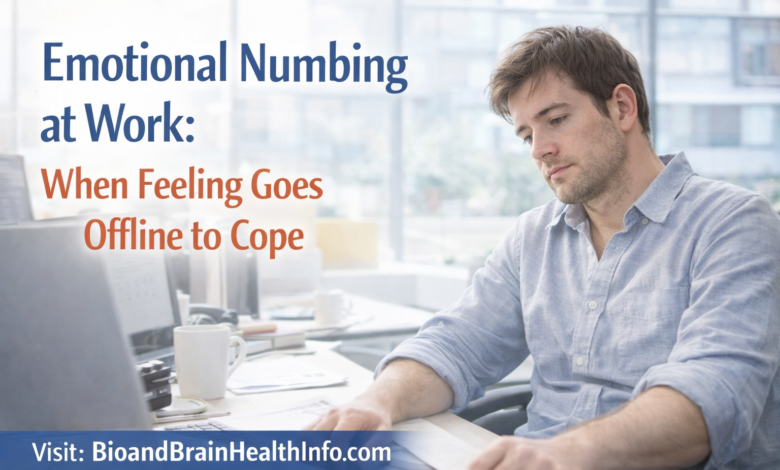
Emotional numbing work often develops when emotional shutdown, dissociation at work, trauma response patterns, and burnout recovery overlap after prolonged exposure to a toxic environment.
Thank you for reading this post, don't forget to subscribe!“One day you notice the noise is gone—not because peace arrived, but because feeling became too costly.
Even after leaving, the nervous system can stay on alert because it learned unpredictability as normal. Regulation returns through consistency, not force.”
INTRODUCTION
Emotional Numbing After Toxic Work often brings a quiet fear: “Am I losing myself because I don’t feel the way I used to?”
In emotional numbing work environments, emotional shutdown can feel like absence rather than protection.
Dissociation at work may follow prolonged strain, while trauma response patterns flatten sensation to reduce overload.
When burnout recovery begins, many people misinterpret this numbness as a personal flaw or emotional failure.
The misunderstanding is subtle but painful—confusing identity with survival. Numbness is not who you are; it is what your system learned to do to endure.
This response does not mean something is broken inside you. It means something became unsafe for too long.
This article will help you understand what’s happening — without labels, blame, or self-attack.
REASON FOR THIS BLOG
To explain why emotional numbness can appear after toxic work and to separate trauma-based shutdown from identity—without diagnosis, urgency, or pressure to change.
Please Explore This Blog narcissistic-leadership-burnout
INNER SEARCH MIRROR
Before understanding anything, many people quietly ask:
Why do I feel emotionally flat at work now?
Why don’t reactions come naturally anymore?
Why does numbness feel safer than feeling?
Why do I disconnect even outside the workplace?
Why did rest not immediately bring emotions back?
Why do I feel distant from myself, not just others?
If these questions feel familiar, they reflect a shared human response—not a personal failing.
Emotional Numbing Work: The Mind’s Adaptation
In emotional numbing work, the mind adapts when feeling becomes linked to threat or exhaustion. Emotional shutdown develops not because emotions disappear, but because expression feels costly.
Dissociation at work can emerge when attention narrows to survive constant demand, while trauma response patterns reduce emotional range to preserve energy.
As burnout recovery begins, numbness often lingers because the mind learned distance as protection.
This is not avoidance by intent; it is adaptation by necessity.
The reaction served a purpose when safety was uncertain. Understanding this distinction separates self-blame from context.
Personal note: Many people feel relief when they realize numbness once helped them endure.
Emotional Numbing Work and Automatic Protection
During emotional numbing work, the nervous system reacts before thought. Emotional shutdown reflects a freeze response when fight or flight feels unsustainable.
Dissociation at work helps the body reduce sensory input, while trauma response patterns keep arousal within survivable limits.
Even during burnout recovery, the system may stay guarded because it learned unpredictability over time. These reactions are automatic, not chosen.
Common signs include:
Reduced emotional range
Mental fog or detachment
Low reactivity to stress
Fatigue without sadness
Delayed emotional response
Personal note: Knowing the body acted first often softens self-judgment.
CORE DISTINCTION – Identity vs Survival Responses
This distinction anchors the article.
Survival responses exist to reduce overload and preserve functioning. Identity reflects values, conscience, and emotional capacity over time.
In emotional numbing work, survival may appear as emotional shutdown or dissociation at work. Identity does not disappear during these states—it remains intact beneath protection.
Trauma response patterns alter access, not essence. Burnout recovery restores availability gradually, not instantly.
Confusing survival with identity creates fear: “This is who I am now.” Separating them restores trust: this is what your system did, not who you are.
Authority returns when protection is understood, not judged.
Please Explore This Blog trust-issues-after-toxic-job
Emotional Numbing Work: Trauma Response vs Self-Labeling
In emotional numbing work, the most painful fear is often “What if this means something is wrong with me?”
When emotional shutdown, dissociation work, trauma response, and burnout recovery overlap, people may worry they are becoming cold or unfeeling.
The key difference is motivation, not behavior.
| Trauma Response | Narcissistic Pattern |
|---|---|
| Feels remorse after harm | Lacks remorse |
| Reflects inward | Deflects responsibility |
| Questions impact | Justifies impact |
| Seeks repair | Avoids accountability |
Numbness driven by trauma carries conscience and concern, even when feelings are muted.
Personal note: Many people feel immediate relief when they realize their capacity for reflection itself answers the question.
Emotional Numbing Work and Gentle Re-Orientation
After emotional numbing work, growth is not about forcing feeling back online.
Emotional shutdown, dissociation work, trauma response, and burnout recovery unfold on their own timeline when safety becomes consistent.
Healing often shows up subtly: moments of curiosity, brief emotional flickers, or less self-criticism. Slowing down is not avoidance—it is how the system relearns trust.
Choosing peace means allowing neutrality before intensity returns. Agency is restored not by pushing change, but by respecting the pace at which capacity rebuilds.
This orientation honors protection while making room for reconnection—without pressure, deadlines, or performance.
Personal note: I’ve seen steadiness return when people stop demanding emotional proof from themselves.
HEALING COMPASS / ORIENTATION TABLE
This compass offers a steady map from numbness toward reconnection.
These are not steps to complete—only common phases people recognize as stability returns.
| Stage | Inner Experience |
|---|---|
| Recognition | “This numbness had a purpose.” |
| Stabilization | “Consistency helps me feel safer.” |
| Softening | “Small feelings come and go.” |
| Reconnection | “I feel present more often.” |
| Integration | “I trust my pace again.” |
Each stage affirms capacity rather than demand. Healing unfolds through safety and understanding, not effort.
Why Numbness Is a Signal, Not a Failure
In emotional numbing work, numbness often arrives quietly, without warning or explanation. Emotional shutdown is not the absence of feeling, but the mind reducing intensity to preserve stability.
Dissociation work allows attention to narrow when overwhelm becomes constant, while trauma response patterns limit emotional range to prevent further depletion.
During burnout recovery, this muted state may feel alarming, especially when people expect relief to feel dramatic.
Yet numbness is not collapse—it is containment. The system is conserving energy after prolonged strain.
Understanding this reframes numbness from something broken into something protective, restoring dignity to an experience many people silently fear.
Why Feeling Less Was the Safer Option
Within emotional numbing work, the nervous system often learns that feeling fully carries cost. Emotional shutdown emerges when expression repeatedly meets pressure or unpredictability.
Dissociation work steps in to reduce exposure, while trauma response mechanisms prioritize functioning over connection.
In burnout recovery, the system may stay guarded because safety has not yet felt consistent. This is not avoidance by choice—it is safety by design.
Feeling less became the safer option when feeling more led to exhaustion or harm.
Recognizing this removes self-blame and replaces it with respect for how intelligently the system adapted under strain.
Why Numbness Persists Outside the Workplace
Many people are surprised when emotional numbing work continues even after conditions change. Emotional shutdown does not switch off with context alone.
Dissociation work trained the system to stay narrow, and trauma response patterns learned unpredictability over time.
During burnout recovery, the body may remain cautious until consistency is experienced repeatedly.
This persistence does not mean you are stuck; it means your system is waiting for proof of safety.
Numbness lingers not because something is wrong, but because adaptation takes time to unwind.
Understanding this prevents the common mistake of judging recovery by speed rather than stability.
Why Neutrality Is Part of Healing
In emotional numbing work, people often expect healing to look like joy or motivation. Instead, emotional shutdown may soften first into neutrality.
Dissociation work eases gradually, trauma response patterns loosen slowly, and burnout recovery often restores calm before intensity.
Neutrality is not emptiness—it is capacity returning without overload. This middle state allows the system to test safety without risk.
Many people mistake neutrality for stagnation, but it is a meaningful sign of regulation.
Feeling “nothing in particular” is often the bridge between numbness and authentic emotional presence.
Please Explore This Blog recovery-after-narcissistic-workplace
Why Self-Trust Returns Before Emotion
After emotional numbing work, self-trust often returns before strong feeling does.
Emotional shutdown may still be present, dissociation work may still flicker, and trauma response patterns may still influence reactions during burnout recovery.
Yet clarity begins to reappear first. You start trusting your pace, your limits, and your perceptions again. This is not accidental.
Self-trust creates the safety emotions require to re-emerge. When pressure to “feel something” drops, the system relaxes.
Healing progresses not by chasing emotion, but by restoring trust in your internal signals.
Closing Note
If these insights resonate, it does not mean you are disconnected or damaged. It means your system learned how to survive prolonged strain. With safety and understanding, what adapted can soften again—without force, urgency, or self-attack.
Medical / Ethical Positioning — Emotional Numbing Work
In emotional numbing work, ethical clarity protects people from turning distress into self-diagnosis.
When emotional shutdown appears, education must explain patterns without labeling identities.
Ethical framing focuses on how the mind interprets threat, confusion, and meaning under prolonged strain. Using trauma-aware language prevents harm while restoring orientation.
This layer emphasizes transparency, consent, and stabilization over interpretation. The goal is not to name what someone is, but to clarify what many people experience in difficult environments.
Personal note: Ethical language often brings safety before insight.
| Focus | Ethical Anchor |
|---|---|
| Role | Education |
| Language | Non-pathologizing |
| Priority | Safety |
| Aim | Reduce self-attack |
Psychological Layer — Emotional Numbing Work
Within emotional numbing work, the mind searches for meaning when emotional access narrows. Dissociation work reflects a psychological shift where interpretation becomes protective.
Rather than processing events fully, the mind simplifies reality to reduce overload.
Confusion arises not from weakness, but from disrupted meaning-making. This layer explains how the psyche adapts by narrowing focus, postponing emotional integration until conditions feel safer.
Understanding this restores coherence without forcing emotional engagement.
Personal note: Clarity often returns when meaning is restored gently.
| Mental Function | Adaptation |
|---|---|
| Interpretation | Simplified |
| Attention | Narrowed |
| Meaning | Deferred |
| Coherence | Preserved |
Nervous System Layer — Emotional Numbing Work
During emotional numbing work, the body reacts automatically through trauma response patterns. These reactions occur before thought and are designed to preserve safety.
Reduced sensation, slowed reactions, or detachment are not chosen behaviors—they are reflexes. The nervous system limits input when intensity becomes unmanageable.
This layer explains protection, not pathology, helping people understand why the body may remain guarded even after pressure decreases.
Personal note: Learning this often replaces fear with respect for the body.
| Body Reaction | Purpose |
|---|---|
| Dulling | Reduce overload |
| Slowing | Conserve energy |
| Detachment | Limit exposure |
| Guarding | Maintain safety |
Mental Health Layer —Emotional Numbing Work
In emotional numbing work, burnout recovery reshapes mental capacity rather than signaling illness. Prolonged strain affects clarity, energy, and self-trust, not character.
Mental health here refers to functional bandwidth—the ability to process, feel, and reflect. When capacity is depleted, numbness can replace engagement as a stabilizing state.
Recognizing this prevents mislabeling exhaustion as identity failure.
Personal note: Many people feel relief when depletion is named accurately.
| Capacity Area | Effect |
|---|---|
| Focus | Reduced |
| Energy | Limited |
| Trust | Shaken |
| Motivation | Quiet |
Identity Layer — Inner Continuity & Meaning
Beneath emotional numbing work, identity remains intact even during emotional shutdown. Values, conscience, and moral awareness do not disappear—they become less accessible while survival takes priority.
This layer separates temporary protection from enduring selfhood. Identity is not defined by emotional availability in unsafe conditions.
Reconnecting with this truth restores dignity without forcing feeling or action.
Personal note: Identity often resurfaces when pressure to perform disappears.
| Identity Element | Status |
|---|---|
| Values | Intact |
| Conscience | Present |
| Character | Unchanged |
| Worth | Stable |
Reflective Support Layer (Including AI) – Emotional Numbing Work
After emotional numbing work, reflective tools help organize thought without directing change. Journaling, conversation, or AI can mirror patterns neutrally, allowing insight to surface naturally.
This layer supports reflection without advice, pressure, or interpretation. Mirroring restores internal dialogue after confusion, helping people hear themselves again.
Personal note: Reflection feels safest when nothing is being pushed.
| Tool | Function |
|---|---|
| Journaling | Externalize |
| Conversation | Normalize |
| AI | Reflect patterns |
| Silence | Integrate |
Emotional Numbing Work — A Lived Insight
In emotional numbing work, what surprised me most was not the lack of feeling, but how quickly I judged myself for it.
Emotional shutdown can arrive quietly, and dissociation work makes it hard to explain what’s happening even to yourself.
Trauma response patterns flatten sensation to preserve capacity, while burnout recovery unfolds slower than expectation.
The insight that helped me most was realizing numbness wasn’t proof of disconnection—it was evidence of adaptation.
When I stopped treating muted emotion as failure and started seeing it as protection, self-trust returned before feeling did.
That shift brought steadiness without forcing change.
Please Explore This Blog narcissistic-dependency-workplace
COSMIC / PHILOSOPHICAL TAKEAWAY – Emotional Numbing Work and Human Meaning
“What withdraws under pressure is not the soul, but access to it.”
In emotional numbing work, emotional shutdown, dissociation work, trauma response, and burnout recovery reflect a universal human pattern: meaning pauses when safety is uncertain.
Across cultures, people have learned to narrow experience to endure prolonged strain. This narrowing is not loss—it is waiting. Identity does not dissolve when feeling dims; it rests beneath protection.
Meaning returns not through intensity, but through continuity. When consistency replaces unpredictability, the inner world opens again—quietly, without demand.
Healing honors timing more than effort.
FINAL CLOSING – Emotional Numbing Work — Returning to Steadiness
If emotional numbing work has shaped your experience, nothing about your response means you are broken or beyond repair.
Emotional shutdown, dissociation work, trauma response, and burnout recovery reflect a system that adapted to keep you functioning when feeling became costly.
With safety and understanding, what adapted can soften again. You are not required to force emotion, explain yourself, or move faster than your capacity allows.
Let this be an invitation to pause and notice steadiness returning in small ways.
Clarity often arrives before feeling—and that is enough to begin.
FAQ SECTION – Emotional Numbing Work
1. Is emotional numbing a mental illness?
No. It’s a common adaptive response to prolonged stress or threat.
2. Why do I feel numb even after leaving the job?
Because the nervous system learned unpredictability and needs consistency to recalibrate.
3. Does numbness mean I’m dissociating permanently?
No. Dissociation can soften gradually as safety increases.
4. Why don’t I feel relief yet?
Relief often follows stability, not distance alone.
5. Is this burnout or trauma?
It can involve elements of both; this article explains patterns, not diagnoses.
6. Can emotional numbness affect relationships?
Yes, temporarily—because connection requires safety.
7. Should I push myself to feel again?
Pressure often delays recovery; gentleness supports it.
8. Will my emotions come back?
For many people, yes—gradually and naturally.
9. Is neutrality part of healing?
Yes. Neutrality often precedes fuller emotional range.
Please Explore This Blog nervous-system-dysregulation-work-stress
🌿 Final Blog Footer — Bio & Brain Health Info
Written by Lex, founder of Bio & Brain Health Info — exploring the intersections of psychology, spirituality, and emotional recovery through calm, trauma-aware understanding.
✨ Insight & Reflection
Healing does not begin when answers arrive — it begins when self-attack stops.
Clarity grows in spaces where safety is restored.
🧠 Learn
Narcissism • Emotional Healing • Spiritual Psychology
🌍 A Moment for You
💡 Pause for two minutes. Let your body settle before moving on.
🧭 If This Article Helped, Your Next Questions Might Be:
These questions are natural continuations — not obligations.
✨ Cosmic Family Invitation
You are not here by accident. If these words reached you, clarity was already beginning.
We rise together — different souls, one journey. 🕊️
📩 Connect with us
info@bioandbrainhealthinfo.com
Telegram: @bioandbrainhealthinfo
WhatsApp Channel: Punehealth
Lex | Bio & Brain Health Info
Cosmic Family — Different Souls, One Journey.
REFERENCES & CITATION
Trusted Sources on Numbness, Stress, and Recovery
American Psychological Association — Stress & Emotional Responses
https://www.apa.org/topics/stressHarvard Health Publishing — Emotional Numbness Explained
https://www.health.harvard.edu/mind-and-mood/when-you-feel-nothing-at-allNational Institute for Occupational Safety and Health — Work Stress
https://www.cdc.gov/niosh/topics/stressCleveland Clinic — Dissociation and Stress Responses
https://health.clevelandclinic.org/dissociation/World Health Organization — Mental Health at Work
https://www.who.int/teams/mental-health-and-substance-use/mental-health-at-workMind UK — Burnout and Emotional Shutdown
https://www.mind.org.uk/workplace/mental-health-at-work/Judith Herman, MD — Trauma and Recovery
https://www.basicbooks.com/titles/judith-herman/trauma-and-recovery/9780465061716/Bessel van der Kolk, MD — The Body Keeps the Score
https://www.penguinrandomhouse.com/books/220128/the-body-keeps-the-score-by-bessel-van-der-kolk-md/Psychology Today — Emotional Numbing
https://www.psychologytoday.com/us/basics/emotional-numbing