Exit Trauma From Toxic Workplace : Why Leaving Still Hurts
Understanding Exit Trauma After Leaving a Toxic Workplace

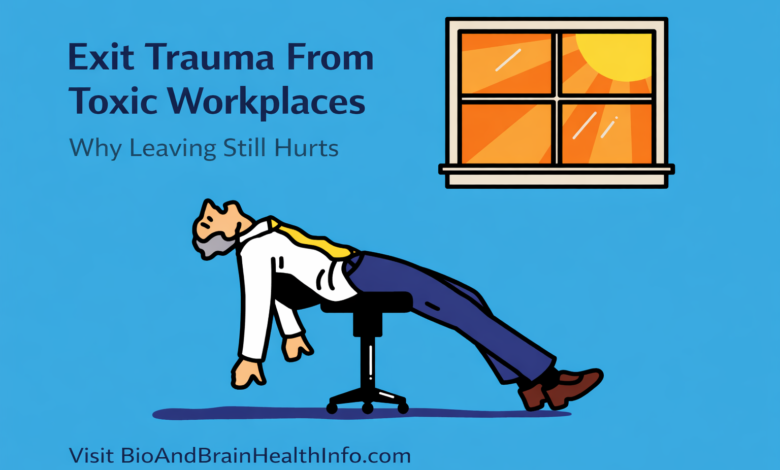
Exit trauma from toxic workplaces often includes exit trauma, grief after a job, unfinished emotional processing, and a slow recovery path that continues even when the environment is left behind.
Thank you for reading this post, don't forget to subscribe!Leaving changes the environment, but the body may still be listening for what once felt unsafe.
Relief and grief can coexist when an ending carries unprocessed meaning.
Even after leaving, the nervous system can stay on alert because it learned unpredictability as normal. Regulation returns through consistency, not force.
Exit Trauma From Toxic Workplaces: Introduction
After exit trauma from toxic workplaces, a common fear quietly appears: “Why does it still hurt if I’m finally out?”
This confusion deepens when exit trauma is mistaken for weakness, instead of a natural response to prolonged strain.
Many people experience grief after a job not only for the role they left, but for the version of themselves that had to adapt to survive.
The misunderstanding comes from blending trauma with identity, assuming distress means something is wrong inside. In reality, this is unfinished emotional processing responding to loss, disruption, and relief all at once.
Recovery does not follow a straight line; the recovery path often begins after the exit, not before.
This article will help you understand what’s happening — without labels, blame, or self-attack.
REASON FOR THIS BLOG
To explain why distress can continue after leaving a toxic workplace and to separate trauma-based responses from identity — without judgment, diagnosis, or pressure to heal quickly.
Please Explore This Blog why-narcissists-cant-apologize
INNER SEARCH MIRROR
After leaving, many people quietly look for language that matches what they feel — not because they’re stuck, but because the experience hasn’t settled yet.
Why do I still feel heavy after leaving?
Why does relief come with sadness?
Why do I miss parts of a job that hurt me?
Why does my confidence dip now, not before?
Why do memories surface when things are calm?
Why does starting fresh feel harder than expected?
If these questions sound familiar, they reflect a shared human response to endings that carried strain and meaning.
Exit Trauma From Toxic Workplaces: Psychological Explanation
Exit trauma from toxic workplaces develops because the mind adapts to survive prolonged strain, not because something is wrong with you.
During exit trauma, attention narrows toward stability, and reactions prioritize getting through each day.
After leaving, grief after a job often emerges as the mind finally has space to process what was endured and what was lost.
This can feel confusing when emotional processing arrives late, creating doubt about whether leaving was the right choice.
In truth, intent and reaction are different: intent was self-preservation; reactions were shaped by pressure. The recovery path begins when adaptation is recognized as intelligence, not failure.
Personal note: Many people feel calmer once they stop judging the timing of their feelings.
Exit Trauma From Toxic Workplaces: Nervous System Explanation
In exit trauma from toxic workplaces, the nervous system often remains active after the situation ends. During exit trauma, fight, flight, or freeze responses learned to anticipate threat before thought could intervene.
Even with relief present, grief after a job can coexist because the body responds faster than logic. Emotional processing follows sensation, not intention, which is why reactions can feel sudden or disproportionate.
The recovery path unfolds as the nervous system relearns predictability.
Common signs include:
Tension during quiet moments
Startle responses to emails or reminders
Fatigue after small decisions
Emotional flatness followed by waves
Restlessness without clear cause
Personal note: Many people recognize these signals only once safety allows awareness.
Please Explore This Blog why-narcissists-avoid-accountability
Identity vs Survival Responses
This distinction anchors everything.
Survival responses protect continuity. Identity carries values and conscience.
After exit trauma from toxic workplaces, survival can stay active longer than expected. Exit trauma amplified protective reactions because safety was uncertain.
Grief after a job does not mean identity was tied to harm; it means meaning was disrupted. Emotional processing reflects survival unwinding, not character changing.
The recovery path clarifies this separation: survival adapts quickly to threat, while identity remains stable beneath adaptation.
What changed was how you protected yourself, not who you are. When safety becomes consistent, survival quiets.
Identity does not need repair — it needs room to be expressed again.
Exit Trauma From Toxic Workplaces: Trauma vs Narcissism
A common fear after exit trauma from toxic workplaces is wondering whether lingering reactions resemble narcissism. The difference is motivation, not behavior.
Exit trauma aims to restore safety; narcissism aims to protect ego. With grief after a job, trauma shows remorse after conflict, reflection once distance is gained, and willingness to accept accountability.
Emotional processing includes discomfort about impact on others, not entitlement to control. Along the recovery path, these qualities become clearer rather than hidden.
Personal note: People who worry about becoming harmful usually do so because conscience is intact.
Quiet contrast:
| Trauma | Narcissism |
|---|---|
| Remorse present | Remorse avoided |
| Reflection increases | Reflection deflected |
| Accountability valued | Accountability resisted |
Growth Direction After Exit Trauma From Toxic Workplaces
After exit trauma from toxic workplaces, growth appears quietly. Exit trauma loosens when urgency fades and reactions slow. Grief after a job may soften into clarity without being forced.
Emotional processing becomes steadier as pauses lengthen and self-trust returns in small moments.
Along the recovery path, choosing peace often looks like fewer explanations, gentler boundaries, and tolerance for unfinished feelings. This is not withdrawal; it is regulation finding rhythm.
Personal note: Many people notice healing first as less inner debate, not more confidence.
Signs often include calmer mornings, reduced replaying, and an easier time resting without guilt—signals that safety is being re-established.
Healing Compass — From Exit Trauma to Stability
Healing after exit trauma from toxic workplaces follows stages, not deadlines.
This compass offers orientation as exit trauma settles, grief after a job integrates, emotional processing stabilizes, and the recovery path clarifies.
| Stage | Experience | Affirmation |
|---|---|---|
| Awareness | “Something ended” | My perception matters |
| Safety | Distance from strain | Calm is information |
| Stabilization | Fewer spikes | Slowness repairs |
| Understanding | Meaning returns | I adapted wisely |
| Protection | Clearer limits | Peace is allowed |
Movement is not linear. Revisiting stages reflects integration, not setback.
Please Explore This Blog why-narcissists-avoid-accountability
Why Leaving Does Not End the Impact
After exit trauma from toxic workplaces, many people expect relief to replace distress immediately. When that does not happen, confusion grows.
This occurs because exit trauma ends exposure but not conditioning. The body and mind were shaped by prolonged strain, and grief after job reflects the loss of safety, identity, and meaning all at once.
Emotional processing often begins only after survival pressure lifts, which is why pain can surface later. This delay does not mean the decision to leave was wrong.
It means the system finally has space to register what happened. The recovery path unfolds after exit because survival no longer consumes all internal resources.
What feels like regression is often the first sign of genuine healing beginning.
Why Grief Can Exist Without Missing the Job
In exit trauma from toxic workplaces, grief is often misunderstood as longing for harm. In reality, grief after job reflects attachment to effort, hope, and what was invested, not the toxicity itself.
Exit trauma disrupts continuity, and the mind mourns what it worked hard to sustain. Emotional processing allows loss to be acknowledged without rewriting history.
Grief does not mean the workplace was good; it means the human experience inside it mattered. Along the recovery path, grief softens into perspective when meaning is restored.
This distinction is crucial, because mislabeling grief as weakness or nostalgia prolongs suffering.
Grief is not betrayal of self-protection — it is recognition of what was endured and what was sacrificed.
Why Healing Feels Slower Than the Exit
A common frustration after exit trauma from toxic workplaces is feeling that healing lags behind action. Exit trauma resolves externally in a moment, while internal systems recalibrate gradually.
Grief after job unfolds in layers because loss touched routine, identity, and belonging simultaneously.
Emotional processing does not follow logic or timelines; it follows safety. When the system no longer has to perform, suppressed responses surface.
The recovery path therefore feels uneven, not because progress is absent, but because integration is ongoing. Slowness here is not stagnation.
It is regulation returning in stages. Expecting instant calm places pressure on a system that is learning how to rest again.
Why Self-Doubt Appears After You Leave
After exit trauma from toxic workplaces, self-doubt often intensifies rather than resolves. This happens because exit trauma trained the mind to second-guess itself in order to survive.
Grief after job can reopen questions about worth, competence, and judgment. Emotional processing revisits moments that once required suppression, leading to replay and reflection.
Along the recovery path, doubt is not proof of failure; it is evidence that inner authority is recalibrating after external control. The system is learning to trust itself again without constant monitoring.
Self-doubt fades not through reassurance, but through repeated experiences of safety where decisions no longer carry hidden consequences.
Why Peace Can Feel Unfamiliar at First
In exit trauma from toxic workplaces, peace can feel strangely empty or unsettling. Exit trauma conditioned the nervous system to associate alertness with safety.
When tension drops, grief after job and unfamiliar stillness can feel disorienting. Emotional processing continues even in calm moments, making peace feel incomplete.
Along the recovery path, rest may initially trigger unease because vigilance once had purpose. This does not mean something is missing; it means something unnecessary is loosening.
Learning to trust calm is a phase of healing, not avoidance. Peace becomes comfortable only after the system repeatedly experiences that nothing bad follows stillness.
Closing Note
If these insights resonate, remember this: nothing here suggests you are broken or behind. What unfolded after leaving reflects a system relearning safety, not a self that failed. With understanding and time, what adapted under pressure can soften without being forced.
Please Explore This Blog narcissistic-personality-brain-differences
Medical / Ethical Positioning — Exit Trauma From Toxic Workplaces
After exit trauma from toxic workplaces, ethical strain often precedes emotional symptoms. The mind tries to resolve whether harm was justified, minimized, or ignored.
When grief after job appears, it is frequently tied to unanswered moral questions rather than events alone.
This layer concerns meaning: whether fairness, responsibility, and duty were upheld. Healing begins when the system stops seeking ethical coherence from structures that failed to provide it.
Personal note: Many people feel lighter once they stop expecting moral closure from unethical systems.
| Aspect | Effect |
|---|---|
| Fairness | Unresolved |
| Responsibility | Diffused |
| Moral clarity | Delayed |
| Ethical trust | Fractured |
Psychological Layer — Exit Trauma From Toxic Workplaces
In exit trauma from toxic workplaces, the psychological layer focuses on interpretation. The mind keeps scanning for explanations because exit trauma disrupted predictability.
Thoughts loop not to dramatize, but to understand what could not be processed during pressure. This layer explains why confusion often increases after leaving.
Meaning-making resumes once survival demand drops. Psychological relief begins when ambiguity is tolerated instead of interrogated.
Personal note: Many people calm down once they stop forcing a final explanation.
| Process | Impact |
|---|---|
| Interpretation | Overactive |
| Meaning search | Prolonged |
| Mental replay | Common |
| Cognitive fatigue | Increased |
Nervous System Layer — Exit Trauma From Toxic Workplaces
With exit trauma from toxic workplaces, the nervous system reacts before thought. Exposure trained the body to anticipate consequences, especially when emotional processing was postponed.
Even after exit, muscle tone, breathing, and alertness may remain elevated. These reactions are automatic safety programs, not emotional choices.
Regulation returns through repeated neutrality, not insight.
Personal note: Many people only recognize how tense they were once relaxation becomes possible.
| Signal | Response |
|---|---|
| Silence | Alertness |
| Authority cues | Tension |
| Uncertainty | Vigilance |
| Calm moments | Unease |
Mental Health Layer — Exit Trauma From Toxic Workplaces
After exit trauma from toxic workplaces, mental health strain appears as depletion rather than collapse.
Recovery path confusion arises when energy, focus, and motivation fluctuate without clear reason. Prolonged stress reduces clarity and self-trust, even in safe environments.
This is load, not disorder. Mental restoration begins when rest is seen as repair rather than avoidance.
Personal note: Many people regain clarity by restoring capacity, not confidence.
| Area | Change |
|---|---|
| Focus | Inconsistent |
| Energy | Reduced |
| Self-trust | Shaken |
| Motivation | Uneven |
Identity Layer — Exit Trauma From Toxic Workplaces
Despite exit trauma from toxic workplaces, identity remains intact. Values persist beneath adaptation, even when expression was constrained.
Grief after job may blur self-recognition, but it does not rewrite conscience. This layer restores dignity by separating who you are from what you had to do to endure.
Identity does not need recovery — it needs conditions where it no longer has to hide.
Personal note: People often rediscover themselves by removing pressure, not by redefining who they are.
| Element | Status |
|---|---|
| Values | Preserved |
| Conscience | Active |
| Meaning | Dormant |
| Self-continuity | Intact |
Reflective Support Layer (Including AI) — Exit Trauma From Toxic Workplaces
In exit trauma from toxic workplaces, reflective tools support clarity without direction. Journaling, conversation, or AI can mirror thoughts neutrally when exit trauma disrupted trust in dialogue.
This layer does not instruct or correct; it reflects patterns safely. Insight arises through articulation, not advice.
Personal note: Many people think more clearly once their thoughts are witnessed without judgment.
| Tool | Function |
|---|---|
| Journaling | Externalizes thought |
| Conversation | Normalizes experience |
| AI reflection | Mirrors patterns |
| Silence | Integrates meaning |
Social / Relational Integration Layer — Exit Trauma From Toxic Workplaces
After exit trauma from toxic workplaces, social reintegration often lags behind insight. Recovery path confusion appears when connection feels draining or unfamiliar.
This layer concerns pacing relationships without reenacting performance or withdrawal. Trust rebuilds through low-stakes presence, not explanation.
Personal note: Many people reconnect best when they stop narrating what they survived.
| Area | Shift |
|---|---|
| Boundaries | Softer, clearer |
| Trust | Gradual |
| Expression | Selective |
| Belonging | Re-emerging |
Personal Note — Exit Trauma From Toxic Workplaces
What clarified this subject for me was noticing how people questioned themselves more after leaving than while enduring it.
With exit trauma from toxic workplaces, the doubt wasn’t about strength or decisions; it was about timing. Feelings arrived late, and that delay was misread as failure.
When grief after a job surfaced, many assumed they were regressing. I’ve learned the opposite is often true. Emotions wait until safety allows them to be felt.
Understanding this replaced self-criticism with patience. The insight wasn’t dramatic; it was stabilizing.
When we stop judging the order of our reactions, clarity returns quietly, and trust in our own process rebuilds without effort.
Please Explore This Blog long-term-narcissistic-abuse-recovery
Cosmic / Philosophical Takeaway — Exit Trauma From Toxic Workplaces
“Endings teach us what survival postponed.”
Across human experience, leaving is not the conclusion of meaning; it is where meaning finally has space.
Exit trauma from toxic workplaces reveals how exit trauma delays feeling until danger passes.
Grief after a job is not nostalgia for harm; it is the mind acknowledging effort, hope, and identity that were suspended.
Emotional processing restores coherence by allowing loss to be named without rewriting truth.
The recovery path unfolds when we stop forcing resolution and allow understanding to settle naturally.
Healing, at its widest scale, is not about erasing what happened, but about restoring continuity where interruption once ruled.
Final Closing — Exit Trauma From Toxic Workplaces
If this article resonated, let this be your reassurance: nothing is wrong with you for how this unfolded.
Exit trauma from toxic workplaces often continues because exit trauma taught your system to stay alert, not because you failed to move on.
Grief after a job reflects meaning and effort, not attachment to harm.
Emotional processing follows safety, not timelines, and the recovery path is shaped by consistency, not force.
You do not need to resolve everything now. If even a small sense of steadiness appeared while reading, that is enough for today.
With understanding and patience, what adapted under pressure can soften again.
Please Explore This Blog rebuilding-confidence-after-narcissistic-abuse
FAQ — Exit Trauma From Toxic Workplaces
1. Why does it still hurt after I left?
Because the body processes safety after exposure ends.
2. Is grief normal if the workplace was toxic?
Yes. Grief reflects loss of effort and meaning, not approval of harm.
3. Does delayed emotion mean I’m stuck?
No. Feelings often wait until safety allows them.
4. Why do memories resurface during calm periods?
Because vigilance is no longer required, allowing integration.
5. Is this a sign of weakness?
No. It reflects adaptation to prolonged strain.
6. How long does recovery take?
There is no fixed timeline; stability comes first.
7. Should I confront or seek closure?
Not necessarily. Regulation often restores clarity without confrontation.
8. Why does confidence dip after leaving?
Inner authority is recalibrating after external pressure.
9. Can peace feel uncomfortable at first?
Yes. Calm can feel unfamiliar before it feels safe.
🌿 Final Blog Footer — Bio & Brain Health Info
Written by Lex, founder of Bio & Brain Health Info — exploring the intersections of psychology, spirituality, and emotional recovery through calm, trauma-aware understanding.
✨ Insight & Reflection
Healing does not begin when answers arrive — it begins when self-attack stops.
Clarity grows in spaces where safety is restored.
🧠 Learn
Narcissism • Emotional Healing • Spiritual Psychology
🌍 A Moment for You
💡 Pause for two minutes. Let your body settle before moving on.
🧭 If This Article Helped, Your Next Questions Might Be:
These questions are natural continuations — not obligations.
✨ Cosmic Family Invitation
You are not here by accident. If these words reached you, clarity was already beginning.
We rise together — different souls, one journey. 🕊️
📩 Connect with us
info@bioandbrainhealthinfo.com
Telegram: @bioandbrainhealthinfo
WhatsApp Channel: Punehealth
Lex | Bio & Brain Health Info
Cosmic Family — Different Souls, One Journey.
References & Citations
World Health Organization — Mental Health at Work
https://www.who.int/publications/i/item/9789240053052American Psychological Association — Work Stress & Recovery
https://www.apa.org/monitor/2013/04/work-stressNational Institute for Occupational Safety and Health — Stress at Work
https://www.cdc.gov/niosh/topics/stressHarvard Business Review — Toxic Work Cultures
https://hbr.org/2018/01/how-toxic-work-cultures-destroy-peopleMind UK — Work-Related Stress and Recovery
https://www.mind.org.uk/workplace/mental-health-at-work/Judith Herman, MD — Trauma and Recovery
https://www.basicbooks.com/titles/judith-lewis-herman/trauma-and-recovery/9780465087303Bessel van der Kolk, MD — The Body Keeps the Score
https://www.penguinrandomhouse.com/books/177875/the-body-keeps-the-score-by-bessel-van-der-kolk-md/Greater Good Science Center (UC Berkeley) — Stress, Meaning, Healing
https://greatergood.berkeley.edu/topic/stressNational Alliance on Mental Illness (NAMI) — Trauma-Informed Care
https://www.nami.org/About-Mental-Illness/Treatments/Trauma-Informed-CareBritish Psychological Society — Work, Stress, and Wellbeing
https://www.bps.org.uk/topics/work-and-organisations