Nervous System Dysregulation Work
Why You Can’t Relax After Leaving Work

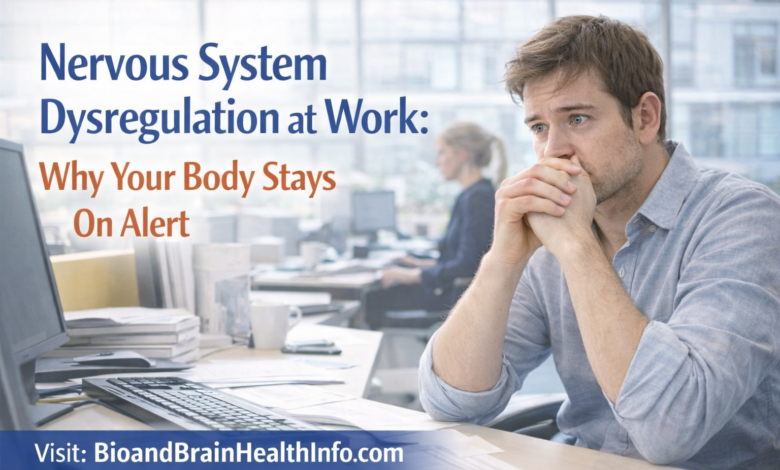
Nervous system dysregulation work often appears when nervous system stress, hypervigilance, trauma physiology, and recovery work intersect after prolonged workplace pressure.
Thank you for reading this post, don't forget to subscribe!“Your body didn’t forget how to rest—it learned when rest wasn’t safe.
Even after leaving, the nervous system can stay on alert because it learned unpredictability as normal. Regulation returns through consistency, not force.”
INTRODUCTION
Nervous System Dysregulation From Work Stress often brings a quiet fear: “Why can’t I relax even when the job is over?”
In nervous system dysregulation work, the body may stay tense long after deadlines end. Nervous system stress can look like constant alertness, while hypervigilance keeps scanning for problems that no longer exist.
Trauma physiology explains how repeated pressure conditions the body to expect threat, and recovery work unfolds more slowly than people expect.
The common misunderstanding is believing this tension means something is wrong with you. It doesn’t. This is not identity—it is adaptation.
Your system learned how to function under strain, and it hasn’t yet learned that safety is consistent again.
This article will help you understand what’s happening — without labels, blame, or self-attack.
REASON FOR THIS BLOG
To explain why the body can remain on high alert after work stress and to separate nervous system adaptation from personal identity—without diagnosis, urgency, or pressure to change.
Please Explore This Detail narcissistic-leadership-burnout
INNER SEARCH MIRROR – Nervous System Dysregulation Work
Before understanding anything, many people quietly ask:
Why can’t my body relax after work?
Why do I feel alert even during rest?
Why does calm feel unfamiliar now?
Why do small things trigger tension?
Why does my body react before I think?
Why doesn’t time away fix this?
If these questions feel familiar, they reflect a shared human response—not a personal flaw.
PSYCHOLOGICAL EXPLANATION -Nervous System Dysregulation Work: How the Mind Adapts
In nervous system dysregulation work, the mind adapts to prolonged demand by prioritizing readiness over rest. Nervous system stress teaches the brain that staying alert prevents mistakes or conflict.
Hypervigilance develops as attention narrows toward potential problems, even when none are present.
Trauma physiology explains how repeated pressure conditions expectation, not intention.
During recovery work, this readiness may persist because the mind learned usefulness, not danger.
The reaction is automatic and protective, not chosen or flawed. Understanding this reframes constant alertness as adaptation rather than overreaction.
Personal note: Many people feel relief when they realize their mind learned this for a reason.
| Learned Pattern | Purpose |
|---|---|
| Alert focus | Prevent errors |
| Anticipation | Reduce surprises |
| Mental scanning | Maintain control |
| Readiness | Preserve function |
Nervous System Dysregulation Work and Automatic Responses
During nervous system dysregulation work, the body reacts before thought through fight, flight, or freeze. Nervous system stress primes the system to respond quickly.
Hypervigilance keeps muscles and attention engaged, while trauma physiology supports survival by limiting relaxation.
Recovery work unfolds slowly because the body learned unpredictability over time. These reactions are reflexive, not personal choices.
Common warning signs include:
Persistent muscle tension
Shallow or rapid breathing
Startle responses
Difficulty settling at night
Fatigue without restfulness
Personal note: Understanding the body’s timing often eases self-judgment.
Please Explore This Detail trust-issues-after-toxic-job
Identity vs Survival Responses
This distinction anchors the article.
Survival responses exist to protect the system under sustained demand. Identity reflects values, conscience, and long-term character.
In nervous system dysregulation work, survival may look like tension, scanning, or difficulty relaxing.
Identity does not change during these states—it is temporarily overshadowed by protection. Nervous system stress and hypervigilance alter access to calm, not who you are.
Trauma physiology explains protection; recovery work restores availability. Confusing survival with identity creates fear: “This is who I am now.”
Separating them restores self-trust. You are not your alert state—you are the person whose system learned to keep you safe.
Nervous System Dysregulation Work: Trauma Response vs Self-Labeling
In nervous system dysregulation work, a common fear is “What if this means something is wrong with me?”
When nervous system stress stays high, hypervigilance can resemble emotional hardness from the outside.
Trauma physiology explains why this happens: protection increases while access to softness decreases.
The difference lies in motivation, not behavior.
| Trauma-Based Response | Narcissistic Pattern |
|---|---|
| Feels remorse after impact | Lacks remorse |
| Reflects inward | Avoids reflection |
| Seeks accountability | Deflects blame |
| Wants repair | Preserves dominance |
Recovery work depends on recognizing that the presence of conscience already answers the fear.
Personal note: Many people feel relief when they realize reflection itself is not a narcissistic trait.
Nervous System Dysregulation Work and Gentle Re-Orientation
After nervous system dysregulation work, growth is less about change and more about orientation.
Nervous system stress eases when environments become predictable, not when effort increases.
Hypervigilance often softens into neutrality before calm appears. Trauma physiology unwinds gradually, and recovery work restores capacity through consistency rather than insight alone.
Signs of healing are often quiet: fewer spikes, longer pauses, and less internal urgency. Slowing down is not withdrawal—it is how safety is re-learned.
Choosing peace means respecting the pace at which the body trusts again. Agency returns not through control, but through permission to move gently.
Personal note: I’ve seen steadiness return when people stop negotiating with their nervous system.
HEALING COMPASS / ORIENTATION TABLE
This compass offers orientation, not instruction. These stages describe how stability often returns after prolonged activation.
| Stage | Inner Experience |
|---|---|
| Recognition | “My body adapted for a reason.” |
| Stabilization | “Consistency helps me settle.” |
| Softening | “Alertness eases in small ways.” |
| Reconnection | “Rest feels more accessible.” |
| Integration | “I trust my body again.” |
Each stage affirms capacity rather than demand. Healing unfolds through safety and time, not pressure.
Why Your Body Stays Alert After Work Ends
In nervous system dysregulation work, many people are confused by a body that refuses to settle once tasks are done. Nervous system stress trains alertness as a survival skill, not a conscious choice.
Hypervigilance develops when attention is repeatedly rewarded for catching problems early.
Trauma physiology explains how repeated demand conditions expectation rather than danger itself.
During recovery work, the body does not instantly recognize that pressure has ended—it waits for consistency.
This waiting is not resistance; it is intelligence. Understanding this reframes constant alertness as learned protection, not a failure to relax, restoring dignity to an experience often judged harshly.
Why Relaxation Can Feel Unsafe
Within nervous system dysregulation work, relaxation may feel uncomfortable or unfamiliar.
Nervous system stress taught the body that vigilance prevented mistakes or consequences. Hypervigilance kept awareness sharp, while trauma physiology narrowed tolerance for unpredictability.
During recovery work, calm can initially register as vulnerability rather than relief.
This does not mean something is wrong—it means the system learned safety through readiness.
When relaxation was paired with risk in the past, the body stays cautious. Seeing this removes self-blame and explains why “trying to relax” often backfires.
Safety is relearned through predictability, not effort.
Why Symptoms Fluctuate Day to Day
People in nervous system dysregulation work often notice good days followed by sudden setbacks.
Nervous system stress does not unwind in a straight line. Hypervigilance rises when cues resemble past demand, even subtly.
Trauma physiology stores patterns, not timelines, so activation can return briefly without warning. During recovery work, fluctuation is not regression—it is recalibration.
The system tests safety, retreats, then tries again.
Understanding this prevents panic when symptoms return and reframes variability as part of integration rather than proof of failure.
Why Thinking Your Way Out Doesn’t Work
In nervous system dysregulation work, many people attempt to reason their body into calm. Nervous system stress, however, operates below conscious logic.
Hypervigilance activates before thought, and trauma physiology prioritizes speed over reflection.
Recovery work restores regulation through experience, not explanation. This is why insight alone rarely settles the body.
Knowing this reduces frustration and self-criticism. The nervous system is not resisting understanding—it is waiting for repeated signals of safety.
Calm returns through lived consistency, not mental effort.
Why Self-Trust Returns Before Calm
After nervous system dysregulation work, the first sign of healing is often subtle.
Nervous system stress may still appear, hypervigilance may still flicker, and trauma physiology may still influence reactions during recovery work.
Yet self-trust begins to return earlier. You start respecting limits, believing signals, and allowing rest without justification.
This trust creates the conditions calm requires. Regulation follows permission, not pressure.
When self-trust stabilizes, the body no longer needs to stay on guard. Healing begins quietly, from the inside out.
Closing Note
If these insights resonate, it does not mean your system is broken. It means your body learned how to keep you functioning under sustained demand. With safety and understanding, what adapted can soften again—without force, urgency, or self-attack.
Please Explore This Detail recovery-after-narcissistic-workplace
Medical / Ethical Positioning — Nervous System Dysregulation Work
In nervous system dysregulation work, ethical framing prevents people from turning adaptive responses into diagnoses.
From a medical-education standpoint, the focus is on how the mind interprets threat, confusion, and meaning under pressure—without labeling identity.
Using nervous system stress language clarifies patterns while protecting autonomy.
Ethical clarity prioritizes stabilization, consent, and transparency, ensuring readers gain orientation rather than pressure to act.
This layer explains experience, not pathology, and restores trust by naming what many humans encounter at work strain.
Personal note: Ethical language often brings safety before insight.
| Anchor | Position |
|---|---|
| Role | Education |
| Language | Non-pathologizing |
| Aim | Reduce self-attack |
| Priority | Safety |
Psychological Layer — Nervous System Dysregulation Work
Within nervous system dysregulation work, the psyche seeks coherence when conditions are demanding.
Hypervigilance shapes interpretation by scanning for signals that once mattered. Meaning becomes provisional; the mind simplifies to preserve stability.
This layer explains how interpretation shifts under load—why uncertainty feels personal, and why clarity narrows to essentials.
Understanding this restores coherence without forcing emotional access, helping people separate confusion from character.
Personal note: Relief often follows when meaning—not self—is questioned.
| Function | Shift |
|---|---|
| Interpretation | Threat-weighted |
| Attention | Narrowed |
| Meaning | Provisional |
| Coherence | Preserved |
Nervous System Layer — Nervous System Dysregulation Work
During nervous system dysregulation work, the body responds reflexively. Trauma physiology prioritizes speed and safety over reflection, keeping systems ready.
These automatic responses—tension, scanning, delayed settling—are protective, not chosen.
This layer clarifies why the body can stay alert without danger present and why time alone doesn’t switch it off.
Naming automatic protection reduces shame and restores respect for bodily intelligence.
Personal note: Understanding timing often softens self-judgment.
| Reaction | Purpose |
|---|---|
| Tension | Readiness |
| Scanning | Early detection |
| Guarding | Safety |
| Delay | Energy control |
Mental Health Layer — Nervous System Dysregulation Work
In nervous system dysregulation work, mental health refers to capacity, not diagnosis. Recovery work unfolds as bandwidth returns—clarity, energy, and self-trust rebuild gradually.
Prolonged strain reduces availability without erasing competence.
This layer reframes fatigue and fog as depletion, preventing identity collapse and supporting realistic expectations for restoration.
Personal note: Naming depletion accurately often brings relief.
| Capacity | Effect |
|---|---|
| Clarity | Reduced |
| Energy | Limited |
| Trust | Wobbly |
| Focus | Intermittent |
Identity Layer — Inner Continuity & Meaning
Beneath nervous system dysregulation work, identity endures. Values, conscience, and integrity remain present even when access to calm is limited.
Survival responses overshadow expression; they do not redefine the self.
This layer anchors continuity, separating temporary protection from enduring character, and restores dignity without demanding change.
Personal note: Identity often reappears when pressure eases.
| Element | Status |
|---|---|
| Values | Intact |
| Conscience | Present |
| Character | Unchanged |
| Worth | Stable |
Reflective Support Layer (Including AI) — Gentle Mirroring
After nervous system dysregulation work, reflective supports help organize experience without instruction.
Tools like journaling, conversation, or AI mirror patterns neutrally, allowing insight to surface safely.
Mirroring restores internal dialogue after confusion, supporting integration without urgency.
Personal note: Reflection feels safest when nothing is pushed.
| Tool | Function |
|---|---|
| Journaling | Externalize |
| Conversation | Normalize |
| AI | Pattern mirror |
| Silence | Integrate |
Nervous System Dysregulation Work — A Lived Insight
In nervous system dysregulation work, what helped me most was recognizing that my body wasn’t failing—it was remembering.
Nervous system stress made alertness feel normal, and I judged myself for not “switching off.” Over time, I saw how hypervigilance had been useful in demanding environments, even when it later felt exhausting.
Learning about trauma physiology reframed my experience from weakness to adaptation, and recovery work became less about fixing and more about allowing consistency to rebuild trust.
When I stopped asking why my body wouldn’t relax and started asking what it had learned to protect, steadiness returned before calm did.
That shift changed everything.
Please Explore This Detail narcissistic-dependency-workplace
COSMIC / PHILOSOPHICAL TAKEAWAY – Nervous System Dysregulation Work and Human Meaning
“What tightens under pressure is not the self, but access to ease.”
In nervous system dysregulation work, nervous system stress, hypervigilance, trauma physiology, and recovery work reflect a universal human truth: systems adapt to endure.
Across time, humans have learned vigilance where unpredictability ruled. This narrowing is not loss—it is waiting.
Meaning returns when consistency replaces threat, not when effort increases. Identity does not disappear during activation; it rests beneath protection.
When safety becomes repeatable, the body loosens its grip. Healing unfolds quietly, honoring timing over force and understanding over urgency.
FINAL CLOSING – Nervous System Dysregulation Work — Returning to Steadiness
If nervous system dysregulation work has shaped your days, nothing about your response means you are broken.
Nervous system stress, hypervigilance, trauma physiology, and recovery work describe a body that learned vigilance to keep you functioning.
With safety and understanding, what adapted can soften again. You are not required to explain, confront, or hurry your body into calm.
Let this be an invitation to notice small signs of steadiness returning—longer pauses, fewer spikes, gentler mornings.
Clarity often arrives before relaxation, and that is enough. Healing grows where self-attack ends and consistency is allowed to do its quiet work.
Please Explore This Detail narcissistic-control-disguised-care-work
FAQ SECTION – Nervous System Dysregulation Work
1. Why can’t I relax after leaving work?
Because your body learned alertness through repetition and needs consistency to recalibrate.
2. Is nervous system dysregulation a diagnosis?
No. This article explains patterns, not diagnoses.
3. Why does rest not fix it immediately?
Distance helps, but regulation returns through repeatable safety, not time alone.
4. Are my reactions happening before I think?
Yes. Many responses occur automatically, before conscious thought.
5. Does hypervigilance mean something is wrong with me?
No. It reflects learned protection under sustained demand.
6. Can symptoms fluctuate day to day?
Yes. Fluctuation is common as the system tests safety.
7. Will calm come back?
For many people, yes—gradually and naturally.
8. Should I push myself to relax?
Pressure often delays settling; gentleness supports it.
9. Is neutrality part of healing?
Often, yes. Neutrality can precede deeper calm.
🌿 Final Blog Footer — Bio & Brain Health Info
Written by Lex, founder of Bio & Brain Health Info — exploring the intersections of psychology, spirituality, and emotional recovery through calm, trauma-aware understanding.
✨ Insight & Reflection
Healing does not begin when answers arrive — it begins when self-attack stops.
Clarity grows in spaces where safety is restored.
🧠 Learn
Narcissism • Emotional Healing • Spiritual Psychology
🌍 A Moment for You
💡 Pause for two minutes. Let your body settle before moving on.
🧭 If This Article Helped, Your Next Questions Might Be:
These questions are natural continuations — not obligations.
✨ Cosmic Family Invitation
You are not here by accident. If these words reached you, clarity was already beginning.
We rise together — different souls, one journey. 🕊️
📩 Connect with us
info@bioandbrainhealthinfo.com
Telegram: @bioandbrainhealthinfo
WhatsApp Channel: Punehealth
Lex | Bio & Brain Health Info
Cosmic Family — Different Souls, One Journey.
REFERENCES & CITATION
Trusted Sources on Stress, Regulation, and Recovery
American Psychological Association — Stress & Health
https://www.apa.org/topics/stressHarvard Health Publishing — Stress and the Nervous System
https://www.health.harvard.edu/staying-healthy/how-stress-affects-your-bodyNational Institute for Occupational Safety and Health (NIOSH) — Work Stress
https://www.cdc.gov/niosh/topics/stressCleveland Clinic — Fight, Flight, Freeze Responses
https://health.clevelandclinic.org/fight-flight-freeze/World Health Organization — Mental Health at Work
https://www.who.int/teams/mental-health-and-substance-use/mental-health-at-workMind UK — Work Stress and Wellbeing
https://www.mind.org.uk/workplace/mental-health-at-work/Judith Herman, MD — Trauma and Recovery
https://www.basicbooks.com/titles/judith-herman/trauma-and-recovery/9780465061716/Bessel van der Kolk, MD — The Body Keeps the Score
https://www.penguinrandomhouse.com/books/220128/the-body-keeps-the-score-by-bessel-van-der-kolk-md/Psychology Today — Hypervigilance Explained
https://www.psychologytoday.com/us/basics/hypervigilance