Why do we suffer from our own thoughts?
Understanding Overthinking, Emotional Suffering, and Awareness

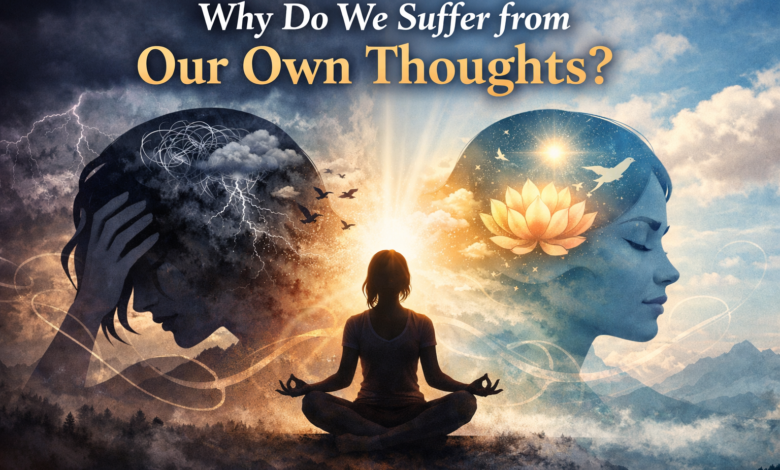
Understanding why do we suffer from our own thoughts begins with exploring the deeper layers of suffering from thoughts psychology, where patterns of overthinking and mental suffering trigger nervous system and emotional suffering, making it essential to learn how to observe your thoughts with awareness and balance.
Thank you for reading this post, don't forget to subscribe!“The greatest suffering often does not come from the world, but from the stories the mind keeps telling about it.”
Sometimes the hardest struggles in life do not come from the outside world. They come from inside the mind. A moment happens, a conversation ends, a relationship changes, or a difficult situation appears. In reality, the moment may pass quickly, yet the mind continues revisiting it again and again.
Many people quietly experience this and begin asking themselves a deep question: why do we suffer from our own thoughts even when nothing harmful is happening in the present moment?
The human mind has a powerful ability to remember, analyze, and imagine. This ability helped humanity survive for thousands of years.
However, the same ability can also lead to overthinking and mental suffering, where the brain repeatedly analyzes situations that have already passed. One event may occur once in real life, yet internally it may replay many times in different forms.
This repeated mental activity is closely related to suffering from thoughts psychology, where the mind tries to search for meaning, explanations, or control over emotional experiences. When thoughts become emotionally charged, they can also activate the body’s stress response, leading to nervous system and emotional suffering.
Learning how to observe your thoughts rather than becoming trapped in them is often the first step toward understanding the deeper nature of mental suffering.
Introduction — Why do we suffer from our own thoughts?
This blog explores the deeper psychological and biological reasons behind why do we suffer from our own thoughts. It examines how thinking patterns develop, why the brain tends to repeat emotional memories, and how overthinking and mental suffering gradually affect the nervous system.
Modern psychology explains that the brain constantly processes information from the past, present, and future. It analyzes memories, predicts possible outcomes, and tries to protect the individual from emotional harm. While this mental process is natural, it can sometimes create patterns of suffering from thoughts psychology, where thinking becomes repetitive and emotionally draining.
The nervous system plays an important role in this process. When thoughts repeatedly trigger emotional reactions, the body begins to experience nervous system and emotional suffering, even if the original situation has already ended. This can lead to emotional fatigue, mental exhaustion, and difficulty finding calmness.
Understanding why do we suffer from our own thoughts helps individuals recognize that suffering is not always caused by external events. Often, it is created by the way the mind interprets and holds onto those events. Developing the ability how to observe your thoughts can gradually reduce the emotional intensity attached to them.
My Story — When Thinking Became More Exhausting Than Reality
There was a time in my life when I began noticing that the most exhausting part of difficult situations was not always the situation itself. The real exhaustion came from the way my mind kept returning to those moments again and again.
A single experience could replay in my mind many times. I would analyze what happened, imagine different possibilities, and try to understand every small detail. While the event itself had already passed, my thoughts continued to revisit it repeatedly.
This was a clear experience of overthinking and mental suffering. The mind believed it was searching for clarity, but the constant analysis was creating deeper nervous system and emotional suffering instead. Even on days when life seemed stable and progress was happening, the body could still feel mentally tired.
That was when I started questioning more deeply why do we suffer from our own thoughts.
Inner Search Mirror — Questions Many People Ask Quietly
At some point, many individuals begin asking themselves important questions about their inner experiences:
- Why does my mind keep repeating the same situations again and again?
- Why do certain thoughts stay in my head for years?
- Why do small events sometimes create strong emotional reactions?
- Why do I feel mentally exhausted even when my life appears stable?
- Why does the mind struggle more than real life itself?
These questions are part of a deeper search for understanding suffering from thoughts psychology. They show that a person is beginning to reflect on why do we suffer from our own thoughts and how repeated thinking patterns shape emotional experiences.
When these questions arise, they often mark the beginning of learning how to observe your thoughts with greater awareness.
Why This Blog Exists – Why do we suffer from our own thoughts?
This blog exists to explore a truth many people experience but rarely discuss openly. The human mind is constantly active, producing thoughts, interpretations, and emotional reactions. The challenge is not the presence of thoughts, but the way we relate to them.
By understanding overthinking and mental suffering, the connection between thinking patterns and nervous system and emotional suffering becomes clearer. Psychology, neuroscience, and ancient wisdom traditions all suggest that awareness can change the relationship between the mind and emotional pain.
Learning how to observe your thoughts does not mean stopping thoughts completely. Instead, it means recognizing them without becoming trapped in them. This understanding helps explain why do we suffer from our own thoughts and how that suffering can gradually transform into greater clarity and balance.
Please Explore This Blog why-emotions-feel-overwhelming
⭐ Understanding Emotional Patterns – Why do we suffer from our own thoughts?
Emotional Bridge — When Adult Reactions Feel Bigger Than the Situation
Many people begin noticing something confusing in their adult relationships. A small disagreement, a delayed message, a change in someone’s tone, or a moment of distance can suddenly trigger strong emotional reactions. The situation itself may appear minor, yet internally it feels deeply personal.
At that moment people often wonder again why do we suffer from our own thoughts, because the emotional reaction feels stronger than the actual event.
This is where overthinking and mental suffering often begins. The mind quickly starts analyzing the situation: Did I do something wrong? Are they upset with me? Did I lose their respect? The brain tries to search for meaning behind every small signal.
These reactions are not random. They are usually connected to earlier emotional experiences that shaped how the mind interprets relationships. When the brain detects something that resembles past emotional pain, it activates protective thinking patterns. These patterns can create suffering from thoughts psychology, where the mind tries to protect itself by analyzing every detail of the situation.
As these thoughts repeat, they begin influencing the body as well. The heart rate may increase, tension may appear, and emotional heaviness may develop. This is how nervous system and emotional suffering gradually becomes connected to repeated thinking patterns.
Learning how to observe your thoughts during these moments can help interrupt this cycle before it becomes overwhelming.
Psychological Explanation — How Early Emotional Patterns Shape Identity
Psychologists often explain that emotional reactions in adulthood are strongly influenced by earlier relational experiences. The brain learns patterns from childhood, family dynamics, and early relationships. These experiences quietly shape how individuals interpret emotional signals later in life.
When emotional support or validation is inconsistent during early life, the mind may develop heightened sensitivity to rejection or distance. As a result, small relational changes can trigger intense mental analysis. This is one reason why do we suffer from our own thoughts in situations that appear small from the outside.
The brain attempts to protect the individual by predicting possible emotional threats. Unfortunately, this protective mechanism can create overthinking and mental suffering, where the mind repeatedly searches for reassurance or certainty.
Over time these repeated mental patterns form part of suffering from thoughts psychology, where identity becomes connected to emotional interpretations. When the brain interprets a situation as personal failure or rejection, the nervous system reacts automatically, producing nervous system and emotional suffering even when the real situation may be neutral or temporary.
Developing awareness of these patterns helps individuals begin learning how to observe your thoughts rather than immediately believing them.
Trauma & Self-Doubt Connection — Why do we suffer from our own thoughts?
Another important factor behind why do we suffer from our own thoughts is the development of inner self-criticism. When a person repeatedly experiences emotional pain, disappointment, or rejection, the mind may start forming protective beliefs.
These beliefs can sound like internal voices:
- Maybe I am not good enough.
- Maybe I always make mistakes.
- Maybe people will leave eventually.
Although these thoughts appear to offer explanation, they often strengthen overthinking and mental suffering instead of resolving it. The mind becomes highly alert, constantly scanning situations for possible signs of failure or rejection.
This pattern strengthens suffering from thoughts psychology, where the brain continues analyzing emotional situations long after they have passed. Over time this repeated mental activity also affects the body, increasing nervous system and emotional suffering.
Understanding this connection helps individuals begin shifting their relationship with thoughts. When people start learning how to observe your thoughts, they gradually realize that not every thought represents truth. Some thoughts are simply echoes of earlier emotional experiences that the mind is still trying to understand.
Please Explore This Blog revenge-vs-justice-is-self-destruction
⭐ Nervous System & Habitual Pain -Why do we suffer from our own thoughts?
Nervous System Explanation — Why Calm Sometimes Feels Unfamiliar
To understand why do we suffer from our own thoughts, it is important to understand the role of the nervous system. The brain and body are constantly communicating through networks of nerves that regulate emotions, stress responses, and physical sensations. When the nervous system repeatedly experiences stress or emotional pain, it gradually becomes accustomed to that state.
Over time the body can begin to treat tension as normal. This is why some individuals feel restless or uncomfortable when life becomes calm. The mind may unconsciously search for problems or replay past situations because the nervous system has adapted to a state of alertness. In these situations, overthinking and mental suffering become familiar mental habits rather than conscious choices.
Psychologists explain that repeated emotional stress can strengthen neural pathways related to fear and analysis. These pathways can lead to patterns of suffering from thoughts psychology, where the brain automatically returns to thoughts connected with worry, criticism, or emotional pain. When this happens frequently, it can also produce nervous system and emotional suffering, leaving the body feeling tired even without physical exertion.
Learning how to observe your thoughts helps interrupt this cycle because awareness allows the nervous system to gradually experience calm without interpreting it as danger.
Habitual Pain Pattern — When Emotional Pain Becomes Familiar
Another important reason why do we suffer from our own thoughts is that emotional pain can become psychologically familiar. When the mind repeatedly experiences disappointment, rejection, or criticism, it begins forming expectations around those experiences.
These expectations influence how new situations are interpreted. A neutral situation may be analyzed through a lens of past emotional memories. This often strengthens overthinking and mental suffering, because the mind continuously compares present experiences with earlier pain.
Over time this repeated comparison becomes part of suffering from thoughts psychology, where the brain expects emotional difficulty even in situations that may not actually contain it. The nervous system reacts accordingly, maintaining patterns of nervous system and emotional suffering that reinforce the mental cycle.
Why Normal Survival Feels Like a Mistake – Why do we suffer from our own thoughts?
Many people also experience shame about how they responded to earlier emotional challenges. Coping mechanisms such as withdrawal, overthinking, emotional sensitivity, or constant self-analysis may appear embarrassing in hindsight. However, these reactions often developed as survival responses.
The mind was attempting to protect itself from emotional pain. Yet when individuals judge these responses harshly, the brain begins generating critical thoughts again. This strengthens overthinking and mental suffering, reinforcing the belief that something is wrong with the person.
Understanding why do we suffer from our own thoughts helps shift this perspective. These patterns are not personal failures but learned responses shaped by experience. When individuals practice how to observe your thoughts with curiosity instead of judgment, the nervous system gradually learns that awareness can replace habitual emotional pain.
Please Explore This Blog what-is-maya-in-real-life-ego-create-hidden-suffering
⭐ Identity Awareness – Why do we suffer from our own thoughts?
Identity vs Learned Conditioning — When Identity Is Shaped by Others
A deeper layer behind why do we suffer from our own thoughts is the difference between authentic identity and learned conditioning. Many beliefs about ourselves are not created consciously. They are shaped by family expectations, social approval, criticism, and repeated feedback from the environment.
Over time these external voices can slowly become internal voices. A person may begin evaluating themselves through the opinions of others rather than through their own understanding. When this happens, the mind constantly checks whether it is accepted, respected, or valued.
This constant evaluation often leads to overthinking and mental suffering, because the brain is trying to manage identity through external validation. The result is a pattern described in suffering from thoughts psychology, where thoughts repeatedly question personal worth or social acceptance. As these thoughts repeat, they can also influence the body, producing nervous system and emotional suffering.
Learning how to observe your thoughts helps individuals recognize that many internal beliefs were learned rather than chosen.
Internal Dialogue Realization — How the Mind Speaks to Itself
Another powerful step in understanding why do we suffer from our own thoughts is noticing the way the mind speaks internally. Many people develop an automatic inner dialogue that constantly evaluates situations, predicts outcomes, and judges personal actions.
This internal dialogue often operates quietly in the background, yet it strongly shapes emotional experience. If the inner voice becomes overly critical, the brain begins repeating patterns of overthinking and mental suffering.
These patterns strengthen suffering from thoughts psychology, where the mind continuously analyzes past events or future possibilities. As the thoughts repeat, they activate emotional reactions in the body, contributing to nervous system and emotional suffering.
Recognizing this internal dialogue is an important step toward change. When individuals learn how to observe your thoughts without immediately believing them, the mind gradually shifts from automatic reaction toward awareness and clarity.
Please Explore This Blog pet-loss-grief-why-losing-a-pet-hurts-so-much
⭐ Spiritual Integration -Why do we suffer from our own thoughts?
Gita Integration — Soul, Karma, and Maya
When exploring why do we suffer from our own thoughts, many psychological insights also connect deeply with spiritual teachings. The Bhagavad Gita describes the mind as a powerful instrument that can either create suffering or guide a person toward awareness.
One well-known verse explains this idea clearly:
“For the mind alone is the friend of the self, and the mind alone is the enemy of the self.”
(Bhagavad Gita 6.5)
This teaching suggests that when the mind becomes attached to fear, identity, and control, it creates overthinking and mental suffering. But when the mind develops awareness and detachment, it becomes supportive rather than destructive.
The Gita also introduces the concept of Maya, the illusion created by attachment and identification. When thoughts are taken as absolute truth, individuals experience suffering from thoughts psychology, where emotional reactions dominate perception. This often produces nervous system and emotional suffering because the body responds to mental interpretations as if they were real threats.
Learning how to observe your thoughts helps create distance between awareness and mental activity, allowing the mind to gradually release attachment.
Spiritual Self-Communication — Regulating the Mind Through Awareness
Spiritual teachings also offer practical ways to regulate emotional experiences. One powerful practice is conscious self-communication, where individuals begin guiding their mind with awareness rather than reacting automatically.
Instead of fighting thoughts, a person gently reminds themselves that thoughts are temporary mental events. This shift gradually reduces overthinking and mental suffering, because the mind stops treating every thought as a personal reality.
When practiced regularly, this awareness weakens patterns of suffering from thoughts psychology and helps calm the body’s stress responses related to nervous system and emotional suffering.
Through reflection, meditation, and conscious awareness, individuals learn how to observe your thoughts without becoming trapped in them. Over time this practice allows the mind to move from constant reaction toward steadier emotional balance.
Please Explore This Blog 3-gunas-and-personality-mental-health
⭐Transformation & Growth – Why do we suffer from our own thoughts?
Turning Point — Self-Forgiveness and Ending Internal Neglect
A major turning point in understanding why do we suffer from our own thoughts often begins with self-forgiveness. Many people spend years blaming themselves for emotional reactions, mistakes, or past decisions. This constant self-criticism strengthens overthinking and mental suffering, because the mind keeps revisiting situations with judgment instead of understanding.
Self-forgiveness does not mean ignoring responsibility. It means recognizing that many reactions were survival responses shaped by experience. When individuals stop internally attacking themselves, patterns of suffering from thoughts psychology begin to loosen. The nervous system slowly learns that awareness can replace constant tension, reducing nervous system and emotional suffering.
This shift marks the moment when people start learning how to observe your thoughts with compassion instead of resistance.
Questions for reflection:
- Am I judging myself for reactions that once helped me survive?
- What would change if I treated my mind with patience instead of criticism?
- Can I allow past experiences to become lessons instead of identities?
Healing Compass — Practical Emotional Regulation Tools
Understanding the mind is important, but transformation also requires practical actions. Simple daily practices can help reduce overthinking and mental suffering and calm the nervous system.
Practical tools to regulate emotional patterns:
• Pause and breathe: When intense thoughts appear, take slow breaths to calm the nervous system.
• Name the thought: Instead of believing the thought, recognize it as a mental event.
• Observe without reacting: Practice how to observe your thoughts without immediately responding to them.
• Limit mental replay: When the mind repeats a situation, gently shift attention toward present activities.
• Body awareness: Movement, stretching, or walking helps release nervous system and emotional suffering.
These small steps gradually weaken patterns of suffering from thoughts psychology.
Rebuilding Identity & Relationships — A New Perspective
Healing also involves rebuilding the relationship with oneself and with others. When people understand why do we suffer from our own thoughts, they begin realizing that identity is not defined by past reactions or temporary emotions.
A healthier perspective toward relationships emerges:
Practical identity rebuilding tips:
✔ Value awareness more than perfection.
✔ Allow mistakes to become learning experiences.
✔ Communicate emotions instead of suppressing them.
✔ Focus on emotional balance rather than constant approval.
✔ Surround yourself with relationships that encourage growth.
Self-reflection questions:
- What qualities define the person I want to become?
- How can I treat myself with the same kindness I offer others?
- Which relationships support emotional stability?
By practicing awareness and compassion, individuals gradually shift from repeated overthinking and mental suffering toward a calmer inner experience. Understanding why do we suffer from our own thoughts becomes the beginning of building a healthier relationship with the mind and with life itself.
Please Explore This Blog spiritual-awakening-after-suffering-ego-collapse
⭐Closing Authority – Why do we suffer from our own thoughts?
Personal Note – Why do we suffer from our own thoughts?
One quiet realization changed how I understood the mind: life may hurt us once, but the mind can replay that pain many times. When we begin learning how to observe your thoughts, the emotional weight attached to them slowly decreases.
Understanding why do we suffer from our own thoughts helps us recognize that thoughts are mental events, not permanent truths.
With awareness, patterns of overthinking and mental suffering gradually soften, and the body experiences less nervous system and emotional suffering. The goal is not to stop thinking, but to change the relationship with thinking.
⭐ FAQ Or People Also Ask
1. Why do we suffer from our own thoughts?
Because the mind repeats emotional experiences and interprets them personally, creating overthinking and mental suffering.
2. Can thoughts create real emotional pain?
Yes. Repeated thinking can activate the body’s stress response and lead to nervous system and emotional suffering.
3. What is suffering from thoughts psychology?
It refers to mental patterns where repeated thoughts create emotional distress.
4. How can I observe my thoughts?
Pause, notice the thought, and recognize it as a mental event rather than immediate reality.
5. Why does my mind repeat painful situations?
The brain tries to analyze and protect itself from similar future experiences.
6. Is overthinking connected to anxiety?
Yes, persistent overthinking and mental suffering often increase anxiety and stress.
7. Can awareness reduce emotional suffering?
Yes. Learning how to observe your thoughts can calm the mind and nervous system.
8. Is it possible to stop negative thought loops?
While thoughts may continue, awareness helps prevent them from controlling emotional responses.
Please Explore This Blog ego-dissolution-and-inner-clarity-emotionally-free
⭐ References with URLs For Study – Why do we suffer from our own thoughts?
📌 Psychology of Rumination & Repetitive Negative Thinking
“Thinking too much: rumination and psychopathology” — a scientific review about repetitive negative thinking patterns (rumination) that contribute to mental distress and psychopathology. Thinking too much: rumination and psychopathology (PMC)
“Rumination: A Cycle of Negative Thinking” — explains how dwelling on negative feelings can contribute to emotional suffering and distress. Rumination: A Cycle of Negative Thinking (APA)
📌 Nervous System & Stress Physiology
“Physiology, Stress Reaction” — overview of how stress activates the nervous system, including sympathetic and parasympathetic responses. Physiology, Stress Reaction (NCBI Bookshelf)
“Understanding the stress response” — covers how chronic stress affects both physical and psychological health. Understanding the stress response (Harvard Health)
📌 Cognitive Processes & Overthinking
“Overthinking: Why Are We Often Trapped in Our Own Thoughts?” — article that discusses how overthinking can lead to anxiety and stress. Overthinking: Why Are We Often Trapped in Our Own Thoughts?
“Ironic process theory” — explains why attempting to suppress thoughts can sometimes make them more persistent. Ironic process theory (Wikipedia)
“Cognitive distortion” — overview of how irrational thinking patterns can distort perception and emotional well-being. Cognitive distortion (Wikipedia)
📌 Stress & Emotional Impact
“Mind wandering in anxiety disorders” — connection between thought patterns like worry and anxiety symptoms. Mind wandering in anxiety disorders (ScienceDirect)
1️⃣ Bhagavad Gita Quotes on Detachment and Action
Verse 2.47 — detachment from the fruits of action and emotional surrender
URL: Bhagavad Gita Quotes on Detachment
🔗 https://www.bhagavadgitaforall.com/blog/detachment-quotes-from-bhagavad-gita
This shloka teaches that we act without attachment to outcomes — a key spiritual principle explaining why we suffer from our own thoughts, as attachment fuels repeated thinking and emotional tension.
2️⃣ Gita on Mind as Friend or Enemy – Why do we suffer from our own thoughts?
Chapter 6, Verse 5 — “Elevate yourself through the power of your mind…”
URL: Mastering the Mind Through Bhagavad Gita
🔗 https://jkyog.in/en/wisdom/blog/mastering-the-mind-insights-from-bhagavad-gita-chapter-6-on-personal-responsibility-and-inner-control
This verse highlights how the mind can be a powerful ally or its greatest obstacle, which directly relates to overthinking and mental suffering.
3️⃣ Gita on How Mind Can Be Enemy – Why do we suffer from our own thoughts?
Chapter 6, Verse 6 — “For those who have conquered the mind…”
URL: Bhagavad Gita 6.6 full verse & commentary
🔗 https://www.holy-bhagavad-gita.org/chapter/6/verse/6/
This teaching connects with why internal thought patterns can trap us in suffering and how mind mastery brings peace.
4️⃣ Gita & Emotional Stability -Why do we suffer from our own thoughts?
Bhagavad Gita on balancing mind and desires
URL: The Bhagavadgita on Controlling and Stabilizing the Mind
🔗 https://www.hinduwebsite.com/stablemind.asp
This resource explains how desires and attachments disturb the mind — a central cause of mental suffering and thought loops.
5️⃣ Gita & Reasoning Behind Human Suffering – Why do we suffer from our own thoughts?
Gita explains suffering arises from faulty thinking and attitudes
URL: The Bhagavad-Gita on Suffering
🔗 https://www.hinduwebsite.com/divinelife/suffering.asp
This text relates suffering to thoughts, beliefs, and perceptions — exactly the psychological point your blog talks about.
6️⃣ Gita Shlokas to Overcome Negative Emotions
Six Gita shlokas on detachment, fear, and emotional transformation
URL: 6 shlokas from the Bhagavad Gita to help overcome negative emotions
🔗 https://timesofindia.indiatimes.com/life-style/soul-search/6-shlokas-from-the-bhagavad-gita-to-help-overcome-negative-emotions/photostory/111195642.cms
These verses illustrate how detachment from fear and attachment changes emotional responses — providing a spiritual perspective on why thoughts hurt us.