Why Emotions Feel Overwhelming?
How Attachment, Thought Patterns, and Nervous System Stress

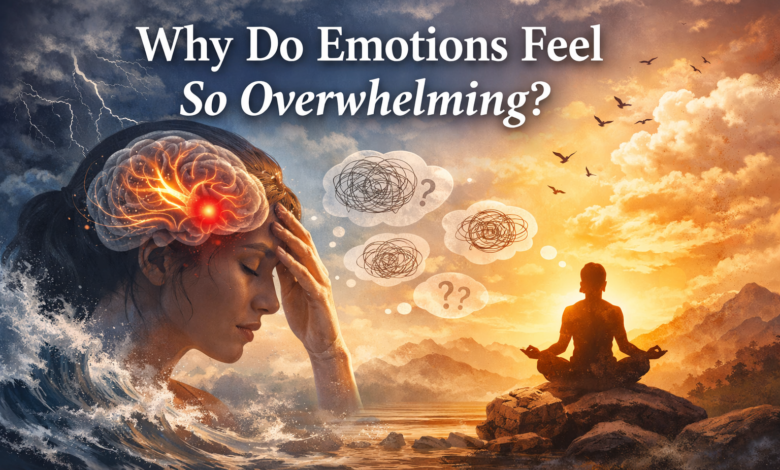
Many people search to understand why emotions feel overwhelming, but psychology shows that the real cause is often emotional suffering and resistance to reality, and learning emotional acceptance and accepting reality psychology is the first step in understanding how to stop fighting emotions and calming the nervous system.
Thank you for reading this post, don't forget to subscribe!“Emotions do not overwhelm us because they are strong — they overwhelm us because we resist the reality they are trying to show.”
Many people search to understand why emotions feel overwhelming, especially during moments of rejection, loss, or uncertainty. In reality, emotional intensity rarely comes only from the event itself. It often arises from emotional suffering and resistance that occur when the mind struggles to accept reality.
Psychology shows that emotions naturally rise and fall when the nervous system processes an experience. However, when individuals resist or replay the experience repeatedly, emotional intensity increases. This is why emotional acceptance, accepting reality psychology, and learning how to stop fighting emotions become essential tools for emotional stability.
Spiritual teachings describe a similar principle. The Bhagavad Gita explains that emotional experiences such as pleasure and pain are temporary sensations that arise and pass with time (Bhagavad Gita 2.14). Modern neuroscience echoes this insight, showing that emotions dissipate when they are not repeatedly reactivated by rumination (Siegel, 2010).
Why Do Emotions Feel Overwhelming in Everyday Life?
Many emotional reactions feel stronger than the situation appears to justify.
Examples include:
A small disagreement feeling like rejection
A delayed response feeling like abandonment
A mistake feeling like personal failure
When these reactions occur, people begin asking why emotions feel overwhelming even when the situation seems manageable.
The answer often lies in the interaction between the nervous system and the mind.
The Nervous System Reacts Before Logic – Why Do Emotions Feel So Overwhelming?
The brain processes emotional threat rapidly.
When an emotionally significant event occurs:
The amygdala detects potential danger
Stress hormones such as cortisol and adrenaline increase
The body prepares for defensive response
This reaction occurs before conscious reasoning begins.
Because of this rapid activation, emotions can feel intense even when the situation itself is not dangerous.
Emotional Suffering and Resistance
Understanding emotional suffering and resistance is central to explaining why emotions feel overwhelming.
The First Wave — Emotion
The first emotional wave is natural.
For example:
sadness after rejection
anger after betrayal
fear after uncertainty
These emotions are part of the human emotional system.
The Second Wave — Resistance
The second wave occurs when the mind resists the emotional experience.
Common internal reactions include:
“I should not feel this way.”
“Why is this happening to me?”
“I must stop feeling this immediately.”
This internal conflict creates emotional suffering and resistance, which prolongs emotional distress.
Psychological research shows that resisting emotional experience often increases physiological stress rather than reducing it (Gross, 1998).
Please Explore This Blog spiritual-awakening-after-suffering-ego-collapse
Personal Experience — When Reality Is Clear but Emotion Resists
A moment from my life illustrates how emotional resistance develops.
Someone I loved once told me very clearly:
“I cannot marry you. If I must choose between my family and you, I will choose my family.”
The statement was direct.
The reality was visible.
Yet emotionally, I was not ready to accept it.
Instead of practicing emotional acceptance, I believed I could change the situation.
I thought:
Maybe I can convince him
Maybe he will change his mind
Maybe if I try harder things will be different
This pattern is extremely common in relationships, business decisions, and life goals.
Even when reality is clear, people often continue trying to change it because accepting the truth feels painful.
Hope vs Emotional Resistance – Why Do Emotions Feel So Overwhelming?
Hope can be healthy. However, hope becomes emotional resistance when we attempt to force reality to change. When resistance continues for too long, emotional exhaustion develops.
The nervous system remains activated, and the mind repeatedly revisits the same event. This cycle explains why emotions feel overwhelming in many situations.
The Psychology of Accepting Reality – Why Do Emotions Feel So Overwhelming?
Learning accepting reality psychology changes the emotional experience significantly.
Acceptance Reduces Emotional Pressure
When reality is accepted, the internal struggle ends. The situation itself may not change. However, the relationship with the situation changes.
Before acceptance:
Mind is fighting reality
Body remains tense
Emotions stay activated
After acceptance:
Mind becomes clearer
Body relaxes
emotional intensity decreases
This is why emotional acceptance is a powerful psychological tool.
Why the Mind Keeps Replaying Painful Experiences
Another major reason why emotions feel overwhelming is rumination.
Rumination Renews Emotional Activation
When the mind repeatedly replays a painful event:
the nervous system reacts again
stress hormones increase again
emotional intensity returns
In effect, the body experiences the same emotional event multiple times. Research in affective neuroscience shows that recalling emotional memories can activate similar neural pathways as experiencing the event itself (LeDoux, 1996).
Reflection vs Rumination – Why Do Emotions Feel So Overwhelming?
It is important to distinguish between reflection and rumination.
Reflection seeks understanding.
Rumination seeks control.
When people repeatedly analyze events that cannot be changed, emotional distress increases.
Learning how to stop fighting emotions includes recognizing when reflection has become rumination.
Emotional Acceptance as a Psychological Skill
Developing emotional acceptance allows individuals to process emotions without creating additional resistance.
What Emotional Acceptance Means
Emotional acceptance does not mean:
approving harmful behavior
ignoring injustice
suppressing emotion
Instead, it means acknowledging emotional experience without fighting it.
How to Stop Fighting Emotions – Why Do Emotions Feel So Overwhelming?
Simple practices help reduce resistance:
observing emotional sensations without judgment
slowing breathing to calm the nervous system
avoiding immediate reaction during emotional intensity
allowing emotional waves to pass naturally
These practices align with accepting reality psychology, which teaches that reality must be acknowledged before it can be addressed effectively.
The Spiritual Perspective — Emotional Attachment
Spiritual teachings also address why emotions feel overwhelming.
In the Bhagavad Gita, emotional suffering is described as arising from attachment to temporary experiences.
Attachment Creates Emotional Intensity
Attachment often forms around:
identity
expectations
relationships
future plans
When these attachments are threatened, emotional reactions become stronger.
Recognizing attachment helps individuals understand the deeper source of emotional distress.
Please Explore This Blog revenge-vs-justice-is-self-destruction
Key Insight – Why Do Emotions Feel So Overwhelming?
Emotions are temporary.
Resistance makes them persistent.
Understanding this distinction is the foundation of emotional maturity.
When individuals develop emotional acceptance, practice accepting reality psychology, and learn how to stop fighting emotions, emotional experiences become easier to navigate.
The Neuroscience of Emotional Overwhelm
Understanding why emotions feel overwhelming requires examining how the brain and nervous system process emotional experiences. Emotional reactions are not purely psychological events; they are biological responses shaped by neural circuits, hormones, and learned cognitive patterns.
When emotional triggers appear, the body responds through a complex network involving the amygdala, stress hormones, autonomic nervous system, and cognitive rumination loops. These biological mechanisms explain why emotional experiences can feel intense even when the rational mind understands the situation.
Learning emotional acceptance and practicing accepting reality psychology becomes easier when individuals understand that emotional overwhelm is not simply weakness. It is often the result of a nervous system reacting faster than conscious reasoning.
The Amygdala — The Brain’s Emotional Alarm System
The amygdala is a small structure deep within the brain that detects emotional threats. Its primary function is survival: identifying potential danger and preparing the body for rapid response.
When emotionally significant events occur, the amygdala activates within milliseconds. This reaction happens before conscious thinking begins.
How the Amygdala Triggers Emotional Intensity
When the amygdala detects perceived threat:
Heart rate increases
Breathing becomes shallow
Stress hormones release
Attention narrows toward the perceived danger
This rapid activation explains why people often feel intense emotional reactions before they have time to logically interpret the situation.
For example: Why Do Emotions Feel So Overwhelming?
A rejection in a relationship may trigger the same neural alarm as physical danger. Even though the situation is social rather than life-threatening, the nervous system interprets it as a potential threat to identity or belonging.
This biological reaction contributes to why emotions feel overwhelming, especially when the mind begins resisting the emotional experience.
Cortisol and Adrenaline — Stress Hormones and Emotional Intensity
When the amygdala signals threat, the hypothalamus activates the stress response system, releasing hormones such as cortisol and adrenaline.
These hormones prepare the body for survival responses such as fight, flight, or freeze.
What Cortisol Does During Emotional Stress
Cortisol increases:
blood sugar for energy
alertness and vigilance
emotional reactivity
While cortisol is useful during real danger, prolonged emotional stress keeps the body in a heightened state of activation.
This state can produce symptoms such as:
emotional sensitivity
difficulty concentrating
irritability
fatigue after emotional conflict
When cortisol remains elevated, emotional experiences feel more intense than they normally would. This biological stress loop contributes significantly to emotional suffering and resistance.
Please Explore This Blog what-is-maya-in-real-life-ego-create-hidden-suffering
The Autonomic Nervous System and Emotional Regulation
The autonomic nervous system regulates how the body responds to stress.
It has two major branches:
Sympathetic Nervous System — Activation
The sympathetic system prepares the body for action.
During emotional stress, it causes:
increased heart rate
muscle tension
heightened alertness
emotional urgency
This state makes emotional reactions feel immediate and powerful.
Parasympathetic Nervous System — Regulation
The parasympathetic system restores calm after stress.
It slows:
breathing
heart rate
muscle tension
Practices such as slow breathing, grounding, and reflection activate this system. These techniques support emotional acceptance and reduce the internal pressure created by emotional suffering and resistance.
Understanding this balance helps explain how to stop fighting emotions by calming the nervous system rather than trying to suppress feelings directly.
Rumination Loops — When Thoughts Keep Emotions Alive
Another major factor behind why emotions feel overwhelming is rumination.
Rumination occurs when the mind repeatedly revisits an emotional event.
How Rumination Extends Emotional Stress
When a person replays a painful event repeatedly:
the brain reactivates the emotional memory
the amygdala signals threat again
stress hormones release again
In effect, the nervous system experiences the event multiple times.
Neuroscientist Joseph LeDoux demonstrated that recalling emotional memories can activate the same neural circuits involved in the original experience (LeDoux, 1996).
This explains why emotional suffering and resistance can persist long after the event has passed.
Reflection vs Rumination – Why Do Emotions Feel So Overwhelming?
Reflection is constructive thinking.
Rumination is repetitive thinking.
Reflection asks:
“What can I learn from this?”
Rumination asks:
“Why did this happen to me?”
Learning how to stop fighting emotions includes recognizing when reflection has become rumination.
Accepting Reality Psychology and Nervous System Recovery
One of the most effective methods for calming emotional overwhelm is accepting reality psychology.
Acceptance interrupts the cycle of resistance.
What Emotional Acceptance Does to the Brain
When individuals practice emotional acceptance:
the amygdala becomes less reactive
cortisol levels decrease
the parasympathetic nervous system activates
emotional intensity gradually reduces
Instead of trying to eliminate emotions immediately, acceptance allows the nervous system to process the experience naturally.
Research in mindfulness and emotional regulation shows that acknowledging emotional experiences without judgment can reduce amygdala activation and improve emotional recovery (Siegel, 2010).
This is why emotional acceptance is not weakness—it is a biological regulation strategy.
Thought Patterns, Attachment, and the Super Maya Framework
Understanding why emotions feel overwhelming requires looking beyond biology and examining how thought patterns and attachment shape emotional experience.
While the brain and nervous system create the first emotional reaction, it is the mind’s interpretation that often prolongs emotional intensity.
When people resist reality or attach identity to emotional experiences, emotional suffering and resistance increase.
This pattern is why many individuals continue feeling distress long after the original event has passed. Developing emotional acceptance and practicing accepting reality psychology helps interrupt these cycles and teaches people how to stop fighting emotions in a healthier way.
Please Explore This Blog pet-loss-grief-why-losing-a-pet-hurts-so-much
Thought Patterns That Amplify Emotional Intensity
Human thoughts naturally attempt to interpret emotional events. However, certain patterns make emotional reactions stronger than necessary.
Catastrophic Thinking -Why Do Emotions Feel So Overwhelming?
Catastrophic thinking occurs when the mind assumes the worst possible outcome.
Examples include:
“This rejection means my life is ruined.”
“This mistake proves I will never succeed.”
“If this relationship ends, I will never find love again.”
These thoughts intensify distress and contribute to why emotions feel overwhelming. Instead of observing the emotional experience, the mind begins building dramatic narratives around it.
Practicing emotional acceptance allows individuals to recognize the emotion without turning it into a permanent life story.
Personalization – Why Do Emotions Feel So Overwhelming?
Personalization occurs when people interpret events as reflections of their identity.
For example:
- A disagreement becomes:
- “I am not good enough.”
- A business setback becomes:
- “I am a failure.”
This pattern fuses identity with temporary circumstances, creating deeper emotional distress.
Learning how to stop fighting emotions includes separating identity from experience. Emotions may reflect circumstances, but they do not define personal worth.
Attachment — The Hidden Driver of Emotional Pain
Attachment is one of the most powerful forces influencing emotional experience. When individuals attach their sense of security or identity to specific outcomes, emotional reactions become stronger.
Attachment may form around:
- relationships
- social approval
- career success
- personal expectations
- imagined futures
When these attachments are threatened, emotional intensity increases.
This is one of the core reasons why emotions feel overwhelming.
Attachment to Expected Outcomes – Why Do Emotions Feel So Overwhelming?
People often create detailed internal visions of how life should unfold.
For example:
- a relationship must lead to marriage
- a business must succeed after effort
- a specific career path must work
When reality diverges from these expectations, emotional resistance appears.
Instead of practicing accepting reality psychology, individuals attempt to force reality to match the imagined outcome. This conflict produces emotional suffering and resistance.
The Super Maya Insight – Why Do Emotions Feel So Overwhelming?
Your Super Maya philosophy provides a powerful explanation for emotional suffering.
Definition of Maya
Maya can be understood simply as:
Unconscious attachment that increases suffering.
Emotion itself is not Maya.
Attachment to emotional interpretation is Maya.
For example:
- Feeling anger = natural emotion.
- Believing anger defines your identity = attachment.
- Feeling sadness = human experience.
- Believing sadness will never end = Maya.
Understanding this distinction helps individuals practice emotional acceptance while avoiding unnecessary suffering.
Please Explore This Blog 3-gunas-and-personality-mental-health
Emotional Overreaction as a Signal of Attachment
When emotional reactions become extremely intense, it often indicates that an attachment has been threatened.
Emotional Signals
Overwhelming emotional responses often signal attachment to:
- validation
- belonging
- control
- identity
- expectation
When these attachments weaken, emotional stability increases.
This insight aligns with both psychology and spiritual philosophy. Recognizing attachment does not eliminate emotion immediately, but it reduces emotional suffering and resistance.
Why Fighting Emotions Makes Them Stronger
One of the paradoxes of emotional experience is that resisting emotion often strengthens it.
When individuals try to suppress emotions, the mind becomes more focused on the feeling.
Psychologists sometimes call this the rebound effect.
For example:
Trying not to think about something often causes the mind to think about it more frequently.
Similarly, trying to eliminate emotions immediately often intensifies them.
Learning how to stop fighting emotions involves allowing emotions to exist temporarily without interpreting them as permanent truths.
Emotional Acceptance as a Path to Clarity
Emotional acceptance does not mean approving every situation or abandoning personal growth.
Instead, it means acknowledging emotional reality before attempting to change external circumstances.
Emotional Acceptance in Practice – Why Do Emotions Feel So Overwhelming?
Practicing emotional acceptance includes:
- observing emotional reactions without judgment
- allowing emotional waves to pass naturally
- recognizing when thought patterns amplify distress
- separating identity from emotional experience
These practices support accepting reality psychology, which teaches that emotional clarity often emerges after resistance ends.
The Psychological Turning Point
When individuals understand why emotions feel overwhelming, a significant shift occurs.
Instead of trying to eliminate emotional experiences, they begin observing them.
This shift creates several benefits:
- emotional reactions shorten in duration
- rumination decreases
- clarity improves
- decision-making becomes calmer
Over time, practicing emotional acceptance weakens patterns of emotional suffering and resistance, allowing individuals to navigate emotional experiences more skillfully.
Spiritual Integration: Bhagavad Gita, Detachment, and Emotional Stability
Modern psychology explains the biological and cognitive reasons why emotions feel overwhelming, but spiritual traditions explored emotional suffering thousands of years ago. Ancient wisdom texts such as the Bhagavad Gita describe emotional distress as a result of attachment to temporary experiences.
In spiritual philosophy, emotional pain does not arise simply from events themselves but from the mind’s attachment to outcomes, identity, and expectations. This insight closely mirrors modern psychology’s understanding of emotional suffering and resistance.
Learning emotional acceptance, practicing accepting reality psychology, and understanding how to stop fighting emotions therefore align not only with neuroscience but also with spiritual teachings about awareness and detachment.
Please Explore This Blog ego-dissolution-and-inner-clarity-emotionally-free
Emotional Turbulence in the Bhagavad Gita
The Bhagavad Gita describes emotional reactions such as pleasure, pain, joy, and sorrow as temporary states that naturally arise and fade.
A well-known verse explains this principle:
“Contact with material experiences produces heat and cold, pleasure and pain. These experiences come and go; they are temporary.”
— Bhagavad Gita 2.14
This teaching suggests that emotional experiences are not permanent realities but passing sensations. When individuals attach identity to these experiences, emotional intensity increases.
Understanding this principle helps explain why emotions feel overwhelming. The mind interprets temporary emotional states as permanent truths.
Spiritual awareness teaches individuals to observe emotional experiences rather than becoming consumed by them.
Detachment Is Not Emotional Suppression – Why Do Emotions Feel So Overwhelming?
A common misunderstanding is that spiritual detachment means ignoring emotions.
In reality, detachment means observing emotions without becoming controlled by them.
Emotional Suppression
Suppression involves pushing emotions away.
Examples include:
- pretending not to feel sadness
- avoiding emotional experiences
- denying internal reactions
Suppression often increases emotional suffering and resistance because the mind continues fighting the emotional state.
Spiritual Detachment – Why Do Emotions Feel So Overwhelming?
Detachment involves awareness without attachment.
For example:
Feeling sadness → acknowledging the emotion
Recognizing sadness → temporary emotional experience
Detachment allows emotional experience without defining identity through that experience.
This perspective naturally supports emotional acceptance.
Karma Yoga and Emotional Balance – Why Do Emotions Feel So Overwhelming?
Another central teaching of the Bhagavad Gita is Karma Yoga, the practice of acting fully while remaining unattached to outcomes.
The Gita advises:
“You have the right to perform your duty, but you are not entitled to the fruits of your actions.”
— Bhagavad Gita 2.47
This teaching addresses a major cause of emotional overwhelm: attachment to results.
People often become emotionally distressed when outcomes do not match expectations. This attachment strengthens emotional suffering and resistance.
Practicing Karma Yoga encourages individuals to focus on effort and responsibility rather than obsessing over results.
This mindset supports accepting reality psychology, which recognizes that external outcomes cannot always be controlled.
The Spiritual Psychology of Emotional Attachment
Spiritual traditions describe attachment as a mental state where individuals bind their identity to temporary conditions.
Attachment may appear in forms such as:
- desire for approval
- fear of rejection
- attachment to success
- attachment to personal identity
When these attachments become threatened, emotional intensity increases.
This process explains why emotions feel overwhelming during moments of rejection, failure, or unexpected change.
Recognizing attachment helps individuals develop awareness and reduce emotional reactivity.
Awareness Weakens the Power of Maya – Why Do Emotions Feel So Overwhelming?
Your Super Maya insight explains this process clearly.
Maya can be understood as:
- Unconscious attachment that increases suffering.
- Emotion itself is not the problem.
- Attachment to emotional interpretation creates suffering.
For example:
Feeling disappointment = natural emotional response
Believing disappointment defines life = Maya
When awareness increases, attachment weakens. As attachment weakens, emotional suffering and resistance gradually decrease.
This awareness naturally supports emotional acceptance and teaches individuals how to stop fighting emotions.
Spiritual Awareness and Nervous System Stability
Spiritual practices often calm the nervous system in ways similar to psychological regulation techniques.
Practices such as:
- meditation
- prayer
- reflective journaling
- conscious breathing
activate the parasympathetic nervous system and reduce stress hormone activity. These practices therefore support emotional regulation both psychologically and biologically. Spiritual awareness does not eliminate emotional experience, but it changes the relationship with emotion.
Instead of reacting automatically, individuals begin observing emotional patterns with greater clarity.
Please Explore This Blog trust-issues-causes-modern-world
Emotional Stability Through Awareness – Why Do Emotions Feel So Overwhelming?
When spiritual awareness and psychological understanding combine, emotional experiences become easier to navigate.
Several changes often occur:
- emotional reactions become shorter
- rumination decreases
- acceptance becomes easier
- identity becomes less dependent on temporary circumstances
Understanding why emotions feel overwhelming therefore becomes a pathway to emotional maturity rather than a sign of weakness.
Through emotional acceptance, accepting reality psychology, and spiritual awareness, individuals gradually learn how to stop fighting emotions and develop greater emotional stability.
Practical Emotional Regulation and Final Insight – Why Do Emotions Feel So Overwhelming?
Understanding why emotions feel overwhelming often begins with recognizing the role of emotional suffering and resistance. When the mind fights reality, emotional intensity increases. Practicing emotional acceptance allows individuals to observe emotions without judgment and reduces the urge to react immediately.
According to accepting reality psychology, emotional clarity develops when people acknowledge situations instead of arguing with them.
Learning how to stop fighting emotions helps calm the nervous system and prevents rumination loops.
Simple practices such as conscious breathing, pausing before reacting, and allowing emotional waves to pass naturally strengthen emotional acceptance, gradually transforming overwhelming feelings into emotional awareness and psychological stability.
⭐ Frequently Asked Questions – Why Do Emotions Feel So Overwhelming?
1. Why do my emotions feel so overwhelming all the time?
Emotions feel overwhelming when the brain’s threat system activates the amygdala and releases stress hormones like cortisol. This response increases emotional intensity and alertness. When emotional suffering and resistance are added through rumination or overthinking, the nervous system stays activated longer, making emotions feel stronger.
2. Why do small situations make me feel emotionally overwhelmed?
Small situations can trigger emotional overwhelm when they connect to deeper emotional memories or expectations. The brain interprets the event as a meaningful threat, activating stress responses. Practicing emotional acceptance and understanding accepting reality psychology can help reduce emotional intensity.
3. How do I stop feeling emotionally overwhelmed quickly?
To reduce emotional overwhelm, pause and slow your breathing to calm the nervous system. Observing your emotions without judgment helps interrupt rumination loops. Learning how to stop fighting emotions allows the brain to process feelings naturally instead of amplifying them.
4. What causes emotional overwhelm in the brain?
Emotional overwhelm occurs when the amygdala, the brain’s emotional alarm system, detects stress or perceived threat. It triggers hormones like cortisol and adrenaline, increasing emotional sensitivity. When rumination continues, this cycle explains why emotions feel overwhelming.
5. Why do I cry easily when I feel overwhelmed?
Crying is a natural emotional release that helps regulate stress hormones. When emotional intensity builds up, the body uses crying to release tension and restore balance. Practicing emotional acceptance allows the nervous system to process these emotions more effectively.
6. Is emotional overwhelm a sign of anxiety or stress?
Emotional overwhelm can be related to anxiety, stress, or nervous system activation. When the brain perceives emotional pressure or uncertainty, stress responses increase. Understanding emotional suffering and resistance and practicing emotional regulation techniques can reduce this intensity.
Please Explore This Blog ego-dissolution-and-spiritual-transformation
⭐ Reading References – Why Do Emotions Feel So Overwhelming?
1. Emotional Regulation Research
James J. Gross – Emotion Regulation in Psychology
Explains how emotional suppression and acceptance affect emotional intensity.
https://www.apa.org/monitor/2014/02/emotion-regulation
2. Neuroscience of Emotion (Amygdala & Fear Processing)
Joseph LeDoux – The Emotional Brain
Research explaining how the amygdala processes emotional threats and triggers stress responses.
https://www.ncbi.nlm.nih.gov/pmc/articles/PMC3181984/
3. Mindfulness and Emotional Regulation
Daniel J. Siegel – The Mindful Brain
Explores how awareness and mindfulness calm the nervous system and reduce emotional reactivity.
https://mindsightinstitute.com/resources/the-mindful-brain/
4. Stress Hormones and the Nervous System
Harvard Medical School – Understanding the Stress Response
https://www.health.harvard.edu/staying-healthy/understanding-the-stress-response
5. Rumination and Emotional Distress
American Psychological Association – Rumination and Emotional Health
https://dictionary.apa.org/rumination
6. Emotional Acceptance and Psychological Flexibility
Acceptance and Commitment Therapy (ACT) Research
https://contextualscience.org/act
7. Nervous System Regulation and Emotional Awareness
Polyvagal Theory – Stephen Porges
https://www.polyvagalinstitute.org/
8. Mindfulness and Emotional Processing
Greater Good Science Center – Mindfulness & Emotions
https://greatergood.berkeley.edu/topic/mindfulness
9. Bhagavad Gita – Spiritual Understanding of Emotion
Bhagavad Gita (Chapter 2, Verse 14)
Explains that pleasure and pain are temporary experiences.
https://www.holy-bhagavad-gita.org/chapter/2/verse/14
10. Karma Yoga and Detachment
Bhagavad Gita (Chapter 2, Verse 47)
Describes acting without attachment to outcomes.
https://www.holy-bhagavad-gita.org/chapter/2/verse/47