Covert Narcissism Examples in Everyday Life
How Hidden Narcissism Looks in Real Situations

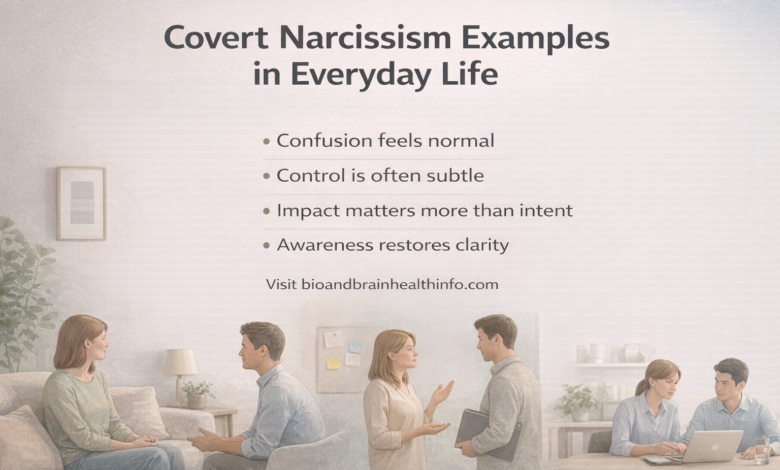
Covert narcissism examples are often misunderstood because covert narcissist behavior, subtle narcissism signs, passive aggressive narcissism, and hidden control tactics can appear ordinary rather than harmful.
Thank you for reading this post, don't forget to subscribe!What confuses most people isn’t cruelty — it’s how normal everything looked while something felt off.
The harm was quiet, but the impact lingered.
Even after leaving, the nervous system can stay on alert because it learned unpredictability as normal. Regulation returns through consistency, not force.
Covert Narcissism Examples in Everyday Life
Many people searching for covert narcissism examples are not trying to analyze someone else — they are trying to understand themselves.
The fear underneath is often simple and unsettling: Why do I still feel uneasy if nothing “obvious” happened?
Everyday situations involving covert narcissist behavior, subtle narcissism signs, passive aggressive narcissism, and hidden control tactics can blur reality slowly, making self-doubt feel personal.
What’s often misunderstood is the difference between trauma responses and identity.
Confusion, hesitation, or emotional shrinking are not flaws — they are protective responses to unclear relational signals.
When experiences don’t match visible harm, the mind turns inward for answers. That inward turn can feel like losing yourself, when it is actually adaptation.
This article will help you understand what’s happening — without labels, blame, or self-attack.
REASON FOR THIS BLOG
To help readers recognize everyday relational patterns that create confusion, and to separate trauma-based reactions from identity — without judgment, diagnosis, or pressure to define anyone.
Please Explore This Blog emotional-neglect-narcissistic-mother
INNER SEARCH MIRROR
You might be here because you’re quietly wondering:
Why did nothing feel “clear”?
Why do I replay conversations?
Why do I doubt small reactions?
Why did it feel subtle but heavy?
Why do I feel tense around calm people?
Why does clarity come late?
Why do examples resonate so deeply?
If these questions feel familiar, you’re not imagining things.
PSYCHOLOGICAL EXPLANATION –Covert Narcissism Examples
Psychologically, covert narcissism examples often feel confusing because the mind adapts to inconsistency rather than overt harm.
In situations involving covert narcissist behavior, subtle narcissism signs, passive aggressive narcissism, and hidden control tactics, intent is rarely obvious.
The psyche responds by monitoring tone, timing, and emotional shifts to reduce uncertainty. This is survival conditioning, not personality change.
Over time, self-questioning replaces trust because ambiguity trains the mind to scan for meaning.
Intent and reaction must be separated here: one may be unconscious, the other protective.
Understanding adaptation helps remove self-blame without assigning fault.
| Response | Purpose |
|---|---|
| Overthinking | Meaning-seeking |
| Self-doubt | Risk reduction |
| Caution | Emotional safety |
| Withdrawal | Self-protection |
Personal note: Naming adaptation eased my self-criticism.
NERVOUS SYSTEM EXPLANATION- Covert Narcissism Examples
From a biological view, covert narcissism examples activate the nervous system before conscious thought.
In environments shaped by covert narcissist behavior, subtle narcissism signs, passive aggressive narcissism, and hidden control tactics, the body learns to anticipate emotional shifts.
Fight, flight, or freeze responses occur automatically to preserve safety, not to judge reality accurately. This is why reactions can persist after distance — the body learned unpredictability.
These responses are reflexive, not chosen, and they soften as safety becomes consistent.
Common warning signs include:
Sudden tension
Emotional scanning
Delayed responses
Shallow breathing
Mental fatigue
Personal note: Understanding the body reduced my need for explanations.
Please Explore This Blog trauma-bonding-narcissistic-mother
CORE DISTINCTION
Identity vs Survival Responses
This distinction anchors everything.
Survival responses exist to protect.
They narrow expression, delay trust, and prioritize safety.
Identity remains constant.
It holds values, conscience, empathy, and intention.
In covert narcissism examples, survival strategies are often mistaken for personality traits.
Quiet compliance, emotional withdrawal, or hesitation are not who you are — they are what you did to stay safe. Identity does not disappear under pressure; it waits.
When the environment stabilizes, expression returns naturally.
Authority comes from recognizing this clearly: protection is temporary, identity is enduring. No confrontation is required for this understanding to take hold.
TRAUMA VS NARCISSISM – Covert Narcissism Examples
The deepest fear behind covert narcissism examples is often self-labeling. But motivation matters more than surface behavior.
In situations involving covert narcissist behavior, subtle narcissism signs, passive aggressive narcissism, and hidden control tactics, trauma responses can look confusing from the outside.
The difference is not what someone does, but why they do it.
Motivation-based contrast:
| Trauma Response | Narcissistic Motivation |
|---|---|
| Feels remorse | Lacks remorse |
| Reflects on impact | Avoids reflection |
| Accepts accountability | Deflects responsibility |
| Seeks repair | Protects image |
Trauma protects connection; narcissism protects self-image.
Personal note: Realizing remorse was evidence of health brought relief.
GROWTH DIRECTION – Covert Narcissism Examples
Understanding covert narcissism examples can quietly restore agency when framed gently.
In experiences shaped by covert narcissist behavior, subtle narcissism signs, passive aggressive narcissism, and hidden control tactics, growth does not come from fixing yourself.
It emerges as pressure reduces. Signs of healing are subtle: reactions soften, pauses feel safer, and internal dialogue slows.
Choosing peace often looks like fewer explanations and more trust in simple emotional signals.
This is not improvement through effort, but orientation through steadiness.
Agency returns when urgency fades and space is allowed for natural recalibration.
Personal note: I noticed healing when slowing down stopped feeling unsafe.
HEALING COMPASS / ORIENTATION TABLE
This compass is not a checklist — it’s a stabilizing map.
| Stage | Grounding Affirmation |
|---|---|
| Awareness | “This reaction has a reason.” |
| Safety | “My system can settle.” |
| Understanding | “Confusion does not define me.” |
| Recovery | “Choice returns with calm.” |
| Protection | “I honor limits quietly.” |
Each stage supports the next. There is no rush between them. Stability forms when insight aligns with safety, and clarity grows when self-trust is allowed to return naturally.
1. Why Everyday Confusion Is the First Signal
Many people notice covert narcissism examples not through obvious harm, but through persistent confusion that does not resolve.
Covert narcissist behavior often blends into normal interactions, while subtle narcissism signs appear as emotional inconsistencies rather than clear actions.
Over time, passive aggressive narcissism introduces doubt indirectly, and hidden control tactics operate through silence, withdrawal, or emotional ambiguity.
The breakthrough here is recognizing that confusion itself carries information. When clarity is repeatedly delayed, the mind adapts by questioning itself.
This response is protective rather than flawed. Understanding confusion as a signal allows self-trust to begin returning without confrontation or labeling.
Please Explore This Blog inner-child-wounds-narcissistic-mother
2. Motivation Matters More Than What Is Visible
What makes covert narcissism examples destabilizing is that covert narcissist behavior often lacks obvious intent.
Subtle narcissism signs can resemble sensitivity or restraint, while passive aggressive narcissism hides impact behind politeness or delay.
Hidden control tactics rarely announce themselves; they shape emotional outcomes quietly. The core breakthrough is learning to focus on motivation rather than surface appearance.
When patterns consistently avoid accountability or redirect responsibility, the nervous system responds by becoming vigilant.
This vigilance is not judgment. It is self-protection forming in response to repeated ambiguity.
3: Self-Doubt Is a Learned Response, Not a Trait
Repeated exposure to covert narcissism examples can gradually train self-doubt. Covert narcissist behavior often creates situations where emotional reactions are questioned or minimized.
Subtle narcissism signs may invalidate experience indirectly, while passive aggressive narcissism erodes confidence through inconsistency.
Over time, hidden control tactics teach the mind to second-guess before trusting itself. This breakthrough reframes self-doubt as learned conditioning rather than personality.
The mind adapts to survive unclear environments by monitoring itself more closely.
When this is understood, self-attack softens naturally.
4: Quiet Harm Does Not Require Loud Proof
One reason covert narcissism examples linger is the absence of dramatic evidence. Covert narcissist behavior often avoids confrontation, while subtle narcissism signs operate through implication rather than statement.
Passive aggressive narcissism delivers impact without ownership, and hidden control tactics leave no clear event to reference.
The breakthrough here is recognizing that harm does not need to be loud to be real.
Repeated emotional disorientation alone can affect trust and safety. Lived impact matters even when it is difficult to explain.
5: Healing Begins When Pressure to Decide Ends
Many people studying covert narcissism examples feel pressure to define or conclude quickly.
Yet covert narcissist behavior often thrives under rushed interpretation.
Subtle narcissism signs become clearer when space replaces urgency, while passive aggressive narcissism loses influence as reactivity slows.
Hidden control tactics weaken when attention shifts from constant analysis to steadiness.
The final breakthrough is understanding that healing does not require decisions. It requires safety.
As pressure eases, perception sharpens on its own, and clarity returns without force.
Closing note
Clarity does not come from proving what happened. It comes from trusting what your system learned while protecting you.
Please Explore This Blog preparing-to-leave-abusive-partner
Medical / Ethical Positioning — Covert Narcissism Examples
From a medical and ethical standpoint, covert narcissism examples raise questions about interpretation, not diagnosis.
When covert narcissist behavior is discussed outside context, the mind may convert uncertainty into self-blame.
Ethically, education should clarify patterns without assigning pathology.
The mind seeks meaning when threat feels ambiguous, and without ethical framing, language itself can become harmful.
A whole-system approach prioritizes transparency, avoids labels, and protects dignity by explaining experiences rather than defining people.
| Ethical Focus | What It Protects |
|---|---|
| Context | Meaning accuracy |
| Language | Psychological safety |
| Education | Informed understanding |
| Boundaries | Non-pathologizing care |
Personal note: Ethical clarity reduced my urge to label experiences.
Psychological Layer — Covert Narcissism Examples
Psychologically, covert narcissism examples often challenge how the mind interprets mixed emotional signals.
Subtle narcissism signs can disrupt meaning-making because they lack clear cause-and-effect. The psyche responds by revisiting conversations, tones, and intentions in search of coherence.
This is not obsession; it is the mind attempting to restore predictability. When meaning feels unstable, self-questioning increases.
Understanding this layer reframes confusion as a cognitive response to ambiguity rather than a personal weakness.
| Mental Process | Purpose |
|---|---|
| Meaning-seeking | Restore clarity |
| Replay | Detect patterns |
| Doubt | Reduce risk |
| Withdrawal | Regain control |
Personal note: Seeing confusion as meaning-seeking softened self-criticism.
Nervous System Layer — Covert Narcissism Examples
At the nervous system level, covert narcissism examples activate automatic protection. Passive aggressive narcissism often produces unclear emotional cues, prompting the body to stay alert.
Before conscious thought, the body tightens, attention narrows, and energy is conserved.
These reactions are not chosen; they are reflexive safety responses.
The body reacts to unpredictability faster than the mind can explain it. This layer explains why calm can feel unfamiliar even after distance.
| Body Signal | Protective Role |
|---|---|
| Muscle tension | Readiness |
| Shallow breath | Alertness |
| Scanning | Threat detection |
| Fatigue | Energy preservation |
Personal note: Body awareness explained reactions words could not.
Mental Health Layer — Covert Narcissism Examples
From a mental health perspective, covert narcissism examples can affect clarity over time. Hidden control tactics create prolonged cognitive strain, which quietly drains energy and confidence.
Decision-making may feel heavier, focus less stable, and self-trust inconsistent. These effects reflect sustained stress rather than personality change.
Mental health improves not through answers, but through reduced load.
As pressure eases, clarity and internal trust gradually return.
| Prolonged Effect | Inner Experience |
|---|---|
| Cognitive load | Mental fatigue |
| Vigilance | Reduced focus |
| Stress carryover | Low energy |
| Doubt | Weakened trust |
Personal note: Rest restored clarity faster than analysis.
Please Explore This Blog exit-plan-narcissistic-abuse
Identity Layer (Inner Continuity & Meaning) — Covert Narcissism Examples
Identity remains intact beneath survival responses, even within covert narcissism examples. When covert narcissist behavior is present, expression may shrink, but values do not disappear.
Conscience, empathy, and moral orientation persist quietly beneath adaptation. Identity is revealed through consistency over time, not reactions under pressure.
This layer anchors meaning by separating who a person is from how they protect themselves.
| Identity Marker | What Persists |
|---|---|
| Values | Moral compass |
| Conscience | Capacity for care |
| Meaning | Inner continuity |
| Choice | Returns with safety |
Personal note: Identity felt clearer when pressure eased.
Reflective Support Layer (Including AI) — Covert Narcissism Examples
Reflective supports help process covert narcissism examples without directing conclusions.
Subtle narcissism signs can be explored safely through journaling, conversation, or AI as mirrors rather than authorities.
These tools reflect language and patterns back to the individual, allowing meaning to organize without pressure.
Reflection externalizes thought, reduces isolation, and preserves agency by not telling the person what to decide.
| Tool | Reflective Function |
|---|---|
| Journaling | Externalize thought |
| Conversation | Normalize experience |
| AI | Mirror language |
| Silence | Integrate insight |
Personal note: Reflection helped me hear myself clearly.
Integration Layer (Stability Over Resolution) — Covert Narcissism Examples
Integration is where covert narcissism examples settle without forcing resolution. Hidden control tactics lose influence when insight, body signals, and values stop competing.
Integration does not demand certainty; it allows understanding to coexist with unanswered questions. Stability emerges as internal systems align, reducing friction and urgency.
This layer represents internal agreement rather than conclusion.
| Integrated Element | Stabilizing Effect |
|---|---|
| Insight | Reduced conflict |
| Body cues | Trusted signals |
| Values | Consistent meaning |
| Pace | Natural slowing |
Personal note: Integration felt like relief, not certainty.
Please Explore This Blog covert-narcissism-dsm-diagnosis-clarity
PERSONAL NOTE — Covert Narcissism Examples
When I first tried to make sense of covert narcissism examples, what stood out was how easily language can turn inward.
I noticed how covert narcissist behavior, when described without context, can quietly push people to doubt their own intentions. What grounded me was learning to pause before interpretation.
Insight came not from proving patterns, but from noticing my capacity for reflection and accountability.
That capacity told me more about my values than any framework ever could.
Lived authority, I’ve learned, is not about certainty. It’s about staying honest with yourself while refusing to turn confusion into self-judgment.
COSMIC / PHILOSOPHICAL TAKEAWAY — Covert Narcissism Examples
“Meaning does not disappear under pressure; it waits for safety to return.”
When we look at covert narcissism examples through a wider lens, patterns like covert narcissist behavior, subtle narcissism signs, passive aggressive narcissism, and hidden control tactics reflect a deeper human truth: systems under strain seek order.
The mind reaches for stories when signals are mixed, not because it is flawed, but because it is meaning-driven. Philosophy reminds us that identity is not forged in confusion.
It is revealed in stillness. When pressure eases, what remains is often quieter, wiser, and more intact than expected.
FAQ SECTION — CLARITY WITHOUT ALARM
Are covert narcissism examples always intentional?
No. Many patterns emerge without conscious intent.Why do subtle behaviors affect me so deeply?
Because ambiguity strains meaning and safety.Does noticing these patterns mean I am judgmental?
No. Awareness is not accusation.Can passive patterns cause real harm?
Yes. Impact does not require loud behavior.Why do I doubt myself more than others?
Because adaptation often turns inward first.Do I need to label anyone to heal?
No. Understanding does not require naming.Why does clarity come slowly?
Because safety restores perception gradually.Is it normal to feel calmer after reading examples?
Yes. Recognition often reduces isolation.Will this confusion last forever?
No. Consistency allows the system to settle.
FINAL CLOSING — Covert Narcissism Examples
If covert narcissism examples brought you here, let this be your reassurance.
Confusion does not mean you are broken, and noticing covert narcissist behavior, subtle narcissism signs, passive aggressive narcissism, or hidden control tactics does not require you to reach conclusions today.
Nothing is wrong with you for reacting to mixed signals. The mind and body adapt to protect meaning and safety.
With steadiness and understanding, what adapted can soften again. You are invited to move gently, to choose calm over urgency, and to let clarity return in its own time.
Healing grows where self-attack ends.
🌿 Final Blog Footer — Bio & Brain Health Info
Written by Lex, founder of Bio & Brain Health Info — exploring the intersections of psychology, spirituality, and emotional recovery through calm, trauma-aware understanding.
✨ Insight & Reflection
Healing does not begin when answers arrive — it begins when self-attack stops.
Clarity grows in spaces where safety is restored.
🧠 Learn
Narcissism • Emotional Healing • Spiritual Psychology
🌍 A Moment for You
💡 Pause for two minutes. Let your body settle before moving on.
🧭 If This Article Helped, Your Next Questions Might Be:
These questions are natural continuations — not obligations.
✨ Cosmic Family Invitation
You are not here by accident. If these words reached you, clarity was already beginning.
We rise together — different souls, one journey. 🕊️
📩 Connect with us
info@bioandbrainhealthinfo.com
Telegram: @bioandbrainhealthinfo
WhatsApp Channel: Punehealth
Lex | Bio & Brain Health Info
Cosmic Family — Different Souls, One Journey.