Empath Relationship With Narcissist: Self-Loss
How Empaths Lose Themselves in Narcissistic Dynamics

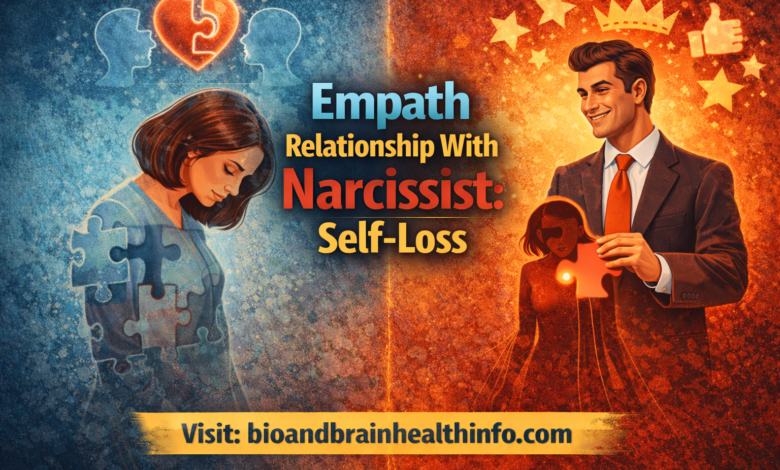
An empath relationship with narcissist dynamics often involves emotional enmeshment, boundary issues, empath burnout, and toxic attachment patterns that many people experience without fully understanding why.
Thank you for reading this post, don't forget to subscribe!“Clarity begins when we stop asking why we stayed and start understanding what we were trying to protect.”
Sometimes what feels like deep connection is actually emotional enmeshment — and understanding this distinction restores self-trust.
“Sometimes the hardest part is not leaving — it is realizing how deeply your nervous system learned to stay ready for unpredictability.
Even after leaving, the nervous system can stay on alert because it learned unpredictability as normal. Regulation returns through consistency, not force.”
🌱 INTRODUCTION -Empath Relationship With Narcissist
An empath relationship with narcissist dynamics often creates emotional enmeshment, boundary issues, empath burnout, and toxic attachment that slowly make people question themselves.
The deeper fear is not just the relationship — it is wondering, “Am I losing myself?”
Many misunderstand these reactions as identity flaws rather than trauma responses shaped by emotional pressure.
You are not broken; your system adapted to survive confusion and intensity.
This article will help you understand what’s happening — without labels, blame, or self-attack.
🧭 REASON FOR THIS BLOG – Empath Relationship With Narcissist
To help readers understand why self-doubt and emotional confusion appear in intense relational dynamics and to separate survival responses from identity — without judgment or diagnosis.
🔎 INNER SEARCH MIRROR – Empath Relationship With Narcissist
You may quietly ask yourself:
Why do I feel responsible for someone else’s emotions?
Why do I doubt myself even after stepping away?
Why did empathy turn into exhaustion?
Why do boundaries feel uncomfortable or selfish?
Why does emotional distance feel unsafe?
Why do I miss connection even when it hurt?
Why does clarity come slowly instead of instantly?
Please Explore This Blog codependent-relationship-with-narcissist-psychology-behind
🧠 PSYCHOLOGICAL EXPLANATION – Empath Relationship With Narcissist
In an empath relationship with narcissist dynamics, emotional enmeshment can develop when empathy meets strong relational intensity.
Boundary issues often arise because the empath learns to prioritize harmony over self-definition, gradually leading to empath burnout and toxic attachment patterns.
This is not weakness; it is adaptation. The mind attempts to maintain connection by adjusting behavior to reduce conflict or uncertainty.
Over time, reactions become conditioned responses rather than conscious choices.
| Situation | Adaptation |
|---|---|
| Emotional unpredictability | Increased people-pleasing |
Personal note: Many people later realize they were trying to keep emotional safety, not lose themselves.
🧬 NERVOUS SYSTEM EXPLANATION – Empath Relationship With Narcissist
In an empath relationship with narcissist patterns, emotional enmeshment and boundary issues are reinforced by nervous system learning.
Repeated unpredictability activates fight, flight, or freeze responses before conscious thought begins, which can contribute to empath burnout and toxic attachment.
The body seeks familiarity, even if it feels draining, because it recognizes learned emotional rhythms.
Possible warning signs:
Hypervigilance in conversations
Sudden shutdown or withdrawal
Over-explaining to avoid conflict
Difficulty relaxing alone
Emotional exhaustion after interaction
Personal note: Many reactions feel automatic because the nervous system acts faster than reasoning.
🧭 CORE DISTINCTION – Empath Relationship With Narcissist
Survival responses exist to protect safety; identity reflects values, character, and conscious choice.
In an empath relationship with narcissist dynamics, emotional enmeshment, boundary issues, empath burnout, and toxic attachment may shape behavior, but they do not define who you are.
Survival adapts quickly to reduce perceived threat or maintain connection, while identity remains steady beneath those reactions.
When people confuse survival patterns with identity, self-blame increases.
Authority and healing begin when you recognize that your reactions were strategies developed under pressure — not permanent traits or personal failure.
🌿TRAUMA VS NARCISSISM – Empath Relationship With Narcissist
In an empath relationship with narcissist dynamics, emotional enmeshment, boundary issues, empath burnout, and toxic attachment can create confusion about identity.
Trauma responses usually involve remorse, reflection, and willingness to change, while narcissistic motivation centers more on protecting self-image.
| Trauma Response | Narcissistic Motivation |
|---|---|
| Self-reflection | Image protection |
| Accountability attempts | Defensiveness |
Personal note: Many fears dissolve when motivation, not behavior, becomes clearer.
🌱 GROWTH DIRECTION – Empath Relationship With Narcissist
In an empath relationship with narcissist patterns, healing from emotional enmeshment, boundary issues, empath burnout, and toxic attachment begins with slowing down rather than forcing change.
Signs of healing may include choosing calm over urgency, noticing personal needs without guilt, and allowing space for clarity to grow gradually.
Personal note: Growth often feels quiet — like returning to yourself without needing to prove anything.
🧭 HEALING COMPASS / ORIENTATION TABLE
Healing moves in stages, offering orientation instead of pressure:
| Stage | Orientation |
|---|---|
| Awareness | “I am noticing patterns.” |
| Stabilizing | “Safety comes before decisions.” |
| Understanding | “My reactions had reasons.” |
| Rebuilding | “Self-trust grows slowly.” |
| Protection | “Boundaries protect energy.” |
This compass helps transform insight into steady movement — allowing healing to unfold at a humane pace rather than through force.
Please Explore This Blog communal-narcissism-explained-helping-behavior-hidden-ego
🌿 10 Signs — Empath Relationship With Narcissist: Self-Loss Patterns
1. Emotional Enmeshment: Losing Emotional Boundaries Slowly
Emotional enmeshment appears when feelings become shared rather than individual. In an empath relationship with narcissist dynamics, emotions may merge unintentionally, making it difficult to know where your experience ends and another person’s expectations begin.
2. Boundary Issues: Saying Yes When Your Body Says No
Boundary issues often develop gradually. You may agree to maintain harmony even when discomfort exists internally. This does not mean weakness; it reflects learned adaptation to avoid conflict or emotional unpredictability.
3. Empath Burnout: Feeling Drained After Connection
Empath burnout can feel like emotional exhaustion without clear cause. Repeated emotional labor may reduce internal energy, leaving confusion about why connection feels heavy instead of nourishing.
4. Toxic Attachment: Difficulty Letting Go Despite Awareness
Toxic attachment may create strong emotional ties even when clarity grows. The nervous system can associate familiarity with safety, making separation emotionally complex rather than simply logical.
5. Empath Relationship With Narcissist: Self-Doubt Becoming Normal
In an empath relationship with narcissist patterns, self-doubt may quietly increase. You may begin questioning your perception or feelings, mistaking survival adaptation for personal failure.
6. Emotional Enmeshment: Over-Responsibility for Others’ Emotions
Emotional enmeshment may lead to feeling responsible for another person’s emotional stability. You might monitor moods closely, believing harmony depends entirely on your response.
7. Boundary Issues: Fear of Being Seen as Selfish
Boundary issues often include guilt when prioritizing personal needs. Choosing rest or space may feel uncomfortable, even when logically necessary for emotional balance.
8. Empath Burnout: Loss of Personal Interests or Identity
Empath burnout can show as fading connection with hobbies, goals, or identity. Attention shifts toward maintaining relationship stability rather than personal growth.
9. Toxic Attachment: Missing Intensity More Than Connection
Toxic attachment sometimes causes longing for emotional intensity rather than genuine safety. The nervous system may interpret strong emotional highs as closeness, even when stability is absent.
10. Empath Relationship With Narcissist: Confusing Survival With Personality
In an empath relationship with narcissist experiences, survival responses can feel like personality traits. Recognizing this distinction helps reduce self-blame and restores clarity about identity versus adaptation.
🌱 Closing Note
These signs are not labels or diagnoses. They describe patterns many people experience while trying to maintain connection and emotional safety. Self-loss is often a survival response — and understanding it gently allows identity and self-trust to return without force.
Please Explore This Blog empathetic-narcissism-when-empathy-becomes-control
🌿 A Whole-System View of the Human Healing Process
🩺 Medical / Ethical Positioning — Empath Relationship With Narcissist Context
Healing requires ethical clarity: in an empath relationship with narcissist dynamics, emotional enmeshment can affect how the mind interprets threat, confusion, and meaning.
Ethical positioning avoids diagnosing individuals and instead focuses on understanding relational impact.
This perspective supports safety, autonomy, and informed self-awareness rather than blame or confrontation.
| Ethical Focus | Meaning |
|---|---|
| Non-diagnostic view | Patterns over labels |
| Consent awareness | Respecting autonomy |
| Harm recognition | Naming impact calmly |
| Safety prioritization | Stability before change |
Personal note: Ethical clarity often restores internal permission to step back gently.
🧠 Psychological Layer — Meaning-Making and Interpretation
Within an empath relationship with narcissist experiences, toxic attachment may shape how meaning is constructed internally.
The mind organizes events into narratives to reduce confusion, sometimes interpreting unpredictability as personal responsibility.
Psychological healing involves revisiting interpretation patterns and allowing new perspectives without rejecting past coping strategies.
| Psychological Process | Effect |
|---|---|
| Meaning formation | Creates coherence |
| Pattern recognition | Builds awareness |
| Emotional attribution | Assigns cause |
| Cognitive reframing | Expands perspective |
Personal note: Insight grows when interpretation shifts from blame to understanding.
🧬 Nervous System Layer — Automatic Protection Responses
In an empath relationship with narcissist environments, empath burnout may develop as the body learns to react automatically for safety.
These reactions occur faster than conscious reasoning and aim to maintain stability.
Healing involves recognizing bodily responses as protective signals rather than evidence of weakness.
| Body Reaction | Protective Purpose |
|---|---|
| Tension increase | Prepare for action |
| Withdrawal | Reduce overwhelm |
| Hyperfocus | Monitor safety |
| Fatigue | Preserve energy |
Personal note: The body often protects long before the mind understands why.
🌱 Mental Health Layer — Effects of Prolonged Emotional Stress
During an empath relationship with narcissist dynamics, boundary issues can influence mental clarity by creating constant internal negotiation.
Prolonged stress may reduce energy, blur decision-making, and weaken self-trust.
Understanding these effects helps normalize fluctuations in focus or motivation without assuming personal inadequacy.
| Mental Effect | Description |
|---|---|
| Cognitive fatigue | Reduced processing capacity |
| Emotional overload | Heightened sensitivity |
| Self-doubt cycles | Uncertain decisions |
| Motivation shifts | Energy conservation |
Personal note: Recognizing stress patterns reduces unnecessary self-criticism.
🧭 Identity Layer (Inner Continuity & Meaning)
Even within an empath relationship with narcissist patterns, emotional enmeshment does not erase identity.
Values and conscience remain present beneath survival responses.
Healing includes rediscovering internal continuity — recognizing that adaptation occurred around identity rather than replacing it.
| Identity Aspect | Stability Source |
|---|---|
| Core values | Personal meaning |
| Conscience | Moral compass |
| Self-awareness | Reflective capacity |
| Choice potential | Future direction |
Personal note: Identity often waits quietly until safety returns.
🤝 Reflective Support Layer (Including AI) – Empath Relationship With Narcissist
In an empath relationship with narcissist recovery, tools such as journaling, conversation, or AI reflection can support understanding by mirroring thoughts without directing decisions.
Reflective tools help organize emotional experiences, allowing distance between reaction and interpretation while maintaining personal agency.
| Reflective Tool | Function |
|---|---|
| Journaling | Externalizes thoughts |
| Dialogue | Clarifies perspective |
| AI reflection | Structured mirroring |
| Creative expression | Emotional processing |
Personal note: Reflection feels safer when it guides awareness rather than control.
🌿 Integrated Whole-System Reflection – Empath Relationship With Narcissist
Healing within an empath relationship with narcissist experiences is rarely linear; it moves across layers simultaneously.
Emotional enmeshment may influence ethical boundaries, psychological meaning-making, nervous system safety responses, mental clarity, identity continuity, and reflective practices.
When these layers are viewed together, healing becomes less about fixing one part and more about restoring balance across systems.
Whole-system awareness encourages patience and reduces urgency, allowing insight, stability, and self-trust to develop naturally through consistent understanding rather than forced transformation.
Personal note: Integration often feels quieter than expected — more like alignment than dramatic change.
Please Explore This Blog empaths-and-narcissists-why-they-attract
PERSONAL NOTE – Empath Relationship With Narcissist
In writing about empath relationship with narcissist dynamics, I have seen how emotional enmeshment can quietly blur identity without anyone intending harm.
Boundary issues and empath burnout often grow gradually, not dramatically. Toxic attachment does not mean someone is foolish; it often means they valued connection deeply.
What changed for me was understanding that confusion is not character weakness — it is a nervous system trying to maintain stability.
Insight arrived not through force, but through slowing down and allowing patterns to be seen without self-judgment.
COSMIC / PHILOSOPHICAL TAKEAWAY – Empath Relationship With Narcissist
“Healing is not the erasing of experience — it is the widening of awareness around it.”
An empath relationship with narcissist experiences can feel intensely personal, yet emotional enmeshment, boundary issues, empath burnout, and toxic attachment are human responses to relational complexity.
The deeper lesson is not about blame; it is about consciousness expanding beyond reaction. When awareness grows, identity separates from survival.
What once felt like fate becomes understanding. Meaning returns quietly — not through dramatic endings, but through steady self-recognition.
FINAL CLOSING – Empath Relationship With Narcissist
If you recognize emotional enmeshment, boundary issues, empath burnout, or toxic attachment in your story, nothing is wrong with you. These are responses shaped by adaptation.
An empath relationship with narcissist patterns does not erase identity; it challenges it.
With safety and understanding, what adapted can soften again. You do not need urgency or confrontation.
You need steadiness. Healing is rarely loud — it is a gradual return to clarity, self-trust, and calm awareness.
Let that be enough for now.
Please Explore This Blog empathy-and-narcissism-psychological-differences
FAQ SECTION – Empath Relationship With Narcissist
1. Can an empath relationship with narcissist patterns change?
Change depends on mutual reflection and accountability. Without those, patterns often repeat.
2. Why do I still feel attached after leaving?
The nervous system bonds through familiarity, even when logic says otherwise.
3. Is emotional enmeshment the same as love?
No. Enmeshment reduces individuality; love respects autonomy.
4. Are boundary issues a personality flaw?
No. They are often learned adaptations to maintain connection.
5. What causes empath burnout?
Chronic emotional labor without reciprocal stability.
6. How do I rebuild self-trust?
By observing reactions without labeling yourself negatively.
7. Is toxic attachment permanent?
No. Attachment patterns can shift with awareness and consistency.
8. Why do I doubt my perception?
Repeated relational confusion can weaken confidence in interpretation.
9. Does understanding remove pain instantly?
Understanding reduces self-blame first; relief follows gradually.
FINAL CLOSING – Empath Relationship With Narcissist
In an empath relationship with narcissist experiences, emotional intensity may distort perspective, yet identity remains intact beneath reaction.
Nothing is wrong with you for reacting to harm. With safety and understanding, what adapted can soften again.
If this article offered clarity, allow that clarity to settle slowly.
There is no rush to define everything today. Stability grows in consistent, quiet steps. You are allowed to return to yourself at your own pace.
🌿 Final Blog Footer — Bio & Brain Health Info
Written by Lex, founder of Bio & Brain Health Info — exploring the intersections of psychology, spirituality, and emotional recovery through calm, trauma-aware understanding.
✨ Insight & Reflection
Healing does not begin when answers arrive — it begins when self-attack stops.
Clarity grows in spaces where safety is restored.
🧠 Learn
Narcissism • Emotional Healing • Spiritual Psychology
🌍 A Moment for You
💡 Pause for two minutes. Let your body settle before moving on.
🧭 If This Article Helped, Your Next Questions Might Be:
How does the nervous system store emotional stress?
What are healthy boundary foundations?
How does trauma differ from personality patterns?
How can recovery feel steady instead of urgent?
✨ Cosmic Family Invitation
You are not here by accident. If these words reached you, clarity was already beginning.
We rise together — different souls, one journey.
📩 Connect with us
info@bioandbrainhealthinfo.com
Telegram: @bioandbrainhealthinfo
WhatsApp Channel: Punehealth
Lex | Bio & Brain Health Info
Cosmic Family — Different Souls, One Journey.
REFERENCES & CITATIONS – Empath Relationship With Narcissist
American Psychological Association – Trauma Overview
https://www.apa.org/topics/traumaNational Institute of Mental Health – Stress Effects on the Body
https://www.nimh.nih.gov/health/topics/stressHarvard Health Publishing – Understanding the Stress Response
https://www.health.harvard.edu/staying-healthy/understanding-the-stress-responseNational Library of Medicine – Attachment and Mental Health
https://www.ncbi.nlm.nih.gov/pmc/articles/PMC4085672/Mayo Clinic – Emotional Exhaustion and Burnout
https://www.mayoclinic.org/healthy-lifestyle/adult-health/in-depth/burnout/art-20046642American Psychiatric Association – Personality and Behavior
https://www.psychiatry.org/patients-families/personality-disordersCleveland Clinic – Trauma Response Explained
https://my.clevelandclinic.org/health/diseases/24881-trauma-responseGreater Good Science Center – Self-Compassion Research
https://greatergood.berkeley.edu/topic/self_compassionWorld Health Organization – Mental Health Overview
https://www.who.int/health-topics/mental-health