How the 3 Gunas Shape Personality
How the 3 Gunas Influence Mental Stability

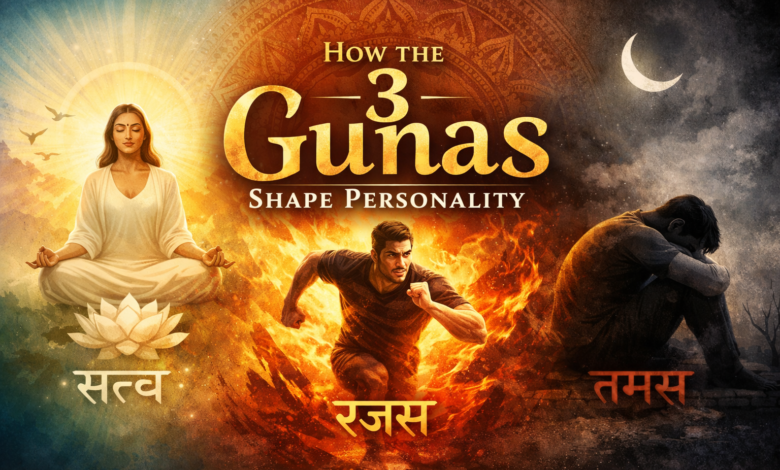
The concept of 3 gunas and personality becomes clearer when we understand the sattva rajas tamas meaning, explore the three gunas in Bhagavad Gita, examine the connection between gunas and mental health, and learn how to increase sattva for emotional clarity and psychological balance.
Thank you for reading this post, don't forget to subscribe!Some days you feel clear, grounded, and steady. Other days your mind races with urgency, and sometimes it sinks into heaviness without reason. You begin to question your personality, your discipline, even your stability. But what if these shifts are not flaws in who you are, but movements within you? What if your restlessness, clarity, and exhaustion are patterns shaped by deeper forces you have never been taught to understand?
“You are not unstable — you are experiencing shifting states within a stable awareness.”
Why Personality Feels Inconsistent — A Deeper Explanation
Most people believe personality is fixed.
- You are either calm or anxious.
- Driven or lazy.
- Disciplined or distracted.
But lived experience contradicts this.
There are days when your thinking is clear, your responses measured, and your emotions stable. On those days, you feel aligned with your values. You act with intention rather than impulse.
And then there are days when your mind races without direction. Small triggers provoke disproportionate reactions. You feel restless, irritated, and internally pressured.
There are also days of heaviness — where motivation drops, clarity fades, and even simple tasks feel overwhelming.
If personality were fixed, these shifts would not be so pronounced.
This is where the framework of 3 gunas and personality becomes psychologically meaningful.
Rather than defining personality as static, the doctrine of the three gunas in Bhagavad Gita describes personality as dynamically influenced by three energetic qualities of nature: sattva, rajas, and tamas.
Understanding this model does not require blind belief. It requires observation.
When viewed through a modern psychological lens, the concept of the gunas becomes a practical tool for self-understanding.
The Sattva Rajas Tamas Meaning — Scriptural Context
To understand the psychological implications, we must first clarify the sattva rajas tamas meaning within classical teaching.
In Chapter 14 of the Bhagavad Gita, Krishna explains that all human behavior arises from three qualities (gunas) inherent in prakriti — nature.
- Sattva is described as luminous, pure, and harmonious. It brings clarity and knowledge.
- Rajas is characterized by activity, desire, restlessness, and attachment to action.
- Tamas is marked by inertia, darkness, confusion, and resistance.
Importantly, the Gita does not describe these as personality labels. It describes them as dynamic influences.
- They are not who you are.
- They are what operate within you.
This distinction is critical when examining 3 gunas and personality in a modern context. If misunderstood as identity, the gunas become limiting labels. If understood as fluctuating states, they become tools for awareness.
Krishna further states that these gunas bind the individual through attachment:
- Sattva binds through attachment to happiness and knowledge.
- Rajas binds through attachment to action and outcome.
- Tamas binds through attachment to ignorance and inaction.
This suggests that even clarity can become attachment if identified with ego.
The spiritual teaching is subtle.
The psychological teaching is practical.
Gunas and Mental Health — A Modern Psychological Bridge
The relevance of gunas and mental health becomes clearer when we examine how these states influence emotional regulation.
Modern psychology describes emotional dysregulation in terms of:
- Overactivation (anxiety, irritability)
- Underactivation (apathy, withdrawal)
- Balanced regulation (emotional stability)
These correspond closely with rajasic, tamasic, and sattvic dominance.
- Rajas resembles sympathetic nervous system activation — fight or flight.
- Tamas resembles hypo-arousal or freeze response.
- Sattva resembles parasympathetic balance and autonomic flexibility.
This is not an attempt to force equivalence between scripture and neuroscience. It is an observation of parallel models describing human experience from different languages.
When discussing 3 gunas and personality, we are describing how repeated dominance of one state influences behavioral patterns.
- If rajas dominates consistently, personality expresses as driven, competitive, reactive.
- If tamas dominates consistently, personality expresses as avoidant, lethargic, resistant.
- If sattva is cultivated, personality expresses as composed, clear, and value-driven.
The implications for mental health are significant.
An anxious individual may not be “broken.” They may be experiencing chronic rajasic dominance.
A withdrawn individual may not be inherently lazy. They may be experiencing tamasic overwhelm.
This reframing reduces shame and increases agency.
Please Explore This Blog spiritual-awakening-after-suffering-ego-collapse
Personality as Pattern, Not Essence
Personality is often mistaken for essence.
But research in behavioral psychology shows that personality expression is strongly influenced by repeated behavior, environment, stress levels, and physiological state.
The doctrine of the three gunas in Bhagavad Gita aligns with this observation.
The gunas describe patterns of energy that condition perception and behavior.
- They are not destiny.
- They are tendencies.
- When tendencies repeat, they feel like identity.
For example:
- A person under chronic stress may develop a rajasic personality style — reactive, impatient, competitive.
- A person exposed to repeated overwhelm without resolution may develop tamasic patterns — withdrawal, numbness, avoidance.
- A person practicing discipline and reflection may cultivate sattvic qualities — steadiness, clarity, composure.
The key insight is this:
- You are not your guna.
- You are the observer of its operation.
That perspective alone introduces psychological distance — a core principle in cognitive regulation.
Why This Framework Matters Today
Modern society amplifies rajas.
- Constant stimulation.
- Digital comparison.
- Performance pressure.
- Productivity obsession.
Simultaneously, overstimulation often leads to tamas — burnout, withdrawal, numbing behaviors.
This oscillation between rajas and tamas explains many contemporary mental health struggles.
Understanding 3 gunas and personality provides a structured framework for navigating these oscillations.
It helps answer:
- Why do I feel hyperactive one week and unmotivated the next?
- Why does productivity sometimes lead to collapse?
- Why does clarity feel temporary?
- Because the gunas fluctuate.
- Without awareness, they dominate.
- With awareness, they can be regulated.
And that is where the discussion eventually leads to how to increase sattva — not as moral superiority, but as cultivation of clarity and balance.
Reflection Without Labeling
Before moving forward, pause for structured reflection. Do you notice patterns of:
- Persistent urgency and restlessness?
- Chronic fatigue and avoidance?
- Periodic clarity followed by agitation?
Observe without judgment. This is not about categorizing yourself permanently. It is about recognizing which guna tends to dominate under stress.
The more honestly you observe, the more accurately you understand your behavioral conditioning. And understanding is the first movement toward transformation.
⭐ PART 2 — Rajasic Dominance: The Restless Personality
Rajas in the Three Gunas in Bhagavad Gita
In Chapter 14 of the Bhagavad Gita, rajas is described as born of desire and attachment. It is the force that drives movement, ambition, craving, competition, and productivity.
- Rajas is not negative by definition.
- Without rajas, nothing would move.
- No career would be built.
- No family would be sustained.
- No progress would occur.
But when examining 3 gunas and personality, rajas becomes psychologically significant when it dominates without balance.
The sattva rajas tamas meaning clarifies that rajas binds the individual through attachment to action and the results of action.
- This attachment creates pressure.
- Pressure creates agitation.
- Agitation shapes personality.
Rajasic Personality Traits
When rajas dominates personality expression, several patterns emerge:
- Constant mental activity
- Urgency without clarity
- Competitive comparison
- Difficulty resting
- Irritability when obstructed
- Strong attachment to achievement
Externally, this personality may appear driven and successful. Internally, however, the experience often includes anxiety.
This is where gunas and mental health becomes highly relevant.
- Rajasic dominance does not feel peaceful.
- It feels necessary.
The mind says:
- “I must act.”
- “I must improve.”
- “I must prove.”
This compulsion shapes behavior repeatedly. Repeated behavior shapes personality.
Thus, within the framework of 3 gunas and personality, chronic rajas produces a reactive and performance-driven identity.
The Nervous System Under Rajasic Dominance
Modern neuroscience describes a similar state as sympathetic nervous system dominance.
The sympathetic system prepares the body for action.
- Heart rate increases.
- Breathing shortens.
- Cortisol rises.
- Adrenaline mobilizes energy.
This state is useful for short-term response. But prolonged sympathetic activation creates instability.
Under chronic rajas:
- Sleep becomes lighter and fragmented
- Emotional reactivity increases
- Impulse control weakens
- Decision-making becomes emotionally biased
Cortisol dysregulation impairs prefrontal cortex function. When prefrontal regulation weakens, emotional impulses become stronger.
This creates a feedback loop:
Agitation → Reaction → Consequence → Regret → More agitation.
This loop is not moral failure.
It is dysregulated rajas.
Please Explore This Blog ego-dissolution-and-inner-clarity-emotionally-free
Rajasic Mental Struggles — The Hidden Side
The hidden psychological cost of rajas includes:
1️⃣ Anxiety Masked as Ambition
Ambition may conceal fear of inadequacy.
2️⃣ Irritability Masked as High Standards
Perfectionism often hides internal pressure.
3️⃣ Overthinking Masked as Planning
Excessive mental rehearsal signals insecurity.
4️⃣ Burnout After Achievement
After intense effort, exhaustion follows.
This pattern reflects unstable energy expenditure. Within 3 gunas and personality, rajasic dominance produces an identity built around action.
When action pauses, self-worth feels threatened.
This is attachment — precisely what the three gunas in Bhagavad Gita describe as binding.
Why Modern Society Amplifies Rajas
Contemporary culture rewards:
- Speed
- Visibility
- Productivity
- Constant availability
Digital stimulation increases dopamine cycles.
- Comparison culture increases insecurity.
- Work culture increases cortisol exposure.
- These environmental conditions strengthen rajas.
- Without awareness, personality adapts to environment.
Thus, in discussing 3 gunas and personality, we must acknowledge that rajas is socially reinforced.
The result?
- High-functioning anxiety becomes normalized.
- Rest feels guilty.
- Silence feels uncomfortable.
- This is not personality destiny.
- It is conditioned dominance.
When Rajas Becomes Unstable
Rajas becomes unstable when:
- Sleep rhythm collapses
- Diet becomes overstimulating
- Rest is neglected
- Self-worth depends entirely on performance
In Chapter 17 of the Bhagavad Gita, rajasic tendencies are reinforced through overstimulating foods — excessively spicy, salty, or stimulating substances.
Modern parallels include:
- Excess caffeine
- Processed sugar
- High stimulation digital exposure
These inputs intensify sympathetic activation. In biological terms:
- Cortisol spikes increase.
- Blood sugar fluctuates.
- Emotional volatility rises.
This strengthens rajasic personality expression. Again, this shows how gunas and mental health intersect with physiology.
The Psychological Turning Point
The turning point in rajasic dominance occurs when awareness interrupts compulsion.
When you notice:
“I am restless.”
Instead of:
“I am this way.”
That subtle shift introduces distance. Distance weakens attachment. Attachment reduction is central in the three gunas in Bhagavad Gita.
Krishna does not say eliminate action. He says act without attachment. This is the difference between balanced rajas and dysregulated rajas.
- Balanced rajas serves purpose.
- Dysregulated rajas serves ego.
- Understanding this prepares the ground for the next phase — tamas.
- Because prolonged rajas often collapses into tamas.
And that cycle explains much of modern burnout.
Transition
- If rajas is overactivation,
- tamas is shutdown.
- Both are imbalanced expressions within 3 gunas and personality.
In the next section, we examine tamasic dominance in depth — its nervous system pattern, mental health implications, and how it shapes identity.
Please Explore This Blog trust-issues-causes-modern-world
⭐ PART 3 — Tamasic Dominance: Withdrawal, Brain Fog, and Emotional Shutdown
Tamas in the Three Gunas in Bhagavad Gita
If rajas represents restless movement, tamas represents resistance to movement.
In the Bhagavad Gita, tamas is described as born of ignorance, inertia, heaviness, and confusion. It binds the individual through negligence, indifference, and sleep-like dullness.
The sattva rajas tamas meaning becomes clearer here:
- Rajas agitates.
- Tamas obscures.
- Sattva illuminates.
Within the framework of 3 gunas and personality, tamas shapes personality not through action, but through withdrawal.
- This is not laziness in the moral sense.
- It is stagnation in the energetic sense.
Tamasic Personality Traits
When tamas dominates personality expression, certain patterns become visible:
- Chronic procrastination
- Emotional numbness
- Avoidance of responsibility
- Brain fog
- Oversleeping or irregular sleep
- Dependence on distraction
Unlike rajasic agitation, tamas feels heavy.
The mind does not race — it slows.
The body does not mobilize — it resists.
In discussions of gunas and mental health, tamasic dominance is often mistaken for lack of discipline. But psychologically, it resembles hypo-arousal or freeze response.
- This distinction matters.
- Because shame increases tamas.
- Awareness reduces it.
The Nervous System Under Tamasic Dominance
Modern neuroscience describes a freeze response when stress becomes overwhelming.
- Instead of fight or flight, the body shuts down.
- Heart rate may stabilize, but energy drops.
- Motivation decreases.
- Cognitive clarity reduces.
- This state is protective.
When the system perceives that action will not solve the threat, it conserves energy.
However, chronic freeze leads to stagnation. Within 3 gunas and personality, prolonged tamas creates an identity of withdrawal.
- “I don’t feel like doing anything.”
- “I’ll start tomorrow.”
- “Nothing really matters.”
This is not always depression, though it can resemble it. It is often unprocessed overwhelm expressed as inertia.
Tamasic Mental Struggles — The Hidden Pattern
The hidden psychological struggles of tamas include:
1️⃣ Avoidance of Growth
Important conversations are postponed.
2️⃣ Emotional Numbing
Instead of feeling sadness or anger, the individual feels dullness.
3️⃣ Digital Escapism
Scrolling replaces reflection.
4️⃣ Learned Helplessness
Repeated failure reduces initiative.
These patterns influence 3 gunas and personality by reinforcing stagnation.
- Repeated avoidance shapes identity.
- Identity shapes future behavior.
- This is conditioning.
The Hormonal and Biological Layer of Tamas
Tamas often correlates with:
- Irregular sleep cycles
- Poor gut health
- Low physical activity
- High processed food intake
Chapter 17 of the Bhagavad Gita describes tamasic food as stale, lifeless, and impure.
Modern equivalents include:
- Heavily processed meals
- Excess alcohol
- Overconsumption
- Food lacking nutritional density
Biologically, such inputs may cause:
- Blood sugar instability
- Reduced dopamine balance
- Chronic inflammation
- Fatigue cycles
This reinforces low activation.
The connection between gunas and mental health becomes visible here — tamasic lifestyle reinforces tamasic psychology.
Why Tamas Often Follows Rajas
A critical insight in understanding 3 gunas and personality is that rajas and tamas often form a cycle.
- Excessive rajas (overwork, overthinking, overstimulation) eventually leads to collapse.
- Collapse becomes tamas.
The pattern looks like:
Overdrive → Burnout → Withdrawal → Guilt → Forced Overdrive → Collapse again.
This oscillation defines much of modern emotional instability.
- Neither state is balanced.
- Both are imbalanced dominance.
- The solution is not eliminating action.
- The solution is increasing sattva.
But before reaching sattva, awareness of tamas is essential.
Please Explore This Blog ego-dissolution-and-spiritual-transformation
The Psychological Turning Point in Tamas
The turning point occurs when stagnation is observed without self-attack.
Instead of:
“I am lazy.”
The reframing becomes:
“Tamas is dominant right now.”
This shift reduces shame.
- Reduced shame reduces freeze.
- Reduced freeze increases small movement.
- Small movement reduces tamas.
In the three gunas in Bhagavad Gita, Krishna emphasizes awareness of the gunas operating without identifying with them.
That awareness is the beginning of freedom.
- You are not tamas.
- You are witnessing tamas.
- That witnessing creates space.
- Space allows choice.
- Choice increases sattva.
Important Distinction — Tamas vs Clinical Depression
While discussing gunas and mental health, it is essential to clarify:
Tamasic states can resemble depressive symptoms.
However, clinical depression involves complex biochemical and psychological factors requiring professional support.
The guna framework is a philosophical-psychological model.
It complements, but does not replace, clinical understanding.
This distinction preserves both spiritual insight and medical integrity.
Transition
We have now examined:
- Rajasic overactivation
- Tamasic shutdown
Both shape 3 gunas and personality through repeated dominance. But neither represents balance.
Balance emerges through sattva. Before exploring how to increase sattva, we must understand its nature deeply.
⭐ PART 4 — Sattvic Dominance: Clarity, Emotional Regulation, and Inner Stability
Sattva in the Three Gunas in Bhagavad Gita
If rajas agitates and tamas obscures, sattva illuminates.
In the Bhagavad Gita, sattva is described as pure, luminous, and free from turbulence. It brings clarity, harmony, and knowledge.
The sattva rajas tamas meaning becomes psychologically relevant here:
- Sattva does not suppress emotion.
- Sattva regulates emotion.
- Sattva does not eliminate action.
- Sattva purifies intention behind action.
Within the framework of 3 gunas and personality, sattvic dominance does not produce passivity. It produces steadiness.
It is the state in which:
- Thoughts are clear
- Reactions are measured
- Motivation is balanced
- Sleep is stable
- Decisions align with values
This is not emotional numbness. It is emotional maturity.
Sattvic Personality Traits
When sattva dominates personality expression, the patterns are noticeable:
- Calm under pressure
- Clarity before action
- Consistent discipline
- Reduced impulsivity
- Emotional transparency without volatility
- Balanced ambition
Unlike rajasic urgency, sattvic drive is purposeful. Unlike tamasic avoidance, sattvic rest is restorative.
In discussions of 3 gunas and personality, sattva represents integration.
- Energy exists — but is not chaotic.
- Stillness exists — but is not dull.
The Nervous System Under Sattvic Dominance
From a biological perspective, sattva corresponds to parasympathetic balance and autonomic flexibility.
Autonomic flexibility means:
- The ability to activate when needed
- The ability to return to calm quickly
This is the foundation of emotional regulation. In the language of gunas and mental health, sattva reduces:
- Chronic anxiety
- Emotional impulsivity
- Stress recovery time
- Mood instability
Balanced cortisol rhythm supports:
- Better sleep
- Improved digestion
- Stable energy
- Clear cognition
Sattva is not only spiritual clarity. It is physiological coherence.
Please Explore This Blog silent-ego-in-success-and-inner-stability
Emotional Regulation in Sattvic States
A key feature of sattva is response over reaction.
- Emotion still arises.
- Anger may appear.
- Fear may surface.
- Sadness may be felt.
But the gap between stimulus and response widens. This pause is the foundation of emotional intelligence.
Within 3 gunas and personality, sattvic dominance strengthens:
- Self-awareness
- Impulse control
- Value-based decision making
This is not suppression. Suppression pushes emotion down. Regulation processes emotion consciously.
That distinction is crucial in discussions of gunas and mental health.
The Subtle Binding of Sattva
The three gunas in Bhagavad Gita also warn that sattva binds through attachment to happiness and knowledge.
This is subtle.
A person may become attached to being calm.
- They may develop spiritual superiority.
- They may avoid necessary conflict in order to preserve inner peace.
- This attachment is still conditioning.
- The ultimate teaching is not permanent sattvic dominance.
- It is awareness of all gunas without identification.
- That awareness transcends conditioning.
But practically, increasing sattva stabilizes personality and mental health before transcendence becomes relevant.
How Sattva Reshapes Personality Over Time
Repeated sattvic behaviors reinforce sattvic identity.
For example:
- Regular sleep rhythm
- Mindful speech
- Moderate diet
- Disciplined routine
- Reflective awareness
When repeated, these shift baseline nervous system tone.
- Baseline tone shapes perception.
- Perception shapes behavior.
- Behavior shapes personality.
Thus, within 3 gunas and personality, increasing sattva gradually reshapes how a person appears and feels internally.
This is not instant. It is cumulative.
Sattva and Leadership of the Mind
A sattvic personality does not eliminate rajas or tamas.
It governs them.
- Rajas becomes purposeful action.
- Tamas becomes restorative rest.
- Sattva becomes the regulator.
This internal hierarchy stabilizes emotional health.
In modern psychological terms:
- Prefrontal cortex strengthens
- Amygdala reactivity reduces
- Stress response becomes proportional
Sattva aligns with executive control. And executive control defines mature personality.
Why Sattva Is Rare in Overstimulated Environments
Modern culture promotes rajasic overstimulation.
- Constant notifications.
- Artificial lighting.
- Irregular sleep.
- Performance metrics.
These disrupt parasympathetic stability. Without intentional lifestyle regulation, sattva weakens.
This is why discussions of how to increase sattva become practical rather than philosophical.
Sattva must be cultivated.
It does not arise automatically in overstimulated systems.
The Psychological Experience of Increasing Sattva
When sattva increases, individuals often report:
- Reduced urgency
- Greater patience
- Improved concentration
- Lower emotional volatility
- Clearer moral judgment
In terms of gunas and mental health, this shift reduces:
- Anxiety cycles
- Impulsive decision regret
- Relationship instability
- Self-criticism
Increasing sattva is not about becoming saintly. It is about becoming regulated.
Transition
We have now explored:
- Rajasic overactivation
- Tamasic shutdown
- Sattvic regulation
Together, they define the dynamic nature of 3 gunas and personality.
⭐ PART 5 — Which Guna Is Dominant in You Right Now?
Self-Assessment Without Labeling
When discussing 3 gunas and personality, the most common mistake is labeling.
- “I am rajasic.”
- “I am tamasic.”
- “I am sattvic.”
The teaching in the Bhagavad Gita does not support fixed identity. It describes fluctuating states.
The question is not:
“Which guna am I?”
The better question is:
“Which guna is dominant in me right now?”
Self-awareness reduces attachment. Attachment reduction stabilizes mental health.
Understanding the sattva rajas tamas meaning becomes practical only when applied to present-moment observation.
Signs of Rajasic Dominance
Rajas is dominant when:
- Your thoughts feel urgent
- You struggle to rest without guilt
- You feel irritated by slow progress
- Your sleep feels shallow
- Comparison dominates internal dialogue
Emotionally: You feel activated, pressured, slightly restless.
Nervous system: Sympathetic tone is high.
Hormonal pattern: Cortisol likely elevated.
In terms of gunas and mental health, prolonged rajasic dominance increases anxiety and emotional volatility.
This does not mean rajas is bad. It means it requires regulation.
Signs of Tamasic Dominance
Tamas is dominant when:
- You postpone important actions
- You feel mentally foggy
- You avoid uncomfortable conversations
- You seek excessive distraction
- You feel heavy or indifferent
Emotionally: Low motivation, low initiative.
Nervous system: Hypo-arousal or freeze.
Hormonal pattern: Reduced activation, unstable energy.
Within 3 gunas and personality, tamasic dominance influences identity through withdrawal patterns.
Again — not a flaw. A state.
Signs of Sattvic Dominance
Sattva is dominant when:
- You can pause before reacting
- Your thinking feels clear
- You sleep deeply and wake steadily
- You act according to values
- You feel composed without suppression
Emotionally: Balanced.
Nervous system: Parasympathetic flexibility.
Hormonal rhythm: Stable cortisol cycle.
Sattva supports long-term emotional regulation. This is why discussions of how to increase sattva are closely connected to mental stability.
Why Awareness Is the Turning Point
The shift from identity to observation is crucial.
Instead of saying:
“I am anxious.”
You say:
“Rajas is active.”
Instead of:
“I am lazy.”
You say:
“Tamas is present.”
That shift creates psychological distance.
- Distance creates choice.
- Choice creates regulation.
- Regulation increases sattva.
This is the functional application of 3 gunas and personality.
Please Explore This Blog spirituality-as-spirit-science-15-laws-consciousness-suffering
⭐ PART 6 — How to Increase Sattva: Diet, Lifestyle, and Mental Discipline
Why Increasing Sattva Is a Practical Strategy
The goal is not eliminating rajas or tamas.
- Both are necessary.
- Rajas provides action.
- Tamas provides rest.
But without sattva as regulator, imbalance occurs. Increasing sattva strengthens clarity and emotional regulation.
In modern terms:
- Improved nervous system flexibility
- Reduced chronic stress
- Stable mood
- Better impulse control
Thus, how to increase sattva becomes a structured lifestyle question.
Sattvic Diet and Biological Stability
In Chapter 17, the Bhagavad Gita describes sattvic food as:
- Fresh
- Pure
- Moderate
- Nourishing
- Clean
Modern interpretation:
- Fresh vegetables
- Whole grains
- Balanced protein
- Seasonal fruits
- Adequate hydration
- Moderate natural seasoning
Physiological impact:
- Stable blood sugar
- Balanced cortisol rhythm
- Reduced inflammation
- Improved gut-brain communication
Diet influences hormonal regulation. Hormonal regulation influences emotional stability.
Thus, diet directly affects gunas and mental health.
Regulating Rajasic Inputs
To reduce excessive rajas:
- Limit caffeine spikes
- Reduce digital overstimulation
- Avoid extreme sleep irregularity
- Moderate excessively spicy or processed foods
These changes calm sympathetic activation. Balanced stimulation supports sattva.
Reducing Tamasic Reinforcement
To reduce tamas:
- Maintain consistent sleep timing
- Increase physical movement
- Avoid heavy late-night meals
- Limit passive digital consumption
- Reduce alcohol excess
Small movement reduces inertia. Inertia reduction increases clarity. Clarity increases sattva.
Mental Discipline and Sattvic Growth
Beyond diet and environment, sattva grows through:
- Daily reflection
- Mindful speech
- Honest self-observation
- Value-driven action
- Structured routine
In the three gunas in Bhagavad Gita, disciplined repetition (abhyasa) strengthens clarity.
Modern psychology agrees:
Repetition reshapes neural pathways.
This is where 3 gunas and personality meets behavioral science. Identity follows repeated behavior.
The 90-Day Integration Principle
Sattva does not dominate overnight. Neuroplastic adaptation requires repetition.
Within approximately 8–12 weeks of consistent lifestyle adjustment:
- Sleep rhythm stabilizes
- Stress recovery improves
- Emotional reactivity decreases
- Decision clarity increases
This gradual shift reshapes personality expression.
- Not magically.
- Mechanistically.
The Higher Spiritual Insight
Ultimately, the three gunas in Bhagavad Gita teach transcendence beyond all three. But transcendence is not achieved through bypassing imbalance.
It begins with increasing sattva.
When clarity stabilizes, attachment weakens.
When attachment weakens, identification with personality softens.
And that is spiritual maturity.
⭐ Conclusion — You Are Not Your Guna
The discussion of 3 gunas and personality is not about categorizing people.
It is about understanding patterns.
- Rajas explains agitation and urgency.
- Tamas explains stagnation and withdrawal.
- Sattva explains clarity and regulation.
But none of them define your essence.
In the Bhagavad Gita, Krishna makes a crucial distinction: the gunas operate within nature — not within the true self.
This insight changes everything.
- You are not your anxiety.
- You are not your laziness.
- You are not even your calmness.
- You are the awareness observing these movements.
Reframing Gunas and Mental Health
When someone says:
“I am anxious.”
The guna framework suggests:
“Rajas is dominant.”
When someone says:
“I am unmotivated.”
The reframing becomes:
“Tamas is active.”
This distinction removes moral judgment. It replaces shame with awareness. Awareness is stabilizing. Stabilization supports mental health.
This is why understanding gunas and mental health is not philosophical — it is practical.
Personality Is Conditioned, Not Fixed
Personality feels permanent because patterns repeat. But patterns repeat because states dominate.
- When rajas dominates repeatedly, personality becomes reactive.
- When tamas dominates repeatedly, personality becomes withdrawn.
- When sattva is cultivated intentionally, personality becomes steady.
Thus, within the model of 3 gunas and personality, change is possible.
Not through force. Through regulation.
Why Increasing Sattva Matters
The purpose of learning how to increase sattva is not spiritual superiority.
- It is nervous system stability.
- It is emotional regulation.
- It is cognitive clarity.
- It is behavioral consistency.
Sattva does not eliminate ambition (rajas). It purifies it.
Sattva does not eliminate rest (tamas). It refines it.
When sattva increases:
- Reaction time slows
- Emotional recovery improves
- Stress resilience strengthens
- Sleep deepens
- Decision clarity sharpens
This is not mystical. It is psycho-biological coherence.
The Integrated Model
Let us summarize the integration:
- Sattva rajas tamas meaning describes energetic qualities.
- The three gunas in Bhagavad Gita explain how these qualities bind behavior.
- Modern neuroscience maps these states to autonomic activation.
- Gunas influence nervous system tone.
- Nervous system tone influences emotional regulation.
- Emotional regulation influences personality expression.
This is not religion versus psychology. It is two models describing the same lived reality.
The Highest Insight
Increasing sattva stabilizes personality. But the ultimate insight is deeper.
When you observe:
“Rajas is active.”
or
“Tamas is present.”
without identification — you begin to step beyond conditioning. That witnessing consciousness is not agitated.
Not dull.
Not even luminous.
It is aware.
And awareness weakens attachment. Attachment reduction reduces suffering. That is the final teaching of the three gunas in Bhagavad Gita.
⭐ Final Authority Close
Personality is not destiny.
It is the repeated expression of dominant states.
- States can be observed.
- States can be influenced.
- States can be balanced.
You are not your guna. But your guna influences how you experience life. When you understand the mechanics of 3 gunas and personality, you stop fighting yourself.
You start regulating yourself.
And when regulation strengthens, clarity increases. When clarity increases, suffering decreases.
That is not mystical transformation. That is disciplined awareness.
⭐ Frequently Asked Questions (FAQ)
1️⃣ What are the 3 gunas and how do they shape personality?
The 3 gunas and personality framework explains how human behavior is influenced by three qualities of nature: sattva (clarity), rajas (activity), and tamas (inertia). These qualities affect thought patterns, emotional reactions, and behavioral tendencies. Repeated dominance of one guna shapes personality expression over time.
2️⃣ What is the sattva rajas tamas meaning in simple terms?
The sattva rajas tamas meaning can be understood as three energetic states:
- Sattva = balance and clarity
- Rajas = restlessness and desire
- Tamas = dullness and resistance
They are not fixed identities but dynamic tendencies that influence mood, motivation, and perception.
3️⃣ How do the three gunas in Bhagavad Gita relate to modern psychology?
The three gunas in Bhagavad Gita describe behavioral conditioning in spiritual language. Modern psychology maps similar states to nervous system patterns: sympathetic activation (rajas), freeze response (tamas), and parasympathetic balance (sattva). Both models describe how internal states shape behavior.
4️⃣ Are the gunas permanent personality types?
No. The concept of 3 gunas and personality refers to fluctuating states, not permanent personality labels. A person may experience rajasic dominance under stress, tamasic withdrawal during overwhelm, and sattvic clarity through disciplined regulation.
5️⃣ How do gunas affect mental health?
The relationship between gunas and mental health becomes clear when observing stress patterns. Chronic rajas may contribute to anxiety and irritability, while prolonged tamas may resemble withdrawal or low motivation. Increasing sattva supports emotional regulation and psychological balance.
6️⃣ How can I know which guna is dominant in me?
You can observe your current state:
- Racing thoughts and urgency suggest rajas.
- Brain fog and avoidance suggest tamas.
- Calm clarity and measured response suggest sattva.
Self-awareness is the first step in applying the 3 gunas and personality model effectively.
7️⃣ Can diet influence the gunas?
Yes. According to the three gunas in Bhagavad Gita, food influences mental states. Fresh, balanced food supports sattva. Highly stimulating food may increase rajas. Heavy or stale food may reinforce tamas. Diet impacts hormonal rhythm and nervous system balance.
8️⃣ How to increase sattva naturally?
If you are wondering how to increase sattva, focus on:
- Consistent sleep rhythm
- Balanced diet
- Reduced overstimulation
- Breath regulation
- Honest self-reflection
- Structured daily discipline
Increasing sattva improves emotional clarity and nervous system stability.
9️⃣ Is increasing sattva the ultimate goal?
Increasing sattva stabilizes personality and supports mental health. However, the three gunas in Bhagavad Gita teach that ultimate freedom comes from awareness beyond all three gunas, not attachment to even sattvic qualities.
🔟 Can understanding the gunas improve emotional regulation?
Yes. Understanding 3 gunas and personality reduces self-judgment and increases regulation. When you recognize a state as rajasic or tamasic, you create psychological distance. That distance allows conscious response instead of impulsive reaction.
📚 Scriptural Foundation
1️⃣ Bhagavad Gita – Chapter 14 (The Three Gunas)
Easwaran, E. (Trans.). (2007). The Bhagavad Gita (2nd ed.). Nilgiri Press.
Online Version:
https://www.bhagavad-gita.org/Gita/verse-14-1.html
2️⃣ Vivekananda, S. (1896/2001). The Bhagavad Gita. Advaita Ashrama.
https://www.advaitaashrama.org
🧠 Nervous System & Emotion Regulation Research
3️⃣ Porges, S. W. (2011). The Polyvagal Theory.
W. W. Norton & Company.
Polyvagal Institute:
https://www.polyvagalinstitute.org
Supports: Autonomic regulation, parasympathetic balance (parallel to sattva).
4️⃣ McEwen, B. S. (2007). Physiology and neurobiology of stress and adaptation. Physiological Reviews, 87(3), 873–904.
https://doi.org/10.1152/physrev.00041.2006
Supports: Cortisol regulation, chronic stress (rajasic dominance parallels).
5️⃣ Gross, J. J. (1998). The emerging field of emotion regulation. Review of General Psychology, 2(3), 271–299.
https://doi.org/10.1037/1089-2680.2.3.271
Supports: Emotional regulation framework (sattvic stability parallels).
6️⃣ Thayer, J. F., & Lane, R. D. (2000). Neurovisceral integration model. Journal of Affective Disorders, 61(3), 201–216.
https://doi.org/10.1016/S0165-0327(00)00338-4
Supports: Nervous system flexibility and emotional control.
🧘 Mindfulness & Behavioral Regulation
7️⃣ Tang, Y. Y., Hölzel, B. K., & Posner, M. I. (2015). The neuroscience of mindfulness meditation. Nature Reviews Neuroscience, 16(4), 213–225.
https://doi.org/10.1038/nrn3916
Supports: Long-term neural adaptation (increase in sattva parallels).
8️⃣ Lally, P., van Jaarsveld, C. H., Potts, H. W., & Wardle, J. (2010). Habit formation in the real world. European Journal of Social Psychology, 40(6), 998–1009.
https://doi.org/10.1002/ejsp.674
Supports: Repetition reshapes identity (behavior → personality).
🥗 Diet & Mental Health
9️⃣ Jacka, F. N. et al. (2017). A randomized controlled trial of dietary improvement for adults with major depression. BMC Medicine, 15(1), 23.
https://bmcmedicine.biomedcentral.com/articles/10.1186/s12916-017-0791-y
Supports: Diet directly impacts mood regulation (aligns with sattvic dietary principles).
💤 Sleep & Hormonal Stability
🔟 Walker, M. P. (2017). Why We Sleep. Scribner.
Supports: Sleep rhythm, emotional regulation, cortisol balance.