Maya Meaning in Psychology: The Illusion of Perception
What Is Maya in Psychology? How Your Mind Creates Illusion

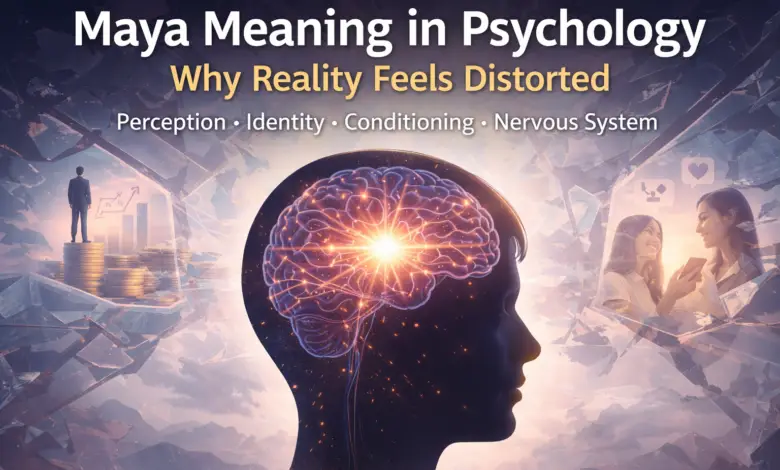
Maya meaning in psychology explains how how perception shapes reality, influenced by identity and conditioning psychology, where thought patterns and emotional illusion arise through nervous system and perception distortion.
Thank you for reading this post, don't forget to subscribe!When we explore the Maya meaning in psychology, we are not describing illusion as something imaginary or unreal. Instead, we are understanding how the human mind interprets reality through filters that feel completely true, even when they are shaped by internal patterns. What you experience daily is not pure reality—it is your mind’s version of reality.
Two individuals can live the same external situation. One experiences peace, while the other experiences pressure. The environment remains unchanged, but the internal interpretation creates a completely different emotional outcome. This is where the Maya meaning in psychology becomes powerful—it reveals that suffering is not always created by life itself, but by how the mind processes life.
In psychological terms, the brain is not a passive observer. It is an active interpreter. It assigns meaning, creates narratives, and builds connections based on past experiences. Over time, these interpretations become automatic. You no longer question them—you simply live through them. That is how how perception shapes reality becomes your daily experience without conscious awareness.
Most people believe their thoughts reflect truth. But in reality, thoughts often reflect conditioning, emotional states, and repeated internal dialogue. When these thoughts are not questioned, they slowly become your perceived reality. This is the subtle beginning of thought patterns and emotional illusion—where internal assumptions start shaping how life feels.
Understanding the Maya meaning in psychology is not about rejecting life or becoming detached from reality. It is about learning to see clearly—where your interpretation is influencing your experience more than the actual situation.
How Perception Shapes Reality in Daily Life
The concept of how perception shapes reality becomes most visible in everyday thinking. Consider a simple example: if you believe “I am behind in life,” your mind will begin searching for evidence to support that belief. You will compare your progress with others, notice their achievements more than your own, and ignore signs of your growth.
Gradually, this belief strengthens. Not because it is objectively true, but because your attention keeps reinforcing it. This is how perception operates—it selects, filters, and amplifies certain information while ignoring the rest.
This process is not intentional. It is automatic. The brain prefers familiarity over accuracy. If a belief has been repeated long enough, it feels safe to maintain it. This is how thought patterns and emotional illusion are formed. You are not consciously choosing to distort reality—but your mind is doing it for you.
Another example can be seen in relationships. If you carry a belief that “people will eventually leave,” your perception will constantly scan for signs of rejection. Even neutral behavior may feel like disconnection. Over time, your emotional response strengthens that belief, creating a cycle where perception shapes emotional experience, and emotional experience reinforces perception.
This is why two people can experience the same situation differently. One sees opportunity; the other sees pressure. One feels supported; the other feels alone. The difference is not the situation—it is the perception.
Thought Patterns and Emotional Illusion in the Human Mind
The human mind operates through patterns. These patterns are built over time through repetition, emotional experiences, and learned responses. Once a pattern is established, the mind begins to follow it automatically, often without conscious awareness.
This is where thought patterns and emotional illusion become powerful. A repeated thought such as “I am not doing enough” may start as a temporary feeling. But when it is repeated daily, it becomes a belief. That belief then influences emotions, creating anxiety, pressure, or dissatisfaction—even when there is no immediate reason.
Emotions, in turn, intensify these thoughts. Fear can make the future appear more threatening than it actually is. Shame can make past mistakes feel permanent. Stress can narrow your perspective, making small problems appear larger than they are. This interaction between thought and emotion creates a loop where perception becomes distorted.
In this state, you are not responding to reality—you are responding to your internal interpretation of reality. This is the psychological form of Maya. Not a false world, but a filtered experience of the world.
Over time, this loop becomes your normal state. You may not even realize that your thoughts are shaping your emotional experience. It feels natural. It feels real. That is why illusion is not easily recognized—it does not feel like illusion.
Read Also: spiritual-psychology
Identity and Conditioning Psychology Behind Your Thinking
To understand this deeper, we need to explore identity and conditioning psychology. Your thoughts are not created in isolation. They are shaped by your upbringing, environment, cultural expectations, and personal experiences.
From a young age, you learn what success looks like, what failure means, and how you should behave to be accepted. These lessons are not always taught directly—they are absorbed through observation and repetition. Over time, they form your internal identity.
For example, if you grow up in an environment where achievement is constantly emphasized, you may develop an identity where your worth is tied to productivity. Even when you are doing well, you may feel like it is not enough. This is not because reality is lacking—it is because your conditioning is influencing perception.
This is how identity and conditioning psychology creates internal pressure. You begin to measure your life based on external standards. You compare timelines, outcomes, and achievements. Slowly, your identity becomes attached to performance rather than presence.
This attachment creates vulnerability. When performance changes, your sense of self feels unstable. When comparison increases, your satisfaction decreases. This is how Maya operates through identity—it hides your natural state behind learned expectations.
Maya Meaning in Psychology (Psychological Explanation of Perception Distortion)
One of the most important aspects of the Maya meaning in psychology is understanding why illusion feels so real. If these patterns are not accurate reflections of reality, why do they feel so convincing?
The answer lies in how the brain processes information. The mind does not evaluate every thought logically. Instead, it relies on patterns and emotional signals to respond quickly. This is efficient for survival, but it also creates nervous system and perception distortion when stress is involved.
When your nervous system is activated—through stress, pressure, or uncertainty—your perception changes. The brain becomes more focused on potential threats. Neutral situations may feel negative. Uncertainty may feel dangerous. This is not a conscious choice—it is a biological response.
This is where nervous system and perception distortion becomes important. Your body reacts before your mind fully processes the situation. If the body feels unsafe, thoughts will follow that feeling. This creates a perception that aligns with emotional state, not objective reality.
How the Mind Converts Thoughts into Emotional Reality
The mind does not simply think—it feels. Every thought carries an emotional tone. When a thought is repeated, the emotion attached to it becomes stronger. Over time, the emotional intensity makes the thought feel more real.
For example, if you repeatedly think “I am not stable,” the emotion of insecurity begins to grow. That emotion then influences how you interpret future situations. Even small uncertainties may feel overwhelming. This is how thought patterns and emotional illusion transform into lived experience.
This process is subtle. You may not notice when it begins. But once it becomes established, it shapes how you see yourself, your life, and your future. That is why awareness is essential. Not to stop thoughts completely, but to observe how they are influencing perception.
Maya Meaning in Psychology – Identity, Comparison, and the Illusion of Being “Behind”
One of the most common forms of psychological Maya appears in comparison. The feeling of being “behind” is rarely based on objective reality. It is often created through internal standards influenced by society, media, and peer expectations.
This connects again to how perception shapes reality. When you compare your journey with others, you are not comparing equal conditions. You are comparing visible outcomes without understanding hidden factors. Yet, the mind treats this comparison as meaningful, creating pressure and dissatisfaction.
This comparison loop strengthens identity and conditioning psychology. You begin to define yourself based on where you stand relative to others. This creates a constant need to prove, improve, or validate yourself externally.
Over time, this leads to emotional fatigue. You are not just living your life—you are measuring it continuously. This measurement becomes the source of stress, not life itself.
Read Also: why-do-we-suffer-from-our-own-thoughts
How Conditioning Shapes Your Self-Perception and Life Pressure
Your self-perception is not formed overnight. It is built through years of conditioning. Messages like “you must succeed,” “you must be better,” or “you must not fail” become internal rules. These rules then influence how you see yourself.
This is where thought patterns and emotional illusion intensify. You may feel pressure even when nothing urgent is happening. You may feel dissatisfaction even when progress exists. This is not because life is lacking—it is because your internal standards are rigid.
Breaking this pattern does not require rejecting ambition or growth. It requires understanding how your conditioning is shaping your perception. When you begin to see this clearly, the illusion starts to weaken.
Early Signs You Are Living in Psychological Maya
Recognizing the early signs of psychological Maya is the first step toward clarity. These signs are not extreme—they are subtle patterns that feel normal.
You may notice constant overthinking, even when situations are manageable. You may feel pressure without clear reason. You may compare yourself frequently, leading to dissatisfaction. You may question your progress, even when you are moving forward.
These are signs of nervous system and perception distortion, where internal patterns are influencing how life feels more than reality itself.
When Thought Patterns and Emotional Illusion Start Controlling You
The moment thought patterns and emotional illusion begin controlling your decisions, you lose clarity. You react instead of responding. You assume instead of observing. You feel overwhelmed without understanding why.
This is not weakness. It is unconscious patterning.
The awareness of this is the beginning of change. When you start questioning your thoughts—not rejecting them, but observing them—you create space between perception and reality.
And in that space, clarity begins.
Nervous System and Perception Distortion Explained
To understand the Maya meaning in psychology, it is not enough to study thoughts alone. We must also understand the body. Because before a thought becomes a belief, it is often first experienced as a feeling.
This is where nervous system and perception distortion plays a critical role.
The nervous system is responsible for detecting safety and threat. When it feels stable, the mind can think clearly. When it feels unstable, perception changes immediately. Neutral situations may feel stressful. Uncertainty may feel dangerous. Small problems may appear overwhelming.
This shift does not happen because reality has changed. It happens because the body is signaling discomfort.
In such moments, thoughts are no longer neutral. They align with the emotional state of the body. If the body feels unsafe, the mind begins producing thoughts that match that feeling. This creates a loop where perception becomes distorted without conscious awareness.
This is one of the most important insights in the Maya meaning in psychology:
You are not always reacting to reality—you are reacting to your nervous system state.
This explains why the same situation can feel manageable on one day and overwhelming on another. The difference is not the situation. The difference is the internal state.
Understanding this breaks a major illusion. It shows that not every thought needs to be believed. Some thoughts are simply reflections of temporary physiological states.
Read Also emotional-neglect-effects-fear-of-abandonment-adulthood
Why Your Body Reacts Before Logic
The human brain is designed for survival, not accuracy. This means that the body reacts before the mind has time to analyze.
When stress increases, the nervous system activates a protective response. Heart rate changes, breathing becomes shallow, and attention narrows. In this state, the brain prioritizes speed over clarity.
This is where nervous system and perception distortion becomes visible. The mind begins to interpret situations quickly, often assuming the worst. It is not trying to mislead you—it is trying to protect you.
However, in modern life, this response is often triggered by non-threatening situations—financial pressure, social comparison, uncertainty about the future. The body reacts as if there is danger, and the mind follows that signal.
This creates thought patterns and emotional illusion, where the intensity of feeling makes the situation appear more serious than it actually is.
Recognizing this pattern is important. It shifts your understanding from “something is wrong with me” to “my system is responding automatically.”
This awareness is the beginning of regulation.
My Experience with Maya (Money, Success, and Collapse)
My understanding of the Maya meaning in psychology did not come from theory. It came from experience.
I started earning at a very early age—around 18. Financial growth came quickly. Opportunities increased. Recognition increased. People started coming closer. At that time, I believed this was success.
But what I did not understand was this:
Money came before emotional stability.
I was not prepared for the attention, the lifestyle, and the internal pressure that came with it. Slowly, without realizing, my identity began attaching to success. Not to who I was—but to what I had.
This is where identity and conditioning psychology began shaping my life.
More income led to more spending. More spending led to more validation. I started buying things not for need, but for identity. Watches, clothes, shoes, accessories—everything became a symbol of progress.
But all watches show the same time.
That realization came much later.
At that time, I was not asking:
“Do I need this?”
I was unconsciously asking:
“What does this say about me?”
This is how how perception shapes reality works at a deeper level. I believed I was growing, but I was actually reinforcing an identity built on external validation.
Over time, this pattern repeated. Growth phases came, followed by collapse phases. Business fluctuations happened in different years. Each rise strengthened overconfidence. Each fall created instability.
But the pattern remained the same:
external success → internal attachment → emotional dependence.
How Thought Patterns and Emotional Illusion Controlled My Decisions
Looking back, I can clearly see how thought patterns and emotional illusion influenced my decisions.
Spending was not always logical—it was emotional.
Choices were not always conscious—they were reactive.
There was a silent belief operating in the background:
“I must maintain this image.”
“I must not look small.”
“I must continue this lifestyle.”
These were not spoken thoughts. But they shaped behavior.
This is how identity and conditioning psychology works. It creates invisible rules that guide decisions without awareness.
At that time, it felt normal. It felt like progress. But in reality, it was disconnection—from effort, from value, and from long-term thinking.
The most important thing I realized later was this:
I was working hard to earn money—but I was not respecting the energy behind it.
The pressure, the effort, the mental strain—all of it was disconnected from how I was spending. This created imbalance. Not immediately, but gradually.
And when awareness is absent, imbalance eventually becomes collapse.
Read Also why-do-we-suffer-from-our-own-thoughts
Identity and Conditioning Psychology in Real Life Decisions
The real turning point came during a difficult phase—when financial stability reduced significantly.
This was during a time when I had material things around me, but not enough money for daily living. I had possessions—but not stability.
That contrast created clarity.
I remember looking at my surroundings—clothes, watches, items I had collected—and realizing something deeply uncomfortable:
These things did not support me when I needed stability.
They only supported an image when things were going well.
This is the harsh truth of identity and conditioning psychology—when identity is built on external validation, it does not hold during internal challenges.
During that period, I had to sell items below their value just to manage basic needs. Even that was not always enough.
What stayed with me was not the loss of money.
It was the shift in perception.
I started seeing clearly how how perception shapes reality had influenced my life. I was not living consciously. I was responding to conditioning, expectation, and emotional impulses.
And in that moment, the Maya meaning in psychology became real for me—not as a concept, but as lived experience.
The Moment of Collapse and Clarity – Maya Meaning in Psychology
There was one moment that changed everything.
I realized that I had spent years building a lifestyle that did not match my inner stability. I was living externally ahead, but internally unprepared.
During that phase, support was limited. People who were present during success were not always present during difficulty. This was not about blaming others—it was about understanding the nature of relationships built on circumstances.
One person, a neighbor, helped during that time—offering basic support when it was needed most. That moment stayed with me. It showed me that real connection is not built on success—it is built on humanity.
That experience shifted my understanding completely.
I saw clearly that the illusion was not in money, not in people, not in opportunities.
The illusion was in unconscious living.
This is the deepest layer of the Maya meaning in psychology:
Maya is not what you have.
Maya is how you relate to what you have.
When awareness is absent, success can create illusion.
When awareness is present, even struggle can create clarity.
That was my turning point.
Breaking Maya Through Awareness and Stability
Understanding the Maya meaning in psychology is not enough. Awareness without application remains incomplete. The real shift begins when awareness starts influencing how you think, decide, and respond to life.
The illusion does not break suddenly. It weakens gradually.
The first change I experienced was not external. Life did not become easier overnight. Situations did not disappear. But something internal started becoming stable. The urgency reduced. The pressure reduced. The need to prove reduced.
This is where the real transformation begins.
The Maya meaning in psychology becomes practical when you start observing your thoughts instead of immediately believing them. Earlier, every thought felt like truth. Now, there is space between the thought and your response.
That space is awareness.
And awareness creates stability.
When awareness increases, unconscious patterns start becoming visible. You begin to notice where thought patterns and emotional illusion are influencing your decisions. You begin to see how small triggers were creating large reactions.
This is not suppression. This is clarity.
Stability does not mean life becomes problem-free. It means your internal response becomes balanced.
Read Also: What Is Conscious Living? Meaning, Emotional Awareness
How Perception Shapes Reality — When You Become Conscious
When you begin to understand how perception shapes reality, your relationship with life changes completely.
Earlier, perception was automatic. Now, perception becomes observed.
You start noticing patterns like:
- reacting quickly without understanding the situation
- assuming outcomes without evidence
- comparing without context
- creating pressure without real urgency
These patterns were always present. But now, they are visible.
This visibility weakens their control.
For example, if a thought appears—“I am falling behind”—instead of accepting it immediately, you pause. You ask:
Is this fact, or is this interpretation?
That simple question creates distance.
This is how awareness breaks thought patterns and emotional illusion. Not by force, but by observation.
Over time, this changes how reality feels. Situations that once created pressure begin to feel manageable. Not because life changed, but because perception is no longer distorted.
This is the practical understanding of the Maya meaning in psychology—when you see clearly, illusion loses its strength.
Read Also revenge-vs-justice-is-self-destruction
Nervous System Stability Reduces Perception Distortion
One of the biggest shifts in my journey came from understanding the connection between the body and perception.
You cannot create clear thinking with an unstable nervous system.
When the body is stressed, the mind becomes reactive. When the body is calm, the mind becomes clear. This is why nervous system and perception distortion must be addressed—not just thinking patterns.
Earlier, I was trying to fix thoughts directly. But thoughts were not the root problem. The root was internal instability.
When the nervous system is dysregulated:
- thoughts become negative
- future feels uncertain
- decisions feel pressured
- emotions feel intense
This is not because life is worse. It is because perception is altered.
Once I started focusing on stability—through simple practices like slowing down, reducing unnecessary pressure, and observing emotional reactions—the intensity of thoughts reduced naturally.
This is where the connection becomes clear:
Stable body → Clear perception
Unstable body → Distorted perception
This is the biological layer of the Maya meaning in psychology.
Maya Meaning in Psychology – Rebuilding Identity Beyond Conditioning
Another major transformation came from understanding identity and conditioning psychology.
Earlier, my identity was built on:
- success
- performance
- external validation
- social image
When these things changed, my identity felt unstable. That instability created emotional pressure.
But when awareness increased, I started questioning:
Who am I without performance?
Who am I without comparison?
Who am I without external validation?
This questioning is uncomfortable—but necessary.
Because most identity is not original. It is conditioned.
Rebuilding identity does not mean rejecting ambition or growth. It means removing unnecessary attachment.
You can work. You can grow. You can earn.
But your identity does not have to depend on it.
This shift reduces pressure significantly. Because now, your actions are not driven by fear or validation—they are driven by clarity.
This is how identity and conditioning psychology transforms into self-awareness.
Practical Steps to Break Thought Patterns and Emotional Illusion
Understanding is incomplete without action. The Maya meaning in psychology becomes useful only when it changes daily life.
Here are the practical steps that helped me break thought patterns and emotional illusion:
1️⃣ Observe Before Reacting
Before responding to any situation, pause.
Notice your thought. Notice your emotion.
Ask: Is this reaction necessary?
This creates awareness.
2️⃣ Question Your Interpretation
Not every thought is truth.
Ask:
- Is this fact?
- Or is this my perception?
This reduces how perception shapes reality unconsciously.
3️⃣ Reduce Comparison Inputs
Social media, constant comparison, external validation—these strengthen illusion.
Reduce unnecessary exposure.
Focus on your own path.
4️⃣ Respect Your Effort and Energy
One of my biggest lessons was this:
Money is not just money.
It is your time, your pressure, your energy.
When you respect effort, unconscious behavior reduces.
This breaks illusion at a practical level.
5️⃣ Stabilize Your Nervous System
You cannot think clearly in constant stress.
Slow down your system:
- take breaks
- reduce overload
- avoid continuous pressure
This directly reduces nervous system and perception distortion.
6️⃣ Build Conscious Decision-Making
Before spending, reacting, or committing—ask:
Is this aligned with me?
Or am I trying to prove something?
This shifts you from unconscious to conscious living.
Read Aslo: Repeating Patterns Psychology: Why You Repeat the Same Emotional
Living Without Illusion Does Not Mean Leaving Life
One important misunderstanding about the Maya meaning in psychology is that awareness requires detachment from life.
That is not true.
You do not need to leave work, relationships, or ambition.
You only need to remove unconscious attachment.
You can:
- earn money
- build success
- maintain relationships
But without losing awareness.
This is where clarity becomes strength.
Earlier, life was driven by reaction.
Now, life becomes guided by understanding.
The Final Realization — Clarity Over Illusion
The most important realization in my journey was this:
Life did not become heavy.
My interpretation made it heavy.
The illusion was not outside.
It was inside my thinking patterns.
The Maya meaning in psychology is not about rejecting the world.
It is about seeing clearly how your mind shapes the world you experience.
When awareness is absent, illusion feels real.
When awareness is present, reality becomes simple.
This does not mean you will never face difficulty.
It means you will not lose yourself in it.
Personal Closing Insight
👉 “Maya disappears not when the world changes — but when perception becomes clear.”
This is not a sudden transformation.
It is a gradual process of observing, understanding, and stabilizing.
You are not required to become perfect.
You are only required to become aware.
And once awareness begins, illusion slowly loses its control.
Read Also spirituality-as-spirit-science-15-laws-consciousness-suffering
🔥 PEOPLE ALSO ASK ABOUT Maya Meaning in Psychology
What is Maya meaning in psychology?
Maya meaning in psychology refers to how the mind creates a filtered version of reality through thought patterns, conditioning, and emotional interpretation. It is not the external world, but the internal perception that shapes experience.
How does perception create emotional illusion in psychology?
Perception creates emotional illusion when the brain interprets situations based on past experiences, beliefs, and emotions rather than objective facts. This leads to distorted emotional reactions.
What is the difference between delusion and perception distortion?
Delusion in psychology is a fixed false belief resistant to evidence, often linked to clinical conditions. Perception distortion, however, is common and occurs when thoughts and emotions influence how reality is interpreted.
How does conditioning psychology influence reality?
Conditioning psychology shapes how we interpret situations based on past experiences, upbringing, and repeated beliefs. It creates automatic responses that can distort perception without conscious awareness.
Can the nervous system affect how we see reality?
Yes, a dysregulated nervous system can make the brain perceive situations as threatening or overwhelming, even when they are not. This leads to perception distortion and emotional imbalance.
Why do thought patterns create emotional suffering?
Repeated negative thought patterns reinforce certain beliefs, which the brain starts treating as truth. This creates emotional illusion and unnecessary suffering.
How does identity relate to Maya in psychology?
Identity becomes part of Maya when a person attaches their self-worth to roles, achievements, or past experiences, leading to a fixed and distorted self-perception.
Why do two people experience the same situation differently?
Because perception is shaped by conditioning, emotions, and nervous system responses, two people can interpret the same event in completely different ways.
Can awareness reduce perception distortion?
Yes, awareness helps identify automatic thought patterns and emotional reactions, allowing a person to respond consciously instead of reacting unconsciously.
How does emotional illusion affect decision-making?
Emotional illusion can lead to impulsive or fear-based decisions, as the mind reacts to perceived threats rather than actual reality.
🔥 FAQ SECTION ABOUT Maya Meaning in Psychology
What is the definition of delusion in psychology?
The definition of delusion in psychology refers to a fixed false belief that remains unchanged even when clear evidence contradicts it. It is typically associated with psychiatric conditions and differs from everyday perception distortion.
What is Maya meaning in psychology and spirituality?
Maya meaning in psychology refers to perception distortion shaped by thoughts and conditioning, while spiritually it represents illusion created by attachment and lack of awareness.
How does perception and reality in psychology differ?
In psychology, reality is objective, but perception is subjective. The brain interprets reality through past experiences, emotions, and beliefs, which can lead to distortion.
What is conditioning psychology and how does it affect behavior?
Conditioning psychology explains how repeated experiences shape thoughts, reactions, and behaviors. It influences how individuals interpret situations and respond emotionally.
How does a dysregulated nervous system distort perception?
A dysregulated nervous system keeps the body in a stress or threat mode, causing the brain to interpret neutral situations as dangerous or overwhelming.
What are thought patterns and emotional illusion?
Thought patterns are repeated ways of thinking, and when they become automatic, they can create emotional illusion by shaping how reality is perceived.
How can you identify perception distortion in daily life?
You can identify perception distortion by noticing repeated negative interpretations, emotional overreactions, and assumptions that are not supported by facts.
Is emotional suffering always linked to perception distortion?
Not always, but a significant part of emotional suffering is influenced by how situations are interpreted rather than the situation itself.
How can awareness improve mental clarity?
Awareness helps you observe thoughts without reacting immediately, reducing emotional illusion and improving clarity in decision-making.
How does understanding Maya improve life stability?
Understanding Maya helps you separate reality from interpretation, allowing you to respond calmly, make better decisions, and maintain emotional balance.
🔥 REFERENCES ABOUT MAYA MEANING
🧠 Psychology & Perception
- https://www.apa.org/monitor/nov01/perception
(American Psychological Association – perception & how mind interprets reality) - https://www.simplypsychology.org/perception.html
(Perception and reality in psychology basics) - https://www.verywellmind.com/what-is-a-delusion-2795215
(Definition of delusion in psychology – clear explanation)
🧬 Nervous System & Emotional Regulation
- https://www.ncbi.nlm.nih.gov/pmc/articles/PMC5573560/
(Scientific paper on stress, nervous system, and perception) - https://www.verywellmind.com/what-happens-when-your-nervous-system-is-dysregulated-5207955
(Dysregulated nervous system explanation)
🧠 Conditioning Psychology
- https://www.simplypsychology.org/classical-conditioning.html
(Foundation of conditioning psychology) - https://www.britannica.com/science/conditioning-psychology
(Encyclopaedia Britannica – conditioning overview)
🕉️ Spiritual Integration (Maya & Gita)
- https://www.holy-bhagavad-gita.org/chapter/7/verse/14
(Bhagavad Gita – Maya concept, divine illusion) - https://www.holy-bhagavad-gita.org/chapter/2/verse/47
(Karma Yoga – action without attachment)