Blame Shifting Narcissist: Why You Always Feel Wrong
How Responsibility Gets Reversed in Conflict

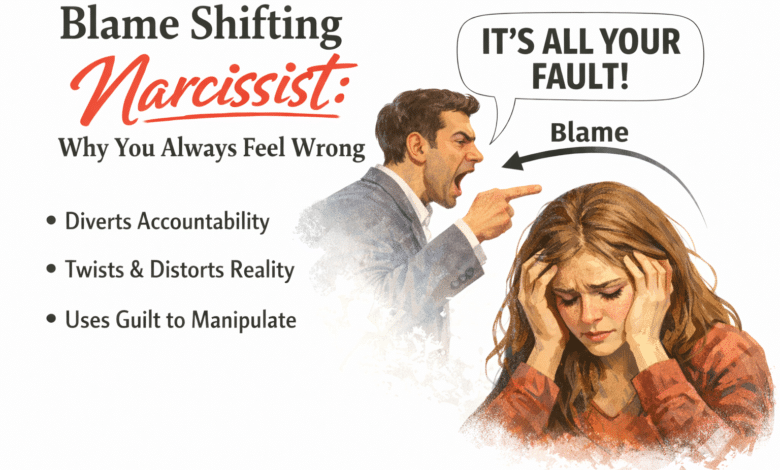
A blame shifting narcissist often uses blame shifting tactics, gaslighting behavior, psychological manipulation, and narcissistic defenses to redirect responsibility, creating confusion that makes people question their own reactions instead of understanding the interaction pattern.
“Clarity returned when I stopped trying to win the argument and started trying to understand the pattern.”
When arguments slowly begin to feel like personal failure, confusion replaces clarity and self-trust quietly fades.
The weight is not always in the conflict itself, but in the invisible shift where responsibility starts feeling heavy and personal.
Even after leaving, the nervous system can stay on alert because it learned unpredictability as normal. Regulation returns through consistency, not force.
INTRODUCTION -Blame Shifting Narcissist
A blame shifting narcissist may use blame shifting tactics, gaslighting behavior, psychological manipulation, and narcissistic defenses in ways that leave people questioning their own reactions rather than understanding the pattern.
Many readers arrive here with one core fear: “Am I losing myself?”
Often the misunderstanding lies between trauma responses and identity, where adaptation is mistaken for weakness.
If you feel confused or self-critical after conflict, you are not alone — these reactions reflect learned survival, not personal failure.
This article will help you understand what’s happening — without labels, blame, or self-attack.
REASON FOR THIS BLOG -Blame Shifting Narcissist
To explain why self-doubt appears when responsibility repeatedly shifts during conflict, and to help readers separate emotional adaptation from identity — without diagnosis, judgment, or pressure to act quickly.
INNER SEARCH MIRROR – Blame Shifting Narcissist
You may be searching because something feels familiar but difficult to explain:
-
Why do I feel wrong after every argument?
-
Why do conversations leave me doubting myself?
-
Is this manipulation or am I overreacting?
-
Why do I apologize even when hurt?
-
Why does clarity disappear during conflict?
-
Why does guilt stay longer than the issue itself?
Please Explore This Blog borderline-and-narcissist-couple-dynamics
PSYCHOLOGICAL EXPLANATION – Blame Shifting Narcissist
Blame Shifting Narcissist Patterns: How Responsibility Gets Reversed
A blame shifting narcissist dynamic often includes blame shifting tactics, gaslighting behavior, psychological manipulation, and narcissistic defenses that redirect attention away from accountability.
Over time, the mind adapts by scanning for personal mistakes instead of evaluating interaction patterns. This is not weakness; it is survival conditioning shaped by repeated emotional pressure.
The brain learns to reduce conflict by internalizing responsibility, even when it does not belong there.
Understanding this distinction helps reduce self-blame and restore perspective without assuming intent or assigning clinical labels.
| Pattern | Internal Effect |
|---|---|
| Responsibility reversal | Self-doubt increases |
| Emotional confusion | Overthinking grows |
| Mixed signals | Trust weakens |
Personal note: Clarity often begins when patterns are observed without trying to prove who is right.
NERVOUS SYSTEM EXPLANATION – Blame Shifting Narcissist
Blame Shifting Narcissist Dynamics Through a Nervous System Lens
Within a blame shifting narcissist pattern, blame shifting tactics, gaslighting behavior, psychological manipulation, and narcissistic defenses activate threat responses before conscious reasoning begins.
The nervous system interprets unpredictability as danger, triggering fight, flight, or freeze reactions automatically.
Emotional reactions happen faster than logical thought, which explains why words may feel confusing or overwhelming during conflict.
Recognizing these biological responses reduces shame and supports regulation without forcing immediate decisions.
Common warning signs:
-
Sudden anxiety during conversations
-
Difficulty expressing thoughts clearly
-
Strong urge to apologize quickly
-
Mental blankness or shutdown
-
Lingering tension after interaction
Personal note: Many people discover relief when they realize their reactions are physiological, not personal failures.
CORE DISTINCTION -Blame Shifting Narcissist
Identity vs Survival Responses
Survival responses are protective mechanisms shaped by repeated emotional environments; identity reflects values, conscience, and deeper self-direction.
A blame shifting narcissist dynamic can blur this boundary through blame shifting tactics, gaslighting behavior, psychological manipulation, and narcissistic defenses, causing survival strategies to feel like personal flaws.
Protection is not identity. Adaptation is not character weakness.
Authority emerges when this distinction becomes clear: survival seeks safety in the moment, while identity remains stable beyond the interaction.
Understanding this separation restores self-trust without needing to change who you are.
Please Explore This Blog borderline-narcissist-traits-emotional-patterns
TRAUMA VS NARCISSISM – Blame Shifting Narcissist
Trauma Responses vs Blame Shifting Narcissist Patterns
Within a blame shifting narcissist dynamic, blame shifting tactics, gaslighting behavior, psychological manipulation, and narcissistic defenses can look similar to trauma reactions, but motivation differs.
Trauma responses seek safety and often include remorse and reflection; patterns driven by control avoid accountability.
Understanding motivation reduces self-labeling and restores clarity without diagnosis.
| Trauma Response | Control Pattern |
|---|---|
| Reflects afterward | Avoids reflection |
| Feels remorse | Deflects responsibility |
| Seeks repair | Redirects blame |
Personal note: Relief often begins when behavior is viewed through motivation rather than labels.
GROWTH DIRECTION -Blame Shifting Narcissist
Blame Shifting Narcissist Patterns and Gentle Reorientation
Healing from a blame shifting narcissist pattern involves recognizing blame shifting tactics, gaslighting behavior, psychological manipulation, and narcissistic defenses without rushing toward solutions.
Growth appears quietly through slower reactions, reduced self-blame, and choosing calm over constant explanation.
Agency returns when understanding replaces urgency, allowing space for stability and internal safety to develop naturally.
Personal note: Progress sometimes looks less like change and more like feeling less pulled into old reactions.
HEALING COMPASS / ORIENTATION TABLE – Blame Shifting Narcissist
Healing often moves gradually rather than dramatically. The process may follow a simple orientation:
| Stage | Gentle Orientation |
|---|---|
| Awareness | “Something feels different.” |
| Understanding | Patterns begin making sense |
| Regulation | Emotions settle more easily |
| Boundaries | Energy becomes clearer |
| Protection | Self-trust strengthens quietly |
Insight becomes stability when clarity is allowed to unfold at a natural pace.
Please Explore This Blog borderline-or-narcissist-psychological-differences
🌿 10 Signs — Blame Shifting Narcissist: Why You Always Feel Wrong
Responsibility Gets Reversed During Conflict
A blame shifting narcissist may use blame shifting tactics, gaslighting behavior, psychological manipulation, and narcissistic defenses to redirect responsibility, leaving you explaining yourself repeatedly while the original issue quietly disappears.
Conversations End With Self-Doubt
Blame shifting tactics combined with gaslighting behavior can create confusion where psychological manipulation subtly reshapes memory, and narcissistic defenses keep focus away from accountability toward your reactions.
Apologizing Becomes Automatic
Psychological manipulation and blame shifting tactics within a blame shifting narcissist dynamic can condition quick apologies, while gaslighting behavior and narcissistic defenses reinforce feeling responsible for emotional harmony.
Issues Shift Away From Original Topic
Gaslighting behavior and psychological manipulation may redirect discussions, while narcissistic defenses maintain control through blame shifting tactics that transform simple disagreements into personal criticism.
You Feel Guilty Without Clear Reason
A blame shifting narcissist pattern often includes psychological manipulation and gaslighting behavior that activate internal guilt, supported by blame shifting tactics and narcissistic defenses that obscure clarity.
Emotional Reactions Are Used Against You
Blame shifting tactics paired with psychological manipulation may highlight your emotional responses as proof of fault, while gaslighting behavior and narcissistic defenses reinforce confusion about your own perspective.
Boundaries Become Framed as Overreaction
Gaslighting behavior and narcissistic defenses may reinterpret boundaries as problems, while psychological manipulation and blame shifting tactics subtly suggest you are creating conflict unnecessarily.
Clarity Appears Only After Conversations End
Psychological manipulation within a blame shifting narcissist dynamic often creates delayed clarity, as gaslighting behavior and blame shifting tactics disrupt real-time understanding through emotional pressure.
You Try Harder to Explain Yourself Each Time
Blame shifting tactics and narcissistic defenses encourage over-explaining, while psychological manipulation and gaslighting behavior maintain imbalance by shifting focus away from shared responsibility.
Feeling Wrong Becomes the Default
Over time, psychological manipulation, blame shifting tactics, gaslighting behavior, and narcissistic defenses can normalize self-doubt, making internal criticism feel familiar even when situations do not justify it.
🌱 CLOSING NOTE
Recognizing patterns connected to a blame shifting narcissist does not require blame or labeling; it begins with restoring clarity and reducing self-attack. Understanding blame shifting tactics, gaslighting behavior, psychological manipulation, and narcissistic defenses allows space for gentler self-trust to return. Healing rarely comes from forcing answers but from noticing when responsibility quietly shifts and choosing steadiness over confusion.
Please Explore This Blog borderline-vs-narcissist-clinical-comparison
🌿 A Whole-System View of the Human Healing Process
Medical / Ethical Positioning – Blame Shifting Narcissist
A blame shifting narcissist dynamic involving psychological manipulation can influence how the mind assigns meaning to conflict.
Ethical understanding avoids diagnosis and focuses instead on patterns of interpretation — where confusion arises not from weakness but from repeated exposure to shifting responsibility.
Healing begins when meaning-making becomes compassionate rather than self-critical.
| Ethical Lens | Interpretation Shift |
|---|---|
| Pattern awareness | Reduces self-blame |
| Context focus | Clarifies confusion |
| Non-diagnosis stance | Maintains safety |
| Slow insight | Prevents pressure |
Personal note: Ethical clarity often restores stability before emotional certainty returns.
Psychological Layer – Blame Shifting Narcissist
Within a blame shifting narcissist pattern, gaslighting behavior can alter internal narratives by reframing events subtly.
The psyche adapts by searching for internal errors to reduce relational tension. This survival logic protects connection but may weaken self-trust temporarily.
Recognizing psychological adaptation helps reframe confusion as a learned strategy rather than a personal flaw.
| Psychological Process | Internal Result |
|---|---|
| Meaning distortion | Doubt increases |
| Responsibility scanning | Self-criticism rises |
| Conflict anticipation | Hyper-awareness forms |
| Emotional reasoning | Clarity fluctuates |
Personal note: The mind often chooses perceived safety over accuracy when pressure is repeated.
Nervous System Layer – Blame Shifting Narcissist
In a blame shifting narcissist dynamic involving blame shifting tactics, the nervous system prioritizes protection through automatic reactions.
Fight, flight, or freeze responses activate before conscious thought, shaping emotional responses and speech patterns.
These reactions are biological signals aimed at safety rather than evidence of weakness or instability.
| Nervous Response | Protective Function |
|---|---|
| Freeze | Prevent escalation |
| Flight | Create distance |
| Fight | Restore control |
| Fawn | Maintain harmony |
Personal note: Understanding body responses often removes unnecessary shame from emotional reactions.
Mental Health Layer – Blame Shifting Narcissist
Exposure to psychological manipulation within a blame shifting narcissist context may gradually affect mental clarity, motivation, and internal confidence.
Long-term stress reshapes attention patterns, causing fatigue and difficulty trusting personal perception.
Recognizing these impacts helps separate temporary strain from identity or long-term capability.
| Mental Impact | Experience |
|---|---|
| Cognitive fatigue | Slower decisions |
| Emotional depletion | Reduced resilience |
| Self-doubt loops | Hesitation increases |
| Focus fragmentation | Energy drains faster |
Personal note: Mental exhaustion often signals prolonged stress, not lack of strength.
Identity Layer (Inner Continuity & Meaning)
Even within a blame shifting narcissist dynamic involving narcissistic defenses, identity remains deeper than survival strategies.
Values, empathy, and conscience continue beneath protective reactions.
Healing involves reconnecting with this stable inner continuity rather than attempting to rebuild identity from scratch.
| Identity Anchor | Inner Stability |
|---|---|
| Values | Direction remains |
| Conscience | Moral clarity persists |
| Self-awareness | Growth continues |
| Meaning-making | Purpose evolves |
Personal note: Identity often stays intact even when behavior changes to survive.
Reflective Support Layer (Including AI)
(How tools mirror thoughts without directing them)
Support tools such as journaling, reflective conversation, or AI can provide neutral mirrors during a blame shifting narcissist pattern involving psychological manipulation.
These tools do not replace personal judgment but help externalize thoughts, making patterns visible without pressure or directive advice.
| Reflective Tool | Function |
|---|---|
| Journaling | Externalizes thoughts |
| Calm dialogue | Organizes emotion |
| AI reflection | Pattern recognition |
| Structured prompts | Slow thinking |
Personal note: Reflection becomes powerful when it guides awareness rather than decisions.
Please Explore This Blog bpd-and-narcissism-psychological-overlap
Integration Layer — Whole-System Healing Orientation
Healing within a blame shifting narcissist context emerges when psychological manipulation is understood across systems rather than isolated as one problem.
The mind interprets meaning, the body protects safety, mental energy fluctuates, and identity remains continuous beneath adaptation.
Whole-system awareness allows recovery to unfold gradually, supporting clarity without urgency.
Instead of forcing change, integration invites steady observation and compassionate adjustment, allowing patterns to soften naturally as stability grows.
| Integration Focus | Result |
|---|---|
| Awareness | Reduced confusion |
| Regulation | Emotional steadiness |
| Reflection | Clearer perspective |
| Continuity | Restored self-trust |
Personal note: Healing often feels less like transformation and more like remembering stability already present.
PERSONAL NOTE – Blame Shifting Narcissist
Over time, I noticed that conversations linked to a blame shifting narcissist pattern often felt confusing not because of intensity but because responsibility quietly moved without clear acknowledgment.
When blame shifting tactics and psychological manipulation appear repeatedly, the instinct is to search for personal mistakes rather than observe the interaction itself.
Learning to pause and notice patterns instead of judging myself changed how I understood conflict.
It was not about proving anyone wrong or assigning labels; it was about restoring internal clarity.
Self-trust began returning when I stopped assuming confusion meant weakness and started recognizing adaptation as a natural response to emotional unpredictability.
Please Explore This Blog bpd-and-narcissist-couple-relationship-cycle-explained
COSMIC / PHILOSOPHICAL TAKEAWAY – Blame Shifting Narcissist
“Clarity grows not by forcing answers, but by allowing awareness to soften what confusion once held tightly.”
A blame shifting narcissist dynamic involving blame shifting tactics, gaslighting behavior, psychological manipulation, and narcissistic defenses can make reality feel unstable, yet human awareness has a quiet ability to reorganize meaning over time.
Healing does not require dramatic transformation; it unfolds through small moments of recognition where perception becomes steadier.
When awareness replaces reaction, the mind begins reconnecting with truth gently rather than through struggle.
Understanding becomes less about controlling others and more about aligning with inner stability.
In this way, growth feels less like change and more like remembering who you were beneath adaptation.
FINAL CLOSING – Blame Shifting Narcissist
Understanding a blame shifting narcissist pattern, including blame shifting tactics, gaslighting behavior, psychological manipulation, and narcissistic defenses, is not about labeling people or forcing decisions.
It is about reclaiming calm clarity and reducing unnecessary self-attack. Nothing is wrong with you for reacting to confusion or emotional pressure; many responses emerge from a nervous system trying to maintain safety.
Healing often begins when pressure to immediately resolve everything is replaced with gentleness toward yourself.
If something in this article felt familiar, allow that recognition to exist without urgency. Stability grows gradually, and self-trust returns through steady awareness rather than force.
FAQ SECTION – Blame Shifting Narcissist
❓ What is a blame shifting narcissist?
It refers to interaction patterns where responsibility is redirected away from oneself during conflict, often creating confusion and self-doubt for others.
❓ Is blame shifting always narcissism?
No. Many people shift blame occasionally under stress. Patterns, consistency, and lack of reflection distinguish ongoing dynamics from isolated behavior.
❓ Why do I feel wrong after every argument?
Repeated responsibility reversal can train the mind to assume fault quickly, even when situations are complex or shared.
❓ How does gaslighting behavior affect perception?
Gaslighting may subtly challenge memory or interpretation, which can weaken confidence in personal experiences over time.
❓ Why does clarity come after conversations end?
Stress responses activate during conflict, limiting cognitive processing. Understanding often returns once the nervous system settles.
❓ Can psychological manipulation be unintentional?
Sometimes patterns develop unconsciously. Observing effects is more helpful than assuming intent.
❓ How do I know if I am overreacting?
Notice whether self-doubt appears consistently after interactions. Repeated confusion can signal relational patterns rather than personal failure.
❓ Does healing require confrontation?
Not necessarily. Awareness and internal stability often precede external decisions.
❓ Why does the feeling last after leaving?
The nervous system may remain alert because it learned unpredictability as normal; regulation returns gradually through consistency.
❓ What helps restore self-trust?
Slow observation, reduced self-criticism, and understanding emotional responses as adaptations rather than identity.
🌿 Final Blog Footer — Bio & Brain Health Info
Written by Lex, founder of Bio & Brain Health Info — exploring the intersections of psychology, spirituality, and emotional recovery through calm, trauma-aware understanding.
✨ Insight & Reflection
Healing does not begin when answers arrive — it begins when self-attack stops.
Clarity grows in spaces where safety is restored.
🧠 Learn
Narcissism • Emotional Healing • Spiritual Psychology
🌍 A Moment for You
💡 Pause for two minutes. Let your body settle before moving on.
🧭 If This Article Helped, Your Next Questions Might Be:
These questions are natural continuations — not obligations.
✨ Cosmic Family Invitation
You are not here by accident. If these words reached you, clarity was already beginning.
We rise together — different souls, one journey. 🕊️
📩 Connect with us
info@bioandbrainhealthinfo.com
Telegram: @bioandbrainhealthinfo
WhatsApp Channel: Punehealth
Lex | Bio & Brain Health Info
Cosmic Family — Different Souls, One Journey.
REFERENCES & CITATIONS – Blame Shifting Narcissist
Trusted Sources Supporting Psychological and Nervous System Understanding
-
American Psychiatric Association — Narcissistic Personality Disorder Overview
https://www.psychiatry.org/patients-families/personality-disorders/what-are-personality-disorders -
Cleveland Clinic — Gaslighting and Emotional Manipulation Explained
https://health.clevelandclinic.org/gaslighting/ -
Psychology Today — Understanding Narcissistic Behavior Patterns
https://www.psychologytoday.com/us/basics/narcissism -
National Institute of Mental Health (NIMH) — Trauma and Stress Responses
https://www.nimh.nih.gov/health/topics/post-traumatic-stress-disorder-ptsd -
Harvard Health Publishing — Stress Response and Brain Function
https://www.health.harvard.edu/mind-and-mood/understanding-the-stress-response -
Polyvagal Theory Overview (Stephen Porges Research Summary)
https://www.polyvagalinstitute.org -
Verywell Mind — Psychological Manipulation and Gaslighting Dynamics
https://www.verywellmind.com/what-is-gaslighting-5076080 -
APA Dictionary of Psychology — Defense Mechanisms Overview
https://dictionary.apa.org/defense-mechanism -
Mind.org.uk — Emotional Abuse and Relationship Dynamics
https://www.mind.org.uk/information-support/types-of-mental-health-problems/abuse/ -
Greater Good Science Center (UC Berkeley) — Emotional Regulation Research
https://greatergood.berkeley.edu/topic/emotion_regulation