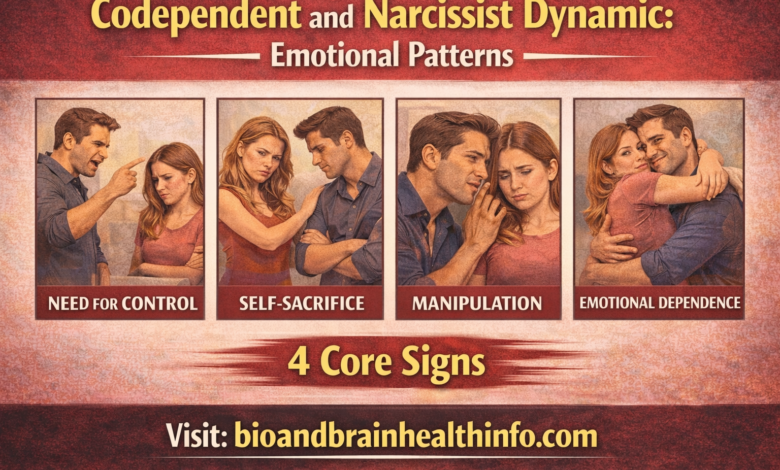
The codependent and narcissist dynamic often develops through trauma bond patterns, emotional dependency cycles, rescue patterns, and relationship imbalance dynamics that create strong emotional attachment while quietly increasing confusion and emotional strain.
“Attachment can feel like love when survival patterns become familiar.”
“Some relationships feel intense not because they are deeply aligned — but because emotional roles quietly become intertwined, making distance feel unfamiliar even when clarity begins.”
Even after leaving, the nervous system can stay on alert because it learned unpredictability as normal. Regulation returns through consistency, not force.
INTRODUCTION – Codependent and Narcissist Dynamic
The codependent and narcissist dynamic often develops through trauma bond cycles, emotional dependency patterns, rescue behaviors, and relationship imbalance that leave people wondering, “Why is this so hard to let go?”
Many misunderstand their reactions as weakness, when they are often survival adaptations shaped by relational patterns rather than identity flaws.
Emotional attachment can feel powerful because roles reinforce each other over time.
This article will help you understand what’s happening — without labels, blame, or self-attack.
REASON FOR THIS BLOG – Codependent and Narcissist Dynamic
This article explores how relational patterns form between emotional dependency and self-focused dynamics, helping readers recognize adaptation rather than self-blame and understand the psychological mechanisms behind relationship imbalance without diagnosis or judgment.
INNER SEARCH MIRROR – Codependent and Narcissist Dynamic
You may recognize yourself asking:
Why does leaving feel harder than staying?
Why do I feel responsible for fixing things?
Why does emotional intensity feel like connection?
Why do I return even after deciding to leave?
Why does distance create anxiety instead of relief?
PSYCHOLOGICAL EXPLANATION – Codependent and Narcissist Dynamic
The codependent and narcissist dynamic often reflects trauma bond cycles where emotional dependency, rescue patterns, and relationship imbalance reinforce each other psychologically.
One partner may seek validation through giving or fixing, while the other maintains stability through receiving or directing attention. These patterns form gradually through adaptation rather than intention alone.
Individuals may internalize responsibility for relational harmony, increasing self-monitoring and emotional investment.
Understanding this separates intent from reaction — many responses developed as strategies to maintain connection rather than signs of personal weakness.
Dynamic Pattern
Adaptive Response
Emotional imbalance
Increased caretaking
Personal note: Awareness often begins when patterns are observed without judgment.
NERVOUS SYSTEM EXPLANATION – Codependent and Narcissist Dynamic
The codependent and narcissist dynamic can strongly influence biological responses because trauma bond interactions combine emotional reward with unpredictability.
Emotional dependency cycles activate fight, flight, or freeze responses before conscious reasoning occurs. The nervous system learns to anticipate emotional shifts, interpreting intensity as familiarity.
This explains why leaving may feel physically uncomfortable even when logically understood.
Warning signs may include:
Emotional highs followed by exhaustion
Strong urge to restore connection quickly
Anxiety during emotional distance
Overthinking conversations
Difficulty relaxing after conflict
Personal note: The body often reacts to relational patterns faster than the mind can interpret them.
Identity vs Survival Responses – Codependent and Narcissist Dynamic
The codependent and narcissist dynamic involves trauma bond patterns, emotional dependency cycles, rescue roles, and relationship imbalance that shape behavior — but these adaptations do not define identity.
Survival equals protection: automatic responses developed to maintain emotional connection or reduce conflict. Identity reflects values, conscience, and authentic choice.
Recognizing this distinction restores authority: reactions belong to learned relational patterns, while identity remains stable beneath adaptation.
Understanding this separation allows individuals to observe dynamics without turning against themselves.
TRAUMA VS NARCISSISM – Codependent and Narcissist Dynamic
Understanding the codependent and narcissist dynamic helps reduce fear of self-labeling when trauma bond patterns, emotional dependency, rescue roles, and relationship imbalance appear similar to narcissistic behavior. The difference lies in motivation rather than actions.
Trauma-Based Response
Narcissistic Pattern
Reflects with remorse
Protects self-image
Seeks understanding
Avoids accountability
Questions own impact
Redirects responsibility
Personal note: Genuine reflection usually signals healing, not narcissism.
GROWTH DIRECTION – Codependent and Narcissist Dynamic
Recognizing the codependent and narcissist dynamic within trauma bond cycles, emotional dependency patterns, rescue behaviors, and relationship imbalance can gently shift awareness.
Growth may appear as slower emotional responses, clearer internal boundaries, and a gradual movement toward calm interactions.
Healing reflects realignment rather than fixing.
Personal note: Progress often feels like increased steadiness instead of dramatic change.
HEALING COMPASS / ORIENTATION TABLE
Stage
Gentle Orientation
Awareness
“Patterns become visible.”
Understanding
“Reactions have context.”
Regulation
“Slowing supports clarity.”
Integration
“New choices emerge naturally.”
Protection
“Peace grows through boundaries.”
This compass offers a steady map that converts insight into stability without pressure or urgency.
1️⃣ Codependent and Narcissist — Emotional Roles Become Fixed
A trauma bond may develop when emotional highs and lows reinforce attachment. Over time, predictable emotional cycles create familiarity, making the relationship feel deeply significant even when imbalance exists.
2️⃣ Codependent and Narcissist — Caretaking Defines Identity
Emotional dependency can lead one partner to prioritize the other’s emotional state, creating a sense of purpose through support while personal needs gradually move into the background.
3️⃣ Codependent and Narcissist — Fixing Feels Like Love
Rescue patterns may appear as constant problem-solving or emotional repair attempts. This can strengthen attachment while maintaining imbalance between giving and receiving.
4️⃣ Codependent and Narcissist — Unequal Emotional Responsibility
Relationship imbalance occurs when one partner manages harmony while the other maintains control of direction or attention, reinforcing complementary but uneven roles.
5️⃣ Codependent and Narcissist — Intensity Mistaken for Connection
Trauma bond dynamics often create emotional intensity that feels meaningful, even when stability is inconsistent or unpredictable.
6️⃣ Boundaries Feel Difficult to Maintain
Emotional dependency may cause discomfort when asserting personal needs, as connection feels linked to availability or emotional sacrifice.
7️⃣Helping Becomes a Default Role
Rescue patterns can become automatic, where offering solutions or reassurance maintains emotional closeness while limiting equal partnership.
8️⃣ Communication Revolves Around One Partner
Relationship imbalance may appear through conversations centered on one person’s experiences, leaving the other feeling responsible for maintaining emotional flow.
9️⃣ Leaving Feels Physically Uncomfortable
Trauma bond cycles may create strong emotional pull, making distance feel unsettling even when the mind recognizes imbalance.
🔟Self-Worth Linked to Being Needed
Emotional dependency can tie identity to caregiving roles, reinforcing attachment through usefulness rather than mutual emotional exchange.
🌱 Closing Note
Recognizing the codependent and narcissist dynamic is not about assigning blame but about understanding how complementary roles can develop over time. Awareness supports emotional clarity, helping individuals move toward balance, self-respect, and healthier relational patterns gradually.
🌿 A Whole-System View of the Human Healing Process
🩺 Medical / Ethical Positioning
Understanding the codependent and narcissist dynamic from an ethical perspective helps the mind interpret threat and confusion without assigning blame.
Trauma bond patterns and relationship imbalance influence perception subtly, shaping meaning through repeated emotional reinforcement.
Ethical healing focuses on recognizing patterns and reclaiming personal agency rather than defining individuals.
Ethical Perspective
Meaning Shift
Observation
Notice patterns without labeling
Emotional signals
Context over judgment
Boundaries
Self-responsibility
Healing stance
Compassion with clarity
Personal note: Ethical understanding often brings calm where analysis once created tension.
🧠 Psychological Layer
The psychology behind the codependent and narcissist dynamic involves emotional dependency and rescue patterns that reinforce internal narratives about connection and safety.
Over time, individuals may interpret intensity as closeness, creating cognitive frameworks that normalize imbalance.
Psychological healing emerges when these internal narratives become visible and flexible.
Psychological Mechanism
Internal Effect
Reinforcement cycles
Emotional attachment
Role identity
Caretaking focus
Meaning-making
Interpreting intensity as love
Cognitive reframing
New relational perspective
Personal note: Awareness begins when familiar patterns are seen from new angles.
⚡ Nervous System Layer
The codependent and narcissist dynamic may influence biological responses because trauma bond cycles combine reward and unpredictability.
The body learns to associate emotional intensity with connection, triggering automatic protective reactions before conscious awareness.
Body Response
Protective Function
Elevated alertness
Anticipate emotional shifts
Emotional surge
Maintain connection
Freeze response
Avoid conflict
Energy fluctuation
Regulate unpredictability
Personal note: The nervous system remembers emotional rhythms even after logic changes.
🌱 Mental Health Layer
Long-term involvement in a codependent and narcissist dynamic can affect mental clarity and emotional stamina.
Relationship imbalance and emotional dependency may create persistent internal monitoring, influencing self-confidence and decision-making without indicating personal inadequacy.
Mental Impact
Gentle Interpretation
Overthinking
Safety evaluation
Emotional fatigue
Sustained engagement
Self-questioning
Adaptive reflection
Reduced focus
Emotional overload
Personal note: Mental exhaustion often reflects adaptation, not weakness.
🧭 Identity Layer (Inner Continuity & Meaning)
Despite the codependent and narcissist dynamic, identity remains intact beneath survival roles created by trauma bond experiences.
Values and conscience continue guiding internal direction even when behavior adapts to relational imbalance.
Identity Element
Stable Quality
Core values
Inner guidance
Personal meaning
Evolving awareness
Authentic voice
Gradual return
Self-direction
Quiet resilience
Personal note: Identity often reappears when emotional pressure softens.
🤝 Reflective Support Layer (Including AI)
Exploring the codependent and narcissist dynamic through journaling, reflective conversation, or AI mirroring allows emotional patterns to be seen from outside perspective.
These tools help individuals slow interpretation and observe emotional dependency cycles without immediate reaction.
Reflective Tool
Support Role
Journaling
Externalize thoughts
Guided reflection
Slow emotional processing
AI mirroring
Pattern visibility
Silent observation
Integrate insight
Personal note: Reflection becomes transformative when curiosity replaces urgency.
🌌 Integrated Whole-System Perspective – Codependent and Narcissist Dynamic
Healing from the codependent and narcissist dynamic involves aligning ethical awareness, psychological understanding, nervous system regulation, identity continuity, and reflective support.
Trauma bond patterns and rescue dynamics affect multiple layers simultaneously, yet healing unfolds when these layers reconnect gently.
Tools like journaling or reflective AI provide distance from emotional intensity, allowing individuals to reinterpret patterns without blame.
A whole-system approach recognizes growth as gradual integration rather than sudden change, restoring balance through consistent awareness and self-trust.
Integrated Layer
Healing Direction
Ethical clarity
Balanced perspective
Psychological flexibility
New meaning
Nervous system regulation
Consistent safety
Reflective integration
Growing stability
Personal note: Whole-system healing often feels like returning to inner equilibrium rather than creating something new.
PERSONAL NOTE – Codependent and Narcissist Dynamic
Writing about the codependent and narcissist dynamic explained taught me that emotional patterns often look confusing only when viewed through judgment instead of understanding.
Trauma bond experiences and relationship imbalance can make people question their identity, yet many reactions are adaptive responses shaped by emotional dependency and rescue patterns.
Over time I learned that clarity did not come from labeling myself or others but from observing behavior without self-attack.
Healing felt less like fixing something broken and more like recognizing what had been protecting me.
When emotional patterns were seen gently, inner stability slowly returned, showing that growth comes from awareness rather than pressure.
COSMIC / PHILOSOPHICAL TAKEAWAY
“Growth begins when meaning replaces confusion.”
The codependent and narcissist dynamic explained reminds us that human relationships often mirror deeper survival learning rather than conscious intention.
Trauma bond cycles and emotional dependency arise when connection and uncertainty intertwine, creating powerful emotional gravity.
Yet beneath rescue patterns and relationship imbalance exists an inner compass that seeks balance naturally. Healing does not require erasing the past but understanding how experiences shaped perception.
When awareness expands, identity separates from survival responses, allowing individuals to reclaim direction.
Seen from a wider perspective, every relational struggle becomes part of a larger human journey toward self-understanding, compassion, and conscious choice.
FINAL CLOSING – Codependent and Narcissist Dynamic
Understanding the codependent and narcissist dynamic explained does not mean judging yourself or anyone involved.
Trauma bond reactions and emotional dependency patterns develop for reasons connected to safety and connection. Nothing is wrong with you for adapting to emotional intensity.
Healing often begins quietly — noticing relationship imbalance without urgency, choosing peace over analysis, and allowing your nervous system to rediscover steadiness.
There is no pressure to change everything immediately. Small moments of clarity gradually reshape emotional experience.
If something in this article resonated, simply allow awareness to grow gently. Change emerges from understanding, not force.
FAQ SECTION – Codependent and Narcissist Dynamic
1. What is a codependent and narcissist dynamic?
It describes a relational pattern where emotional dependency and control behaviors interact, often creating cycles of imbalance and strong attachment.
2. Why does the relationship feel addictive?
Trauma bond patterns combine emotional reward and unpredictability, making connection feel intense and difficult to leave.
3. Does being codependent mean something is wrong with me?
No. Codependency often develops as an adaptive response to relational environments.
4. Can a relationship imbalance change over time?
Change is possible when awareness, boundaries, and mutual responsibility increase.
5. Why do I feel responsible for their emotions?
Rescue patterns may develop when emotional safety becomes linked to caring for others’ reactions.
6. Is emotional dependency always unhealthy?
Dependency itself is natural; imbalance occurs when needs become one-sided or self-sacrificing.
7. How can I recognize trauma bond signs?
Strong emotional highs and lows, difficulty leaving, and persistent self-doubt are common indicators.
8. Can healing happen without leaving the relationship?
Sometimes, if both individuals actively engage in growth and accountability.
9. Why does confusion remain after separation?
The nervous system may continue reacting to learned relational patterns even after distance.
10. What helps restore inner balance?
Gentle awareness, emotional regulation, and gradual rebuilding of personal boundaries.
FINAL CLOSING – Codependent and Narcissist Dynamic
The codependent and narcissist dynamic explained is ultimately about understanding human adaptation rather than assigning blame.
Trauma bond experiences, rescue patterns, and emotional dependency show how deeply humans seek connection and safety.
If you recognize parts of yourself here, allow that recognition to be an act of compassion rather than criticism. Healing unfolds through patience and consistent self-respect, not urgency.
You are allowed to move slowly, to learn gently, and to rediscover balance step by step. Nothing is wrong with you for reacting to harm.
With safety and understanding, what adapted can soften again.
🌿 Final Blog Footer — Bio & Brain Health Info
Written by Lex, founder of Bio & Brain Health Info — exploring the intersections of psychology, spirituality, and emotional recovery through calm, trauma-aware understanding.
✨ Insight & Reflection Healing does not begin when answers arrive — it begins when self-attack stops. Clarity grows in spaces where safety is restored.
🌍 A Moment for You 💡 Pause for two minutes. Let your body settle before moving on.
🧭 If This Article Helped, Your Next Questions Might Be: How trauma bonds form • Emotional boundaries • Nervous system healing • Identity recovery after relationship imbalance
✨ Cosmic Family Invitation You are not here by accident. If these words reached you, clarity was already beginning. We rise together — different souls, one journey. 🕊️