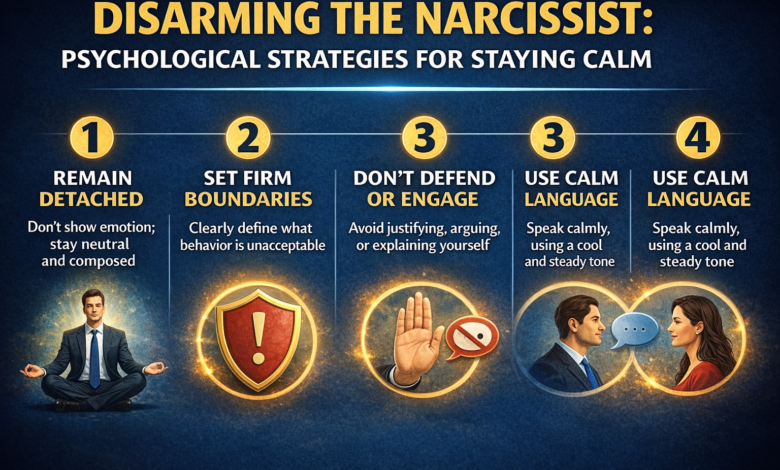
disarming the narcissist, emotional detachment, gray rock method, boundary setting, conflict strategies
Disarming the narcissist involves emotional detachment, the gray rock method, boundary setting, and conflict strategies designed to reduce escalation while maintaining psychological stability.
Thank you for reading this post, don't forget to subscribe!
“Calm is not weakness — it is strategic clarity.”
Sometimes the goal is not to win — it is to remain steady when intensity rises.
Even after leaving, the nervous system can stay on alert because it learned unpredictability as normal. Regulation returns through consistency, not force.
🔷 Disarming the Narcissist
This article explores disarming the narcissist not as a power battle, but as a regulation strategy.
Emotional detachment is not coldness; the gray rock method is not punishment; boundary setting is not aggression; and conflict strategies are not about winning.
The goal is stability — reducing reactivity while preserving dignity. Disarming the narcissist begins internally, not externally.
This article will help you understand what’s happening — without labels, blame, or self-attack.
REASON FOR THIS BLOG – Disarming the Narcissist
To explain how disarming the narcissist works psychologically. To separate nervous system reactions from identity while offering calm, ethical strategies for stability.
PSYCHOLOGICAL EXPLANATION- Disarming the Narcissist
Disarming the narcissist begins internally, not externally. Emotional detachment reduces reinforcement of reactive cycles.
The gray rock method limits emotional engagement, preventing escalation. Boundary setting clarifies limits without entering power contests, and conflict strategies focus on containment rather than persuasion.
Psychologically, individuals often adapt by overexplaining or defending themselves to restore fairness.
This adaptation reflects survival conditioning within unpredictable dynamics. Stability grows when intention shifts from “changing them” to regulating self.
Reactive Pattern
Strategic Shift
Overexplaining
Brief responses
Emotional engagement
Neutral tone
Personal note: Calm clarity interrupts escalation.
NERVOUS SYSTEM EXPLANATION – Disarming the Narcissist
Disarming the narcissist also requires understanding nervous system activation. Emotional detachment helps reduce fight responses.
The gray rock method minimizes stimulation that fuels escalation. Boundary setting stabilizes safety cues, and conflict strategies prevent prolonged stress loops. The body reacts before logic.
Common signals include:
Rapid heartbeat
Defensive tone
Mental racing
Muscle tension
Emotional flooding
Reactivity happens automatically; awareness allows regulation before response.
Personal note: The body seeks safety before justice.
CORE DISTINCTION – Disarming the Narcissist
Identity vs Survival Responses
Disarming the narcissist is not about becoming cold or passive.
Survival responses = defending, proving, arguing, escalating to restore balance. Identity = your values, dignity, emotional integrity.
Emotional detachment is not indifference. The gray rock method is not suppression.
Boundary setting is not aggression. Conflict strategies are not surrender.
When survival patterns feel intense, it reflects threat detection — not character flaw. The distinction restores internal authority and prevents self-attack.
TRAUMA VS NARCISSISM – Disarming the Narcissist
When learning about disarming the narcissist, some fear: Am I becoming manipulative too? Emotional detachment, the gray rock method, boundary setting, and conflict strategies differ in motivation.
Trauma-Based Response
Narcissistic Pattern
Remorse after harm
Little accountability
Self-reflection
Image protection
Repair attempts
Blame shifting
Personal note: Intention reveals identity more than reaction.
GROWTH DIRECTION -Disarming the Narcissist
Disarming the narcissist often becomes less about technique and more about internal steadiness.
Emotional detachment feels lighter, the gray rock method becomes natural, boundary setting feels clearer, and conflict strategies become shorter.
Healing shows up as slower reactions, fewer explanations, and choosing peace over proving. Calm grows quietly.
Personal note: Stability feels like reduced urgency.
HEALING COMPASS / ORIENTATION TABLE -Disarming the Narcissist
Stage
Inner Orientation
Awareness
“I see the pattern.”
Regulation
“I pause before reacting.”
Clarity
“Not every conflict needs engagement.”
Boundary
“Limits protect stability.”
Integration
“Calm becomes natural.”
This compass reframes disarming the narcissist as internal regulation, not external control.
When emotional detachment grows, you notice fewer impulsive reactions and more intentional responses. Emotional detachment allows internal distance from triggering behavior without suppressing feelings. This shift shows that disarming the narcissist starts internally, where emotional clarity reduces the need to defend or explain constantly.
🔹 2. Conversations Become Neutral Instead of Defensive
The gray rock method creates predictable communication patterns that avoid emotional escalation. Instead of arguing or over-explaining, responses become brief and neutral. The gray rock method helps reduce emotional fuel that often keeps conflict cycles active, supporting calmer relational dynamics.
🔹 3. Personal Limits Feel Clear and Steady
Boundary setting allows interactions to feel less confusing because expectations become visible. Through boundary setting, responsibility returns to each individual rather than remaining trapped in reactive loops. Disarming the narcissist includes strengthening personal clarity instead of seeking external approval.
🔹 4. Arguments Lose Their Urgency
Healthy conflict strategies reduce emotional urgency by slowing conversations and minimizing reactive language. Conflict strategies focused on regulation help prevent escalation while maintaining dignity. This shift signals that stability is becoming more important than winning disagreements.
🔹 5. Internal Stability Feels Stronger Than External Validation
Disarming the narcissist becomes noticeable when internal calm no longer depends on external responses. The focus moves toward maintaining emotional balance regardless of outcomes. This stage reflects growing self-trust and reduced emotional dependency.
🔹 6. Emotional Energy Is Protected More Carefully
Emotional detachment supports awareness of where energy is spent. You may notice fewer long explanations or attempts to fix misunderstandings. Emotional detachment helps conserve mental resources, allowing more grounded decision-making.
🔹 7. Silence Feels Safer Than Over-Explaining
Using the gray rock method often means allowing silence instead of filling space with emotional justification. The gray rock method teaches that calm neutrality communicates boundaries without confrontation, gradually reducing conflict intensity.
🔹 8. Boundaries Are Expressed Without Guilt
Boundary setting evolves from fear-based defense into calm self-respect. When boundary setting becomes natural, emotional responses feel less reactive. This reflects stronger identity alignment rather than avoidance.
🔹 9. Conflict Feels Manageable Instead of Overwhelming
Balanced conflict strategies allow engagement without emotional exhaustion. Conversations become shorter, clearer, and less charged. Conflict strategies help maintain safety without escalating emotional intensity.
🔹 10. Inner Calm Remains Even When Behavior Does Not Change
Disarming the narcissist ultimately means your stability no longer depends on another person’s behavior. The nervous system recognizes safety internally, allowing emotional freedom even when external patterns remain unchanged.
🌿 Closing Note
Disarming the narcissist is not about changing someone else — it is about restoring inner stability. Emotional detachment, gray rock method, boundary setting, and conflict strategies work together to reduce reactivity and strengthen calm presence. Progress appears quietly through consistency rather than dramatic change.
🌿 A Whole-System View of the Human Healing Process
🧭 Medical / Ethical Positioning – Disarming the Narcissist
Healing requires understanding how perception shapes experience. In disarming the narcissist, ethical positioning means recognizing how the mind interprets threat, confusion, and meaning without rushing into diagnosis.
Safety-focused understanding reduces blame while encouraging informed choices.
Ethical healing separates behavior observation from identity labeling and respects personal agency while acknowledging relational impact.
Core Aspect
Whole-System Meaning
Threat interpretation
Brain prioritizes survival signals
Confusion response
Mind seeks predictable meaning
Ethical clarity
Avoid premature labeling
Agency focus
Support informed decisions
🧠 Psychological Layer – Disarming the Narcissist
Psychologically, disarming the narcissist involves recognizing internal meaning-making patterns rather than controlling another person’s behavior.
The mind often interprets inconsistency as danger, creating self-doubt. Healing begins when interpretation shifts from self-blame toward contextual awareness.
In disarming the narcissist, the nervous system reacts before conscious thought. Automatic safety responses include fight, flight, freeze, or fawn.
The body interprets unpredictability as risk, activating protective reflexes.
Healing involves gradual regulation through consistency, allowing the nervous system to relearn safety without forcing emotional suppression.
Body Response
Protective Function
Fight
Defend against perceived threat
Flight
Seek escape from overwhelm
Freeze
Reduce stimulation exposure
Fawn
Maintain relational safety
🌱 Mental Health Layer – Disarming the Narcissist
Disarming the narcissist affects mental health through prolonged stress that can weaken clarity and self-trust. Chronic uncertainty drains cognitive energy and increases rumination.
Healing requires restoring predictability and internal stability rather than analyzing every interaction.
Improved emotional boundaries help rebuild mental focus and reduce internal chaos.
Identity remains deeper than reactive survival patterns. In disarming the narcissist, recognizing identity as values, conscience, and internal direction prevents confusion between temporary responses and core self.
Healing involves reconnecting with personal meaning beyond relational dynamics.
Identity Aspect
Inner Stability Role
Values
Guide decisions
Conscience
Maintain integrity
Self-concept
Anchor continuity
Purpose
Restore direction
🪞 Reflective Support Layer (Including AI) – Disarming the Narcissist
Reflective tools help mirror thoughts without directing outcomes.
When disarming the narcissist, journaling, conversation, or AI reflections allow observation without judgment.
This creates psychological distance that supports insight rather than reaction. Reflection strengthens awareness while preserving personal autonomy.
Reflective Tool
Function
Journaling
Externalize thoughts
Dialogue
Clarify perspectives
AI reflection
Neutral mirroring
Structured prompts
Encourage insight
🌌 Integration Layer — Whole-System Healing
Whole-system healing integrates cognitive understanding, emotional regulation, and identity alignment. Disarming the narcissist becomes less about external control and more about internal coherence.
Sustainable change occurs when perception, nervous system regulation, and values operate together.
Reflection tools assist integration by helping individuals observe patterns calmly and maintain perspective while rebuilding trust in their own responses.
Writing about disarming the narcissist changed how I understand conflict. I once believed strength meant explaining more, defending better, proving clarity.
Over time, I saw that emotional detachment was not coldness — it was nervous system wisdom.
The gray rock method was not silence — it was conservation of energy. Boundary setting was not rejection — it was alignment.
Conflict strategies were not about winning — they were about stability.
“Clarity returned for me when I stopped trying to win arguments and started protecting my nervous system.”
COSMIC / PHILOSOPHICAL TAKEAWAY – Disarming the Narcissist
“Calm is a form of power that does not need applause.”
Disarming the narcissist through emotional detachment, gray rock method, boundary setting, and conflict strategies reflects something deeper than tactics.
It reveals how consciousness matures under pressure. The nervous system seeks safety; the mind seeks meaning; identity seeks coherence.
When responses become regulated rather than reactive, inner authority strengthens quietly.
Not every storm must be answered with thunder. Sometimes evolution appears as steadiness.
FAQ SECTION – Disarming the Narcissist
1. Does disarming the narcissist mean ignoring them?
No. It means regulating your response rather than escalating engagement.
2. Is emotional detachment unhealthy?
Not when used to reduce reactivity and protect clarity.
3. Does the gray rock method always work?
It reduces emotional fuel but may not change behavior.
4. Are boundaries aggressive?
Healthy boundary setting communicates limits without hostility.
5. Why do conflicts escalate so quickly?
The nervous system reacts before logical reasoning.
6. Can conflict strategies stop manipulation?
They reduce reinforcement, not necessarily intent.
7. Why do I still feel tense after leaving?
The body may still associate unpredictability with threat.
Disarming the narcissist is not about controlling another person. It is about strengthening emotional detachment, practicing the gray rock method when necessary, maintaining boundary setting with clarity, and using conflict strategies that preserve dignity.
Nothing is wrong with you for reacting to intensity. With safety and understanding, what adapted can soften again. Regulation grows through consistency, not force.
If this article brought clarity, allow that clarity to settle. There is no urgency. Stability develops quietly.
🌿 Final Blog Footer — Bio & Brain Health Info
Written by Lex, founder of Bio & Brain Health Info — exploring the intersections of psychology, spirituality, and emotional recovery through calm, trauma-aware understanding.
✨ Insight & Reflection Healing does not begin when answers arrive — it begins when self-attack stops. Clarity grows in spaces where safety is restored.
🌍 A Moment for You 💡 Pause for two minutes. Let your body settle before moving on.
🧭 If This Article Helped, Your Next Questions Might Be: • Why do narcissistic patterns trigger anxiety? • How do boundaries rebuild self-trust? • What is the gray rock method psychologically? • How does trauma shape conflict responses?
✨ Cosmic Family Invitation You are not here by accident. If these words reached you, clarity was already beginning. We rise together — different souls, one journey. 🕊️