Discard Phase Narcissist: Phase Really Means
Why Narcissists Suddenly Leave

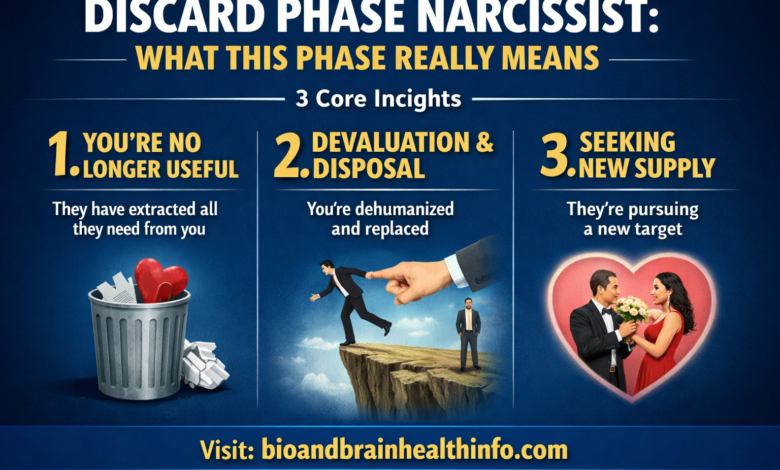
The discard phase narcissist pattern often appears inside the narcissistic abuse cycle — especially within the idealize devalue discard dynamic — where emotional withdrawal creates confusion, trauma bond break, and deep emotional questioning for the person left behind.
Thank you for reading this post, don't forget to subscribe!“Being discarded does not mean you were disposable; it often means the dynamic itself could not sustain real emotional depth.”
Sometimes the deepest pain is not the ending itself — but the sudden loss of emotional meaning we believed was real.
“Sometimes what hurts most is not the ending — but how suddenly the emotional meaning disappears.
Even after leaving, the nervous system can stay on alert because it learned unpredictability as normal. Regulation returns through consistency, not force.”
🧠 INTRODUCTION- Discard Phase Narcissist
The discard phase narcissist dynamic inside the narcissistic abuse cycle — especially the idealize devalue discard pattern — can create sudden emotional withdrawal that leaves people questioning their worth and struggling through a painful trauma bond break.
Many fear they are losing themselves, when in reality the reaction reflects nervous system adaptation rather than identity failure.
The confusion comes from mistaking survival responses for personal flaws. You are not alone in this experience.
This article will help you understand what’s happening — without labels, blame, or self-attack.
🌱 REASON FOR THIS BLOG – Discard Phase Narcissist
To help readers understand why emotional confusion and self-doubt often appear after relational rupture and to separate trauma-based reactions from identity — without diagnosis, judgment, or blame.
🔍 INNER SEARCH MIRROR – Discard Phase Narcissist
You may recognize yourself here:
Why did the connection disappear so suddenly?
Why do I still think about them even after leaving?
Was the emotional withdrawal my fault?
Why does the trauma bond break feel physically painful?
Am I overreacting or was the narcissistic abuse cycle real?
Why does the idealize devalue discard pattern keep replaying in my mind?
Why does healing feel slow even when I understand logically?
Please Explore This Blog discarding-a-narcissist-safely
🧠 PSYCHOLOGICAL EXPLANATION – Discard Phase Narcissist
The discard phase narcissist pattern within the narcissistic abuse cycle often follows the idealize devalue discard progression, where intense closeness shifts into emotional withdrawal, triggering confusion during a trauma bond break.
Psychologically, humans adapt to intermittent reinforcement — moments of connection mixed with distance — which strengthens attachment even when stability disappears.
This adaptation is not weakness but survival conditioning responding to unpredictability.
Example:
| Experience | Psychological Adaptation |
|---|---|
| Sudden closeness → distance | Increased emotional investment |
Personal note: Many people realize later they were responding to hope, not illusion.
🌿 NERVOUS SYSTEM EXPLANATION -Discard Phase Narcissist
During the discard phase narcissist stage of the narcissistic abuse cycle, the brain reacts before conscious thought, especially after the idealize devalue discard pattern creates emotional withdrawal and trauma bond break signals.
Fight, flight, or freeze responses activate automatically because unpredictability registers as threat.
This means strong emotional reactions are biological responses rather than signs of emotional weakness.
Early warning signs may include:
Sudden anxiety spikes
Rumination loops
Body tension
Sleep disruption
Emotional numbness
Personal note: Understanding the nervous system helped many shift from self-blame toward self-protection.
🧭 CORE DISTINCTION – Discard Phase Narcissist
Identity vs Survival Responses
Survival reactions exist to protect, not define identity.
In a discard phase narcissist dynamic, responses triggered by the narcissistic abuse cycle and idealize devalue discard process reflect adaptation to emotional withdrawal rather than personal failure.
Identity includes values, conscience, and long-term character; survival responses are temporary strategies shaped by stress and trauma bond break experiences.
Survival = protection mechanism responding to threat.
Identity = deeper self beyond circumstances.
When readers understand this distinction, shame decreases because reactions stop being interpreted as permanent personality flaws.
🌿TRAUMA VS NARCISSISM – Discard Phase Narcissist
Within a discard phase narcissist dynamic tied to the narcissistic abuse cycle, the idealize devalue discard pattern and emotional withdrawal during a trauma bond break can make people fear they became the problem.
The difference lies in motivation:
| Trauma Response | Narcissistic Pattern |
|---|---|
| Reflection | Avoidance |
| Remorse | Deflection |
| Accountability | Blame shifting |
Personal note: Many discover their self-questioning itself reflects emotional responsibility, not pathology.
🧭 GROWTH DIRECTION – Discard Phase Narcissist
After the discard phase narcissist stage in a narcissistic abuse cycle, especially following idealize devalue discard emotional withdrawal and trauma bond break experiences, healing often begins quietly.
Signs include slowing reactions, observing patterns without urgency, and choosing internal peace over external validation.
Growth is less about fixing and more about allowing stability to return gradually.
Personal note: Healing sometimes feels subtle before it feels strong.
🧭 HEALING COMPASS / ORIENTATION TABLE
Purpose: Turning understanding into stability.
| Stage | Orientation |
|---|---|
| Awareness | “I see the pattern now.” |
| Safety | “I can slow down without pressure.” |
| Regulation | “My body can relearn calm.” |
| Rebuilding | “Trust grows step by step.” |
| Protection | “Boundaries protect energy.” |
Healing is not a race; it is a gradual return to self-alignment.
Please Explore This Blog do-narcissists-change-psychology-evidence
🌿 10 Signs — Discard Phase Narcissist
1️⃣ Discard Phase Narcissist — Sudden Emotional Distance
A common sign in the discard phase narcissist dynamic is abrupt emotional withdrawal without clear explanation. Connection may feel replaced by silence, leaving confusion rather than closure. This shift often disrupts emotional safety and creates deep questioning.
2️⃣ Narcissistic Abuse Cycle — Communication Becomes Inconsistent
Within the narcissistic abuse cycle, contact may alternate between engagement and avoidance. This unpredictability keeps emotional attention focused on the relationship, reinforcing attachment even when stability disappears.
3️⃣ Idealize Devalue Discard — Rapid Change in Perception
The idealize devalue discard pattern can feel like moving from deep admiration to sudden criticism. The shift may seem confusing because emotional intensity previously created strong meaning and expectation.
4️⃣ Trauma Bond Break — Difficulty Letting Go
A trauma bond break often involves emotional pull even after separation. The nervous system may still search for familiar patterns because intermittent connection strengthened attachment over time.
5️⃣ Emotional Withdrawal — Conversations Lose Depth
Emotional withdrawal may appear as reduced empathy or disengaged responses. Discussions that once felt meaningful become shallow or avoidant, leaving one person feeling unseen or emotionally disconnected.
6️⃣ Discard Phase Narcissist — Closure Feels Missing
During a discard phase narcissist experience, endings may occur without explanation or accountability. Lack of closure can create rumination because the brain naturally seeks understanding when emotional meaning suddenly disappears.
7️⃣ Narcissistic Abuse Cycle — Blame Shifts Toward You
Inside the narcissistic abuse cycle, responsibility may gradually shift toward one partner. Self-doubt increases because criticism replaces mutual reflection, even when problems were previously shared.
8️⃣ Idealize Devalue Discard — Emotional Confusion After Separation
After idealize devalue discard stages, emotions may feel mixed — relief alongside grief. This contrast reflects nervous system adjustment rather than inconsistency in character or personal weakness.
9️⃣ Trauma Bond Break — Physical Stress Responses
A trauma bond break can produce physical sensations such as tension, restlessness, or fatigue. The body processes loss biologically, especially when unpredictability conditioned emotional vigilance.
🔟 Emotional Withdrawal — Loss of Future Orientation
Emotional withdrawal sometimes removes shared plans or future discussions. The absence of direction can feel destabilizing because shared vision often anchors emotional security within relationships.
🌱 Closing Note – Discard Phase Narcissist
Understanding these patterns does not mean judging anyone or diagnosing behavior. It simply helps separate survival responses from identity, allowing clarity to grow slowly and gently without self-attack or urgency.
“Clarity often returns when we stop trying to force answers and begin allowing understanding to unfold with patience.”
Please Explore This Blog do-narcissists-know-they-are-narcissists
🌿 A Whole-System View of the Human Healing Process
🛡️ Medical / Ethical Positioning — Discard Phase Narcissist Context
Healing within a discard phase narcissist experience inside the narcissistic abuse cycle requires ethical clarity: education without diagnosis.
The mind interprets threat through perceived loss of meaning rather than objective danger, which explains intense reactions without implying pathology.
Ethical understanding focuses on informed awareness, safety prioritization, and gradual stabilization instead of labeling behavior or assigning blame.
Personal note: Ethical language often protects readers from replacing confusion with new self-judgment.
| Ethical Element | Whole-System Meaning |
|---|---|
| Education | Understanding without diagnosis |
| Safety focus | Regulation before insight |
| Neutral language | Reduces shame |
| Gradual clarity | Supports autonomy |
🧠 Psychological Layer — Meaning and Interpretation
Within a discard phase narcissist dynamic involving idealize devalue discard patterns, the mind searches for narrative coherence.
Humans naturally attempt to assign meaning to sudden relational shifts, which can create looping questions.
Psychological healing involves reframing interpretation: confusion signals disrupted expectation, not personal failure or loss of worth.
Personal note: Many people feel relief when they understand confusion is an adaptive search for meaning.
| Psychological Aspect | Interpretation |
|---|---|
| Narrative search | Brain seeks story completion |
| Meaning-making | Attempts to restore order |
| Cognitive loops | Searching for clarity |
| Emotional memory | Guides perception |
🌿 Nervous System Layer — Automatic Protection
In a discard phase narcissist situation linked to emotional withdrawal, the body prioritizes safety automatically.
The nervous system reacts faster than conscious reasoning, scanning for predictability and stability.
Automatic responses may include heightened alertness or withdrawal because the body attempts to restore equilibrium after perceived relational instability.
Personal note: Recognizing automatic protection can reduce frustration toward one’s own reactions.
| Nervous System Response | Protective Function |
|---|---|
| Hypervigilance | Detect unpredictability |
| Freeze responses | Reduce overwhelm |
| Energy shifts | Preserve resources |
| Sensory sensitivity | Monitor environment |
🧭 Mental Health Layer — Impact on Clarity and Energy
During a discard phase narcissist experience following trauma bond break dynamics, prolonged stress can influence cognitive clarity, emotional endurance, and trust in personal perception.
Mental health effects often arise from sustained uncertainty rather than weakness, as the brain reallocates resources toward monitoring and processing relational disruption.
Personal note: Many regain clarity gradually once internal safety increases.
| Mental Health Impact | Description |
|---|---|
| Reduced focus | Attention shifts inward |
| Emotional fatigue | Processing overload |
| Self-doubt | Meaning disruption |
| Decision hesitation | Protective slowing |
🌱 Identity Layer — Inner Continuity & Meaning
Even within a discard phase narcissist pattern embedded in a narcissistic abuse cycle, core identity remains intact beneath survival reactions.
Values, conscience, and deeper personal direction continue quietly, although temporarily obscured by emotional noise.
Healing involves reconnecting with continuity rather than rebuilding identity from nothing.
Personal note: People often rediscover identity not by searching harder, but by softening internal pressure.
| Identity Element | Inner Continuity |
|---|---|
| Values | Remain stable |
| Conscience | Guides choices |
| Meaning | Evolves gradually |
| Authentic self | Exists beyond reactions |
🤍 Reflective Support Layer (Including AI) – Discard Phase Narcissist
During a discard phase narcissist process shaped by emotional withdrawal experiences, reflective tools like journaling, calm conversation, or AI dialogue can mirror internal thoughts without directing decisions.
Reflection helps organize experience into coherent understanding, allowing emotional processing while preserving autonomy and personal agency.
Personal note: Reflection tools work best when they clarify rather than push conclusions.
| Reflective Tool | Support Function |
|---|---|
| Journaling | Externalizes thought patterns |
| Dialogue | Creates perspective |
| AI reflection | Neutral mirroring |
| Slow questioning | Encourages insight |
🌿 Reflective Integration — Whole-System Perspective
A discard phase narcissist experience inside an idealize devalue discard cycle affects multiple layers simultaneously: ethical understanding, psychological meaning-making, nervous system protection, mental health endurance, identity continuity, and reflective support.
Healing emerges when these layers are seen as interconnected rather than isolated problems.
Understanding how the mind interprets threat, confusion, and meaning allows compassion toward internal responses while gradually restoring coherence and self-trust.
Personal note: Integration often begins when experiences are understood as patterns rather than personal failures.
Please Explore This Blog dsm-5-narcissistic-personality-criteria-explained