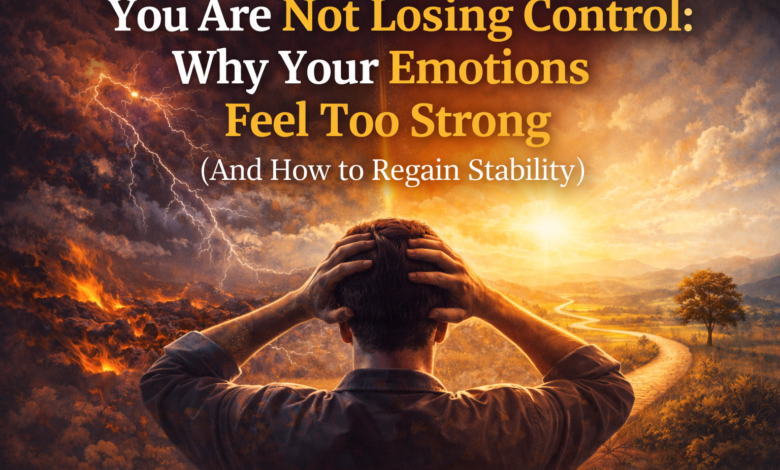
You Are Not Losing Control: Why Your Emotions Feel Too Strong
You Are Not Losing Control: Why Your Emotions Feel Too Strong

There are moments that don’t make sense even to you.
A small situation happens. Something very normal. Something that, logically, should not affect you this much. But inside, your reaction feels intense. Your emotions rise quickly, your thoughts become louder, and your body feels slightly tense. Before you can even understand what is happening, you are already reacting.
And later, when everything settles, a quiet realization comes:
“Why did I react like that?”
“Why do my emotions feel so strong?”
“Am I losing control?”
I have felt this personally, and for a long time, I misunderstood it. I used to think that maybe I was not emotionally stable enough. Maybe I needed more control. Maybe I needed to suppress my reactions better so that I could appear calm and composed.
But the more I tried to control my emotions forcefully, the more intense they became. It was like trying to push something down that only wanted to come up stronger. And slowly, I started seeing something clearly — I was not losing control.
👉 My system was reacting faster than my awareness.
And this is where most people misjudge themselves.
Why Emotions Feel Overwhelming (Understanding Emotional Overwhelm)
Emotions do not become overwhelming because you are weak.
They become overwhelming because they are fast, automatic, and deeply connected to your internal system.
When something triggers you, your emotional response does not wait for your permission. It does not analyze the situation logically. It does not ask whether this reaction is necessary or not.
👉 It simply reacts.
This is why emotional overwhelm feels sudden.
Because by the time your awareness starts observing what is happening, the emotion has already started building inside you. There is already intensity. There is already movement. There is already reaction.
This creates a gap between:
- what you feel
- and what you understand
And this gap is what creates the experience of feeling out of control.
How Emotional Overwhelm Feels Inside (Emotional Awareness Layer)
If you observe closely, emotional overwhelm is not just mental.
It is physical.
You may notice:
- your chest feels tight
- your breathing changes slightly
- your thoughts become faster
- your attention becomes narrow
- your body feels alert
These are not random sensations.
👉 This is your nervous system activating
And once this activation begins, your emotional intensity increases automatically.
This is why it feels like:
👉 emotions are controlling you
But in reality, it is your system reacting in a way it has learned over time.
Emotional Control and the Nervous System Connection
To truly understand emotional control, you have to move beyond the idea that emotions are only mental.
Your emotions are deeply connected to your body.
Your nervous system plays a central role in how you feel and how you react.
When your system senses something uncertain, uncomfortable, or emotionally important, it activates automatically. This activation is designed to protect you. It prepares your body to respond.
But here is the important part:
👉 your nervous system does not always differentiate between real danger and emotional triggers.
So even a small situation can create a strong emotional response if it connects with something deeper inside you.
This is why sometimes your reaction feels bigger than the situation.
Not because you are wrong.
👉 But because your system is responding based on past patterns and stored emotional memory.
Why Emotional Reactions Feel Instant (Speed of Nervous System)
Your emotional system works faster than your logical mind.
Before you can think:
👉 you feel
Before you can analyze:
👉 you react
This is the natural order.
Your brain processes emotional signals quickly because it is designed for survival. It prioritizes reaction over reflection.
This is why later you feel:
“I should have handled that differently”
Because now your awareness has caught up.
But during the moment, your reaction was leading.
And this is not failure.
👉 This is timing.
Why You Are Not Losing Control (Identity Shift)
The biggest misunderstanding people carry is this:
👉 “If I cannot control my emotions immediately, I am losing control”
But this is not true.
You are not losing control.
You are experiencing:
👉 a faster emotional response and a slower awareness response
This changes everything.
Because now the problem is not:
- “How do I stop emotions?”
The real question becomes:
👉 “How do I increase awareness so it can meet the reaction?”
This is a completely different approach.
And it removes self-blame.
My Personal Realization
I remember clearly a phase where I used to question myself after almost every emotional reaction. I would replay situations in my mind, trying to understand why my response felt so intense. I believed that if I could just control myself better, everything would be fine.
But slowly, I started noticing a pattern.
My reactions were not random.
They were fast.
And my understanding was always coming later.
That was the turning point for me.
I stopped asking, “Why am I like this?”
And started seeing, “My system is reacting before I can observe it.”
That one shift removed a lot of pressure.
Because now I was not fighting myself.
I was understanding myself.
🌱 Grounding Line
“I am not losing control.
My emotions are simply faster than my awareness.”
Why Emotional Triggers Feel So Strong (Real Reason Behind Emotional Overwhelm)
If you observe your emotional reactions carefully, you will start noticing a pattern. Your emotions do not rise randomly. They are triggered.
Something happens externally — a word, a tone, a situation, a behavior — and suddenly your internal state changes. The reaction feels immediate, almost automatic. And often, the intensity of your reaction does not match the size of the situation.
This is where confusion begins.
You ask yourself:
“Why did this affect me so much?”
“Why do small things trigger such strong emotions?”
I have experienced this deeply. There were moments where a simple situation would create a disproportionate emotional reaction inside me. It felt like something much bigger was happening internally than what was visible outside. And for a long time, I thought the problem was the situation.
But slowly, I started understanding something different.
👉 The situation was not the full cause.
👉 It was only the trigger.
Emotional Triggers and Past Patterns (Hidden Layer Most People Miss)
An emotional trigger is not just about the present moment.
It is connected to something already stored inside you.
Your brain does not react only to what is happening now.
It reacts to:
- past experiences
- emotional memories
- learned patterns
- unresolved feelings
This means when something triggers you, your reaction is not coming only from the current situation.
👉 It is coming from a combination of past and present.
This is why the reaction feels stronger than expected.
Because your system is not responding to one moment.
👉 It is responding to multiple layers at once.
How Emotional Triggers Activate Old Patterns
Let’s understand this simply.
A situation happens.
Your brain quickly compares it with past experiences.
If it finds similarity, it activates an existing emotional pattern.
That pattern already has:
- emotion
- reaction style
- internal meaning
So instead of creating a fresh response, your system replays a stored one.
This is why emotional reactions can feel repetitive.
Because they are.
👉 They are pattern-based responses.
Why Emotional Reactions Keep Repeating (Emotional Loop)
Just like thoughts create loops, emotions also create loops.
When a trigger happens:
- Emotion rises
- Reaction happens
- Situation ends
- But emotion is not fully processed
So your system holds onto it.
And when a similar situation appears again:
👉 the same reaction returns
This creates an emotional loop.
You may notice:
- same type of reaction
- same type of frustration
- same type of emotional pain
Even in different situations.
I started seeing this in my own behavior. Different people, different situations, but similar emotional responses. At first, it felt like coincidence. But it was not.
It was a pattern.
And once I saw that pattern, things started making more sense.
Emotional Control vs Emotional Suppression (Critical Difference)
Many people try to deal with strong emotions by suppressing them.
They try to:
- stay quiet
- ignore feelings
- avoid reaction
- act normal
But suppression is not control.
👉 It is delay.
When you suppress emotion:
- it does not disappear
- it stays in your system
- it builds pressure
And eventually, it comes out again.
Sometimes stronger.
This is why emotional reactions keep repeating.
Because they are:
👉 not processed, only postponed
Why Suppressing Emotions Makes Things Worse
When you suppress emotions, two things happen:
- The original emotion remains incomplete
- A new layer of tension is added
Now your system is holding:
- the original emotional energy
- plus the effort of suppression
This increases internal pressure.
And when the next trigger happens, the reaction becomes stronger.
This is why people feel:
👉 “I am trying to control myself, but it’s not working”
Because control is being confused with suppression.
Emotional Identity: Why Some Triggers Affect You More
There is another deeper layer behind emotional triggers.
Not all triggers affect you equally.
Some feel small.
Some feel very intense.
The difference is:
👉 identity connection
When a situation touches something related to your identity, your reaction becomes stronger.
For example:
- respect
- validation
- self-worth
- control
- being understood
If a trigger connects with any of these, your system reacts more intensely.
Because now it is not just about the situation.
👉 It is about how you see yourself
This is why emotional reactions sometimes feel personal, even when the situation is not that serious.
My Personal Realization
I remember noticing this in my own reactions. Some situations would pass easily, but some would stay in my mind longer and create stronger emotional responses. When I looked deeper, I saw a pattern.
The situations that affected me the most were not random.
They were connected to something I cared about internally.
Something related to how I saw myself.
And once I saw this, I stopped blaming the situation.
I started understanding the connection.
That was a very important shift.
Why Your Brain Does Not Let Emotional Patterns Go
At this point, an important question comes:
👉 “If I understand my emotions, why do they still repeat?”
Because understanding alone is not enough.
Your brain needs:
- awareness
- processing
- and new response patterns
If the pattern remains the same, the reaction remains the same.
So even if you logically understand something, your system may still react in the old way.
Because that pattern is already trained.
And anything trained repeats automatically.
The Second Breakthrough
Now something becomes clear.
You are not emotionally unstable.
You are not weak.
And you are not losing control.
👉 You are experiencing triggered patterns.
Patterns created by:
- past experiences
- emotional memory
- identity connection
- lack of processing
And once you see this clearly, something shifts.
You stop judging your reactions.
You start understanding their source.
And that is where real change begins.
🌱 Grounding Line
“My emotions are not random.
They are patterns reacting to deeper layers inside me.”
How to Control Emotions Without Losing Yourself
At this stage, one truth becomes very clear.
You don’t need to suppress your emotions.
You don’t need to force control.
You don’t need to become emotionless.
Because the problem was never emotions.
👉 The problem was unconscious reaction without awareness.
So the solution is not control in the traditional sense.
The solution is:
👉 emotional regulation through awareness
This is a very important shift.
Because when you try to control emotions forcefully, you create resistance. And resistance increases pressure. And pressure eventually leads to stronger reactions.
But when you learn to regulate emotions, you don’t fight them.
👉 You understand them, allow them, and guide them.
How to Regulate Emotions Step by Step (Practical System)
Now we move from understanding to real practice.
This is the system that actually helps you with how to regulate emotions in real life.
Not by suppression.
But by awareness and structure.
🔹 Step 1: Pause Before Reaction (Create Awareness Gap)
When a trigger happens, your first instinct is to react.
But instead of reacting immediately, pause for a moment.
Even 2–3 seconds is enough.
This creates a gap between:
- stimulus
- and response
That gap is where control begins.
👉 Without pause, reaction is automatic
👉 With pause, response becomes possible
🔹 Step 2: Notice the Emotion (Emotional Awareness)
Now shift your focus inward.
Instead of asking:
👉 “Why is this happening?”
Ask:
👉 “What am I feeling right now?”
Name it if possible:
- anger
- frustration
- fear
- discomfort
This step is powerful.
Because when you name an emotion, you reduce its intensity.
🔹 Step 3: Allow the Emotion (Stop Fighting It)
Most people try to stop the emotion immediately.
But stopping creates resistance.
Instead:
👉 allow the emotion to exist
Feel it.
Observe it.
But don’t build a story around it.
This is the difference between:
- experiencing emotion
- and reacting to emotion
And this step reduces emotional overwhelm.
🔹 Step 4: Understand the Trigger (Pattern Awareness)
Now gently ask:
👉 “What triggered this?”
Not to blame.
But to understand.
Is it:
- a past pattern?
- an identity issue?
- a fear?
- a repeated situation?
This step connects your reaction to its source.
And once you see the source, the reaction loses intensity.
🔹 Step 5: Choose Response (Real Emotional Control)
Now you reach the most important step.
Instead of reacting automatically, you choose your response.
Ask:
👉 “How do I want to respond?”
This is real emotional control.
Not stopping emotions.
👉 But choosing action after awareness.
Emotional Control vs Emotional Awareness (Final Clarity)
Let’s simplify this clearly.
❌ Emotional Control (Wrong Way)
- suppress feelings
- act normal
- ignore internal state
- builds pressure
✅ Emotional Regulation (Right Way)
- notice emotion
- allow it
- understand it
- respond consciously
This is the shift.
From force → to awareness.
Why Emotional Reactions Start Reducing Naturally
When you follow this system, something changes slowly.
- your reactions become slower
- your awareness becomes faster
- your triggers lose intensity
- your emotional patterns weaken
This creates:
👉 emotional stability
Not because you removed emotions…
But because you stopped reacting unconsciously.
Emotional Overwhelm and Nervous System Balance
As you practice awareness, your nervous system also changes.
Because now:
- you are not reacting instantly
- you are not suppressing forcefully
- you are allowing and processing
This reduces internal stress.
And when stress reduces:
👉 emotional overwhelm reduces
This is how your system becomes more balanced.
The Real Meaning of Emotional Control
Now everything becomes clear.
Emotional control is not:
- stopping emotions
- being calm all the time
- never reacting
Emotional control is:
👉 being aware of your emotion before your reaction takes over
It is the ability to:
- feel deeply
- but respond consciously
🌱 Personal Note
At one point, I believed that I needed to control my emotions completely. I thought if I could just stay calm all the time, I would feel stable.
But the more I tried to suppress my emotions, the more they built inside me. And when they came out, they felt stronger than before.
Clarity started to return when I stopped fighting my emotions.
When I allowed them.
When I understood them.
And slowly, I realized something very simple but powerful:
👉 I don’t need to control my emotions.
👉 I need to become aware of them.
And that changed everything.
❗ Reflection Disclaimer
This content is for awareness and understanding.
It is not a medical or psychological diagnosis.
If your condition feels overwhelming, consider professional support.
🔍 People Also Ask About You Are Not Losing Control
1. Why do emotions feel overwhelming?
Emotions feel overwhelming because they are fast and automatic responses of the nervous system.
2. How to control emotions without suppressing them?
By becoming aware of the emotion, allowing it, and choosing a response instead of reacting automatically.
3. Why do I react emotionally so quickly?
Because your emotional system works faster than your logical awareness.
4. Can emotional triggers be reduced?
Yes, by understanding patterns and increasing awareness.
5. What is emotional regulation?
It is the ability to understand, manage, and respond to emotions consciously.
6. Is emotional control possible?
Yes, but through awareness, not suppression.
7. Why do the same emotional reactions repeat?
Because of past patterns and unprocessed emotional experiences.
8. How to stay calm in emotional situations?
Pause, observe, allow emotion, and respond consciously.
❓ FAQ About You Are Not Losing Control
1. How to regulate emotions naturally?
By creating awareness, allowing emotions, and reducing automatic reactions.
2. Why do I feel out of control emotionally?
Because your emotional response is faster than your awareness.
3. What causes emotional overwhelm?
Nervous system activation and unresolved emotional patterns.
4. Can emotional awareness improve control?
Yes, awareness is the foundation of emotional control.
5. Is suppressing emotions harmful?
Yes, it increases internal pressure and leads to stronger reactions later.
6. How to handle emotional triggers?
By observing, understanding, and responding consciously.
7. Do emotions reduce with awareness?
Yes, their intensity reduces over time.
8. What is the fastest way to calm emotions?
Pause, breathe, and observe without reacting.
🌿 Final Grounding Line
“I don’t need to control my emotions.
I need to be aware of them before they control me.”
📚 REFERENCES (WITH URL)
🧠 Psychology & Emotional Regulation
- American Psychological Association
👉 https://www.apa.org/topics/emotion
(Emotions, regulation, and behavior understanding) - National Institute of Mental Health
👉 https://www.nimh.nih.gov/health/topics/stress
(Stress response, emotional overwhelm, mental patterns) - Mayo Clinic
👉 https://www.mayoclinic.org/healthy-lifestyle/adult-health/in-depth/stress-management/art-20044456
(Stress, emotional response, and nervous system)
🧠 Emotional & Cognitive Understanding
- Emotional Intelligence
👉 https://en.wikipedia.org/wiki/Emotional_Intelligence
(Understanding emotions and self-regulation) - The Body Keeps the Score
👉 https://en.wikipedia.org/wiki/The_Body_Keeps_the_Score
(Trauma, nervous system, emotional patterns)
🧘♂️ Spiritual & Awareness Layer
- Bhagavad Gita
👉 https://www.holy-bhagavad-gita.org
(Detachment, awareness, control of mind and emotions) - The Power of Now
👉 https://en.wikipedia.org/wiki/The_Power_of_Now
(Observing emotions and present awareness)