Empathy and Narcissism: Psychological Differences
Why Narcissists Struggle With Empathy

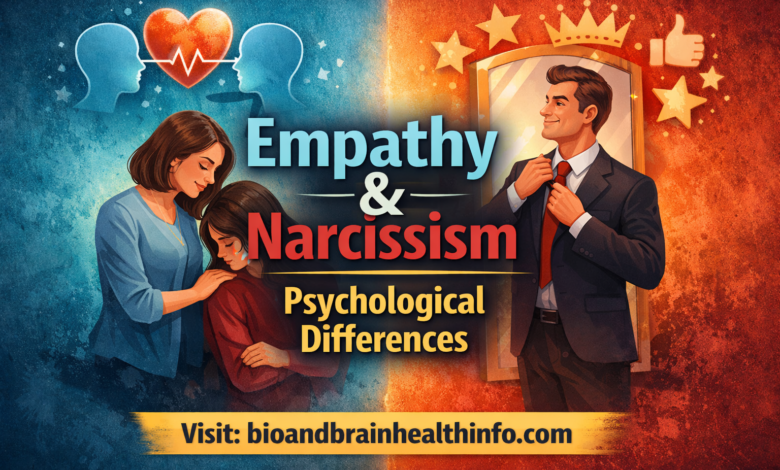
Empathy and narcissism differ through empathy deficit patterns, emotional intelligence variations, personality traits, and social psychology dynamics that shape how people understand and respond to others’ emotions.
Thank you for reading this post, don't forget to subscribe!“Understanding emotional differences begins when curiosity replaces judgment.”
Differences in empathy are often about emotional processing, not worth or character.
“Sometimes emotional distance feels louder than words, leaving questions that linger long after conversations end.
Even after leaving, the nervous system can stay on alert because it learned unpredictability as normal. Regulation returns through consistency, not force.”
🌱 Empathy and Narcissism: Psychological Differences
Some interactions feel emotionally uneven — one person deeply senses feelings while another seems distant or self-focused. The core fear becomes: “Is empathy missing, or am I expecting too much?”
Many misunderstand empathy differences as moral failure instead of psychological variation shaped by emotional intelligence and personality traits.
This is not about judging individuals; it is about understanding relational dynamics.
The core fear becomes: “Is something wrong with me for needing deeper understanding?”
Many misunderstand emotional differences as personal failure rather than variations in psychological processing. Your reactions are not flaws; they are responses to relational dynamics.
This article will help you understand what’s happening — without labels, blame, or self-attack.
🧭 4️⃣ REASON FOR THIS BLOG – Empathy and Narcissism
To clarify psychological differences in empathy without pathologizing individuals, helping readers separate emotional reactions from identity while understanding relational impact calmly.
🔎 5️⃣ INNER SEARCH MIRROR – Empathy and Narcissism
You may quietly wonder:
Why do some people struggle to understand feelings?
Why does emotional connection feel one-sided?
Why do I explain emotions repeatedly?
Why does emotional intelligence feel uneven?
Why does empathy sometimes feel absent?
Why do personality traits shape emotional reactions?
Why does distance remain even after clarity?
Please Explore This Blog characteristics-narcissistic-father-family-impact
Empathy and Narcissism: Psychological Differences in Emotional Processing
Empathy and narcissism differ through empathy deficit tendencies, emotional intelligence variation, personality traits, and social psychology influences that shape emotional interpretation.
Some individuals process emotions cognitively rather than emotionally, creating misunderstandings in connection. These differences reflect adaptation rather than moral failure.
Survival conditioning may prioritize self-focus when vulnerability feels unsafe, leading to reduced emotional attunement.
| Psychological Dynamic | Effect |
|---|---|
| Cognitive empathy | Understanding without feeling |
Personal note: Recognizing processing differences often reduces personalizing emotional gaps.
Empathy and Narcissism: Nervous System Patterns Behind Emotional Reactivity
Empathy and narcissism interactions influenced by empathy deficit patterns, emotional intelligence differences, personality traits, and social psychology can activate automatic nervous system responses.
Fight, flight, or freeze reactions occur before conscious thought, shaping how emotions are expressed or avoided.
Emotional distance may reflect regulation strategy rather than intention to harm.
Possible warning signs:
Emotional shutdown during conflict
Rapid defensiveness
Difficulty sustaining vulnerability
Over-intellectualizing feelings
Withdrawal after emotional intensity
Personal note: Nervous system protection often appears as emotional distance.
Identity vs Survival Responses in Empathy and Narcissism Dynamics
Survival responses protect safety; identity reflects values, conscience, and intention.
Within empathy and narcissism patterns shaped by empathy deficit tendencies, emotional intelligence differences, personality traits, and social psychology, behavior may represent learned regulation rather than character truth.
Emotional reactions often arise from protective adaptation, not lack of worth or capacity for growth.
When survival patterns are mistaken for identity, shame increases; when distinguished clearly, understanding becomes possible.
Authority lies in recognizing that emotional differences describe processing styles — not human value.
Empathy and Narcissism: Trauma Responses vs Narcissistic Motivation
Within empathy and narcissism dynamics shaped by empathy deficit, emotional intelligence differences, personality traits, and social psychology, fear of “becoming the problem” often appears.
Comparing motivation reduces self-labeling:
| Trauma Response | Narcissistic Motivation |
|---|---|
| Remorse present | Image protection |
| Reflection attempts | Defensive rigidity |
| Accountability effort | Externalizing blame |
Personal note: Understanding intent softens harsh self-judgment.
Empathy and Narcissism: Gentle Growth Toward Emotional Balance
In empathy and narcissism patterns involving empathy deficit, emotional intelligence variation, personality traits, and social psychology influences, healing may look like slowing conversations, noticing emotional signals earlier, and choosing steadiness over reaction.
Signs of growth include calmer pauses, clearer boundaries, and reduced urgency to prove understanding.
Personal note: Progress often feels quiet rather than dramatic.
HEALING COMPASS / ORIENTATION TABLE
Healing often unfolds through simple stages:
| Stage | Orientation |
|---|---|
| Awareness | “I notice patterns calmly.” |
| Stabilizing | “Safety supports clarity.” |
| Understanding | “Reactions had reasons.” |
| Integration | “I respond thoughtfully.” |
| Protection | “Boundaries preserve peace.” |
This compass offers direction without pressure, helping insight translate into stable emotional balance.
Please Explore This Blog characteristics-of-narcissistic-husband-marriage-patterns
🌿 10 Signs — Empathy and Narcissism: Psychological Differences Explained
1. Emotional Understanding Versus Self-Focused Processing Styles
Empathy and narcissism differ in how emotional signals are processed. One person may naturally tune into others’ feelings, while another focuses more on personal interpretation. This difference is often about processing style rather than intentional harm.
2. Difficulty Recognizing Emotional Nuance in Conversations
An empathy deficit may appear as missing subtle emotional cues or responding logically instead of emotionally. This does not always reflect lack of care; it may reflect learned coping or cognitive-focused emotional processing.
3. Variations in Emotional Awareness and Regulation
Differences in emotional intelligence influence how individuals recognize, interpret, and respond to feelings. Some people identify emotions quickly, while others require time or intellectual understanding before emotional connection emerges.
4. Personality Traits: Stable Patterns Shaping Emotional Interaction
Personality traits influence how people approach vulnerability, conflict, and emotional closeness. Traits emphasizing independence or self-protection may create emotional distance even when connection is desired.
5. Social Psychology: Environmental Influences on Empathy Development
Social psychology shows that culture, upbringing, and reinforcement shape empathy expression. Emotional responses often reflect learned relational expectations rather than inherent emotional absence.
6. Empathy and Narcissism: Emotional Validation Versus Self-Referencing Responses
Empathy and narcissism can differ in conversational focus. One style validates others’ feelings, while another references personal experience more frequently, which may feel emotionally uneven.
7. Empathy Deficit: Over-Intellectualizing Emotional Experiences
An empathy deficit may appear as analyzing emotions rather than feeling them. Intellectual explanations can create distance when emotional attunement is expected.
8. Emotional Intelligence: Comfort With Vulnerability Varies Between Individuals
Emotional intelligence influences how safe vulnerability feels. Some people open emotionally with ease, while others maintain control through emotional restraint.
9. Personality Traits: Sensitivity to Criticism Affecting Emotional Responses
Certain personality traits increase defensiveness when facing emotional feedback. Protective responses may reduce empathy expression temporarily without eliminating underlying capacity.
10. Social Psychology: Group Dynamics Influencing Emotional Behavior
Social psychology highlights how roles, expectations, and social context influence empathy expression. Behavior often adapts to environment rather than reflecting fixed emotional identity.
🌱 Closing Note
These signs describe differences in emotional processing, not judgments about worth or character. Empathy and narcissism dynamics influenced by empathy deficit, emotional intelligence, personality traits, and social psychology reflect diverse ways humans relate emotionally. Understanding these patterns reduces self-blame and allows clarity to emerge without turning empathy into criticism or labeling.
Please Explore This Blog characteristics-narcissistic-man-relationship-patterns
🌿 A Whole-System View of the Human Healing Process
🩺 Medical / Ethical Positioning — Empathy and Narcissism Context
Within empathy and narcissism understanding, empathy deficit differences can influence how the mind interprets threat, confusion, and meaning during relational tension.
Ethical positioning focuses on impact awareness rather than labeling people.
Healing begins when individuals shift from assigning blame to understanding relational dynamics while maintaining personal responsibility and emotional autonomy.
| Ethical Element | Purpose |
|---|---|
| Context evaluation | Reduce misinterpretation |
| Impact awareness | Clarify emotional effects |
| Boundaries | Protect autonomy |
| Neutral language | Maintain safety |
Personal note: Ethical clarity often lowers internal conflict more than emotional analysis alone.
🧠 Psychological Layer — Meaning Construction and Interpretation
In empathy and narcissism differences influenced by emotional intelligence variation, the mind constructs meaning through internal narratives to manage ambiguity.
When emotional signals feel inconsistent, interpretation fills gaps, sometimes amplifying misunderstanding.
Psychological flexibility allows multiple explanations instead of fixed conclusions, supporting balanced perception.
| Psychological Function | Role |
|---|---|
| Narrative building | Create coherence |
| Attribution patterns | Assign meaning |
| Expectation shaping | Predict behavior |
| Cognitive flexibility | Adapt perspective |
Personal note: When interpretation becomes flexible, emotional tension often softens.
🧬 Nervous System Layer — Automatic Protection Responses
Empathy and narcissism interactions shaped by personality traits may activate automatic bodily responses.
The nervous system scans tone, pace, and emotional intensity to assess safety, often reacting before conscious awareness.
These responses aim to maintain equilibrium rather than express judgment.
| Body Reaction | Protective Goal |
|---|---|
| Increased alertness | Detect change |
| Freeze response | Reduce risk |
| Emotional detachment | Maintain control |
| Physical fatigue | Conserve resources |
Personal note: The body’s reactions reflect protection, not weakness.
🌱 Mental Health Layer — Effects of Prolonged Emotional Stress
In empathy and narcissism dynamics influenced by social psychology, prolonged relational stress may affect clarity, energy, and self-trust.
Continuous emotional interpretation can lead to mental fatigue, reducing confidence in perception and decision-making while increasing emotional sensitivity.
| Mental Impact | Outcome |
|---|---|
| Cognitive overload | Reduced focus |
| Emotional fatigue | Lower resilience |
| Self-doubt | Hesitation increases |
| Energy fluctuation | Inconsistent motivation |
Personal note: Naming stress often restores compassion toward oneself.
🧭 Identity Layer (Inner Continuity & Meaning)
Even within empathy and narcissism differences shaped by empathy deficit experiences, identity remains intact beneath survival responses.
Values and conscience continue guiding behavior quietly, offering continuity despite relational confusion.
Healing involves reconnecting with internal alignment rather than redefining identity entirely.
| Identity Aspect | Stability Source |
|---|---|
| Core values | Internal direction |
| Conscience | Ethical grounding |
| Awareness | Reflection capacity |
| Choice | Personal agency |
Personal note: Identity often feels hidden, yet it remains present.
🤝 Reflective Support Layer (Including AI)
Empathy and narcissism understanding supported by emotional intelligence reflection can benefit from journaling, dialogue, or AI mirroring tools.
These approaches organize thoughts and provide structured perspective without directing decisions, allowing individuals to explore interpretation safely.
| Reflective Tool | Benefit |
|---|---|
| Journaling | External clarity |
| Conversation | Perspective testing |
| AI reflection | Pattern awareness |
| Creative writing | Emotional integration |
Personal note: Reflection becomes powerful when it encourages curiosity rather than control.
🌿 Integrated Whole-System Reflection
Empathy and narcissism healing within social psychology contexts involves ethical awareness, psychological interpretation, nervous system regulation, mental health stabilization, identity continuity, and reflective support working together.
Rather than focusing on one dimension, a whole-system view recognizes that emotional processing occurs across multiple layers simultaneously.
Understanding this integration helps reduce urgency and encourages steady awareness, allowing clarity and self-trust to grow naturally without forcing conclusions.
| Integration Layer | Outcome |
|---|---|
| Ethical awareness | Balanced understanding |
| Psychological insight | Flexible thinking |
| Nervous system safety | Reduced reactivity |
| Identity continuity | Stable self-trust |
Personal note: Integration often feels like alignment rather than dramatic transformation.
Please Explore This Blog characteristics-of-a-narcissistic-mother-emotional-effects
PERSONAL NOTE – Empathy and Narcissism
While studying empathy and narcissism through lived observation, I began to see how empathy deficit patterns do not always reflect lack of humanity but differences in emotional intelligence and personality traits shaped by social psychology influences.
At one point, I questioned whether uneven emotional responses meant something was wrong — either with me or the other person. Over time, clarity emerged when I stopped personalizing processing differences.
Understanding that emotional styles vary helped reduce internal tension.
Insight did not arrive dramatically; it arrived quietly through recognizing that variation in empathy does not define worth, character, or potential for growth.
🌌 COSMIC / PHILOSOPHICAL TAKEAWAY
“Understanding begins when we separate difference from deficiency.”
Empathy and narcissism, influenced by empathy deficit variations, emotional intelligence levels, personality traits, and social psychology dynamics, reflect different emotional processing styles rather than moral categories.
Human beings experience emotion through diverse internal systems shaped by biology, upbringing, and learned survival strategies.
When curiosity replaces judgment, emotional gaps become opportunities for awareness rather than conflict. Growth often begins when we realize that difference does not equal danger.
Meaning emerges through understanding, not comparison, allowing emotional insight to deepen without turning complexity into condemnation.
Please Explore This Blog characteristics-narcissistic-mother-emotional-patterns
🌱 FINAL CLOSING – Empathy and Narcissism
Empathy and Narcissism: Returning to Calm Emotional Understanding
If you recognize empathy deficit tendencies, differences in emotional intelligence, personality traits, or social psychology influences within empathy and narcissism dynamics, nothing is wrong with you for feeling confused or affected.
Emotional differences can feel destabilizing when misunderstood. With safety and understanding, what adapted can soften again.
Healing is not about forcing sameness; it is about recognizing processing styles without self-attack.
You are allowed to seek clarity gently. Nothing is wrong with you for reacting to harm.
With safety and understanding, what adapted can soften again.
❓ FAQ SECTION – Empathy and Narcissism
1. What is the difference between empathy and narcissism?
Empathy involves emotional attunement, while narcissism often emphasizes self-focus; both exist along psychological spectrums.
2. Does empathy deficit mean someone cannot care?
Not necessarily; it may reflect processing differences rather than absence of concern.
3. How does emotional intelligence affect relationships?
Higher emotional intelligence often improves emotional recognition and regulation.
4. Are personality traits fixed?
Traits can remain stable but behaviors can adapt through awareness.
5. What role does social psychology play?
Social context shapes emotional expression and relational expectations.
6. Can empathy develop over time?
Yes, emotional skills can strengthen with reflection and practice.
7. Is emotional distance intentional?
Sometimes it reflects regulation strategies rather than conscious rejection.
8. Does understanding eliminate conflict?
Understanding reduces blame, which often decreases conflict intensity.
9. Is empathy always healthy?
Empathy is healthiest when balanced with boundaries and self-awareness.
🌿 FINAL CLOSING – Empathy and Narcissism
Empathy and narcissism differences shaped by emotional intelligence, personality traits, and social psychology do not define human value.
Emotional gaps can feel unsettling, yet they are often rooted in survival adaptation rather than intention to harm.
Nothing is wrong with you for reacting to complexity. With safety and understanding, what adapted can soften again.
Allow insight to settle gradually. You do not need urgency or perfect clarity today.
Healing often begins with gentler interpretation and steady awareness.
🌿 Final Blog Footer — Bio & Brain Health Info
Written by Lex, founder of Bio & Brain Health Info — exploring the intersections of psychology, spirituality, and emotional recovery through calm, trauma-aware understanding.
✨ Insight & Reflection
Healing does not begin when answers arrive — it begins when self-attack stops.
Clarity grows in spaces where safety is restored.
🧠 Learn
Narcissism • Emotional Healing • Spiritual Psychology
🌍 A Moment for You
💡 Pause for two minutes. Let your body settle before moving on.
🧭 If This Article Helped, Your Next Questions Might Be:
How does empathy deficit affect long-term relationships?
What is the role of the nervous system in emotional processing?
Can emotional intelligence improve through awareness?
How do personality traits influence relational stability?
✨ Cosmic Family Invitation
You are not here by accident. If these words reached you, clarity was already beginning.
We rise together — different souls, one journey. 🕊️
📩 Connect with us
info@bioandbrainhealthinfo.com
Telegram: @bioandbrainhealthinfo
WhatsApp Channel: Punehealth
Lex | Bio & Brain Health Info
Cosmic Family — Different Souls, One Journey.
📚 REFERENCES & CITATIONS
1. American Psychological Association — Narcissistic Personality Disorder Overview
https://www.apa.org/topics/personality-disorders/narcissistic-personality-disorder
2. National Institute of Mental Health — Personality Disorders
https://www.nimh.nih.gov/health/topics/personality-disorders
3. National Library of Medicine (PMC) — Narcissism and Empathy Research Review
https://www.ncbi.nlm.nih.gov/pmc/articles/PMC4415495/
4. Frontiers in Psychology — Narcissism and Interpersonal Functioning
https://www.frontiersin.org/articles/10.3389/fpsyg.2018.00001/full
5. Greater Good Science Center (UC Berkeley) — What Is Empathy?
https://greatergood.berkeley.edu/topic/empathy
6. Harvard Health Publishing — Emotional Intelligence and Relationships
https://www.health.harvard.edu/blog/emotional-intelligence-and-relationships-2019092417820
7. Cleveland Clinic — Emotional Regulation and Trauma Response
https://my.clevelandclinic.org/health/articles/trauma-response
8. American Psychological Association — Emotional Intelligence Research
https://www.apa.org/monitor/2018/09/cover-emotional-intelligence
9. Stanford Encyclopedia of Philosophy — Empathy
https://plato.stanford.edu/entries/empathy/
10. World Health Organization — Mental Health Overview
https://www.who.int/health-topics/mental-health