Narcissism in social media: how do I know if I am a narcissist
How Do I Know If I Am a Narcissist on Social Media or Just Expressing Myself?

Introduction—The Digital Mirror
“The intersection of narcissism in social media, digital self-image psychology, online validation culture, and social media mental health reveals how our online lives both shape and strain our inner world.”
Thank you for reading this post, don't forget to subscribe!In the digital age, many people quietly wonder: how do I know if I am a narcissist when I post photos, share thoughts, or promote my work online? Am I simply expressing myself, or am I feeding ego through likes and shares?
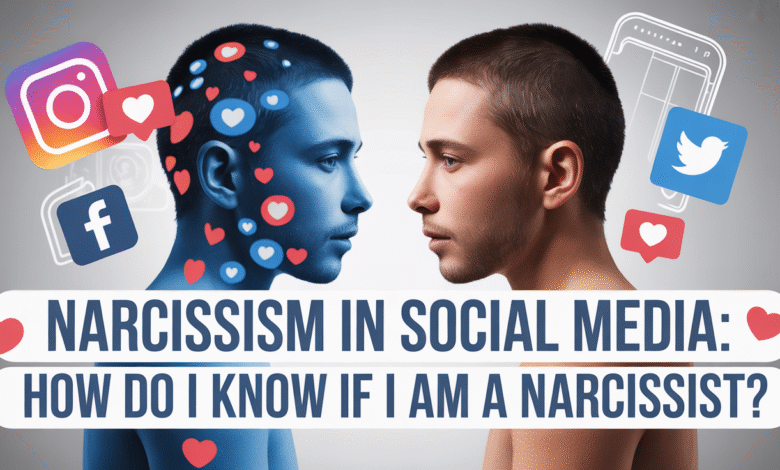
The question is valid. Researchers increasingly highlight the rise of narcissism in social media, where endless selfies, curated posts, and highlight reels often mask deeper insecurities.
Psychologists call this digital self-image psychology — the study of how online identities affect self-worth.
Add to this the addictive online validation culture and its dopamine-driven approval loops, and we see the link to declining social media mental health.
This first part explores these themes to understand whether social media use reflects ego, self-expression, or a cry for connection.
Narcissism in Social Media—The Confusion
The phenomenon of narcissism in social media has been studied for over a decade. Platforms encourage self-promotion: every like feels like validation, every follower like proof of importance.
Yet the confusion lies here: not everyone posting selfies is narcissistic. For some, it is self-expression; for others, it is connection.
True narcissism in social media reveals itself not in sharing but in obsession with image, admiration, and superiority.
Please enjoy reading narcissistic-parenting-traits-how-do-i-know-if-i-am-a-narcissist
Narcissism in Social Media and Real Life
Interestingly, narcissism in social media may not match real-life personality. Some extroverts post rarely, while anxious introverts may overshare as a way to connect.
Thus, labeling someone narcissistic solely based on posting patterns oversimplifies a complex psychological issue.
The real question is not “Do I post often?” but “Why do I post?”
Digital Self-Image Psychology—Building the Avatar
We all construct avatars online. Digital self-image psychology studies how we shape and polish these avatars to reflect not who we are, but who we wish to be.
Students post achievements, hiding failures.
Parents share smiling children, hiding exhaustion.
Influencers project luxury, hiding debt.
This curated identity, examined by digital self-image psychology, can cause inner conflict. The more the online self diverges from the real self, the greater the anxiety and depression.
Digital Self-Image Psychology and Mental Health
Studies show that when people invest heavily in their online image, their social media mental health declines. Comparison, envy, and imposter syndrome follow.
Thus, digital self-image psychology explains why posting may not always be narcissistic—sometimes it is survival in a world that equates worth with visibility.
Online Validation Culture—The Addiction to Approval
At the core of the struggle is online validation culture. Every like, comment, or share becomes a dopamine hit. Over time, this creates addiction: people refresh feeds, check notifications obsessively, and measure self-worth by numbers.
This is where narcissism in social media thrives. Instead of inner validation, people seek external approval.
Please enjoy reading narcissism-and-ambition-how-do-i-know-if-i-am-a-narcissist
Online Validation Culture and Ego
The danger of online validation culture is that it merges with ego. A person begins to believe:
“If my post is liked, I matter.”
“If ignored, I am worthless.”
Philosophically, this is maya—illusion. Spiritually, it is bondage. Online validation culture traps the soul in endless cycles of craving and disappointment.
Social Media Mental Health—The Bigger Picture
The impact of social media on mental health is evident worldwide. Studies link heavy use to anxiety, depression, and even loneliness. Ironically, the more connected people are online, the more isolated they often feel offline.
Social media Mental health is harmed when online life becomes the only measure of self-worth. Instead of balance, obsession takes root.
Social Media, Mental Health, and Today’s Youth
The youngest generation suffers most. Teens compare their looks, achievements, and relationships to curated online feeds. The result is rising body-image issues, performance anxiety, and emotional burnout.
This crisis of social media mental health reflects a deeper societal failure: replacing love and community with clicks and likes.
When Expression Becomes Ego
Let’s go back to the fundamental inquiry—how can I determine if I exhibit narcissistic tendencies on social media?
The answer lies in intention. If posting is about joy, sharing, or connection, it is self-expression. If posting is about admiration, envy, or superiority, it edges toward narcissism.
Understanding the balance between narcissism in social media, digital self-image psychology, online validation culture, and social media mental health allows us to post without guilt—and reflect when ego takes over.
Spiritual Reflection—Sharing vs. Showing Off
Spirituality reframes the debate. Krishna teaches that action is judged not by appearance but by intention. Posting about gratitude, community, or devotion can be service.
Posting for envy or pride reflects ego. The digital stage is neutral—the heart behind it matters.
Please enjoy reading narcissism-in-friendships-how-do-i-know-if-i-am-a-narcissist
Conclusion—Awareness as the First Step
In closing Part 1, the question “How do I know if I am a narcissist on social media?” becomes less about behavior and more about motivation.
We explored narcissism in social media as both reality and myth.
We studied digital self-image psychology and how curated avatars affect identity.
We examined online validation culture as a driver of ego.
And we reflected on social media mental health, which reveals the true cost of digital obsession.
Transition to Part 2: Next, we will dive deeper into how these patterns affect relationships, careers, and spirituality—and how to heal through boundaries, mindful posting, and authentic self-expression.
When Posts Shape Our Relationships