Rebuilding Self Trust After Narcissist: Believing Yourself Again
Learning to Believe Yourself Again

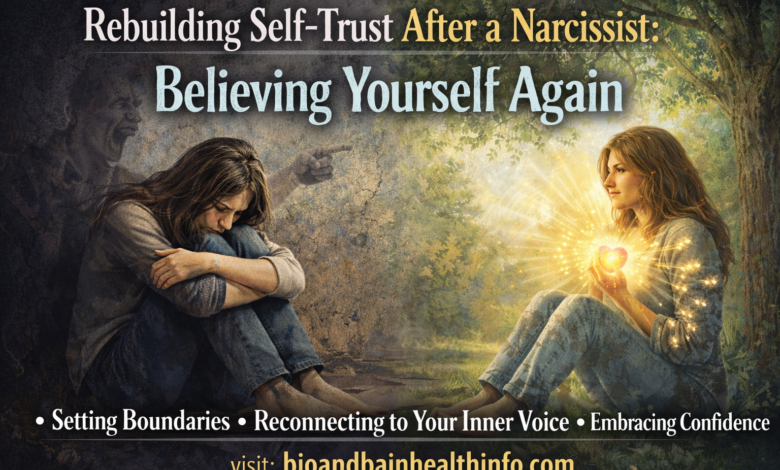
Rebuilding self-trust after a narcissist involves self trust, gaslighting recovery, identity repair, and confidence as belief in oneself slowly returns.
Thank you for reading this post, don't forget to subscribe!Doubt doesn’t disappear when the relationship ends.
It lingers because trust was interrupted, not because you are broken.
Even after leaving, the nervous system can stay on alert because it learned unpredictability as normal. Regulation returns through consistency, not force.
INTRODUCTION
Rebuilding Self-Trust After a Narcissist often begins with a quiet fear: “Can I believe myself again?”
Many people notice hesitation, second-guessing, or a loss of confidence long after the relationship has ended.
The misunderstanding is assuming this means your identity was damaged. In reality, self trust was disrupted through gaslighting recovery, not erased.
During identity repair, the mind pauses its certainty to avoid further harm. This response can feel unsettling, but it reflects protection, not failure.
Confidence doesn’t vanish; it waits for safety to return. Nothing about this phase means you lost your inner compass.
It shows that your system adapted to confusion and is now recalibrating.
This article will help you understand what’s happening — without labels, blame, or self-attack.
REASON FOR THIS BLOG
To help readers understand why self-doubt lingers after relational manipulation and to separate trauma-based reactions from identity — with clarity, care, and no diagnosis.
Please Explore This Blog long-term-narcissistic-abuse-recovery
INNER SEARCH MIRROR
Many people quietly ask themselves questions like these:
Why do I doubt my own memory?
Why do I second-guess simple decisions?
Why does my confidence feel fragile?
Why do I hesitate before speaking?
Why don’t I trust my reactions yet?
Am I overthinking everything?
Did the relationship change me?
If these questions sound familiar, you are not isolated in this experience.
PSYCHOLOGICAL EXPLANATION -Rebuilding Self-Trust After a Narcissist
Rebuilding Self-Trust After a Narcissist begins with understanding adaptation. Repeated contradiction, dismissal, and distortion teach the mind to pause its certainty as a form of safety.
During gaslighting recovery, self trust narrows not because judgment is flawed, but because risk was present. Identity repair starts when the system separates intention from reaction.
You did not choose doubt; it was conditioned through experience. Confidence doesn’t collapse — it conserves itself until clarity feels safe again.
Healing occurs as the mind relearns that its perceptions no longer need to be defended.
| Learned Response | Purpose |
|---|---|
| Hesitation | Avoid conflict |
| Self-questioning | Reduce harm |
| Reduced certainty | Preserve safety |
Personal note: Understanding this stopped me from blaming my hesitation.
NERVOUS SYSTEM EXPLANATION – Why the Body Reacts Before Trust Returns
Rebuilding Self-Trust After a Narcissist also involves the body. Fight, flight, or freeze responses activate before conscious thought, shaping confidence from the bottom up.
During gaslighting recovery, the nervous system associates expression with risk. Identity repair unfolds as reactions soften, not through logic but through safety.
Confidence returns when the body no longer anticipates punishment for clarity.
Common signs include:
Sudden self-doubt
Tightness when speaking
Over-monitoring reactions
Delayed decisions
Emotional caution
Personal note: My confidence returned when my body stopped bracing first.
Identity vs Survival Responses
This distinction anchors Rebuilding Self-Trust After a Narcissist.
Survival responses exist to protect. They create hesitation, caution, and self-monitoring when safety is uncertain.
Identity reflects values, conscience, and inner truth — who you are when expression is safe.
Survival can temporarily mute confidence, but it does not redefine identity. Self trust withdraws to avoid harm; it does not disappear.
When safety stabilizes, identity re-emerges naturally. Confusing survival with self creates unnecessary fear. Separating them restores authority over your own experience.
You were protecting yourself — not losing yourself.
Please Explore This Blog confidence-after-narcissistic-abuse
Rebuilding Self-Trust After a Narcissist Is Not Narcissism
A common fear during Rebuilding Self-Trust After a Narcissist is, “What if this doubt means something is wrong with me?”
That fear comes from confusing behavior with motivation. In gaslighting recovery, self trust narrows to reduce harm, not to gain control.
Identity repair unfolds alongside reflection, not avoidance. Confidence may pause, but conscience remains active.
The difference is revealed through motivation, not appearance.
| Trauma-Based Response | Narcissistic Pattern |
|---|---|
| Feels remorse | Lacks concern |
| Reflects inwardly | Deflects responsibility |
| Seeks accountability | Avoids accountability |
| Withdraws to heal | Withdraws to control |
Personal note: Understanding motivation ended my fear of self-labeling.
Orienting Gently While Rebuilding Self-Trust After a Narcissist
Rebuilding Self-Trust After a Narcissist is a process of orientation, not correction. During gaslighting recovery, self trust rebuilds as safety becomes consistent.
Identity repair shows up quietly—less urgency to justify yourself, more comfort with pauses, and a softer relationship with doubt.
Confidence returns as pressure reduces, not when it is demanded. Growth often looks like slowing down, choosing peace over proving, and noticing steadier internal signals.
These shifts are signs of healing, not avoidance. Agency restores itself when the system no longer anticipates punishment for clarity.
Personal note: I noticed progress when calm felt preferable to certainty.
HEALING COMPASS / ORIENTATION TABLE
Healing self-trust follows a gentle, non-linear rhythm. This compass offers orientation without urgency.
| Stage | What It Feels Like | Quiet Affirmation |
|---|---|---|
| Safety | Reduced self-doubt | “I am allowed to pause.” |
| Stabilization | Fewer second guesses | “Stillness protects clarity.” |
| Integration | Trusting small signals | “My perceptions matter.” |
| Reconnection | Confidence returns | “I can listen to myself.” |
| Protection | Boundaries feel natural | “Peace guides my choices.” |
This map is not a timeline. It reminds you that trust rebuilds through consistency, not pressure—and that clarity follows safety.
Self-Trust Withdraws to Protect You, Not to Punish You
Rebuilding Self-Trust After a Narcissist begins with understanding why self trust became cautious. During gaslighting recovery, believing yourself carried emotional risk, so certainty softened as protection.
This pause is not weakness; it is intelligent restraint. Identity repair does not start by forcing confidence back, but by recognizing why doubt formed in the first place.
Confidence retreats when clarity is unsafe and waits until conditions change. What looks like hesitation is actually discernment in recovery.
When this is understood, self-attack eases and trust begins returning naturally, without effort or pressure.
Doubt Is a Learned Response, Not a Personality Flaw
In Rebuilding Self-Trust After a Narcissist, doubt often feels personal, but it is contextual.
Gaslighting recovery reveals how repeated contradiction trains the mind to double-check itself to avoid conflict. Self trust narrows because certainty once led to harm. I
dentity repair happens when doubt is seen as a learned response, not a character trait. Confidence was not erased; it was paused.
This insight alone removes shame.
What adapted to confusion can readapt to clarity once safety is stable again.
Your Identity Stayed Intact Beneath the Confusion
A core truth of Rebuilding Self-Trust After a Narcissist is that identity does not disappear.
During gaslighting recovery, expression becomes guarded, but values and conscience remain present.
Identity repair allows these inner signals to resurface once threat is removed. Self trust returns when internal alignment feels safe again.
Confidence grows quietly as inner consistency replaces external validation. You were never empty or lost—your identity was sheltered.
When this is recognized, trust rebuilds without reconstruction.
Confidence Returns Through Safety, Not Self-Force
One of the quiet lessons in Rebuilding Self-Trust After a Narcissist is that confidence does not respond to pressure.
During gaslighting recovery, forcing certainty often increases self-doubt. Self trust rebuilds through consistent safety, not confrontation with fear.
Identity repair unfolds as reactions soften and clarity feels less risky.
Confidence appears as ease—less need to explain, justify, or defend.
This is not avoidance; it is stabilization. When safety becomes familiar, confidence returns without effort.
Trust Rebuilds When You Stop Questioning Your Questioning
The final shift in Rebuilding Self-Trust After a Narcissist happens when self trust is no longer interrogated.
Gaslighting recovery often leaves people monitoring their own thoughts, questioning even the questioning.
Identity repair completes when this loop loosens. Confidence emerges when inner signals are allowed without scrutiny.
Trust does not arrive as certainty; it returns as quiet permission to listen inwardly again.
Nothing dramatic changes—something settles. That settling is the signal that trust is re-forming.
Closing Note
Clarity returned for me when I stopped asking whether I could trust myself and started respecting why I hadn’t yet.
Please Explore This Blog identity-loss-after-abusive-relationship
Medical / Ethical Positioning — Rebuilding Self-Trust After a Narcissist
From a medical-ethical perspective, Rebuilding Self-Trust After a Narcissist centers on how the mind interprets threat, confusion, and meaning without pathologizing the person.
When self trust was repeatedly undermined, interpretation becomes cautious to prevent further harm. Ethical care emphasizes explanation over labels, consent over correction, and timing over urgency.
The aim is to restore accurate meaning-making while protecting dignity, ensuring understanding does not become another source of self-attack.
| Ethical Focus | Role |
|---|---|
| Meaning | Clarify experience |
| Safety | Prevent mislabeling |
| Autonomy | Respect pacing |
| Care | Educate, not judge |
Personal note: Ethical framing made curiosity feel safer than self-doubt.
Psychological Layer — Rebuilding Self-Trust After a Narcissist
Psychologically, Rebuilding Self-Trust After a Narcissist reflects how the mind reorganizes meaning after gaslighting recovery.
Conflicting messages teach the psyche to slow certainty and double-check perception to avoid risk. Confusion is not indecision; it is a temporary buffer while interpretation recalibrates.
Healing restores coherent meaning by separating past distortion from present reality, allowing confidence to return without force.
| Mental Process | Effect |
|---|---|
| Threat appraisal | Over-caution |
| Meaning framing | Paused |
| Interpretation | Slowed |
| Re-alignment | Gradual |
Personal note: Clarity returned when meaning felt safe again.
Nervous System Layer — Rebuilding Self-Trust After a Narcissist
At the bodily level, Rebuilding Self-Trust After a Narcissist shows how the nervous system protects safety automatically. Confidence narrows when expression once led to punishment.
The body reduces risk through guarded responses before thought intervenes. Healing unfolds as these reflexes soften through repeated safety, not persuasion.
Trust rebuilds from the bottom up as the body learns that clarity no longer invites harm.
| Body Response | Purpose |
|---|---|
| Guarded posture | Reduce exposure |
| Hesitation | Assess safety |
| Startle | Prevent threat |
| Rhythm repair | Restore balance |
Personal note: My body relaxed before my words did.
Mental Health Layer — Rebuilding Self-Trust After a Narcissist
Within mental health, Rebuilding Self-Trust After a Narcissist explains how prolonged stress affects clarity, energy, and self trust.
Decision fatigue, low motivation, and second-guessing are conservation strategies, not deficits. Capacity returns as internal signals feel reliable again.
Healing prioritizes restoring confidence in perception over analyzing every reaction. Stability precedes certainty.
| Capacity | Impact |
|---|---|
| Focus | Temporarily reduced |
| Energy | Conserved |
| Confidence | Rebuilding |
| Self-trust | Returning |
Personal note: Trust grew when I stopped demanding proof.
Identity Layer (Inner Continuity & Meaning) — Rebuilding Self-Trust After a Narcissist
The identity layer clarifies that Rebuilding Self-Trust After a Narcissist does not require reconstruction. Identity repair reveals that values and conscience remain intact beneath survival responses.
Expression may withdraw, but inner continuity persists.
Healing allows these values to surface once safety stabilizes, restoring trust without redefining who you are.
| Identity Element | Status |
|---|---|
| Values | Intact |
| Conscience | Present |
| Meaning | Dormant |
| Continuity | Preserved |
Personal note: Remembering my values steadied my sense of self.
Reflective Support Layer (Including AI) — Rebuilding Self-Trust After a Narcissist
Reflective supports assist Rebuilding Self-Trust After a Narcissist by mirroring thoughts without directing outcomes during gaslighting recovery.
Journaling, conversation, or AI reflection help organize experience, reduce isolation, and clarify patterns without pressure.
These tools reflect rather than instruct, allowing insight to emerge safely and independently.
| Support Tool | Function |
|---|---|
| Journaling | Externalize thoughts |
| Dialogue | Normalize experience |
| AI reflection | Pattern mirroring |
| Prompts | Gentle clarity |
Personal note: Reflection helped me hear myself again.
Environmental & Rhythm Layer — Rebuilding Self-Trust After a Narcissist
Daily rhythm quietly supports Rebuilding Self-Trust After a Narcissist. Confidence strengthens when environments are predictable and low-demand.
Consistent routines teach safety through repetition, allowing trust to return without analysis.
This layer emphasizes rhythm over insight—how ordinary stability rebuilds belief in oneself over time.
| Element | Effect |
|---|---|
| Routine | Predictability |
| Space | Calm signaling |
| Pace | Reduced demand |
| Consistency | Regulation |
Personal note: Predictable days restored my confidence.
PERSONAL NOTE — Rebuilding Self-Trust After a Narcissist
There was a time when Rebuilding Self-Trust After a Narcissist felt abstract to me. I understood what had happened, yet I still hesitated before trusting my own thoughts.
What shifted was recognizing that gaslighting recovery interrupts belief, not intelligence. I stopped treating doubt as evidence of weakness and started seeing it as unfinished protection.
I didn’t try to convince myself to be confident. I allowed pauses, checked facts gently, and respected the part of me that had learned caution.
Over time, certainty returned without effort. Trust rebuilt quietly, not because I pushed it, but because I stopped turning against myself.
Please Explore This Blog self-worth-recovery-after-narcissist
COSMIC / PHILOSOPHICAL TAKEAWAY — Rebuilding Self-Trust After a Narcissist
What withdraws to survive eventually returns to truth.
In Rebuilding Self-Trust After a Narcissist, self trust, identity repair, confidence, and gaslighting recovery follow a universal rhythm.
Systems retreat when meaning becomes unsafe, not because truth disappears. Doubt is not the opposite of wisdom; it is wisdom waiting for stable ground.
When confusion ends, clarity does not need to be rebuilt — it re-emerges. The self is not lost in distortion; it is sheltered beneath it.
When pressure fades, inner alignment restores itself naturally. Trust returns when struggle ends.
FINAL CLOSING — Rebuilding Self-Trust After a Narcissist
If you are in Rebuilding Self-Trust After a Narcissist, nothing about this phase means you failed or changed for the worse.
Self trust often softens during gaslighting recovery because believing yourself once carried risk.
Identity repair unfolds as safety replaces confusion, and confidence returns through consistency, not force.
You are allowed to move slowly, to pause before deciding, and to choose peace over proving.
Nothing is wrong with you for reacting to harm. With safety and understanding, what adapted can soften again.
Let this be reassurance, not instruction — an invitation to trust timing rather than judge it.
Please Explore This Blog learning-to-trust-again-after-abuse
FAQ SECTION
1. Why do I doubt myself after leaving a narcissist?
Because repeated distortion trained caution, not because your judgment is broken.
2. Is self-doubt a sign I’m weak?
No. It reflects protection learned in an unsafe context.
3. How long does rebuilding self-trust take?
There is no fixed timeline; safety determines pace.
4. Am I overthinking everything now?
Heightened checking is common after confusion-based harm.
5. Will my confidence return naturally?
Yes, as consistency replaces unpredictability.
6. Do I need to confront the past to heal?
Confrontation is not required for trust to rebuild.
7. Is this the same as trauma bonding?
Not necessarily; self-doubt can occur without bonding dynamics.
8. Should I force myself to decide faster?
Forcing often delays trust rather than supporting it.
9. How do I know I’m healing?
When self-attack decreases and inner signals feel steadier.
🌿 Final Blog Footer — Bio & Brain Health Info
Written by Lex, founder of Bio & Brain Health Info — exploring the intersections of psychology, spirituality, and emotional recovery through calm, trauma-aware understanding.
✨ Insight & Reflection
Healing does not begin when answers arrive — it begins when self-attack stops.
Clarity grows in spaces where safety is restored.
🧠 Learn
Narcissism • Emotional Healing • Spiritual Psychology
🌍 A Moment for You
💡 Pause for two minutes. Let your body settle before moving on.
🧭 If This Article Helped, Your Next Questions Might Be:
These questions are natural continuations — not obligations.
✨ Cosmic Family Invitation
You are not here by accident. If these words reached you, clarity was already beginning.
We rise together — different souls, one journey. 🕊️
📩 Connect with us
info@bioandbrainhealthinfo.com
Telegram: @bioandbrainhealthinfo
WhatsApp Channel: Punehealth
Lex | Bio & Brain Health Info
Cosmic Family — Different Souls, One Journey.
REFERENCES & CITATION
American Psychological Association (APA) — Gaslighting & psychological abuse
https://www.apa.org/monitor/nov01/gaslightingNational Institute of Mental Health (NIMH) — Trauma & stress responses
https://www.nimh.nih.gov/health/topics/post-traumatic-stress-disorder-ptsdHarvard Health Publishing — Effects of chronic stress
https://www.health.harvard.edu/staying-healthy/understanding-the-stress-responseCleveland Clinic — Emotional abuse and recovery
https://my.clevelandclinic.org/health/articles/17921-emotional-abuseVerywell Mind — Gaslighting recovery (clinically reviewed)
https://www.verywellmind.com/gaslighting-psychological-abuse-5053618Mind (UK) — Trauma and self-trust
https://www.mind.org.uk/information-support/types-of-mental-health-problems/trauma/Frontiers in Psychology — Self-concept after trauma
https://www.frontiersin.org/articles/10.3389/fpsyg.2018.01548/fullWorld Health Organization (WHO) — Mental health & recovery
https://www.who.int/teams/mental-health-and-substance-use