Trust Issues After Toxic Job: When New Work Feels Unsafe
Why New Workplaces Feel Unsafe

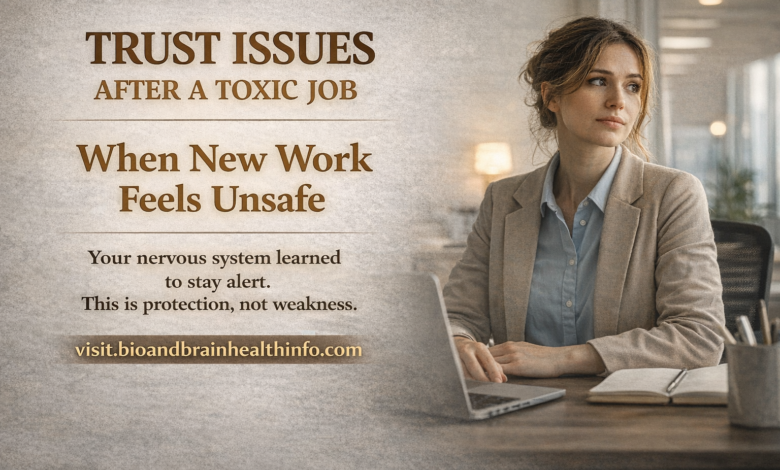
Trust issues after toxic job experiences often stem from trust damage caused by workplace trauma, leading to hypervigilance and a slow process of emotional healing.
Thank you for reading this post, don't forget to subscribe!“After a harmful job, safety doesn’t return the moment the door closes behind you.
Even after leaving, the nervous system can stay on alert because it learned unpredictability as normal. Regulation returns through consistency, not force.”
Trust Issues After a Toxic Job
Trust issues after toxic job experiences often surface in new workplaces as a quiet fear: “Why do I still feel unsafe?”
Many people assume trust damage means they are broken or overly suspicious. In reality, workplace trauma trains the mind and body to stay alert, and hypervigilance becomes a learned form of protection.
This reaction is frequently mistaken for personality change, when it is actually a nervous system response shaped by past conditions.
Emotional healing does not mean forcing openness or confidence before safety is felt. What you are noticing is not a flaw in character, but an adaptive response to repeated unpredictability.
Your identity has not been lost—it has been guarded.
This article will help you understand what’s happening — without labels, blame, or self-attack.
REASON FOR THIS BLOG
To help readers understand why trust feels fragile after a toxic job and to separate trauma-based reactions from identity—without judgment, diagnosis, or pressure to heal faster.
Please Explore This Blog performance-pressure-narcissistic-workplace
INNER SEARCH MIRROR – Trust Issues After Toxic Job
After a toxic job, trust issues don’t always feel dramatic. They show up as quiet questions you don’t say out loud.
Why do I scan people before relaxing?
Why does “nice” feel unsafe?
Why do small changes trigger doubt?
Why don’t I trust my judgment yet?
Why does safety feel temporary?
Why am I always waiting for a shift?
Why does calm feel unfamiliar?
These questions don’t mean something is wrong with you. They mean your system is still orienting after unpredictability—and you’re not alone in that experience.
PSYCHOLOGICAL EXPLANATION – Trust Issues After a Toxic Job
Trust issues after toxic job experiences develop through repetition, not weakness. When trust damage occurs in a workplace, the mind adapts by prioritizing detection over connection.
Workplace trauma teaches vigilance because past cues were unreliable. Hypervigilance becomes a learned strategy, not a conscious choice, while emotional healing often lags behind cognitive understanding.
The intent was protection; the reaction is caution. This distinction matters.
The mind isn’t trying to sabotage new relationships—it is trying to prevent past harm from repeating.
Personal note: When patterns repeat long enough, the brain stops asking if danger exists and starts asking when. That shift is adaptive, not personal.
Trust Issues After a Toxic Job and the Body’s Alarm System
Trust issues after toxic job experiences are also physiological. The nervous system links workplace trauma with threat, keeping hypervigilance active even in safer environments.
Emotional healing is slowed because the body reacts before the mind can assess. Fight, flight, or freeze responses activate automatically, based on memory—not present reality.
This is not overreaction; it is speed. The nervous system learned that subtle cues mattered for survival.
Common warning signs:
Tension during meetings
Difficulty relaxing at work
Sudden self-doubt
Over-monitoring tone or feedback
Fatigue after social interaction
These responses are protective, not defective.
Identity vs Survival Responses – Trust Issues After Toxic Job
This distinction anchors recovery.
Survival responses exist to protect you. They include caution, distance, and hyper-awareness after trust damage. They are temporary and context-driven.
Identity, however, holds your values, conscience, and capacity for connection. It remains intact beneath workplace trauma and trust issues after toxic job experiences.
Survival says: “Stay alert.”
Identity says: “I know who I am.”
Confusing the two leads to self-blame. Separating them restores dignity. What adapted did so intelligently. Who you are was never erased—it was shielded.
Please Explore This Blog narcissistic-leadership-burnout
Trust Issues After a Toxic Job: Trauma or Something Else?
One of the heaviest fears behind trust issues after toxic job experiences is, “What if this means something is wrong with me?”
This is where clarity matters. Trust damage shaped by workplace trauma is driven by protection, not entitlement.
Hypervigilance reflects awareness, not manipulation. Emotional healing remains possible because the motivation underneath is care, not control.
| Trauma-Based Response | Narcissistic Pattern |
|---|---|
| Feels remorse after conflict | Lacks remorse |
| Reflects on impact | Deflects responsibility |
| Seeks accountability | Avoids accountability |
Personal note: Wanting to understand yourself is evidence of conscience, not pathology.
Trust Issues After a Toxic Job: Re-orienting Gently
Growth after trust issues after toxic job experiences doesn’t announce itself loudly.
As trust damage settles, workplace trauma loosens its grip, and hypervigilance softens through repetition of safety—not effort.
Emotional healing often shows up as quieter pauses, less scanning, and fewer internal alarms. Orientation returns when pace slows naturally and choices feel less urgent.
Peace becomes preferable to proving anything. Agency re-emerges through consent with your own timing, not through pressure to “move on.”
Personal note: Healing felt real to me when I stopped measuring progress and started noticing ease.
HEALING COMPASS / ORIENTATION TABLE
This compass offers stability when trust issues after toxic job experiences feel disorienting.
It maps movement without commands, honoring how trust damage, workplace trauma, hypervigilance, and emotional healing unfold in sequence.
| Stage | Orientation |
|---|---|
| Recognition | “My reactions make sense.” |
| Stabilization | “I’m allowed to go slowly.” |
| Differentiation | “Past threat ≠ present moment.” |
| Reconnection | “Trust grows with consistency.” |
| Integration | “Calm feels more familiar.” |
This isn’t a ladder to climb—it’s a map to return to when steadiness wavers.
Why Trust Doesn’t Reset Automatically
Trust issues after toxic job experiences persist because trust damage formed through repetition, not a single event.
Prolonged workplace trauma teaches the nervous system that consistency is unreliable, so hypervigilance becomes the default filter for safety.
Even when conditions improve, the body stays cautious until predictability is proven over time. This delay is not resistance to growth—it is an intelligent pause.
Emotional healing begins when the system no longer has to guess what might happen next. Trust doesn’t reset with logic; it returns when the environment stays steady long enough for uncertainty to fade.
What looks like distrust is often discernment still recalibrating.
Hypervigilance Is Not a Personality Trait – Trust Issues After Toxic Job
Many people mistake trust issues after toxic job experiences as a flaw, when they are actually the residue of trust damage shaped by workplace trauma.
Hypervigilance is not who you are—it is what your system learned to do quickly. The mind scans not because it enjoys suspicion, but because it once needed speed to stay safe.
Emotional healing unfolds as the nervous system learns it no longer has to stay ahead of danger.
When vigilance softens, identity becomes visible again. The reduction of scanning is not loss of awareness; it is the return of choice.
Trust Returns Through Pattern, Not Assurance
After trust issues after toxic job experiences, reassurance rarely works because trust damage was created when words and outcomes didn’t align.
Workplace trauma conditions the system to believe patterns over promises. Hypervigilance stays active until consistency repeats without correction or penalty.
This is why calm environments may still feel unsafe at first. Emotional healing progresses when predictability becomes boring, not exciting.
Trust doesn’t return through explanation—it returns when nothing surprising happens for long enough that the system stops bracing.
Guardedness Can Coexist With Integrity
A common fear behind trust issues after toxic job experiences is becoming closed or cynical. In reality, trust damage from workplace trauma often heightens values rather than erasing them.
Hypervigilance may delay openness, but it does not remove conscience, empathy, or fairness. Emotional healing allows boundaries and warmth to exist together.
Guardedness is a temporary posture, not a moral shift.
Integrity remains intact beneath caution, waiting for conditions that allow expression without cost.
Healing Feels Quiet Before It Feels Confident
The early signs of recovery after trust issues after toxic job experiences are subtle.
As trust damage settles and workplace trauma loosens its grip, hypervigilance decreases in frequency rather than intensity.
You may notice fewer internal alarms before you notice confidence. Emotional healing often feels like neutrality before relief, and steadiness before optimism.
This quiet phase is not stagnation—it is recalibration. Confidence returns later, after the system no longer needs to protect itself every moment.
🌱 Closing Note
Breakthroughs do not arrive as sudden clarity. They appear as reduced effort, softer vigilance, and longer moments of internal quiet. When safety becomes consistent, trust follows naturally—without force.
Please Explore This Blog exit-trauma-toxic-workplaces
🩺 Medical / Ethical Positioning – Trust Issues After Toxic Job
From a medical-ethical lens, trust issues after toxic job experiences are understood as adaptive responses, not disorders.
When workplace trauma disrupts predictability, the mind assigns meaning through threat detection rather than evaluation. This interpretation preserves safety at the cost of ease.
Ethical care avoids pathologizing vigilance and instead protects dignity, autonomy, and timing.
The goal is not to force trust, but to respect how hypervigilance formed while allowing emotional healing to emerge through consistent, non-coercive environments.
| Focus | Ethical Meaning |
|---|---|
| Safety | Must precede insight |
| Consent | Healing cannot be rushed |
| Context | Behavior reflects conditions |
| Dignity | Responses deserve respect |
Personal note: Ethics felt real when understanding replaced urgency.
🧠 Psychological Layer – Trust Issues After Toxic Job
Psychologically, trust issues after toxic job experiences reflect how the mind organizes meaning under pressure. Trust damage reshapes perception, causing neutral cues to feel uncertain after workplace trauma.
The mind learns to interpret ambiguity as risk, not possibility. Hypervigilance becomes a cognitive shortcut, conserving energy by avoiding surprise.
Emotional healing occurs as interpretation widens again—when not every unknown must be solved immediately.
| Process | Interpretation |
|---|---|
| Ambiguity | Feels unsafe |
| Neutral cues | Seem loaded |
| Silence | Signals threat |
| Consistency | Restores meaning |
Personal note: Relief came when interpretation softened before belief did.
⚡ Nervous System Layer – Trust Issues After Toxic Job
At the nervous-system level, trust issues after toxic job experiences are stored as speed, not memory.
Workplace trauma teaches the body to respond before reflection. Hypervigilance activates automatically to prevent repeat harm, independent of present safety.
Emotional healing begins when the body no longer has to predict outcomes moment by moment.
Regulation returns through repetition of calm, not explanation.
| Body Signal | Protective Role |
|---|---|
| Tension | Readiness |
| Alertness | Threat scanning |
| Fatigue | Energy conservation |
| Startle | Fast protection |
Personal note: My body relaxed before my thoughts trusted.
🧩 Mental Health Layer – Trust Issues After Toxic Job
Over time, trust issues after toxic job experiences affect mental clarity. Trust damage combined with workplace trauma drains focus, increases doubt, and fragments self-trust.
Hypervigilance consumes cognitive bandwidth, leaving less room for creativity or rest.
Emotional healing restores mental space gradually, often beginning with neutrality rather than confidence.
Clarity improves when internal alarms quiet.
| Impact | Mental Effect |
|---|---|
| Prolonged stress | Reduced focus |
| Self-monitoring | Decision fatigue |
| Doubt | Lower confidence |
| Calm | Mental clarity |
Personal note: Thinking improved when pressure eased.
🧭 Identity Layer (Inner Continuity & Meaning) – Trust Issues After Toxic Job
Identity remains intact beneath trust issues after toxic job experiences. Workplace trauma affects behavior, not values.
While hypervigilance may delay openness, conscience, fairness, and meaning persist. Emotional healing allows identity to surface again without performance.
Trusting yourself is not forgetting the past—it is remembering who you were before protection became necessary.
| Identity Core | Remains Intact |
|---|---|
| Values | Unchanged |
| Conscience | Present |
| Capacity for trust | Dormant, not lost |
| Meaning | Preserved |
Personal note: Identity returned when self-blame ended.
🪞 Reflective Support Layer (Including AI) – Trust Issues After Toxic Job
Reflective tools support trust issues after toxic job recovery by mirroring rather than directing.
Journaling, conversation, or AI reflection help externalize thoughts shaped by workplace trauma without demanding conclusions.
Hypervigilance softens when inner dialogue becomes visible and less urgent.
Emotional healing is supported through clarity, not instruction.
| Tool | Support Function |
|---|---|
| Journaling | Externalizes thoughts |
| Dialogue | Normalizes experience |
| AI reflection | Mirrors patterns |
| Silence | Integrates insight |
Personal note: Being mirrored reduced inner urgency.
🔗 Integration Layer (Whole-System Coherence)
Integration occurs when trust issues after toxic job experiences are understood across systems—not fixed in isolation.
Trust damage, workplace trauma, hypervigilance, and emotional healing align when safety stabilizes body, mind, and meaning together.
Healing becomes less about effort and more about coherence.
Systems settle when they no longer compete for control.
| System | Role |
|---|---|
| Body | Regulates |
| Mind | Interprets |
| Identity | Anchors |
| Support | Reflects |
Personal note: Coherence arrived quietly, not dramatically.
PERSONAL NOTE – Trust Issues After a Toxic Job — A Lived Insight
After trust issues after a toxic job, what helped me most was noticing how my internal pace changed before my confidence returned.
I could sense trust damage loosening not through reassurance, but through predictability. The residue of workplace trauma didn’t disappear overnight; it softened when my days became boring in a good way.
Hypervigilance reduced quietly, without announcements, and emotional healing followed consistency rather than effort.
The insight was simple: my system wasn’t broken—it was waiting for proof.
When proof arrived in small, repeatable ways, trust didn’t need convincing; it resumed on its own timeline.
Please Explore This Blog performance-pressure-narcissistic-workplace
COSMIC / PHILOSOPHICAL TAKEAWAY – Trust Issues After a Toxic Job and Human Meaning
“What endures harm learns to pause before it learns to open.”
Across human experience, trust issues after a toxic job reflect an ancient truth: systems that survive uncertainty learn to wait.
Trust damage narrows perception until safety repeats, while workplace trauma shifts meaning from possibility to protection.
Hypervigilance is the language of survival, not a verdict on character. Emotional healing restores meaning gently—by letting the world become predictable again.
Trust is not forced open; it is invited back by consistency. When safety stabilizes, meaning returns quietly, without demand.
FINAL CLOSING – Trust Issues After a Toxic Job — Returning to Ease
If trust issues after a toxic job are shaping your present, nothing about your pace means you are failing. Trust damage resolves through steadiness, not pressure.
Workplace trauma leaves imprints that soften when environments remain consistent. Hypervigilance fades as the nervous system learns it no longer needs to predict every outcome.
Emotional healing often feels like neutrality before relief—and that is enough. Nothing is wrong with you for reacting to harm.
With safety and understanding, what adapted can soften again.
Please Explore This Blog narcissistic-leadership-burnout
FAQ SECTION
1. Why do new workplaces feel unsafe after a toxic job?
Because the body learned unpredictability and needs time to recalibrate.
2. Does guardedness mean I’ve changed permanently?
No. Guardedness is a temporary protective response.
3. Why do small cues trigger doubt?
They resemble past inconsistencies your system learned to monitor.
4. Is it normal to feel neutral before confident?
Yes. Neutrality often precedes calm and trust.
5. Do I need to confront the past to heal?
Not always. Consistency can restore trust without confrontation.
6. Why does reassurance not help much?
Because trust returns through pattern, not words.
7. Can trust rebuild without forcing openness?
Yes. Openness returns when safety feels reliable.
8. How long does recovery take?
It varies; pace follows stability, not effort.
🌿 Final Blog Footer — Bio & Brain Health Info
Written by Lex, founder of Bio & Brain Health Info — exploring the intersections of psychology, spirituality, and emotional recovery through calm, trauma-aware understanding.
✨ Insight & Reflection
Healing does not begin when answers arrive — it begins when self-attack stops.
Clarity grows in spaces where safety is restored.
🧠 Learn
Narcissism • Emotional Healing • Spiritual Psychology
🌍 A Moment for You
💡 Pause for two minutes. Let your body settle before moving on.
🧭 If This Article Helped, Your Next Questions Might Be:
These questions are natural continuations — not obligations.
✨ Cosmic Family Invitation
You are not here by accident. If these words reached you, clarity was already beginning.
We rise together — different souls, one journey. 🕊️
📩 Connect with us
info@bioandbrainhealthinfo.com
Telegram: @bioandbrainhealthinfo
WhatsApp Channel: Punehealth
Lex | Bio & Brain Health Info
Cosmic Family — Different Souls, One Journey.
REFERENCES & CITATION
American Psychological Association — Workplace Stress
https://www.apa.org/topics/workplace/stressWorld Health Organization — Mental Health at Work
https://www.who.int/teams/mental-health-and-substance-use/mental-health-at-workCDC / NIOSH — Work Stress
https://www.cdc.gov/niosh/topics/stressHarvard Health — How Stress Affects the Body
https://www.health.harvard.edu/staying-healthy/how-stress-affects-your-bodyCleveland Clinic — Trauma Responses
https://health.clevelandclinic.org/trauma-response/Mind UK — Mental Health at Work
https://www.mind.org.uk/workplace/mental-health-at-work/Judith Herman, MD — Trauma and Recovery
https://www.basicbooks.com/titles/judith-herman/trauma-and-recovery/9780465061716/Bessel van der Kolk, MD — The Body Keeps the Score
https://www.penguinrandomhouse.com/books/220128/the-body-keeps-the-score-by-bessel-van-der-kolk-md/Psychology Today — Trauma Basics
https://www.psychologytoday.com/us/basics/traumaHarvard Business Review — Toxic Leadership
https://hbr.org/topic/leadership