1️⃣ Grandiosity vs Self-Protection
What appears as confidence or superiority may sometimes function as emotional armor. Grandiosity can emerge when individuals compensate for insecurity, using external strength to manage internal vulnerability and maintain psychological stability.
2️⃣ Validation Seeking and Self-Worth
Some relational patterns described as narcissist personality traits involve persistent validation seeking, where external approval temporarily regulates self-esteem rather than reflecting deep internal confidence or emotional security.
3️⃣ Emotional Distance and Overload
From a narcissism psychology lens, reduced empathy or emotional withdrawal may develop when individuals struggle to process overwhelming feelings, leading to defensive detachment rather than conscious emotional harm.
4️⃣ Control and Predictability
Certain narcissistic behavior signs include controlling tendencies or rigidity, which may arise from a need to reduce uncertainty and maintain emotional predictability rather than purely manipulative motives.
5️⃣ Clinical Framework vs Everyday Patterns
Understanding DSM-5 narcissism helps distinguish between clinical personality disorder criteria and common personality expressions, reducing confusion and preventing people from applying diagnostic labels to complex relational behaviors too quickly.
6️⃣ Idealization and Devaluation Cycles
Rapid shifts between admiration and criticism often reflect unstable relational expectations, where individuals struggle to maintain balanced perception of others due to internal emotional inconsistency.
7️⃣ Boundary Confusion
Difficulty recognizing or respecting boundaries may develop when identity formation is unstable, causing personal needs and others’ autonomy to blur during emotionally charged interactions.
8️⃣ Entitlement Patterns
Entitlement can emerge from repeated reinforcement environments where expectations were prioritized, creating learned relational habits rather than fixed personality pathology.
9️⃣ Sensitivity to Criticism
Strong reactions to feedback may function as protection against shame, where emotional defenses activate quickly to preserve internal stability and avoid perceived rejection.
🔟 Image Management
Maintaining a strong external image may reflect fear of vulnerability, where self-presentation becomes a strategy to prevent exposure of perceived inadequacy.
1️⃣1️⃣ Intense Relationship Dynamics
High emotional intensity in relationships may indicate dependency patterns where connection becomes closely tied to validation rather than mutual emotional balance.
1️⃣2️⃣ External Validation Dependence
Reliance on external affirmation often indicates difficulty maintaining internal emotional regulation, leading individuals to seek reassurance from others to stabilize self-perception.
Please Explore This Blog 5-types-of-narcissist-blame-shifting-explained
🌿 A Whole-System View of the Human Healing Process
🛡️ Medical / Ethical Positioning -12 Traits of a Narcissist
Healing requires distinguishing between observable patterns and ethical interpretation. When examining narcissist personality traits, ethical positioning avoids labeling individuals and instead prioritizes safety, consent, and context.
The mind interprets threat through meaning-making: ambiguity can feel unsafe even without visible harm.
Ethical clarity prevents over-pathologizing while supporting informed awareness and emotional boundaries.
| Focus |
Ethical Lens |
| Interpretation |
Context matters |
| Responsibility |
Shared dynamics |
| Safety |
Non-judgmental awareness |
| Boundaries |
Protect without labeling |
(Personal note: ethical clarity often reduces emotional escalation.)
🧠 Psychological Layer – 12 Traits of a Narcissist
From a narcissism psychology perspective, the mind constantly interprets signals for meaning. Confusion arises when internal expectations conflict with lived experience.
Psychological processing translates subtle cues into narratives that shape perception of threat or connection.
Understanding interpretation patterns helps individuals separate emotional reactions from cognitive assumptions.
| Aspect |
Interpretation |
| Meaning-making |
Story formation |
| Projection |
Filling unknown gaps |
| Bias |
Past shapes perception |
| Reflection |
Reframing experience |
(Personal note: insight deepens when we observe thinking patterns rather than chase certainty.)
⚡ Nervous System Layer – 12 Traits of a Narcissist
Automatic body responses connected to narcissistic behavior signs can activate before conscious reasoning.
The nervous system prioritizes safety through rapid detection of unpredictability, altering breath, posture, and focus without deliberate choice.
These reactions protect survival even when logical danger is unclear.
| Response |
Body Action |
| Fight |
Tension, urgency |
| Flight |
Avoidance impulse |
| Freeze |
Emotional shutdown |
| Scan |
Hypervigilance |
(Personal note: recognizing body cues can reduce confusion about emotional reactions.)
🌫️ Mental Health Layer – 12 Traits of a Narcissist
Long-term exposure to patterns associated with DSM-5 narcissism discussions may influence mental clarity and energy, especially when uncertainty persists.
Prolonged stress reshapes attention, reduces confidence in perception, and weakens internal trust.
Mental health impact often appears gradually rather than dramatically.
| Effect |
Experience |
| Cognitive fatigue |
Difficulty deciding |
| Emotional drain |
Reduced motivation |
| Self-doubt |
Questioning reality |
| Fragmentation |
Loss of focus |
(Personal note: subtle shifts in energy often signal deeper strain.)
🧭 Identity Layer (Inner Continuity & Meaning)
Beneath relational patterns and interpretations of narcissist personality traits, identity remains anchored in values and conscience.
Survival responses may change behavior temporarily, but internal meaning systems persist.
Recognizing this continuity supports self-trust and reduces fear of “losing oneself.”
| Core |
Meaning |
| Values |
Stable reference |
| Conscience |
Inner compass |
| Memory |
Continuity of self |
| Choice |
Capacity to realign |
(Personal note: identity feels clearer when viewed as deeper than reactions.)
🔍 Reflective Support Layer (Including AI) -12 Traits of a Narcissist
Reflective tools connected to narcissism psychology — journaling, dialogue, or AI reflection — create structured mirrors for thought rather than direction.
External reflection slows reactive interpretation, allowing observation without immediate conclusion.
Supportive tools provide perspective while preserving autonomy.
| Tool |
Function |
| Journaling |
Pattern visibility |
| Conversation |
Emotional processing |
| AI reflection |
Neutral mirroring |
| Pausing |
Cognitive space |
(Personal note: reflection becomes powerful when curiosity replaces urgency.)
Please Explore This Blog 2-narcissists-together-relationship-psychology
🌱 Integrated Whole-System Orientation -12 Traits of a Narcissist
A whole-system view connected to narcissistic behavior signs recognizes that healing unfolds across interpretation, biology, identity, and reflection simultaneously.
Rather than fixing one layer, stability emerges when awareness integrates meaning-making, body signals, emotional clarity, and supportive mirrors.
Tools like journaling or reflective dialogue do not direct outcomes but reveal patterns, allowing individuals to move from confusion toward grounded self-understanding.
Healing becomes less about correcting the past and more about recognizing internal continuity while building new experiences of safety and coherence.
(Personal note: integration often feels quiet — more like alignment than transformation.)
PERSONAL NOTE -12 Traits of a Narcissist
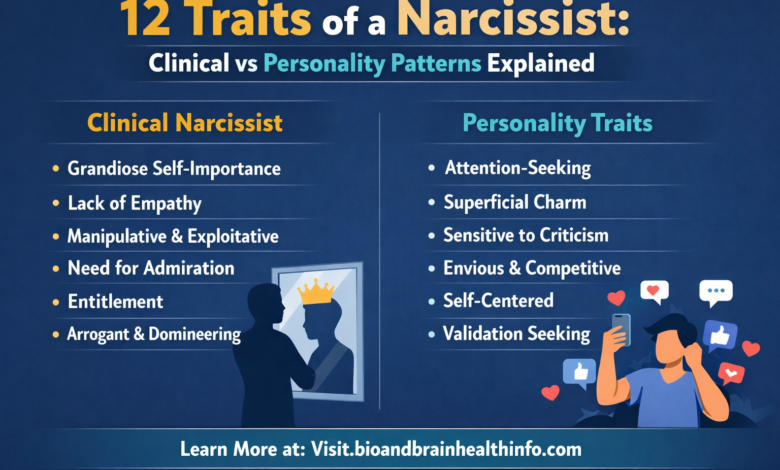
While writing 12 Traits of a Narcissist: Clinical vs Personality Patterns Explained, I realized how easily conversations about narcissist personality traits can move from curiosity into self-blame or labeling.
My intention in exploring narcissism psychology and narcissistic behavior signs — while respecting DSM-5 narcissism boundaries — is not to define people but to create clarity where confusion lives.
Over time, I learned that understanding patterns does not require judgment; it requires steadiness. Readers often arrive searching for certainty, yet what helps most is permission to observe without rushing to conclusions.
Insight becomes meaningful when it reduces internal conflict rather than creating new categories to fear.
Clarity returned for me when I stopped asking what was wrong with me and began asking what my experience was trying to show me.
COSMIC / PHILOSOPHICAL TAKEAWAY —12 Traits of a Narcissist
“Human understanding deepens not by dividing people into labels, but by learning how meaning evolves through experience.”
In 12 Traits of a Narcissist: Clinical vs Personality Patterns Explained, the deeper lesson is that human behavior exists on a spectrum where narcissist personality traits, narcissism psychology, narcissistic behavior signs, and DSM-5 narcissism remind us of the difference between observation and identity.
Life rarely presents clear categories; instead, it offers patterns that ask for awareness. When we approach understanding with curiosity rather than judgment, meaning shifts from control toward compassion.
Philosophically, healing is not about defining others but recognizing how perception shapes reality.
The search for clarity becomes a quiet spiritual process — one that restores balance between understanding human complexity and maintaining inner stability.
Please Explore This Blog 12-traits-of-a-narcissist-in-a-relationship-explained
FAQ SECTION -12 Traits of a Narcissist
❓ What are common narcissistic behavior signs without diagnosis?
They may include validation seeking, emotional inconsistency, or strong image management, but context matters and patterns alone do not equal diagnosis.
❓ Are narcissist personality traits always harmful?
Not necessarily; traits exist on a spectrum, and impact depends on awareness, flexibility, and relational dynamics.
❓ How does narcissism psychology explain behavior?
It examines emotional regulation, self-concept development, and adaptation patterns rather than assuming intent.
❓ What is the difference between traits and DSM-5 narcissism?
DSM-5 narcissism describes clinical criteria requiring assessment, while everyday traits may appear without meeting diagnostic thresholds.
❓ Why do people confuse trauma with narcissism?
Surface behaviors can look similar; motivation, remorse, and accountability usually clarify the difference.
❓ Can someone change these patterns?
Growth depends on self-awareness, willingness to reflect, and consistent relational learning.
❓ Why does confusion last after leaving a relationship?
The nervous system may continue interpreting past unpredictability as present threat until stability is experienced repeatedly.
❓ How can readers avoid self-labeling?
Focus on understanding experiences rather than assigning identity labels.
❓ Is learning about narcissism meant to judge others?
No; education aims to reduce confusion and support healthier boundaries.
FINAL CLOSING (VERY IMPORTANT) —12 Traits of a Narcissist
Reading 12 Traits of a Narcissist: Clinical vs Personality Patterns Explained may bring relief because narcissist personality traits, narcissism psychology, narcissistic behavior signs, and DSM-5 narcissism often become clearer when viewed without urgency or blame.
Nothing is wrong with you for reacting to harm. With safety and understanding, what adapted can soften again. Healing does not require forcing answers or deciding immediately what everything means.
Instead, clarity grows slowly as awareness becomes steady and self-trust returns. Allow yourself to move forward gently, keeping curiosity rather than pressure.
If this article helped, consider it an invitation to continue learning at your own pace — not a demand for change, but a reminder that calm understanding is already a step toward stability.
🌿 Final Blog Footer — Bio & Brain Health Info
Written by Lex, founder of Bio & Brain Health Info — exploring the intersections of psychology, spirituality, and emotional recovery through calm, trauma-aware understanding.
✨ Insight & Reflection
Healing does not begin when answers arrive — it begins when self-attack stops.
Clarity grows in spaces where safety is restored.
🧠 Learn
Narcissism • Emotional Healing • Spiritual Psychology
🌍 A Moment for You
💡 Pause for two minutes. Let your body settle before moving on.
🧭 If This Article Helped, Your Next Questions Might Be:
These questions are natural continuations — not obligations.
✨ Cosmic Family Invitation
You are not here by accident. If these words reached you, clarity was already beginning.
We rise together — different souls, one journey. 🕊️
📩 Connect with us
info@bioandbrainhealthinfo.com
Telegram: @bioandbrainhealthinfo
WhatsApp Channel: Punehealth
Lex | Bio & Brain Health Info
Cosmic Family — Different Souls, One Journey.
REFERENCES & CITATIONS -12 Traits of a Narcissist
📚 Psychology & Clinical References
-
American Psychiatric Association — DSM-5 Overview (Narcissistic Personality Disorder)
https://www.psychiatry.org/psychiatrists/practice/dsm
-
Cleveland Clinic — Narcissistic Personality Disorder (Clinical Explanation)
https://my.clevelandclinic.org/health/diseases/9742-narcissistic-personality-disorder
-
Mayo Clinic — Narcissistic Personality Disorder Symptoms and Causes
https://www.mayoclinic.org/diseases-conditions/narcissistic-personality-disorder/symptoms-causes
-
Psychology Today — Narcissism Definition and Psychological Insights
https://www.psychologytoday.com/us/basics/narcissism
-
National Institute of Mental Health (NIMH) — Personality Disorders Overview
https://www.nimh.nih.gov/health/topics/personality-disorders
-
APA Dictionary of Psychology — Narcissism Definition
https://dictionary.apa.org/narcissism
-
Verywell Mind — Narcissistic Traits vs Narcissistic Personality Disorder
https://www.verywellmind.com/what-is-narcissistic-personality-disorder-425426
-
Frontiers in Psychology — Research Articles on Narcissism Psychology
https://www.frontiersin.org/journals/psychology
-
National Library of Medicine (PubMed) — Narcissism Research Database
https://pubmed.ncbi.nlm.nih.gov/
-
Mind UK — Personality Disorders and Emotional Regulation Guidance
https://www.mind.org.uk/information-support/types-of-mental-health-problems/personality-disorders/