Trauma Bond Recovery: When Letting Go Hurts Like Withdrawal
Why Letting Go Feels Like Withdrawal

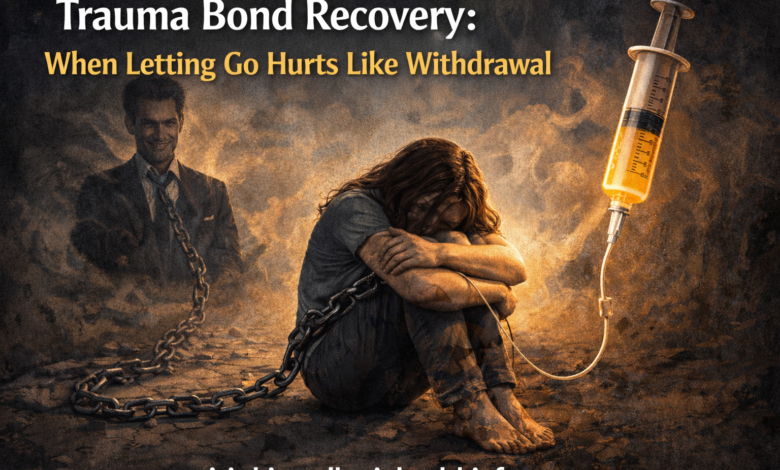
Trauma bond recovery often involves trauma bonding patterns that feel like emotional addiction during abuse recovery, driven by the nervous system.
Thank you for reading this post, don't forget to subscribe!Letting go can hurt not because you are attached to harm,
but because your system learned connection through intensity.
Even after leaving, the nervous system can stay on alert because it learned unpredictability as normal. Regulation returns through consistency, not force.
Trauma Bond Recovery
Trauma bond recovery often brings a confusing fear: Why does separation feel like withdrawal instead of relief?
Many people misread this pain as emotional addiction or weakness, when it is more accurately the nervous system completing a cycle formed through trauma bonding.
During abuse recovery, the body learned to associate closeness with survival, even when the relationship caused harm.
This reaction is not identity—it is adaptation. You are not losing yourself, and you are not “too attached.” Your system is recalibrating after prolonged stress.
What feels like craving is often the body releasing learned patterns of safety and threat.
Understanding this difference is what begins to reduce shame and restore steadiness.
This article will help you understand what’s happening — without labels, blame, or self-attack.
REASON FOR THIS BLOG
To help readers understand why letting go after abusive relationships can feel like withdrawal.
This article separates trauma-based nervous system responses from identity, without diagnosis, judgment, or pressure to heal faster.
Please Explore This Blog confidence-after-narcissistic-abuse
INNER SEARCH MIRROR
Before understanding trauma bond recovery, many people quietly search for reassurance that they are not broken.
These questions often live beneath the surface—unspoken, heavy, and isolating.
Why does letting go feel harder than staying?
Why do I miss someone who hurt me?
Why does my body panic even when my mind knows the truth?
Why does distance feel like danger?
Why does calm feel unfamiliar?
Why do I doubt my decision after leaving?
Why does this feel like withdrawal?
If you recognize yourself here, you are not alone. These questions are not signs of weakness—they are signals of a system trying to recalibrate after prolonged emotional intensity.
PSYCHOLOGICAL EXPLANATION: Trauma Bond Recovery and Adaptation
Trauma bond recovery begins with understanding adaptation, not pathology. During trauma bonding, the mind learns to associate emotional closeness with relief from threat.
Moments of connection—however inconsistent—become psychologically reinforced because they reduce fear temporarily.
This is not intention or desire; it is conditioning. The reaction to separation is often mistaken for emotional addiction, but it is more accurately the brain completing a learned survival loop.
Abuse recovery requires separating intent from reaction: you are not choosing harm, and you are not failing to move on. Your mind adapted to unpredictability to preserve connection.
Personal note: Real clarity arrived for me when I saw reactions as learned responses—not personal flaws.
NERVOUS SYSTEM EXPLANATION: Trauma Bond Recovery in the Body
Trauma bond recovery also unfolds in the nervous system, not just in thought. When safety was inconsistent, the body learned to stay alert.
Fight, flight, or freeze responses activate automatically—often before logic or memory engage.
This is why leaving can trigger shaking, panic, longing, or numbness without conscious choice.
These reactions are biological, not emotional weakness. Common signs include: rapid heart rate, chest tightness, compulsive checking, emotional flooding, or sudden doubt.
The nervous system responds to separation as loss of regulation, not loss of love. Regulation returns slowly through predictability, not willpower.
Personal note: Understanding my body’s timing helped me stop arguing with myself.
Please Explore This Blog rebuilding-self-trust-after-narcissist
CORE DISTINCTION: Identity vs Survival Responses
This distinction anchors trauma bond recovery.
Survival responses exist to protect life. They are fast, reflexive, and driven by threat memory.
Identity reflects values, conscience, and long-term meaning.
Missing someone harmful does not define who you are. Longing does not cancel insight. Fear does not erase truth.
Survival reactions can coexist with clear values without contradicting them. When you stop confusing reflex with identity, shame loosens.
You are not divided—you are transitioning. As safety increases, survival responses soften naturally.
Identity remains intact throughout the process, even when emotions feel chaotic.
TRAUMA VS NARCISSISM: Relief Through Motivation
A common fear during trauma bond recovery is, “What if I’m the narcissist?” This fear dissolves when we compare motivation, not behavior.
Trauma bonding creates reactions driven by fear and attachment loss, while narcissism is driven by control and self-protection at others’ expense.
Emotional addiction reflects distress when safety is removed, not entitlement. Abuse recovery includes remorse, reflection, and responsibility—qualities that require conscience.
A regulated nervous system can feel guilt and self-questioning; narcissism avoids both.
| Trauma Response | Narcissistic Pattern |
|---|---|
| Feels remorse | Avoids remorse |
| Reflects inward | Deflects blame |
| Seeks repair | Seeks dominance |
| Accepts accountability | Rejects accountability |
Personal note: Relief came when I noticed accountability—not perfection—was the true divider.
GROWTH DIRECTION: Orientation Without Pressure
Trauma bond recovery is not about forcing detachment; it is about allowing the system to relearn safety.
As trauma bonding loosens, urgency fades and internal pace slows. You may notice longer neutral moments, fewer intrusive thoughts, or a quiet preference for calm over intensity.
These shifts are not dramatic—they are stabilizing. Abuse recovery often feels subtle before it feels strong.
When emotional addiction softens, choice returns without effort. The nervous system begins to trust consistency, and peace becomes more familiar than chaos.
Growth here means orientation, not fixing—moving gently toward what does not require self-betrayal.
Personal note: Choosing calm repeatedly taught my system more than any explanation ever did.
Please Explore This Blog nervous-system-recovery-after-abuse
HEALING COMPASS — Orientation Map
This compass supports trauma bond recovery by offering clarity without commands. Healing unfolds in stages, not steps, especially after trauma bonding and emotional addiction.
Abuse recovery progresses as the nervous system regains predictability.
| Stage | Orientation |
|---|---|
| Awareness | “What I feel has context.” |
| Stabilization | “Safety can be repeated.” |
| Separation | “Distance reduces threat.” |
| Integration | “My values remain intact.” |
| Protection | “Peace is now my baseline.” |
Each stage affirms presence, not performance. You do not move forward by pushing—you move forward by allowing your system to settle into what no longer harms.
Why Separation Feels Like Withdrawal
Trauma bond recovery often feels physically distressing because trauma bonding conditions the body to associate emotional intensity with safety.
When the connection breaks, the system reacts as if something essential is missing.
This is why emotional addiction can mimic withdrawal—restlessness, longing, and fear are not signs of weakness, but of learned attachment under threat.
In abuse recovery, the brain is relearning regulation without unpredictability. The nervous system initially protests because chaos once signaled connection.
Understanding this reframes the pain: discomfort is not proof that leaving was wrong—it is evidence that conditioning is dissolving.
Longing Does Not Mean You Want the Harm
A key shift in trauma bond recovery is realizing that longing is not desire for abuse. Trauma bonding fuses relief and harm, making absence feel unbearable even when presence was painful.
This confusion fuels emotional addiction, where the body seeks familiar intensity, not mistreatment.
During abuse recovery, the mind may romanticize fragments of connection because the nervous system still equates intensity with survival.
This does not reflect your values or true wishes. Longing is a signal of adaptation, not preference.
When safety becomes consistent, craving loses its authority without being forced away.
Guilt Is a Survival Reflex, Not a Moral Truth
In trauma bond recovery, guilt often surfaces after distance is created. Trauma bonding trained the self to prioritize another’s emotional state to avoid conflict or loss.
This creates emotional addiction to responsibility for someone else’s stability.
During abuse recovery, choosing yourself can feel “wrong” because the nervous system learned compliance as protection.
Guilt here is not conscience—it is conditioning. True conscience includes self-respect and reflection.
As regulation improves, guilt softens into clarity, revealing that safety was never a betrayal, only a boundary reclaimed.
Confusion Is a Transitional State, Not a Regression
Periods of confusion are common in trauma bond recovery because trauma bonding disrupts internal reference points.
When external validation disappears, emotional addiction leaves a temporary vacuum where certainty used to be borrowed.
This phase is often misread as failure in abuse recovery, when it is actually recalibration.
The nervous system is learning to orient inward rather than scan for approval or threat.
Confusion signals that old patterns are loosening and new ones are not yet solid. Stability follows this phase quietly, without dramatic insight or effort.
Peace Feels Unfamiliar Before It Feels Safe
The final shift in trauma bond recovery is recognizing that calm may initially feel empty.
Trauma bonding conditioned the system to associate intensity with aliveness, making stillness seem dull or unsettling.
This fuels emotional addiction to highs and lows even during abuse recovery.
The nervous system needs time to experience peace as nourishing rather than threatening.
When consistency replaces unpredictability, calm stops feeling foreign. Peace is not the absence of connection—it is connection without cost.
🌱 Closing Note
Breakthroughs do not arrive as realizations alone. They arrive as less urgency, less self-attack, and more internal quiet—signs that your system is returning to itself.
Please Explore This Blog emotional-withdrawal-after-narcissist
Medical / Ethical Positioning in Trauma Bond Recovery
From a medical-ethical perspective, trauma bond recovery is not a character issue but a response to prolonged threat and relational unpredictability.
The mind assigns meaning under pressure, often mislabeling fear as attachment to preserve continuity.
In trauma bonding, confusion becomes adaptive rather than pathological. Emotional addiction reflects learned regulation patterns, not moral failure.
Ethical care in abuse recovery avoids coercion, urgency, or forced insight, allowing the nervous system to regain trust through predictability and consent rather than control.
| Medical-Ethical Focus | Role in Healing |
|---|---|
| Informed consent | Restores agency |
| Non-pathologizing lens | Reduces shame |
| Predictability | Supports regulation |
| Autonomy | Rebuilds trust |
Psychological Layer: Trauma Bond Recovery
Psychologically, trauma bond recovery involves dismantling distorted meaning formed under pressure.
During trauma bonding, the mind links relief, hope, and fear into a single narrative to reduce uncertainty.
This can create emotional addiction, where intensity feels meaningful even when harmful. In abuse recovery, clarity returns when meaning is separated from survival.
The nervous system does not drive this process directly; interpretation does.
Healing occurs as the mind relearns to assign meaning without threat as the organizing force.
| Psychological Process | Effect |
|---|---|
| Threat-based meaning | Confusion |
| Relief association | Attachment |
| Narrative correction | Clarity |
| Internal reference | Stability |
Nervous System Layer: Trauma Bond Recovery
In trauma bond recovery, the nervous system operates faster than conscious thought. Trauma bonding trains the body to stay alert, scanning for emotional shifts as survival cues.
What appears as emotional addiction is often a reflexive attempt to regulate uncertainty.
During abuse recovery, safety is initially interpreted as unfamiliar, not calming.
Regulation emerges when the body experiences consistency without consequence, allowing defensive responses to downshift naturally.
| Nervous System Response | Purpose |
|---|---|
| Hypervigilance | Threat detection |
| Freeze/appease | Harm reduction |
| Withdrawal distress | Loss of predictability |
| Settling response | Safety recognition |
Mental Health Layer: Trauma Bond Recovery
From a mental health lens, trauma bond recovery addresses the erosion of clarity caused by prolonged stress.
Trauma bonding disrupts attention, memory, and confidence, making decision-making feel unsafe.
Emotional addiction often masks exhaustion rather than desire. In abuse recovery, restoring self-trust requires reducing internal pressure, not increasing effort.
As the nervous system stabilizes, mental energy returns gradually, supporting coherence and realistic self-appraisal.
| Mental Health Impact | Outcome |
|---|---|
| Cognitive fatigue | Doubt |
| Emotional overload | Indecision |
| Reduced self-trust | Dependency |
| Restored pacing | Clarity |
Identity Layer: Inner Continuity Beneath Survival
At the identity level, trauma bond recovery reveals that values remain intact beneath adaptation. Trauma bonding alters behavior, not conscience.
Emotional addiction may shape reactions, but it does not redefine character. In abuse recovery, recognizing that the nervous system learned protection—without corrupting identity—reduces self-attack.
Identity stabilizes when survival responses are no longer mistaken for personal truth.
| Identity Aspect | What Remains |
|---|---|
| Values | Consistent |
| Conscience | Intact |
| Capacity for care | Unchanged |
| Self-respect | Recoverable |
Reflective Support Layer (Including AI): Mirroring Without Control
Reflective tools support trauma bond recovery by offering containment without direction.
Journaling, conversation, or AI reflection help externalize thought patterns shaped by trauma bonding.
This reduces emotional addiction to internal rumination. In abuse recovery, such tools allow observation without correction, helping the nervous system experience safety in expression.
Reflection works best when it mirrors rather than instructs, reinforcing autonomy.
| Reflective Tool | Function |
|---|---|
| Journaling | Pattern visibility |
| Dialogue | Emotional processing |
| AI reflection | Non-judgmental mirroring |
| Silence | Integration |
PERSONAL NOTE — Trauma Bond Recovery
In my own trauma bond recovery, clarity did not arrive through willpower or confrontation. It arrived when I stopped interpreting my confusion as weakness.
What looked like attachment was actually my system trying to survive emotional unpredictability.
Understanding trauma bonding helped me see that emotional addiction was not desire—it was conditioning.
During abuse recovery, my nervous system needed steadiness more than answers. Once I respected that pace, self-trust returned quietly.
Healing did not require becoming stronger. It required becoming safer with myself. That shift changed everything—without drama, urgency, or self-attack.
Please Explore This Blog why-i-miss-my-narcissistic-ex
COSMIC / PHILOSOPHICAL TAKEAWAY — Trauma Bond Recovery
“What adapts to survive is not broken—it is intelligent under pressure.”
In trauma bond recovery, the deeper lesson is not about leaving a person, but about restoring internal order.
Trauma bonding shows how the mind clings to meaning when stability disappears. Emotional addiction reflects the human need for continuity, not moral failure.
In abuse recovery, the nervous system teaches a quiet truth: healing is not a leap forward, but a return inward.
When safety replaces urgency, what adapted can soften. Nothing essential was lost—only temporarily rearranged.
FINAL CLOSING — Trauma Bond Recovery
If this process feels slower than expected, nothing is wrong with you. Trauma bond recovery unfolds as safety accumulates, not as insight accelerates.
Trauma bonding trained your system to equate intensity with connection. Emotional addiction fades as consistency replaces unpredictability.
In abuse recovery, the nervous system learns through experience, not instruction. You are not required to forgive, rush, or resolve everything today.
Regulation returns through gentleness. When safety becomes familiar, clarity follows naturally.
You are already moving forward—by understanding instead of judging.
FAQ SECTION — Trauma Bond Recovery
1. Why does trauma bond recovery feel like withdrawal?
Because the nervous system learned regulation through intensity, not safety.
2. Is trauma bonding the same as love?
No. Trauma bonding is survival-based attachment under threat.
3. Why do I miss someone who harmed me?
Because emotional addiction reflects conditioning, not preference.
4. How long does abuse recovery take?
There is no fixed timeline; safety determines pace.
5. Can clarity return without confronting the abuser?
Yes. Healing is internal, not relational.
6. Why do calm relationships feel unfamiliar?
Your nervous system learned unpredictability as normal.
7. Does understanding trauma bonding stop the pain?
Understanding reduces self-attack; regulation reduces pain.
8. Am I broken for struggling to let go?
No. You adapted intelligently under pressure.
🌿 Final Blog Footer — Bio & Brain Health Info
Written by Lex, founder of Bio & Brain Health Info — exploring the intersections of psychology, spirituality, and emotional recovery through calm, trauma-aware understanding.
✨ Insight & Reflection
Healing does not begin when answers arrive — it begins when self-attack stops.
Clarity grows in spaces where safety is restored.
🧠 Learn
Narcissism • Emotional Healing • Spiritual Psychology
🌍 A Moment for You
💡 Pause for two minutes. Let your body settle before moving on.
🧭 If This Article Helped, Your Next Questions Might Be:
These questions are natural continuations — not obligations.
✨ Cosmic Family Invitation
You are not here by accident. If these words reached you, clarity was already beginning.
We rise together — different souls, one journey. 🕊️
📩 Connect with us
info@bioandbrainhealthinfo.com
Telegram: @bioandbrainhealthinfo
WhatsApp Channel: Punehealth
Lex | Bio & Brain Health Info
Cosmic Family — Different Souls, One Journey.
REFERENCES & CITATION
Judith Herman, MD — Trauma and Recovery
https://www.basicbooks.com/titles/judith-lewis-herman/trauma-and-recovery/9780465087303/Bessel van der Kolk, MD — The Body Keeps the Score
https://www.penguinrandomhouse.com/books/216244/the-body-keeps-the-score-by-bessel-van-der-kolk-md/Patrick Carnes, PhD — Trauma Bonding Research
https://www.journaloftraumapractice.comNational Institute of Mental Health (NIMH) — Trauma & Stress
https://www.nimh.nih.gov/health/topics/post-traumatic-stress-disorder-ptsdHarvard Health Publishing — Stress & Nervous System Regulation
https://www.health.harvard.edu/topics/stressAmerican Psychological Association (APA) — Emotional Abuse
https://www.apa.org/topics/abusePolyvagal Theory – Stephen Porges, PhD
https://www.stephenporges.comCleveland Clinic — Trauma Response Patterns
https://my.clevelandclinic.org/health/diseases/traumaNational Domestic Violence Hotline — Abuse Recovery
https://www.thehotline.orgMind UK — Emotional Abuse & Recovery
https://www.mind.org.uk