Empaths and Narcissists: Why They Attract Each Other
The Emotional Push-Pull Dynamic

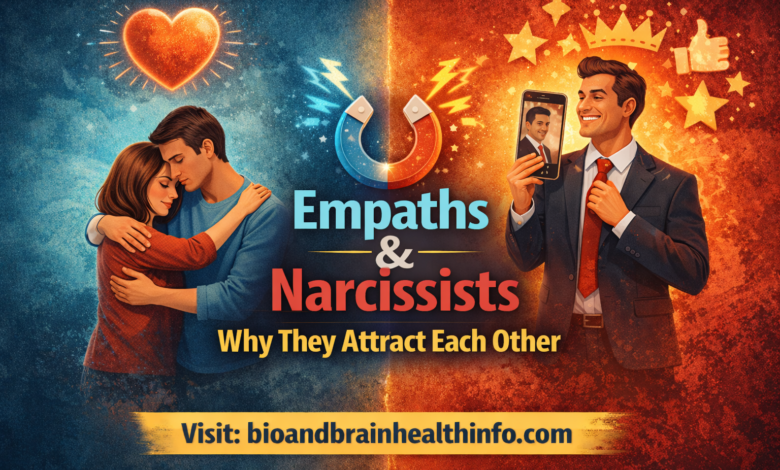
Empaths and narcissists often connect through attachment wounds, emotional polarity, trauma bonding, and deeper relationship psychology dynamics that create intense attraction and confusion.
Thank you for reading this post, don't forget to subscribe!“Intensity can feel like destiny, especially when old wounds recognize each other.”
Sometimes attraction is not compatibility — it is familiarity.
“Some connections feel familiar before they feel safe.
Even after leaving, the nervous system can stay on alert because it learned unpredictability as normal. Regulation returns through consistency, not force.”
🌱 Empaths and Narcissists
Some connections feel magnetic from the beginning — intense, meaningful, almost destined. Yet over time, the same connection may feel destabilizing.
The core fear is not just “Why them?” but “Why do I keep attracting this?”
Many misunderstand these patterns as personal flaws instead of relational conditioning shaped by attachment wounds and emotional polarity.
This is not about labeling anyone; it is about understanding attraction dynamics.
This article will help you understand what’s happening — without labels, blame, or self-attack.
🧭 REASON FOR THIS BLOG – Empaths and Narcissists
To explain why intense attraction forms between certain relational patterns and to separate survival-based bonding from identity — without judgment, diagnosis, or shame.
🔎 INNER SEARCH MIRROR – Empaths and Narcissists
You may quietly ask yourself:
Why does intensity feel like love?
Why do calm relationships feel unfamiliar?
Why do attachment wounds feel activated so quickly?
Why is emotional polarity so magnetic?
Why does trauma bonding feel hard to break?
Why do I doubt myself after conflict?
Why does leaving not end the pull?
Please Explore This Blog empathy-and-narcissism-psychological-differences
🧠 PSYCHOLOGICAL EXPLANATION – Empaths and Narcissists
Empaths and narcissists often connect through complementary attachment wounds and emotional polarity that create psychological reinforcement.
Trauma bonding can develop when intermittent validation strengthens emotional dependence.
This is not evidence of weakness; it reflects survival conditioning shaped by early relationship psychology experiences.
The mind interprets intensity as significance and unpredictability as importance, reinforcing attachment even when distress appears.
| Dynamic | Psychological Effect |
|---|---|
| Intermittent validation | Increased emotional investment |
Personal note: Understanding conditioning reduces self-blame for staying engaged.
🧬 NERVOUS SYSTEM EXPLANATION – Empaths and Narcissists
Empaths and narcissists may activate each other’s nervous systems through emotional polarity and trauma bonding patterns rooted in attachment wounds.
The brain responds to inconsistency with fight, flight, or freeze reactions before conscious thought occurs. Intensity stimulates alertness, which can feel like chemistry.
Relationship psychology shows that heightened arousal may be mistaken for compatibility.
Warning signs may include:
Racing thoughts after interactions
Hyperfocus on messages
Emotional highs and lows
Difficulty calming alone
Persistent anticipation
Personal note: The body often interprets intensity as connection.
🧭 CORE DISTINCTION – Empaths and Narcissists
Survival seeks protection; identity reflects values and conscience. In empaths and narcissists dynamics shaped by attachment wounds, emotional polarity, trauma bonding, and relationship psychology, reactions often arise from survival systems responding to familiarity. Attraction may represent conditioning rather than destiny.
When survival patterns are mistaken for identity, self-doubt increases. When distinguished clearly, clarity returns. You are not your bonding pattern.
You are the awareness capable of observing it. Authority begins when this distinction becomes steady rather than emotional.
🌿 TRAUMA VS NARCISSISM – Empaths and Narcissists
In empaths and narcissists dynamics shaped by attachment wounds, emotional polarity, trauma bonding, and relationship psychology, confusion often leads to self-labeling.
Comparing motivation reduces fear:
| Trauma Response | Narcissistic Motivation |
|---|---|
| Remorse and reflection | Protecting self-image |
| Accountability attempts | Deflection or blame |
Understanding motivation rather than behavior helps restore clarity without diagnosing.
Personal note: Many fears dissolve when intent becomes clearer than reaction.
Please Explore This Blog characteristics-narcissistic-father-family-impact
🌱 GROWTH DIRECTION – Empaths and Narcissists
Within empaths and narcissists patterns involving attachment wounds, emotional polarity, trauma bonding, and relationship psychology, healing often appears as slowing down, noticing internal signals earlier, and choosing peace over intensity.
Growth may feel quiet — less driven by urgency and more guided by calm awareness.
Personal note: Stability often begins when you stop trying to fix everything at once.
🧭 HEALING COMPASS / ORIENTATION TABLE
Healing can unfold through simple stages:
| Stage | Orientation |
|---|---|
| Awareness | “I notice patterns without blame.” |
| Stabilizing | “Calm supports clarity.” |
| Understanding | “My reactions had reasons.” |
| Integration | “I move gently.” |
| Protection | “Boundaries support peace.” |
This map offers direction without pressure, helping insight become steady internal grounding.
Please Explore This Blog characteristics-of-narcissistic-parenting-psychological-impact
🌿 10 Signs — Empaths and Narcissists: Why They Attract Each Other
1. Empaths and Narcissists: Familiar Emotional Patterns That Feel Instantly Deep and Meaningful
Empaths and narcissists may experience rapid emotional closeness because familiar relational patterns feel safe to the nervous system. Attraction may come from recognition of emotional roles rather than genuine compatibility, creating a strong initial bond that feels destined.
2. Attachment Wounds: Early Emotional Needs Creating Unconscious Relational Pull
Attachment wounds can shape attraction by activating unmet emotional needs. One partner may seek closeness while the other seeks validation, creating a dynamic where both feel understood even when deeper needs remain unresolved.
3. Emotional Polarity: Opposite Emotional Styles Generating Strong Magnetic Energy
Emotional polarity creates a push-pull dynamic where contrasting emotional expressions amplify attraction. Calm versus intensity, giving versus receiving, or empathy versus self-focus may feel complementary despite underlying imbalance.
4. Trauma Bonding: Intensity Strengthening Emotional Attachment Through Highs and Lows
Trauma bonding develops when emotional unpredictability alternates between closeness and distance. The cycle reinforces attachment through relief after stress, making separation feel difficult even when awareness grows.
5. Relationship Psychology: Shared Patterns Reinforcing Familiar Roles
Relationship psychology explains how repeated relational scripts guide attraction. Individuals may unconsciously adopt familiar roles learned earlier, reinforcing emotional patterns that feel natural despite discomfort.
6. Empaths and Narcissists: Empathy Meeting Strong Validation Needs
Empaths and narcissists may connect when empathy aligns with a desire for admiration or reassurance. This interaction can initially feel balanced, yet over time emotional energy may flow unevenly.
7. Attachment Wounds: Fear of Abandonment or Emotional Distance Driving Closeness
Attachment wounds may cause heightened sensitivity to emotional shifts. Small signals can trigger deeper responses, strengthening emotional dependence and reinforcing connection through shared vulnerability.
8. Emotional Polarity: Intensity Mistaken for Deep Compatibility
Emotional polarity may create excitement and passion that resembles compatibility. The nervous system interprets heightened emotional states as meaningful, even when long-term stability remains uncertain.
9. Trauma Bonding: Emotional Cycles That Increase Psychological Investment
Trauma bonding strengthens through repeated emotional cycles, where moments of connection follow distress. The relief experienced after tension reinforces attachment and makes patterns feel significant.
10. Relationship Psychology: Meaning-Making That Sustains Attraction Despite Challenges
Relationship psychology shows that people create narratives to explain attraction. When meaning is assigned to intensity, individuals may interpret challenges as growth rather than signals to reassess compatibility.
🌱 Closing Note
These signs describe patterns, not identities. Empaths and narcissists attraction dynamics involving attachment wounds, emotional polarity, trauma bonding, and relationship psychology reflect relational conditioning rather than personal failure. Understanding attraction calmly helps restore clarity without turning empathy into suspicion or self-blame.
Please Explore This Blog characteristics-narcissistic-parents-long-term-effects
🌿 A Whole-System View of the Human Healing Process
🩺 Medical / Ethical Positioning — Empaths and Narcissists Context
Within empaths and narcissists dynamics, attachment wounds can shape how the mind interprets threat, confusion, and meaning without clear external danger.
Ethical healing focuses on understanding relational impact rather than assigning fault.
This perspective supports informed boundaries, emotional consent, and personal autonomy, helping individuals rebuild clarity without turning understanding into accusation.
| Ethical Focus | Purpose |
|---|---|
| Context awareness | Understand patterns |
| Emotional consent | Respect autonomy |
| Impact recognition | Reduce confusion |
| Neutral language | Maintain safety |
Personal note: Ethical clarity often reduces emotional overwhelm faster than analysis alone.
🧠 Psychological Layer — Meaning Construction and Interpretation
In empaths and narcissists attraction influenced by emotional polarity, the mind seeks coherence by building narratives around behavior.
Psychological interpretation fills gaps when signals feel mixed, sometimes exaggerating responsibility or intention.
Healing involves expanding interpretation flexibility, allowing multiple meanings instead of rigid conclusions.
| Psychological Process | Function |
|---|---|
| Narrative creation | Reduce uncertainty |
| Attribution bias | Assign intention |
| Pattern recognition | Predict outcomes |
| Cognitive flexibility | Adapt perspective |
Personal note: Meaning shifts gently when curiosity replaces certainty.
🧬 Nervous System Layer — Automatic Safety Responses
Empaths and narcissists dynamics linked with trauma bonding activate automatic bodily responses before conscious thought.
The nervous system scans tone, rhythm, and emotional shifts to determine safety.
These reactions are protective, preparing connection or withdrawal depending on perceived stability.
| Body Reaction | Protective Role |
|---|---|
| Hypervigilance | Detect risk |
| Freeze response | Prevent escalation |
| Emotional surge | Signal urgency |
| Fatigue | Conserve energy |
Personal note: The body reacts to patterns long before logic evaluates them.
🌱 Mental Health Layer — Effects of Prolonged Emotional Stress
In empaths and narcissists interactions shaped by relationship psychology, prolonged emotional strain may affect clarity, energy, and self-trust.
Constant interpretation of relational signals can create cognitive fatigue, making decision-making slower and internal confidence less stable.
| Mental Impact | Outcome |
|---|---|
| Decision fatigue | Slower clarity |
| Emotional overload | Reduced resilience |
| Self-doubt loops | Uncertainty grows |
| Motivation shifts | Energy fluctuates |
Personal note: Reduced clarity often reflects overload, not incapacity.
🧭 Identity Layer (Inner Continuity & Meaning) – Empaths and Narcissists
Even within empaths and narcissists attraction influenced by attachment wounds, identity remains intact beneath survival responses.
Values and conscience continue guiding choices quietly, even when emotional patterns feel overwhelming.
Healing involves rediscovering internal continuity rather than creating a new self.
| Identity Aspect | Stability Source |
|---|---|
| Values | Inner direction |
| Conscience | Ethical compass |
| Awareness | Reflection ability |
| Choice | Personal agency |
Personal note: Identity may feel distant during stress but rarely disappears.
🤝 Reflective Support Layer (Including AI) – Empaths and Narcissists
In empaths and narcissists healing connected with emotional polarity, reflective tools like journaling, dialogue, or AI provide structured mirroring without directing decisions.
Reflection allows distance between reaction and interpretation, helping organize thoughts and strengthen self-awareness.
| Reflective Tool | Benefit |
|---|---|
| Journaling | External clarity |
| Dialogue | Perspective testing |
| AI reflection | Pattern recognition |
| Creative expression | Emotional integration |
Personal note: Reflection works best when it invites insight instead of pushing action.
🌿 Integrated Whole-System Reflection – Empaths and Narcissists
Empaths and narcissists healing shaped by relationship psychology requires integration across ethical awareness, psychological interpretation, nervous system regulation, mental clarity, identity continuity, and reflective support.
These layers interact dynamically, meaning healing is less about fixing one area and more about restoring balance across systems.
When interpretation softens and safety increases, attraction patterns lose urgency and self-trust grows naturally.
Whole-system understanding allows individuals to step out of reactive cycles and move toward grounded awareness.
| Integration Layer | Outcome |
|---|---|
| Ethical awareness | Balanced perspective |
| Psychological insight | Flexible thinking |
| Nervous system safety | Reduced reactivity |
| Identity continuity | Stable self-trust |
Personal note: Integration feels like alignment rather than dramatic change.
Please Explore This Blog characters-of-a-narcissist-personality-patterns
🌿 PERSONAL NOTE – Empaths and Narcissists
While exploring empaths and narcissists dynamics through observation and learning, I began to see how attachment wounds quietly shape attraction long before awareness arrives.
Emotional polarity can feel meaningful because it mirrors familiar emotional rhythms rather than true compatibility. Trauma bonding often grows slowly, making confusion appear personal instead of relational.
Relationship psychology helped me understand that attraction does not always reflect destiny — sometimes it reflects recognition of old patterns seeking completion.
Clarity came when I stopped asking why I felt drawn and started observing what the dynamic was teaching about awareness, boundaries, and internal stability.
🌌 COSMIC / PHILOSOPHICAL TAKEAWAY – Empaths and Narcissists
“What feels like fate is often familiarity wearing the mask of meaning.”
Empaths and narcissists attraction shaped by attachment wounds, emotional polarity, trauma bonding, and relationship psychology reveals a deeper truth about human connection: people often meet where their unfinished emotional stories intersect.
These encounters are not necessarily mistakes; they are mirrors reflecting patterns that seek understanding.
When seen through awareness rather than blame, relationships become teachers instead of labels.
The purpose is not to judge who someone is but to understand what the interaction reveals about growth.
Meaning emerges when awareness replaces self-criticism, allowing connection to become insight rather than confusion.
🌱 FINAL CLOSING – Empaths and Narcissists
Empaths and Narcissists: Returning to Calm Understanding
If you recognize patterns of attachment wounds, emotional polarity, trauma bonding, or relationship psychology within empaths and narcissists dynamics, nothing is wrong with you for feeling deeply affected.
Attraction is often shaped by familiarity and survival learning rather than conscious choice.
With safety and understanding, what adapted can soften again. Healing does not require urgency or dramatic decisions; it grows through gentle awareness and steady self-trust.
You are allowed to learn slowly, to observe without blame, and to reconnect with your own inner stability without forcing clarity before you are ready.
❓FAQ SECTION – Empaths and Narcissists
1. Why do empaths and narcissists attract each other?
Complementary emotional patterns and attachment dynamics can create strong initial connection.
2. Are attachment wounds responsible for attraction?
They can influence familiarity and emotional recognition, but they do not define destiny.
3. What is emotional polarity in relationships?
Opposing emotional styles creating intense push-pull dynamics.
4. Is trauma bonding the same as love?
No. Trauma bonding involves emotional reinforcement through cycles of stress and relief.
5. Can relationship psychology explain repeated attraction patterns?
Yes, patterns often reflect learned relational templates.
6. Does awareness mean ending the relationship?
Not necessarily; awareness supports informed choice, not forced action.
7. Why do calm relationships sometimes feel unfamiliar?
The nervous system may associate intensity with emotional meaning.
8. Can these patterns change over time?
Yes, increased awareness and regulation often shift attraction patterns.
9. Is empathy a weakness in these dynamics?
No. Empathy becomes healthier when combined with clear boundaries.
Please Explore This Blog closet-narcissist-traits-hidden-narcissism
🌿 FINAL CLOSING – Empaths and Narcissists
Empaths and narcissists dynamics influenced by attachment wounds may create strong emotional experiences, yet they do not define your identity or future relationships.
Nothing is wrong with you for reacting to intensity or confusion. With safety and understanding, what adapted can soften again.
Allow clarity to unfold naturally. Healing is not about rushing toward answers but about gently returning to yourself.
If this article offered insight, let it settle quietly — awareness grows through patience, not pressure.
🌿 Final Blog Footer — Bio & Brain Health Info
Written by Lex, founder of Bio & Brain Health Info — exploring the intersections of psychology, spirituality, and emotional recovery through calm, trauma-aware understanding.
✨ Insight & Reflection
Healing does not begin when answers arrive — it begins when self-attack stops.
Clarity grows in spaces where safety is restored.
🧠 Learn
Narcissism • Emotional Healing • Spiritual Psychology
🌍 A Moment for You
💡 Pause for two minutes. Let your body settle before moving on.
🧭 If This Article Helped, Your Next Questions Might Be:
How do attachment wounds shape attraction patterns?
What is the nervous system’s role in trauma bonding?
How can emotional polarity shift into balance?
What does healthy emotional pacing feel like?
✨ Cosmic Family Invitation
You are not here by accident. If these words reached you, clarity was already beginning.
We rise together — different souls, one journey. 🕊️
📩 Connect with us
info@bioandbrainhealthinfo.com
Telegram: @bioandbrainhealthinfo
WhatsApp Channel: Punehealth
Lex | Bio & Brain Health Info
Cosmic Family — Different Souls, One Journey.
📚 REFERENCES & CITATIONS
1. American Psychological Association — Narcissistic Personality Traits and Relationship Patterns
https://www.apa.org/topics/personality-disorders/narcissistic-personality-disorder
2. National Library of Medicine — Attachment Theory and Adult Relationships (Peer-Reviewed)
https://www.ncbi.nlm.nih.gov/pmc/articles/PMC4085672/
3. Frontiers in Psychology — Narcissism and Interpersonal Dynamics Research
https://www.frontiersin.org/articles/10.3389/fpsyg.2018.00001/full
4. Harvard Health Publishing — Understanding Emotional Attachment and Relationship Behavior
https://www.health.harvard.edu/blog/attachment-styles-and-relationships
5. Greater Good Science Center (UC Berkeley) — Empathy and Emotional Regulation Research
https://greatergood.berkeley.edu/topic/empathy
6. Cleveland Clinic — Trauma Bonding and Trauma Responses Explained
https://my.clevelandclinic.org/health/articles/trauma-response
7. National Institute of Mental Health — Stress and Emotional Regulation Overview
https://www.nimh.nih.gov/health/topics/stress
8. Psychology Today — Trauma Bonding and Relationship Psychology Concepts
https://www.psychologytoday.com/us/basics/trauma-bonding
9. World Health Organization — Mental Health and Emotional Wellbeing
https://www.who.int/health-topics/mental-health
10. Stanford Encyclopedia of Philosophy — Empathy and Moral Psychology
https://plato.stanford.edu/entries/empathy/