When Love Becomes Emotional Drain: Relationship Psychology
When Love Hurts More Than It Heals: Understanding Emotional Drain in Relationships

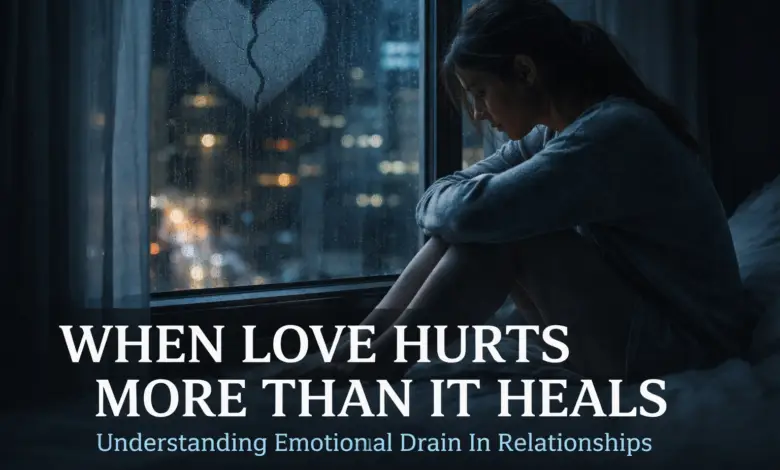
Understanding when love becomes emotional drain is one of the hardest emotional realizations a person can face. What begins as connection can slowly turn into emotional exhaustion in relationships, where love creates more stress than peace.
Thank you for reading this post, don't forget to subscribe!This often happens through one sided relationship psychology, when one person carries most of the emotional effort while the other gives far less.
Over time, expectation vs capacity in relationships creates repeated disappointment as you expect emotional depth from someone unable or unwilling to provide it.
If this pattern continues, many people begin losing themselves in a relationship, sacrificing their needs, peace, and identity just to keep the connection alive.
This guide explains why that happens and how to heal without abandoning yourself.
When Love Becomes Emotional Drain, It Does Not Always Break Suddenly
The reality of when love becomes emotional drain is that it usually does not begin with one big ending. It begins quietly. A relationship that once felt comforting starts feeling heavy. A person who once felt close starts becoming emotionally confusing. What once looked like love starts turning into stress, overthinking, waiting, and silent pain.
This shift is difficult to notice at first because many people are taught that love requires sacrifice, adjustment, and patience. So instead of asking whether the relationship is still healthy, they keep trying harder. They give more time, more emotion, more understanding, and more chances.
Slowly, they stop asking, “Is this relationship good for me?” and start asking, “What else should I do to make this work?” That is often the first real sign of emotional exhaustion in relationships.
Love becomes draining when connection no longer gives peace and starts demanding self-sacrifice just to survive.
Read Also : Maya Meaning in Psychology
My Story of When Love Becomes Emotional Drain
I understand when love becomes emotional drain not only as a psychological pattern, but as lived truth.
There was a time in my life when I believed I truly loved someone. But when I look back with more awareness, I can see that I was emotionally attached to what he was giving me inside.
He gave me attachment, attention, and the feeling that someone had chosen me. At that stage of life, that emotional attachment felt very powerful to me. Because of that, I ignored many things I should have seen clearly.
He had no real career growth. He depended on his family’s money. There was no strong direction, no emotional maturity, and no stable future vision. Still, I stayed emotionally invested because I was not only seeing the person. I was seeing the emotional comfort I was getting through him.
Why Attachment Can Hide Reality in the Beginning
This is where many people become trapped. When someone gives you the emotional bond you are starving for, your mind often focuses on the comfort and ignores the instability.
You do not see the whole relationship clearly. You only see the part that gives relief to your loneliness, pain, or inner emptiness.
That is why unhealthy love can feel powerful in the beginning. It is not always deep love. Sometimes it is deep attachment.
Read Also: why-you-feel-drained-in-relationships
Emotional Exhaustion in Relationships Often Starts With Hope
At first, I thought the relationship would improve. I believed that if I loved more, adjusted more, and stayed patient, things would become stable. But instead, the relationship became more painful. There was drama, rejection, instability, and eventually physical, mental, and emotional abuse.
Even after this, I did not leave easily.
That is one of the hardest truths to admit in any story about emotional exhaustion in relationships. People do not always stay because they do not understand the pain. Sometimes they stay because losing the attachment feels more frightening than continuing the suffering.
Why People Stay Even After Seeing the Damage
Many people think staying means weakness or lack of intelligence. That is not always true. A person may clearly see the damage and still remain emotionally trapped because attachment affects the nervous system deeply.
Once your emotional security gets connected to one person, your body begins to fear loss even when your mind understands the relationship is harmful.
This is why emotionally draining relationships can feel so confusing. Your awareness may say, “This is hurting me,” while your attachment says, “Do not let this go.”
Family Rejection Made the Emotional Drain Even Worse
At the same time, my own family rejected me. I was pushed out of my own home. I was not treated like someone in pain who needed care. I was treated like a problem, like my existence and my relationship could damage other people’s lives and reputation.
That kind of experience changes a person deeply.
When your own home stops feeling like home, your emotional pain becomes larger than heartbreak. Now it is not just about losing one person. It is about losing safety, belonging, identity, and emotional ground all at once.
When There Is No Safe Place to Return To
This is important to understand in one sided relationship psychology. Sometimes a person is not only attached to their partner. They are attached to the feeling that this relationship is the only place left where they might still belong.
So when family rejection and relationship instability happen together, the emotional dependency becomes even stronger. You stop fighting only for love. You start fighting for survival, connection, and a place in the world.
One Sided Relationship Psychology Begins When Only One Person Keeps Carrying Everything
After being rejected, I kept calling, trying, fixing, and begging for connection. I was the one trying to hold everything together. I wanted patch-up, understanding, and some sense of emotional return. But nothing became real. Nothing became stable. Nothing became mutual.
This is where one sided relationship psychology becomes visible.
One person keeps investing emotional labor.
One person keeps explaining.
One person keeps waiting.
One person keeps hoping.
And the other person keeps staying emotionally unavailable, inconsistent, or absent.
The Pain of Carrying a Relationship Alone
When only one person is doing the emotional work, love slowly becomes a burden. You begin carrying conversations, repair, hope, and emotional responsibility alone.
Over time, this creates deep emotional exhaustion in relationships because your heart is trying to build something the other person does not have the willingness or capacity to build with you.
That is not mutual love. That is emotional imbalance.
Read Also: Why You Repeat the Same Emotional Patterns
Expectation vs Capacity in Relationships Creates Hidden Suffering
One of the biggest reasons when love becomes emotional drain is that people confuse emotional hope with emotional reality.
I expected love, commitment, emotional depth, and protection. But the other person did not have the capacity to give that consistently. This is the painful truth behind expectation vs capacity in relationships. You may love someone sincerely, but sincerity alone does not create relational capacity.
A person may receive your love and still not know how to hold it.
Why Loving Potential Creates Illusion
This is where illusion begins. You stop seeing the person only as they are, and start seeing the version of them you wish would appear.
You keep hoping that effort, pain, or patience will transform the relationship. But healthy relationships are not built on imagined potential. They are built on present emotional capacity.
If you keep expecting emotional maturity from someone who keeps showing emotional limitation, the relationship becomes a place of repeated disappointment.
Losing Yourself in a Relationship Happens Slowly, Not All at Once
One of the deepest consequences of an emotionally draining relationship is losing yourself in a relationship without noticing it immediately.
You start adjusting your words.
You hide your needs.
You suppress your pain.
You accept less.
You wait longer.
You explain more.
And over time, your own identity becomes secondary to keeping the relationship alive.
How Self-Abandonment Gets Disguised as Love
This is how people lose themselves. Not always in one dramatic moment, but through repeated self-abandonment.
They call it love, loyalty, patience, or sacrifice. But in reality, they are slowly disconnecting from their own worth, truth, and emotional boundaries.
That is why losing yourself in a relationship is so dangerous. By the time you notice it, you are no longer only asking whether the other person loves you. You are asking where you disappeared inside the relationship.
Relationship Illusion: Why Pain Can Feel Like Love
In spiritual psychology, this confusion can be understood as Maya inside relationships. Relationship illusion is when pain, attachment, and longing start looking like proof of love.
A person thinks, “If this hurts so much, it must be real.” But pain alone does not prove emotional depth. Sometimes it only proves emotional entanglement.
You may think you are fighting for love, while actually you are fighting against loneliness, rejection, fear, and the need to feel chosen.
Why Intensity Is Not the Same as Love
Intensity can come from trauma, insecurity, inconsistency, and attachment wounds. Real love is not measured by how much pain you can survive.
Real love is measured by whether the relationship allows both people to feel safe, seen, respected, and emotionally steady.
This is the turning point of awareness.
The First Real Question Is Not “Why Did They Hurt Me?”
The first real question in healing is often not, “Why did they do this to me?”
The deeper question is:
Why did I keep abandoning myself to keep this relationship alive?
That question changes everything. Because now you are not only looking at their behavior. You are looking at your emotional pattern, your attachment style, your self-worth wounds, and your need for connection.
That is where true healing begins.
Part 1 Closing: When Love Becomes Emotional Drain, Awareness Must Come Before Healing
The first stage of healing is not detachment.
The first stage is recognition.
Recognition that when love becomes emotional drain, the relationship has already shifted from mutual care into emotional imbalance. Recognition that emotional exhaustion in relationships often begins long before the breakup.
Recognition that one sided relationship psychology slowly teaches one person to over-function while the other under-functions.
Recognition that expectation vs capacity in relationships creates pain when hope keeps demanding what reality cannot provide. Recognition that losing yourself in a relationship is not love — it is self-abandonment disguised as devotion.
In the next part, we will go deeper into the psychology of why emotionally draining relationships become so hard to leave, and how emotional imbalance slowly turns attachment into exhaustion.