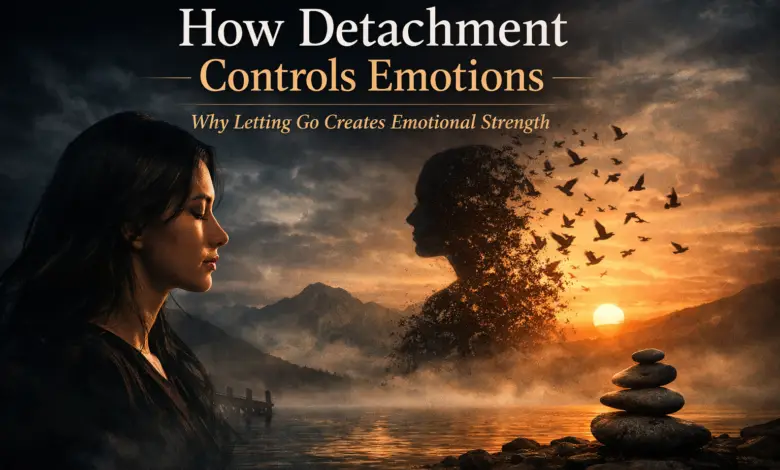
How Detachment Helps Control Emotions: Path Emotional Stability
Why Detachment Is the Secret to Emotional Control and Inner Peace

If you struggle with intense reactions, overthinking, or emotional overwhelm, learning why detachment helps control emotions may change how you understand your entire inner world. Many people chase emotional control by suppressing feelings, yet still lose their peace when life becomes painful, uncertain, or unfair.
Thank you for reading this post, don't forget to subscribe!The real problem is not emotion itself—it is the attachment beneath the emotion. When you do not understand the difference between reaction vs response, every trigger feels personal, every setback destroys your mental calm, and your nervous system loses emotional balance far faster than the situation itself requires.
This blog will help you understand why detachment is not emotional numbness, but the foundation of real emotional stability—and how learning it can transform the way you handle pain, conflict, fear, and uncertainty.
What Most People Get Wrong About Emotional Control
Most people believe emotional control means suppressing feelings, staying silent, or pretending not to care. They think if they can stop crying, stop reacting, or stop showing pain externally, they have mastered their emotions. But suppression is not emotional control. Suppression is internal pressure disguised as discipline.
True emotional control means being able to experience emotion without letting that emotion dominate your behavior, your decisions, or your peace of mind. This is why detachment helps control emotions far more effectively than suppression ever can. Detachment does not ask you to stop feeling. It teaches you how to feel without losing yourself.
When people lack detachment, every emotion becomes personal, urgent, and consuming. A painful event happens, and instead of processing it, they merge with it completely. Their thoughts intensify, their nervous system activates, and they lose mental calm because they cannot separate the event from their internal story about the event.
That is the real issue: not emotion itself, but over-identification with emotion.
Why Detachment Helps Control Emotions During Painful Situations
The reason detachment helps control emotions is because most emotional suffering is not caused only by reality—it is caused by attachment to reality being different than it is.
When life does not go in your favor…
- When the result is different from what you expected
- When painful truth must be acknowledged
- When people disappoint you
- When you feel misunderstood or rejected
…the emotional pain often becomes stronger because the mind starts resisting what happened.
Instead of simply feeling pain, the mind adds:
- “This should not be happening.”
- “Why does this always happen to me?”
- “Why can’t people understand me?”
- “Why is life unfair to me?”
This internal resistance destroys emotional balance because you are no longer reacting only to the event—you are reacting to your resistance toward the event.
Read Also: Detachment helps control emotions because it reduces that resistance.
How My Personal Experience Taught Me Why Detachment Helps Control Emotions
In my own life, I noticed that my strongest emotional reactions rarely came from the event alone. They came from what the event triggered inside me.
Whenever life did not go my way, whenever painful reality had to be accepted, or whenever I felt compromised for others but unseen inside, I became emotionally disturbed far beyond what the situation itself required.
The truth I had to face was difficult:
My emotions were not coming only from reality.
They were coming from what my mind kept creating after reality happened.
I would replay situations repeatedly.
I would build future fears.
I would create internal stories.
I would imagine pain before it happened.
That is when I understood that detachment helps control emotions because detachment stops feeding internal suffering after reality has already occurred.
How Fear and Future Imagination Destroy Mental Calm
One of the biggest reasons people lose mental calm is because the mind reacts to imagined future pain as if it is present reality.
For me, fear often sounded like this:
- What if I stay alone forever?
- What if no one is with me when I am old?
- What if I suffer in life without support?
- What if I never feel emotionally safe?
These thoughts did not stay intellectual. They became emotional experiences.
My body reacted physically:
- Tight chest
- Anxiety
- Panic
- Emotional overwhelm
- Nervous system dysregulation
This is why many people struggle with emotional control even when nothing dangerous is happening in the present. Their nervous system is reacting to imagination, not reality.
Detachment helps control emotions because it teaches you to see thoughts as thoughts—not facts, not certainty, not destiny.
That restores mental calm.
Why Family Conflict Triggered My Emotional Reactions
Much of my emotional suffering came through family conflict.
Deep inside, I carried fear of abandonment and loneliness. I feared dying alone. I feared no one would be there for me in sickness or old age. That fear created hidden emotional pain which later became anger.
Then when my family criticized me, compared me, or pressured me to live differently, my mind interpreted it as rejection.
My internal dialogue became:
- Why don’t they accept me?
- Why do they always compare me?
- Why can’t I live the way I want?
- Why do they never understand me?
That pain quickly became anger.
I fought.
I argued.
I reacted.
I tried to force understanding.
But none of it gave me emotional balance. It only created more suffering.
What I later realized was this:
My pain was intensified because I was attached to needing their acceptance.
This is why detachment helps control emotions—because when attachment weakens, emotional triggers lose power.
Reaction vs Response: The Moment Everything Changed
One of the most powerful shifts in my healing came when I understood the difference between reaction vs response.
Before awareness: Trigger → Emotion → Immediate Reaction
Someone criticizes me → I argue.
Someone misunderstands me → I defend.
Someone pressures me → I explode.
But eventually I realized: Immediate reaction was not protecting me.
It was damaging me.
So I began creating space.
When emotional pain rose, I stopped arguing immediately. I walked away. I cried alone if needed. I allowed the emotional wave to pass before speaking.
That pause created the bridge between reaction vs response.
And in that space, I began asking:
“Is this reaction helping me or harming me?”
“If I love myself, is this behavior good for me?”
“Do I want to destroy my peace trying to control others?”
Those questions transformed my emotional control more than any motivational advice ever did.
How Detachment Creates Emotional Balance Through Acceptance
The deeper I practiced detachment, the more I learned to accept reality without giving it total emotional authority over me.
I began saying:
- Yes, this issue hurts
- Yes, this family conflict exists
- Yes, I feel anger
- Yes, I wish things were different
But also:
I do not need to destroy my nervous system over what I cannot control.
That is when emotional balance started developing.
Because detachment helps control emotions by teaching you to accept painful reality without collapsing into it.
Acceptance does not mean liking reality.
It means acknowledging it honestly.
And once reality is acknowledged, suffering reduces.
Why Detachment Helps Control Emotions More Than Willpower
Many people try to force emotional control through discipline alone.
They tell themselves:
- Stay calm
- Don’t react
- Be mature
- Ignore it
But without detachment, this usually fails.
Why?
Because willpower cannot consistently overpower emotional attachment.
If you are deeply attached to:
- Being understood
- Being respected
- Being validated
- Being accepted
- Getting your desired outcome
Then your emotions will continue overpowering logic.
Detachment helps control emotions because it removes the attachment underneath the reaction.
It solves the root, not just the symptom.
Why Attachment Creates Emotional Suffering and Weakens Emotional Control
To understand why detachment helps control emotions, you must first understand what attachment actually does inside the mind and body.
Attachment is not just liking something or caring deeply. Attachment means your inner peace becomes dependent on something external behaving the way you want. It means your emotional state becomes tied to specific outcomes, people, validation, comfort, or expectations.
When attachment is present, emotional pain becomes amplified because every disruption feels like a threat to your stability.
That is why small events can create huge reactions:
- A criticism feels like rejection
- A disagreement feels like disrespect
- Delay feels like betrayal
- Uncertainty feels unbearable
- Discomfort feels dangerous
This happens because attachment makes the nervous system interpret emotional discomfort as a threat to safety.
That is why detachment helps control emotions—it reduces the emotional dependency that makes ordinary pain feel catastrophic.
How Attachment Dysregulates the Nervous System and Destroys Mental Calm
Many people believe emotional overwhelm is “just in the mind.” It is not. Emotional suffering becomes physical because the nervous system reacts to what the mind believes.
When your mind is attached to an outcome, a person, or a belief about how life should be, then any threat to that attachment activates survival mode. The body begins preparing for danger even if no physical danger exists.
This is why emotional triggers create:
- Tight chest
- Racing thoughts
- Panic sensations
- Muscle tension
- Freeze response
- Shallow breathing
- Restlessness
Your body is reacting to psychological threat.
For example:
If your mind is attached to being accepted by family, criticism becomes a nervous system threat.
If your mind is attached to certainty, uncertainty becomes panic.
If your mind is attached to constant comfort, discomfort becomes emotional overwhelm.
This is why mental calm is impossible without detachment. You cannot have lasting calm while your nervous system treats every unmet expectation as danger.
Why Ego Makes Emotional Reactions Worse
Another major reason detachment helps control emotions is because detachment weakens ego involvement.
Ego is not simply arrogance. In emotional psychology, ego is the part of the mind that builds identity around:
- How others see you
- Whether you feel respected
- Whether you are winning
- Whether you are valued
- Whether reality matches your preferences
The stronger ego attachment becomes, the more emotionally reactive you become.
This is because ego personalizes everything.
Instead of thinking: “Someone disagreed with me.”
Ego turns it into: “They disrespect me.”
Instead of: “Life did not go as planned.”
Ego says: “Life is against me.”
Instead of: “Someone criticized my behavior.”
Ego interprets:“They are attacking who I am.”
This destroys emotional balance because the ego transforms ordinary life friction into identity-level threat.
That is why detachment helps control emotions—it teaches you not to personalize everything.
How Overthinking Destroys Emotional Control
Overthinking is one of the most common reasons people lose emotional control, and overthinking is almost always fueled by attachment.
Why?
Because the mind overthinks what it is attached to.
It replays what matters emotionally:
- Relationships
- Rejection
- Future uncertainty
- Conflict
- Validation
- Fear of loss
- Identity threat
Overthinking creates a repetitive loop:
Thought → Emotional Reaction → More Thought → More Emotion
And the longer this loop continues, the harder it becomes to regain mental calm.
This is why detachment helps control emotions so effectively: detachment breaks identification with thought.
Instead of saying: “This thought must be solved.”
Detachment teaches: “This is a thought, not a command.”
That shift weakens overthinking at its source.
Why Reaction vs Response Determines Emotional Maturity
The difference between reaction vs response is one of the clearest markers of emotional maturity.
A reaction is automatic.
A response is conscious.
Reaction happens when:
- Emotion controls behavior
- Nervous system acts before awareness
- Ego defends automatically
- Pain becomes impulse
Response happens when:
- Awareness creates pause
- Thought is observed before believed
- Emotion is felt without obedience
- Action is chosen consciously
Before I learned detachment, my life was largely reaction-based.
If I felt misunderstood, I reacted.
If I felt judged, I defended.
If I felt pain, I fought.
If I felt rejected, I exploded emotionally.
But over time I saw clearly: My reactions were not solving pain. They were multiplying it.
That realization changed how I viewed reaction vs response.
A reaction may feel powerful in the moment, but often creates regret afterward.
A response may feel harder initially, but creates long-term peace.
Why Wanting Constant Happiness Destroys Emotional Balance
One of the deepest hidden attachments many people carry is attachment to comfort.
They unconsciously believe:
- I should feel happy most of the time
- I should not suffer this much
- Life should be emotionally easier
- If I feel pain, something is wrong
This belief destroys emotional balance because life naturally includes:
- Loss
- Conflict
- Discomfort
- Uncertainty
- Pain
- Failure
- Emotional waves
If you expect life to provide constant comfort, every difficult moment feels like life is malfunctioning.
That expectation creates emotional resistance: “This should not be happening.”
And resistance amplifies suffering.
Detachment helps control emotions because it replaces entitlement with acceptance.
It teaches:
“Pain is part of life.”“Discomfort is not failure.” “Difficulty is not punishment.” “Emotional waves are normal.”
That mindset dramatically improves mental calm.
Why Emotional Control Fails Without Self-Awareness
Many people try to improve emotional control without first understanding their emotional patterns.
But if you do not know:
- What triggers you
- Why it triggers you
- What attachment sits beneath it
- What fear the emotion protects
Then emotional growth remains superficial.
Detachment requires awareness.
You must begin noticing:
What am I attached to right now?
Is it:
- Approval?
- Validation?
- Comfort?
- Certainty?
- Control?
- Being understood?
- Being right?
Because whatever you are attached to will control your emotions until you become aware of it.
That awareness is the first step toward true emotional control.
The Core Psychological Truth Behind Why Detachment Helps Control Emotions
At its deepest level: Emotional suffering is often not caused by emotion itself.
It is caused by attachment beneath the emotion.
Under anger is often attachment to respect.
Under anxiety is often attachment to certainty.
Under heartbreak is often attachment to outcome.
Under overthinking is often attachment to control.
Under resentment is often attachment to fairness.
This is why detachment helps control emotions better than surface-level coping strategies.
Because detachment addresses the root attachment beneath emotional reactivity.
How to Practice Detachment for Better Emotional Control in Real Life
Understanding why detachment helps control emotions is valuable, but emotional transformation only happens when detachment becomes practical during real emotional triggers. Many people understand emotional regulation intellectually, yet forget everything when pain, anger, fear, or rejection hits their nervous system. This is why theory alone does not create change. You need a practical system.
The true test of emotional control is not whether you understand detachment in calm moments. It is whether you remember detachment when your emotions rise and your nervous system wants immediate reaction.
To build lasting emotional balance, detachment must become a repeatable emotional process rather than just an idea.
Step 1: Pause Before Reaction to Improve Reaction vs Response
The first practical reason detachment helps control emotions is that it creates pause between trigger and behavior.
Without detachment: Trigger → Emotion → Immediate Reaction
With detachment: Trigger → Emotion → Pause → Awareness → Response
This pause is where emotional maturity begins.
When you feel emotionally triggered:
- Do not respond immediately
- Do not argue immediately
- Do not defend immediately
- Do not text immediately
- Do not make emotional decisions immediately
Instead, remind yourself: “My first job is regulation, not reaction.”
Improving reaction vs response begins with refusing to let the first emotional impulse control your behavior.
Step 2: Allow the Emotion Without Losing Emotional Control
Many people misunderstand detachment and believe it means pushing emotions away. It does not.
Healthy detachment allows emotion without obedience.
This means:
- Feel anger without exploding
- Feel sadness without collapsing
- Feel fear without obeying panic
- Feel pain without creating drama
One of the biggest reasons detachment helps control emotions is because it teaches your nervous system: “I can survive this feeling without reacting impulsively.”
When I feel overwhelmed now, I often step away, sit alone, cry if needed, and let the physical wave pass through my body. I no longer treat emotional expression as weakness, but I also no longer treat emotion as a command.
That is real emotional control.
Step 3: Separate Facts From Mental Story to Restore Mental Calm
Another reason detachment helps control emotions is because it teaches you to separate reality from interpretation.
Ask yourself: What happened in reality?
Then ask: What story is my mind adding?
Example:
Reality: My family criticized my choices.
Mental Story: They never accept me. Nobody understands me. I will always be alone.
The criticism may hurt. But the story creates far more suffering than the event.
This practice restores mental calm because you stop reacting to exaggerated internal narratives and begin responding to objective reality.
Step 4: Use Self-Respect to Build Emotional Balance
When emotionally triggered, I now ask myself one question that has transformed my life: “If I truly love myself, is this reaction good for me?”
This question immediately changes the frame.
Because many emotional reactions are not healthy expressions—they are self-harm through behavior.
Examples:
- Replaying pain for hours
- Overthinking endlessly
- Fighting to prove your point
- Obsessing over being understood
- Staying in conflict long after needed
These behaviors destroy emotional balance.
Detachment helps control emotions because it shifts focus from “How do I win this emotional moment?” to “How do I protect my peace?”
That is maturity.
Step 5: Accept What You Cannot Control for Lasting Emotional Control
Many people lose emotional control because they keep trying to control things outside their power.
Examples:
- Other people’s opinions
- Other people’s behavior
- Their family’s mindset
- Their partner’s feelings
- Future outcomes
- Past mistakes
- Life uncertainty
This creates endless frustration because control over uncontrollable things is impossible.
One of the deepest lessons detachment taught me was: “I cannot control others, but I can control how much emotional power I give them.”
That realization creates profound emotional balance.
Acceptance means:
- I may not like reality
- I may wish it were different
- But I stop destroying myself fighting what currently exists
That is one of the deepest ways detachment helps control emotions.
Step 6: Redirect Attention Instead of Feeding Emotional Loops
Healing is not endless emotional analysis.
Sometimes the healthiest thing you can do after processing pain is redirect your energy.
After calming yourself and acknowledging reality:
Move attention into:
- Work
- Exercise
- Purpose
- Creativity
- Learning
- Spiritual practice
- Productive routine
This is not avoidance when done consciously. It is emotional discipline.
Detachment helps control emotions because it teaches: “I acknowledge this pain, but I do not need to live inside it all day.”
That mindset dramatically improves mental calm.
How Bhagavad Gita Explains Why Detachment Helps Control Emotions
One of the deepest teachings in the Bhagavad Gita is: “You have control over your actions, not over the fruits of action.”
This teaching perfectly explains why detachment helps control emotions.
It means:
- Do your best
- Act with integrity
- Care deeply
- But do not attach your peace to outcomes
Because when your emotional state depends on outcomes:
- You panic when uncertain
- You collapse when rejected
- You rage when life changes
- You lose emotional balance when plans fail
Detachment restores peace by teaching: “My peace will not depend entirely on life going my way.”
That is inner freedom.
My Final Realization That Created Emotional Balance
One of the deepest realizations that transformed my emotional life was this:
We do not fully understand life. We do not control its design. We move through moments without certainty.
The moment I accepted that life cannot be fully controlled, predicted, or understood, I stopped demanding certainty from it.
I stopped asking life to guarantee:
- Permanent comfort
- Constant understanding
- Perfect outcomes
- Emotional safety at all times
Instead, I learned to live more one moment at a time.
That acceptance created more mental calm than any attempt at control ever did.
Final Truth: Why Detachment Helps Control Emotions Better Than Force
You do not gain emotional control by forcing yourself not to feel.
You gain emotional control when you stop attaching your peace, identity, and worth to every event, thought, and outcome.
That is why detachment helps control emotions:
- It weakens ego attachment
- It improves reaction vs response
- It restores mental calm
- It strengthens emotional balance
- It reduces overthinking
- It calms the nervous system
- It teaches acceptance of reality
Conclusion: Emotional Balance Begins When Attachment Ends
The more attached you are, the more reactive you become.
The more detached you become, the more stable you feel.
Real emotional balance begins when you can say: “Yes, this hurts. Yes, this matters. But I will not destroy myself over what I cannot control.”
That is detachment.
That is emotional control.
That is emotional maturity.
FAQ: How Detachment Helps Control Emotions
1. How does detachment help control emotions?
Detachment helps control emotions by creating space between what you feel and how you respond. Instead of reacting automatically, detachment allows you to observe emotions, reduce impulsive behavior, and choose a calmer response.
2. Does detachment mean suppressing emotions?
No. Detachment does not mean suppressing or ignoring emotions. Healthy detachment means feeling emotions fully without letting them control your actions, identity, or mental peace.
3. Why do attachment and emotional suffering go together?
Attachment creates suffering because when your peace depends on outcomes, validation, or other people’s behavior, emotional pain becomes stronger whenever reality does not match your expectations.
4. What is the difference between detachment and emotional numbness?
Detachment means emotional awareness with boundaries. Emotional numbness means disconnection from feelings. Detachment allows you to care deeply without becoming emotionally consumed.
5. Can detachment improve emotional regulation?
Yes. Detachment improves emotional regulation by helping you pause before reacting, separate thoughts from facts, and calm the nervous system during emotional triggers.
6. How does detachment reduce overthinking?
Detachment reduces overthinking by teaching you not to identify with every thought. Instead of believing or replaying each thought automatically, you learn to observe thoughts without feeding them.
7. Why do I react emotionally even when I know better?
Because emotional reactions often come from nervous system activation and unconscious attachment patterns, not just logic. Understanding something mentally is different from regulating it emotionally.
8. Can detachment help with family conflict and emotional triggers?
Yes. Detachment can reduce family-related emotional triggers by helping you stop seeking constant validation, accept what you cannot control, and respond without unnecessary escalation.
9. Is detachment healthy in relationships?
Healthy detachment strengthens relationships when practiced correctly. It allows you to love and care without becoming emotionally dependent, controlling, or reactive.
10. How do I practice detachment in daily life?
You practice detachment by noticing triggers, allowing emotions without reacting immediately, separating facts from mental stories, accepting what you cannot control, and choosing conscious responses.
People Also Ask: Detachment and Emotional Control
What is detachment in emotional control?
Detachment in emotional control means experiencing emotions without becoming controlled by them. It allows you to observe feelings, thoughts, and triggers without reacting impulsively.
Why does detachment make emotions easier to manage?
Detachment makes emotions easier to manage because it reduces over-identification with thoughts, weakens attachment to outcomes, and creates space before reaction.
Can detachment help with anger issues?
Yes. Detachment can reduce anger by helping you separate the event from your ego’s interpretation, lowering emotional intensity before reacting.
How do I stop reacting emotionally to everything?
To stop reacting emotionally, practice pausing before response, observing thoughts without believing them immediately, and detaching from the need to control every situation.
Does detachment reduce anxiety and overthinking?
Detachment can reduce anxiety and overthinking by teaching you not to treat every thought, fear, or imagined future as reality.
Is detachment good for mental health?
Healthy detachment supports mental health when it helps reduce emotional overwhelm, improve boundaries, and create psychological flexibility without suppressing feelings.
Why do emotionally attached people suffer more?
Emotionally attached people often suffer more because they tie their peace, worth, or safety to external outcomes, validation, or specific expectations.
Can detachment improve relationships?
Yes. Detachment can improve relationships by reducing emotional dependency, lowering reactivity, and allowing healthier boundaries and communication.
What is the spiritual meaning of detachment?
Spiritually, detachment means acting fully in life without clinging to outcomes, identities, or temporary experiences for your sense of peace.
How long does it take to learn emotional detachment?
Learning healthy emotional detachment is gradual. It develops through repeated awareness, nervous system regulation, self-reflection, and consistent practice over time.
Reference / Source URLs
Psychology & Emotional Regulation
- American Psychological Association – Emotion Regulation
https://www.apa.org/topics/emotion-regulation - Verywell Mind – Emotional Regulation Skills
https://www.verywellmind.com/emotion-regulation-4777001 - Psychology Today – Emotional Detachment vs Healthy Detachment
https://www.psychologytoday.com/us/basics/emotional-detachment
Neuroscience / Nervous System
- Harvard Health – Understanding Stress Response
https://www.health.harvard.edu/staying-healthy/understanding-the-stress-response - Cleveland Clinic – Nervous System Regulation
https://health.clevelandclinic.org/nervous-system-regulation - National Institute of Mental Health – Coping With Stress
https://www.nimh.nih.gov/health/publications/so-stressed-out-fact-sheet
Mindfulness / Detachment / Acceptance
- Greater Good Science Center – Mindfulness and Emotional Regulation
https://greatergood.berkeley.edu/topic/mindfulness/definition - Mindful.org – Letting Go of Attachment
https://www.mindful.org/letting-go-of-attachment/
Bhagavad Gita / Spiritual References
- Bhagavad Gita Chapter 2 Verse 47
https://www.holy-bhagavad-gita.org/chapter/2/verse/47 - Bhagavad Gita Chapter 2 Verse 56
https://www.holy-bhagavad-gita.org/chapter/2/verse/56 - Bhagavad Gita Chapter 6 Verse 5
https://www.holy-bhagavad-gita.org/chapter/6/verse/5