ChatGPT Mental Health Guide for Safe Emotional Support
How to Use ChatGPT for Mental Health and AI Journaling

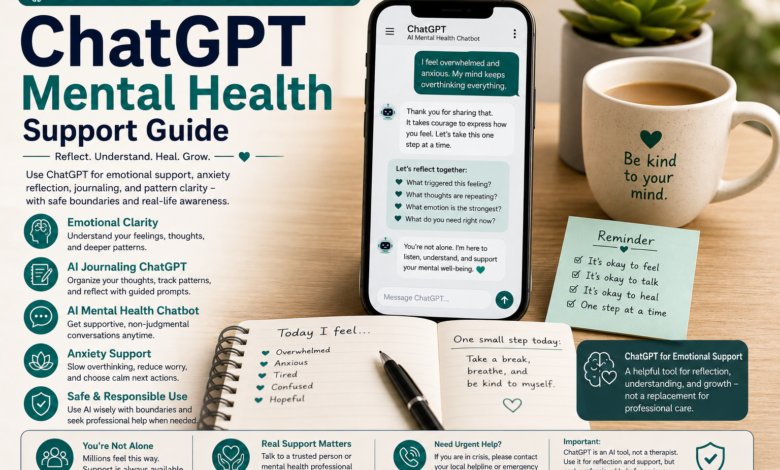
ChatGPT mental health support is becoming important because many people struggle to explain their emotions clearly, even to the people close to them (AI mental health chatbot). Sometimes the mind keeps repeating the same pain through different issues — family stress, anxiety, guilt, overthinking, or emotional confusion.
Thank you for reading this post, don't forget to subscribe!This blog is unique because it does not treat ChatGPT as a therapist or a magic solution. Instead, it explains how ChatGPT for emotional support can help you notice your patterns, organize your thoughts, and understand what your nervous system may be trying to protect.
You will also learn how AI journaling ChatGPT methods can support honest self-reflection, how ChatGPT anxiety support can help you slow repeated thinking, and where an AI mental health chatbot has clear limits.
This guide gives balanced, practical, and human guidance so you can use AI safely without losing the need for real human care.
Why People Are Turning to ChatGPT for Mental Health
Many people do not come to ChatGPT mental health support because they think AI can replace a therapist. They come because their mind is full, their heart feels blocked, and they do not know how to explain what is happening inside them.
Sometimes a person is not ready to speak to a friend, family member, partner, or professional. They may fear judgment, misunderstanding, rejection, or emotional exposure. In that moment, writing to ChatGPT can feel easier than opening the heart in front of another human being.
This is where ChatGPT for emotional support becomes useful as a first reflection space. It allows a person to write without interruption, organize painful thoughts, and slowly notice what they are actually feeling.
- The value is not that ChatGPT “heals” the person.
- The value is that it can help the person pause, name the emotion, separate the facts from the fear, and recognize repeated mental patterns.
ChatGPT Is Not a Therapist, But It Can Be a Reflection Tool
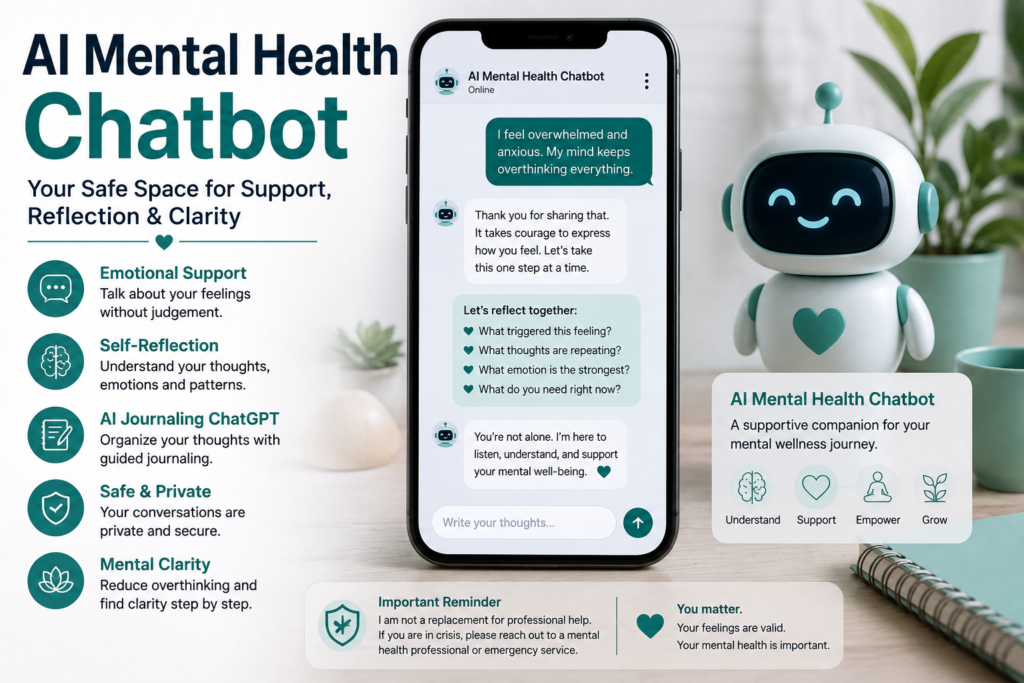
The safest way to understand an AI mental health chatbot is this: it is not a doctor, therapist, emergency service, or replacement for human care.
It cannot diagnose you, treat your condition, understand your full life history, or carry the emotional responsibility that a trained professional can carry.
But it can help with something important: reflection.
When you write honestly, ChatGPT can help you see the difference between the surface issue and the deeper emotional pattern. For example, one day the issue may look like a parent’s words hurt you.
Another day it may look like overthinking, guilt, anger, or sadness.
But underneath all of these different issues, the same emotional loop may be repeating: “I am not understood,” “I am not safe to express,” “I always have to prove myself,” or “My feelings do not matter.”
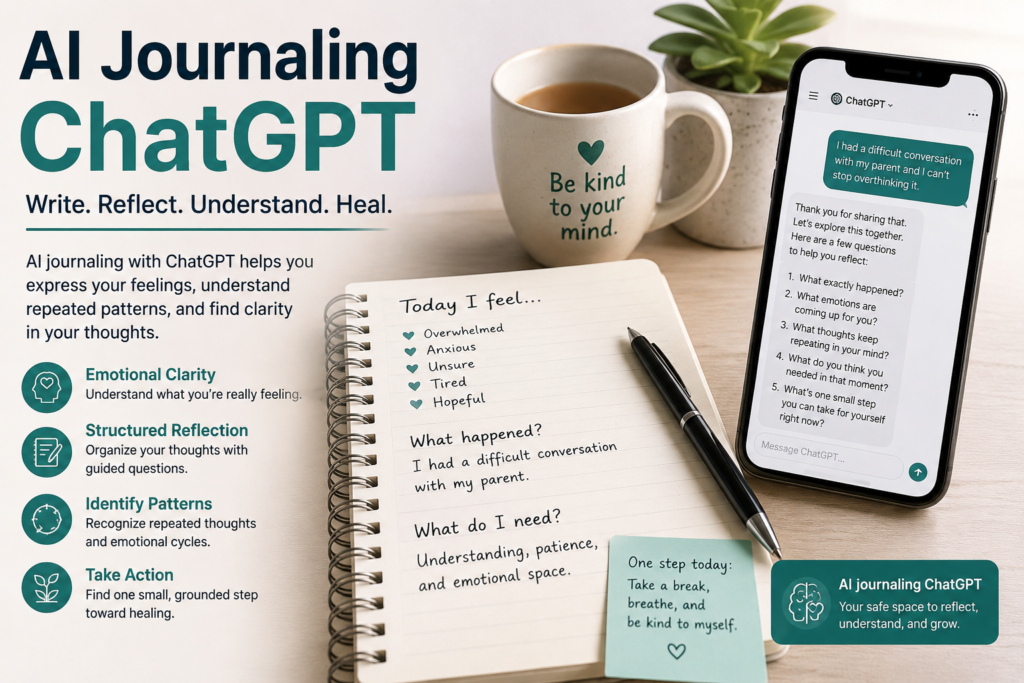
That is where AI journaling ChatGPT can become powerful. It gives your mind a place to slow down and examine the pattern instead of reacting only to the latest trigger.
The Real Problem Is Not Always the Current Issue
One reason emotional pain becomes confusing is that the mind often repeats the same wound through different situations. A person may think they are dealing with five different problems, but many times those problems are connected by one deeper pattern.
For example, a family conversation may trigger sadness. Later, a work mistake may trigger the same feeling. Then a small delay, a message not received, or someone’s tone may create another wave of overthinking.
On the surface, these look like separate issues. But emotionally, the nervous system may be responding from the same place: fear, shame, rejection, helplessness, or the need to be understood.
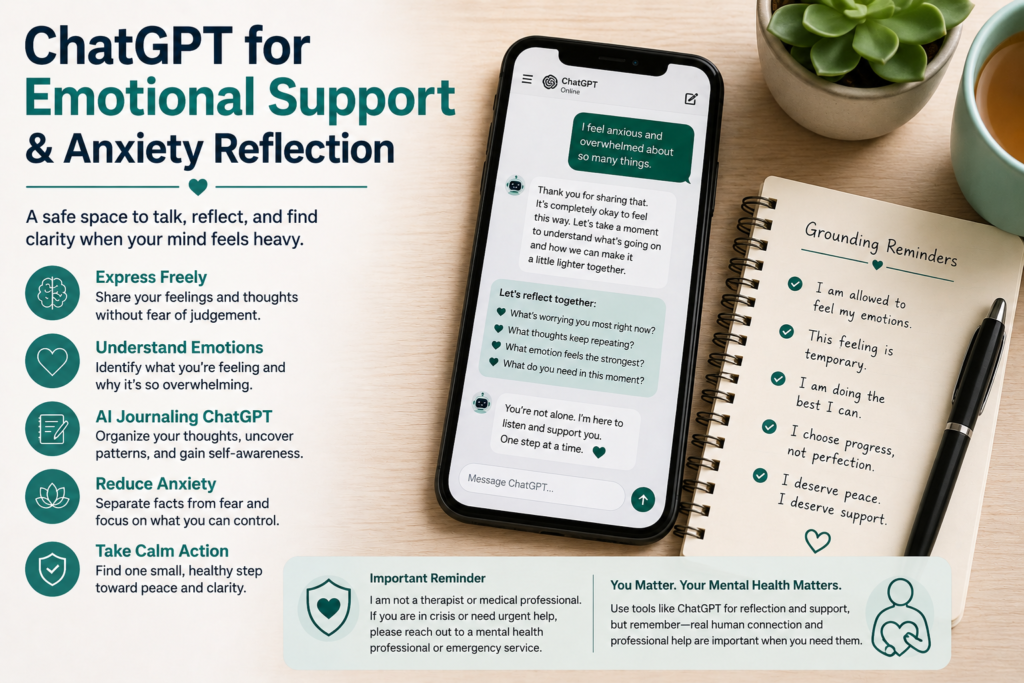
This is why ChatGPT anxiety support can help when used carefully. It can ask reflective questions, summarize what you are repeating, and help you identify whether the mind is solving a real problem or circling around an emotional wound.
A Human Example: When Family Pain Becomes Mental Looping
Imagine someone has a painful conversation with a parent. The words may not look serious from the outside, but inside the person feels heavy, misunderstood, and emotionally frozen.
- They want to speak, but they cannot explain clearly.
- They want support, but they do not fully trust anyone with their heart.
So the mind keeps replaying the conversation again and again.
In that moment, ChatGPT may help the person write:
“What exactly hurt me?”
“What did I expect from them?”
“What emotion is repeating?”
“Is this about today’s conversation, or an old pattern?”
“What do I need to understand before I react?”
This does not remove the need for human support, but it gives the person a starting point. Instead of staying trapped in repeated thinking, they begin to see the emotional structure behind the pain.
The Most Important Rule: Be Honest With What You Write
ChatGPT can only reflect what you bring into the conversation. If you hide the real emotion, exaggerate the story, or write only to get validation, the answer may feel comforting but not truly helpful. This is very important.
If someone wants real clarity, they must write with emotional honesty. That means saying:
“I feel hurt, but I also feel guilty.”
“I am angry, but I also want love.”
“I know I may be overthinking, but I cannot stop.”
“I want support, but I am afraid to trust people.”
“I do not know if this is real danger or my nervous system reacting.”
This level of honesty helps ChatGPT mental health support become more useful. Not because AI knows your soul, but because honest writing makes your own inner pattern more visible.
Safety Boundary: When ChatGPT Is Not Enough
This blog must be very clear: ChatGPT should never be used as the only support when someone is in crisis, at risk of self-harm, unable to function, experiencing severe distress, or feeling disconnected from reality.
OpenAI has also publicly stated that it has worked with mental health experts to improve how ChatGPT responds in sensitive conversations and guides users toward real-world support when needed. (OpenAI)
Professional help is important when symptoms are severe, distressing, or lasting. The National Institute of Mental Health advises seeking professional help when serious symptoms continue for two weeks or more, such as sleep changes, appetite changes, difficulty functioning, concentration problems, or loss of interest in normal activities. (National Institute of Mental Health)
So the balanced message is simple: use ChatGPT as a reflection tool, journaling partner, and emotional organization support — but use real human care, therapy, medical support, or crisis help when the situation needs more than reflection.
Sometimes healing does not begin when we get the perfect answer. It begins when we finally express the truth without hiding from ourselves.
How ChatGPT for Emotional Support Can Help You Express What You Cannot Say
Many people carry emotions they cannot easily explain to another person. They may love their family, respect their parents, care about relationships, and still feel deeply hurt inside.
This inner conflict is difficult because the mind does not only ask, “What happened?”
It also asks, “Am I wrong for feeling this?”
That is where ChatGPT for emotional support can become useful as a private starting point.
When someone writes honestly, ChatGPT can help them slow the emotional pressure and separate three things: what happened, what they felt, and what meaning they gave to the situation. This is important because many emotional loops do not continue because of the event alone. They continue because the mind keeps adding fear, guilt, shame, or old memories to the event.
For example, a parent may say something that feels normal to them, but the child may experience it as rejection, control, criticism, or emotional distance. ChatGPT cannot know the full family history, but it can help the person ask better questions:
“What exactly hurt me?”
“Was I reacting to today’s words or to an old emotional pattern?”
“Did I want understanding, apology, safety, or respect?”
“What would I say if I could speak without fear?”
This is the real value of ChatGPT mental health support. It gives language to emotions before those emotions become reaction, silence, or self-attack.
Read Also : free-ai-mental-health-tools-for-emotional-support
AI Journaling ChatGPT: A Safer Way to Understand Your Repeated Patterns
AI journaling ChatGPT methods are helpful because they turn emotional confusion into structured self-reflection. Normal journaling is powerful, but many people stop because they do not know what to write after the first few lines.
ChatGPT can continue the process by asking reflective questions, summarizing patterns, and helping the person see the difference between repeated thoughts and deeper emotional needs.
A simple structure can be:
1. What happened?
Write only the facts.
2. What did I feel?
Name the emotion without judging it.
3. What did my mind start repeating?
Notice the loop.
4. What old pattern does this feel connected to?
Look for repetition.
5. What is one calm action I can take now?
Move from emotional pressure to grounded response.
This method is powerful because it does not ask the person to immediately “think positive.” Instead, it helps them become honest. Many people do not need forced motivation first. They need emotional organization.
Example Prompt for AI Journaling ChatGPT
Use this prompt when your mind is repeating the same issue again and again:
Prompt:
“I am feeling emotionally stuck about something. Please help me separate the facts, my emotions, my repeated thoughts, and the deeper pattern. Do not validate everything blindly. Ask me honest reflection questions and help me see what I may be avoiding.”
This prompt is strong because it tells ChatGPT not to simply comfort you. It asks for clarity. That matters because emotional healing does not come only from hearing, “You are right.”
Sometimes healing begins when we can finally say, “I am hurt, but I also need to understand my own reaction.”
ChatGPT Anxiety Support: How It Helps With Overthinking
ChatGPT anxiety support can be useful when the mind is stuck in repeated thinking. Anxiety often does not appear as one clear thought. It appears as many different thoughts attacking the same emotional wound.
One moment the mind says, “What if I made a mistake?”
- Then it says, “What if they misunderstood me?”
- Then it says, “What if this affects my future?”
- The topic changes, but the nervous system remains in threat mode.
ChatGPT can help by organizing anxious thoughts into categories:
| Anxiety Loop | Reflection Question |
|---|---|
| Fear of rejection | “Am I afraid of being misunderstood or abandoned?” |
| Fear of mistake | “Is this a real danger or a perfection pressure?” |
| Fear of future | “What can I actually control today?” |
| Fear of conflict | “What truth am I afraid to speak?” |
| Fear of judgment | “Whose approval am I trying to secure?” |
This does not cure anxiety. But it can reduce mental fog. When the mind sees the pattern, it becomes easier to choose a calmer next step.
Why Honesty Matters More Than Perfect Prompts
Many people search for perfect prompts, but the real power is not only in the prompt.
The real power is in emotional honesty.
- If a person writes only the part that makes them look innocent, ChatGPT may give comforting but incomplete guidance.
- If they write only anger, it may miss the sadness.
- If they write only fear, it may miss the need for boundaries.
So the better approach is to write the full truth:
“I feel hurt, but I also know I may be reacting strongly.”
“I want support, but I am afraid to trust people.”
“I feel angry at my parent, but I also feel guilty for feeling angry.”
“I keep thinking about this issue, but I think the real pain is older.”
“I do not want only validation; I want clarity.”
This kind of honesty makes AI mental health chatbot use safer and more useful. It turns the conversation from emotional escape into emotional awareness.
The BBH Method: Use ChatGPT in 4 Layers
For BBH, the best way to use ChatGPT for mental health is not random chatting. It should be structured around four layers:
Layer 1: Expression
First, write everything without editing. This helps reduce emotional pressure. The goal is not to sound mature or perfect. The goal is to bring the inner noise outside the mind.
Layer 2: Pattern Recognition
Ask ChatGPT to identify repeated thoughts, emotional triggers, and recurring themes. This is where a person may realize, “This is not just today’s issue. This is a repeated fear.”
Layer 3: Nervous System Awareness
Ask what the body may be experiencing: tight chest, heaviness, restlessness, urge to defend, urge to withdraw, or emotional freezing. This helps the person understand that the reaction is not only mental. It may also be physiological.
Layer 4: Grounded Action
End with one small action: rest, journaling, breathing, waiting before replying, speaking calmly, setting a boundary, or contacting a trusted person.
This is how ChatGPT mental health support becomes more grounded. It moves from emotional dumping to emotional direction.
Important Safety Limit: ChatGPT Should Not Replace Professional Help
ChatGPT can support reflection, but it should not replace therapy, medical care, emergency support, or diagnosis.
The American Psychological Association has warned that AI chatbots and wellness apps need careful safety consideration when people use them for mental health needs. (American Psychological Association)
This is especially important when distress is severe, symptoms last for weeks, daily functioning is affected, or the person feels unsafe.
The National Institute of Mental Health advises seeking professional support when severe or distressing symptoms last two weeks or more, including sleep changes, appetite changes, difficulty concentrating, loss of interest, or inability to complete usual tasks. (National Institute of Mental Health)
So the safest position is clear: use ChatGPT as a reflection and journaling support, but involve real human help when your emotional state is serious, persistent, or unsafe.
A tool becomes helpful only when it brings you closer to truth. If it helps you avoid truth, it becomes another form of escape.
Jaan, here is Part 3 in BBH authority style.
Part 3: Safe Boundaries, Best Prompts, and When ChatGPT Is Not Enough
The Right Way to Use ChatGPT Mental Health Support
The safest way to use ChatGPT mental health support is to treat it as a reflection tool, not as the final authority over your life. It can help you write, organize, question, and slow down your emotional confusion, but it should not become the only place where your heart exists.
This distinction matters because when a person feels unheard, ChatGPT can feel deeply comforting. It listens without interruption, responds quickly, and helps create language for emotions that were stuck inside for years.
That can be genuinely helpful. But emotional support should not become emotional dependency.
- The goal is not to replace human connection with AI.
- The goal is to use AI to become clearer, safer, and more capable of reaching real support when needed.
A healthy use of ChatGPT for emotional support looks like this: you express your truth, understand your pattern, regulate your nervous system, and then decide one grounded step in real life.
Best ChatGPT Prompts for Mental Health Reflection
These prompts are useful because they do not ask ChatGPT to blindly agree with you. They ask for clarity, emotional honesty, and pattern recognition.
Prompt 1: For Emotional Confusion
“Help me understand what I am feeling. Separate the facts, emotions, assumptions, fears, and possible deeper pattern. Do not simply validate me. Help me see clearly.”
Prompt 2: For Repeated Thinking
“I keep thinking about the same issue again and again. Please help me identify whether this is a real problem to solve, an emotional wound repeating, or anxiety trying to find certainty.”
Prompt 3: For Family or Parent-Related Pain
“I feel hurt after a family conversation. Help me understand what expectation, boundary, old pattern, or emotional need may be underneath this reaction.”
Prompt 4: For Anxiety
“I feel anxious and my thoughts are moving fast. Help me slow them down, separate what I can control from what I cannot control, and choose one calm next action.”
Prompt 5: For Journaling
“Guide me through an AI journaling ChatGPT session. Ask me one question at a time about what happened, what I felt, what I needed, what pattern is repeating, and what grounded action I can take.”
These prompts make AI journaling ChatGPT more useful because they create structure. Without structure, a person may only keep repeating the pain. With structure, the same conversation becomes a mirror for self-awareness.
How to Know ChatGPT Is Helping You
ChatGPT is helping you when you feel more honest, clear, grounded, and responsible after using it. You may still feel emotional, but you should also feel more aware of what is happening inside you.
Healthy signs include:
| Healthy Sign | What It Means |
|---|---|
| You understand your emotion better | The conversation created clarity |
| You see a repeated pattern | The issue is no longer only surface-level |
| You feel less pressure to react immediately | Your nervous system is slowing down |
| You can name one practical next step | Reflection is becoming action |
| You remember human support still matters | AI is not replacing real connection |
This is the right use of an AI mental health chatbot. It should help you return to yourself and your life with more awareness.
How to Know ChatGPT Is Not Helping You
ChatGPT may become unhealthy if you use it only to avoid people, avoid decisions, or avoid professional help. It can also become risky if you keep asking the same question again and again until you receive the answer your anxious mind wants.
Be careful if you notice these patterns:
| Warning Sign | What It May Mean |
|---|---|
| You ask the same question repeatedly | Anxiety may be searching for certainty |
| You only want validation | You may be avoiding deeper truth |
| You avoid all human conversations | AI may be replacing real support |
| You feel panicked without ChatGPT | Dependency may be forming |
| You ignore professional help | The problem may need more support |
This does not mean ChatGPT is bad. It means the way you are using it needs a boundary. A tool is healthy when it supports your growth. A tool becomes unhealthy when it keeps you away from reality, responsibility, or real care.
ChatGPT Anxiety Support: Use It to Slow the Loop, Not Feed It
ChatGPT anxiety support is most helpful when it slows overthinking. It becomes less helpful when it feeds reassurance-seeking.
For example, if you ask, “Are you sure I am okay?” twenty times, the mind may feel calm for a few minutes, but the anxiety loop becomes stronger. The brain learns that it needs repeated reassurance before it can feel safe.
A better question is:
“What uncertainty am I trying to remove, and what is one grounded action I can take even without full certainty?”
This kind of question trains the mind toward emotional strength. It does not fight anxiety with endless reassurance. It teaches the nervous system that you can act gently even when you do not feel completely sure.
When You Should Seek Human or Professional Help
ChatGPT should never be your only support when your emotional pain is severe, unsafe, or affecting daily life. Please seek real human or professional help if you are experiencing intense distress, thoughts of self-harm, inability to function, panic that feels unmanageable, extreme mood changes, confusion, or a feeling that you may not be safe.
Also seek support when emotional pain continues for many days or weeks and affects sleep, appetite, work, relationships, concentration, or basic daily responsibilities.
In those situations, ChatGPT can help you prepare what to say, but it should not replace speaking to a doctor, therapist, counselor, emergency service, trusted family member, or crisis support line.
A safe prompt in that situation is:
“Help me write a clear message to ask someone for support. Keep it simple, honest, and urgent.”
This is a healthier use of ChatGPT mental health support because it moves you toward real care instead of keeping you alone with AI.
The BBH Safe Use Framework
Use this simple BBH framework whenever you use ChatGPT for mental health reflection:
1. Express Honestly
Write what is true, not what sounds perfect. Include anger, sadness, guilt, fear, confusion, and your own possible role in the pattern.
2. Ask for Pattern Clarity
Do not only ask, “Who is right?” Ask, “What pattern is repeating inside me?”
3. Notice the Body
Ask what your nervous system may be doing. Are you freezing, defending, withdrawing, pleasing, overthinking, or trying to control the outcome?
4. Choose One Grounded Action
End every conversation with one real-world step: rest, breathing, journaling, waiting before replying, speaking clearly, setting a boundary, or asking for human support.
5. Keep Human Support Open
Do not let ChatGPT become the only place where your emotions live. Let it help you prepare for safer human connection, not escape from it forever.
Final Thought: The Real Purpose of ChatGPT for Mental Health
The purpose of ChatGPT for emotional support is not to make AI your therapist. The purpose is to help you become more honest with yourself. When used carefully, ChatGPT can help you understand your emotional errors, repeated thinking patterns, anxiety loops, family pain, and inner needs.
But the deepest healing still requires more than answers. It requires awareness, nervous system regulation, real-life action, safe relationships, and professional help when needed.
So use ChatGPT as a mirror, not as a replacement for life. Let it help you write what you could not say, understand what keeps repeating, and prepare for the next honest step.
Sometimes the first safe conversation is not the final healing. It is the doorway that helps you stop hiding from your own truth.
Jaan, here are FAQ, People Also Ask, and external references with URLs for the ChatGPT mental health blog.
FAQ Section
1. Can ChatGPT help with mental health?
ChatGPT can help with mental health reflection by organizing thoughts, supporting journaling, and helping you notice repeated emotional patterns. However, ChatGPT is not a therapist, doctor, or crisis support service, so it should be used as a reflection tool, not as a replacement for professional help.
2. Is ChatGPT safe for emotional support?
ChatGPT can be safe for emotional support when used with clear boundaries. It may help you express emotions, slow overthinking, and understand what you are feeling. But if your distress is severe, long-lasting, or unsafe, you should speak with a qualified mental health professional or emergency support service.
3. Can ChatGPT replace a therapist?
No. ChatGPT cannot replace a therapist because it cannot diagnose, treat mental health conditions, understand your full life history, or provide professional clinical care. The American Psychological Association advises people not to rely on generative AI chatbots to deliver psychotherapy or psychological treatment. (American Psychological Association)
4. How can I use ChatGPT for journaling?
You can use ChatGPT for journaling by writing what happened, what you felt, what thoughts repeated, what deeper pattern may be present, and what one calm action you can take next. This makes AI journaling ChatGPT more useful because it turns emotional confusion into structured reflection.
5. Can ChatGPT help with anxiety?
ChatGPT may help with anxiety by helping you separate facts from fears, notice reassurance-seeking, and choose one grounded next step. But ChatGPT anxiety support should not replace therapy, medication guidance, or crisis care when anxiety is severe or affecting daily functioning.
6. What should I not use ChatGPT for in mental health?
You should not use ChatGPT for diagnosis, emergency help, crisis support, medication decisions, or replacing therapy. You should also avoid using it only for repeated reassurance because that can keep the anxiety loop active instead of helping you build emotional strength.
7. How do I make ChatGPT more helpful for emotional support?
Be honest, balanced, and clear. Do not write only the side that makes you look right. Share your real emotion, your confusion, your possible overreaction, and what you are afraid to admit. ChatGPT can only reflect the information you give it.
8. When should I seek professional mental health help?
Seek professional help if emotional distress continues, affects sleep, appetite, work, relationships, concentration, or daily responsibilities. The National Institute of Mental Health recommends considering how symptoms affect daily life and seeking support when symptoms are serious or persistent. (National Institute of Mental Health)
People Also Ask
Can ChatGPT be used for mental health?
Yes, ChatGPT can be used for mental health reflection, journaling, and emotional organization, but it should not be used as a therapist or medical provider.
Is ChatGPT good for anxiety?
ChatGPT can help you slow anxious thoughts and separate facts from fears. It is not a cure for anxiety and should not replace professional treatment.
Is it okay to talk to ChatGPT about personal problems?
Yes, you can talk to ChatGPT about personal problems for reflection and clarity. For serious distress, unsafe thoughts, trauma, or ongoing symptoms, real human and professional support is important.
Can ChatGPT give therapy?
No. ChatGPT can provide supportive reflection and general information, but it cannot provide professional psychotherapy, diagnosis, or treatment.
What is the best way to use ChatGPT for emotional support?
The best way is to write honestly, ask for pattern clarity, notice body reactions, and end with one grounded real-life action.
Can AI mental health chatbots be risky?
Yes. AI mental health chatbots can become risky if people rely on them instead of professional care, use them for crisis support, or develop emotional dependency. OpenAI has also discussed improving ChatGPT responses around self-harm, mania, psychosis, and unhealthy emotional attachment. (OpenAI)
Should I trust ChatGPT with my emotions?
Use ChatGPT as a supportive reflection tool, but do not blindly trust it as the final truth. It can help you think, but it cannot fully understand your life, history, nervous system, or clinical needs.
What should I ask ChatGPT when I am overthinking?
Ask: “Help me separate facts, fears, assumptions, repeated thoughts, and one grounded action I can take now.”
External References With URLs
- OpenAI — Strengthening ChatGPT’s Responses in Sensitive Conversations
https://openai.com/index/strengthening-chatgpt-responses-in-sensitive-conversations/
Use for: ChatGPT safety, sensitive conversations, self-harm, mania, psychosis, emotional reliance. - National Institute of Mental Health — Caring for Your Mental Health
https://www.nimh.nih.gov/health/topics/caring-for-your-mental-health
Use for: self-care, mental health basics, when to seek professional support. - National Institute of Mental Health — My Mental Health: Do I Need Help?
https://www.nimh.nih.gov/health/publications/my-mental-health-do-i-need-help
Use for: when symptoms may need help, daily functioning, mild vs serious symptoms. - American Psychological Association — Health Advisory on Generative AI Chatbots and Wellness Apps
https://www.apa.org/topics/artificial-intelligence-machine-learning/health-advisory-chatbots-wellness-apps
Use for: AI chatbot safety, warning against replacing psychotherapy. - World Health Organization — Mental Health
https://www.who.int/health-topics/mental-health
Use for: definition of mental health and overall well-being. - World Health Organization — Mental Health: Strengthening Our Response
https://www.who.int/news-room/fact-sheets/detail/mental-health-strengthening-our-response
Use for: mental health as emotional, psychological, social well-being and global health context.