Why Habits Don’t Stick: Real Psychology Behind Failed Routines
Why Habits Fail Even When You Want to Change

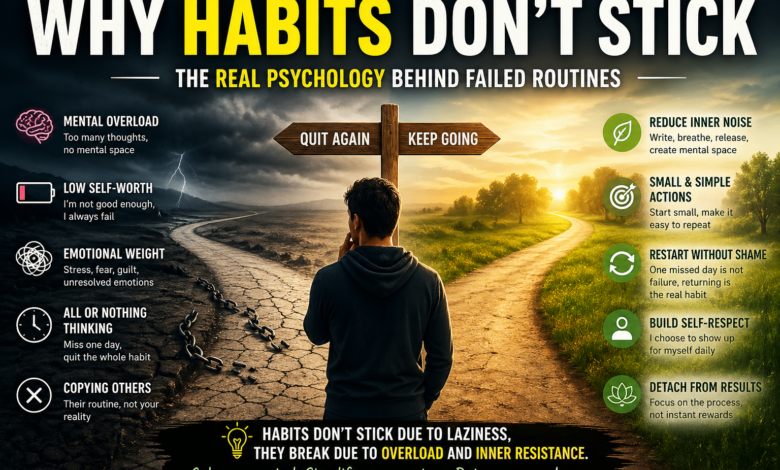
Most people think habits fail because they are lazy, weak, or not disciplined enough. But why habits don’t stick is often much deeper than motivation. Many people start a routine with excitement, then slowly lose clarity, energy, and emotional permission to continue.
Thank you for reading this post, don't forget to subscribe!👉 This blog explains why habits fail through nervous system overload, low self-worth, unclear identity, and hidden emotional pressure.
Instead of giving generic productivity advice, it explores routine breakdown psychology and why even simple actions can feel heavy when the mind is carrying too much.
You will also understand how discipline failure is not always a character weakness, but often a sign that the habit was built without safety, simplicity, and inner readiness.
👉Using behavior change psychology, awareness, and practical restart methods, this guide will help you rebuild habits in a calmer, more human way.
Why Habits Don’t Stick Even When You Truly Want to Change
Most people think habits fail because they are lazy, weak, or not serious enough. But why habits don’t stick is often much deeper than that.
Many people genuinely want to change.
- They want to wake up early, eat better, exercise, read, meditate, work consistently, or stop wasting time.
- They start with excitement, make a plan, and feel hopeful for a few days.
Then something changes. The energy drops. The mind becomes unclear. The person forgets why they started.
👉The routine starts feeling heavy. One missed day becomes guilt. Two missed days become shame. After that, the person slowly returns to the old pattern.
This is where most habit advice becomes too shallow. It says, “Be disciplined,” but it does not ask what is happening inside the person. A habit does not only need time; it needs inner agreement.
If the mind, body, emotions, and nervous system are not ready, even a simple habit can feel like pressure. That is why why habits fail should not be understood only as a motivation problem. It is often an inner overload problem.
Read Also: bad decision psychology
The Problem Is Not Always Laziness
When a person cannot continue a habit, people quickly call it laziness.
👉Sometimes even the person starts attacking themselves: “I am useless. I cannot stay consistent. I always fail.” But this self-attack creates more pressure, and more pressure makes the habit even harder.
Many cases of discipline failure are not about weak character. They are about emotional heaviness, low self-worth, nervous system overload, and lack of clarity. A person may want to act, but internally they may feel tired, scared, confused, or overloaded. Outside, the action looks simple. Inside, it feels like a mountain.
This is why habits can become difficult even when the person knows the benefit.
- They know exercise is good.
- They know sleep matters.
- They know writing, bathing, walking, praying, or working can help. But knowing is not the same as being internally ready.
When the inner system is full of noise, even a small routine may need too much convincing power.
A habit sticks better when it feels safe, simple, and possible.
Why Motivation Fades After the First Few Days
Motivation is powerful in the beginning, but it is not stable enough to carry a habit for a long time. Motivation usually comes from emotion. A person watches a video, hears someone’s success story, feels inspired, and decides, “From tomorrow, I will change everything.” For a few days, this feeling works.
But after that, real life returns. Stress comes back. Tiredness comes back. Old thinking patterns come back. The body wants comfort. The mind wants escape. The person may not see quick results, so the habit starts losing emotional value.
This is one reason habit formation problems become common. People build habits on temporary excitement instead of building them on a repeatable system. They try to change too much too fast. They make a big plan, but they do not create a small path.
👉Motivation starts the journey, but structure continues it. A habit needs a reason, a small action, a clear time, a simple restart rule, and emotional permission to be imperfect. Without that, motivation fades and the old routine wins again.
Read Also: why you can’t stay present
Why Habits Fail When the Mind Is Already Overloaded
One of the biggest hidden reasons why habits fail is mental overload. Many people are not only trying to build one habit. They are also processing social media, comparison, family pressure, financial stress, relationship emotions, food cravings, sleep issues, fear of failure, and other people’s reactions.
This creates an overloaded inner room. The person may say, “I want to start a new habit,” but inside there is already too much running at the same time. The nervous system does not experience the new habit as growth. It experiences it as one more demand.
This is where behavior change psychology becomes important. Human behavior does not change only through goals. It changes when the inner system has enough capacity to repeat a new action. If a person’s emotional load is already high, then adding strict routines may increase resistance.
That is why copying someone else’s routine often does not work. A leader, influencer, or successful person may have their own inner development, lifestyle, support system, and mental training.
Their habit may inspire you, but it may not match your current nervous system. Real habit change must begin from your present capacity, not from someone else’s highlight reel.
Simple Actions Can Feel Heavy Inside
A powerful truth is this: sometimes the action is small, but the emotional weight behind it is large. Taking a bath, making a call, opening a laptop, writing one paragraph, going for a walk, or cleaning a room may look easy from outside. But inside, the person may feel fear, tiredness, resistance, or emotional pressure.
This is one of the most important parts of routine breakdown psychology. A routine does not break only because the person forgets. It breaks because the action starts carrying emotional weight.
👉The mind says, “This is too much.” The body says, “Not now.”
The person begins negotiating with themselves before doing even the smallest task.
Your lived insight is very important here: sometimes a small action needs inner approval, acceptance, and convincing power before the body can move. This explains why basic routines can become difficult during emotional overload. It is not always laziness. It can be a nervous system that is already tired.
- When the inner noise becomes calmer, the same action becomes lighter.
- The bath that once felt impossible can become simple again.
- The walk that once felt heavy can become natural again.
- This shows that habits are not only built by force.
- They are built when the inner system stops fighting the action.
Read Also: daily awareness habits
The First Shift: Stop Attacking Yourself for Failed Habits
Before rebuilding habits, a person must stop turning every failed habit into an identity wound. Missing a routine does not mean you are broken.
It means something in the system needs adjustment.
- Maybe the habit was too big.
- Maybe the timing was wrong.
- Maybe the mind was overloaded.
- Maybe the person needed rest, clarity, or emotional release first.
This is the compassionate foundation of behavior change psychology. A person changes better when they feel understood, not when they feel ashamed. Shame may create short-term pressure, but it rarely creates long-term consistency. Self-respect creates a stronger base.
So the first step is not to ask, “Why am I so weak?”
The better question is, “What made this habit feel heavy inside me?”
That one question changes everything. It moves the person from self-attack to awareness.
And awareness is where real habit rebuilding begins.
Routine Breakdown Psychology: Why Routines Fall Apart Slowly
A routine usually does not break in one moment. It breaks slowly. First, the person misses one day. Then the mind starts creating a story around that one missed day. “I failed again.” “I cannot stay consistent.” “Maybe this is not for me.” This is where routine breakdown psychology becomes important.
The missed habit is often not the real problem. The emotional reaction after missing the habit becomes the bigger problem. One missed workout, one late morning, one unfinished task, or one day of low energy becomes proof in the person’s mind that they are not disciplined.
This is how why habits fail becomes connected to self-image. The person does not only lose the routine; they lose trust in themselves. After that, starting again feels harder because the habit now carries emotional history. The person is not only restarting the habit. They are also facing guilt, shame, and fear of failing again.
Read Also: control your thoughts and emotions
Why One Missed Day Becomes a Full Stop
Many people leave habits because they believe consistency means never missing. This is one of the biggest reasons behind discipline failure. When the person misses one day, they think the whole routine is broken. Instead of restarting calmly, they start judging themselves.
This is called all-or-nothing thinking. Either they are perfect, or they are a failure. Either they do the habit daily, or they stop completely. This thinking makes habits emotionally dangerous because every small mistake feels like identity damage.
A healthier view is different. Missing one day is not the end of discipline. Restarting after missing is discipline.
- The person who restarts is not weak.
- They are training return.
- This matters because real life is never perfectly smooth.
- There will be stress, tiredness, travel, emotions, family issues, and unexpected problems.
👉So the question is not, “How can I never miss?” The better question is, “How quickly can I return without self-attack?”
No Visible Result Can Break Self-Belief
Another reason why habits don’t stick is that people do not see visible results quickly.
- They walk for a few days, but the body does not change.
- They meditate for a week, but the mind still overthinks.
- They write for a few days, but traffic does not come.
- They work on discipline, but life still feels heavy.
Then the mind starts asking, “What is the use?” This is where low self-worth becomes dangerous. The person does not only doubt the habit. They start doubting themselves.
This is one of the hidden habit formation problems. People expect emotional reward too soon. When reward does not come, the habit feels meaningless. But many good habits work quietly before they show visible results. Sleep, exercise, writing, prayer, breathing, and focused work build invisible strength first.
The nervous system may become calmer before life becomes easier. Self-trust may return before success becomes visible. The habit may be working even when the result is not yet obvious.
Read Also: why your mind fears uncertainty
Behavior Change Psychology: Why Copied Habits Usually Fail
Many people start habits after watching leaders, influencers, successful people, or motivational videos. Inspiration is not wrong. It can open the mind. But copying another person’s routine without understanding your own inner system can create pressure. This is where behavior change psychology becomes very important.
👉Someone may wake up at 4 AM, exercise for two hours, read 50 pages, and work with deep focus. But that person may have a different lifestyle, different emotional capacity, different nervous system, different financial condition, different family pressure, and years of inner development behind them.
When a person copies only the visible routine but not the invisible foundation, the habit becomes heavy. They compare their beginning with someone else’s trained system. Then they feel behind, weak, or undisciplined.
This is why habits must be personalized. A habit that works for one person can become pressure for another. Real change does not come from copying a perfect routine. It comes from building a routine that matches your present reality and slowly expands your capacity.
Your Habit Must Match Your Inner System
A habit sticks better when it matches your energy, personality, environment, emotional state, and current life stage.
👉 If the habit is too big, too strict, or too far from your present identity, the nervous system may resist it. It may not say “I am afraid.” It may simply create delay, tiredness, avoidance, or excuses.
This does not mean you should never challenge yourself. Growth needs challenge. But challenge must be within a range your system can accept. If the mind feels attacked by the habit, it will defend itself. If the body feels overloaded, it will choose comfort.
👉So instead of asking, “What is the best habit in the world?” ask, “What is the smallest version of this habit that my system can repeat honestly?”
That question makes habit building more human. Five minutes of walking may be better than a one-hour plan that you quit. One paragraph may be better than a full article plan that creates fear. Small repeatable action builds trust.
Read Also: spiritual-psychology
Maya, Fast Results, and the Illusion of Instant Change
In the BBH view, Maya can be understood as unconscious attachment that increases suffering. In habit building, Maya appears as attachment to fast results, perfect routines, influencer lifestyles, and the illusion of instant transformation.
A person may believe, “If I follow this one morning routine, my whole life will change.” But when life does not change quickly, disappointment comes.
👉The person was not only attached to the habit; they were attached to the emotional fantasy behind the habit.
This is another reason why habits fail. The habit becomes a way to escape discomfort instead of a way to build stability. The person wants instant confidence, instant health, instant focus, instant peace, or instant success. When reality moves slowly, the mind feels cheated.
Maya makes people chase the image of transformation. Awareness brings them back to the process of transformation. This difference matters deeply. The image wants quick reward. The process asks for repetition, patience, and honesty.
Detachment Helps Habits Become Lighter
Detachment does not mean not caring. It means caring without becoming trapped in immediate results. When a person practices detachment, the habit becomes lighter because they are not demanding proof every day.
- They walk because walking supports the body.
- They write because writing trains clarity.
- They breathe because breathing calms the nervous system.
- They work because work builds direction.
- They restart because restarting protects self-trust.
This is how detachment helps discipline failure. Instead of asking, “Did I get the result today?” the person asks, “Did I return to the action today?” This creates a calmer relationship with habits.
Detachment also reduces comparison.
- You do not need to copy another person’s full routine.
- You can respect their path and still build your own.
- You can learn from others without becoming emotionally controlled by their success.
A habit becomes sustainable when it is not used to punish the self, prove worth, or chase instant reward. It becomes sustainable when it becomes a small daily act of self-respect.
The Second Shift: Build Habits From Inner Honesty
After understanding routine breakdown, copied habits, and Maya, the second shift is inner honesty. Before building a habit, ask yourself: “Is this habit truly mine, or am I doing it because I feel behind?” This question can protect you from pressure.
Some habits fail because they were never chosen from the real self. They were chosen from comparison, guilt, fear, or influence. The person starts them, but deep inside there is no agreement.
Inner honesty brings the habit back to truth.
- Maybe you do not need ten habits.
- Maybe you need one simple routine that gives your mind peace.
- Maybe you do not need a perfect morning system.
- Maybe you need a calm evening shutdown.
- Maybe you do not need to copy anyone.
- Maybe you need to reduce the noise around you first.
This is the deeper side of why habits don’t stick. Habits need more than planning. They need alignment. When your action, reason, identity, and nervous system begin to agree, consistency becomes easier.
Read Also: Detachment & Conscious Living
What Actually Works When Habits Don’t Stick
When people ask why habits don’t stick, they often search for a stronger routine, a stricter rule, or a better productivity system. But if the inner system is overloaded, more pressure will not create real consistency.
👉What actually works is a calmer method: reduce emotional load, make the habit smaller, restart without shame, and build from self-respect.
This is where behavior change psychology becomes practical. A habit should not feel like punishment. It should feel like a small agreement with your future self.
- If the action is too big, the nervous system may resist it.
- If the goal is too far, the mind may lose trust.
- If the routine is too strict, one missed day can become a full collapse.
So the better question is not, “How can I force myself?”
The better question is, “How can I make this habit simple enough that my mind and body can accept it today?”
Step 1 — Make the Habit Small Enough for Your Nervous System
A habit becomes easier when it is small enough to repeat even on a difficult day.
This is why the 5-minute method works well for many people.
- Instead of promising one hour of exercise, start with five minutes of walking.
- Instead of forcing a full article, write one paragraph.
- Instead of trying to meditate perfectly, sit quietly and breathe.
This helps reduce habit formation problems because the nervous system does not feel attacked. The action becomes approachable.
👉The body says, “I can do this.” The mind says, “This is not too much.”
You can also pause every three to four hours and take a few slow breaths.
Do not try to solve your whole life in that moment. Just breathe in, breathe out, and return to the present body. This small pause helps clear inner noise before it becomes overload.
The goal is not dramatic change. The goal is repeatable action.
Step 2 — Write the Emotional Load on Paper
Many habits fail because the mind is carrying too much invisible weight. A person may think they are failing at discipline, but actually they are carrying stress, fear, comparison, anger, sadness, family pressure, money worry, social media noise, and unfinished emotional conversations inside.
Writing helps because it turns invisible pressure into visible information. Take a paper and write what is running inside you. Write your fears, pending tasks, emotional reactions, unnecessary thoughts, and repeated worries. Do not judge them. Just see them.
This simple act supports routine breakdown psychology because it shows why the routine was becoming heavy. Sometimes the habit is not the real issue. The hidden load around the habit is the issue.
👉After writing, ask one question: “What is truly necessary for my life right now, and what am I carrying without reason?”
This question creates space. And many habits need space before they can become stable.
Step 3 — Cut Unnecessary Mental Noise
A habit needs energy. But modern life steals energy through unnecessary mental processing. A person may spend hours thinking about social media, celebrities, movies, restaurants, other people’s opinions, old conversations, or someone else’s actions. Some of these thoughts may look small, but together they create mental overload.
This is one reason why habits fail even when the person has time. Time is not enough. Mental space is also required. If the mind is full of things that are not truly important, the person may not have enough inner energy for meaningful habits.
So gently ask yourself: “Is this thought important for my real life?” If not, let it go again and again. You are not here to carry every unnecessary emotion, action, and reaction from others. You are allowed to live with less load and more peace.
This is not avoidance. This is mental boundary. A calm mind repeats habits better than an overloaded mind.
Read Also: Start Here – Your Journey to Mental Clarity & Emotional Healing
The 3-Day Restart Method for Discipline Failure
One of the best ways to heal discipline failure is to stop treating missed days as the end.
Missing a habit is human.
Restarting is training.
The real habit is not perfect consistency; the real habit is returning without self-attack.
Use a simple 3-day restart method. If you miss a habit, do not create a long story.
- On day one, restart with the smallest version.
- On day two, repeat the same small version.
- On day three, gently return to your normal routine if your energy allows. If not, continue the smaller version.
This method protects self-trust. It tells your mind, “I do not abandon myself after one mistake.”
That message is powerful because many people lose habits not from the missed day itself, but from the shame after the missed day.
Consistency is not built by never falling. It is built by learning how to return.
Restart Like the Heart Keeps Beating
A beautiful way to understand restart is to observe the heart.
The heart does not ask, “What if I failed yesterday?” It does not overthink every beat.
It simply continues. Breath also works like this. You inhale, exhale, and continue. Life itself is built on returning.
Habits can follow the same principle.
- You do not need to punish yourself to restart.
- You do not need a perfect mood.
- You do not need emotional permission every time.
- You only need one small return.
This is an important correction in behavior change psychology. Many people think discipline means force. But long-term discipline often means returning gently and repeatedly. A small restart done today is better than a perfect plan delayed for next week.
When the mind says, “You failed,” answer with action: “I am restarting.” That is enough. The habit begins again from the next breath.
Read Also: Emotional Healing Roadmap
Identity-Based Habit Building That Feels Human
Habits last longer when they are connected to identity, but this identity should not be harsh.
Do not say, “I must become perfect.”
Say, “I am becoming a person who returns.”
Do not say, “I am weak if I miss.”
Say, “I am learning to build my life with honesty.”
Identity-based habits work because they change the meaning of action.
- Walking is not only exercise. It becomes self-respect.
- Writing is not only content creation. It becomes clarity. B
- athing is not only routine. It becomes care for the body.
- Breathing is not only a technique. It becomes a return to the present.
This helps solve why habits don’t stick at a deeper level. A habit becomes more stable when it belongs to the person’s self-image. But that self-image must be humane, not pressured.
A powerful identity line can be: “I am here to live honestly and respectfully. I am not here to carry every unnecessary emotion from others.”
Build Habits From Self-Respect, Not Self-Attack
Many people try to build habits from shame. They say, “I hate myself, so I must change.” This may create short energy, but it does not create a peaceful life. Self-attack makes the nervous system feel unsafe. When the system feels unsafe, it looks for escape.
👉Build habits from self-respect instead. Say, “Because I matter, I will do one small action.”
This changes the emotional meaning of the habit. The habit is no longer a punishment for being behind. It becomes support for becoming stable.
This is where low self-worth slowly heals. Every small completed habit gives the mind one message: “I can trust myself again.” Not because you became perfect, but because you returned.
So when discipline failure appears, do not use it to attack your identity. Use it as feedback. Make the habit smaller, reduce the load, restart gently, and continue.
Read Also: AI Therapy & Self-Help Tools
Final Reflection: Habits Become Easier When Inner Noise Becomes Calmer
The real answer to why habits fail is not always found in calendars, apps, reminders, or strict plans.
- Sometimes the answer is inside the nervous system.
- Sometimes the mind is carrying too much.
- Sometimes the person is copying a life that does not match their inner system.
- Sometimes they are attached to fast results.
- Sometimes one missed day becomes shame.
What actually works is simpler and deeper: calm the inner noise, reduce unnecessary load, choose habits that match your real life, and restart without losing respect for yourself.
This is the BBH view of habit formation problems. Habits are not only built through discipline. They are built through clarity, emotional safety, awareness, detachment, and repeated return.
- When the inner system becomes calmer, action becomes lighter.
- When action becomes lighter, repetition becomes possible.
- And when repetition becomes possible, the habit slowly becomes part of who you are.
People Also Ask
1. Why do habits don’t stick?
Habits don’t stick because people often start with motivation but lack emotional readiness, nervous system capacity, and a simple repeatable system.
2. Why do habits fail after a few days?
Habits fail after a few days because motivation drops, stress returns, and the routine starts feeling heavy.
3. Is discipline failure laziness?
No. Discipline failure can come from overload, low self-worth, unclear goals, shame, or nervous system resistance.
4. How can I restart a failed habit?
Restart with the smallest version. One missed day is not failure; returning again is the real habit.
5. What is routine breakdown psychology?
Routine breakdown psychology explains how one missed day becomes guilt, shame, self-doubt, and then quitting.
FAQ
1. What is the main reason habits fail?
The main reason is overload. The mind is already carrying too much pressure.
2. How does behavior change psychology help?
Behavior change psychology shows that habits need repetition, cues, emotional safety, and identity connection.
3. Why do copied habits fail?
Copied habits fail because they may not match your nervous system, lifestyle, energy, or inner identity.
4. How can I make habits easier?
Make them smaller, reduce mental noise, write your emotional load, and restart without shame.
5. What makes habits stick long term?
Small action, clear reason, emotional safety, consistency, and self-respect make habits stick.
External Reference links:
- Website: NIH / PMC
Article: Making health habitual: the psychology of habit formation
URL: https://pmc.ncbi.nlm.nih.gov/articles/PMC3505409/
Use for: behavior change psychology, habit formation, repetition. - Website: NIH / PMC
Article: Time to Form a Habit: Systematic Review and Meta-Analysis
URL: https://pmc.ncbi.nlm.nih.gov/articles/PMC11641623/
Use for: habits take time, no fixed quick result, habit formation problems. - Website: American Psychological Association
Article: Making lifestyle changes that last
URL: https://www.apa.org/topics/behavioral-health/healthy-lifestyle-changes
Use for: small steps, lifestyle change, realistic habit building.