What Is Detachment Meaning? The Truth Most People Get Wrong
Detachment Meaning: How to Care Without Losing Yourself

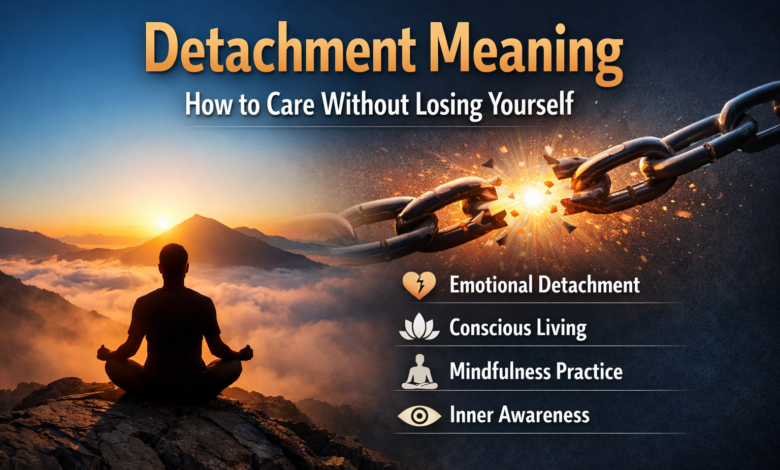
Most people search what is detachment meaning when they feel overwhelmed, stuck, or mentally exhausted—but the truth is, detachment is not about giving up or not caring. It is about learning conscious living where your peace does not depend on outcomes, people, or situations.
Thank you for reading this post, don't forget to subscribe!In this blog, you will understand what is detachment meaning through real-life examples, emotional detachment, and practical mindfulness practice and awareness practice you can apply daily.
If you struggle with overthinking, stress, or emotional pressure, this guide will help you build clarity, stability, and inner control without losing ambition or relationships.
Modern pressure, constant comparison, and emotional overload make detachment harder than ever, which is why this guide on detachment in modern life explains why so many people feel lost today and how to return to inner clarity.
What Is Detachment Meaning and Why Do People Misunderstand It?
There was a time when I couldn’t sleep—not because I wasn’t working hard, but because I needed a result too badly.
It wasn’t just about money or business. It was about what that result meant to me. If my business didn’t recover, if profit didn’t come back, if things didn’t stabilize, then what would happen next?
That question didn’t stay in my mind as a thought—it became a constant pressure that followed me throughout the day.
👉 Every decision, every action, even my learning process started revolving around one hidden demand: this must work.
I was trying everything. I was working on YouTube, building blogs, learning new systems, even taking courses to improve my knowledge. From the outside, it looked like effort. But inside, it wasn’t effort—it was pressure. I wasn’t learning because I wanted to grow. I was learning because I needed certainty. I wasn’t working with clarity. I was working with fear.
That’s when I slowly began to notice something important.
👉 I was not just working on my business—I was emotionally dependent on it succeeding in a specific way.
That realization didn’t come instantly. It came after observing how much my peace was connected to one outcome. And that is where the real understanding of what is detachment meaning begins—not in theory, but in experience.
What Is Detachment Meaning in Real Life?
When people search for what is detachment meaning, they often expect something simple—let go, don’t care, stay calm, avoid stress. But detachment is not about becoming indifferent or emotionally disconnected from life. That interpretation is incomplete and often harmful.
A more accurate understanding is this:
Detachment means staying fully involved in life while not allowing your emotional stability to depend on specific outcomes.
This is where conscious living begins. Conscious living is not about escaping situations, responsibilities, or relationships. It is about being aware of how your mind is reacting to them, and choosing clarity over emotional pressure.
Detachment does not remove action. It removes unnecessary internal struggle.
Read Also➡️ “Emotional Detachment vs Emotional Suppression: Key Difference Explained”
Why Emotional Detachment Is Commonly Misunderstood
Most people misunderstand emotional detachment because they confuse it with two extreme responses.
The first is emotional shutdown. When someone feels overwhelmed, they say, “I don’t care anymore,” or “I’m done with everything.” This looks like detachment from the outside, but internally it is exhaustion, not awareness. Avoidance is not detachment—it is a reaction to overload.
The second misunderstanding is escape. Some believe that leaving responsibilities, relationships, or difficult environments will automatically create peace.
But running away from situations does not remove attachment. It only changes the form of attachment. Even the desire to escape becomes another form of emotional dependence.
This is exactly where the teachings of Bhagavad Gita become important. Detachment is not about leaving life. It is about staying in life and performing your role without binding your identity or peace to the results.
Attachment vs Detachment: The Real Inner Difference
The difference between attachment and detachment is not visible outside—it is internal.
Attachment begins when your mind says:
- This must happen
- This should go my way
- This person must behave like this
- This result is necessary for me to feel stable
Detachment begins when your awareness shifts to:
- I will do my best
- I will respond to what comes
- My effort is in my control, but the outcome is not fully mine
This shift looks small, but it completely changes your mental state. One creates pressure. The other creates stability.
Understanding Through a Real-Life Example
Consider a situation where someone is dealing with a serious health condition.
In an attached state, the mind creates pressure: “I must get completely cured.
This treatment must work. I cannot accept anything else.”
Even though the intention is natural, the mental demand creates additional suffering. The person is not only dealing with the condition but also with fear, resistance, and constant emotional stress.
In a detached state, the same person still takes treatment, still follows discipline, still does everything necessary. But internally, there is acceptance: “I will take care of myself fully, but I understand that outcomes are not fully in my control.”
This does not reduce effort—it reduces unnecessary suffering.
Attachment is when you demand a specific outcome for peace. Detachment is when you give your best effort without making peace dependent on the result.
The Psychology Behind Attachment
Attachment is not just a mindset—it is deeply connected to how the nervous system functions.
When we create expectations, the brain links them to safety and control. The moment reality does not match that expectation, the brain reacts as if something is wrong. This triggers stress, overthinking, anxiety, and the urge to control situations more tightly.
That is why attachment often feels intense. It is not just emotional—it is physiological. The body reacts as if uncertainty is danger.
This is why people experience:
- constant mental loops
- difficulty sleeping
- fear of failure
- emotional exhaustion
👉 In simple terms: Attachment is when your system treats outcomes as survival instead of possibility.
A Simple Metaphor to Understand This
Imagine holding sand in your hand.
When you hold it tightly, trying to control every grain, your hand becomes tense and the sand starts slipping away. The tighter the grip, the more pressure you feel—and the less control you actually have.
Detachment is not dropping the sand. It is holding it with awareness—allowing it to stay or leave without losing your balance.
This is the essence of conscious living.
Where Conscious Living Begins
Conscious living does not begin with meditation or techniques. It begins with awareness of one simple question: 👉 “Am I acting with clarity, or reacting with expectation?”
The moment you notice thoughts like:
- This must happen
- I cannot accept this
- Why is this not going my way
you are entering attachment.
The moment you shift to:
- I will act
- I will respond
- I will accept and adjust
you are entering detachment.
Your Real-Life Reflection
In my own journey, this shift became visible during a phase of business pressure. I was working continuously, learning new approaches, changing strategies, observing others, and trying to improve my system. But internally, there was constant pressure because I was expecting a specific outcome.
That expectation did not improve my performance—it increased stress and reduced clarity.
The turning point came when I stopped demanding certainty and focused only on my responsibility. I still worked with full effort, but I allowed outcomes to unfold instead of forcing them mentally.
That is where detachment started—not as a concept, but as a practice.
3 Serious Questions You Should Ask Yourself
Take a moment and reflect honestly:
- Am I putting effort into my work, or am I emotionally dependent on a specific result?
- If things do not go my way, do I adapt my action, or do I lose my inner stability?
- Am I acting with awareness, or reacting from fear and expectation?
These questions reveal whether you are living in attachment or conscious awareness.
What Detachment Is NOT
To remove confusion clearly, detachment is not:
- ignoring people
- disconnecting from relationships
- avoiding responsibilities
- suppressing emotions
- escaping life situations
What Detachment Actually Means
👉 Detachment means staying fully involved in life without letting external voices, expectations, or outcomes control your inner state.
It is not withdrawal. It is clarity.
It is not weakness. It is stability.
It is not escape. It is conscious participation.
What Comes Next
Understanding what is detachment meaning is only the beginning. The deeper understanding lies in how attachment forms, why the mind creates expectations, and how we can practice detachment without losing responsibility or emotional connection.
In the next part, we will go deeper into the psychology of attachment, the teachings of Bhagavad Gita, and the role of awareness and boundaries in building true detachment in daily life.
Read Also ➡️ “How to Practice Detachment in Daily Life”
What Is Detachment Meaning in Psychology, Gita, and Real Life Practice
In Part 1, we understood what is detachment meaning at a surface level—how attachment creates pressure and how detachment creates stability. But understanding the definition is not enough. The real question is deeper:
👉 why does attachment form so strongly, and why is it so difficult to practice detachment even when we understand it?
Because attachment is not just a thought. It is a pattern—built from psychology, reinforced by emotions, and often misunderstood in spiritual teachings.
Why Emotional Attachment Feels So Powerful
When we talk about emotional detachment, many people assume it is a simple mental shift. But in reality, attachment is deeply rooted in how the mind and nervous system function.
Every expectation we create becomes a mental image. That image is not neutral—it carries emotional weight. When you think, “this should happen,” your brain connects that expectation to safety, identity, or success. So when reality does not match that image, the system reacts.
This reaction is what we experience as:
- anxiety
- overthinking
- frustration
- emotional instability
From a mindfulness practice and awareness practice perspective, this is the moment where unconscious living becomes visible. You are no longer responding to reality—you are reacting to the gap between expectation and reality.
That gap is where suffering begins.
The Hidden Pattern: Expectation → Control → Stress
Let’s simplify this process clearly.
First, the mind creates an expectation.
Then, it tries to control situations to match that expectation.
When control fails, stress begins.
This is why people feel exhausted even when they are doing the right actions. It is not the action that drains them—it is the constant mental resistance.
👉 In conscious living, the goal is not to remove goals or ambitions. The goal is to remove emotional dependency on how those goals must unfold.
A Deeper Spiritual Understanding (Gita Perspective)
This is where the teachings of Bhagavad Gita provide clarity that is often misunderstood.
👉 The concept of Karma Yoga does not say “do nothing.” It says: Act fully, but do not attach your identity or peace to the fruits of action.
This is very different from modern interpretations of emotional detachment. Many people think detachment means reducing effort or becoming passive. But in reality, the Gita emphasizes higher responsibility with lower emotional dependence.
Another important insight is this: Even the desire to feel “detached” can become an attachment.
When someone says, “I want to become peaceful, I want to become detached,” that desire itself can create pressure. The mind starts chasing a state instead of understanding it.
So true detachment is not something you chase. It is something that develops through awareness practice and conscious living.
Boundaries: The Practical Indicator of Attachment
One of the most practical ways to understand what is detachment meaning is through boundaries.
Attachment often crosses boundaries silently.
For example:
- when someone’s behavior controls your mood
- when a result decides your self-worth
- when a relationship defines your emotional stability
- when work pressure removes your inner balance
In all these cases, the boundary between involvement and dependency has been crossed.
Detachment does not remove relationships, work, or responsibilities. It restores boundaries.
👉 You care, but you are not controlled. You act, but you are not consumed. You stay involved, but you do not lose yourself.
Attachment begins when involvement turns into emotional dependency.
Detachment begins when awareness restores boundaries.
A Metaphor to Understand Inner Control
Think of your mind as a steering wheel.
In attachment, the steering wheel is not fully in your control. External situations, people, and outcomes keep pulling it in different directions. You react constantly, adjusting emotionally based on what happens outside.
In detachment, you still drive through the same road—traffic, obstacles, uncertainty—but your hands remain steady on the steering wheel. Situations influence your decisions, but they do not control your internal state.
This is the difference between unconscious reaction and conscious living.
Why People Struggle With Mindfulness and Awareness Practice
Many people try mindfulness practice or awareness practice, but they struggle to maintain it in real life. The reason is simple—they try to apply awareness only when things go wrong.
But awareness is not a tool for crisis. It is a way of living.
If you are only mindful during stress, you are still dependent on situations to remind you. Conscious living requires consistent observation:
- noticing your thoughts
- noticing your expectations
- noticing your emotional reactions
Without judgment.
Over time, this observation weakens attachment patterns naturally.
Real-Life Application: Work, Relationships, and Identity
Let’s bring this into practical life.
In Work
Attachment: “This project must succeed, otherwise I fail.”
Detachment: “I will execute this fully, and improve based on results.”
In Relationships
Attachment: “This person must behave this way for me to feel okay.”
Detachment: “I value this relationship, but I do not depend on it for my emotional stability.”
In Identity
Attachment: “I must prove myself.”
Detachment: “I will grow and improve, without tying my worth to outcomes.”
This is not emotional distance. This is emotional maturity.
👉 3 Serious Questions to Reflect
Pause and reflect deeply:
- Where in my life have I confused care with control?
- Am I trying to control outcomes because I don’t trust uncertainty?
- Do I lose myself when situations don’t go as expected?
These questions are not theoretical. They reveal your current level of conscious living.
The Inner Shift That Changes Everything
The shift from attachment to detachment is not dramatic. It is subtle, but powerful.
You move from:
- demanding → allowing
- controlling → responding
- fearing → understanding
This shift does not remove challenges. It changes how you experience them.
And that is the essence of emotional detachment—not removing life, but removing unnecessary suffering.
How to Practice Detachment in Real Life: Business, Relationships, and Health
Understanding what is detachment meaning gives clarity, and exploring its psychology and spiritual depth builds awareness—but real transformation begins only when you apply detachment in everyday situations where pressure, emotion, and uncertainty are present.
Detachment is not tested when life is comfortable. It is tested when outcomes are uncertain, when people behave differently than expected, and when situations challenge your sense of control.
In those moments, detachment is not a concept—it becomes a daily practice of conscious living, where you learn to act fully without becoming emotionally dependent on results.
The Practical Foundation of Detachment
Before applying detachment in specific areas, it is important to understand one simple but powerful shift.
Most people live like this:
- they think about outcomes
- they emotionally depend on outcomes
- they react when outcomes don’t match expectations
But conscious living introduces a different pattern:
- act with full effort
- observe your expectations
- allow outcomes
- adjust without losing stability
This shift may look small, but it changes your entire internal experience.
👉 Detachment is not about reducing effort—it is about removing emotional dependency from effort.
Detachment in Business: Clarity Without Pressure
In business, attachment often hides behind ambition. You may be working hard, improving your skills, learning new systems, and still feel restless. That restlessness does not come from lack of action—it comes from emotional pressure tied to results.
When your mind keeps repeating, “this must work,” your decisions slowly shift from clarity to urgency.
👉 You start comparing yourself, doubting your path, overanalyzing results, and reacting to short-term outcomes instead of building long-term direction.
Detachment in business does not mean you stop caring about profit, growth, or success. It means you separate your identity and emotional stability from those outcomes.
In practical terms, this means you still:
- improve your strategy
- learn new systems
- adapt your client base
- refine your approach
But internally, you operate from a different space: 👉 “I will execute my best decisions, but I will not collapse if results take time.”
This creates something very powerful—clarity under pressure.
Attachment makes you chase results with anxiety.
Detachment allows you to build results with clarity.
Detachment in Relationships: Care Without Control
Relationships are one of the most sensitive areas where attachment becomes visible. Most emotional suffering in relationships does not come from the relationship itself—it comes from expectations about how the other person should behave.
When you expect someone to understand you, respond in a certain way, or behave according to your emotional needs, attachment forms silently. And when those expectations are not met, frustration, disappointment, and overthinking begin.
Detachment in relationships is not about becoming distant or emotionally cold. It is about removing control while maintaining care.
This means you can:
- express your thoughts clearly
- maintain healthy boundaries
- value the relationship
- stay emotionally present
But at the same time, you do not allow another person’s behavior to control your inner stability.
👉 You care, but you do not depend. You stay connected, but you do not lose yourself.
This balance is what turns emotional attachment into emotional maturity.
Read Also ➡️ How Detachment Helps Control Emotions
Detachment in Health: Discipline Without Fear
Health situations often create the strongest attachment because they directly affect survival, comfort, and uncertainty. When facing a health issue, the mind naturally tries to control outcomes by creating urgency.
Thoughts like:
- “I must get better quickly”
- “This treatment must work”
- “I cannot accept this condition”
create additional stress on top of the physical situation.
Detachment in health does not mean ignoring the condition. It means removing mental resistance while maintaining disciplined action.
In real practice, this means:
- following treatment consistently
- taking care of diet and routine
- resting properly
- observing the body without panic
But internally, you shift from fear to acceptance: 👉 “I will take care of my health fully, but I will not fight reality mentally.”
This reduces emotional stress and allows your system to function with greater stability.
A Metaphor to Understand Real-Life Detachment
Imagine you are rowing a boat in a river.
The river represents life—sometimes calm, sometimes unpredictable. You cannot control the current, the flow, or the external conditions. But you can control how you row.
👉 Attachment is when you try to control the river itself, becoming frustrated when it doesn’t move the way you want.
Detachment is when you focus on rowing with full strength and direction, adjusting your movement according to the flow, without losing balance.
You are still moving forward—but without fighting the nature of the river.
This is conscious living.
The BBH Daily Detachment Practice System
To make detachment practical, you need a simple system you can follow daily. Without structure, awareness fades quickly.
Morning: Set Clear Action Without Pressure
Start your day by identifying 2–3 actions that are in your control. Do not define success based on outcomes—define it based on execution.
During the Day: Observe Your Mind
Whenever stress appears, pause and ask:
- Am I acting, or am I demanding?
- Am I focused on effort, or stuck in outcome?
This is your mindfulness practice in real time.
Evening: Reflect Without Judgment
At the end of the day, review:
- Did I act with clarity or pressure?
- What did I learn, regardless of results?
This builds awareness practice and gradually weakens attachment patterns.
Detachment is not built in one decision.
It is built through daily awareness, small corrections, and consistent conscious action.
👉 3 Serious Questions to Reflect
Take a moment and answer honestly:
- Where in your life are you trying to control outcomes instead of improving your actions?
- Are you emotionally dependent on people or results for your peace?
- If things don’t go your way, can you remain stable and adapt—or do you collapse internally?
These questions are not just reflections—they are indicators of your level of conscious living.
Read This ➡️ “Maya Meaning in Psychology: The Illusion of Perception”
Final Understanding of Detachment
When you truly understand what is detachment meaning, you realize that it is not about removing ambition, relationships, or responsibility. It is about changing your relationship with them.
👉 Detachment means you continue to act, care, and grow—but without making your peace dependent on outcomes, people, or situations.
This is not escape.
This is not weakness.
This is inner strength with clarity.
Completion Thought
Detachment does not guarantee success, perfect relationships, or ideal health outcomes.
But it guarantees something more important:
👉 You will no longer suffer unnecessarily while moving through life.
And that is where conscious living becomes real—not as a concept, but as a way of experiencing every situation with stability, awareness, and strength.
FAQ – Frequently Asked Questions
What is detachment meaning in simple words?
Detachment meaning refers to staying involved in life without making your emotional stability dependent on outcomes, people, or situations. It does not mean not caring. It means caring without losing your inner balance.
What is emotional detachment and is it healthy?
Emotional detachment means maintaining emotional balance without becoming dependent on another person’s behavior or a specific result. Healthy emotional detachment supports clarity, boundaries, and peace, while unhealthy detachment becomes emotional avoidance or suppression.
How do you practice detachment in daily life?
You practice detachment by focusing on effort instead of outcomes, observing your expectations, and responding to situations with awareness instead of pressure. Mindfulness practice and awareness practice help you notice when you are demanding control instead of acting with clarity.
What is detachment meaning in relationships?
Detachment in relationships means caring for someone without trying to control them or making your peace dependent on their behavior. It allows love, respect, and connection while maintaining boundaries and emotional stability.
Why is detachment so difficult to practice?
Detachment is difficult because the mind connects expectations with safety, control, and emotional comfort. When reality does not match expectation, stress and overthinking increase. Awareness practice helps break this pattern by teaching you to act without emotional dependency on outcomes.
What is the difference between detachment and not caring?
Detachment means staying involved without emotional dependence, while not caring means emotional withdrawal or disconnection. Detachment keeps responsibility, awareness, and balance intact. Not caring often comes from frustration, exhaustion, or avoidance.
How does detachment help with stress and overthinking?
Detachment helps reduce stress and overthinking by removing the pressure to control every outcome. When you stop making peace dependent on specific results, your mind becomes calmer, your nervous system feels safer, and your decisions become clearer.
What does the Bhagavad Gita say about detachment?
The Bhagavad Gita teaches detachment through Karma Yoga, which means acting with full effort without becoming attached to the fruits of action. It does not teach escape from life. It teaches responsibility, awareness, and inner balance while performing your duty.
Read Also: Nervous System Reset Program for Anxiety & Stress
People also ask
1. What is detachment meaning in simple words?
Detachment meaning refers to staying involved in life without making your emotional stability dependent on outcomes, people, or situations. It is not about not caring—it is about caring without losing inner balance. This is the foundation of conscious living.
2. What is emotional detachment and is it healthy?
Emotional detachment means maintaining emotional balance without becoming dependent on others’ behavior or external results. Healthy emotional detachment supports clarity, reduces stress, and improves relationships, while unhealthy detachment can become emotional avoidance or suppression.
3. How do you practice detachment in daily life?
You can practice detachment by focusing on actions instead of outcomes, observing your expectations through awareness practice, and accepting results without emotional resistance. Simple mindfulness practice—like pausing before reacting—helps build this habit daily.
4. What is detachment meaning in relationships?
Detachment in relationships means caring and staying connected without trying to control the other person. It allows love with boundaries, where your peace does not depend entirely on someone else’s behavior or response.
5. Why is detachment so difficult to practice?
Detachment is difficult because the mind links expectations to safety and control. When outcomes don’t match expectations, the nervous system reacts with stress and anxiety. Building awareness practice helps break this pattern over time.
6. What is the difference between detachment and not caring?
Detachment is conscious involvement without emotional dependency, while not caring is emotional withdrawal. Detachment keeps responsibility and awareness intact, whereas not caring often comes from frustration or avoidance.
7. How does detachment help with stress and overthinking?
Detachment reduces stress by removing the pressure of controlling outcomes. When you stop demanding specific results, your mind becomes calmer, reducing overthinking and allowing clearer decision-making through conscious living.