Detachment in Relationships: How to Love Without Losing Yourself
Why Emotional Attachment Hurts in Relationships (And How Detachment Helps)

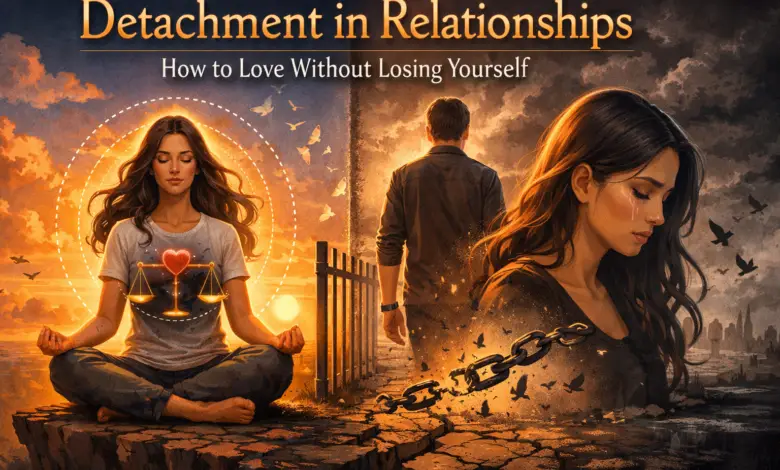
Detachment in relationships is one of the most misunderstood concepts in emotional healing. Many people searching for how to detach emotionally from someone fear that detachment means becoming cold or uncaring, but true detachment is the opposite—it is learning to love without losing yourself.
Thank you for reading this post, don't forget to subscribe!When emotional attachment in relationships becomes unhealthy, it often creates anxiety, overthinking, and deep fear of loss. For those struggling with fear of abandonment in relationships, love can begin to feel more like survival than connection.
This is why learning healthy detachment in love is not about caring less—it is about creating emotional balance so love no longer becomes suffering.
What Detachment in Relationships Really Means
When people hear the phrase detachment in relationships, they often misunderstand it immediately. They assume detachment means becoming cold, distant, emotionally unavailable, or no longer caring about the person they love.
But healthy detachment in relationships is not emotional numbness, and it is not the absence of love. Real detachment means learning how to stay emotionally present without allowing your peace, identity, and inner stability to become dependent on another person’s behavior.
The healthiest form of love is not obsessive attachment. It is connection with awareness. It is the ability to care deeply while remaining grounded in yourself. It is loving someone without turning them into the center of your emotional survival. This is what healthy detachment in love truly looks like.
Most people do not suffer in relationships because they love too much. They suffer because they attach their emotional safety to another human being.
They begin believing that their peace depends on whether someone stays, responds, understands, validates, or chooses them. Once this happens, the relationship stops being simple connection and starts becoming emotional dependency.
That is where emotional pain begins.
Read Also: Emotional Detachment vs Emotional Suppression: Key Difference Explained
My Personal Experience With Emotional Attachment in Relationships
For most of my life, I did not understand that my suffering in relationships was rooted in emotional attachment in relationships, not simply love. I thought my pain came from caring deeply. I thought I was hurt because I loved honestly.
But over time I realized something much deeper—my strongest attachment did not appear when things were peaceful. It appeared whenever my inner pain, fear, past wounds, or feelings of non-acceptance got activated.
Whenever I felt emotionally unsafe, my attachment intensified.
It was never just about the person in front of me. It was about what their presence or absence triggered inside me.
When fear of abandonment in relationships activated within me, it did not feel logical. It did not feel like I had time to calmly think through what was happening. My body reacted before my mind could understand anything.
My nervous system would enter panic before I even knew what I was afraid of. My chest tightened, my mind raced, my emotions surged, and suddenly I felt like I was under attack from within.
Then, only after the emotional storm began, my thoughts would start trying to explain the fear.
My mind would ask:
Why Is This Happening to Me?
- Why me?
- What did I do wrong?
- Why does nobody stay with me?
- Why am I always left alone?
- What if I lose everything?
- What if I fail?
- What if this pain never ends?
This is something many people do not understand about fear of abandonment in relationships. Sometimes the fear begins in the body first, and the mind creates catastrophic thoughts afterward to justify the panic. The body sounds the alarm, and the mind starts searching for reasons.
If the fear continued building, my anxiety would intensify until I emotionally broke down. What began as uncertainty would become panic. What began as pain would become helplessness. And when it reached that point, I no longer felt like I had control over myself.
Why Emotional Attachment Hurts More Than People Realize
Many people think attachment simply means missing someone too much or loving too intensely. But unhealthy relationship attachment goes much deeper than that.
Attachment becomes dangerous when the relationship is no longer just a bond—it becomes the foundation of your emotional regulation.
At that point, your nervous system begins treating the relationship like survival.
That means:
- Distance feels like danger
- Silence feels like rejection
- Conflict feels like abandonment
- Uncertainty feels like panic
This is why people who struggle with emotional dependency in relationships often know logically that they are overreacting, yet still cannot calm themselves. Logic becomes weak when the nervous system believes survival is at risk.
That was my reality.
Even when I knew my reaction was irrational, even when I knew the situation did not deserve that level of panic, the emotional storm still came. That is why I eventually learned something painful but important:
Understanding your emotions is not the same as controlling them.
You can understand your fear completely and still be overwhelmed by it if your nervous system remains dysregulated.
How My Attachment Response Changed Over Time
Earlier in my life, my attachment pain looked very different than it does now.
When I was younger, emotional pain activated fight mode in me. I became reactive. I entered attack mode. Revenge mode. Protest mode. If I felt abandoned or hurt, I wanted to fight the pain externally. I wanted to argue, control, fix, demand, or force resolution because I could not tolerate the emotional discomfort inside me.
That is how many people unconsciously respond when they do not know how to detach emotionally from someone—they try to control the outside world to calm the inside world.
But after repeated emotional exhaustion, life pain, and deep inner burnout, my nervous system changed.
My attachment no longer came out as attack.
It turned inward.
When Attachment Stops Looking Like Chasing
This is something many people misunderstand.
Not everyone with attachment wounds keeps chasing forever. Sometimes the nervous system becomes too exhausted to protest externally, and attachment transforms into collapse.
That is what happened to me.
Instead of fighting outwardly, I began freezing.
Instead of attacking, I shut down.
Instead of chasing, I withdrew.
I would isolate from everyone, cry until emotionally empty, and retreat into myself. Before, I would beg, call, chase, and try to repair everything immediately. But over time my nervous system shifted from protest to shutdown.
This is important because many people think: “I do not chase anymore, so maybe I healed.”
But often that is not healing.
Often that is simply trauma becoming quieter.
Silence is not always peace.
Withdrawal is not always detachment.
Sometimes it is just another survival response.
Why I Began Searching for Detachment
My real search for how to detach emotionally from someone did not begin because I wanted to stop loving. It began because I became exhausted from being controlled by my own emotions.
I was not searching for coldness.
I was searching for peace.
I wanted to know:
- Why do my emotions overpower logic?
- Why can’t I calm myself even when I know better?
- Why does attachment create so much suffering?
- Why do I lose myself whenever fear is activated?
I searched through many places for answers.
I tried external help.
I tried reasoning with myself.
I tried understanding psychology.
But while those helped partially, something still felt incomplete.
Because I was trying to solve emotional pain while still believing I needed to control every emotion to be okay.
The true shift only began when I started learning spiritual understanding—especially through the teachings of the Bhagavad Gita.
That was when I encountered a truth that changed my entire understanding of detachment in relationships:
Peace does not come from controlling every emotion.
Peace comes from learning not to obey every emotion.
That realization changed everything.
Read Also : How to Practice Detachment in Daily Life and End Emotional Suffering
Why Awareness Alone Does Not Stop Emotional Attachment
One of the most frustrating parts of healing emotional attachment in relationships is realizing that awareness alone often does not create immediate change.
You may understand exactly what is happening. You may know the relationship is unhealthy. You may recognize your fear of abandonment in relationships. You may even understand your patterns logically in great detail.
And yet…
You still panic.
You still overthink.
You still freeze.
You still want to react.
This creates confusion in many people because they think: “If I understand my attachment, why can’t I stop it?”
The answer is simple but profound: Because emotional attachment in relationships is not only cognitive.
It is physiological.
Your suffering is not created only by thoughts. It is created by a nervous system that has learned to interpret emotional uncertainty as danger.
This means when attachment is triggered, your body reacts before your rational mind has time to intervene.
That is why how to detach emotionally from someone is not just a mindset issue. It is a nervous system and awareness practice.
Why Your Body Panics Before Your Mind Understands
My personal experience taught me something many people miss: Fear often activates before thought.
I used to believe my panic attacks and emotional storms were caused by negative thinking. But over time I realized something deeper was happening. My body would enter fear first, and then my mind would scramble to explain the panic afterward.
My nervous system would activate before I consciously understood why.
Then my thoughts would begin:
- What if I lose everything?
- What if this person leaves?
- What if I cannot survive this?
- What if nobody ever stays?
- What if I am alone forever?
The thoughts were not always the cause of the panic. Often they were the explanation my mind created after the alarm had already started.
This is why people with strong relationship abandonment anxiety often feel like they are trapped in reactions they cannot reason with. The body is in survival mode. Once that happens, logic becomes secondary.
The Nervous System’s Role in Relationship Attachment
To understand emotional dependency in relationships, you must understand survival biology.
When your nervous system perceives emotional danger, it activates the same core responses used for physical threat:
Fight
You become angry, reactive, controlling, demanding, or argumentative.
Flight
You try to escape, avoid, distract, or run emotionally.
Freeze
You shut down, numb out, isolate, or collapse inward.
Fawn
You beg, chase, over-give, people-please, or abandon yourself to keep connection.
These are not personality flaws.
They are survival adaptations.
Earlier in my life, attachment pain triggered fight mode in me. I became reactive, angry, controlling, and desperate to force emotional resolution. But over time, after repeated exhaustion and pain, my nervous system shifted from fight into freeze.
That is when my suffering became quieter—but not gone.
I stopped externally chasing.
But internally I was collapsing.
That is why not all silence means healing.
Sometimes silence is simply survival in a different form.
Why Love Becomes Emotional Dependency
Healthy love and unhealthy attachment can look similar from the outside, but internally they are completely different.
Healthy love says: “I care deeply about you, but my peace is not dependent on controlling you.”
Attachment says: “I need you to behave a certain way for me to feel okay.”
That is the difference.
Once someone becomes the regulator of your inner state, love turns into dependency.
You begin unconsciously expecting them to:
- Remove your loneliness
- Heal your insecurity
- Prevent your abandonment pain
- Stabilize your emotions
- Prove your worth
But no human being can sustainably carry that burden.
This is why emotional attachment in relationships eventually creates suffering, even when love is real.
Because you are asking another person to regulate wounds they did not create.
Read Also: Why letting go is so hard emotionally?
Bhagavad Gita on Attachment and Emotional Suffering
This is where the teachings of the Bhagavad Gita transformed my understanding.
The Gita explains attachment not merely as desire for objects or people, but as identification with outcomes and dependence on external conditions for inner peace.
One of its most practical teachings states:
From attachment comes desire,
from desire comes frustration,
from frustration comes anger,
from anger comes delusion,
and from delusion comes destruction of wisdom.
This is not abstract spirituality.
It is psychological reality.
In relationships, the pattern often looks like this:
Attachment
“I need this person.”
Desire / Expectation
“They must stay / respond / love me the way I need.”
Fear / Frustration
“What if they don’t?”
Emotional Reaction
Anger, panic, chasing, shutdown, overthinking.
Loss of Clarity
You act against your own values.
Suffering
More pain, regret, emotional exhaustion.
The Gita names this entire loop Maya—illusion or distorted perception.
In practical psychological terms:
Maya is when emotional attachment convinces you that your peace depends on what you cannot control.
That insight changed my life.
Because I realized:
My suffering was not only from the situation.
My suffering was from believing the situation controlled my inner peace.
Why Detachment Is Not Suppression
Another dangerous misunderstanding is thinking detachment means emotional suppression.
It does not.
Suppression says: “Do not feel this.”
Detachment says: “Feel this fully—but do not become ruled by it.”
This is a critical difference.
Healthy detachment in love means:
- You allow fear to exist
- You allow grief to exist
- You allow disappointment to exist
- You allow longing to exist
But you stop assuming:“Because I feel it, I must act on it.”
That became one of the most life-changing realizations of my healing: Not every emotion deserves action.
Some emotions deserve witnessing.
Some deserve breathing through.
Some deserve tears.
Some deserve reflection.
But not every emotion deserves reaction.
The Beginning of Freedom
When I began understanding detachment this way, I stopped trying to destroy my emotions.
Instead, I started learning how to sit with them.
I realized:
- Fear can rise without needing control
- Pain can rise without needing reaction
- Anxiety can rise without immediate catastrophe
- Love can exist without possession
This was not easy.
But it was freedom.
Because for the first time, I was not trying to win against emotion.
I was learning to stand beside it without surrendering my identity.
Read Also : Attachment vs Love: Why You Seek It from the Wrong People
What Detachment Truly Gives You
Real detachment in relationships gives you:
Emotional Space
A gap between feeling and action.
Clarity
The ability to see reality without panic distortion.
Boundaries
The strength to stop tolerating emotional harm.
Self-Respect
The willingness to choose peace over desperate attachment.
Freedom
The understanding that pain may visit—but it does not have to control you.
What Detachment Changed in My Real Life
Learning detachment in relationships did not make me avoid difficult situations. It did not make me stop caring. It did not turn me into someone who runs from pain or disconnects from love.
What it changed was my relationship with emotional pain.
Before learning detachment, I believed peace would come only if I could control what was happening around me. I thought if the relationship improved, if the person stayed, if they understood me, if they stopped hurting me, then I would finally feel calm.
But over time I realized something painful: Trying to control life to avoid pain was creating more pain than the situation itself.
That was the turning point.
Detachment taught me that my job is not to control every situation.
My job is to control my response to the situation.
This changed the way I live.
Now when fear, abandonment, or emotional pain rises, I do not immediately ask:“How do I fix this?”
Instead I ask: “How do I respond wisely without letting pain control me?”
That shift alone changed everything.
The Core Principle of Healthy Detachment in Love
If I had to define healthy detachment in love in one sentence, it would be this:
Detachment is the ability to feel deeply without reacting impulsively.
That is all.
Not numbness.
Not suppression.
Not avoidance.
Just emotional awareness with disciplined response.
You can cry and still be detached.
You can feel pain and still be detached.
You can miss someone and still be detached.
Because detachment is not measured by what you feel.
It is measured by whether your feelings control your actions.
Read Also: Detachment & Awareness
My 5-Step Practical Detachment Framework
This is the real framework that changed my life and helped me learn how to detach emotionally from someone without becoming emotionally shut down.
1. Awareness — Name What Is Happening
The first step is noticing the truth of the moment.
Instead of saying:“Everything is falling apart.”
I now pause and ask:“What is actually happening inside me right now?”
Usually the answer is:
- Fear is activated
- Abandonment wound is triggered
- My nervous system is in survival mode
- I am feeling helpless, not unsafe
This creates separation between self and emotion.
Because: You cannot regulate what you do not recognize.
Awareness turns unconscious reaction into conscious observation.
2. Boundaries — Stop Actions That Multiply Pain
Pain is one thing.
But many people multiply their pain through impulsive reaction.
Examples include:
- Repeated calling or texting
- Begging for reassurance
- Overexplaining
- Arguing from panic
- Stalking social media
- Seeking emotional closure from unavailable people
I learned that when I react from pain, I often create fresh wounds on top of the original wound.
So now my boundary is simple: If I am emotionally overwhelmed, I do not act immediately.
This protects me from turning temporary pain into lasting regret.
3. Clean Intention — Remove Hidden Emotional Demands
Many people believe they are loving purely when in reality their love is mixed with fear and unconscious demand.
Examples:
- “Love me so I feel worthy.”
- “Stay so I feel safe.”
- “Choose me so I do not feel abandoned.”
- “Understand me so I feel validated.”
That is not pure connection.
That is attachment asking another person to regulate your wounds.
Detachment taught me to question my intention: Am I loving this person… Or am I needing them to stabilize me?
This question alone can reveal massive emotional truth.
4. Pure Emotion — Feel Fully Without Suppression
One of the biggest mistakes people make while trying to learn emotional detachment in relationships is suppressing what they feel.
That is not healing.
That is emotional avoidance.
Sometimes I still allow myself to:
- Cry
- Grieve
- Feel sadness
- Sit with fear
- Admit I am hurt
Because pain denied becomes pain prolonged.
But I no longer believe: Feeling pain means I must react to pain.
Now I let emotion move through me without needing immediate action.
This is one of the deepest forms of emotional maturity.
5. Acceptance — Let Reality Be What It Is
This is the hardest step.
Acceptance means:
- Accepting that people may leave
- Accepting that not everyone will understand you
- Accepting that love does not guarantee permanence
- Accepting that pain is part of life
The mind hates acceptance because it wants certainty.
But detachment taught me: Peace does not come from certainty. Peace comes from learning to remain steady in uncertainty.
Sometimes life hurts.
Sometimes people leave.
Sometimes things do not go your way.
Detachment means allowing reality to exist without emotional war against it.
The Question That Changed My Reactions
One practical tool I now use often is widening perspective.
When emotional pain rises, I ask myself:
Will This Matter in Five Years?
That question helps me break emotional tunnel vision.
Because pain makes everything feel permanent and catastrophic.
But perspective restores balance.
I ask:
- If I react today, what damage will I create?
- What will this stress do to my health?
- Is this pain worth losing myself over?
- Will this still matter at the same intensity years from now?
This often brings me back to reality.
The Final Lesson the Gita Taught Me
The greatest lesson I learned from the Bhagavad Gita was not to stop feeling.
It was this: You are responsible for your actions, not for controlling every outcome.
That means:
- Love honestly
- Act with integrity
- Set boundaries
- Feel your emotions
- Do your best
But stop trying to control what others choose, how life unfolds, or whether pain appears.
That is where suffering reduces.
Because attachment says: “I need reality to go my way.”
Detachment says: “I will meet reality as it is.”
Read Also: AI Therapy & Self-Help Tools
Final Reflection
Detachment in relationships is not about becoming distant.
It is about becoming stable.
It is learning that fear may rise, grief may rise, pain may rise—but none of them must automatically control your behavior.
My life changed when I stopped asking:“How do I stop feeling this?”
And started asking: “How do I remain myself while feeling this?”
That is real detachment.
That is emotional freedom.
That is peace.
Personal Closing Note
I once believed peace would come when life stopped hurting me.
But peace came when I learned pain can exist without controlling me.
Detachment did not remove my emotions.
It taught me not to surrender my life to them.
FAQ — Detachment in Relationships
1. What is detachment in relationships?
Detachment in relationships means staying emotionally connected without becoming emotionally dependent. It is the ability to love someone while maintaining your own inner peace, identity, and emotional balance.
2. Is detachment in relationships healthy?
Yes, healthy detachment in relationships is essential. It prevents emotional dependency, reduces overthinking, improves boundaries, and allows love to exist without fear-based control.
3. How do I detach emotionally from someone I love?
To detach emotionally from someone, begin by observing your attachment patterns, setting boundaries, allowing emotions without reacting impulsively, and learning to separate love from dependency.
4. Why is emotional attachment so painful in relationships?
Emotional attachment becomes painful when your peace depends on another person’s behavior, presence, or validation. This creates fear, anxiety, overthinking, and emotional instability.
5. What causes fear of abandonment in relationships?
Fear of abandonment in relationships often comes from past emotional wounds, trauma, inconsistent caregiving, painful breakups, or nervous system sensitivity to rejection and loss.
6. Can you love someone and still be detached?
Yes. In fact, the healthiest love includes detachment. It means caring deeply without trying to control the person, force outcomes, or lose yourself emotionally.
7. Is detachment the same as emotional suppression?
No. Detachment means feeling emotions fully without being ruled by them. Suppression means avoiding or denying emotions, which often worsens emotional pain over time.
8. Why do I panic when someone pulls away from me?
Panic often happens because your nervous system interprets distance, silence, or uncertainty as emotional danger. This can activate abandonment wounds and survival responses.
9. How does Bhagavad Gita explain attachment?
The Bhagavad Gita teaches that attachment creates suffering because it ties your inner peace to outcomes and external conditions you cannot fully control.
10. What is the difference between love and attachment?
Love is caring without control. Attachment is needing someone to behave a certain way for you to feel emotionally safe. Love gives freedom; attachment creates dependency.
11. Can detachment reduce relationship anxiety?
Yes. Learning detachment helps reduce relationship anxiety by teaching you to tolerate uncertainty, regulate emotional reactions, and stop seeking constant reassurance.
12. How long does it take to learn detachment?
Detachment is not a one-time event. It is an ongoing practice of awareness, emotional regulation, boundaries, and acceptance that develops over time with repetition.
People Also Ask
1. How do you practice detachment in a relationship?
Practice detachment by observing your emotions before reacting, setting healthy boundaries, reducing emotional dependency, and accepting what you cannot control.
2. Can detachment improve a relationship?
Yes. Healthy detachment improves relationships by reducing neediness, emotional reactivity, and control-based behavior while increasing respect and emotional balance.
3. Why do I get emotionally attached so quickly?
Quick emotional attachment often comes from unmet emotional needs, fear of abandonment, loneliness, trauma history, or anxious attachment patterns.
4. What does healthy detachment look like in love?
Healthy detachment means loving deeply while remaining emotionally stable, maintaining boundaries, and not depending on another person for your self-worth.
5. Is detachment a trauma response?
Sometimes. Emotional withdrawal can be a trauma response, but true detachment is conscious emotional regulation—not numbness or shutdown.
6. Why does abandonment trigger panic in relationships?
Abandonment can trigger panic because the nervous system may interpret rejection, distance, or uncertainty as emotional danger or survival threat.
7. Can you be detached and still care deeply?
Yes. Detachment allows you to care deeply without becoming emotionally consumed, dependent, or controlled by the relationship.
8. How do I stop overreacting in relationships?
To stop overreacting, build awareness of your triggers, regulate your nervous system, pause before acting, and separate emotion from immediate behavior.
9. Does detachment mean letting go of control?
Yes. Detachment involves releasing the need to control people, outcomes, and situations in order to preserve inner peace.
10. Why does the Bhagavad Gita teach detachment?
The Bhagavad Gita teaches detachment because attachment creates suffering when peace becomes dependent on external outcomes.
Psychology / Attachment / Nervous System References
- Bowlby, John – Attachment and Loss, Vol. 1: Attachment
Foundational work on attachment theory and emotional bonding. - Levine, Amir & Heller, Rachel – Attached
Practical explanation of attachment styles and relationship dynamics. - Porges, Stephen – The Polyvagal Theory
Nervous system regulation, safety, and survival responses. - van der Kolk, Bessel – The Body Keeps the Score
Trauma, emotional memory, and body-based activation. - Siegel, Daniel – The Developing Mind
Interpersonal neurobiology and emotional regulation.
Spiritual / Gita References
- Bhagavad Gita – Chapter 2, Verses 62–63
On attachment leading to desire, anger, delusion, and destruction of wisdom. - Bhagavad Gita – Chapter 2, Verse 47
On focusing on action, not attachment to outcomes. - Bhagavad Gita – Chapter 6, Verse 5
On elevating oneself through mastery of mind.