The Role of Self-Trust in Healing Attachment: How to Build It Back
How Self-Trust Helps You Stop Self-Abandonment and Rebuild Safer Relationships

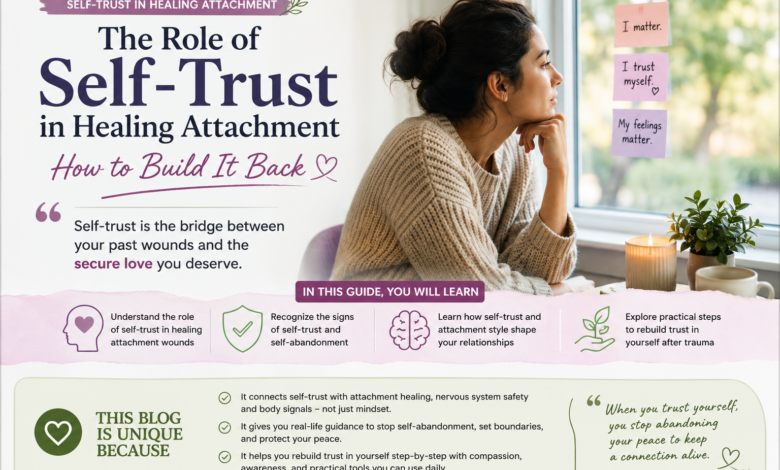
In this guide, you will learn how self-trust and attachment style shape the way you handle closeness, fear, reassurance, and emotional pain.
Thank you for reading this post, don't forget to subscribe!You will also understand the signs of self-trust, why attachment wounds make you doubt yourself, and how to build self-trust after trauma without abandoning your needs, body signals, or emotional boundaries.
If you often ignore red flags, overexplain your feelings, or lose yourself to keep connection alive, this article will help you begin rebuilding trust in yourself in a practical and compassionate way.
Why do you keep doubting your feelings, ignoring red flags, and losing yourself just to keep a relationship alive?
This is where the role of self-trust in healing attachment becomes deeper than ordinary confidence advice.
Most articles explain self-trust as decision-making or self-esteem, but this blog looks at self-trust through attachment pain, nervous system safety, body signals, emotional over-responsibility, and self-abandonment.
In this guide, you will learn how self-trust and attachment style shape the way you handle closeness, fear, reassurance, and emotional pain.
Read Also: how-to-stop-getting-defensive
The Role of Self-Trust in Healing Attachment: How to Build It Back
Sometimes attachment pain does not begin when someone leaves you. Sometimes it begins much earlier, when you stop trusting your own feelings while trying to keep a connection alive.
- You may feel something is wrong, but still ignore yourself.
- You may notice tension in your body, but tell yourself you are overthinking.
- You may want to say no, but say yes because losing the relationship feels more frightening than losing your peace.
- You may keep explaining, adjusting, waiting, and hoping that one day people will understand what you are carrying.
This is where the role of self-trust in healing attachment becomes deeply important.
Self-trust is not only confidence. It is not only making strong decisions. It is the quiet inner ability to say, “My feelings matter. My body signals matter. My peace matters. I can listen to myself without abandoning love, family, or connection.”
When self-trust is damaged, attachment becomes confusing.
- You may keep doubting your feelings.
- You may ignore red flags.
- You may say yes when you want to say no.
- You may wait for others to understand your pain before you give yourself permission to protect your own health.
Attachment pain can become confusing when you keep choosing connection while slowly losing your own peace.
That question can change everything.
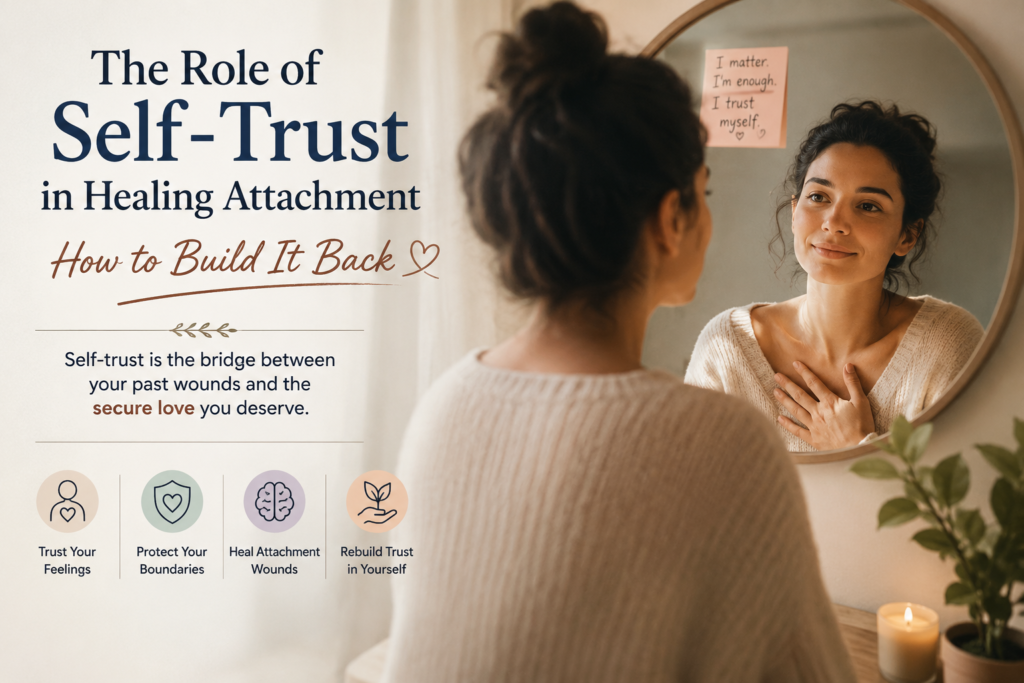
What Is Self-Trust?
Self-trust means trusting your feelings, decisions, boundaries, body signals, and ability to handle life even when relationships feel uncertain.
It does not mean you are always right. It does not mean you never feel fear. It does not mean you become emotionally hard, cold, or detached from people. Real self-trust means you stay connected to yourself even when love, family, conflict, or attachment pain becomes emotionally heavy.
A person with healthy self-trust can say, “I may feel confused, but I will not ignore myself.”
They can say, “I may care about others, but I will not destroy my health for emotional drama.”
They can also say, “I may make mistakes, but I can repair and learn.”
Self-trust is the inner belief that you can listen to yourself, protect yourself, and return to yourself after confusion. It is not about becoming perfect. It is about becoming honest.
This is why self-trust and attachment style are deeply connected.
- If you have anxious attachment, you may doubt your own feelings and depend on others for reassurance.
- If you have avoidant attachment, you may distrust emotional needs and protect yourself by staying distant.
- If you have fearful avoidant attachment, you may want connection but also fear being hurt, controlled, or abandoned.
Understanding self-trust and attachment style helps you see that the issue is not only, “I need someone to love me better.” Sometimes the deeper issue is, “I need to stop leaving myself whenever love feels uncertain.”
Self-trust and attachment style are closely connected because the way you learned to bond with others often shapes how much you believe your own feelings, needs, and boundaries.
Why Self-Trust Matters in Attachment Healing
The role of self-trust in healing attachment is foundational because attachment wounds often push people to search for safety outside themselves.
- You may think, “If they understand me, I will feel calm.”
- You may think, “If they choose me, I will feel secure.”
- You may think, “If they stop hurting me, I will finally trust myself again.”
But when your whole safety depends on someone else’s behavior, your nervous system stays unstable. You may monitor every tone, overthink every delay, overexplain your feelings, or try to manage everyone’s emotions so nothing breaks.
Self-trust brings the focus back to your inner relationship with yourself.
It asks:
- Can I trust myself to notice when something is hurting me?
- Can I trust myself to stop ignoring my body?
- Can I trust myself to say no when my peace is at risk?
- Can I trust myself to survive even if someone disagrees, leaves, or misunderstands me?
This does not remove the need for healthy relationships. We all need connection, care, repair, and emotional support. But self-trust helps you stop making another person the only source of your safety.
Secure attachment is not only about trusting someone else. It is also about knowing you will not abandon yourself to keep someone close.
When intense emotional bonding becomes mixed with fear, reassurance-seeking, or overthinking, self-trust helps you slow down.
Why Trauma Destroys Self-Trust
Trauma can damage self-trust because it teaches you to doubt your own inner signals.
If you grew up around emotional pressure, criticism, inconsistency, rejection, gaslighting, emotional neglect, or unresolved family conflict, you may have learned to silence your needs to keep peace.
You may have learned that your role was to understand everyone, adjust for everyone, and carry emotions that were never fully yours.
Over time, the body learns a painful survival pattern:
“Connection is more important than my truth.”
This is how self-abandonment begins.
- You feel hurt, but you minimize it.
- You feel tired, but you keep going.
- You feel anxious, but you keep listening.
- You feel something is wrong, but you tell yourself to be patient.
- You see red flags, but you explain them away because accepting the truth may force you to set a boundary.
This is especially painful when family or close relationships are involved.
- You may become the middle person between people who carry anger, resentment, or unresolved emotions toward each other.
- You may listen to one side, then the other side, and try to balance everything.
- You may try to explain respect, emotional understanding, and peace.
But if the people involved are not ready for real repair, you may become the one losing your patience, health, and mental clarity.
This is not weakness. It is emotional over-responsibility.
This is why how to build self-trust after trauma must include more than positive thinking. The body has to learn, through repeated action, that you will listen sooner, protect your peace sooner, and stop treating your own discomfort as an inconvenience.
Healing from trust recovery after emotional harm is not only mental; it is also emotional, physical, and nervous-system based.
A Human Experience: When You Ignore Your Health for Emotional Drama
Sometimes the loss of self-trust does not happen in one dramatic moment. It happens slowly, through repeated emotional pressure.
You may keep listening, balancing, explaining, calming, and trying to help people understand each other. You may become the emotional bridge between unresolved pain, hoping that your patience will create peace.
But if the people involved are not ready for emotional respect, responsibility, or repair, you may slowly become the one carrying the weight of everyone’s conflict.
At first, you may think you are helping.
Later, your body starts showing the truth.
- You feel frozen.
- You feel anxious.
- You feel tired.
- You may lose patience, lose focus, or feel mentally overloaded.
Something inside you knows the situation is not healthy, but you still ignore yourself because connection, family, love, or responsibility feels more important than your own peace.
This is where self-trust becomes personal.
- You feel something is wrong, but you doubt your feelings.
- You notice red flags, but you explain them away.
- You say yes when you want to say no.
- You keep explaining yourself because some part of you is still waiting for others to understand your pain.
But healing begins when you finally ask a different question:
“Why am I ignoring my health for emotional drama that I cannot fully control?”
That question is not selfish. It is awareness.
Self-trust means learning that your body is also part of the truth.
- Your anxiety is information.
- Your tiredness is information.
- Your frozen feeling is information.
- Your loss of peace is information.
You can care about people and still refuse to become the emotional container for every unresolved conflict.
You can love your family and still protect your nervous system.
You can want relationships to heal and still admit that you cannot repair what others are not willing to face.
This is where nervous system regulation becomes important. Your body is not trying to disturb your life. Sometimes it is trying to warn you that the emotional weight has become too much.
A powerful boundary for attachment healing is this:
I will not ignore my health for emotional drama.
This does not mean becoming cold. It means becoming honest.
It means you are no longer willing to abandon your body, your mind, and your peace just to keep a connection alive.
Read Also: relationship
Read Also attachment-and-connection
Signs of Self-Trust
The signs of self-trust are often quiet. They may not look dramatic from the outside, but they change how you live inside your relationships.
Some signs of self-trust include:
- You listen to your body before dismissing it.
- You can say no without explaining for hours.
- You notice red flags without immediately defending them.
- You can make a decision without asking ten people for permission.
- You can admit when something hurts without calling yourself weak.
- You stop chasing people who repeatedly confuse your nervous system.
- You can repair mistakes without attacking your whole identity.
- You can care about people without becoming responsible for their emotional choices.
- You can pause before reacting from fear.
- You can choose health over emotional chaos.
These signs of self-trust show that your inner relationship is becoming safer. You are no longer waiting for everyone else to validate your pain before you take your own feelings seriously.
When you understand the signs of self-trust, you begin to notice small healing moments.
- Every time you pause before reacting, you build trust.
- Every time you keep one promise to yourself, you build trust.
- Every time you choose health over emotional drama, you build trust.
The signs of self-trust often appear in small daily choices, not only in big relationship decisions.
One of the clearest signs of self-trust is being able to say no without explaining yourself for too long.
Another of the signs of self-trust is noticing red flags and taking your own discomfort seriously.
When you begin rebuilding trust in yourself, the signs of self-trust become easier to notice in your thoughts, body signals, and boundaries.
Abandonment fear in adulthood can make people hold on to relationships even when their body feels exhausted.
Self-Trust and Attachment Style: How Patterns Change
Self-trust and attachment style work together because attachment wounds shape how you respond to closeness, conflict, distance, and uncertainty.
When self-trust is low, anxious attachment may become chasing, overexplaining, people-pleasing, or panic.
Avoidant attachment may become emotional shutdown, distance, or silent protection. Fearful avoidant attachment may become a painful cycle of wanting closeness and fearing it at the same time.
When self-trust grows, these patterns do not vanish overnight, but they become easier to notice before they control your behavior.
- If you have anxious attachment, self-trust helps you ask, “Is this present danger, or is this old abandonment fear?”
- If you have avoidant attachment, self-trust helps you ask, “Do I truly need space, or am I escaping vulnerability?”
- If you have fearful avoidant attachment, self-trust helps you ask, “Can I slow down instead of pushing and pulling?”
This is where self-trust and attachment style become a practical healing map. You stop using attachment labels to shame yourself, and you start using them to understand your nervous system.
Body-based emotional regulation helps you notice when anxiety, tiredness, or a frozen feeling is asking for protection.
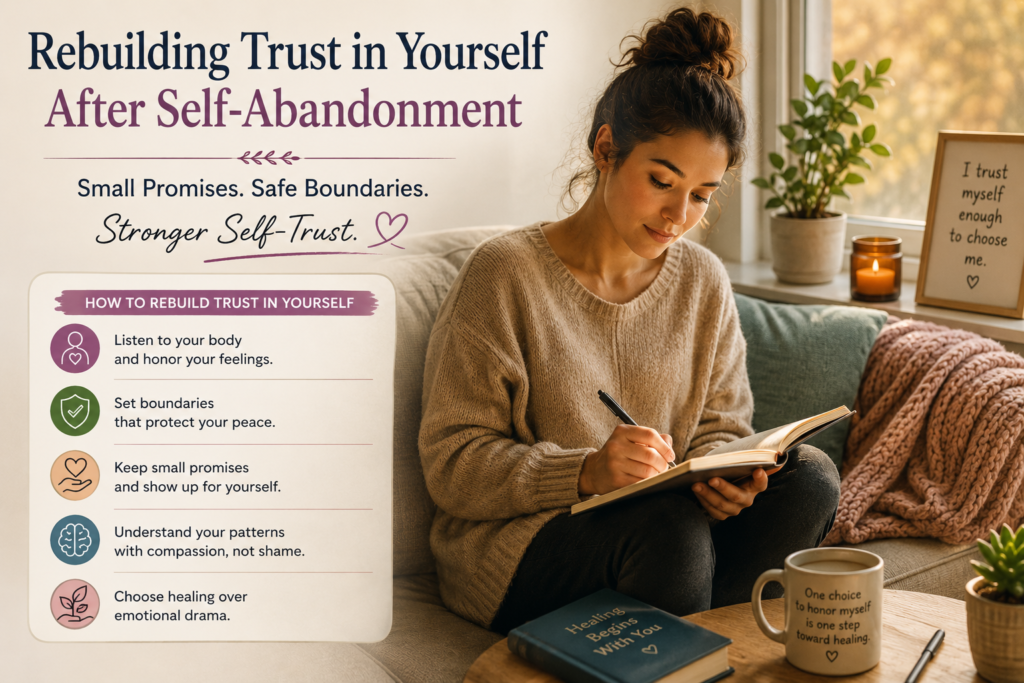
Rebuilding Trust in Yourself After Self-Abandonment
Rebuilding trust in yourself begins when you understand that self-abandonment was often a survival strategy.
- You may have said yes because saying no felt unsafe.
- You may have stayed silent because conflict felt dangerous.
- You may have overexplained because being misunderstood felt unbearable.
- You may have ignored red flags because losing connection felt worse than losing peace.
- The goal is not to hate yourself for these patterns. The goal is to become responsible for changing them gently.
Rebuilding trust in yourself means proving to your body that you will not keep repeating the same abandonment. It means you stop making big promises that collapse under pressure and start making small promises you can actually keep.
You can begin with simple promises:
- I will pause before saying yes.
- I will notice when my body feels frozen.
- I will not reply immediately when I am emotionally activated.
- I will sleep before making a major emotional decision.
- I will not keep explaining myself to someone who is not listening.
- I will choose one action today that protects my health.
Rebuilding trust in yourself is not one big emotional breakthrough. It is repeated evidence that you are becoming reliable to your own body.
This is why rebuilding trust in yourself after attachment wounds must include action, not only insight. Your body needs proof that you are no longer leaving yourself behind.
How to Build Self-Trust After Trauma
How to build self-trust after trauma starts with small, repeatable actions. Trauma teaches the body that safety is unstable.
Healing teaches the body that you can become a steady place to return to.
You do not build self-trust by forcing yourself to become strong overnight.
You build it by showing up in small ways when your old pattern wants you to ignore yourself again.
1. Start With Body Check-Ins
Ask yourself, “What am I feeling in my body right now?”
Do not judge the answer.
Just notice. Anxiety, tiredness, tightness, heaviness, restlessness, and frozen feelings are not failures. They are information.
This is one of the simplest ways to understand how to build self-trust after trauma because it teaches your body that you are finally listening.
2. Keep Very Small Promises
If you promise yourself ten big changes and fail, shame grows. If you promise one small action and keep it, self-trust grows.
- Read for five minutes.
- Walk for ten minutes.
- Sleep on time once.
- Eat properly.
- Meditate for two minutes.
Finish one work task. Do not reply immediately when emotionally triggered.
These small acts teach the body that you are becoming dependable.
This is why how to build self-trust after trauma must be practical. Your nervous system trusts repeated experience more than motivational thinking.
3. Practice a Clean No
A clean no does not need a courtroom explanation.
- You can say, “I cannot take this on right now.”
- You can say, “I need rest.”
- You can say, “I care, but I cannot become the middle person in this.”
Clean boundaries protect attachment healing because they stop love from becoming self-loss. If boundaries feel confusing, start with healthy boundaries that protect your health without attacking another person.
4. Stop Explaining to People Who Refuse Repair
Explaining is healthy when someone wants to understand. Explaining becomes self-abandonment when you keep repeating your pain to someone who uses your words against you, ignores them, or changes the topic.
Self-trust asks you to notice the difference.
You can be kind without becoming endlessly available for emotional confusion.
5. Use Repair Instead of Shame
How to build self-trust after trauma is not about never making mistakes. It is about repairing without self-attack.
- Instead of saying, “I ruined everything,” try saying, “I missed a signal, and now I can listen sooner.”
- Instead of saying, “I am weak,” try saying, “I was scared, and I am learning a safer way.”
- Instead of saying, “I always choose wrong,” try saying, “I am learning to slow down before choosing.”
This is how healing becomes safer. Your nervous system does not need more punishment. It needs honest repair.
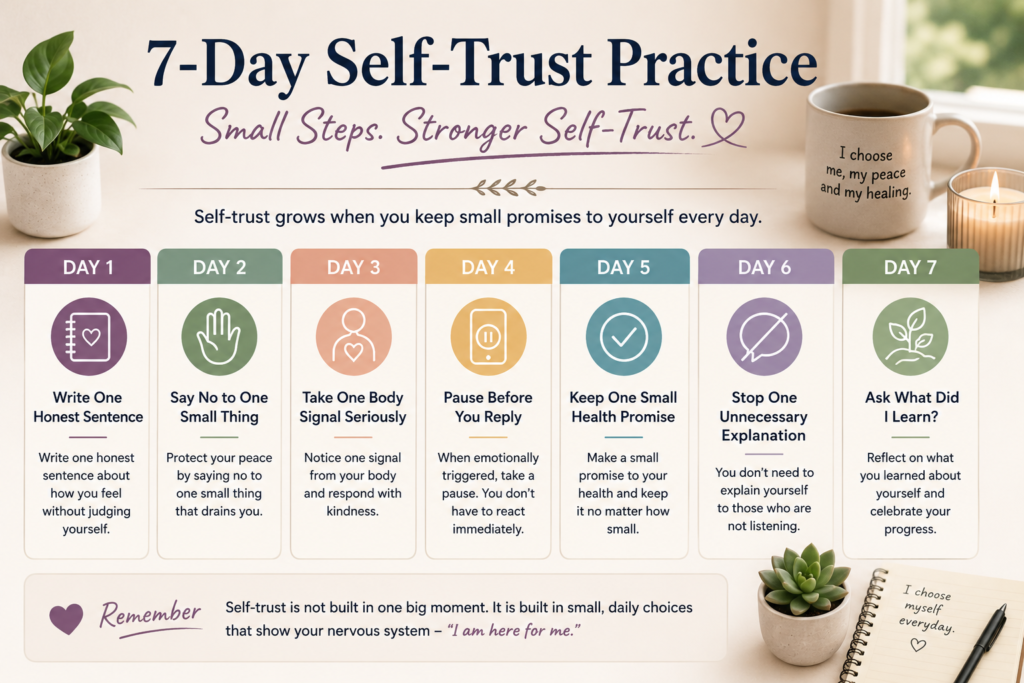
A Simple 7-Day Self-Trust Practice
If you want to begin rebuilding trust in yourself, start with seven small actions.
Day 1: Write one honest sentence about what you feel.
Day 2: Say no to one small thing that drains you.
Day 3: Take one body signal seriously.
Day 4: Do not reply immediately when emotionally triggered.
Day 5: Keep one small health promise.
Day 6: Stop one unnecessary explanation.
Day 7: Ask, “What did I learn about myself this week?”
This practice works because self-trust depends on evidence. Your body needs to see that you are not only thinking about healing, but acting in small ways that protect your peace.
This is also a simple way to practice how to build self-trust after trauma without overwhelming yourself. You are not trying to fix your whole life in one week. You are teaching your body that your feelings, health, and boundaries matter.
You will also understand the signs of self-trust, why attachment wounds make you doubt yourself, and how to build self-trust after trauma. Self-trust and attachment style are closely connected because the way you learned to bond with others often shapes how much you believe your own feelings, needs, and boundaries.
Protecting your emotional limits is not selfish; it is one way to stop love from becoming self-loss.
People Also Ask
Why is self-trust important in attachment healing?
Self-trust is important because attachment wounds often make you depend completely on another person for safety. The role of self-trust in healing attachment is to help you care about connection without abandoning your feelings, body signals, or boundaries.
Can trauma make you stop trusting yourself?
Yes. Trauma can make you doubt your emotions, needs, memory, decisions, and intuition. This is why how to build self-trust after trauma must include emotional safety, body awareness, boundaries, and repeated small promises.
What are the signs that I do not trust myself?
Common signs include overexplaining, people-pleasing, ignoring red flags, asking for constant reassurance, doubting your feelings, staying in unhealthy emotional patterns, and feeling frozen when you need to make a decision. These are the opposite of the signs of self-trust.
How does self-trust affect attachment style?
Self-trust and attachment style are connected because attachment patterns affect how you handle closeness, fear, distance, and conflict. More self-trust can help anxious, avoidant, and fearful patterns become less reactive.
Can rebuilding trust in yourself improve relationships?
Yes. Rebuilding trust in yourself can improve relationships because you become more honest, more boundaried, and less dependent on another person to regulate your entire emotional state.
Read Also: relationship
FAQs
What is the role of self-trust in healing attachment?
The role of self-trust in healing attachment is to help you stop abandoning yourself for connection. It helps you listen to your emotions, respect your body signals, set healthier boundaries, and build safer relationships without making another person your only source of peace.
How do I know if I am rebuilding trust in myself?
You may notice that you pause before reacting, say no more honestly, listen to your body sooner, stop explaining yourself repeatedly, and make decisions with less panic. These signs of self-trust show that your inner safety is growing.
How can I build self-trust after trauma if I keep doubting myself?
How to build self-trust after trauma starts with small actions. Do not begin with huge life changes. Begin by keeping one promise, listening to one body signal, setting one boundary, and repairing one mistake without shame.
What is the connection between self-trust and attachment style?
Self-trust and attachment style are connected because insecure attachment often makes you doubt your emotions, fear abandonment, avoid vulnerability, or depend on others for safety. Self-trust helps you respond with more awareness and less panic.
Why is rebuilding trust in yourself so hard?
Rebuilding trust in yourself is hard because your nervous system may have learned that self-abandonment kept you safe. Healing asks you to create new evidence that your feelings, boundaries, and health matter.
Can self-trust help fear of abandonment?
Yes. Self-trust does not remove the human need for connection, but it reduces the feeling that another person’s presence is your only safety. When you trust yourself more, abandonment fear can become easier to regulate.
Read Also: attachment-and-connection
Personal Note
My healing became clearer when I realized that I was not losing peace because I was weak. I was losing peace because I was carrying emotional responsibility that was never fully mine.
For a long time, I thought patience meant staying available for everyone’s pain. I thought love meant explaining, balancing, adjusting, and trying harder. But slowly I understood that when my body becomes anxious, frozen, and tired, it is not trying to disturb my life. It is trying to tell me the truth.
Self-trust did not return through one big decision. It returned through small moments where I chose not to ignore myself again.
I still care. I still feel. I still want peace. But now I understand one thing more deeply:
I cannot keep losing my health for emotional drama and call it love.
Sometimes healing attachment begins with one quiet promise:
“I will stay connected to myself too.”
Read Also: healing-resources-hub
Conclusion
The role of self-trust in healing attachment is not only about feeling confident. It is about becoming someone your own nervous system can rely on.
- You do not need to become fearless.
- You do not need to make perfect choices.
- You do not need to stop caring about people.
But you do need to stop abandoning your health, your body, and your peace for emotional patterns that keep hurting you.
- Self-trust says, “I can love people and still protect myself.”
- It says, “I can feel attachment pain and still listen to my truth.”
- It says, “I can care deeply without becoming responsible for everything.”
That is why the role of self-trust in healing attachment is so powerful. It turns healing from a desperate search for external safety into a steady return to your own inner safety.
And sometimes, that is the beginning of secure love.
External References
- R. Chris Fraley, University of Illinois — Adult Attachment Theory and Research
URL: https://labs.psychology.illinois.edu/~rcfraley/attachment.htm - National Library of Medicine — Adult attachment and psychological well-being
URL: https://pmc.ncbi.nlm.nih.gov/articles/PMC10047625/ - CPTSD Foundation — Self-Trust
URL: https://cptsdfoundation.org/2023/05/08/self-trust/ - National Library of Medicine — Adult attachment styles, resilience, and early experiences
URL: https://pmc.ncbi.nlm.nih.gov/articles/PMC12056111/ - Sarah Herstich LCSW — How to Build Self-Trust After Trauma and Emotional Neglect
URL: https://www.sarahherstichlcsw.com/blog/how-to-build-self-trust-especially-after-trauma-and-emotional-neglect