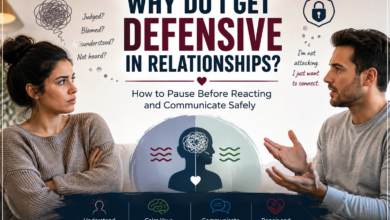
why do I take criticism personally
Feedback Anxiety, Attachment & Self-Worth


If you often ask, “why do I take criticism personally,” especially at work, you are not alone. A small correction from a manager, client, or coworker can sometimes feel like rejection, failure, or proof that you are not good enough.
Thank you for reading this post, don't forget to subscribe!This is where feedback anxiety at work begins. Your mind may know the feedback is about a task, but your body may react with shame, tension, overthinking, or fear of criticism.
For some people, taking criticism personally is connected to self-worth, attachment patterns, perfectionism, or past experiences where approval felt unsafe or conditional. It can also lead to people pleasing at work, over-apologizing, saying yes too quickly, or working harder just to feel secure again.
This blog explains why criticism feels so personal, how your nervous system responds, and practical ways to receive feedback without losing your confidence or emotional safety.
Introduction: When One Small Comment Feels Like a Big Emotional Hit
Have you ever received simple feedback at work and felt your whole body react?
Maybe your manager corrected one small detail. Maybe a client replied with a short message. Maybe your boss said, “Can we improve this?” and suddenly your chest tightened, your mind started racing, and you felt like you had failed as a person.
- You may have told yourself, “Why am I so sensitive?”
- You may have replayed the sentence ten times.
- You may have started working harder immediately, not only to improve the task, but to feel safe again.
This is why many people quietly search: why do I take criticism personally?
The painful part is that the feedback may be about the work, but inside your body, it can feel like rejection.
- A correction can feel like shame.
- A suggestion can feel like judgment.
- A delayed reply can feel like danger.
- A small mistake can feel like proof that your value is suddenly at risk.
This does not mean you are weak. It may mean your nervous system has learned to connect approval with safety. If respect, love, attention, or belonging once felt conditional, then workplace criticism can feel much bigger than the actual situation.
This article will explain why criticism at work can feel so personal, how feedback anxiety at work affects self-worth, how attachment patterns may shape your reactions, and how secure professional boundaries can help you respond without losing yourself.
YMYL Safety Note: This article is educational and for self-understanding only. It does not diagnose you, your boss, your coworkers, or your workplace. Secure communication can support healthier repair, but it cannot replace safety, boundaries, or professional help when abuse, coercion, humiliation, or fear is present.
Quick Answer: Why Do I Take Criticism Personally?
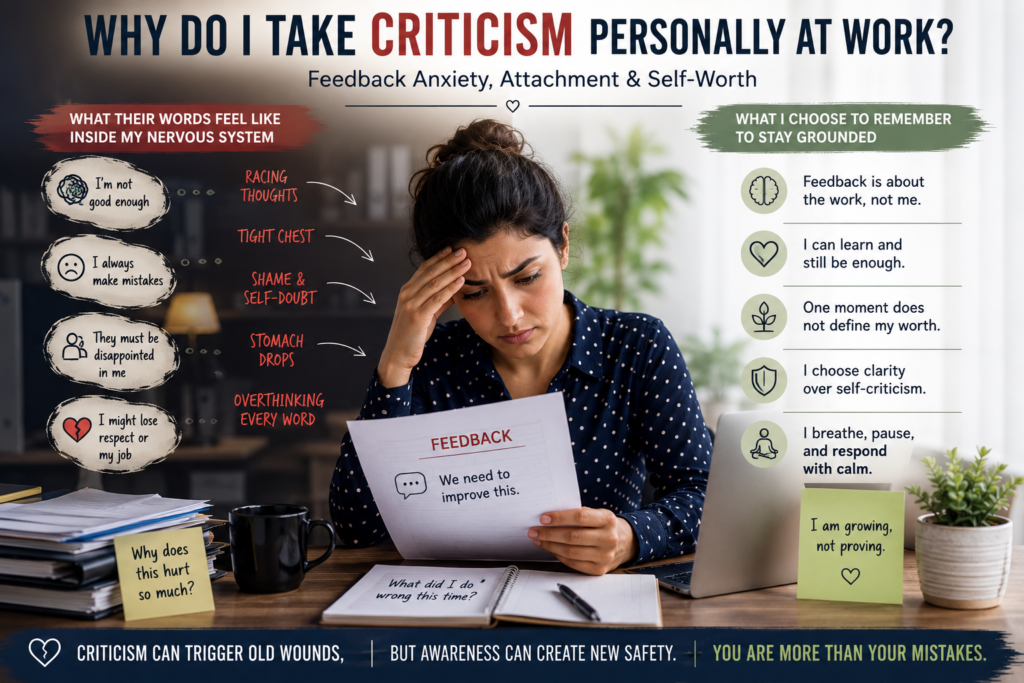
You may take criticism personally because your nervous system connects feedback with rejection, shame, failure, or loss of approval. At work, this can happen when performance, authority, and self-worth become emotionally linked.
When criticism touches an old fear, the body may react before the mind can stay calm. You may know logically that feedback is part of work, but emotionally it may feel like, “I am not good enough,” “They are disappointed in me,” or “I am about to lose safety.”
| Question | Clear Answer |
|---|---|
| Why do I take criticism personally? | Because your body may read correction as rejection, especially if approval has felt connected to safety, belonging, or self-worth. |
| Is this only insecurity? | Not always. It can involve past criticism, attachment wounds, perfectionism, workplace pressure, or fear of disappointing authority figures. |
| Can this reaction change? | Yes. With awareness, nervous system regulation, clearer boundaries, and safer self-talk, feedback can become information instead of an identity threat. |
| Does caring about feedback mean I am weak? | No. Caring about your work is healthy. The problem begins when feedback becomes proof of your worth. |
The goal is not to become emotionless. The goal is to stop turning every correction into a full attack on your identity.
Why Feedback at Work Can Feel Like Rejection
Feedback at work is supposed to help improve performance. But emotionally, it does not always feel that simple.
A sentence like “Please revise this” can feel like “You are not good enough.”
A delayed reply from a manager can feel like “They are upset with me.”
A client asking for changes can feel like “You failed.”
A public correction in a meeting can feel like humiliation.
This is where feedback anxiety at work begins. The brain may understand the task, but the body may react as if belonging is under threat.
Ask yourself gently:
Do you feel calm when feedback is specific, but panic when feedback is vague?
Do you overthink your manager’s tone more than the actual feedback?
Do you feel like one mistake can erase all your good work?
Do you work harder after criticism, not only to improve, but to feel safe again?
Do you become quiet, defensive, overly apologetic, or restless after feedback?
If yes, the issue may not be the feedback alone. It may be the emotional meaning your nervous system gives to feedback.
This is why the question why do I take criticism personally is not a small question. It often points to self-worth, safety, attachment, body memory, and old protection patterns.
Read Also: role of self-trust in healing attachment
The Nervous System Behind Feedback Anxiety at Work
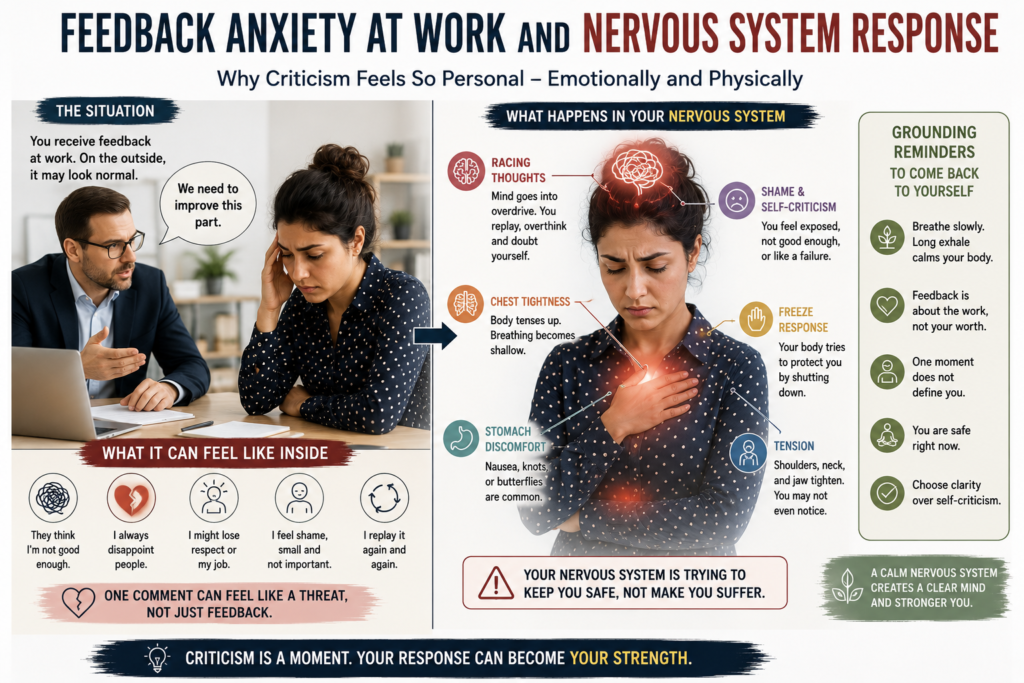
Feedback anxiety at work often begins before you can think clearly. Your body reacts first.
- Your chest may tighten. Your face may feel hot.
- Your stomach may drop. Your throat may close.
- Your hands may become restless.
- Your mind may start preparing explanations, apologies, defenses, or extra work.
- This is not always a logical response. It is often a nervous system response.
When the body senses threat, it may move into fight, flight, freeze, or fawn.
| Nervous System Response | Workplace Reaction | Inner Meaning |
|---|---|---|
| Fight | You become defensive, irritated, or argumentative. | “I must protect myself.” |
| Flight | You want to avoid emails, meetings, or the person who gave feedback. | “I need to escape this feeling.” |
| Freeze | You go blank, cannot speak, or feel numb. | “I do not know what to do.” |
| Fawn | You over-apologize, people-please, or say yes too quickly. | “I must regain approval.” |
This is why taking criticism personally can feel so intense. The body may not be reacting only to the present comment. It may be reacting to the meaning attached to it: “I am unsafe,” “I am failing,” “I will be rejected,” or “I must fix this immediately.”
A helpful grounding line is:
This is feedback about the work. It is not a final judgment on my worth.
This sentence may sound simple, but it can interrupt the emotional spiral. It reminds the nervous system that a correction is not the same as rejection.
Read Also : somatic experiencing for beginners
Attachment, Self-Worth, and Taking Criticism Personally
Attachment patterns shape how we respond to approval, distance, conflict, correction, and emotional uncertainty.
In the workplace, attachment does not only appear in close personal relationships. It can also show up with bosses, clients, coworkers, senior colleagues, teams, and authority figures.
If you learned that approval was connected to safety, criticism may feel like danger. If love or respect felt conditional, feedback may feel like rejection. If authority once felt harsh, unpredictable, humiliating, or emotionally unsafe, a manager’s correction may feel much bigger than the actual issue.
This is one reason people ask, why do I take criticism personally, especially in professional settings.
- They are not only reacting to words.
- They are reacting to the emotional memory of being judged, dismissed, ignored, or made to feel not good enough.
Taking criticism personally may show up as:
- Replaying the feedback for hours.
- Feeling ashamed after small corrections.
- Needing reassurance that everything is okay.
- Overworking to regain approval.
- Avoiding feedback conversations.
- Feeling angry because the criticism touched a vulnerable place.
- Feeling like one mistake changes how people see you.
- Losing sleep after a difficult work conversation.
Your reaction may not be your fault, but learning how to pause, protect yourself, and respond more safely can become part of your healing.
Read Also : how to build self-esteem after attachment wounds
The Workplace Trigger Map: What Happened vs. What Your Body Heard
One of the most useful healing steps is separating the actual workplace event from the emotional meaning your body created.
Many people who struggle with fear of criticism are not only reacting to the feedback. They are reacting to the story that appears after feedback.
| Workplace Event | What Actually Happened | What Your Body May Hear | Secure Reframe |
|---|---|---|---|
| Manager asks for changes | A task needs revision. | “I failed.” | “The work needs improvement, not my whole identity.” |
| Client replies coldly | The message had little warmth. | “They are angry with me.” | “Tone is not always proof of rejection.” |
| Boss delays response | They did not reply yet. | “I am in trouble.” | “A delay is not evidence of danger.” |
| Team ignores your idea | Your idea was not discussed. | “I do not matter.” | “One moment of silence does not define my value.” |
| Feedback is vague | You need clarity. | “I should already know.” | “Asking for specifics is professional.” |
| Deadline changes suddenly | Work pressure increased. | “I must sacrifice myself.” | “I can discuss capacity and priority.” |
This chart helps because it teaches the mind to pause between event and meaning. That pause is where healing begins.
People Pleasing at Work After Criticism
People pleasing at work often begins as a safety strategy. After criticism, you may start saying yes to everything. You may reply instantly. You may take extra work without checking your capacity. You may avoid asking questions because you do not want to appear difficult.
From outside, this may look like dedication. Inside, it may feel like fear.
People pleasing at work can sound like:
“I cannot disappoint them.”
“I must fix this before they lose trust in me.”
“If I say no, they will think I am not committed.”
“If I ask for more time, I will look weak.”
“If I make one mistake, everything will collapse.”
This pattern can create burnout because the person is not only working. They are trying to regulate fear through performance.
People pleasing at work may temporarily reduce anxiety, but it slowly teaches the nervous system that your needs are less important than approval.
The healing step is not to become careless. The healing step is to become clear.
A secure response may sound like:
“I can complete this by Friday, not today.”
“I want to improve this. Can you clarify the main priority?”
“I can take this on if we move another task.”
“I hear the feedback. I will review and respond with next steps.”
These statements are respectful, professional, and self-protective. They help you stay responsible without abandoning yourself.
Read Also: why-delayed-replies-hurt-so-much
Fear of Criticism and Boss Triggers
Fear of criticism becomes stronger when authority feels emotionally unsafe. A boss, manager, client, teacher, or senior colleague may unconsciously become an attachment trigger.
Even if they are not trying to harm you, your nervous system may react as if their approval decides your safety.
This can happen when:
- Feedback is vague.
- Tone feels cold.
- Expectations keep changing.
- Mistakes are handled with shame.
- You feel watched or judged.
- You do not know where you stand.
- Praise is rare, but criticism is frequent.
- You have a history of being judged harshly.
- You learned to perform well to avoid rejection.
Fear of criticism does not mean you cannot handle growth. It means your body may need more clarity, regulation, and inner safety before it can receive feedback as information.
A powerful question to ask is:
Am I responding to what was actually said, or to what my body believes it means?
This question creates space. It helps you separate the present conversation from old fear.
Read Also : why emotional attachment feels intense
Workplace Psychological Safety: Why Feedback Feels Easier in Safer Environments
Workplace psychological safety means people can ask questions, admit mistakes, share concerns, and receive feedback without fear of humiliation or punishment. It does not mean avoiding accountability. It means accountability happens with respect and clarity.
A psychologically safer workplace makes feedback easier to process because the nervous system does not have to spend as much energy scanning for threat.
In a safer feedback culture, a manager may say:
“This section needs improvement. Here is what should change, and here is the deadline.”
In an unsafe feedback culture, a manager may say:
“I do not understand how you missed this.”
The first response gives direction. The second response may create shame.
If you are already sensitive to feedback, workplace psychological safety matters even more. Clear expectations, respectful tone, predictable communication, and repair after misunderstanding can reduce feedback anxiety at work.
However, psychological safety is not only the manager’s responsibility and not only the employee’s responsibility. It is a relational environment. Leaders create safety through clarity, respect, and consistency.
Employees support safety through honest communication, accountability, and repair. Organizations support safety through fair systems, realistic workload, and respectful culture.
But remember: attachment awareness should not be used to blame employees or diagnose coworkers. It is a tool for self-understanding, not labeling.
Read Also: why-do-i-miss-someone-who-emotionally-abused-me
The Feedback Response Ladder: From Trigger to Secure Action
When criticism hits, many people jump from trigger to reaction. The goal is to build a small ladder between the two.
| Step | What It Means | Example |
|---|---|---|
| 1. Notice | Recognize the body reaction. | “My chest is tight. I feel ashamed.” |
| 2. Name | Identify the emotional meaning. | “My body thinks this means rejection.” |
| 3. Separate | Divide task from identity. | “This is about the report, not my worth.” |
| 4. Clarify | Ask what needs to change. | “What is the main priority to revise?” |
| 5. Respond | Answer from steadiness. | “I’ll update this and send it by Friday.” |
| 6. Repair | Follow up if needed. | “I want to clarify yesterday’s feedback so I can improve the right part.” |
This ladder is simple, but it gives the nervous system a new path. Instead of collapsing into shame or overworking from panic, you create a practical route back to clarity.
Real Solution Chart: Before, During, and After Feedback
| Moment | What May Happen Inside | Secure Response |
|---|---|---|
| Before feedback | You expect rejection or judgment. | Remind yourself: “Feedback is information, not identity.” |
| During feedback | Chest tightens, mind races, shame rises. | Slow your breathing and ask for specifics. |
| After feedback | You replay everything and overwork. | Write down the actual task changes, not the emotional story. |
| When you want to please | You say yes without checking capacity. | Pause and say: “Let me check my timeline.” |
| When you feel defensive | You explain, argue, or shut down. | Say: “I hear the concern. What is the main change needed?” |
| When you feel ashamed | You believe one mistake defines you. | Say: “This is one moment, not my whole identity.” |
| When you avoid the person | You feel unsafe around authority. | Use a short repair message to clarify expectations. |
This table matters because healing does not happen only by understanding the pattern. Healing also needs a new response.
What to Do in the First 30 Seconds After Criticism
The first 30 seconds after criticism matter because this is when the nervous system may push you into old protection.
You may want to defend.
You may want to apologize too much.
You may want to promise everything.
You may want to disappear.
You may want to attack yourself internally.
Instead, use this small practice.
| Moment | 30-Second Practice |
|---|---|
| Feedback hurts | Put both feet on the floor. |
| Mind races | Take three slow breaths. |
| Shame appears | Say silently: “This is about the work, not my worth.” |
| You want to defend | Ask: “What is the main change needed?” |
| You want to please | Say: “Let me check my capacity first.” |
| You feel frozen | Look at one object in the room and slowly exhale. |
| You want to overexplain | Write the facts before replying. |
These steps are simple, but they interrupt the old loop. Instead of reacting from fear of criticism, you begin responding from steadiness.
Worksheet: Feedback Trigger & Secure Response Practice
Use this worksheet after a difficult feedback moment. You can write it in a journal, phone note, or printed page.
Step 1: What happened?
Write only the facts.
Example:
“My manager said the report needs more detail.”
“My client asked for revision.”
“My boss replied shortly.”
“My idea was not discussed in the meeting.”
Step 2: What did my body feel?
Choose what fits:
- Tight chest
- Hot face
- Heavy stomach
- Racing thoughts
- Frozen feeling
- Restlessness
- Anger
- Shame
- Urge to apologize
- Urge to overwork
- Urge to avoid
Step 3: What story did my mind create?
Examples:
“They are disappointed in me.”
“I am not good enough.”
“I will lose respect.”
“I always make mistakes.”
“I have to fix this immediately.”
“I cannot say no now.”
“They will reject me.”
Step 4: What is the actual work issue?
Examples:
“The report needs revision.”
“The deadline needs clarification.”
“The client wants a different format.”
“The manager wants more detail.”
“The team needs an update.”
Step 5: What is my secure response?
Examples:
“I will ask for specifics.”
“I will check my capacity before saying yes.”
“I will make the changes without attacking myself.”
“I will clarify the priority.”
“I will respond after I calm my body.”
Step 6: What sentence can I use?
Choose one:
“Thank you. I will review this and come back with next steps.”
“Can you clarify the main change you want?”
“I can do this by Friday, not today.”
“I hear the concern. Let me understand the priority.”
“I want to improve this without rushing from panic.”
This worksheet helps because it turns a painful emotional reaction into a clearer repair process.
Secure Professional Boundary Scripts
Secure professional boundaries help you stay responsible without abandoning yourself. They are especially important when you are taking criticism personally or falling into people pleasing at work.
Use these scripts:
When feedback is vague
“Can you help me understand the specific part you want improved?”
When the deadline feels unrealistic
“I can complete this by Friday. If it is needed earlier, we may need to shift another task.”
When you feel defensive
“I want to understand the concern clearly before I respond.”
When you need time to process
“Thank you for the feedback. I will review this and come back with the next steps.”
When you are over-apologizing
“I understand the correction. I will make the changes.”
When you are scared to ask questions
“I want to make sure I improve the right part. Can you clarify what matters most?”
When you are taking too much responsibility
“I can support this, but I need to confirm what should be deprioritized.”
These scripts are not cold. They are secure. They let you stay professional without turning criticism into self-attack.
Read Also: emotional healing roadmap
How to Receive Feedback Without Losing Your Self-Worth
Receiving feedback without losing self-worth does not mean pretending criticism never hurts. It means creating a better inner process when it does hurt.
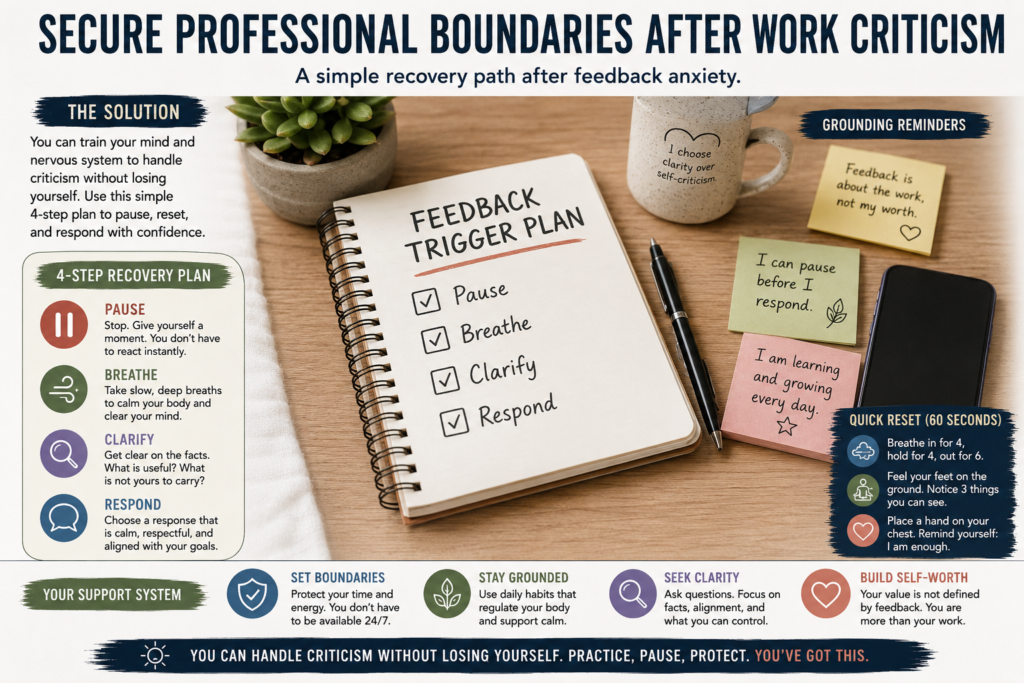
Try this sequence:
First, let the body settle before deciding what the feedback means.
Second, separate the task from your identity.
Third, ask for specifics instead of guessing.
Fourth, decide what is your responsibility and what is not.
Fifth, respond with clarity instead of panic.
A secure inner response may sound like:
“I can improve this work without attacking myself.”
“One correction does not erase my effort.”
“I can ask for clarity without being difficult.”
“I can care about my work and still protect my nervous system.”
“I do not have to earn safety through overworking.”
This is the deeper healing. You are not trying to become careless. You are trying to become less controlled by fear.
When you stop treating every correction as proof of unworthiness, feedback becomes easier to use.
For deeper healing, explore Brain Mastery → Confidence & Mindset, Relationship → Attachment & Connection, and Support → Emotional Healing Roadmap to understand how criticism, self-worth, attachment patterns, and emotional safety connect.
People Also Ask
1. Why do I take criticism personally at work?
You may take criticism personally at work because your nervous system may connect feedback with rejection, shame, failure, or loss of approval. When work becomes tied to self-worth, even small corrections can feel emotionally unsafe.
2. Why does feedback make me anxious?
Feedback can make you anxious when your brain reads it as a threat instead of information. If you already fear mistakes, rejection, or disappointing authority figures, feedback may trigger racing thoughts, body tension, overexplaining, or people pleasing at work.
3. How do I stop taking work feedback personally?
Start by separating the task from your identity. Feedback usually means something in the work needs adjustment, not that you are a failure. Pause, breathe, ask for specifics, and respond after your body feels more grounded.
4. Why do I feel scared of disappointing my boss?
Fear of disappointing your boss may come from pressure, perfectionism, past criticism, or older attachment patterns where approval felt connected to safety. A boss or manager can become an authority trigger, even when the current situation is professional.
5. Is people pleasing at work linked to anxiety?
Yes, people pleasing at work can be linked to anxiety when saying no feels unsafe. A person may overwork, reply instantly, avoid conflict, or accept too much responsibility to prevent rejection, criticism, or disappointment.
FAQ
1. Is taking criticism personally a weakness?
No. Taking criticism personally is not weakness. It usually means your mind and body are reacting strongly to perceived rejection, shame, or failure. With awareness and practice, you can learn to receive feedback without losing self-worth.
2. Can attachment style affect workplace behavior?
Yes. Attachment patterns can affect how people respond to feedback, authority, teamwork, deadlines, and conflict. Some people become anxious and approval-seeking, while others withdraw, avoid support, or become overly independent.
3. What is feedback anxiety at work?
Feedback anxiety at work is the fear, tension, overthinking, or emotional distress that appears before, during, or after receiving feedback. It may show up as panic, shame, defensiveness, people pleasing, or fear of being judged.
4. What are secure professional boundaries?
Secure professional boundaries are clear limits around time, workload, communication, and emotional energy. They help you stay responsible without overworking, overexplaining, saying yes automatically, or abandoning your needs.
5. When should I seek support for workplace anxiety?
Seek support if workplace anxiety is affecting sleep, health, confidence, relationships, or daily functioning. If the workplace includes harassment, threats, discrimination, humiliation, or unsafe conditions, consider appropriate HR, legal, workplace, or mental health support.
BBH Support Resource
Want a simple tool to practice this after work feedback?
Download the BBH Feedback Trigger & Secure Response Worksheet to reflect on your trigger, body reaction, hidden need, and safer words for the next conversation.
Email Request Note:
Email info@bioandbrainhealthinfo.com and write:
“Send me the Feedback Trigger Worksheet.”
Personal Note
My healing became easier when I stopped treating every correction as proof that I was not enough.
Sometimes the hardest part of feedback is not the feedback itself. It is the old story that wakes up inside the body. The story may say, “You failed,” “You are not safe,” “They will reject you,” or “You must prove yourself again.”
But one correction is not your whole identity. One mistake is not your entire value. One difficult conversation is not proof that you are unsafe.
If you have been asking why do I take criticism personally, the answer may not be that you are too sensitive. The answer may be that your body is asking for a safer way to process pressure, authority, and self-worth.
You can learn to receive feedback without collapsing into shame. You can grow without attacking yourself. You can respect your work without making your work the only proof of your value.
Conclusion
Taking criticism personally at work can feel confusing because the mind knows feedback is part of professional life, but the body may feel rejected, judged, or unsafe. This is why why do I take criticism personally is such an important question. It opens the door to understanding feedback anxiety at work, fear of criticism, attachment patterns, and people pleasing at work.
The goal is not to stop caring. The goal is to care without losing yourself.
Feedback can become information. Boundaries can become safety. Self-worth can become separate from performance. And with practice, one correction at work no longer has to become a full attack on who you are.
External References and Further Reading
- Harvard Business School Online
Title: How to Build Psychological Safety in the Workplace
URL: https://online.hbs.edu/blog/post/psychological-safety-in-the-workplace - PsychSafety
Title: Psychological Safety & Giving Feedback
URL: https://psychsafety.com/giving-feedback-with-psychological-safety/ - Verywell Mind
Title: How to Not Take Things Personally
URL: https://www.verywellmind.com/how-to-not-take-things-personally-6541892 - Cleveland Clinic
Title: Attachment Styles: Causes, What They Mean
URL: https://my.clevelandclinic.org/health/articles/25170-attachment-styles - PubMed
Title: Psychological Safety in Feedback: What Does It Look Like and How Can Educators Work With Learners to Foster It?
URL: https://pubmed.ncbi.nlm.nih.gov/32170881/