Free AI Panic Prompt When Your Body Feels Unsafe
AI Panic Support Prompt to Calm Your Body and Mind

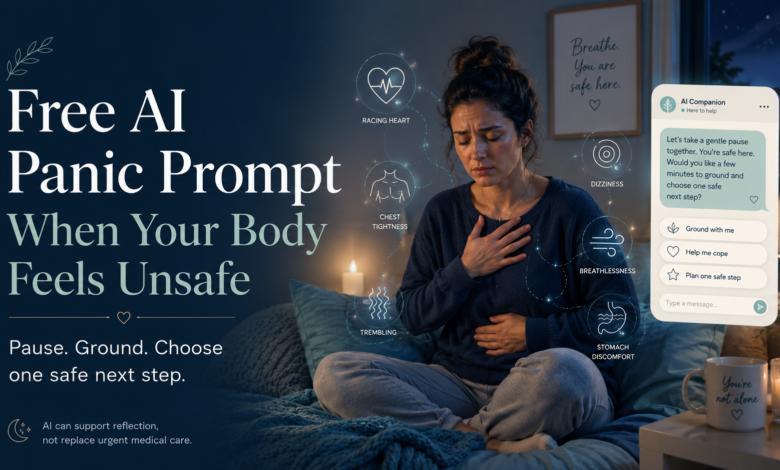
When panic takes over, your heartbeat may feel too fast, your breathing may feel difficult, and your mind may convince you that something terrible is about to happen.
Thank you for reading this post, don't forget to subscribe!This free AI prompt for panic attack support gives you one calm, structured tool to use when thinking clearly becomes difficult.
It also includes a ChatGPT prompt for panic attack, simple panic attack grounding techniques, and practical guidance on how to calm a panic attack without forcing yourself to solve everything immediately.
You will also learn how AI prompts for anxiety can help slow racing thoughts, separate fear from present facts, and guide you toward one safe next step.
This article explains what AI can support, what it cannot diagnose, when human or medical help is necessary, and how to protect your emotional safety during panic.
Free AI Panic Prompt When Your Body Feels Unsafe
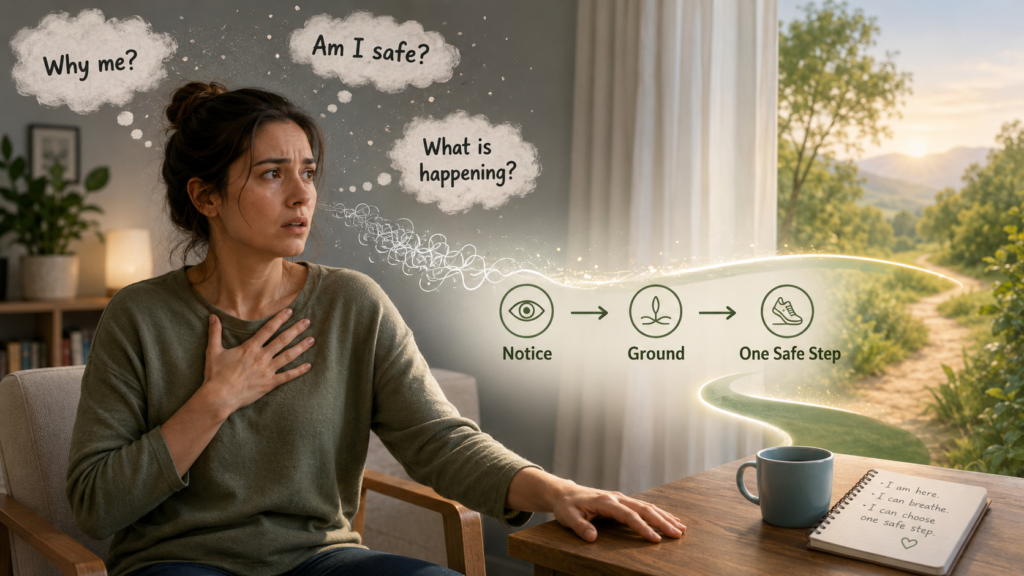
When panic enters the body, it does not politely wait for you to understand what is happening.
Your heartbeat may suddenly feel too forceful. Your chest may feel pressured. Breathing may no longer feel automatic, and you may start trying to control every breath. Within seconds, your attention can become fixed on one terrifying possibility:
What if I cannot breathe properly?
What if my heart cannot take this?
What if I die before anyone understands what is happening?
During panic, we can lose track of the room, the conversation, time, and even the knowledge that we have survived difficult moments before. The body becomes louder than logical thinking.
This free AI prompt for panic attack support is designed for that exact moment.
- It gives you a structured message to paste into an AI chatbot when you need short grounding instructions, not a long lecture.
- It also explains panic attack grounding techniques, how to use a ChatGPT prompt for panic attack safely, and how to calm a panic attack without pretending that AI can diagnose or treat you.
AI may help you organise the moment. It cannot confirm that your symptoms are medically harmless or replace human, medical, therapeutic, or emergency support.
What Is an AI Prompt for Panic Attack Support?
An AI prompt for panic attack support is a prepared instruction that tells an AI chatbot how to respond when you feel panicked, frightened, or mentally overwhelmed.
Without a prepared prompt, you may open a chatbot and type:
- “What is happening to me?”
- “Am I dying?”
- “Is my heart okay?”
- “Why can’t I breathe?”
- “Please tell me I am safe.”
These questions are understandable. But repeatedly asking an AI to guarantee that you are medically safe can strengthen reassurance-seeking without giving you a reliable medical assessment.
A safer prompt asks AI to do something more limited and practical:
- respond in short sentences;
- ask only one question at a time;
- guide present-moment orientation;
- help you notice physical support;
- distinguish a feared outcome from a current fact;
- encourage appropriate human or medical help;
- avoid diagnosis and false reassurance.
The purpose is not to make AI responsible for your safety. The purpose is to reduce mental overload so you can identify the next responsible action.
The Clear SERP Answer
Yes, AI may provide structured emotional and grounding support during a panic spiral. A ChatGPT prompt for panic attack support can guide you through one step at a time, but it cannot diagnose panic, rule out a physical health condition, provide emergency supervision, or replace a qualified professional.
Read Also: “simple grounding technique for panic”
Free Copy-and-Paste AI Prompt for Panic Attack Support
Copy and save this prompt somewhere easy to reach:
I may be experiencing panic or intense anxiety. Please speak to me calmly and use short sentences because I may struggle to read or think clearly.
Do not diagnose me, guarantee that I am safe, or tell me that my symptoms are definitely caused by anxiety.
First, briefly remind me that new, severe, unusual, or medically concerning symptoms may require urgent medical assessment.
Then help me one step at a time:
- Ask me to identify where I am.
- Ask me to name three neutral things I can see.
- Ask me where my body is supported by the chair, bed, floor, or wall.
- Help me return to comfortable breathing without forcing a very deep breath.
- Ask what frightening thought is making the panic stronger.
- Help me separate what I fear may happen from what I can confirm right now.
- Ask whether I am alone and whether I can contact a trusted person.
- Help me choose one small and safe next step.
Give me only one instruction at a time. Do not give me a long list unless I ask for it.
If I mention severe chest pain, fainting, major breathing difficulty, confusion, sudden weakness, a medical emergency, self-harm, harm to another person, or an inability to stay safe, tell me to contact local emergency services or immediate human support.
You may also add:
I do not need to solve the full situation right now. Help me focus only on the next five minutes.
This AI prompt for panic attack support should be prepared while you are relatively calm. During panic, even typing a clear request may feel difficult.
How to Use a ChatGPT Prompt for Panic Attack Support
Save the prompt in a private note, email draft, printed card, or phone shortcut. Give it a clear name such as:
“Use This When Panic Makes Thinking Difficult.”
When panic begins:
- Check whether your symptoms are new, severe, unusual, or medically concerning.
- Seek urgent medical help when necessary.
- Open your saved prompt.
- Paste it into the AI chatbot.
- Ask for one instruction at a time.
- Contact a trusted human when you need presence or practical assistance.
- Stop using the chatbot if it increases fear, repeated checking, or confusion.
A ChatGPT prompt for panic attack support is most useful when it helps you move toward grounding, appropriate assessment, human connection, or a previously agreed care plan.
It is not useful when it keeps you trapped in a loop of asking:
“Are you sure I am safe?”
“Can you guarantee this is anxiety?”
“Tell me again that nothing bad will happen.”
AI cannot provide that certainty responsibly.
YMYL safety note: AI support may help you organise your thoughts and practise grounding, but it cannot diagnose your symptoms or replace emergency care, medical assessment, or treatment from a qualified professional.
When Panic Makes the Body Feel Like the Emergency
Panic is not experienced only as a thought.
It can feel like an emergency inside the chest, breath, stomach, muscles, and mind. The heartbeat may become so noticeable that all attention moves toward it. Breathing may feel restricted or unnatural. You may try to take bigger and bigger breaths, but this effort can make you feel more frightened.
The mind then searches for an explanation:
Why is this happening to me?
Why can I not control my own body?
What if this time is different?
Panic may include a racing heartbeat, shortness of breath, dizziness, trembling, sweating, chest discomfort, nausea, feelings of unreality, fear of losing control, or fear of dying. However, similar symptoms may occur with physical health conditions. An online article or chatbot cannot determine their cause.
That is why the first responsibility is not to label everything as panic. It is to take new, serious, unusual, or concerning symptoms seriously.
Once urgent medical concerns have been properly considered, understanding the panic cycle may help reduce the additional fear created by interpreting every sensation as proof of immediate catastrophe.
How the Nervous System Builds a Panic Spiral
The nervous system is designed to detect and respond to possible danger.
When the brain perceives a threat, the body may prepare to fight, flee, freeze, protect itself, or seek help. The heartbeat may accelerate. Muscles may tense. Breathing may change. Attention may narrow.
This response is useful during real danger. But it can also activate in response to emotional conflict, frightening thoughts, memories, uncertainty, unfamiliar physical sensations, exhaustion, or accumulated stress.
The original sensation may then receive a catastrophic meaning:
Sensation: “My heart is beating hard.”
Interpretation: “My heart may stop.”
Body response: More fear and adrenaline.
Attention: Continuous heartbeat monitoring.
Result: The heartbeat feels even more intense.
This is how a physical sensation, frightening interpretation, and heightened attention can reinforce one another.
The aim of grounding is not to fight the nervous system. It is to give the brain additional information:
I am here.
The floor is supporting me.
I can see the room.
I can contact someone.
I can choose one action.
The Panic Feedback Cycle and Its Interruption Point
How Panic Can Become Stronger
Body sensation, emotional conflict, or frightening thought
↓
The brain reads danger
↓
Heartbeat, breathing, tension, or dizziness increases
↓
Attention becomes fixed on the symptoms
↓
The mind predicts a catastrophe
↓
The nervous system receives another danger message
↓
Panic intensifies
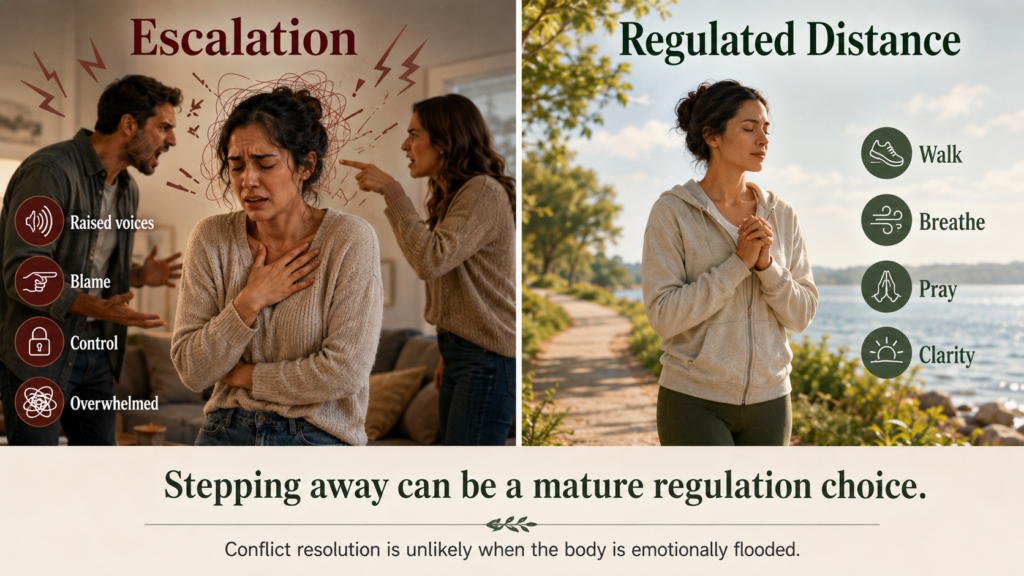
How the Cycle May Be Interrupted
Notice what is happening → Check for urgent medical or safety concerns → Orient to the present environment → Feel physical support beneath the body → Allow breathing to become comfortable → Separate fear from a confirmed present fact → Choose one safe action
These panic attack grounding techniques are not a guarantee that symptoms will disappear immediately. Their purpose is to reduce the extra layers of fear, confusion, and mental pressure surrounding the sensations.
When Relationship Conflict Triggers Panic
Not every panic episode appears without context.
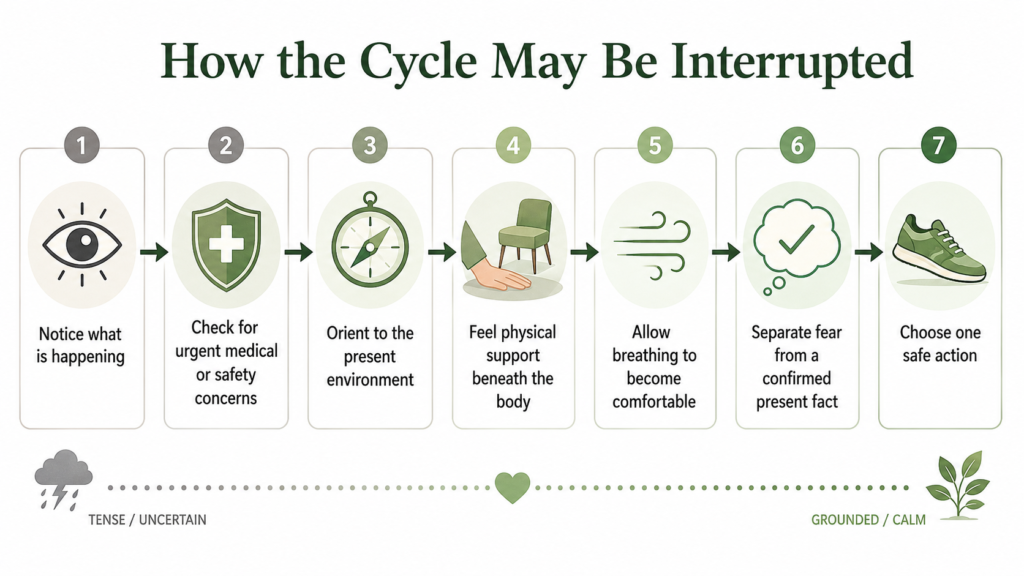
Sometimes panic begins during an argument where voices rise, blame replaces understanding, and the same conflict repeats without resolution.
You may enter the conversation wanting one thing:
Can we stop fighting and understand why this situation feels wrong?
Can we handle it peacefully?
Can we act with maturity?
But when the other person continues raising their voice, blaming, controlling, or refusing to understand, your body may stop experiencing the conversation as a discussion. It may begin experiencing it as danger.
The heartbeat becomes forceful. Breathing becomes difficult. Thoughts lose sequence. You may no longer be trying to resolve the original problem. You may simply be trying to survive the emotional intensity.
This is where panic and relationship vulnerability can meet.
A person may remain in the argument because they believe:
- “I must make them understand.”
- “I cannot leave without a solution.”
- “If I stop now, the relationship may end.”
- “If I explain myself one more time, they may finally listen.”
- “I am responsible for making this right.”
But a nervous system in acute overload may not be capable of mature communication. Remaining in the conflict can increase panic, defensive reactions, shouting, crying, freezing, or saying things that do not reflect your deeper values.
A Real Human Experience from Inside Panic
During panic, my attention can become completely fixed on my breathing and heartbeat. The pressure feels so strong that I fear I cannot breathe properly and may die. I lose track of everything around me.
When panic follows relationship conflict, my first question is often, “Why me?” I do not understand why people cannot stop, discuss the situation maturely, and try to find a peaceful solution.
But I have learned something difficult: if the argument is hurting my body, emotions, and peace—and no solution is coming—continuing the fight may not be wisdom.
Sometimes I need to stop and leave the situation until I can return with my presence fully restored.
“My panic did not reduce because the conflict was solved immediately. It reduced when I stopped forcing a solution and accepted that everything did not need to be resolved in that moment.”
That is not emotional failure. It is nervous-system responsibility.
Attachment, Control and the Need for Immediate Resolution
For some people, unresolved conflict feels emotionally dangerous.
Silence, distance, blame, or misunderstanding may activate fears such as:
- “I am no longer important.”
- “The relationship is ending.”
- “I will be abandoned without closure.”
- “I must fix this before it becomes worse.”
- “I cannot rest until the other person understands me.”
This urgency may come from attachment insecurity, past emotional unpredictability, trauma, repeated invalidation, or previous experiences in which conflict led to loss, rejection, punishment, or prolonged silence.
However, attachment language should not be used to excuse harmful behaviour.
A person’s fear of abandonment does not justify controlling another person. Emotional pain does not make humiliation, coercion, threats, intimidation, or repeated aggression acceptable.
Self-awareness means recognising both sides:
My nervous system may be highly sensitive to unresolved conflict.
And:
I am still allowed to protect myself from communication that becomes unsafe, degrading, or controlling.
The solution is not always to remain and regulate inside the same environment. Sometimes emotional safety requires distance, support, boundaries, or professional help.
How to Calm a Panic Attack Without Forcing Yourself
When people ask how to calm a panic attack, they often expect one instant method.
But panic does not always respond to force.
Trying too hard to eliminate every sensation may communicate another threat to the nervous system:
This feeling must stop immediately because it is dangerous.
A gentler goal is:
I will not demand complete calm. I will help my body carry this moment safely.
Step 1: Stop Solving the Entire Situation
Say:“I do not need to resolve this relationship, health fear, decision, or future in the next five minutes.”
Your problem may still matter. But panic is usually not the best state for solving it.
Step 2: Check Safety and Medical Urgency
Ask:
- Are these symptoms new?
- Are they unusually severe?
- Is there serious chest pain, fainting, major breathing difficulty, confusion, sudden weakness, or another possible emergency?
- Am I safe in this environment?
- Do I need another person or emergency support?
Seek appropriate help rather than using grounding to dismiss danger.
Step 3: Orient Before Analysing
Name:
- where you are;
- today’s date;
- three neutral objects;
- two sounds;
- one point where your body is supported.
This is one of the simplest panic attack grounding techniques because it gives attention a task outside the internal alarm.
Step 4: Stop Forcing Huge Breaths
“Take a deep breath” may not help everyone during panic.
If forced breathing makes you more uncomfortable, allow the breath to be smaller and easier. Let the exhale soften naturally. Do not turn breathing into another test you must perform perfectly.
Step 5: Name the Fear
Complete this sentence: “The frightening outcome my mind is predicting is…”
Then complete: “What I can confirm in this moment is…”
For example:
Fear: “I will completely lose control.”
Present fact: “I am frightened, but I am still able to read, orient, and contact support.”
Step 6: Choose One Action
Not seven actions. One.
You may:
- sit somewhere supported;
- step away from the argument;
- contact a trusted person;
- walk slowly in a safe place;
- pray;
- follow a clinician-approved plan;
- seek medical assessment;
- rest when appropriate.
This is how to calm a panic attack without demanding that the body become peaceful before you act.
A Practical Panic Support Table
| What you notice | What may be happening | One grounded response |
|---|---|---|
| Your heartbeat feels dangerously strong | Fear may be increasing attention to the heartbeat | Check urgent symptoms, then feel your feet and name three objects |
| Breathing feels difficult or unnatural | Panic may change the breathing pattern | Stop forcing large breaths and return to comfortable breathing |
| You keep thinking you may die | The mind may be catastrophising body sensations | Seek medical help when needed; otherwise separate fear from confirmed facts |
| You cannot follow long advice | Cognitive capacity may be narrowed by alarm | Ask AI for one sentence and one action |
| Raised voices increase symptoms | The environment may feel emotionally unsafe | Step away when possible and regulate before continuing |
| You keep trying to solve the fight | Urgency may be maintaining activation | Delay the conversation until both people are calmer |
| You feel alone and vulnerable | Panic may increase the need for presence | Contact a trusted person |
| Symptoms are new or severe | A medical cause cannot be excluded online | Seek urgent assessment |
| Episodes keep returning | A wider care plan may be needed | Speak with a qualified health professional |
This table is educational, not diagnostic.
What Helped Me Recover Faster
My panic did not disappear because someone suddenly gave me the perfect explanation.
Recovery began when I stopped demanding an immediate resolution.
Crying helped release some of the emotional pressure. Walking helped my body move out of the frozen argument. Slowing my breathing helped when it was done gently rather than forcefully. Prayer reminded me that the conflict was not the whole of my life. Talking to AI helped organise thoughts without requiring me to explain everything perfectly. Sleep gave my body time to reduce its activation.
The most important shift was this:
I did not have to solve everything immediately.
This is why AI prompts for anxiety can sometimes be helpful. A structured prompt can interrupt the urgency and return the person to one question:
What is my next safe step?
You can explore more structured prompts in BBH’s guide to 25 Free AI ChatGPT Prompts for Anxiety.
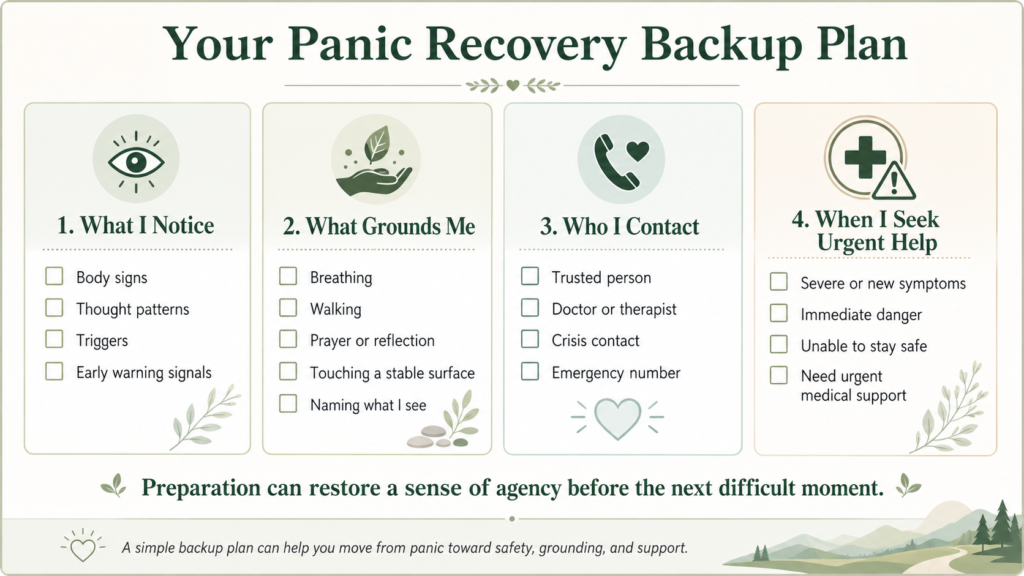
Panic Recovery Backup Plan
Prepare this before your next difficult moment.
My Early Warning Signs
Write down signs such as:
- pressure in the chest;
- monitoring the breath;
- repeating “Why me?”;
- needing immediate answers;
- feeling unable to leave the argument;
- crying, shouting, shaking, or freezing;
- losing track of what the conflict was originally about.
My First Three Actions
Choose only three:
- Step away from escalation.
- Orient to the environment.
- Contact a trusted person or use the saved prompt.
My Recovery Options
Your plan may include:
- crying privately and safely;
- walking;
- comfortable breathing;
- prayer or mantra;
- speaking to AI;
- calling someone;
- using prescribed medication only as directed;
- sleeping after immediate safety needs are addressed;
- contacting a clinician.
My Emergency Plan
Record:
- local emergency number;
- crisis-support contact;
- doctor or therapist details;
- trusted person;
- nearest appropriate medical facility;
- what symptoms require urgent help.
A backup plan does not mean you expect panic to control you. It means you are reducing decision-making when the body is under pressure.
AI Prompts for Anxiety: Useful Tool or Reassurance Loop?
AI prompts for anxiety can support reflection when they help you:
- describe what is happening;
- organise racing thoughts;
- identify a trigger;
- separate facts from predictions;
- choose a practical action;
- prepare questions for a doctor or therapist;
- recognise when human support is needed.
They become less helpful when you use them to:
- demand certainty about the future;
- repeatedly confirm that symptoms are harmless;
- analyse the same conversation for hours;
- replace medical assessment;
- avoid setting a necessary boundary;
- postpone contacting a real person;
- rely on AI as your only emotional relationship.
The aim is not endless conversation. The aim is clearer action.
For broader guidance on safe AI use, read Free AI Mental Health Tools for Emotional Support.
You can also learn how to distinguish anxious predictions from evidence with the Free AI Fact vs Fear Tool.
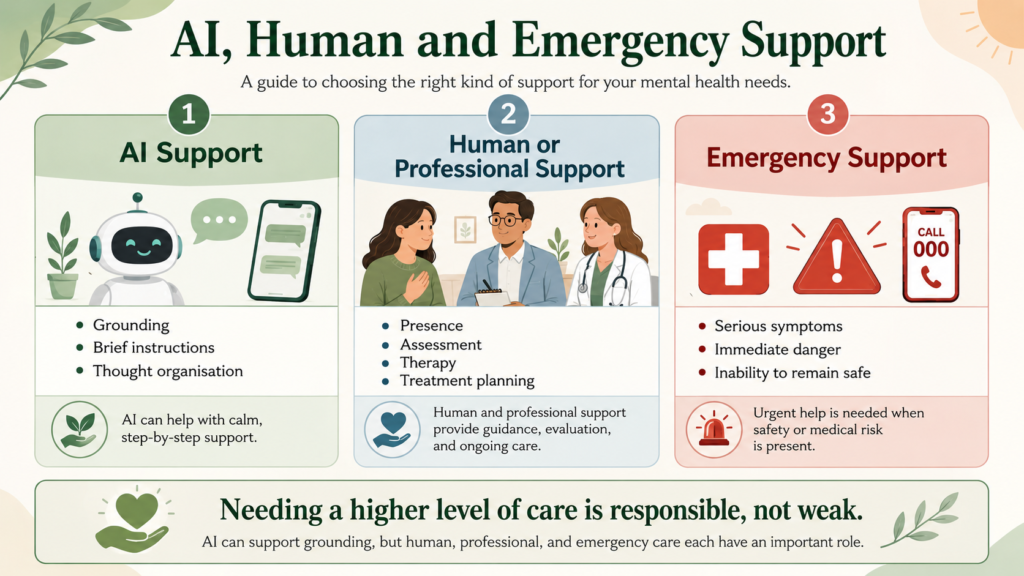
What AI Can and Cannot Do During Panic
| AI may support | AI cannot provide |
|---|---|
| One-step grounding | Physical examination |
| Short calming language | A medical diagnosis |
| Thought organisation | Confirmation that symptoms are harmless |
| Fear-versus-fact reflection | Emergency monitoring |
| A draft panic plan | Therapy or psychiatric treatment |
| Preparation for a professional conversation | Guaranteed confidentiality |
| A reminder to contact help | Physical protection from another person |
A responsible AI prompt for panic attack support keeps these boundaries visible.
AI should be a bridge toward awareness and action, not a replacement for human responsibility.
Privacy When Using a ChatGPT Prompt for Panic Attack Support
You do not need to reveal your full identity or history to receive basic grounding guidance.
Avoid sharing unnecessary information such as:
- your full legal name;
- home address;
- passwords;
- banking details;
- government identification;
- private workplace records;
- another person’s confidential information;
- detailed medical documents unless you understand the platform’s privacy conditions.
You may simply write:
“I am experiencing intense anxiety and need one grounding step.”
Read the platform’s privacy terms. Do not assume an AI conversation has the same confidentiality protections as communication with a licensed professional.
For a deeper explanation of AI’s benefits and limits, visit AI Therapy for Mental Health: Complete Guide.
Krishna’s Guidance: Act Without Forcing the Outcome
During conflict, the mind may believe:
I must make this person understand.
I must receive a solution now.
I cannot leave until the situation ends correctly.
But peace cannot always be forced from another person.
In Bhagavad Gita 2.47, Krishna teaches that we have responsibility for our actions, but not ownership over every result. In Gita 2.48, he teaches balanced action—acting with steadiness rather than attachment to success or failure.
For this situation, the teaching is not that we should run from every difficulty. It is that wise action does not require us to remain attached to controlling the outcome.
- You may have a duty to speak honestly.
- You may need to set a boundary.
- You may need to leave an escalating argument.
- You may need to return later.
- You may need to accept that another person is not currently willing to communicate with maturity.
Stepping away is not automatically cowardice. Sometimes it is the action that prevents panic, aggression, or emotional harm from becoming worse.
“If a conflict is breaking my breath, peace, and balance, I do not have to solve it in panic. Krishna teaches action with steadiness, not attachment to a chaotic outcome.”
Self-respect means remembering that you are not responsible for making every situation happen according to your hope.
Where there is no love, mutual respect, care, or willingness to understand, continuing the same fight may not create repair.
Your karma is your conscious action. The other person’s response remains their responsibility.
When Stepping Away Is Regulation—and When It Becomes Avoidance
Stepping away can be healthy when you clearly communicate:
- “I cannot continue while voices are raised.”
- “I need time to regulate.”
- “I will revisit this when we are both calmer.”
- “I want a solution, but I will not continue through blame or control.”
Avoidance is different. It may involve repeatedly refusing every necessary conversation, disappearing without explanation, punishing through silence, or never returning to address important responsibilities.
The distinction is intention and follow-through.
Regulated distance says:
“I want to handle this responsibly, so I need to regain balance.”
Avoidance says:
“I will never face this because discomfort is unacceptable.”
However, when abuse, intimidation, coercion, threats, or genuine danger is present, you do not owe the other person another private discussion. Safety planning and qualified support become more important than relationship repair.
Explore more support through Mental Health, Anxiety and Overthinking, AI & CBT Tools, Brain Health, and Nervous System Regulation for practical guidance on panic, grounding, emotional safety, and nervous-system recovery.
When AI Is Not Enough
Do not rely on an AI chatbot when:
- symptoms are new, severe, or medically concerning;
- you have serious chest pain or pressure;
- you faint or feel close to fainting;
- breathing difficulty is significant;
- there is confusion or sudden weakness;
- you may harm yourself or someone else;
- you cannot remain safe alone;
- another person is threatening or physically harming you;
- you need medication advice or a diagnosis;
- panic episodes repeatedly disrupt daily life.
Contact local emergency services, a crisis service, a doctor, or another qualified professional according to the situation.
For recurring panic attacks, fear of future attacks, avoidance, or major disruption to work, relationships, sleep, or daily functioning, professional assessment is important. Evidence-based treatment may include psychotherapy, medication, or both, depending on clinical needs.
BBH Support Resource
Want a Simple Tool to Keep Ready?
Download the BBH AI Panic Support Prompt and Grounding Card PDF.
The resource can include:
- the full copy-and-paste prompt;
- a one-instruction-at-a-time version;
- a fear-versus-present-fact exercise;
- a panic feedback-cycle chart;
- three grounding steps;
- a trusted-contact space;
- medical and emergency reminders;
- space for clinician-approved instructions;
- a personal prayer or steadying sentence.
Download the PDF:
BBH_Panic_Recovery_Backup_Plan_Worksheet
Until the direct download is ready, readers may request it by email.
Email: info@bioandbrainhealthinfo.com
Subject: Send Me the BBH AI Panic Support Prompt
Future BBH Anxiety Workbook
This free tool supports one intense moment. The upcoming BBH Anxiety Workbook will explore anxiety patterns, triggers, body reactions, reassurance loops, relationship anxiety, health anxiety, grounding plans, and structured AI reflection in greater depth.
Amazon purchase link:
[ADD AMAZON LINK AFTER PUBLICATION]
Keep this book mention brief. The reader should receive genuine value before seeing a purchase invitation.
People Also Ask
Can AI help during a panic attack?
AI may provide short grounding instructions, organise racing thoughts, and remind you to contact appropriate support. However, it cannot diagnose panic, rule out a medical condition, monitor your physical safety, or replace emergency and professional care.
What should I type into ChatGPT during a panic attack?
You can type: “I feel panicked. Use short sentences, give me only one grounding step at a time, do not diagnose me, and remind me to seek urgent care for new or severe symptoms.” The full prompt above gives the chatbot clearer safety boundaries.
How can I calm a panic attack quickly?
There is no single method that works instantly for everyone. Helpful steps may include checking urgent safety needs, orienting to the room, feeling physical support, using comfortable breathing, reducing catastrophic interpretations, and contacting someone you trust.
What are effective panic attack grounding techniques?
Common grounding methods include naming visible objects, noticing sounds, feeling your feet or chair, stating where you are, and separating feared outcomes from present facts. Grounding should not be used to dismiss serious or unfamiliar physical symptoms.
Can ChatGPT diagnose a panic attack?
No. ChatGPT cannot examine you, assess vital signs, exclude medical causes, or provide a clinical diagnosis. New, severe, unusual, or concerning symptoms require appropriate medical assessment.
Frequently Asked Questions
Is this AI prompt for panic attack support free?
Yes. You may copy and save the BBH prompt without paying BBH. The AI platform you use may have separate free or paid service conditions.
Can I save the prompt on my phone?
Yes. Store it in a private note, bookmark, screenshot, or shortcut so you do not have to recreate it while distressed.
Can this prompt replace a therapist or doctor?
No. It is a grounding and communication tool, not medical advice, diagnosis, psychotherapy, psychiatric care, or emergency support.
Can I use the prompt during relationship conflict?
You may use it to slow down and identify one safe action. However, AI cannot make another person communicate respectfully or protect you from abuse, coercion, threats, or violence.
Can I use the prompt to support someone else?
Yes, as a calm structure, but do not assume the person is experiencing “only panic.” Encourage appropriate human and medical help, especially when symptoms or safety concerns are serious.
Personal Note
Panic taught me that my body cannot carry every fight simply because my mind wants a solution.
I once believed I had to remain in the situation until the other person understood me. I wanted the fighting to stop. I wanted both of us to ask why the situation felt wrong and whether we could handle it peacefully.
But raised voices, blame, repeated arguments, misunderstanding, and control did not create maturity. They made my body more vulnerable.
I learned to ask:
Can my body take this right now?
Some conflicts matter. Some conversations must eventually happen. But after losing balance, peace must become part of recovery.
My backup plan is not one perfect technique. It may include crying, walking, comfortable breathing, prayer, speaking to AI, sleeping, asking for support, or accepting that the problem does not need to be solved immediately.
The deepest change came when I stopped believing that stepping away meant I had failed.
“My mind was not trying to destroy me. It was urgently searching for safety, understanding, and a solution. But I learned that I do not have to sacrifice my body and peace to force an outcome.”
An AI prompt for panic attack support cannot create safety on its own. But it may help you pause long enough to recognise what your body needs, what responsibility belongs to you, and what must be placed back into the hands of another person, a professional, or time.
Action does not require emotional permission.
You can choose the next safe step before you feel completely ready.
Related BBH Resources
Learn to organise racing thoughts with 25 Free AI ChatGPT Prompts for Anxiety.
Separate anxious predictions from current evidence with the Free AI Fact vs Fear Tool.
Explore simple present-moment methods in Grounding for Anxiety.
Understand the safe role of digital support through Free AI Mental Health Tools for Emotional Support.
Read the broader guide to AI Therapy for Mental Health.
External References
National Institute of Mental Health — Panic Disorder: What You Need to Know
https://www.nimh.nih.gov/health/publications/panic-disorder-when-fear-overwhelms
NHS — Panic Disorder
https://www.nhs.uk/mental-health/conditions/panic-disorder/
NHS — Get Help With Anxiety, Fear or Panic
https://www.nhs.uk/mental-health/feelings-symptoms-behaviours/feelings-and-symptoms/anxiety-fear-panic/
Mayo Clinic — Panic Attacks and Panic Disorder: Symptoms and Causes
https://www.mayoclinic.org/diseases-conditions/panic-attacks/symptoms-causes/syc-20376021
Mayo Clinic — Panic Attacks and Panic Disorder: Diagnosis and Treatment
https://www.mayoclinic.org/diseases-conditions/panic-attacks/diagnosis-treatment/drc-20376027
Bhagavad Gita — Chapter 2, Verses 47–48
Use the translation approved for your website’s spiritual-reference standard.
Medical and Mental-Health Disclaimer
This article provides general education and self-reflection only. It does not offer medical advice, diagnosis, psychotherapy, emergency assessment, or treatment. Symptoms associated with panic can overlap with physical health conditions. Seek qualified medical care for new, severe, persistent, unusual, or concerning symptoms.