Free AI Fact vs Fear Tool: Calm Your Anxious Mind!
When Fear Feels Real: Separate Facts From Anxiety!

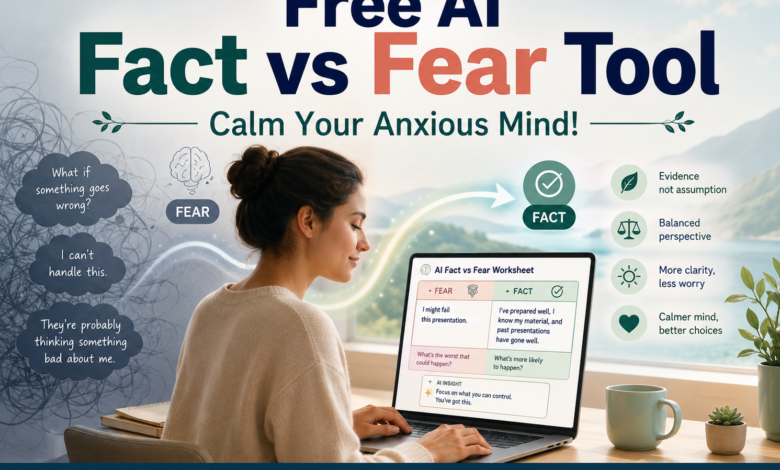
The free AI Fact vs Fear Tool helps you separate confirmed facts from anxious predictions when fear feels more convincing than the evidence. A delayed reply, unfamiliar body sensation, work meeting, or unexpected bill can quickly trigger overthinking and make uncertainty feel like danger.
Thank you for reading this post, don't forget to subscribe!This practical guide explains how to challenge anxious thoughts, use a fact vs fear worksheet, and separate facts from anxious thoughts without dismissing genuine emotions or safety concerns.
You will also learn why nervous-system alarm can intensify fearful conclusions, how attachment experiences shape assumptions, and how reassurance-seeking anxiety can create a repeated checking cycle.
The tool includes a copy-and-paste AI prompt, real-life examples, safety guidance, and one grounded next step for responding with greater clarity rather than immediate fear.
Read Also : “turn anxious thoughts into one weekly action”
Free AI Fact vs Fear Tool: Separate Facts From Anxious Thoughts
This educational article combines lived insight with information from recognised health organisations. It does not provide a diagnosis, medical advice, crisis care or a replacement for qualified professional support.
The free AI Fact vs Fear Tool helps you separate facts from anxious thoughts when fear feels more convincing than the evidence in front of you. A delayed reply, unfamiliar body sensation, unexpected bill or unexplained meeting can quickly trigger overthinking.
This guide explains how to challenge anxious thoughts, complete a fact vs fear worksheet, recognise reassurance-seeking anxiety and choose one grounded next step without dismissing genuine emotions or safety concerns.
You will also learn how nervous-system alarm and attachment experiences can strengthen fearful assumptions.
The article includes a copy-and-paste AI prompt, real-life examples, practical tables, safety boundaries and a downloadable worksheet designed to help you distinguish confirmed facts from anxious predictions before fear writes the entire story.
A message arrives that simply says: “Can we talk?”
You do not yet know what the conversation is about, but your chest tightens.
Your mind begins searching for explanations. Perhaps you have made a mistake. Perhaps the other person is angry. Perhaps something painful is about to happen.
Or maybe someone important has not replied for several hours.
- You look at the unanswered message and feel a familiar heaviness. Silence begins to feel like rejection.
- You reread your last words, searching for evidence that you said something wrong.
- You check whether the person is online.
- You promise yourself that you will stop checking, but a few minutes later your hand reaches for the phone again.
Sometimes the trigger comes from inside the body. You notice an unfamiliar sensation in your chest, stomach or head, and your mind immediately moves toward the most frightening explanation.
Sometimes it happens at work. A manager schedules a meeting but does not explain why. Before the meeting has even started, your nervous system prepares for criticism, humiliation or job loss.
Nothing has been confirmed.
Yet inside the body, the feared outcome can already feel real.
This is not because you are weak or deliberately negative. Fear is designed to attract attention. When the nervous system senses possible danger, it may treat uncertainty as something that must be solved immediately.
“I have learned that a feeling can be completely real without every conclusion created by that feeling being true.” — Shubhangi Halande
Sometimes we investigate the same fear repeatedly, not because new facts have appeared, but because the first answer has stopped making us feel safe.
The purpose of this article is not to tell you that every fear is irrational.
It is to help you listen to fear without allowing it to decide every fact.
What Is a Free AI Fact vs Fear Tool?
A free AI Fact vs Fear Tool is a structured reflection exercise that helps organise an anxious situation into five parts:
- confirmed facts,
- fears or predictions,
- assumptions,
- unknown information, and
- one grounded next step.
You begin by describing what actually happened. You then write what you fear the event may mean. An AI assistant can help separate those layers and organise your words more clearly.
The tool is not a truth detector.
It cannot see the full situation, read another person’s intentions, diagnose a physical symptom or determine whether you are safe. It only works with the information entered, and its response can be incomplete or incorrect.
Its most useful role is to help you ask clearer questions:
- What has actually been confirmed?
- What am I predicting?
- What conclusion am I reaching without enough information?
- What is still unknown?
- Does this situation require action, communication, waiting or human support?
This method may reduce confusion because anxious thinking often combines facts, memories, emotions and possible outcomes into one convincing internal story.
The emotion is real.
The story built around the emotion may still need evidence.
Readers exploring digital emotional-support tools can also visit the BBH AI & CBT learning hub, which explains how AI-assisted reflection and cognitive behavioural ideas can be used without treating technology as a replacement for therapy.
How to Separate Facts From Anxious Thoughts
To separate facts from anxious thoughts, divide the situation into five clear categories.
1. Fact
A fact is information that can presently be observed, verified or supported by reliable evidence.
For example: “I sent a message four hours ago and have not received a reply.”
2. Fear
A fear is an outcome you worry may happen.
For example: “I am afraid this person is losing interest in me.”
3. Assumption
An assumption is a conclusion made without enough confirming information.
For example: “Their silence means that I am being rejected.”
4. Unknown
An unknown is information you do not yet have.
For example: “I do not know why they have not replied or what they are currently doing.”
5. Grounded next step
A grounded next step is a practical response based on the available information rather than the most frightening imagined outcome.
For example: “I will step away from the phone for one hour, continue my planned activity and send one calm message later if communication is still needed.”
This process is not positive thinking.
You are not replacing a frightening possibility with a cheerful but unsupported story.
You are creating a more accurate picture of what is known, what is feared and what still requires information.
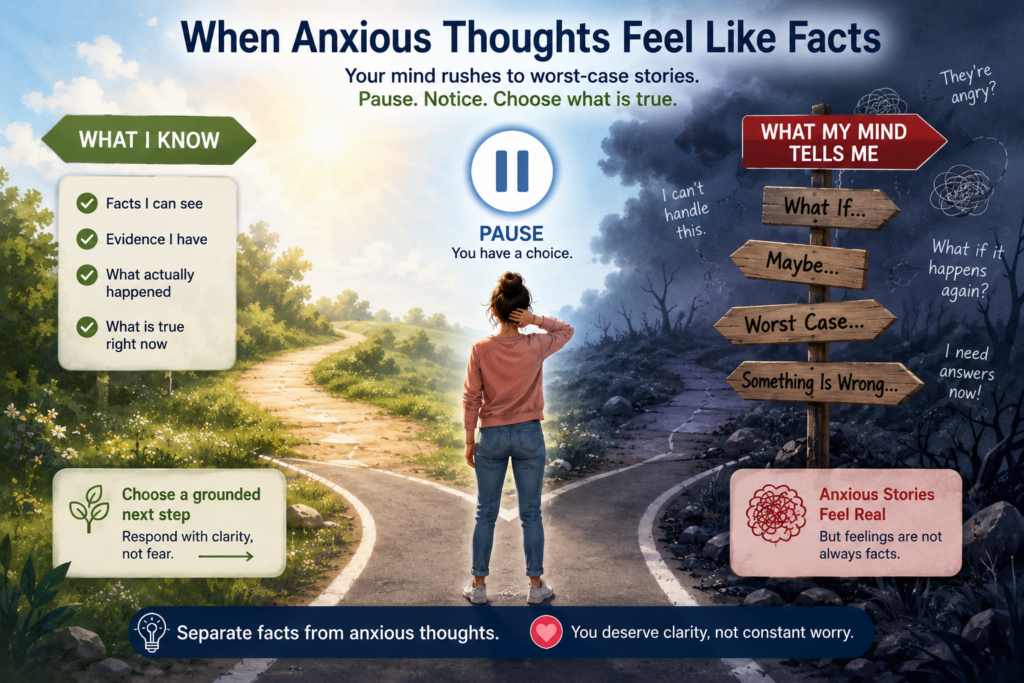
Why Anxious Thoughts Can Feel Like Facts
Anxious thoughts do not arrive only as sentences in the mind.
They can arrive with a full-body reaction:
- pressure or tightness in the chest,
- a faster heartbeat,
- a sinking feeling in the stomach,
- shallow breathing,
- tense muscles,
- restlessness,
- difficulty concentrating,
- an urgent need to check, explain, escape or act.
When the nervous system detects a possible threat, attention may narrow around danger. Neutral details can suddenly feel important. Missing information can feel unsafe. The mind may search for an explanation quickly because not knowing feels intolerable.
This can create emotional reasoning: “I feel frightened, so the danger must already be real.”
The body reaction is real. The emotional distress is real. But the interpretation attached to that distress may still be incomplete.
The nervous system can respond to a perceived threat before you have examined all the evidence. It may also respond to patterns learned from previous experiences.
- A delayed reply today may activate the memory of being ignored in the past.
- An unexpected meeting may activate earlier experiences of harsh criticism.
- A physical sensation may activate memories of illness, panic or loss.
- The body does not always wait for proof before preparing to protect you.
That does not mean physical symptoms should be ignored or automatically labelled anxiety. New, severe, persistent or concerning symptoms may need professional medical assessment.
It means only that body alarm and factual certainty are not the same thing.
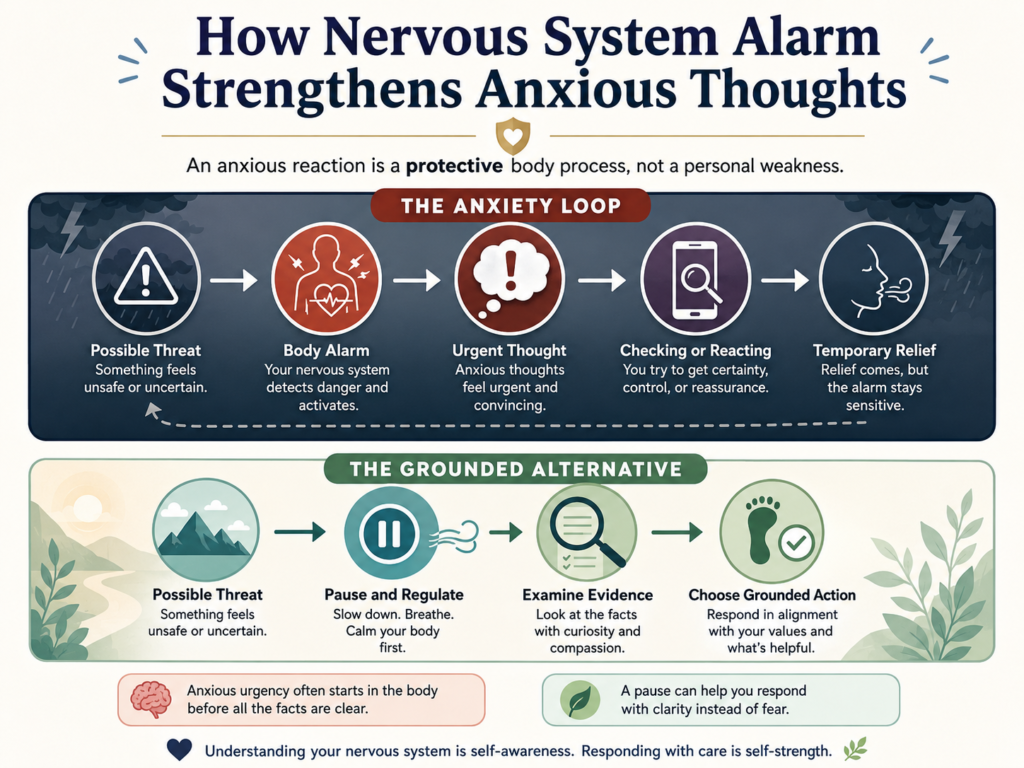
How the Nervous System Strengthens Fear-Based Thoughts
Imagine hearing a sudden sound in the middle of the night.
Before you know what caused it, your body may become alert. Your muscles tighten. Your hearing sharpens. You may hold your breath.
The body prepares before the full situation is known.
A similar pattern may occur with emotional threats.
A change in tone, delayed reply, unexpected expense or uncertain future can activate the need to identify danger quickly.
The mind begins generating explanations:
- “Something is wrong.”
- “They are angry.”
- “I am going to fail.”
- “I cannot cope with this.”
- “This feeling must mean something terrible.”
Once the body is activated, frightening explanations may seem more believable because they match the physical state.
The body feels alarmed, and the mind creates an alarming story.
The story then strengthens the body alarm.
The pattern can become:
Uncertainty → body alarm → fearful interpretation → stronger alarm → checking or reassurance-seeking
The first step is not always to argue with the thought.
Sometimes the first step is to reduce immediate physical activation so the situation can be evaluated more fairly.
You may try:
- placing both feet on the floor,
- relaxing the jaw and shoulders,
- making the exhale slightly longer,
- naming five things you can see,
- placing the phone out of reach temporarily,
- drinking water slowly,
- returning to one familiar task.
Regulation does not prove that a situation is safe.
It creates enough internal space to examine the facts without allowing urgency to make every decision.
When Attachment Fears Shape Anxious Assumptions
Not every anxious interpretation begins in the current moment.
Sometimes the present situation touches an older emotional wound.
- If affection was once unpredictable, a delayed reply may feel like abandonment.
- If criticism was harsh or humiliating, a small correction at work may feel like rejection of your entire worth.
- If people previously withdrew without explanation, emotional distance may feel like proof that you are about to be left.
- If you once had to monitor another person’s mood to remain emotionally safe, a slight change in tone may immediately attract your attention.
This does not prove that the current concern is imaginary.
It may mean the reaction contains two layers:
- what is happening now, and
- what the present situation reminds your nervous system of.
Attachment anxiety can make uncertainty feel relationally dangerous. You may not simply want information. You may be trying to restore emotional safety.
This explains why reassurance can feel relieving at first.
A reply arrives. Someone says they are not angry. A manager explains the purpose of the meeting. A medical result is reassuring.
For a moment, the body settles.
But when the deeper fear remains active, another uncertain situation may restart the same pattern.
The goal is not to stop caring or become emotionally distant. The goal is to recognise when the present moment is carrying the emotional weight of the past.
A helpful question is: “What am I afraid this situation says about my safety, worth or connection?”
For a deeper relationship example, read why delayed replies hurt so much.
Fact vs Fear Anxiety: Facts, Predictions and Unknowns
The following table shows how one anxious event can contain several different kinds of information.
| Category | Meaning | Helpful question | Example |
|---|---|---|---|
| Fact | Information that can currently be observed or confirmed | What do I know without adding interpretation? | “I sent a message and have not received a reply.” |
| Fear | An outcome that feels threatening | What am I afraid may happen? | “I am afraid this person is withdrawing.” |
| Assumption | A conclusion made without enough evidence | What am I deciding before confirmation? | “No reply means rejection.” |
| Unknown | Information that is not currently available | What do I still not know? | “I do not know why they have not replied.” |
| Grounded next step | A proportionate response based on present information | What can I responsibly do now? | “Wait, continue my day and communicate once if needed.” |
A fear is not the same as a lie. An assumption is not always wrong. Sometimes a concern does point toward a genuine problem.
The purpose of the framework is not to prove that fear is false. It is to prevent fear from being promoted to fact before enough information exists.
How to Use the Free AI Fact vs Fear Tool
Use the free AI Fact vs Fear Tool after writing your initial answers in your own words.
Starting with your own reflection helps you remain involved in the process. AI should organise your thinking rather than replace it.
Step 1: Describe what actually happened
Use observable language.
Instead of: “My friend ignored me because I do not matter.”
Write: “I sent my friend a message yesterday and have not received a response.”
The first sentence contains an event, an assumed motive and a conclusion about your worth.
The second sentence records the event.
Step 2: Name the fear or prediction
Complete this sentence: “I am afraid this means…”
Do not criticise the answer. Name it honestly.
You may be afraid that:
- someone will leave,
- you have failed,
- a symptom is serious,
- you will lose money,
- you will be criticised,
- you will not cope,
- the uncertainty will continue.
Naming the fear prevents it from hiding inside the fact.
Step 3: Identify the assumption
Ask: “What conclusion am I making without enough confirmation?”
Common assumptions include:
- “Silence means rejection.”
- “A mistake means I am incompetent.”
- “A bodily sensation means serious illness.”
- “A serious expression means anger.”
- “Uncertainty means danger.”
Step 4: Record what remains unknown
This is one of the most important parts of the exercise.
Without an “unknown” category, the anxious mind may fill every information gap with the worst explanation.
Examples include:
- “I do not know why they have not replied.”
- “I do not know the purpose of the meeting.”
- “I do not know the cause of the symptom.”
- “I do not know whether the problem will continue.”
Unknown does not automatically mean safe. It also does not automatically mean dangerous. It means the answer is not yet available.
Step 5: Choose one grounded next step
The next step should respond to the actual situation.
It may involve:
- waiting for more information,
- asking one clear question,
- arranging medical care,
- reviewing a document,
- completing one practical task,
- asking a trusted person for support,
- contacting an appropriate professional,
- stopping repetitive checking temporarily.
A grounded step is not always the step that provides immediate relief. It is the step that responsibly matches the available evidence.
Read Also : AI Mental Health Detection: Can AI Spot Early Warning Signs?
Free AI Prompt to Challenge Anxious Thoughts
Copy and paste this prompt into ChatGPT or another general AI assistant:
Help me examine an anxious thought without dismissing my emotions or giving me false reassurance.
The situation is:
[Describe what happened using observable information.]
The thought I am having is:
[Write the anxious thought.]
The emotion I feel is:
[Name the emotion and rate its intensity from 0 to 10.]
What I currently know is:
[List the confirmed information.]
What I am afraid may happen is:
[Describe the feared outcome.]
Please organise my response into:
- Confirmed facts
- Fears or predictions
- Assumptions I may be making
- Important information that remains unknown
- Two or three realistic alternative explanations
- One grounded action I can take now
- One calm but believable sentence I can use while uncertainty remains
Do not diagnose me, guarantee that nothing bad will happen, confirm another person’s motives or tell me to ignore medical, legal, safety or professional concerns.
Important YMYL Safety Note
This tool is intended for reflection and thought organisation. It cannot diagnose anxiety, determine whether a physical symptom is harmless, confirm another person’s motives or replace professional medical or mental-health care.
AI may produce an answer that sounds confident while still being incomplete. Review its suggestions rather than treating them as a final verdict.
Readers who want to understand wider benefits and limitations can explore the AI Therapy submenu and this guide to AI therapy tools, benefits and risks.
How to Use the Fact vs Fear Worksheet
A printable fact vs fear worksheet allows you to complete the process away from a chatbot or search engine.
Writing by hand may be especially helpful when opening another app is likely to lead to more searching, checking or reassurance-seeking.
Use one worksheet for one situation.
Do not complete many worksheets containing slightly different versions of the same unchanged fear. That can turn reflection into another checking ritual.
Begin with the event.
Then write the feared meaning exactly as it appears in your mind. You do not have to make it sound reasonable or calm.
Next, identify the assumption connecting the event to the feared outcome.
After that, write what remains unknown.
Finally, choose:
- one practical next step,
- one checking boundary,
- one point at which human support is needed.
For example:
“I will contact the clinic tomorrow morning. Until then, I will not repeatedly search the symptom unless it changes or urgent warning signs appear.”
Or:
“I will send one respectful message after work. I will not send repeated messages to obtain immediate reassurance.”
The fact vs fear worksheet does not promise to eliminate uncertainty. It helps you respond to uncertainty more responsibly.
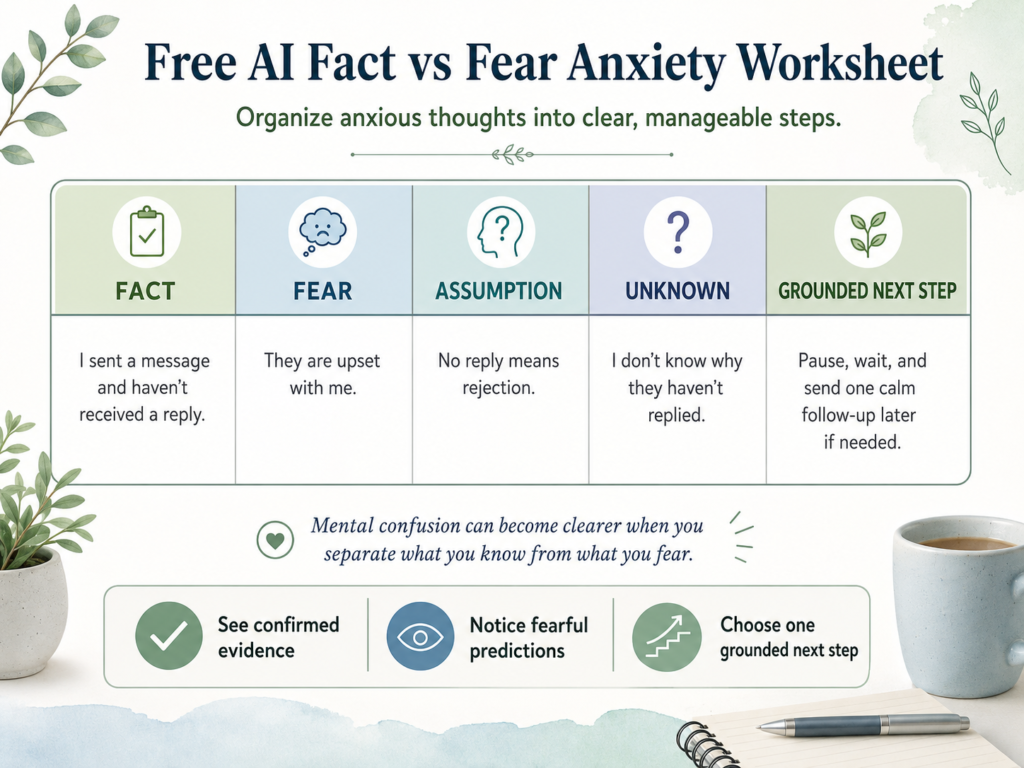
Fact vs Fear Example for Relationship Anxiety
Situation
Someone important has not replied since the morning.
Initial anxious story
“They are avoiding me because they are tired of me.”
Confirmed facts
- A message was sent in the morning.
- No reply has arrived.
- The person has previously taken several hours to respond.
- No direct conflict has been confirmed.
Fear
“They are emotionally withdrawing and may leave.”
Assumption
“A delayed reply means that their feelings have changed.”
Unknowns
- Why the person has not replied.
- What they are doing.
- How they presently feel.
- Whether the delay is related to the relationship.
Alternative explanations
The person may be working, travelling, resting, handling another responsibility, managing stress or waiting until there is enough time to reply properly.
These alternatives are not proof.
They simply remind you that more than one explanation is possible.
Grounded next step
Return attention to one planned activity for the next hour. If communication is still needed later, send one clear message without accusation.
For example: “I wanted to check whether you saw my message. Reply when you have time.”
Clear communication may provide missing information, but it should never be used to pressure someone for reassurance or to remain in a situation involving abuse, coercion or fear.
Fact vs Fear Example for Health Anxiety
Situation
You notice a new or unfamiliar physical sensation.
Initial anxious story
“This must be a serious illness.”
Confirmed facts
- A sensation is present.
- You noticed it recently.
- Its cause has not been medically assessed.
- Other symptoms may or may not be present.
Fear
“Something dangerous is happening inside my body.”
Assumption
“The most frightening possible cause must be the most likely cause.”
Unknowns
- What is causing the sensation.
- Whether it is temporary.
- Whether routine, urgent or emergency assessment is appropriate.
- Whether medication, stress, illness or another factor is involved.
Grounded next step
Record:
- when the symptom began,
- where it is located,
- what it feels like,
- whether it changes,
- any related symptoms,
- relevant medication or recent health changes.
Then contact an appropriate healthcare professional when medical guidance is needed.
Do not use the free AI Fact vs Fear Tool to diagnose a symptom, rule out a medical condition or decide that urgent care is unnecessary.
Chest pain, for example, can have different causes. Concerning symptoms should be medically assessed rather than assumed to be anxiety.
BBH’s guide on anxiety chest pain versus heart-attack warning signs can support general awareness but cannot replace emergency evaluation.
How to Challenge Anxious Thoughts About Work, Money and Social Situations
| Situation | Fear-based conclusion | What remains unknown | Grounded response |
|---|---|---|---|
| A manager requests a meeting | “I am going to be dismissed.” | The reason for the meeting | Review recent work and prepare questions |
| An unexpected bill arrives | “My finances are collapsing.” | Payment options and available resources | Confirm the amount, deadline and possible arrangements |
| Someone seems quieter than usual | “I offended them.” | Their mood and its cause | Review the evidence and ask once if needed |
| A client delays approval | “They think my work is poor.” | The reason for the delay | Follow up professionally at the agreed time |
| You make a mistake | “This proves I am incompetent.” | The actual impact and possible repair | Correct what can be corrected and identify one learning point |
For recurring loops that continue even after you have examined the situation, read why you cannot stop overthinking and how to calm the thought loop.
What to Do After Separating Fact From Fear
Insight alone may not settle anxiety.
The mind may understand the table while the body keeps asking:
“But what if?”
That is why the process requires an action stage.
| What you discover | Appropriate response |
|---|---|
| Important information is missing | Wait, observe or ask one calm question |
| A practical problem is confirmed | Create a small action plan |
| A medical concern exists | Seek suitable healthcare guidance |
| Immediate safety may be involved | Contact urgent or emergency human support |
| No meaningful new evidence exists | Pause checking and return to a planned activity |
| The same doubt repeatedly returns | Record it once and practise tolerating uncertainty |
| Anxiety is disrupting daily functioning | Consider qualified mental-health support |
| AI gives conflicting or alarming answers | Stop repeated prompting and consult a suitable human professional |
A grounded next step should reduce confusion rather than create a larger investigation.
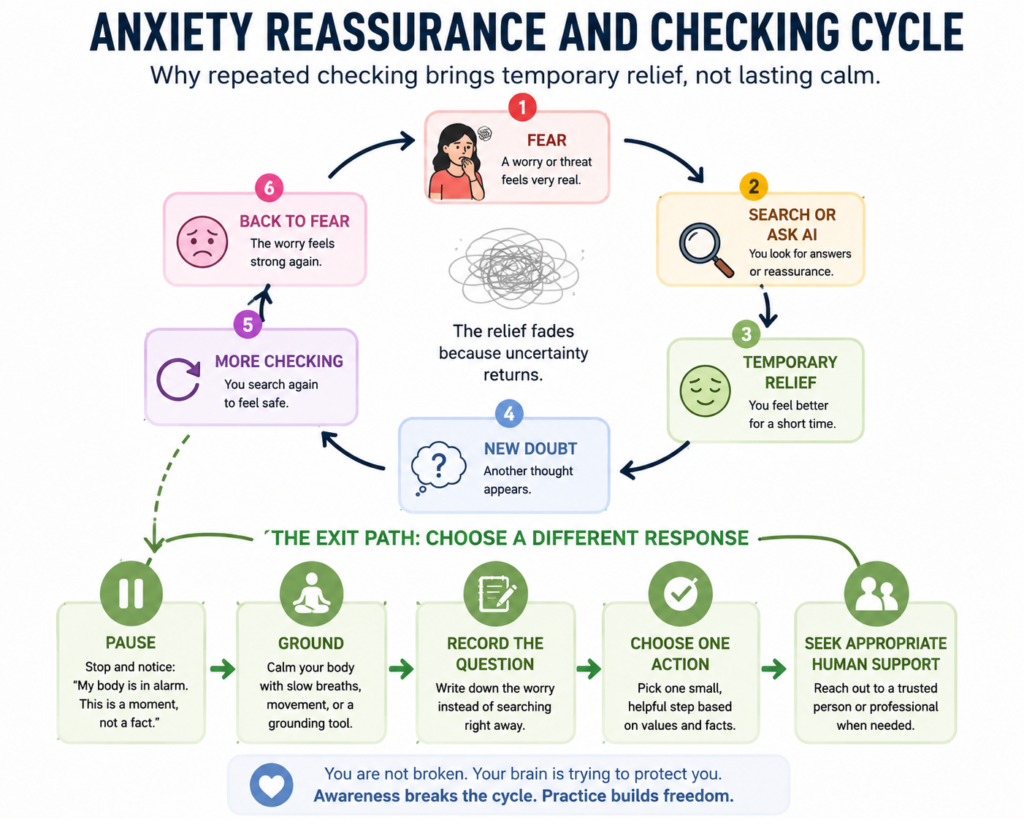
When the Free AI Fact vs Fear Tool Becomes Reassurance-Seeking
The free AI Fact vs Fear Tool can support awareness, but repeated use for the same concern may become reassurance-seeking.
The anxiety checking cycle often looks like this:
Fear → Ask AI or search online → Temporary relief → New doubt → Ask again → Temporary relief → Stronger urge to check
The problem is not that you wanted comfort.
The difficulty is that the nervous system may begin learning:
“I can tolerate uncertainty only after someone or something tells me I am safe.”
An AI response may calm you briefly.
Then another question appears:
- “What if I explained it incorrectly?”
- “What if AI missed something?”
- “What if the opposite answer is true?”
- “Should I ask another chatbot?”
- “Should I rewrite the question?”
At this point, more analysis may no longer produce clarity.
It may strengthen the belief that certainty is only one more search away.
A practical checking boundary
For one unchanged situation:
- Complete the exercise once.
- Save the answer.
- Select one responsible action.
- Set a boundary around further checking.
- Reassess only when meaningful new evidence appears.
This does not apply to emergencies, changing medical symptoms or immediate safety risks.
It is a limit for repeatedly evaluating the same uncertainty when nothing has changed.
How to Stop Reassurance-Seeking Anxiety
The exit path may look like this:
Pause → Ground → Record the concern → Identify the action → Seek suitable human support when needed
Pause
Notice the urge before automatically reopening a search, sending another message or asking AI to reconsider.
Ground
Bring your attention into the present environment. Feel your feet, loosen your jaw, slow the exhale and name what you can see.
Record the concern
Write it once:
“I am afraid the delayed reply means rejection.”
Identify the action
Ask whether the concern requires:
- practical action,
- direct communication,
- waiting,
- medical advice,
- emotional support,
- no further response right now.
Return to life
Choose one concrete activity unrelated to the fear.
The goal is not permanent distraction.
It is to show the nervous system that uncertainty can exist while life continues.
How to Review an AI Answer Safely
AI can organise language, but it should not become the final authority on health, safety, relationships or diagnosis.
A safer AI response should:
- distinguish evidence from interpretation,
- acknowledge uncertainty,
- avoid diagnosing you or another person,
- avoid claiming to know someone’s intention,
- offer more than one possible explanation,
- suggest proportionate practical steps,
- recommend suitable professional support,
- respect medical and safety limits.
Be cautious when an AI response:
- guarantees that nothing is wrong,
- says a symptom is “only anxiety,”
- declares that another person is abusive or unfaithful using limited information,
- encourages surveillance or repeated checking,
- recommends confrontation without sufficient evidence,
- gives medical or legal certainty,
- discourages professional care,
- presents itself as a therapist, doctor or crisis service.
AI is most helpful when it supports reflection and preparation.
It becomes less helpful when it is used to obtain certainty that no tool can responsibly provide.
For wider guidance, read AI apps for anxiety relief and how to use them safely.
One-Minute Fact vs Fear Exercise
When the complete exercise feels too demanding, ask:
What happened?
What do I know?
What am I afraid this means?
What am I assuming?
What remains unknown?
Does this require action, waiting or human support?
Then use one believable sentence:
“I can take the next responsible step without solving every unknown right now.”
This short version of the free AI Fact vs Fear Tool can be saved on your phone, printed as a prompt card or kept in a journal.
When an Anxiety Thought-Challenging Tool Is Not Enough
A worksheet or AI prompt is not appropriate for every situation.
Consider qualified professional support when:
- anxiety repeatedly disrupts sleep, work or relationships,
- reassurance-seeking feels difficult to control,
- fear leads you to avoid important activities,
- physical symptoms are new, severe, persistent or worsening,
- self-help strategies are no longer enough,
- emotional distress is becoming harder to manage,
- abuse, coercion, stalking or intimidation is present.
Seek urgent local assistance when there is:
- immediate physical danger,
- a medical emergency,
- risk of self-harm,
- risk of harm to another person,
- inability to remain safe.
AI and educational content cannot provide crisis intervention.
BBH’s article examining whether AI can detect mental-health warning signs explains why digital detection may support awareness but cannot replace qualified assessment.
A Personal Note From BBH
I understand why a person keeps searching when fear enters the body.
You may not only be looking for information.
You may be looking for the moment your body finally says: “Now I am safe.”
That is why repeated reassurance is so understandable.
But certainty is not always available exactly when we want it.
- Sometimes clarity comes from asking a direct question.
- Sometimes it comes from taking practical action.
- Sometimes it comes from speaking to a doctor, therapist or trusted person.
- Sometimes it comes from allowing an unknown to remain unknown for a little longer without abandoning yourself.
You are not foolish for feeling afraid.
Your nervous system may be trying to protect you.
But protection becomes clearer when fear is allowed to speak without being allowed to decide every fact.
Download the Free Fact vs Fear Anxiety Worksheet
Use the printable BBH fact vs fear worksheet to slow down one anxious situation before reacting.
| Inside the worksheet | How it helps |
|---|---|
| Situation description | Record what happened without immediately interpreting it |
| Confirmed facts | Identify information that can presently be verified |
| Fear or prediction | Name the outcome anxiety is imagining |
| Assumptions | Recognise conclusions made without enough evidence |
| Unknown information | Identify what has not been confirmed |
| Alternative explanations | Consider realistic possibilities beyond the worst-case story |
| Grounded next step | Choose one practical response |
| Checking boundary | Decide when repeated searching or questioning will stop |
| Human-support check | Identify whether professional or urgent support is needed |
Download the worksheet
[Download the Free BBH Fact vs Fear Anxiety Worksheet]
Suggested PDF filename:
bbh-fact-vs-fear-anxiety-worksheet.pdf
This worksheet is part of the upcoming BBH AI Prompts for Anxiety and Panic Workbook, which includes guided prompts, anxiety-pattern exercises, panic-support tools, trackers and printable reflection pages.
The Amazon purchase link will be added after the workbook is published.
People Also Ask About Fact vs Fear Anxiety
How can I tell the difference between fear and fact?
A fact can currently be observed, verified or supported by reliable evidence. Fear is an outcome you worry may occur. Ask what you know, what you are predicting, what you may be assuming and what information is missing. This validates your emotion without automatically treating a possibility as a confirmed conclusion.
Why do anxious thoughts feel so real?
Anxious thoughts can feel real because a perceived threat may produce physical and emotional alarm. A racing heart, tension or urgent need to act can make the thought feel more convincing. The intensity shows that you are distressed, but it does not automatically prove that the feared outcome is occurring.
How do I challenge anxious thoughts?
Write down the thought, identify confirmed evidence and separate it from predictions and assumptions. Consider other realistic explanations and choose one proportionate next step. The purpose is not forced positivity. It is to develop a more balanced interpretation based on the information currently available.
Can AI help with anxious thoughts?
AI may help organise thoughts, identify assumptions and prepare questions for a doctor or therapist. However, it cannot diagnose anxiety, decide whether a symptom is harmless or confirm another person’s motives. Use a free AI Fact vs Fear Tool for structured reflection rather than guaranteed reassurance.
What should I do when I cannot stop checking for reassurance?
Pause before repeating the same search or question. Record the concern, ground your body and identify whether the situation requires action, waiting or human support. Repeated checking may offer temporary relief while strengthening the urge to seek more reassurance whenever uncertainty returns.
Read Also: ai-thearpy
Frequently Asked Questions About the Free AI Fact vs Fear Tool
Is every anxious thought irrational?
No. Anxiety may sometimes respond to a genuine concern. This exercise helps you examine the available evidence, recognise uncertainty and decide whether the situation requires practical action, professional advice or more information.
What should I write under “unknown”?
Write any information you do not presently have. You may not know why someone has not replied or what is causing a symptom. Naming the unknown prevents the mind from automatically filling the gap with the most frightening explanation.
Should I use the tool repeatedly for the same fear?
Usually, complete it once and follow the appropriate next step. Repeating the exercise without new evidence may become reassurance-seeking. Return to it when meaningful information changes or when reviewing the concern with a qualified professional.
Can I use a fact vs fear worksheet for health anxiety?
It may help organise symptoms, fears and questions before speaking with a healthcare professional. It should not be used to diagnose a condition, rule out medical risk or decide that professional assessment is unnecessary.
When should I seek professional support?
Consider professional support when anxiety regularly affects sleep, work, relationships or daily functioning, or when self-help is not enough. Seek urgent local assistance when there is immediate danger, a medical emergency or a risk of harm.
Final Reminder About Fear, Facts and Uncertainty
Fear is not proof that you are weak, dramatic or incapable.
It is an emotional and physical signal asking for attention.
But a signal still requires interpretation.
The free AI Fact vs Fear Tool helps you listen to the fear without automatically allowing it to write the complete story.
- You may discover that action is needed.
- You may discover that information is missing.
- You may discover that the present fear is connected to an older wound.
- You may discover that the kindest next step is qualified human help.
- You do not need to deny your emotions.
Separate what you know from what you fear, name what remains unknown and take the next responsible step available today.
Explore educational guidance on AI-supported reflection, cognitive behavioural techniques and safe digital mental-health tools.
External References
Website: World Health Organization
Page title: Anxiety Disorders
URL:
https://www.who.int/news-room/fact-sheets/detail/anxiety-disorders
Website: National Institute of Mental Health
Page title: Anxiety Disorders
URL:
https://www.nimh.nih.gov/health/topics/anxiety-disorders
Website: American Psychological Association
Page title: What Is Cognitive Behavioral Therapy?
URL:
https://www.apa.org/ptsd-guideline/patients-and-families/cognitive-behavioral
Website: NHS Every Mind Matters
Page title: Tackling Your Worries
URL:
https://www.nhs.uk/every-mind-matters/mental-wellbeing-tips/self-help-cbt-techniques/tackling-your-worries/
Website: NHS
Page title: Health Anxiety
URL:
https://www.nhs.uk/mental-health/conditions/health-anxiety/