Anxiety Chest Pain vs Heart Attack: Warning Signs
Chest Pain or Panic Attack? When Should I Worry?

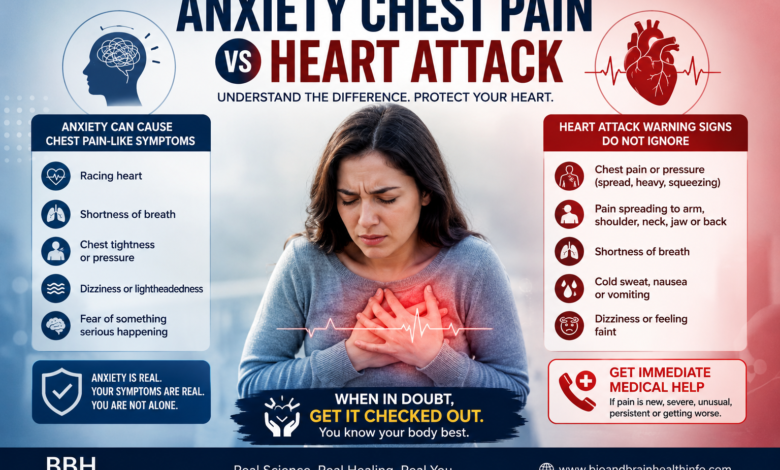
This blog explains anxiety chest pain vs heart attack for readers who feel frightened, confused, or unsure whether chest pain is caused by panic or a medical emergency.
Thank you for reading this post, don't forget to subscribe!It covers related searches such as panic attack vs heart attack, panic chest pain, panic attack heart symptoms, can anxiety cause chest pain, chest pain from anxiety, anxiety chest tightness, stress chest pain, heart attack warning signs, cardiac chest pain symptoms, emergency chest pain signs, am I having a heart attack or anxiety, how to tell anxiety from heart attack, chest pain or panic attack, and when to worry about chest pain.
The article exists to help readers understand symptom overlap, recognise urgent warning signs, learn how the nervous system can create real physical sensations, reduce unsafe self-diagnosis, and choose the safest next step through medical assessment and appropriate anxiety support.
Anxiety Chest Pain vs Heart Attack: Warning Signs
Chest pain can make the whole world feel smaller in seconds.
One moment, you may be sitting quietly, working, walking or trying to sleep. The next, your chest feels tight, your heart begins racing and your mind asks the question you cannot ignore:
“Am I having a heart attack, or is this anxiety?”
That uncertainty can be terrifying. You may check your pulse, search symptoms online, take deeper breaths or wait for the pain to change. Part of you wants reassurance. Another part is frightened that reassurance could make you overlook something serious.
This is why understanding anxiety chest pain vs heart attack is not simply about comparing two symptom lists. It is about recognising that panic can create genuine physical pain while also respecting the fact that heart-related symptoms require medical attention.
Immediate safety note: New, severe, persistent, worsening, spreading or unusual chest pain should receive urgent medical assessment. Call your local emergency number when chest discomfort occurs with shortness of breath, cold sweating, nausea, faintness, unusual weakness or pain spreading to the arm, jaw, neck, shoulder, back or upper abdomen.
Do not drive yourself when you believe you may be experiencing a medical emergency.
The Clear SERP Answer
Anxiety and panic can cause real chest pain, tightness, breathlessness, dizziness, sweating and a racing heartbeat. A heart attack can cause several of the same symptoms.
There are patterns that may appear more commonly in anxiety or cardiac conditions, but you cannot safely diagnose the cause from symptom pattern alone.
The safest answer to anxiety chest pain vs heart attack is this:
- Treat new or concerning chest pain seriously.
- Seek emergency help when warning signs are present.
- Use medical evaluation—not internet comparison—to rule out urgent causes.
- After urgent medical causes have been addressed, explore anxiety, panic, muscle tension, breathing patterns and nervous-system activation with appropriate professional support.
The goal is not to frighten you. It is to prevent false reassurance while helping you understand why anxiety can feel so physical.
Anxiety Chest Pain vs Heart Attack: A Careful Comparison
This table describes common patterns for education only. It cannot diagnose chest pain or safely rule out a heart problem.
| Feature | Anxiety or Panic May Involve | Heart-Related Symptoms May Involve |
|---|---|---|
| Chest sensation | Tightness, sharp pain, pressure, burning or soreness | Pressure, squeezing, heaviness, fullness, aching or pain |
| Heartbeat | Racing, pounding or fluttering | May be normal, fast, irregular or accompanied by weakness |
| Breathing | Rapid breathing, air hunger, feeling unable to take a satisfying breath | Shortness of breath with or without chest discomfort |
| Other sensations | Tingling, trembling, dizziness, chills, hot flushes, fear of dying | Cold sweating, nausea, faintness, weakness or spreading discomfort |
| Trigger | Stress, fear, body scanning or no obvious trigger | Exertion, stress or no obvious trigger |
| Duration | May peak and settle, but can recur or remain while anxiety stays active | May persist, come and go or gradually worsen |
| Response to rest | May ease as panic settles | May or may not improve |
| Safe conclusion | Anxiety is possible, but medical causes may still need assessment | Urgent assessment may be necessary |
No single row provides a diagnosis. Anxiety can cause pressure-like pain, and cardiac symptoms are not always dramatic. Some heart attacks may develop gradually or appear with less typical symptoms.
When Chest Pain Needs Emergency Help
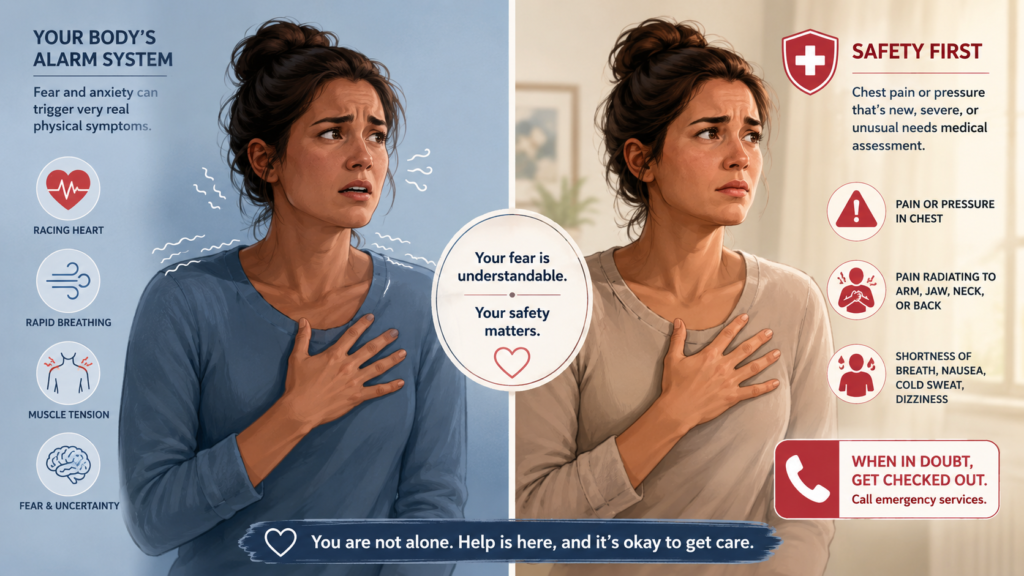
Seek emergency medical help when chest discomfort is:
- severe, crushing, squeezing, heavy or rapidly worsening;
- new or unlike symptoms you have experienced before;
- lasting more than a few minutes or repeatedly returning;
- spreading to one or both arms, the jaw, neck, shoulder, back or upper abdomen;
- accompanied by shortness of breath, cold sweating, nausea or vomiting;
- accompanied by fainting, marked dizziness, confusion or unusual weakness;
- occurring with a strong feeling that something is seriously wrong.
Heart-attack symptoms can vary. Some people experience breathlessness, unusual tiredness, nausea, back discomfort, arm pain or weakness rather than dramatic chest pain.
Risk also deserves attention when a person has diabetes, known heart disease, high blood pressure, high cholesterol, a history of smoking or a strong family history of cardiovascular disease.
Even when you are unsure, it is safer to be assessed than to wait for certainty.
Can Anxiety Cause Real Chest Pain?
Yes. Anxiety can cause genuine chest pain.
During intense fear, the body activates a survival response. The heart may beat faster, breathing may become shallow or rapid and muscles around the chest, shoulders and upper back may tighten.
Rapid breathing can also change the balance of carbon dioxide in the body. This may contribute to dizziness, tingling, light-headedness, chest discomfort and the frightening sense that you cannot get enough air.
At the same time, the mind becomes highly alert to every physical sensation. A small flutter, muscle pull or change in breathing may suddenly feel enormous because your attention is locked onto the body.
None of this means the pain is imagined.
It means the nervous system is capable of creating intense physical sensations.
Readers who want a deeper explanation can explore how the nervous system creates emotional and physical reactions.
Why Panic Can Feel Exactly Like Danger
A panic attack does not begin with calm observation. It begins with alarm.
The brain detects danger—or interprets a sensation as danger—and the body prepares to survive. Adrenaline rises. The heart speeds up. The chest tightens. Breathing changes.
Then the mind notices those changes and thinks:
- “My heart is failing.”
- “I cannot breathe.”
- “Something terrible is happening.”
- “I may collapse.”
- “I may die.”
Those thoughts increase fear, and fear intensifies the sensations.
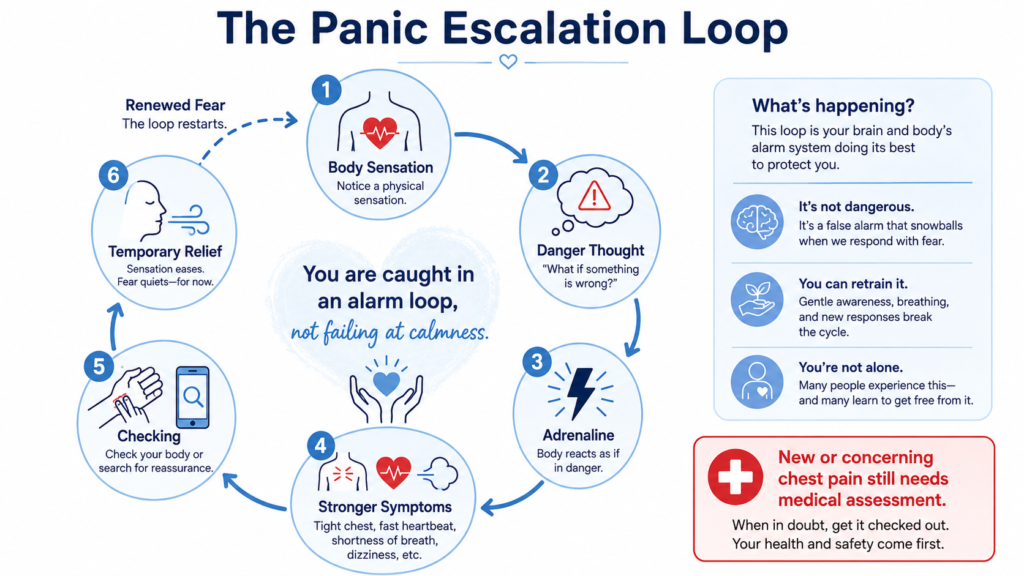
This creates the panic loop:
| Stage | What Happens |
|---|---|
| Body sensation | Tight chest, fast heartbeat or breathlessness appears |
| Threat interpretation | The mind assumes the sensation means immediate danger |
| Nervous-system escalation | Adrenaline and muscle tension increase |
| More sensations | The chest feels tighter and the heartbeat feels stronger |
| Checking and reassurance | Pulse checking, symptom searching or repeated monitoring begins |
| Temporary relief | Reassurance helps briefly |
| Renewed fear | Another sensation restarts the loop |
This is why health uncertainty can become exhausting. The person is not only feeling symptoms. They are trying to solve the symptoms every few seconds.
Read more about why uncertainty makes the mind search, check and overthink.
The Psychology Layer: When the Body No Longer Feels Trustworthy
Repeated panic-like chest symptoms can change your relationship with your body.
You may begin to monitor your heartbeat while resting. You may avoid exercise because a faster pulse feels unsafe. You may fear sleeping alone, travelling, driving or being far from a hospital.
The deeper fear may become:
“What if my body gives me a warning and I fail to recognise it?”
That thought can create a painful attachment to certainty. You want a guarantee that every sensation is harmless, but the body cannot provide perfect certainty. Human bodies shift constantly. Heart rate, digestion, breathing, temperature and muscle tension naturally change throughout the day.
When the mind becomes afraid of those normal changes, body awareness turns into body surveillance.
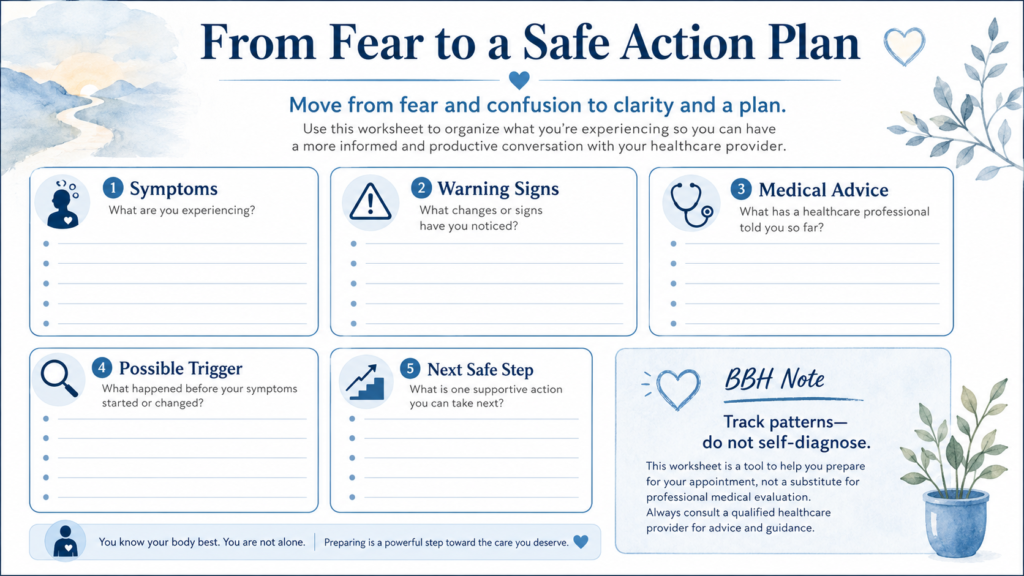
The solution is not to ignore the body. It is to build a safer system:
- Know the emergency warning signs.
- Obtain medical evaluation when symptoms are new or concerning.
- Follow professional advice.
- Stop using repeated checking as the only way to feel safe.
- Learn nervous-system regulation after urgent medical concerns have been addressed.
“Sometimes the most frightening part is not the pain itself. It is the silence between the sensation and the answer, when your mind keeps asking whether your body is warning you or frightening you.”
What to Do When Chest Pain Starts
Step 1: Respect Medical Warning Signs
Before trying to calm yourself, ask whether the symptoms are new, severe, spreading, worsening, persistent or accompanied by emergency signs.
When warning signs are present, call your local emergency number.
Do not delay care while testing whether breathing, distraction, stretching or reassurance makes the pain disappear.
Step 2: Stop Trying to Diagnose Yourself in the Moment
Searching multiple symptom lists while frightened often increases confusion. Anxiety symptoms and cardiac symptoms overlap too much for a home checklist to provide certainty.
Medical professionals may use your history, examination, an ECG, blood tests and other investigations when clinically appropriate.
Step 3: Sit in a Supported Position
When you are waiting for professional guidance or when a clinician has already advised that the episode can be managed as anxiety, sit upright or in another comfortable supported position.
Loosen restrictive clothing and reduce unnecessary movement.
Step 4: Slow the Exhale Gently
Do not force very deep breaths, because over-breathing may worsen dizziness or tingling.
Instead, breathe naturally and allow the exhale to become slightly slower and longer. The goal is not to prove that the symptom is anxiety. The goal is to reduce additional panic while following appropriate medical advice.
Step 5: Reduce Repeated Checking
Repeatedly checking your pulse, oxygen reading, smartwatch or symptom list may provide relief for seconds, but it can teach the brain that every sensation requires emergency monitoring.
After medical guidance has been obtained, practise noticing the urge to check without automatically obeying it.
For additional body-based education, read why the body can continue feeling afraid after stress.
What to Do After Urgent Causes Have Been Ruled Out
Being told that your heart appears medically stable can bring relief. But sometimes the fear returns the next time the chest tightens.
This does not mean the medical evaluation was useless. It means the nervous system may still associate chest sensations with danger.
Long-term recovery may involve several layers.
Understand Your Individual Pattern
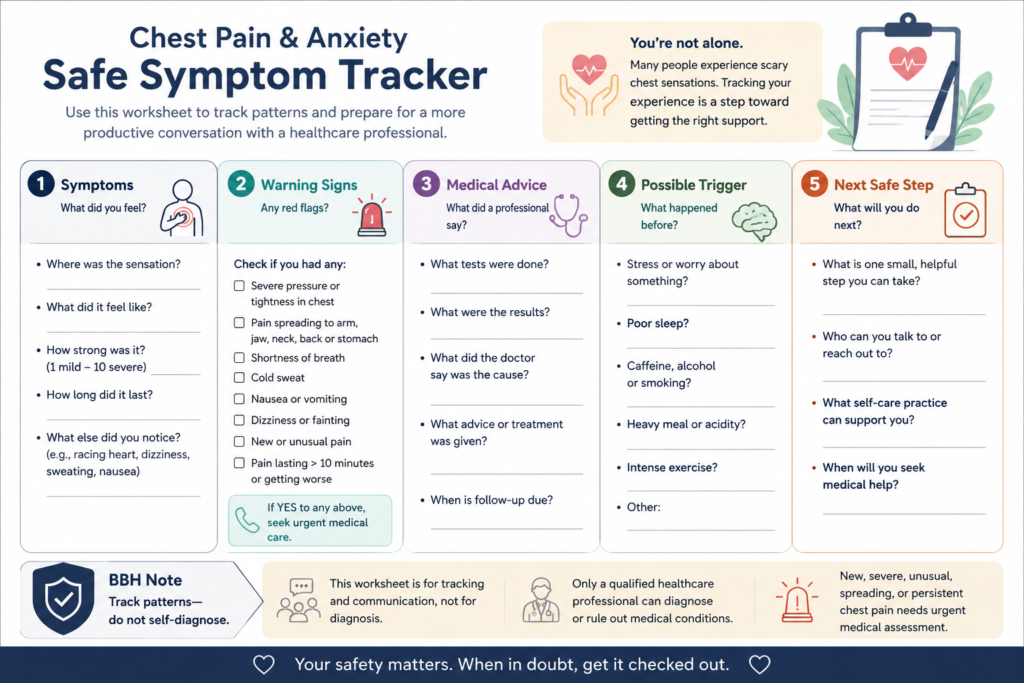
Track:
- when symptoms occur;
- what you were doing beforehand;
- whether you had caffeine, poor sleep or prolonged stress;
- what the sensation felt like;
- how long it lasted;
- whether medical advice was sought;
- what the clinician recommended.
Tracking should create clarity, not obsessive surveillance. Check patterns at a planned time rather than recording every heartbeat throughout the day.
Rebuild Trust in Normal Body Sensations
A clinician may advise gradual return to activity when medically appropriate. This can help you learn that a faster heartbeat during movement is not automatically an emergency.
Do not begin or change an exercise programme based only on an article. Follow professional guidance, particularly when you have cardiac risk factors or ongoing symptoms.
Address Panic and Health Anxiety
Therapy may help when you repeatedly fear a heart attack despite appropriate assessment, avoid normal activities or spend large amounts of time checking symptoms.
Support may focus on:
- understanding panic;
- tolerating uncertainty;
- changing catastrophic interpretations;
- reducing reassurance-seeking;
- gradually rebuilding confidence in the body.
Regulate the Nervous System Without Using Calm as a Test
Grounding, slower breathing and muscle relaxation can support regulation. But they should not become a test such as, “If this works, my heart must be fine.”
A symptom improving with relaxation does not diagnose its cause.
For a wider emotional-regulation framework, explore practical nervous-system regulation for anxiety and stress and how repeated emotional alarm can become an automatic reaction.
Common Mistakes That Increase Fear
Mistake 1: Assuming Every Episode Is “Only Anxiety”
A previous anxiety diagnosis does not make every future symptom anxiety. New, changing or concerning symptoms still deserve appropriate medical attention.
Mistake 2: Assuming Every Sensation Is a Heart Attack
Once urgent conditions have been assessed, treating every small body change as catastrophe can keep the nervous system trapped in alarm.
Mistake 3: Searching Until You Find Certainty
Online information can educate, but it cannot examine you, perform an ECG or interpret tests in context.
Mistake 4: Avoiding All Physical Activity
Avoidance can make normal increases in heart rate feel unfamiliar and frightening. Return to activity only according to medical advice.
Mistake 5: Using Reassurance as the Only Coping Tool
Reassurance may calm fear temporarily, but long-term recovery often requires learning to tolerate normal bodily uncertainty.
When Recurring Chest Pain Needs a Doctor
Arrange medical follow-up when chest discomfort:
- keeps returning;
- changes in character, location or intensity;
- happens during exertion;
- disturbs sleep;
- appears with palpitations, dizziness or breathlessness;
- begins after medication changes;
- causes repeated fear or avoidance;
- continues even after you believe anxiety may be involved.
Chest pain can have many possible causes, including heart, lung, digestive, muscular and anxiety-related conditions. A clinician can assess your full medical context.
Understanding anxiety chest pain vs heart attack should lead to safer decisions—not greater confidence in self-diagnosis.
Read Also: Brain Health → Nervous System Regulation → Mental Health → Anxiety & Overthinking
People Also Ask
1. How can I tell if chest pain is anxiety or a heart attack?
Anxiety may cause tightness, sharp pain, rapid heartbeat and breathlessness, but heart-related symptoms can overlap. New, severe, persistent, spreading or unusual chest pain should be medically assessed.
2. Can anxiety cause real chest pain?
Yes. Anxiety can cause genuine chest discomfort through muscle tension, rapid breathing, increased heart rate and nervous-system activation. It should not be used to rule out another medical cause.
3. What does anxiety chest pain feel like?
It may feel sharp, tight, burning, aching or pressure-like. Some people also experience dizziness, tingling, breathlessness or a racing heart. These sensations cannot diagnose the cause.
4. Can a panic attack feel like a heart attack?
Yes. A panic attack may cause chest pain, sweating, trembling, rapid heartbeat, dizziness and fear of dying. Because several symptoms overlap, unfamiliar or concerning symptoms require assessment.
5. When should I worry about chest pain?
Seek urgent help when chest pain is severe, worsening, spreading, persistent or accompanied by shortness of breath, sweating, nausea, faintness or unusual weakness.
Frequently Asked Questions
1. How long can anxiety chest pain last?
It may last minutes or continue while the nervous system remains activated. Duration alone cannot distinguish anxiety from a cardiac or other medical cause.
2. Can anxiety chest pain occur on the left side?
Yes. Anxiety-related discomfort can occur in different areas of the chest. Location alone cannot safely identify the cause.
3. Can anxiety chest pain happen while resting?
Yes. Anxiety or panic symptoms may appear during rest or sleep. Chest pain at rest may also have other causes and should not automatically be labelled anxiety.
4. Does improvement with breathing prove it is anxiety?
No. Calmer breathing may reduce panic-related symptoms, but improvement does not prove the cause is harmless or rule out a heart condition.
5. Should recurring chest pain be checked?
Yes. Recurring chest discomfort deserves medical evaluation, especially when it changes, happens with exertion or appears with other concerning symptoms.
BBH Support Resource
Want a simple tool to track recurring symptoms safely?
Download the BBH Chest Pain and Anxiety Pattern Tracker to record:
- when the sensation began;
- what it felt like;
- other symptoms that appeared;
- possible stress or panic triggers;
- whether medical care was sought;
- what advice a healthcare professional provided.
This tracker supports pattern awareness only. It cannot diagnose the cause of chest pain or rule out a medical emergency.
Email info@bioandbrainhealthinfo.com and write:
“Send me the Chest Pain and Anxiety Pattern Tracker.”
Personal Note
When the chest feels strange, logic does not always arrive first. Fear does.
You may know that anxiety can affect the body, yet still feel frightened that this time is different. That does not make you dramatic. Chest symptoms touch one of the deepest human fears: the fear that something essential inside the body may be failing.
Respect that fear, but do not let it force you into either extreme.
Do not dismiss yourself by saying, “It is definitely anxiety.”
Do not punish yourself by assuming every sensation means catastrophe.
Choose the middle path: respond to warning signs, seek medical guidance and then work gently with the nervous system when anxiety remains.
The purpose of learning about anxiety chest pain vs heart attack is not to become your own emergency doctor. It is to become more informed, safer and less alone while making responsible decisions.
YMYL Safety Note
This article is for educational purposes only and cannot diagnose the cause of chest pain. New, severe, persistent, spreading, worsening or unusual symptoms require urgent medical assessment.
External References
1. American Heart Association
Page title: Warning Signs of a Heart Attack
Website: American Heart Association
URL: https://www.heart.org/en/health-topics/heart-attack/warning-signs-of-a-heart-attack
2. American Heart Association
Page title: Diagnosing a Heart Attack
Website: American Heart Association
URL: https://www.heart.org/en/health-topics/heart-attack/diagnosing-a-heart-attack
3. NHS
Page title: Coronary Heart Disease
Website: National Health Service
URL: https://www.nhs.uk/conditions/coronary-heart-disease/
4. Healthdirect Australia
Page title: Chest Pain
Website: Healthdirect Australia
URL: https://www.healthdirect.gov.au/chest-pain
5. Mayo Clinic
Page title: Panic Attacks and Panic Disorder—Symptoms and Causes
Website: Mayo Clinic
URL: https://www.mayoclinic.org/diseases-conditions/panic-attacks/symptoms-causes/syc-20376021