Why Is Anxiety Worse in the Morning?
Why Do I Wake Up Already Feeling Afraid?


BBH · Bio and Brain Health
Lived Experience + Mental Health Education
This article is educational and does not diagnose or replace medical or mental-health care.
The Short Answer: Why Is Anxiety Worse in the Morning?
Why is anxiety worse in the morning? For some people, waking brings several things together at once: the body is moving into alertness, yesterday’s unfinished worry or grief becomes conscious again, the mind starts predicting the coming day, and physical sensations such as tension, nausea, shaking or a fast heartbeat may be noticed more strongly.
Morning anxiety is not a separate diagnosis. Different people can wake anxious for very different reasons, including stress, poor sleep, anticipatory worry, grief, an existing anxiety condition, medication or substance effects, and sometimes physical-health factors that deserve medical assessment.
That is why I do not think every anxious morning should be explained with one sentence such as, “It is only cortisol.”
Sometimes the body is becoming alert.
Sometimes the mind is remembering.
Sometimes tomorrow is being predicted before today has even started.
And sometimes the reason is personal enough that no textbook sentence can fully describe it.
For me, morning anxiety became real after Sara died.
“My eyes opened, and yesterday was already in the room.”
That sentence describes my experience better than any clinical definition could.
What Morning Anxiety Can Feel Like Before You Even Stand Up
Waking up anxious can be confusing because sometimes nothing new has happened. The room is the same, the phone has not been checked, nobody has spoken to you, and the day’s problems have not actually begun.
Yet your body may already feel as though it is preparing for something difficult.
Morning anxiety can include:
- a sense of dread as soon as your eyes open;
- racing or repetitive thoughts;
- pressure or tightness in the chest;
- a tight head or headache;
- jaw tension;
- shaking or internal trembling;
- rapid or uncomfortable breathing;
- nausea or stomach discomfort;
- crying;
- an urge to remain in bed and avoid the day;
- fear about work, money, relationships or health;
- immediately remembering something painful;
- feeling exhausted before doing anything;
- repeatedly checking the phone for reassurance;
- feeling that the entire day is already going to go badly.
These symptoms can occur with anxiety, but symptoms alone cannot establish the cause. A new or unusually severe physical symptom should not automatically be labelled anxiety.
BBH YMYL SAFETY NOTE
Morning anxiety can be real and physically intense, but sudden one-sided weakness, new speech difficulty, fainting, severe breathing difficulty, spreading chest pain, a first seizure-like event, or another new severe neurological or medical symptom requires urgent medical assessment rather than self-diagnosis from a blog.
If you feel unable to keep yourself safe or are thinking about ending your life, contact emergency or crisis support in your country and tell another person immediately.
The Morning Sara Was Already Gone
I did not truly understand anxiety after waking up until my Sara passed away.
She was my beautiful baby. I was not emotionally prepared for her death.
The day she died, I cried continuously. I yelled. I broke down. I hardly ate. Panic came into the grief, and my doctor had to help because my body and mind would not settle enough for sleep.
Eventually I held a pillow and somehow slept.
Sleep interrupted the experience for a few hours.
It did not change the reality waiting for me in the morning.
When my eyes opened, pain returned immediately. My eyes hurt. My whole head felt tight. Breathing did not feel easy. Tears came before I could organise a thought. My jaw became so tense that I struggled to move it normally. My body started shaking and my voice felt trapped.
I could not properly call anyone.
I could not simply tell myself to calm down.
My mother heard the sound I was making and came into the room. She held me while my family contacted my doctor.
People around me were trying to help me understand a fact that could not be changed: Sara was gone.
But my mind could not process that fact calmly.
It kept returning to the same questions.
Where is my baby girl?
Why did she leave?
How am I supposed to live without her?
The more vividly I remembered her, the stronger the anxiety became.
Love, grief, physical panic and memory were happening together.
There was also a point in that grief when I did not want to continue living with the pain. That required real human and medical help. It was not something a motivational sentence could solve.
That experience is one reason BBH treats severe emotional distress seriously.
Why Is Anxiety Worse in the Morning When Nothing Has Happened Yet?
This question is important because the reader may assume:
“If nothing happened this morning, why am I already anxious?”
The answer may be that the anxiety is not being generated only by what happened five minutes ago.
The body and mind carry continuity.
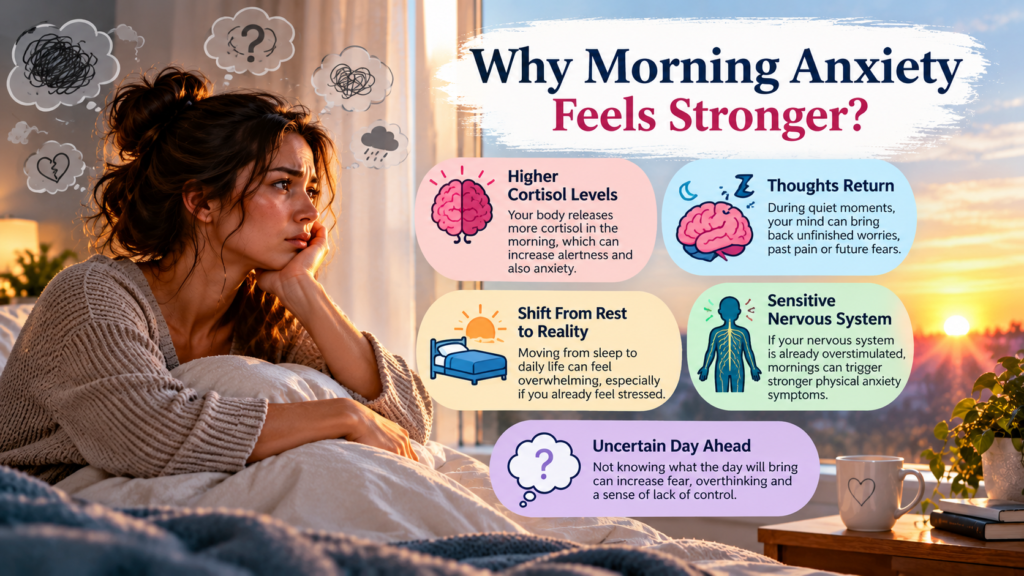
Yesterday’s emotional stress does not automatically disappear during sleep. An upcoming responsibility can already feel threatening before it begins. A relationship conflict can remain unresolved. Grief can still be present. Poor sleep can leave the nervous system tired and more reactive.
That means morning anxiety may represent a combination of body state + memory + anticipation + personal context, rather than one single trigger.
1. Your Body Is Moving From Sleep Into Alertness
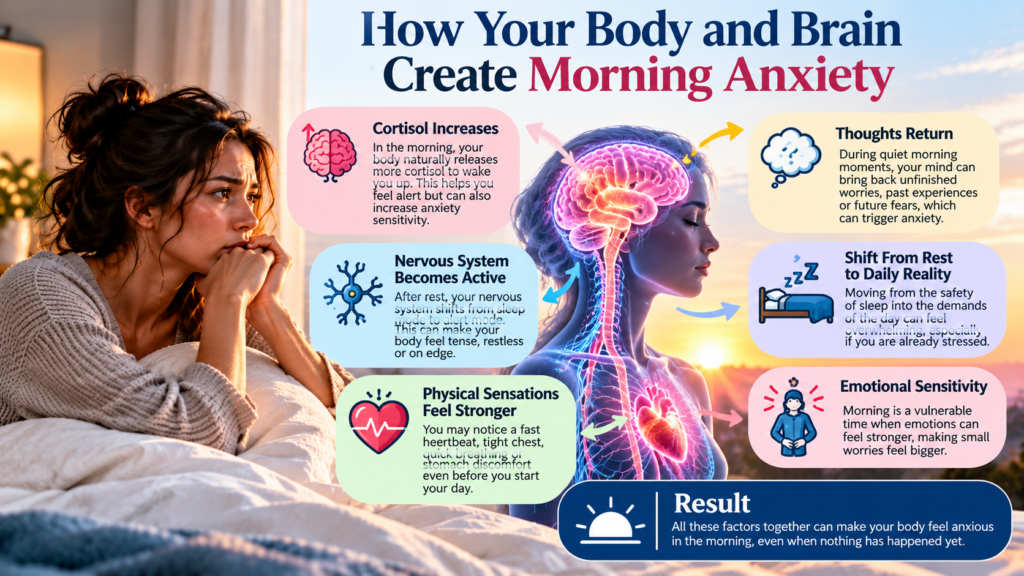
Cortisol follows a strong daily rhythm, with a significant amount of secretion occurring around the morning waking period. Researchers have extensively studied what is commonly called the cortisol awakening response.
But this needs careful wording.
Cortisol is not simply a “bad anxiety chemical.” It plays important metabolic, immune and cognitive roles and helps prepare the body for activity.
Research also shows considerable individual variation, and recent work has questioned overly simplistic claims that waking itself always produces one identical hormonal surge in everyone.
So I would not tell a BBH reader:
“Your morning anxiety is caused by cortisol.”
A safer interpretation is:
Your body is naturally changing state around waking, and if anxiety, sleep disruption, stress or emotional pain is already present, those body sensations may become part of the anxious experience.
Understanding biology should reduce confusion, not create another thing to fear.
2. Yesterday Can Return Before Today Has Begun
One of the strongest patterns I noticed after Sara died was not a new danger.
It was the return of an old reality.
This is different.
An anxious brain does not need a completely new event every morning. Something emotionally important can simply become conscious again.
After a loss, for example, a person may experience a brief space between sleep and remembering. Then the loss becomes real again.
Grief is highly individual. It may involve intense sadness, crying, exhaustion, anger, guilt, numbness and sudden waves of emotion. There is no single correct sequence.
For me, waking repeatedly reopened the fact that Sara was gone.
That does not mean everyone experiencing morning dread has unresolved grief. It means memory deserves a place in the explanation.
3. The Mind Can Name the Entire Day Before It Happens
Another morning-anxiety pattern is prediction.
The eyes open and the mind begins immediately:
- What if the meeting goes badly?
- What if they do not call?
- What if my health problem becomes worse?
- How am I going to finish everything?
- What if today becomes another difficult day?
The strange part is that none of those events has happened yet.
But the body may begin responding to the prediction.
At BBH, I call this:
The Day Named Too Early
The mind takes an unfinished future and gives it a verdict before enough evidence exists.
This is closely connected with overthinking. If you recognise that cycle, explore Why Can’t I Stop Overthinking? Calm the Thought Loop.
The goal is not to force yourself to believe, “Everything will be wonderful.”
The goal is smaller and more realistic:
Do not make a final judgment about an entire day from the first anxious five minutes.
4. Poor Sleep Can Follow You Into the Morning
Sleep and anxiety often influence one another.
You may go to bed worrying, sleep lightly, wake repeatedly, dream intensely or wake feeling physically unrested. In that situation, the morning starts with less emotional capacity.
If nighttime anxiety is part of your pattern, read how anxiety can disturb your sleep.
Notice the direction of this link.
I am not saying every person with morning anxiety has a sleep disorder.
I am saying the previous night is useful information.
Ask:
How did I sleep before I judge how I feel this morning?
5. The Body Can Become the First Thing You Fear
Sometimes morning anxiety becomes frightening because the physical sensation itself becomes the focus.
You notice shaking.
Then you watch the shaking.
You feel the heart.
Then you repeatedly check the heart.
The jaw feels tight.
Then the mind asks whether the tightness means something dangerous.
This can create a feedback loop in which a real physical sensation produces fear, and fear increases attention to the physical sensation.
If trembling or internal vibrations are prominent, read BBH’s guide to shaking during anxiety.
Again, the important BBH rule is:
Real symptoms do not automatically mean anxiety is the only cause.
New, severe or changing symptoms deserve appropriate medical evaluation.
6. Attachment, Love and Uncertainty Can Make Morning Thoughts Louder
Psychology becomes important here because not every worry has the same emotional value.
We usually do not obsess equally about everything.
The mind returns to what matters.
A person.
A health result.
A relationship.
A job.
A financial problem.
A loss.
Something we desperately want to keep.
Something we fear losing.
The more emotionally important an outcome becomes, the harder uncertainty may feel.
This is why morning anxiety can sometimes appear to be “random” while actually circling something deeply meaningful.
Ask yourself:
What feels emotionally important enough that my mind wants an answer before the day has even started?
That question is different from:
“What is wrong with me?”
One attacks identity.
The other investigates the pattern.
BBH Morning Anxiety Map
| What you notice | What may be happening | First safe response |
|---|---|---|
| Eyes open and dread arrives immediately | Waking + anticipation + existing stress | Do not judge the entire day yet |
| Yesterday’s problem appears instantly | Emotional memory has returned | Name the fact without solving everything |
| Thoughts race into the future | Anticipatory anxiety/overthinking | Separate today’s fact from today’s prediction |
| Jaw tightens or body shakes | Physical arousal may be joining anxiety | Slow down and check whether symptoms are familiar or new |
| You immediately reach for your phone | Reassurance or threat checking | Delay unnecessary checking briefly |
| Grief returns | Loss has become conscious again | Allow emotion and seek support |
| Symptoms are new, severe or one-sided | Could require medical assessment | Do not assume anxiety |
| You feel unable to stay safe | Mental-health emergency | Tell someone and seek urgent help |
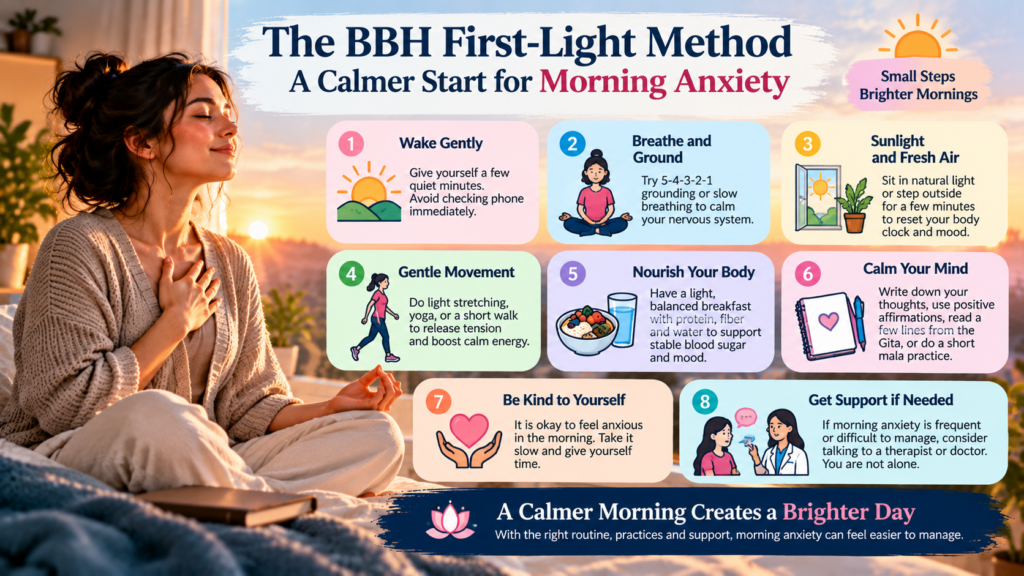
The BBH First-Light Method
You do not need to repair your whole life before breakfast.
The first hour can be smaller than that.
Step 1: Safety Before Interpretation
Ask:
Is this my known anxiety pattern, or is something medically new, severe or different?
Safety comes before psychology.
Step 2: Let One Person In When Needed
After Sara died, I could not solve the first morning alone.
My mother entered the room.
Sometimes regulation begins through another human being before you are capable of doing it by yourself.
Step 3: Name One Fact
Not ten predictions.
One fact.
Examples:
I have a difficult meeting today.
Not:
I am definitely going to fail today.
Or:
I miss someone deeply.
Not:
I will never survive this life without them.
Step 4: Notice the Body Without Turning It Into a Diagnosis
Where is the tension?
Jaw?
Shoulders?
Stomach?
Chest?
Hands?
Head?
Observe first.
Interpret carefully.
Step 5: Give the First Hour One Job
Drink water.
Take prescribed medication as directed.
Wash your face.
Eat if appropriate for you.
Sit near someone.
Walk to the balcony.
Feed your pet.
Pray.
Write one sentence.
The purpose is not productivity.
It is re-entry into the day.
Step 6: Delay Unnecessary Threat Input
If opening email, social media, financial messages or news immediately intensifies your anxiety, experiment with a short first-hour boundary.
You are not hiding from reality.
You are choosing the order in which reality enters.
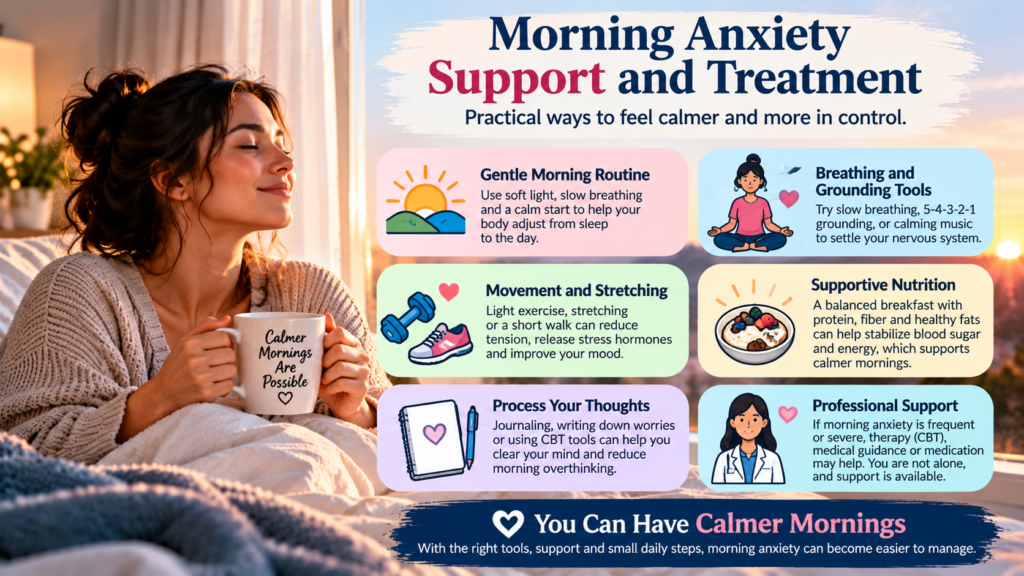
Step 7: Continue Proper Treatment
Grounding, prayer, journaling, breathing and routines may support wellbeing.
They are not substitutes for appropriate professional care when treatment is needed.
NIMH notes that established anxiety treatment can include psychotherapy, medication or both, depending on individual circumstances.
What Changed My Mornings After Sara Died
My recovery did not happen because one trick stopped the anxiety.
Treatment remained important.
Time mattered.
People mattered.
And spiritual meaning became important to me personally.
My ISKCON guru gave me a way to think about Sara’s life that my grieving mind could hold.
He described life as a cycle.
She came.
She stayed.
She passed.
Within my faith, the Bhagavad Gita’s teaching that the soul is not simply the temporary body gave me another way to relate to death.
I want to be careful here.
This is my spiritual understanding, not a medical statement and not something I would force onto a grieving reader.
My guru encouraged me to complete sixteen rounds of mala each day as prayer for Sara and as movement toward Krishna. For around a month, those rounds took several hours of my day.
The beads did not bring her body back.
They gave my morning a duty.
Over time I began to hold two truths together:
I loved her deeply.
And I could not reverse what had happened.
Medicine and professional support did not become unnecessary because I prayed.
Spiritual practice and treatment occupied different places in my recovery.
If Krishna or the Gita is not part of your belief system, you do not need to copy my ritual.
The useful principle is broader:
A difficult morning may become more manageable when the first hour has one meaningful action that connects you with life.
For more of my lived experience with Sara, grief and fear of death, read Death Fear: My Story of Survival and Healing.
When Nervous-System Regulation May Help
When your body is highly activated, it may be difficult to reason your way out of the experience immediately.
A gentle regulation step can create enough space for clearer thinking.
Try:
- Place both feet against the floor or another stable surface.
- Notice the physical support beneath your body.
- Unclench your jaw if you can do so comfortably.
- Lower your shoulders.
- Look around and identify several neutral objects.
- Allow your exhale to become slightly slower rather than forcing huge breaths.
- Ask, “What is happening right now, not what am I predicting?”
- Choose one next action.
For a deeper BBH explanation, read Nervous System Regulation Techniques for Anxiety and Overthinking.
This is a regulation practice, not a test for whether your symptoms are medically harmless.
Morning Anxiety vs Morning Emergency
This distinction matters.
More consistent with an anxiety pattern you already recognise
- dread;
- familiar racing thoughts;
- familiar muscle tension;
- familiar trembling during stress;
- anticipatory worry;
- symptoms that repeatedly appear around stress and have previously been evaluated.
Seek urgent medical care for concerning new symptoms such as
- sudden weakness or numbness on one side;
- facial drooping;
- new difficulty speaking;
- fainting;
- a first seizure-like episode;
- severe chest pain;
- severe breathing difficulty;
- sudden severe neurological changes.
Stroke and TIA symptoms can include sudden facial weakness, arm weakness and speech changes, so those symptoms should not be explained away as anxiety.
One Question That Changed How I See a Hard Morning
Instead of asking:
“How will I survive this whole day?”
Ask:
“What does the next ten minutes actually require from me?”
Those are different psychological tasks.
The first question opens an entire day of imagined difficulty.
The second gives the nervous system one reachable piece of reality.
You might still be anxious.
But you are no longer asking an activated mind to solve twelve hours at once.
BBH First-Light Worksheet
Use these questions when morning dread is strong.
1. What was the first feeling I noticed when my eyes opened?
2. What did my body do?
Head, breathing, jaw, stomach, chest, shaking, tears or something else?
3. What was the first thought or memory that appeared?
4. Is that thought a confirmed fact, a prediction, or a memory?
5. Did I sleep well enough last night?
6. Is this my familiar pattern, or is something medically new or different?
7. Who can I let into this morning if I need support?
8. What is one small first-hour action?
9. What can wait until later today?
10. Do I need professional support today?
BBH Support Resource
BBH First-Light Morning Anxiety Worksheet
Want a simple tool you can keep beside your bed?
The BBH First-Light Morning Anxiety Worksheet will help you record:
- your first waking thought;
- physical symptoms;
- fact vs prediction;
- emotional trigger;
- sleep quality;
- first-hour support;
- one realistic action;
- notes to discuss with your doctor or therapist.
Download Button:
BBH First-Light Morning Anxiety Worksheet
Email Request
Email info@bioandbrainhealthinfo.com and write:
“Send me the First-Light Morning Anxiety Worksheet.”
BBH Book Resource
If anxiety makes it difficult to know what to ask, write or do when your mind becomes overwhelmed, BBH’s upcoming prompt guide provides structured reflection tools that can be used alongside—not instead of—appropriate professional care.
Calm Your Anxious Mind With AI
101 Safe Prompts, Worksheets & Trackers
BBH™ Clarity AI Prompt Guides · Volume 1
By Shubhangi Halande
Amazon Purchase Button: XXX
GET THE BOOK
People Also Ask
1. Why is anxiety worse in the morning?
Why is anxiety worse in the morning can have more than one answer. Waking biology, sleep quality, stress, anticipatory worry, grief and existing anxiety patterns may all contribute. There is no single explanation that applies to every person.
2. Why do I wake up anxious when nothing is wrong?
Your mind may be anticipating the day, returning to yesterday’s unresolved stress or responding to physical sensations associated with becoming alert. Occasionally waking anxious can occur during stressful periods, but persistent distress deserves professional discussion.
3. Can cortisol cause morning anxiety?
Cortisol follows a strong morning rhythm and is involved in preparing the body for activity, but it should not be treated as the universal cause of morning anxiety. Hormonal patterns vary between people, and anxiety is influenced by psychological, behavioural and medical factors too.
4. Why do I wake up with a feeling of dread?
Morning dread may appear with anticipatory anxiety, poor sleep, ongoing stress, grief or another mental-health difficulty. The emotional feeling alone does not identify the cause.
5. How can I calm anxiety after waking up?
First check that symptoms do not suggest a medical emergency. For familiar anxiety, slowing the first few minutes, postponing unnecessary threat-checking, grounding, taking prescribed treatment correctly and focusing on one realistic action may help.
FAQ
1. Is morning anxiety a mental-health diagnosis?
No. “Morning anxiety” describes the timing of anxiety symptoms rather than a separate diagnosis. Persistent symptoms may occur alongside an anxiety disorder or another problem that needs assessment.
2. Can lack of sleep make morning anxiety worse?
It can. Poor or disrupted sleep may reduce emotional capacity and can coexist with anxiety. Sleep problems and anxiety can also reinforce each other.
3. Why do I wake up thinking about yesterday?
Emotionally important or unresolved experiences can return to awareness when you wake. This can include conflict, grief, responsibility, health concerns or uncertainty.
4. Should I stay in bed until morning anxiety disappears?
Not necessarily. If you are medically safe and able to move, one gentle action such as sitting up, drinking water, washing your face or contacting someone may help you re-enter the day. Severe symptoms require appropriate care rather than forcing activity.
5. Will morning anxiety always stay this strong?
Not necessarily. Patterns can change with treatment, better understanding of triggers, sleep support, stress management and time. If symptoms repeatedly interfere with daily life, professional assessment can help identify appropriate treatment.
Related BBH Guides
Continue with these five pages rather than opening twenty unrelated articles.
1. How Anxiety Can Disturb Your Sleep
2. Can Anxiety Cause Body Shaking?
3. Why Can’t I Stop Overthinking? Calm the Thought Loop
4. Nervous System Regulation Techniques for Anxiety and Overthinking
5. Death Fear: My Story of Survival and Healing
Final Thought
Why is anxiety worse in the morning for some people?
Because morning is not always a blank page.
Sometimes the body is already becoming alert while the mind is retrieving yesterday, predicting today and trying to protect what matters most.
After Sara died, I experienced that collision in the most painful way I knew. My eyes would open and the truth was already waiting for me.
I did not become better because I found one trick.
I had medical treatment.
I had people.
I cried.
I prayed.
I completed my mala.
I slowly learned to accept a reality I had desperately wanted to reverse.
Eventually the morning stopped being only the hour when I remembered that Sara was gone.
It also became the hour when I could decide what I would do with the love that remained.
That is the idea I want to leave with you:
You do not have to solve your whole life when your eyes open.
First make sure you are safe.
Then meet the next ten minutes.
Medical & Editorial References
National Institute of Mental Health — Generalized Anxiety Disorder: What You Need to Know
Covers anxiety symptoms and established treatment approaches including psychotherapy and medication.
NIMH: Generalized Anxiety Disorder
NHS — Grief After Bereavement or Loss
Explains that grief can involve sadness, crying, exhaustion, anger, guilt and other reactions that vary from person to person.
NHS: Grief After Bereavement or Loss
Endocrine Reviews — The Cortisol Awakening Response: Regulation and Functional Significance
Reviews the cortisol pattern surrounding morning awakening and its proposed regulatory functions.
Endocrine Society: The Cortisol Awakening Response
NHS — Transient Ischaemic Attack: Symptoms
Provides FAST warning signs including sudden facial weakness, arm weakness and speech difficulty.
NHS: TIA and Stroke Warning Signs
Website: Bio and Brain Health
Author: Shubhangi Halande
Editorial approach: Lived experience + evidence-informed mental-health education
Medical disclaimer: Educational information only. This page does not diagnose, prescribe treatment or replace individual professional medical advice.