Folate Deficiency Symptoms: 7 Warning Signs
Folate Deficiency and Brain Fog: 7 Signs

Have you ever read the same sentence three times because your concentration would not settle? Perhaps you wake up exhausted, forget small tasks, or find ordinary work harder than usual. Feeling mentally foggy can be unsettling, especially when there is no obvious explanation.
Thank you for reading this post, don't forget to subscribe!These experiences have many possible causes. One potential, treatable contributor is inadequate vitamin B9, also known as folate. Understanding folate deficiency symptoms can help you know what to discuss with a healthcare professional—without self-diagnosing from a checklist.
In This Guide
What Is Folate, and Why Does the Brain Need It?
Folate is vitamin B9, a water-soluble nutrient that helps the body make DNA and RNA and supports the normal formation of new cells. It takes part in one-carbon metabolism, a group of reactions involved in amino-acid metabolism and the production of compounds needed for many bodily functions. Folic acid is a form of the vitamin used in many supplements and fortified foods; it is not exactly the same form as the folate occurring naturally in food.
Folate contributes to healthy red blood cell development. When supplies are inadequate, cell division can be disrupted and the body may develop megaloblastic anemia, a condition involving abnormally large developing red blood cells. This helps explain why some folate deficiency symptoms involve low energy, weakness, palpitations, and difficulty concentrating.
Does Folate Directly Increase Memory or Dopamine?
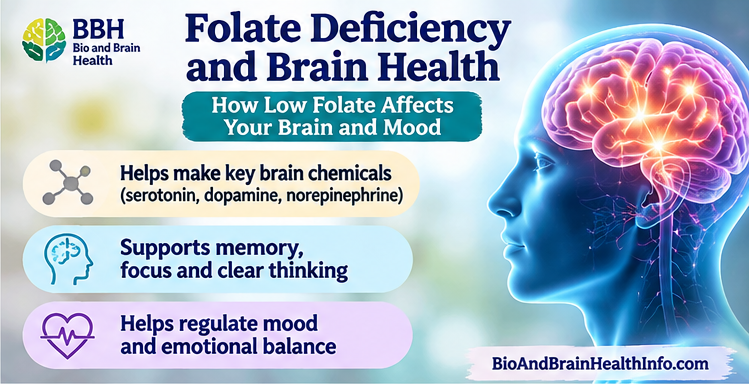
Not in the simple way suggested by some supplement advertisements. Folate-dependent metabolic reactions are relevant to normal neurological function, but this does not prove that increasing folate above adequate levels improves memory, motivation, or neurotransmitter activity. Evidence-based advice distinguishes correcting a real deficiency from taking extra vitamins for a promised brain boost.
For broader context, read our Vitamins and Minerals for Brain Health pillar guide.
7 Folate Deficiency Symptoms Worth Recognizing
The signs below can have many other explanations. One person may notice several; another may have an abnormal blood result without obvious anemia. A symptoms list is a prompt for evaluation, not a diagnostic tool.
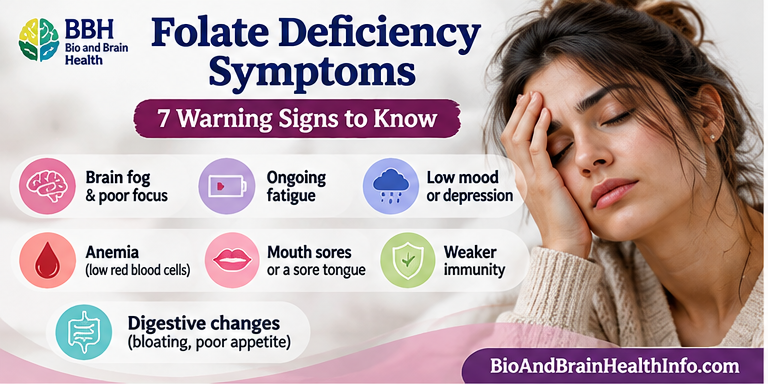
1. Folate Deficiency Symptoms: Persistent Fatigue
Folate deficiency and fatigue commonly appear together when deficiency has affected red blood cell formation. A person may feel tired after a full night’s sleep, struggle with physical exertion, or need more recovery time after ordinary activities. Tiredness can also be related to insufficient sleep, iron deficiency, thyroid disease, depression, medication effects, or other health conditions. Persisting or worsening symptoms merit proper assessment.
2. Brain Fog and Reduced Concentration
Difficulty concentrating is a recognized complaint in folate deficiency anemia. You may lose track of reading, take longer to make decisions, or find it harder to follow conversations. The phrase folate deficiency and brain fog describes a possible connection, not a unique syndrome. Sudden confusion is an emergency symptom, while gradual unexplained cognitive changes still deserve medical attention.
3. Irritability or Changes in Mood
Some people with low folate report irritability. Researchers have also studied the association between folate deficiency and depression. Observational associations do not establish the direction of cause, and depression can have multiple interacting biological, psychological, and social contributors. Folate is not a replacement for psychotherapy, prescribed medication, or professional mental health care.
4. Weakness, Palpitations, or Breathlessness
When anemia develops, a person may experience reduced exercise tolerance, a racing heartbeat, or breathlessness. These symptoms can also reflect heart, lung, and other conditions. New significant breathlessness, chest pain, or fainting requires prompt medical evaluation; do not try to treat it by taking a vitamin.
5. Headaches
Headaches are among possible folate deficiency symptoms, but they are far from specific. Dehydration, migraines, tension-type headaches, and other medical problems are common explanations. Seek urgent care for a sudden, extremely severe headache or a headache with neurological symptoms.
6. Mouth Ulcers or a Sore, Red Tongue
Folate deficiency can be associated with painful inflammation of the tongue and sores inside the mouth. Such changes also occur with local irritation, infections, or other nutrient deficiencies. If ulcers persist or recur, a dental or medical evaluation can help identify the cause.
7. Appetite and Digestive Changes
Loss of appetite, diarrhea, and gastrointestinal complaints may accompany deficiency. In some cases, digestive illness is not merely a symptom: conditions that interfere with nutrient absorption can also contribute to low folate. Persistent diarrhea, unintended weight loss, or other concerning digestive changes should be evaluated.
At-a-Glance Symptom Comparison
| What you notice | Possible folate-related explanation | Also consider |
|---|---|---|
| Tiredness and weakness | Megaloblastic anemia | Iron deficiency, poor sleep, other illness |
| Mental fog | Possible concentration difficulty | B12, thyroid, sleep, blood glucose, medication effects |
| Mood changes | Possible association; cause uncertain | Depression, stress, other conditions |
| Mouth ulcers | Possible tissue changes | Local irritation, infection, other deficiencies |
| Numbness or balance difficulty | Not typical of isolated folate deficiency | Urgently consider B12 or other neurological conditions |
Folate Deficiency and Brain Fog: Why the Connection Is Complicated
It is tempting to look for one nutrient to explain every lapse in attention. But brain fog is a description, not a precise medical diagnosis. It may include slowed thinking, difficulty sustaining attention, memory complaints, or mental exhaustion. Many pathways can produce similar experiences.
One plausible explanation is that advanced folate deficiency produces anemia and limits the body’s capacity for normal oxygen delivery. Folate is also involved in essential cellular metabolism. Yet that does not mean low folate symptoms always involve a direct neurological injury, or that normalizing folate will resolve cognitive complaints from another cause.
Can Low Folate Affect Your Mood?
Studies have explored folate status in people with depression, and some report associations between lower status and depressive symptoms. However, folate deficiency and depression should not be treated as equivalent diagnoses. People with severe or persistent low mood should receive an appropriate assessment; supplements should be discussed as part of care rather than substituted for it.
Can Folate Deficiency Occur Without Anemia?
Yes. Nutritional deficiency may be identified before obvious anemia appears. The NHS notes that some symptoms can occur without anemia. Conversely, a person can have fatigue or cognitive concerns without being folate deficient. This is why assessing vitamin B9 deficiency symptoms requires context, not a single symptom checklist.
Folate Deficiency vs Vitamin B12 Deficiency
This is one of the most important safety distinctions in the article. Both deficiencies can cause megaloblastic anemia and overlapping symptoms such as fatigue and mouth changes. Vitamin B12 deficiency, however, can also cause nerve damage, tingling or numbness, balance problems, and neurological difficulties, sometimes even without anemia.
| Feature | Folate deficiency | Vitamin B12 deficiency |
|---|---|---|
| Megaloblastic anemia | Possible | Possible |
| Weakness and reduced concentration | Possible | Possible |
| Mouth or tongue changes | Possible | Possible |
| Numbness and balance problems | Not typical in isolated deficiency | Important warning signs |
| High-dose folic acid alone | May treat confirmed folate deficiency if prescribed | Does not correct neurological damage from B12 deficiency |
Safety: Large doses of folic acid can correct certain blood abnormalities while an untreated B12 deficiency continues to damage nerves. Ask a clinician to consider B12 status before taking high-dose folic acid for unexplained symptoms. Related context: Vitamin B6 and Brain Health.
What Causes Low Folate Symptoms?
Diet alone does not explain every deficiency. Potential risk factors include low intake of vegetables and legumes, alcohol use disorder, celiac disease or other malabsorption conditions, increased needs during pregnancy, and certain medications that affect folate metabolism. Causes may overlap, so an individual can have more than one nutritional problem at the same time.
What About Methotrexate, Anti-Seizure Medicines, and Other Drugs?
Some medicines affect folate pathways. Whether additional folic acid is appropriate depends on the medicine and the medical indication. For example, folate management in someone prescribed methotrexate is a specific clinical decision; do not change the drug or invent your own supplement schedule. Bring a complete medication and supplement list to your appointment.
Does an MTHFR Gene Variant Mean You Cannot Use Folic Acid?
No. A common misconception is that having an MTHFR variant necessarily makes ordinary folic acid unusable. Public-health recommendations do not support that blanket conclusion. Routine gene testing is not a substitute for evaluating symptoms, diet, or actual nutritional status. The NIH advises that people who could become pregnant receive recommended folic acid even if they have a common MTHFR C677T variant.
How Is Folate Deficiency Tested?
A clinician may review medical history, dietary patterns, medicines, symptoms, and a complete blood count. Blood folate may be measured when appropriate; vitamin B12 testing is often important because deficiency patterns overlap. Other tests depend on clinical findings and may include evaluation for iron deficiency, thyroid problems, or additional causes of anemia and fatigue.
Is Serum Folate the Same as Red Blood Cell Folate?
No. Serum folate is influenced by recent intake and can reflect more recent folate status. Red blood cell folate may provide a longer-term view in some settings, but its usefulness depends on local practice and the clinical question. Neither number should be interpreted without laboratory reference ranges and medical context. Homocysteine can rise with folate deficiency, but it is not specific and can also be affected by B12 status, kidney function, and other factors.
Can You Diagnose Yourself From Online Symptoms?
No. Many folate deficiency symptoms are shared with other conditions. Even a food tracker cannot measure blood folate or identify the cause of brain fog. Use the tracker to organize your observations and questions, not to label yourself with a deficiency.
Foods High in Folate: Everyday Meal Options
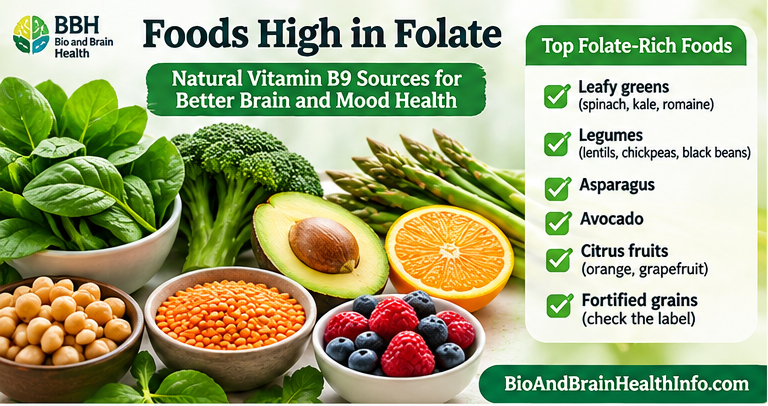
Natural folate is available from dark green vegetables, beans, lentils, chickpeas, asparagus, and other plant foods. Some breads, cereals, and grain products contain added folic acid, depending on the country and product. Eating a varied diet is valuable, although food changes alone may not be adequate treatment for a confirmed deficiency caused by malabsorption or other medical problems.
| Food | Indian meal idea | International meal idea |
|---|---|---|
| Spinach | Palak dal | Spinach and bean soup |
| Lentils | Masoor dal with roti | Lentil salad |
| Chickpeas | Chana curry | Chickpea and vegetable bowl |
| Kidney beans | Rajma rice | Bean chili |
| Broccoli | Vegetable sabzi | Roasted broccoli and tofu |
| Oranges | Whole fruit snack | Fruit with breakfast |
Foods high in folate can be included gradually within a balanced eating pattern. Actual nutrient amounts depend on serving size and preparation. Avoid assuming that one single food will correct all folic acid deficiency symptoms.
How Much Folate Do Adults Need?
Requirements differ by age, pregnancy status, and national guidance. In the United States, the recommended dietary allowance for adults is 400 micrograms of dietary folate equivalents (mcg DFE) per day, with higher amounts during pregnancy (600 mcg DFE) and breastfeeding (500 mcg DFE). The UK commonly states 200 micrograms of folate daily for adults; the measurement frameworks differ, so these are not directly interchangeable numbers.
People who could become pregnant should follow their country’s folic acid advice and their clinician’s guidance, because folic acid taken around conception helps prevent neural tube defects. This public-health recommendation is different from treating diagnosed deficiency.
What About the USA, UK, Canada, and Australia?
Readers should check their national dietary guidance and the labels on locally sold fortified foods. Requirements, fortification practices, and pregnancy recommendations vary. A US food label expressed as dietary folate equivalents should not be assumed to use the same measurement terminology as a UK label. A qualified dietitian can help interpret a dietary plan within local standards.
Treatment: Can Folic Acid Reverse Folate Deficiency?
Folate deficiency is treatable. When a clinician confirms it, folic acid tablets may be prescribed while the cause is addressed; follow-up depends on the situation. The NHS describes treatment commonly lasting several months for folate deficiency anemia, but there is no universal duration or dose suitable for every person.
Do not begin high-dose supplementation simply because you recognize vitamin B9 deficiency symptoms. In particular, B12 deficiency and medication interactions must be considered. More folic acid is not automatically safer or better. Diet, diagnosis, underlying disease, and treatment response all matter.
When Is Medical Attention More Urgent?
Seek medical assessment for persistent unexplained fatigue, worsening concentration, recurring mouth changes, significant breathlessness, or neurological complaints. Sudden confusion, facial drooping, one-sided weakness, or difficulty speaking requires emergency care. Numbness or walking difficulties also deserve prompt assessment. Never delay urgent care to try a dietary supplement.
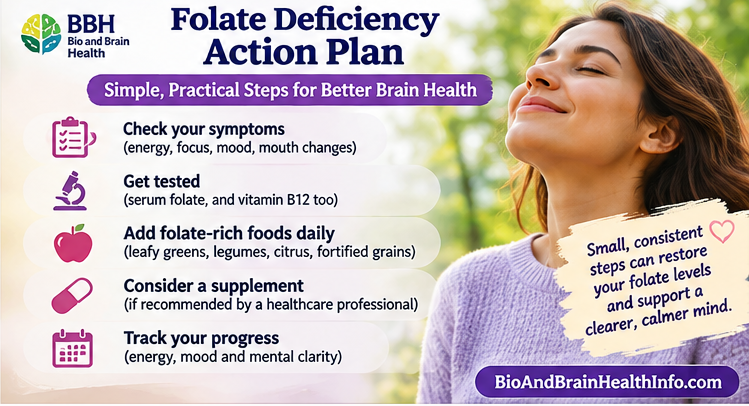
BBH Action Plan: Nourish, Notice, Check, Adjust
| Step | What you can do | What it cannot do |
|---|---|---|
| Nourish | Include varied folate-containing foods. | Guarantee treatment of a diagnosed deficiency. |
| Notice | Track energy, concentration, sleep, foods, and medicines. | Prove folate is the cause. |
| Check | Discuss persistent symptoms and appropriate tests with a clinician. | Replace individualized assessment. |
| Adjust | Follow professional advice and monitor progress. | Justify self-prescribed high doses. |
When you feel mentally tired, it can be easy to blame yourself for a lack of discipline. A more useful response is curiosity: What changed? What are the other possible causes? What information would help a clinician? Understanding low folate symptoms is one part of that inquiry, not a judgment about your motivation or character.
Explore the other educational comparisons in Vitamin B1 Deficiency Symptoms, Vitamin B2 Deficiency Symptoms, and Biotin Deficiency Symptoms. Similar complaints can have different causes and treatments.
People Also Ask
1. What are the first folate deficiency symptoms?
Possible early complaints include tiredness, weakness, irritability, and difficulty concentrating. They are nonspecific, so clinical assessment may be required. Some people may have low folate before obvious anemia develops.
2. Can folate deficiency and brain fog happen together?
Yes. Concentration difficulties may accompany folate deficiency, especially if anemia develops. Brain fog alone is not enough to identify a vitamin deficiency or prescribe treatment.
3. Is folate deficiency and depression a proven cause-and-effect relationship?
No. Research has described associations, but depressive symptoms have many possible causes. A person with depression needs appropriate clinical care and should not rely on folic acid as a stand-alone treatment.
4. What are foods high in folate?
Leafy greens, lentils, beans, chickpeas, asparagus, broccoli, and certain fortified grain products are common sources. Food amounts and folate content vary, so aim for dietary variety.
5. Can folic acid deficiency symptoms improve with treatment?
When symptoms are genuinely related to a confirmed folate deficiency, appropriate treatment may help. The outcome depends on the severity, underlying cause, other nutritional problems, and follow-up care.
Frequently Asked Questions
Is folate the same as vitamin B9?
Yes. Folate refers to vitamin B9; folic acid is a common synthetic form used in fortified foods and supplements. Labels can use different units, so read them carefully.
Can low folate occur with a normal hemoglobin result?
Yes. A deficiency may precede detectable anemia, and some symptoms may occur without anemia. Laboratory results should be interpreted in context.
Does a high homocysteine level diagnose folate deficiency?
No. Homocysteine is influenced by several factors, including B12 status, kidney function, and other conditions. It is not a stand-alone folate deficiency test.
Should I take methylfolate instead of folic acid?
Do not assume an alternative supplement is necessary because of online MTHFR claims. Discuss any supplement choice with your clinician, especially during pregnancy or when taking medication.
Can I prevent low folate with diet alone?
A varied diet helps maintain adequate intake, but some people have increased needs or absorption problems. A confirmed deficiency may need prescribed treatment and follow-up.
Free BBH Support Resource
7-Day Folate Food & Symptom Tracker
Record meals, concentration, energy, symptoms, and questions for your healthcare professional. A tracker cannot diagnose a vitamin deficiency.
Download Free 7-Day Folate Tracker (PDF)
Prefer email? Write to info@bioandbrainhealthinfo.com with the subject “BBH Folate Tracker.”
Browse more learning resources in Brain Health → Vitamins & Minerals.
BBH Support & Navigation
Explore related learning and support pages when you need a wider picture. These resources are educational and do not replace personal medical assessment.
Medical Safety Note
This article is general, evidence-informed education and is not a diagnosis or personalized treatment. Folate deficiency symptoms overlap with many other conditions. Never substitute supplements for evaluation of unexplained fatigue, depression, cognitive change, or neurological symptoms. A clinician can assess B12 status and possible causes before recommending folic acid treatment.
External Medical References
- NIH Office of Dietary Supplements — Folate: Health Professional Fact Sheet
- NIH Office of Dietary Supplements — Folate: Consumer Fact Sheet
- NHS — Vitamin B12 or Folate Deficiency Anaemia: Symptoms
- NHS — B Vitamins and Folic Acid
- NIH Office of Dietary Supplements — Vitamin B12: Health Professional Fact Sheet
Editorial note: Educational information based on public medical references; no individual medical assessment or professional medical review is claimed.