Why Do I Feel Unmotivated?
Why Do I Feel Unmotivated All the Time?

If you keep asking, “why do i feel unmotivated”, perhaps your mornings look like this: the list is ready, the goal still matters, but you sit at your desk and cannot bring yourself to begin.
Thank you for reading this post, don't forget to subscribe!You open a message, check the time, move a few objects around—and the important task remains untouched.
Start Here: Explore BBH Guides
Need a gentle starting point?
Visit our Start Here — Mental Health Guide for Beginners or browse our BBH Support Resources for practical self-help guidance.
Main Menu: Brain Mastery Submenu: Discipline & Action
Continue Reading
How to Increase Dopamine Naturally
Then comes the harder part: judging yourself. You promised that today would be different. You know you are capable of making plans, so why does following them feel so demanding?
There is no single explanation. Sometimes you need a more achievable first step. Sometimes you are overwhelmed, frightened of making a mistake, or pulled away by interruptions. And sometimes low motivation is connected to sleep, depression, medication effects or a health condition that needs proper care.
Why does motivation disappear?
Common lack of motivation causes include fatigue, stress, uncertainty, fear of failure, unclear priorities, constant interruptions or low mood. Rather than demanding more discipline from yourself, identify which barrier is strongest and choose a response that fits it.
If you are exploring how to get motivated when feeling stuck, a five-minute starting step may help with overwhelm; persistent exhaustion or loss of interest deserves a health assessment.
Start today: Ask, “What is stopping me right now—energy, emotion, clarity, environment or health?”
Six Reasons You May Feel Unmotivated
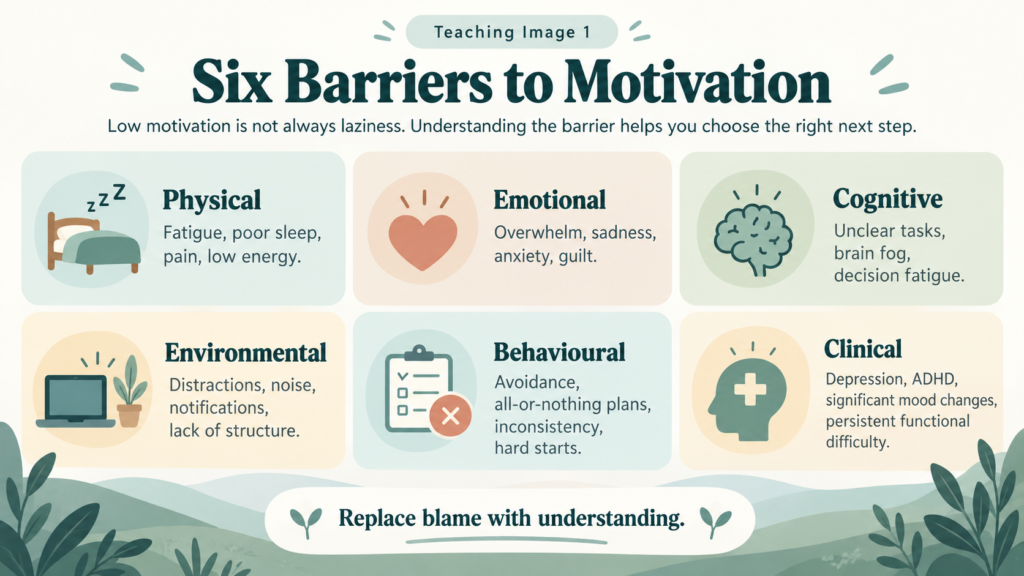
If you are asking why am i always unmotivated, the answer may differ from one day to the next. The explanation depends on the pattern you are living through. These six explanations may overlap; none is a diagnosis.
1. Your body may be tired, not unwilling
Imagine someone who slept badly, skipped a proper meal and spent the morning dealing with urgent responsibilities. Their afternoon concentration may disappear. Telling them to “try harder” misses the physical context.
The NHS guide to tiredness and fatigue notes that sleep difficulties, stress, medicines and medical conditions can contribute to persistent fatigue. If you are exhausted for weeks, or it affects daily functioning, get assessed rather than assuming it is a character flaw.
2. Your plan may be too large for the first step
The thought why do i have no motivation may arise when a goal seems impossibly large. “Write a book” is a meaningful direction, but not a starting action. “Open the draft and write the first two sentences” is. A large task can demand many decisions before the work even begins. Narrowing the next step may reduce that friction.
3. Uncertainty may make a task feel threatening
A person who has never contacted a potential client may delay even a simple introductory email. The real obstacle may be uncertainty: What should I say? What if they reject me? What if I cannot handle the response?
The brain’s emotional and decision-making networks respond to uncertainty and perceived consequences. This does not mean your amygdala classifies every unfamiliar task as dangerous. It means feelings and effort estimates can influence whether you start.
4. You may be emotionally overloaded
Conflict, grief, caregiving, money worries or prolonged stress can leave less attention available for other tasks. You might still care about your goals but feel unable to concentrate on them. Read BBH’s explanation of why small things can trigger big emotions for more context.
5. Your environment keeps interrupting you
If every notification competes with your work, repeatedly returning to a task becomes harder. You may not need more determination; you may need a quieter work environment, a simpler desk or a planned time to check messages. BBH’s guide Focus Is Not Silence looks at attention without demanding a perfectly quiet mind.
6. Low mood or a health condition may be involved
Loss of enjoyment, persistent low mood, altered sleep, fatigue and difficulty functioning may occur with depression and other medical or psychological conditions. The NHS depression symptoms guide describes these as possible symptoms—not proof of a diagnosis from a single feeling. If this fits your experience, seek professional help.
Please Read This :- how-to-increase-dopamine-naturally
Why Your Brain Can Plan a Goal but Resist Starting
Planning and execution overlap, but execution introduces new demands. Planning can be quick and imaginative. Acting asks you to select a step, focus, manage mistakes, tolerate uncertainty and use time and energy.
For example, someone might enjoy choosing a business name, arranging a calendar and imagining future customers. But calling the first customer involves social risk and real decisions. The difference between those experiences helps explain why knowing what to do is not always enough.
Dopamine contributes to reward learning and effort-related motivation. It is not a single motivation switch, and why do i feel unmotivated cannot be answered by assuming a dopamine deficiency. Our related article, How to Increase Dopamine Naturally, explains dopamine and lifestyle habits in greater detail.
“I make plans, but I struggle to stay motivated and consistent.”— Personal Reflection | Bio and Brain Health (BBH)
This sentence matters because it describes a common gap between intention and follow-through. It does not prove a particular brain-chemical problem. Our next step is to discover what gets in the way.
Three Real-Life Challenges: What Low Motivation Can Look Like
Low motivation does not look the same for everyone. Two people may struggle to complete a task but face
entirely different barriers. These examples show why understanding the situation matters before choosing a solution.
Example 1 — The Unfinished Business Task
Maya runs a small business and has a proposal due. She spends an evening choosing a new notebook, rearranging her calendar, and reading productivity tips. The proposal stays blank.
Her challenge is not necessarily a lack of ambition. The task contains many unknowns: the first sentence,
the client’s response, and whether her work will be good enough.
Write a rough three-line proposal outline, even if it is imperfect.
Example 2 — The Exhausted Caregiver
Daniel manages work, housework, and care for an older relative. By evening, he cannot face a promised exercise session. He calls himself lazy.
But when he looks at his week, he notices interrupted sleep, missed meals, and almost no downtime.
Protect basic recovery, ask for practical help, and seek medical advice if exhaustion continues.
Example 3 — The Person Who Keeps Restarting
Aisha makes a detailed Sunday plan: daily meditation, two hours of exercise, a spotless home, and a new professional course. By Tuesday, the plan collapses.
Instead of setting another ambitious schedule, she chooses two realistic minimums: five minutes of study after breakfast and a short evening walk.
Choose smaller, repeatable daily actions instead of demanding a perfect routine.
The Shared Lesson
People may look equally unmotivated from the outside while needing very different forms of support.
Find the barrier before choosing the tool.
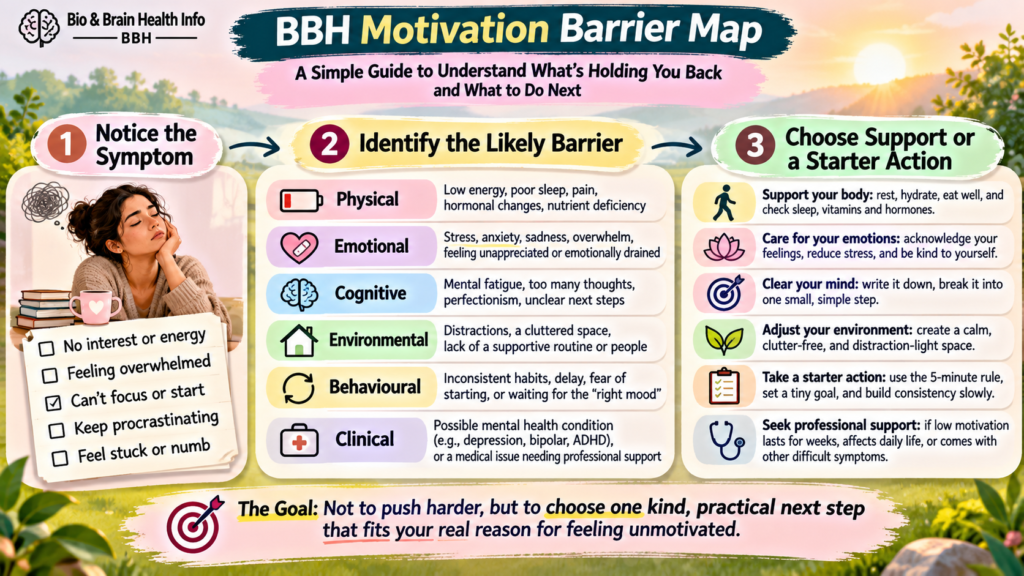
The BBH Motivation Barrier Map
Instead of asking only why do i feel unmotivated, ask which kind of difficulty you are experiencing today. This is an original BBH reflection tool, not a clinical assessment.
BBH Motivation Barrier Map: Find Your Next Step
Different motivation challenges need different solutions. Use this guide to recognize what may be making action
difficult and choose one realistic next step.
| What You Notice | Possible Barrier | Appropriate Next Step |
|---|---|---|
| My body feels heavy and tired | Physical fatigue | Check sleep, meals and symptoms; seek care if persistent. |
| I dread what might happen | Fear or uncertainty | Write down the feared outcome and make the first step safer. |
| I cannot decide where to begin | Unclear task | Define a five-minute observable action. |
| I start, then keep checking my phone | Environmental interruption | Reduce notifications for one short block. |
| I miss two days and abandon the plan | Inflexible routine | Choose a smaller daily minimum and return. |
| I enjoy almost nothing anymore | Possible mood or health concern | Discuss persistent symptoms with a clinician. |
BBH Note: This table supports self-reflection. It cannot diagnose the reason for low motivation or replace professional care.
Imagine two people who both say, “I have no motivation.” One is physically exhausted and needs assessment and recovery.
The other is rested but intimidated by an unfamiliar project and may benefit from a clear first step. The same productivity advice should not automatically be given to both.
How to Tell Which Kind of Help You Need
Try asking three questions in order.
First, is my body asking for recovery? Check sleep, regular meals, persistent pain, illness, medication effects, and the load of caring for other people.
Second, is my mind avoiding uncertainty? Look for perfectionism, fear of criticism, or a task whose next step has not been defined.
Third, is the environment working against me? Frequent alerts, difficult schedules, an unsuitable workspace, or too many competing obligations can make follow-through harder.
Use your answers to choose one response for today. Recovery might mean making a health appointment or taking a genuine break.
Uncertainty might mean requesting clarification or drafting a deliberately imperfect first version. Environmental friction might mean preparing your materials the evening before and turning off two unnecessary notifications. You do not have to solve all three barriers at the same time.
If you repeatedly feel unable to enjoy activities you once valued, if daily functioning is declining, or if your energy stays unusually low despite basic self-care, speak with a qualified health professional. A productivity checklist cannot determine whether an underlying condition needs attention.
Seven Ways to Start When You Feel Stuck
If you search why do i feel unmotivated because the same problem happens every day, experiment with one strategy rather than attempting all seven simultaneously.
1. Make the first step five minutes long
Choose one specific task, set a five-minute timer and give yourself permission to stop afterward. Opening a document, replying to one message or laying out walking shoes counts as beginning. You might continue, but the technique does not guarantee that you will.
2. Link the action to a familiar cue
Try, “After I finish breakfast, I will sit at the desk and draft one paragraph.” The cue makes the starting point more specific. A routine can be meaningful without becoming rigid or punitive.
3. Make distracting habits less convenient
Move the phone out of reach, silence nonessential alerts or work with only one browser tab open. You do not need a “dopamine detox”; digital boundaries can help without claiming to chemically reset the brain.
4. Build movement into the day
A short walk or gentle shoulder and leg movement may make a break more restorative. If a twenty-minute walk is realistic for you, use it; if not, start with less. For ongoing fatigue, adjust physical activity to clinical advice rather than pushing through concerning symptoms. The NHS self-help guidance for tiredness recommends gradual movement where suitable.
5. Acknowledge the effort, not only the outcome
If you prepared a difficult email but did not send it yet, you still identified the next step. Notice that progress without pretending the task is complete. A brief review can be kinder and more informative than a list of everything you did not accomplish.
6. Use a realistic return plan
“Never miss two days” may motivate some people, but for others it can create pressure. A more flexible rule is: after an interruption, restart with the smallest useful version of the habit. Our related BBH article Why Habits Don’t Stick explores what makes consistency difficult.
7. Make room for pleasure and human connection
Music, a conversation, time with a pet, a hobby or a quiet moment outdoors can support well-being. These experiences do not need to become productivity tools. They can simply be worthwhile parts of a full life.
Can Spiritual Reading, Mala and Prayer Help You Begin?
For some readers, a routine rooted in faith or spiritual reflection feels more meaningful than a productivity trick. Reading a few pages of a spiritual text, sitting with a mala, repeating a mantra or breathing gently may offer a familiar pause before starting the day.
The value may be in attention, steadiness, meaning and the regular cue—not in a proven dopamine surge or “amygdala healing.”
A person might read for five minutes, sit quietly, take a comfortable walk and then open the day’s first work task. Others may prefer secular reflection or mindfulness. Both approaches are welcome.
A small spiritual example: Imagine someone sitting with a long to-do list and feeling guilty for not beginning.
Instead of using prayer as another task to complete, they read a meaningful verse, spend a few quiet moments with a mala, and ask, “What is one responsible action I can take with the energy I have today?”
They then open a work document for five minutes. The spiritual pause does not magically create motivation; it may help connect action to personal values and reduce the pressure to do everything at once.
BBH Mind–Body–Purpose Practice
Reconnect with your mind, care for your body, and choose one meaningful action.
01 · MIND Read a few reflective pages or write one intention. | 02 · BODY Walk or move comfortably within your abilities. | 03 · ACTION Choose the first five-minute step that fits today. |
BBH Note: This is an optional well-being practice, not a replacement for medical or psychological treatment.
When a Five-Minute Start Does Not Work
Sometimes you open the document, set the timer, and still cannot concentrate. That does not mean the experiment has failed or that you should punish yourself with a harder task.
Five minutes is one possible entry point, not a universal solution. You may need to simplify the assignment, change the time of day, take care of a physical need, ask someone to sit with you while you work, or rest.
Three Situations That Need Different Solutions
1. The exhausted student:
A student who has not slept well may need sleep more than another study session.
2. The freelancer waiting for information:
Someone missing important project details may need to email a client rather than forcing another hour of uncertain work.
3. The person experiencing emotional numbness:
Someone who feels persistently numb or hopeless may need support from a health professional, not another accountability challenge.
A Kinder Fallback Plan
- Write down what made the action difficult.
- Identify the smallest helpful next step.
- Decide when to revisit the task.
If the obstacle is serious or keeps recurring, seek practical or professional assistance instead of repeatedly blaming yourself.
What If Your Motivation Disappears Again Tomorrow?
When you wonder why do i feel unmotivated the day after a productive afternoon, remember that energy and circumstances change. A useful plan has room for that variation.
Consider a person who finishes thirty minutes of work on Monday but manages only five minutes on Tuesday because of poor sleep.
Instead of declaring the week ruined, they can record the barrier, protect needed rest, and return when able. In this example, consistency means maintaining a workable relationship with the goal, not producing identical results every day.
The NHS Tackling Your To-Do List resource recommends identifying avoided activities and gradually building structure. This is more useful than interpreting every difficult morning as failure.
Where to Get Help When Motivation Becomes a Daily Struggle
For confusion about your first step: a teacher, supervisor, mentor, or trusted colleague may be able to clarify the task, adjust deadlines, or help you break a project into stages. Asking for clarity is a constructive action, not a failure.
For physical fatigue or sleep problems: contact a primary-care clinician, particularly when tiredness is new, persistent, worsening, or accompanied by other symptoms. Keep a short record of sleep, meals, energy patterns, and relevant symptoms to make the conversation easier.
For emotional overload or persistent low mood: consider a licensed mental health professional and a trusted person in your support network. If motivation difficulties are affecting work, relationships, or basic daily care, that impact itself is a reason to seek support.
For gentle self-guided support: use BBH’s Start Here mental health guide and Support Resources hub for educational reading and reflection tools. These pages supplement rather than replace individualized care.
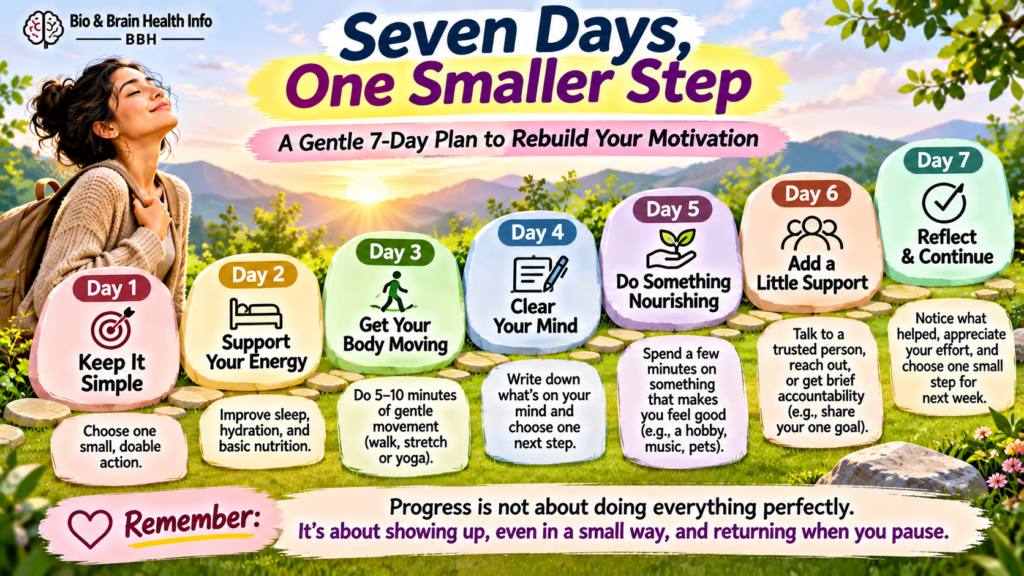
A Realistic 7-Day Motivation Experiment
You do not need to transform your entire routine in one week. Use these seven days to notice your barriers, practise small actions, and discover what feels sustainable.
| Day | Action | Question to Reflect On |
|---|---|---|
| 1 | Notice energy and mood | When do I struggle most? |
| 2 | Pick one avoided task | What part feels uncertain? |
| 3 | Try five minutes | Did a smaller start help? |
| 4 | Reduce one interruption | What pulled my attention away? |
| 5 | Move or reflect gently | What supported steadiness? |
| 6 | Repeat a clear cue | Did the starting moment feel easier? |
| 7 | Review, adjust, return | What should I simplify next week? |
BBH Reminder:
Progress does not require seven perfect days. If you miss a day, return when you can. The purpose is to understand your needs and build a more realistic routine.
This is a self-reflection exercise, not a diagnostic test or a programme guaranteed to change dopamine levels.
People Also Ask
1. Why do I feel unmotivated even when I have goals?
Goals describe what you want, while taking action also requires energy, attention, decisions and manageable effort. Stress and unclear tasks may interfere.
2. Is feeling unmotivated the same as being lazy?
No. Low motivation is a description of an experience, not a diagnosis of character. Consider fatigue, emotional load, environment and health.
3. Can poor sleep cause lack of motivation?
Yes. Sleep problems can affect energy, attention and everyday functioning. Persistent fatigue warrants medical review.
4. How do I start when I have no motivation?
Define a small, specific action and an appropriate time to attempt it. If you are unwell or overwhelmed, address that barrier first.
5. Does dopamine detox fix low motivation?
No literal dopamine detox is established. Limiting distracting digital habits may still improve your work environment.
Frequently Asked Questions
1. Why do I feel unmotivated all the time?
Ongoing low motivation can involve stress, sleep problems, mood changes, ADHD-related difficulties, medication effects or illness. Seek an assessment if it persists or disrupts your life.
2. Can I build discipline without feeling inspired?
Yes, some tasks become easier with a familiar cue and manageable first step. Discipline should not mean ignoring exhaustion or illness.
3. What is the five-minute rule?
It is an experiment in doing only five minutes of a chosen task. Continuing is optional; starting is the achievement.
4. Is spiritual practice a treatment for low motivation?
No. Prayer, mala or reflection may offer structure and meaning for some people, but they are not substitutes for needed clinical care.
5. When should I talk to a doctor?
If low motivation is persistent, affects daily life, comes with prolonged exhaustion or loss of pleasure, or accompanies major mood changes, seek professional assessment.
Health and Safety Note
Low motivation cannot be diagnosed as a dopamine deficiency from symptoms alone. Persistent loss of interest, severe fatigue, hopelessness, or difficulty functioning may require professional assessment.
Practical routines and spiritual practices can support well-being, but they cannot replace medical or mental health treatment.
Important:
If there is immediate danger or thoughts of self-harm, seek urgent local emergency or crisis support.
A Personal Reflection: Goals, Guilt, and the First Step
A familiar experience is to make a thoughtful plan, care deeply about the outcome, and still struggle to begin. In that moment, another motivational quote may not help.
A useful question is more practical:
What is making this particular action hard today?
“I make plans, but I struggle to stay
motivated and consistent.”
This lived insight captures the gap between intention and action without assuming that every reader has the same cause.
Some days the answer may be fatigue; other days it may be fear of getting the work wrong, a crowded schedule, or uncertainty about the next step.
The goal is not to make every difficult feeling disappear before acting. It is to respond wisely to what is happening and choose a realistic next move.
The BBH Approach
Care for the body, notice the emotional load, define one action, and return when possible. If the problem persists, asking for help is also progress.
Final Thought: Find the Barrier Before Blaming Yourself
Maybe your first task is genuinely too large. Maybe your environment is distracting. Maybe your body needs rest, or your mood needs attention. A good plan responds to the real problem rather than punishing you for having one.
The next time you ask why do i feel unmotivated, look for the barrier first. Choose one action that fits your energy and circumstances. And if you need help, let asking for it be your next action.
“The goal is not to win every day.
It is to understand what helps you return.”
FREE BBH PRINTABLE RESOURCE
BBH Motivation Barrier Checklist
Feeling unmotivated but unsure why? Use this free printable worksheet to recognize possible barriers and choose one realistic next step.
The checklist helps you reflect on physical fatigue, emotional pressure, task uncertainty, distractions, and difficulties maintaining habits.
What Is Included?
- Six possible motivation barriers
- Personal reflection checklist
- Practical next-step guidance
- Seven-day motivation action plan
- Guidance on when to seek support
Free PDF:
Download the BBH Motivation Barrier Checklist and Free Motivation Barrier Checklist PDF
BBH Note:
This worksheet supports personal reflection. It does not diagnose a medical or mental health condition or replace professional care.
Related Workbook:
An optional Amazon workbook resource may be added here after publication. The free checklist will remain available independently.
MORE FROM BBH
Start With the Support That Fits You
New to Bio and Brain Health? Visit our Start Here mental health guide to choose a helpful beginning based on your needs and circumstances. Explore our Brain Mastery menu and Discipline & Action collection for related articles about motivation, attention, habits, and practical daily action.
Continue Exploring
You can also explore the five related BBH articles linked throughout this guide, covering dopamine, habit consistency, focus, nervous-system emotions, and low mood.
If changes in motivation are accompanied by sadness or emotional heaviness, read Feeling Sad for No Reason for another perspective on emotional well-being.
BBH Reminder:
Educational resources can support understanding, but persistent symptoms or difficulties with everyday functioning deserve appropriate professional assessment.
References and Further Reading
Editorial Disclaimer
This article is educational and cannot replace diagnosis or individualized medical care. Scientific research should be reviewed as evidence changes.
Written by Shubhangi Halande for Bio and Brain Health (BBH).
Illustrative examples are fictional scenarios, not attributed personal accounts. No clinical review is implied.