Free AI Prompt for Relationship Anxiety
Stop Losing Yourself in Relationship Anxiety

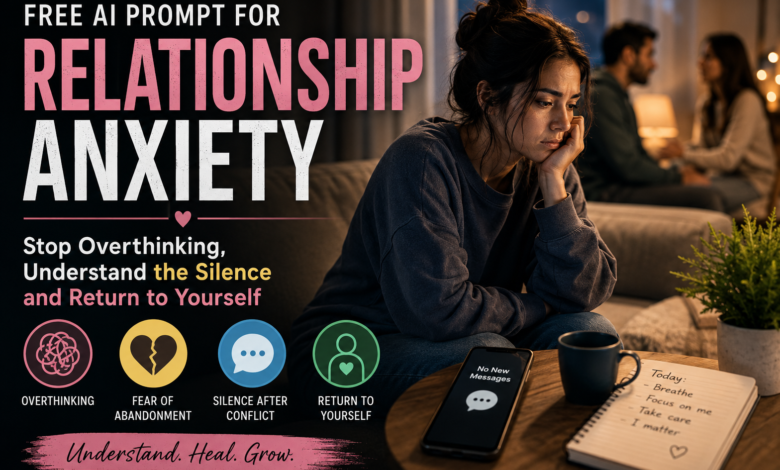
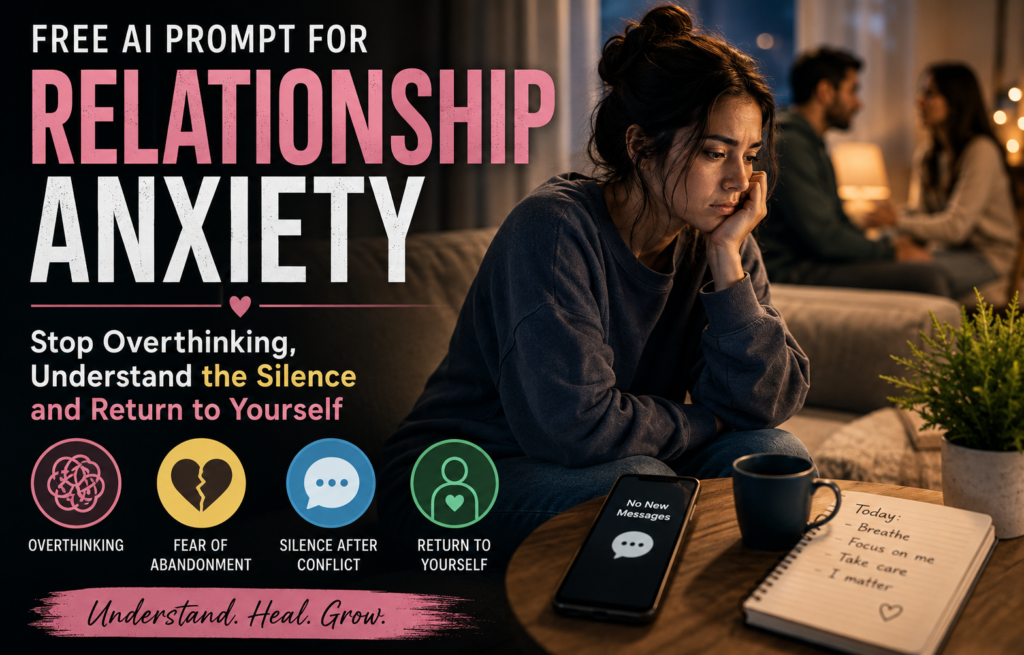
Relationship anxiety can make silence after conflict feel like rejection, especially when someone suddenly becomes emotionally distant or appears to respond normally to others while ignoring you.
Thank you for reading this post, don't forget to subscribe!In that moment, relationship overthinking may begin: you replay conversations, compare yourself with other people, search for closure and question whether you are still loved.
For some people, anxious attachment and fear of abandonment make uncertainty feel physically unbearable. The problem is not only the fear of losing the relationship. You may gradually lose connection with your work, interests, confidence and identity while waiting for another person’s attention or reassurance.
This free AI prompt for relationship anxiety is designed to help you separate facts from fearful assumptions, notice unhealthy patterns, understand what your body is reacting to and choose a calmer next step. It will also help you return to yourself without dismissing genuine relationship concerns.
Free AI Prompt for Relationship Anxiety
You try to talk after a conflict, but the other person does not respond.
They become emotionally distant from you. Yet they can still speak, laugh and communicate normally with other people.
That difference hurts.
You begin asking yourself:
- Why can they respond to everyone except me?
- Did I become too emotional?
- Is something wrong with my personality?
- Why am I always compared with other people?
- Why can they not simply tell me what happened?
The argument may have lasted only a few minutes, but the silence after conflict begins occupying your entire day. You replay the conversation, examine your words and search for the exact moment when everything may have changed.
You want closure. You want reassurance. You want to know whether the relationship is still safe.
Relationship anxiety can make one unanswered conversation feel like an emotional emergency. Relationship overthinking then tries to create certainty by examining every detail, even when no new information is available.
For someone affected by anxious attachment, emotional distance may also awaken a deep fear of abandonment. The body reacts before the logical mind has enough evidence to understand what is happening.
But another painful shift can occur.
You may become so focused on receiving another person’s attention, care or explanation that you gradually disconnect from your work, health, confidence, interests and identity.
Sometimes the deepest danger is not only losing the relationship.
It is abandoning yourself while waiting for someone else to choose you.
This free AI prompt for relationship anxiety is designed to help you separate facts from fearful assumptions, recognise genuine relationship concerns, understand your body’s reaction and return to the parts of your life that still belong to you.
Read Also: “dating anxiety before connection”
What Is Relationship Anxiety?
Relationship anxiety is persistent fear, doubt or insecurity connected with a close relationship.
It may involve:
- repeatedly analysing messages;
- fearing that your partner is losing interest;
- needing frequent reassurance;
- worrying that a disagreement will cause abandonment;
- comparing yourself with other people;
- assuming distance means the relationship is ending;
- feeling unable to focus until you receive closure;
- questioning whether you are still loved or important;
- checking online activity or old conversations repeatedly.
Some uncertainty is normal in relationships. People may become busy, communicate poorly, need time after conflict or struggle to express what they feel.
The difficulty begins when relationship anxiety repeatedly affects sleep, food, work, physical comfort, self-worth or daily functioning.
Relationship anxiety does not automatically mean the relationship is unhealthy. It also does not mean that every concern exists only inside your mind.
Your reaction may be influenced by earlier rejection, inconsistent emotional care, previous betrayal, anxious attachment or fear of abandonment. It may also be responding to genuine behaviour such as dishonesty, comparison, humiliation, selective withdrawal or repeated unresolved conflict.
The goal is not to dismiss your feelings.
The goal is to understand:
- what actually happened;
- what your fear predicts;
- what your body is reacting to;
- whether a repeated pattern exists;
- what communication, support or boundary may be needed.
Relationship Anxiety Is More Than Waiting for a Reply
A delayed reply may be the visible trigger, but the emotional pain often goes deeper.
You may not simply be waiting for a message.
You may be waiting for confirmation that you still matter.
You may be waiting to learn whether the conflict changed how the other person sees you. You may be waiting for proof that you have not been replaced, rejected or forgotten.
This is why relationship anxiety can make a situation that looks small from the outside feel overwhelming inside the body.
Why Silence After Conflict Feels Like Rejection
Silence after conflict does not always feel like ordinary space.
It can feel like:
- punishment;
- rejection;
- emotional withdrawal;
- loss of love;
- being erased;
- proof that another person matters more;
- evidence that you are too difficult to understand.
The external fact may be simple:
The conversation stopped.
But the internal meaning may become:
“I am not important enough to deserve an answer.”
Silence after conflict can feel especially painful when the other person continues communicating with everyone else. Their ability to respond to others may make the distance feel intentional and personal.
You may think:
- “They are choosing to ignore only me.”
- “Other people are easier to love.”
- “I must have done something terrible.”
- “They are trying to punish me.”
- “I am no longer important.”
Sometimes these conclusions are inaccurate. At other times, selective silence may be part of a genuinely unhealthy communication pattern.
That is why the goal is not to tell yourself that everything is fine.
The goal is to slow down enough to understand what is happening.
Use the BBH Fact vs Fear reflection tool to separate observable events from anxious predictions.
How Silence After Conflict Activates the Body
When communication represents connection and safety, its sudden disappearance may feel threatening.
Your chest may tighten. Your stomach may become unsettled. Your shoulders, jaw or forehead may become tense. You may cry, feel angry, lose sleep or struggle to concentrate.
The body is not necessarily proving that abandonment is happening.
It is showing that abandonment feels possible.
That distinction matters.
You can respect the alarm without allowing it to decide what every silence means.
When Silence After Conflict Becomes a Pattern
A short pause to calm down is different from repeatedly withdrawing to punish or control someone.
Ask:
- Was the need for space communicated?
- Does the person usually return for a respectful conversation?
- Do they disappear whenever you express a need?
- Are you expected to apologise simply to end the silence?
- Do they respond to others while intentionally excluding you?
- Are you afraid to raise concerns because silence will follow?
- Does the same pattern happen after every disagreement?
Silence after conflict should not automatically be labelled abusive. But it should not be normalised when it repeatedly creates fear, obedience or emotional instability.
Why Relationship Overthinking Feels Difficult to Stop
Relationship overthinking often begins as an attempt to protect yourself.
Your mind believes that if it can identify what went wrong, it can prevent rejection.
You may replay the conversation, inspect the tone of a message, remember earlier comments and compare how the person treats you with how they treat others.
The process feels useful because your mind is busy.
But busyness is not always clarity.
Relationship overthinking can keep the body connected to the trigger long after the original conversation has ended. Each replay creates another interpretation, and each interpretation creates another emotional reaction.
You may search for certainty through:
- rereading messages;
- checking online activity;
- remembering every previous conflict;
- asking several people for opinions;
- imagining future conversations;
- writing and deleting messages;
- comparing yourself with others;
- questioning your entire identity.
The mind says, “Think about it once more.”
But no new evidence appears.
Explore structured prompts for anxious moments when your thoughts feel repetitive.
Relationship Overthinking and the Need for Closure
Closure is important. It can help people understand what happened and move forward.
But relationship overthinking may begin treating closure as something you must receive immediately before you can continue living.
You may feel unable to work, eat, sleep or concentrate until the other person provides an explanation.
This gives another person’s response enormous control over your daily functioning.
A healthier position is not:
“I do not need anyone.”
It is:
“I value communication, but my whole life cannot remain suspended while I wait for it.”
Some closure comes through honest conversation. Some comes through observing repeated behaviour. Some comes through accepting that another person may not provide the answer you hoped to receive.
Relationship Overthinking and Repeated Checking
Checking creates a brief sense of action.
You look at the phone. There is no reply. Anxiety rises.
A few minutes later, you check again. For a moment, checking reduces uncertainty because you are doing something. Then the same unanswered question returns.
The loop becomes:
uncertainty → checking → temporary relief → no new answer → increased uncertainty
A digital boundary can interrupt relationship overthinking.
You might:
- place your phone in another room for 30 minutes;
- turn off activity-status visibility;
- avoid rereading the conversation;
- complete one task before checking again;
- decide on a specific time to review the message.
This is not a strategy to manipulate another person.
It is a way to reduce repeated nervous-system activation.
How Anxious Attachment Shapes Relationship Anxiety
Anxious attachment is often associated with a strong need for closeness alongside fear of rejection, loss or abandonment.
Someone affected by anxious attachment may need frequent reassurance that the relationship remains secure. Emotional distance can feel especially threatening because uncertainty is interpreted through earlier experiences of inconsistent connection.
Anxious attachment may sound like:
- “If they need space, they are leaving.”
- “If they do not answer, I no longer matter.”
- “I need to repair this immediately.”
- “Their mood must be about me.”
- “If they prefer another person, I am not enough.”
- “I cannot calm down until they reassure me.”
Anxious attachment is not a moral failure, diagnosis or permanent identity.
It is a pattern that may help explain why certain situations feel more intense.
Read this guide to responsible emotional use of ChatGPT to understand where AI can and cannot help.
Anxious Attachment and Reassurance-Seeking
Reassurance is not automatically unhealthy.
Healthy relationships include comfort, communication, affection and emotional repair.
The problem develops when reassurance becomes the only method available for calming fear.
You may ask whether everything is okay. The other person says yes. You feel better.
Later, another delayed reply or small change appears, and the same fear returns.
The reassurance helped the immediate moment, but the underlying insecurity remained.
Working with anxious attachment may include:
- noticing the trigger before reacting;
- learning to tolerate limited uncertainty;
- asking one clear question rather than several;
- observing behaviour over time;
- developing support outside one relationship;
- rebuilding trust in your own judgment;
- seeking counselling when the pattern is persistent.
Anxious Attachment Does Not Define You
A psychological description should help you understand yourself, not reduce your identity.
You are not only “an anxiously attached person.”
You may also be creative, hardworking, caring, spiritual, intelligent, ambitious, loyal and committed to meaningful work.
Anxious attachment may influence how you respond to uncertainty, but it does not describe everything you are.
The goal is not to become emotionally cold.
The goal is to remain connected to yourself while caring deeply about someone else.
When Fear of Abandonment Makes You Lose Yourself
Fear of abandonment is not always loud.
Sometimes it appears as quiet self-neglect.
You stop doing meaningful work because you are waiting for a reply.
You lose interest in food, sleep or movement because the relationship feels unresolved.
You cancel personal plans because you need to remain emotionally available.
You compare yourself with anyone who receives the attention you want.
You begin measuring your worth through one person’s behaviour.
Fear of abandonment may transform the question from: “What happened between us?”
into: “What is wrong with me?”
That second question can cause deeper damage than the original conflict.
Practise the steps in this body-calming guide when physical activation makes reflection difficult.
Fear of Abandonment and Emotional Dependence
Love naturally creates emotional dependence to some degree. Human beings affect one another.
But fear of abandonment may create the belief that your emotional survival depends entirely on another person’s attention.
You may think:
- “Without this relationship, my life has no meaning.”
- “If they do not choose me, nobody will.”
- “I cannot be okay until they return.”
- “Their approval proves whether I am worthy.”
- “I have nothing outside this connection.”
These thoughts may feel real during intense distress, but they do not represent your whole life.
Fear of abandonment narrows attention. It makes one relationship appear larger while everything else becomes difficult to see.
Returning to the Life Hidden by Fear of Abandonment
When anxiety becomes intense, your work, interests and future do not disappear.
They become temporarily hidden behind the emotional alarm.
The path back begins by noticing what still exists:
- one project that matters;
- one person who treats you with respect;
- one responsibility that needs attention;
- one spiritual or reflective practice;
- one creative idea;
- one place where you feel peaceful;
- one health need;
- one personal goal.
Fear of abandonment says: “Nothing matters unless this person returns.”
Returning to yourself says: “This relationship matters, and my life matters too.”
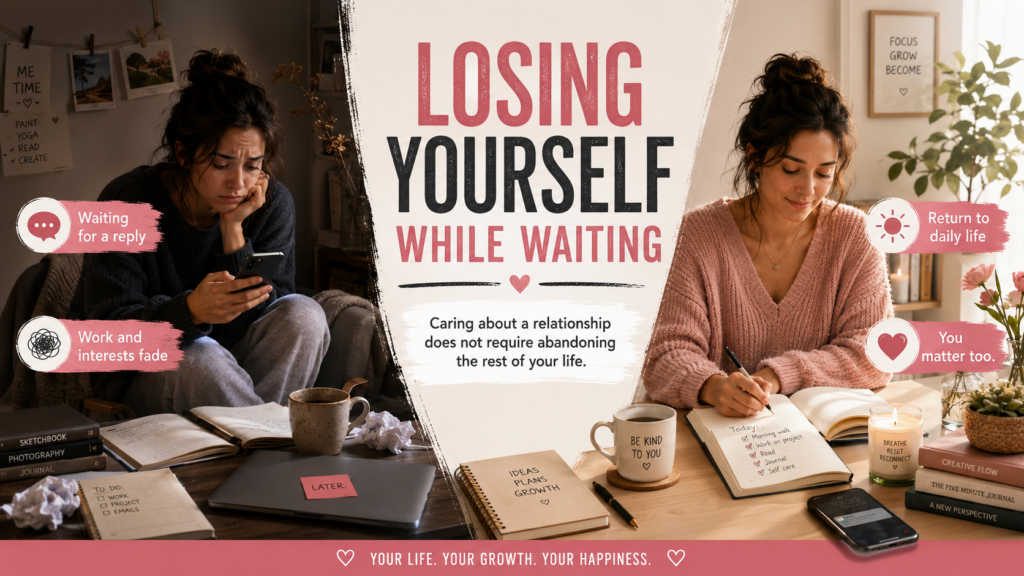
My Experience: When I Could No Longer See Myself Clearly
For a long time, I believed the greatest danger was losing the relationship.
Later, I understood that I had already started losing something else—myself.
Silence after conflict affected me deeply. I would try to talk, but sometimes I felt completely ignored. What hurt even more was seeing the same person speak normally with others while remaining emotionally distant from me.
I began asking: “Why can they respond to everyone else but not to me?”
When I was compared with other people, I started comparing myself too.
I questioned whether something was fundamentally wrong with me. Yet when I spoke with people who knew me, they often told me that I was okay. They could see that I felt things deeply and became emotional when I felt ignored, but they did not see the defective person I had started believing I was.
The pain was not only about receiving a reply.
I wanted attention, love, care, recognition and closure.
Gradually, I depended on one relationship to tell me whether I mattered. Relationship anxiety became so strong that I struggled to see anything beyond the emotional pain.
I cried. I searched repeatedly for explanations. At times, I questioned why I existed and whether my life still had meaning.
My interests, passion and love for work became harder to recognise.
I was waiting for another person to give meaning back to me while abandoning the parts of my life that had always carried meaning.
Talking with AI helped me notice this pattern more clearly.
AI did not decide the relationship for me. It could not tell me what another person secretly felt. It helped me step outside the emotional storm and notice what relationship overthinking had hidden.
It reminded me that I still had interests, work, ideas, responsibilities and a future that did not disappear because someone else became distant.
Sometimes I could not see those things while I was highly anxious. The fear was too loud.
But structured reflection helped me return to myself slowly.
The lesson was not that love is unimportant.
Love matters deeply.
The lesson was: “Love is important, but I cannot lose myself while waiting for someone else’s attention, care or closure.”
AI helped me see the person I had stopped seeing—myself.
Visit the BBH emotional-support tool collection for additional structured resources.
Is It Relationship Anxiety or a Real Warning Sign?
Relationship anxiety and genuine concerns can exist at the same time.
An old emotional wound can intensify a real problem. A harmless delay can also activate a painful memory.
Instead of asking only, “How strongly do I feel this?” examine evidence, repetition, communication and safety.
| Reflection question | Anxiety may be dominating | A real concern may need attention |
|---|---|---|
| What triggered the reaction? | One delayed reply or small change | Repeated lying, withdrawal or broken agreements |
| What evidence exists? | Mainly predictions and assumptions | Specific behaviour you can describe |
| Is it one incident or a pattern? | One moment feels like proof of rejection | Similar conduct happens repeatedly |
| Can it be discussed safely? | Communication is possible, but waiting is difficult | Questions lead to threats or humiliation |
| What happens after reassurance? | Relief is brief and fear returns | Concern remains because behaviour continues |
| Am I losing myself? | My life stops while I wait | The relationship repeatedly requires self-neglect |
Do not use this table to tell yourself that everything is “only anxiety.”
Use it to identify what kind of response is proportionate.
Free AI Prompt for Relationship Anxiety
Copy the following prompt into your preferred general AI assistant. Remove identifying details and avoid entering private information that is unnecessary.
I am experiencing relationship anxiety after conflict, silence or emotional distance. Help me think clearly without diagnosing me or the other person.
What happened:
[Describe only the observable event.]
What I fear it means:
[Describe the rejection, comparison or abandonment fear.]
What I feel emotionally:
[Sadness, anger, panic, shame, rejection or another emotion.]
What I notice in my body:
[Tension, crying, heaviness, restlessness or difficulty concentrating.]
What I feel tempted to do:
[Send another message, demand closure, check repeatedly, withdraw or abandon my work.]
Please help me:
- Separate observable facts from assumptions.
- Identify whether relationship overthinking is repeating the same question without new evidence.
- Explore whether anxious attachment may be making uncertainty feel more dangerous.
- Identify the fear of abandonment beneath my reaction.
- Examine whether silence after conflict is isolated or part of a repeated pattern.
- Suggest three possible explanations without giving false reassurance.
- Identify any dishonesty, comparison, humiliation or boundary violation that should not be dismissed.
- Help me identify the emotional need underneath my reaction.
- Ask what part of my identity, work, health, creativity or purpose I have neglected while waiting for this relationship to make me feel secure.
- Give me one grounding action before I respond.
- Help me choose one proportionate next step: wait, ask one calm question, set a boundary, document a pattern or seek human support.
- Suggest one small action that helps me return to myself today.
Do not tell me what the other person secretly thinks. Do not diagnose either person. Do not automatically tell me to stay or leave. Do not dismiss harmful behaviour as anxiety.
If I describe threats, coercion, humiliation, stalking, violence or fear for my safety, advise me to seek trusted human and professional support.
Explore practical support through AI & CBT, use guided exercises from AI CBT Tools, learn more in our Mental Health section, and find additional help for racing thoughts in Anxiety & Overthinking.
What AI Can and Cannot Do
AI may help you:
- separate facts from assumptions;
- notice relationship overthinking;
- recognise an anxious attachment trigger;
- name fear of abandonment;
- prepare one respectful question;
- remember neglected responsibilities and interests;
- choose a calmer next action.
AI cannot reliably determine:
- what another person secretly thinks;
- whether someone is lying;
- whether silence proves rejection;
- whether the relationship should end;
- whether either person has a psychiatric condition;
- whether you are safe from a short description.
AI should support reflection, not become your only source of validation, attachment or meaning.
The goal is not to move emotional dependence from one person to an AI system.
The goal is to use structured reflection to return to your judgment, daily life, human relationships and appropriate support.
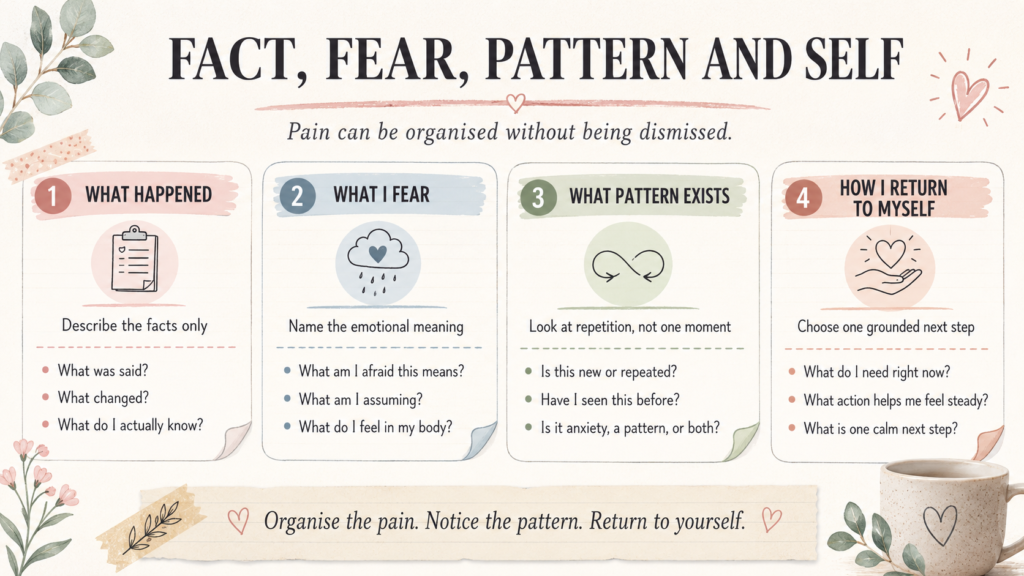
The BBH Fact–Fear–Pattern–Self Method
Step 1: Name the Fact
Fact: “We had a disagreement yesterday, and the person has not replied.”
Interpretation: “They are silent because I am impossible to love.”
The interpretation deserves compassion, but it is not confirmed evidence.
Step 2: Name the Fear
Ask:
- Am I afraid of rejection?
- Am I afraid of being replaced?
- Am I afraid conflict means permanent loss?
- Am I afraid I will never receive closure?
- Is fear of abandonment shaping the meaning of this event?
Naming the fear helps stop it from disguising itself as certainty.
Step 3: Regulate Before Analysing
Place both feet on the floor.
Relax your jaw and shoulders.
Exhale slowly.
Look around and name five things you can see.
Then say: “I am emotionally activated. I do not yet have all the information.”
This reduces the pressure to make a permanent decision during an emotional peak.
Step 4: Examine the Pattern
Ask whether this is:
- one difficult pause;
- relationship overthinking after uncertainty;
- an anxious attachment trigger;
- a recurring communication problem;
- repeated comparison;
- a boundary violation;
- manipulation or coercion.
One difficult moment and a repeated pattern require different responses.
Step 5: Return to One Part of Yourself
Before checking again, choose one action that belongs to your life:
- complete one work task;
- take a shower;
- eat something supportive;
- walk for 15 minutes;
- care for a pet;
- read;
- pray;
- contact someone trustworthy;
- return to a creative project.
This does not mean the relationship has stopped mattering.
It means you will not stop existing while waiting.
Read Also: ai-therapy-tools
Practical Relationship Anxiety Solution Chart
| Painful moment | Common reaction | Safer first response |
|---|---|---|
| Silence after conflict | Sending repeated emotional messages | Record the facts and take a reasonable pause |
| The person responds to others | Comparing your worth | Name the behaviour without attacking your identity |
| Relationship overthinking starts | Replaying every sentence | Ask whether any new evidence is available |
| Anxious attachment is activated | Seeking repeated reassurance | Ask one clear question and regulate |
| Fear of abandonment rises | Giving up work, food or sleep | Return to one stabilising activity |
| You need closure | Demanding an immediate answer | Communicate once and observe the response |
| The same pattern repeats | Blaming everything on anxiety | Document specific behaviour and consider boundaries |
| You feel threatened | Confronting the person alone | Contact trusted or professional support |
How to Calm Relationship Anxiety Without Ignoring the Problem
Calming yourself does not mean pretending nothing is wrong.
It creates enough emotional space to see the problem more accurately.
Before sending another message, ask:
- What do I know?
- What am I assuming?
- Have I already asked this question?
- Am I seeking information or emotional relief?
- Will this message create clarity or pressure?
- Can I wait until my body is calmer?
Relationship overthinking often insists that action must happen immediately.
A pause gives you back choice.
Managing Silence After Conflict Without Self-Abandonment
You cannot force another person to communicate.
But you can decide how you will care for yourself while waiting.
Choose a simple plan:
- send one respectful message if needed;
- decide when you will next check;
- continue eating, sleeping and working;
- speak to someone grounded;
- record the behaviour if it becomes a pattern;
- avoid making your worth dependent on the reply.
Silence after conflict may still hurt.
The goal is not to become unaffected.
The goal is to remain present in your own life while evaluating what the silence means.
Read Also: emotional-healing-roadmap
Secure Communication After Relationship Anxiety
Secure communication does not mean suppressing emotion.
It means expressing your experience without claiming to know the other person’s intention.
Instead of: “You ignore me because everyone else matters more.”
Try: “After our disagreement, communication stopped. Seeing you continue speaking with others while remaining distant from me felt painful and confusing. I would like to understand whether you need space or whether there is something we should discuss.”
Another option is: “I respect that people sometimes need time after conflict. Prolonged silence without clarity is difficult for me. Could we agree on how we communicate when one of us needs space?”
This does not guarantee the response you want.
It allows you to communicate clearly without abandoning your dignity.
Secure communication can support healthier repair, but it cannot replace safety, boundaries, or professional help when abuse, coercion, humiliation, or fear is present.
When the Problem Is Not Only Anxiety
Self-regulation should never be used to train yourself to accept mistreatment.
Pay attention to repeated:
- threats;
- humiliation;
- comparison intended to damage confidence;
- punishment through withdrawal;
- coercion;
- stalking or monitoring;
- sexual pressure;
- financial control;
- isolation;
- aggression;
- fear about how the person may respond.
Relationship anxiety does not remove your right to safety.
Anxious attachment does not mean you must tolerate inconsistency indefinitely.
Fear of abandonment does not mean you should stay where you are controlled.
When safety is involved, contact a trusted person, qualified mental-health professional, domestic-abuse service, legal professional or appropriate local support resource.
People Also Ask
How do I stop relationship anxiety?
Separate facts from assumptions, regulate your physical response and delay impulsive communication. Consider whether the trigger comes from one uncertain moment, a repeated relationship pattern, anxious attachment or fear of abandonment.
Why does silence after conflict make me anxious?
Silence after conflict may feel like rejection, punishment or permanent loss. Earlier experiences can make uncertainty feel dangerous before enough information becomes available.
Why do I overthink everything in my relationship?
Relationship overthinking often tries to prevent rejection by analysing tone, messages and behaviour. It may also be connected with low self-trust, previous betrayal or genuine inconsistency.
Can anxious attachment become more secure?
Anxious attachment patterns can change through awareness, emotional regulation, consistent relationships, clearer boundaries and professional support.
Is fear of abandonment proof that the relationship is wrong?
No. Fear of abandonment may arise from earlier experiences, the present relationship or both. Examine evidence, patterns, communication and safety.
Read Also : Mental Health Guide for Beginners – Start Here for Emotional Healing
Frequently Asked Questions
Can AI help with relationship anxiety?
AI may help organise thoughts and identify assumptions. It cannot know another person’s intentions, diagnose either person or make major relationship decisions.
Should I send another message after an argument?
When there is no emergency, pause before sending repeated messages. One clear message is usually more useful than several messages sent during intense emotion.
Is being emotional a relationship problem?
Emotion is not a defect. What matters is how feelings are understood, regulated and communicated—and whether concerns can be discussed safely.
How do I stop relationship overthinking at night?
Write the facts, record the unanswered question and choose a time to revisit it. Reduce checking and remind yourself that nighttime urgency does not require an immediate decision.
Can I create closure without an explanation?
You may not answer every question alone, but you can observe behaviour, clarify your boundary and decide what the repeated pattern means for your future.
BBH Support Resource
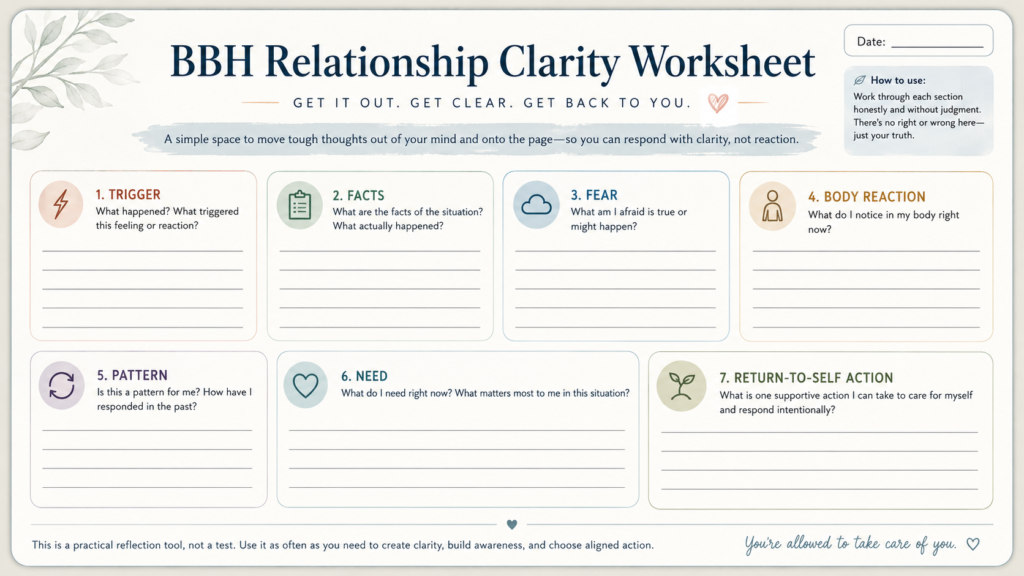
Download the Free Relationship Anxiety Clarity Worksheet
Use the BBH Relationship Anxiety Clarity Worksheet to reflect on:
- what happened;
- what facts you know;
- what your fear predicts;
- what your body is experiencing;
- whether anxious attachment has been activated;
- whether fear of abandonment is shaping your response;
- whether the behaviour is isolated or repeated;
- what part of yourself you have neglected;
- what calm next action you can take.
[Download the Free Relationship Anxiety Clarity Worksheet PDF]
Prefer to receive it by email?
Email info@bioandbrainhealthinfo.com with the subject:
Send Me the Relationship Anxiety Clarity Worksheet
Continue With Deeper Support
This free worksheet will support the upcoming BBH anxiety workbook, created to help readers understand emotional triggers, body reactions, overthinking patterns and safer next steps.
Amazon purchase link: [Add after publication]
The free resource should remain available without requiring a purchase.
Personal Note
Silence did not always feel like silence to me.
After conflict, it could feel like rejection, exclusion and emotional punishment.
When I saw someone communicate normally with others but remain distant from me, I questioned why I was treated differently.
I wanted an explanation. I wanted care. I wanted closure.
Over time, relationship anxiety gave one connection too much power over the way I saw myself.
Relationship overthinking made me search repeatedly for an answer. Anxious attachment made distance feel like immediate danger. Fear of abandonment made it difficult to see that my life still contained meaning outside the relationship.
Silence after conflict became louder than my own work, interests and identity.
Speaking with AI helped me recognise the pattern.
It could not tell me what another person felt or guarantee the future. But it could ask questions that helped me see myself more clearly.
It reminded me that I had work I loved, ideas I wanted to create and parts of my identity that still needed my attention.
I did not need to pretend the relationship was unimportant.
I needed to stop abandoning myself while waiting for another person to make me feel worthy.
That remains my central learning: “Love is important, but I cannot lose myself while waiting for someone else’s attention, care or closure.”
Final Reflection
Relationship anxiety can make one unanswered question feel like the centre of your existence.
But you are more than the conflict.
- You are more than the delayed reply.
- You are more than the person with whom you were compared.
- You are more than another person’s ability—or inability—to provide closure.
Your pain deserves understanding. The relationship deserves honest evaluation. Your behaviour deserves responsibility. Your identity deserves to remain alive while you work through all three.
Pause before acting.
Separate the fact from the fearful meaning.
Notice when relationship overthinking is circling without new evidence.
Recognise anxious attachment without making it your whole identity.
Respect fear of abandonment without allowing it to erase your life.
Evaluate silence after conflict without immediately dismissing it or turning it into proof of rejection.
Then return to one part of your life that still belongs to you.
YMYL and AI Safety Note
This article and its AI prompt provide education and guided self-reflection. They do not provide diagnosis, therapy, crisis intervention, legal advice or individual medical guidance. Seek qualified human support when distress is persistent, disabling or connected with abuse, coercion, threats, self-harm thoughts or personal danger.
External References
- NHS — Maintaining Healthy Relationships and Mental Wellbeing
https://www.nhs.uk/every-mind-matters/lifes-challenges/maintaining-healthy-relationships-and-mental-wellbeing/ - Cleveland Clinic — What Is Anxious Attachment Style, and Do You Have It?
https://health.clevelandclinic.org/anxious-attachment-style - Cleveland Clinic — Attachment Styles: Causes and What They Mean
https://my.clevelandclinic.org/health/articles/25170-attachment-styles - NHS — Counselling
https://www.nhs.uk/tests-and-treatments/counselling/ - Google Search Central — Creating Helpful, Reliable, People-First Content
https://developers.google.com/search/docs/fundamentals/creating-helpful-content