Free AI Mental Health Tools for Emotional Support
Best Free AI Therapy Apps to Try Safely

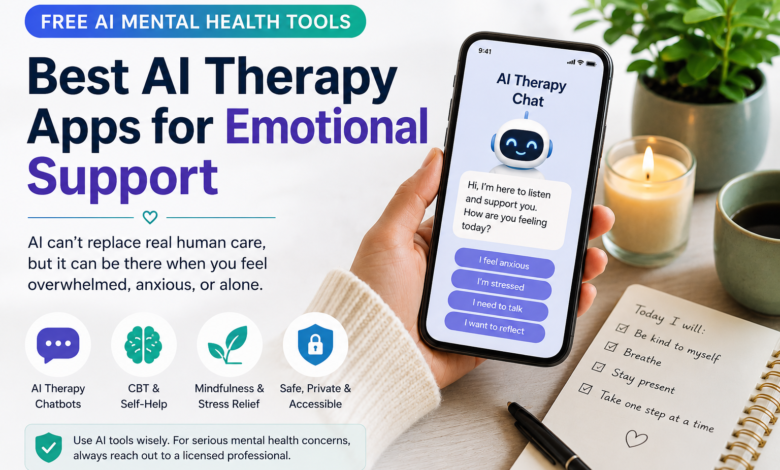
Many people search for free AI mental health tools not because they want to replace therapy, but because they feel alone, anxious, judged, or unable to afford regular support.
Thank you for reading this post, don't forget to subscribe!This guide is written for readers in the USA, UK, Canada, and Australia who need safe emotional help, especially at night, between therapy sessions, or when speaking openly feels difficult.
Unlike many articles that only list free AI therapy apps, this blog explains what each AI therapy chatbot can actually help with, where it may be limited, and how to use it without becoming emotionally dependent on technology.
You will also learn how mental health AI tools support journaling, CBT-style reflection, mood tracking, and stress awareness.
If you are looking for an AI chatbot for anxiety, this guide gives a balanced, human-first view: AI can support reflection, but real healing still needs safety, privacy, and human care.
What Are Free AI Mental Health Tools?
Free AI mental health tools are digital support tools that use artificial intelligence to help people reflect on emotions, track moods, ask guided questions, learn coping skills, and organize difficult thoughts.
These tools may include AI chatbots, CBT-style self-help apps, mood trackers, journaling assistants, anxiety support tools, and wellness apps that offer emotional check-ins.
For many people in the USA, UK, Canada, and Australia, therapy can be expensive, waiting lists can be long, and opening up to another person can feel emotionally unsafe.
This is where mental health AI tools can offer a starting point. They are not a replacement for therapy, but they can help someone pause, name what they feel, and understand their emotional patterns more clearly.
The strongest value of free AI mental health tools is accessibility. A person can use them at night, during stress, between therapy sessions, or when they are not ready to speak to someone directly. Used wisely, they can become a support bridge between silence and human care.
Read Also: “mental health AI tools”and AI Therapy & Self-Help Tools page.
Why People Search for Free AI Therapy Apps
People usually search for free AI therapy apps when they are not just looking for technology. They are often looking for emotional relief without pressure, cost, judgment, or shame.
Some people cannot afford regular therapy. Some feel alone at night. Some need support between therapy sessions. Others are scared to talk openly because they fear being misunderstood.
One reason an AI therapy chatbot can feel easier is that it does not look at your face, judge your appearance, react to your tears, or form a social impression before listening. It does not notice whether your voice is shaking or whether your facial expression looks “too emotional.”
For someone with anxiety, shame, loneliness, or therapy-access problems, that neutral space can feel safer than immediate human conversation.
This does not mean AI understands pain like a human therapist. But it can offer structured questions, journaling prompts, emotional pattern suggestions, and CBT-style reflection. For many readers, that first neutral response can reduce the fear of opening up.
Read Also: “CBT-style reflection”
What These Tools Can Help With
Free AI mental health tools may help with basic emotional awareness, stress reflection, overthinking, anxiety check-ins, mood tracking, journaling, and simple CBT-style thought reframing.
An AI chatbot for anxiety may ask what triggered the worry, how strong the feeling is, what thought is repeating, and what calming action could help in the moment.
These tools can also support people who struggle to explain their emotions clearly. When someone feels mentally overloaded, even writing one clear sentence can feel difficult.
Mental health AI tools can help break emotional confusion into smaller pieces:
- What happened?
- What did I feel?
- What did I think it meant?
- What does my body need now?
For readers who feel lonely, this can be important. Loneliness often becomes heavier at night when the mind starts replaying old memories, future fears, or self-critical thoughts. A guided AI therapy chatbot may not replace human connection, but it can help someone slow down instead of spiraling alone.
Read Also: how to control negative thoughts.
What Free AI Mental Health Tools Cannot Safely Replace
Free AI mental health tools should never replace a licensed therapist, doctor, emergency service, crisis helpline, medication guidance, trauma specialist, or real human care. This is the most important safety rule in this article. AI can support reflection, but it cannot diagnose you, fully understand your life history, see your risk level, or take responsibility for your safety.
An AI therapy chatbot may be helpful for journaling, emotional labeling, grounding prompts, or basic thought reframing. But it should not be used as the only support if someone is experiencing suicidal thoughts, self-harm urges, severe panic, trauma flashbacks, psychosis symptoms, abuse, medical concerns, or medication-related questions.
This distinction matters because vulnerable people may start depending on digital tools when what they truly need is human support. AI can help you prepare your thoughts before speaking to a therapist.
It can help you organize what you want to say. But it should not become the final authority over your mental health decisions.
The BBH Safety Rule Before Using AI for Mental Health
The safest way to use free AI mental health tools is to treat them as a reflection aid, not as a replacement for professional care.
A helpful tool can guide your thinking, but it should not control your choices. This is especially important for people with anxiety, loneliness, trauma history, panic symptoms, depression, or therapy-access problems.
Before using free AI therapy apps, readers should ask a simple question: “Am I using this tool to understand myself better, or am I using it because I am avoiding all human support?”
If the tool helps you journal, calm down, notice patterns, and prepare for better conversations, it can be useful. If it becomes the only place where you share pain, then the support system may be too narrow.
The BBH position is clear: AI can support reflection, but it should never replace therapist, doctor, emergency help, or real human care. Healing needs tools, but it also needs safety, human connection, and wise boundaries.
“A tool can support your mind, but it should never become the final authority over your pain.”
Read Also: “nervous system support” or Nervous System Reset Program for Anxiety & Stress.
Why This Topic Matters Now
The demand for free AI mental health tools is growing because many people are emotionally overloaded and practically unsupported. In countries like the USA, UK, Canada, and Australia, therapy may be costly, delayed, limited by insurance, or difficult to access quickly. At the same time, anxiety, loneliness, burnout, stress, and emotional isolation are common search concerns.
This is why readers need a balanced guide. A weak article only says, “Here are the best apps.” A stronger article asks, “Which tools can help, what are their limits, and how can a vulnerable person use them safely?” That is the real BBH angle.
Free AI therapy apps can be helpful when they give emotional structure without pretending to be human therapy.
- An AI chatbot for anxiety may help someone pause before panic grows.
- A journaling AI may help someone understand the same thought pattern repeating every night.
- A mood tracker may help a person notice what triggers emotional crashes.
But the deeper goal is not to become dependent on AI. The goal is to use mental health AI tools as one step toward emotional awareness, self-regulation, and better support.
Part 1 Closing Transition
Free AI mental health tools can make emotional support more accessible, especially for people who feel alone, judged, or unable to afford therapy.
They can help with journaling, anxiety check-ins, CBT-style reflection, and emotional pattern awareness. But they must be used with safety, privacy awareness, and clear boundaries.
In the next part, we will compare some of the best-known free AI therapy apps and AI mental health tools, including Wysa, Youper, Woebot, Earkick, and Headspace Ebb, so readers can understand what each tool may help with and where caution is still needed.
Best Free AI Mental Health Tools to Try Safely
The best free AI mental health tools are not the tools that simply give fast answers. The best tools are the ones that help a person slow down, understand what they are feeling, and choose a safer next step.
For people with anxiety, loneliness, or therapy-access problems, this matters because emotional support is not only about information. It is also about timing, privacy, and feeling safe enough to begin.
Many free AI therapy apps offer chat-based support, mood tracking, journaling prompts, CBT-style reflection, mindfulness exercises, or anxiety check-ins. Some tools may be stronger for daily emotional check-ins, while others may be better for thought reframing, stress awareness, or guided self-reflection.
Availability, free features, and paid upgrades may vary by country, especially in the USA, UK, Canada, and Australia. So readers should always check the latest app details before depending on one tool fully.
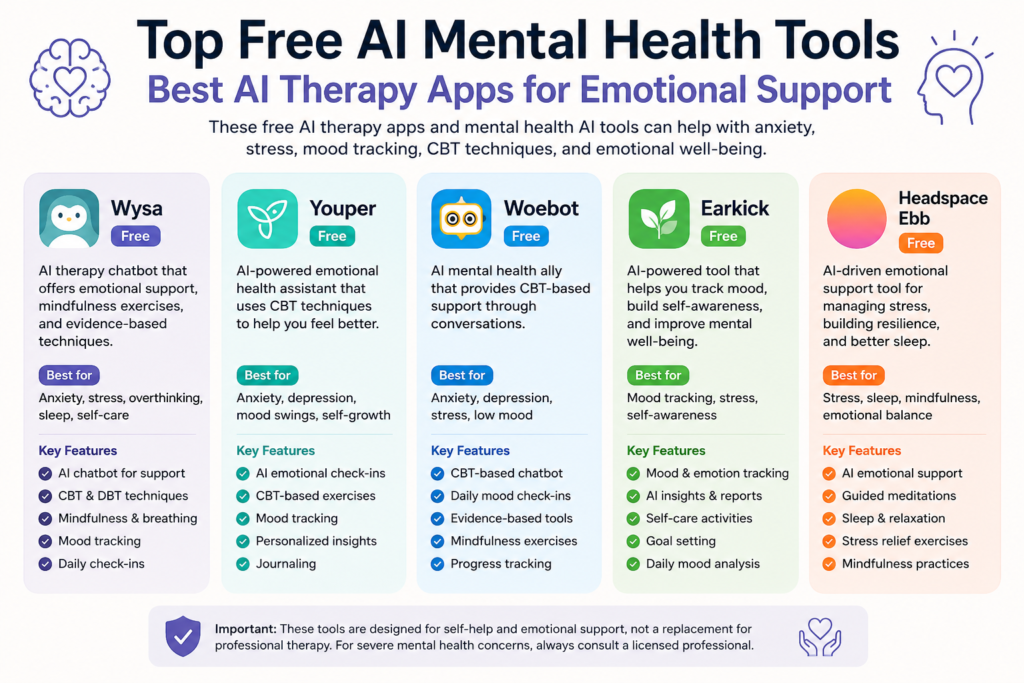
1. Wysa — Best for Anxiety and Daily Emotional Check-Ins
Wysa is one of the most recognized mental health AI tools for emotional check-ins, stress support, anxiety reflection, and guided self-help. It uses an AI chatbot format where users can talk through thoughts and feelings, explore difficult emotions, and access coping techniques.
Wysa describes its app as an interactive AI-powered space for exploring thoughts and feelings, learning skills, and managing emotional wellbeing through clinically designed tools. (Wysa – Everyday Mental Health)
For someone searching for an AI chatbot for anxiety, Wysa can feel useful because it gives a non-judgmental place to start. A person may not be ready to call a therapist, explain everything to a friend, or speak face-to-face. But they may be able to type, “I feel anxious tonight,” and begin from there.
Wysa may be especially helpful for people who need daily check-ins, mood reflection, mindfulness exercises, or basic CBT and DBT-style emotional support.
Its Google Play listing also describes mood tracking, stress and anxiety help, meditation, mindfulness audio, and evidence-based self-help techniques drawn from CBT and DBT. (Google Play)
The safety boundary is important: Wysa can support reflection, but it should not become a replacement for therapy, diagnosis, medication advice, or crisis help.
2. Youper — Best for CBT-Style Self-Reflection
Youper is often discussed as an AI-based emotional health assistant focused on CBT-style support, mood tracking, and anxiety or depression self-management.
A third-party software profile describes Youper as an AI-powered emotional health assistant that uses a conversational chatbot and evidence-based therapies like CBT for anxiety and depression management. (IntuitionLabs)
For readers comparing free AI therapy apps, Youper’s strength is structure. Many people do not only need comfort; they need help identifying the thought pattern behind the emotion. A CBT-style tool may ask what happened, what automatic thought appeared, what emotion followed, and whether another interpretation is possible.
This is where free AI mental health tools can become useful for journaling. Instead of staring at a blank page, the reader receives a guided prompt. That matters for someone with anxiety or loneliness because emotional confusion often becomes heavier when it has no structure.
Youper may be suitable for readers who want self-reflection, mood tracking, and CBT-based mental health exercises.
Choosing Therapy also describes Youper as an AI-integrated mental health app crafted through a CBT lens, with mood tracking and CBT techniques included in its premium offering. (ChoosingTherapy.com)
The caution is that CBT prompts are not the same as therapy. If emotions are intense, unsafe, trauma-linked, or medically complex, human care remains necessary.
3. Woebot — Best for CBT-Based Mental Health Learning
Woebot became known as an AI therapy chatbot that uses evidence-based approaches such as CBT, mindfulness, and DBT-style techniques for everyday emotional support.
Its Google Play listing describes daily check-ins and practical techniques based on Cognitive Behavioral Therapy, Mindfulness, and Dialectical Behavior Therapy. (Google Play)
For readers searching for free AI mental health tools, Woebot’s strongest value is mental health education. It can help users learn how thoughts, emotions, behaviors, avoidance, and stress reactions are connected. This can be helpful for someone who wants to understand their mind but feels overwhelmed by clinical language.
An important update is that Woebot’s direct-to-consumer app availability has changed over time, so readers should check current access in their country before relying on it as an available option.
This is especially important for readers in the USA, UK, Canada, and Australia because app access, partnerships, and service models can differ by location.
A 2024 paper describes Woebot as a self-help chatbot using CBT techniques such as psychoeducation, goal planning, and mood tracking to lower depression and anxiety levels. (PMC)
Woebot should be positioned carefully. It may support learning and reflection, but it cannot replace a therapist who can understand life context, risk, diagnosis, trauma history, or medication concerns.
4. Earkick — Best for Mood Tracking and Stress Awareness
Earkick is another option among mental health AI tools, especially for people who want mood tracking, stress awareness, and private emotional support. Its website positions the tool as instant, private AI support for stress, anxiety, decisions, and personal growth, available 24/7 to help users understand their emotions. (chat.earkick.com)
For someone looking for an AI chatbot for anxiety, Earkick may be useful when the main need is to notice emotional signals before they become overwhelming.
Some people do not recognize stress until the body is already tense, sleep is disturbed, or thoughts are racing. Mood tracking can help reveal patterns across days and weeks.
Earkick’s terms describe the app as helping users monitor mental health, understand themselves better, build healthy habits, and become more resilient against stress and burnout. (Personal AI Chat Bot)
This makes Earkick useful for readers who want a daily check-in style tool rather than a therapy-like experience. It may help someone ask, “What is my emotional pattern this week?” instead of only reacting when anxiety becomes intense.
The safety reminder remains the same: mood tracking can create awareness, but awareness is not the same as treatment. If symptoms are severe, worsening, or unsafe, professional help is still the priority.
5. Headspace Ebb or Similar Wellness AI Tools
Some readers may not want a direct AI therapy chatbot. They may prefer a softer wellness tool that supports mindfulness, sleep, breathing, stress management, and daily emotional regulation. This is where Headspace Ebb or similar wellness AI tools may fit.
Choosing Therapy included Headspace Ebb among AI therapy app options in its 2025 review, alongside tools like Ash, Wysa, Youper, Earkick, and Yuna. The same review also reminds readers that AI chatbots should not replace therapy. (ChoosingTherapy.com)
For people with anxiety, loneliness, and therapy-access problems, a wellness AI tool may feel less clinical and more approachable. A reader may not want to say, “I need therapy.” They may only want help sleeping, calming the body, or making sense of emotional pressure after a difficult day.
This matters because free AI mental health tools should not all be judged the same way. Some are designed for CBT-style reflection. Some are mood trackers. Some are journaling companions. Some are more focused on mindfulness and stress support.
The best choice depends on the reader’s real need: anxiety support, emotional check-ins, journaling, CBT reflection, sleep support, or stress reduction.
Quick Comparison Table: Free AI Mental Health Tools
This comparison table is not a medical ranking. It is a practical guide to help readers compare free AI mental health tools by emotional use case, not only by popularity. Free features, pricing, and availability can change, so readers should always confirm the latest details directly before choosing one tool.
| Tool | Best For | Possible Free Features | Good For | Safety Note |
|---|---|---|---|---|
| Wysa | Anxiety check-ins | AI chat, mood reflection, self-help exercises | Anxiety, stress, low mood | Not crisis care or diagnosis |
| Youper | CBT-style reflection | Mood tracking, guided emotional check-ins | Thought patterns, anxiety, self-reflection | Not a therapist replacement |
| Woebot | CBT-based learning | Psychoeducation, check-ins, mood tools where available | Emotional education, CBT learning | Access may vary by country |
| Earkick | Mood and stress tracking | Mood check-ins, AI support, stress awareness | Burnout, anxiety patterns, habits | Review privacy and data use |
| Headspace Ebb | Wellness support | Mindfulness or stress-support features where available | Sleep, stress, daily calming | Not clinical treatment |
A useful rule is simple: choose the tool that matches the problem you are actually facing.
- If the problem is racing thoughts, an AI chatbot for anxiety may help you slow down.
- If the problem is emotional confusion, a journaling tool may help.
- If the problem is repeated mood changes, tracking may be more useful.
- If the problem is severe distress, the right next step is human care, not only an app.
How to Choose the Right AI Therapy Chatbot
Choosing the right AI therapy chatbot should begin with safety, not excitement. A tool may look modern and comforting, but the reader should ask what it is actually designed to do. Is it for journaling, CBT reflection, anxiety support, mindfulness, mood tracking, or crisis response? If the tool is not built for crisis support, it should not be used that way.
Before using free AI therapy apps, readers should check five things.
- First, does the app clearly explain its limits?
- Second, does it encourage professional help when needed?
- Third, does it have a privacy policy that explains how emotional data is stored or used?
- Fourth, are the free features enough for daily support, or does the useful part sit behind a paywall?
- Fifth, is the tool available and functional in the reader’s country?
This matters for USA, UK, Canada, and Australia readers because mental health laws, data expectations, app access, emergency resources, and healthcare pathways differ by country.
My strong recommendation is this: use mental health AI tools for reflection, journaling, emotional awareness, and preparation for human support. Do not use them as the only place where serious pain is held.
Read Also: Brain Mastery → Focus & Attention blog.
Part 2 Closing Transition
The best free AI mental health tools can make support easier to access, especially when someone feels anxious, alone, judged, or unsure how to begin.
- Wysa may help with anxiety check-ins.
- Youper may support CBT-style reflection.
- Woebot may help with CBT-based learning where available.
- Earkick may support mood and stress tracking.
- Headspace Ebb or similar wellness AI tools may help with calming, mindfulness, and daily regulation.
But choosing a tool is only half of the decision. The other half is safety. Readers must understand privacy, crisis limits, emotional dependency, and when to involve a therapist, doctor, emergency service, or trusted human support.
In Part 3, we will explain how to use these tools safely, what privacy questions to ask, when not to rely on an AI chatbot for anxiety alone, and how to build a simple 5-minute AI mental health check-in.
Are Free AI Mental Health Tools Safe?
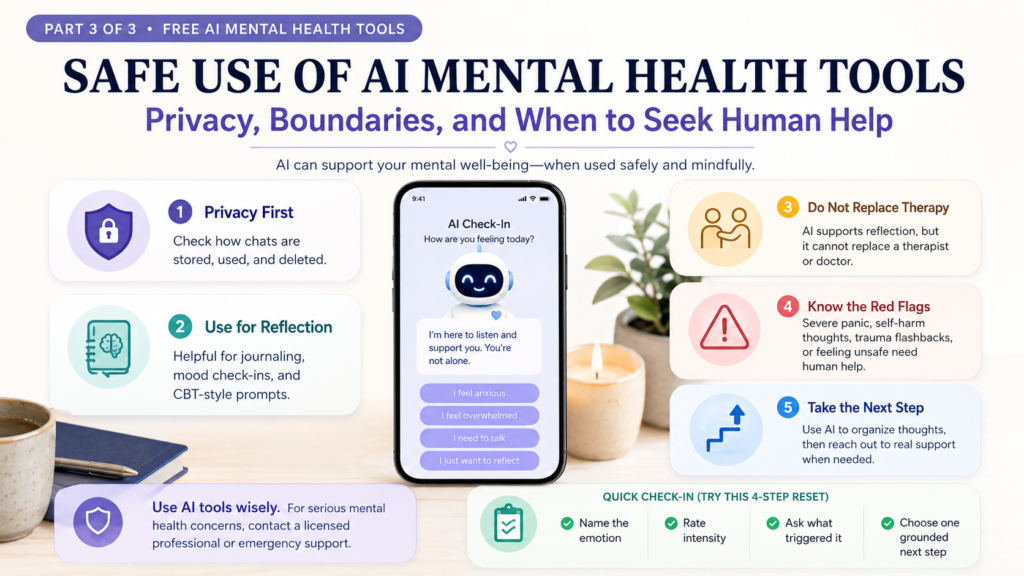
Free AI mental health tools can be safe when they are used for the right purpose. They may help with journaling, emotional check-ins, anxiety reflection, mood tracking, stress awareness, and basic CBT-style prompts. For someone who feels alone at night or cannot afford therapy, this kind of support can create a small moment of emotional structure.
But safety depends on how the tool is used. Mental health AI tools should not be treated like a therapist, doctor, emergency service, or crisis support system. They do not fully understand your life story, trauma history, body language, medical background, medication needs, family situation, or immediate safety risk.
The safest way to use free AI mental health tools is to see them as a mirror, not a master. They can help you notice patterns, name emotions, and prepare better questions for a therapist or trusted person. But they should never become the only place where serious pain is held.
For people in the USA, UK, Canada, and Australia, this distinction matters because therapy access, insurance systems, waitlists, and crisis-support pathways may differ.
AI can support reflection, but real safety still needs human care when the problem becomes serious.
Privacy Questions to Ask Before Using AI Therapy Apps
Before using free AI therapy apps, readers should ask what happens to their emotional data. Mental health information is deeply personal.
When someone types about anxiety, loneliness, trauma, panic, family pain, relationship stress, or self-critical thoughts, they are not sharing ordinary information. They are sharing vulnerable inner material.
A good AI therapy chatbot should clearly explain how chats are stored, whether data is used for training, whether the user can delete information, and whether the app shares data with third parties. Readers should not assume that every emotional support app has the same privacy standard.
This is especially important for users in the USA, UK, Canada, and Australia because privacy expectations and health-data rules can vary across regions. A reader should always check the privacy policy before sharing highly sensitive information.
A simple BBH rule is this: do not share anything with mental health AI tools that you would feel unsafe exposing later unless you clearly understand the app’s privacy protections. Use AI for reflection, but protect your dignity, identity, and emotional safety.
When You Should Not Use an AI Chatbot for Anxiety Alone
An AI chatbot for anxiety may help with mild worry, overthinking, grounding, breathing prompts, journaling, or CBT-style thought reframing. But it should not be used alone when the situation is severe, unsafe, or medically complex.
Do not rely only on free AI mental health tools if you are having suicidal thoughts, self-harm urges, severe panic attacks, trauma flashbacks, psychosis symptoms, abuse-related danger, medication concerns, or a feeling that you may not be safe.
In these situations, the right step is human support, professional care, emergency help, or a crisis service in your country.
This point must be clear because vulnerable people sometimes start depending on the tool that is easiest to reach. Easy access is helpful, but it is not the same as complete care.
An AI therapy chatbot can ask supportive questions, but it cannot physically protect you, contact emergency care for you in every situation, or understand risk like a trained professional.
If anxiety is growing stronger, more frequent, or harder to control, use AI only as a temporary support while you contact a therapist, doctor, crisis line, or trusted person.
Best Way to Use AI Mental Health Tools in Daily Life
The best use of mental health AI tools is structured reflection. Instead of asking AI to “fix” your life, use it to help you understand one moment more clearly. This keeps the tool useful without giving it too much power.
For example, after a stressful day, a reader can ask an AI therapy chatbot: “Help me understand why I felt anxious after this conversation.” The tool may help identify a trigger, an automatic thought, a body response, and a possible coping action. This is more useful than asking, “Tell me what is wrong with me.”
Free AI mental health tools can also help readers prepare for therapy. A person may use AI to list symptoms, organize thoughts, write questions, track patterns, or summarize what they want to discuss with a therapist. This turns AI into a bridge toward human care, not a replacement for it.
For loneliness, AI can offer a first response. But the long-term goal should still include real connection, community, professional care when needed, and daily self-regulation habits.
Read Also: “daily self-regulation habits”
A Simple 5-Minute AI Mental Health Check-In
A short check-in can make free AI mental health tools more practical and safer. The goal is not to talk endlessly with AI. The goal is to create emotional clarity in five minutes and then choose one grounded next step.
Use this simple structure:
- Name the emotion: “I feel anxious, lonely, ashamed, angry, or overwhelmed.”
- Rate the intensity: “This feeling is 7 out of 10.”
- Identify the trigger: “What happened before this feeling started?”
- Ask for one CBT-style reframe: “What is another way to understand this thought?”
- Choose one regulation action: breathing, walking, journaling, drinking water, stretching, or contacting someone safe.
- Decide the human next step: therapist, doctor, friend, support page, crisis service, or rest.
This is a healthy way to use an AI chatbot for anxiety because it keeps the interaction focused. It prevents emotional dependency and turns the tool into a short reflection practice.
Free AI therapy apps are most useful when they help you return to your own awareness, not when they keep you inside endless conversation.
FAQs About Free AI Mental Health Tools
What are free AI mental health tools?
Free AI mental health tools are AI-powered apps, chatbots, journaling tools, and mood trackers that help users reflect on emotions, manage stress, and learn basic coping skills. They can support self-awareness, but they should not replace professional mental health care.
What is the best free AI therapy app?
The best free AI therapy app depends on your need. Wysa may help with anxiety check-ins, Youper may support CBT-style reflection, Woebot may help with CBT learning where available, Earkick may support mood tracking, and Headspace Ebb or similar tools may help with wellness and calming.
Can an AI therapy chatbot replace a therapist?
No. An AI therapy chatbot can support journaling, emotional reflection, and basic coping skills, but it cannot replace a licensed therapist, diagnosis, trauma treatment, medication guidance, crisis support, or real human care.
Are AI chatbots for anxiety safe?
An AI chatbot for anxiety may be helpful for mild anxiety, overthinking, grounding, and CBT-style reflection. But severe panic, suicidal thoughts, self-harm urges, trauma flashbacks, or unsafe situations need professional or emergency support.
Are free AI therapy apps private?
Privacy varies between free AI therapy apps. Users should check whether chats are stored, whether data is used for training, whether information is shared, and whether they can delete their data before sharing sensitive emotional details.
Can mental health AI tools help with CBT?
Some mental health AI tools offer CBT-style prompts, thought reframing, mood tracking, emotional labeling, and journaling exercises. These may help users understand thought patterns, but they are not the same as therapy with a trained professional.
Who should avoid relying only on AI mental health tools?
People with suicidal thoughts, self-harm urges, severe anxiety, trauma flashbacks, psychosis symptoms, medication concerns, abuse-related danger, or worsening emotional distress should not rely only on AI mental health tools.
How should I use free AI mental health tools safely?
Use free AI mental health tools for reflection, journaling, emotional check-ins, CBT-style questions, and preparing for human support. Keep therapists, doctors, crisis services, and trusted people as your priority support when distress becomes serious.
Final Thoughts on Free AI Mental Health Tools
Free AI mental health tools can be helpful for people who feel anxious, lonely, unsupported, or unable to afford therapy. They can offer journaling prompts, emotional check-ins, CBT-style reflection, mood tracking, and anxiety support when someone does not know where to begin.
Their biggest strength is not that they replace human care. Their strength is that they can create a neutral space where someone feels less judged, less exposed, and more able to start expressing what is happening inside. For a person who feels alone at night, even that first sentence can matter.
But the boundary must remain strong. AI can support reflection, but it should never replace therapist, doctor, emergency help, or real human care. The best use of mental health AI tools is to build awareness, organize emotions, and move toward safer support.
A tool can support your mind, but it should never become the final authority over your pain.
People Also Ask Questions
1. What are free AI mental health tools?
Free AI mental health tools are apps, chatbots, mood trackers, journaling tools, and CBT-style self-help platforms that use artificial intelligence to support emotional reflection, anxiety check-ins, stress awareness, and basic coping skills. They can help with daily self-awareness, but they should not replace therapy, medical care, or emergency support.
2. Are AI therapy chatbots safe?
AI therapy chatbots can be safe for basic reflection, journaling, grounding, and mild emotional support when used carefully. But safety depends on privacy, crisis limits, evidence quality, and whether the tool clearly encourages human help when needed. AI should not replace a qualified mental health professional.
3. Can AI replace a therapist?
No. AI can support reflection, journaling, and emotional awareness, but it cannot replace a licensed therapist. It cannot diagnose, understand full life context, provide trauma treatment, manage medication, or respond like real emergency care.
4. What is the best free AI therapy app?
The best free AI therapy app depends on the reader’s need. Wysa may help with anxiety check-ins, Youper may support CBT-style reflection, Woebot may help with CBT learning where available, Earkick may support mood tracking, and Headspace Ebb may support mindfulness and wellness guidance.
5. Can AI help with anxiety?
An AI chatbot for anxiety may help with mild worry, overthinking, emotional check-ins, grounding prompts, breathing support, and CBT-style reframing. But severe panic, trauma flashbacks, self-harm thoughts, or unsafe situations need human professional support.
6. Are free AI therapy apps private?
Privacy varies from app to app. Before using free AI therapy apps, readers should check whether chats are stored, whether data is shared, whether data is used for AI training, and whether the user can delete personal information.
7. Can mental health AI tools help with CBT?
Some mental health AI tools include CBT-style prompts such as identifying automatic thoughts, naming emotions, reframing negative thinking, tracking mood, and journaling emotional patterns. These tools may support self-awareness, but they are not the same as therapy with a trained professional.
8. Who should not rely only on AI mental health tools?
People with suicidal thoughts, self-harm urges, severe panic, psychosis symptoms, trauma flashbacks, abuse-related danger, medication concerns, or worsening emotional distress should not rely only on AI tools. They should contact a therapist, doctor, emergency service, or crisis support.
9. How should I use free AI mental health tools safely?
Use free AI mental health tools for short reflection, journaling, emotional check-ins, mood tracking, CBT-style questions, and preparing for human support. Do not use them as the final authority over serious mental health decisions.
External Linking With URL
Use only 4 external links in this blog. That is enough for trust without making the article look too promotional.
1. American Psychological Association
Anchor text: APA health advisory on AI chatbots and wellness apps
URL: https://www.apa.org/topics/artificial-intelligence-machine-learning/health-advisory-chatbots-wellness-apps
Where to add: Part 1 or Part 3 safety section
Why: This supports the safety message that AI chatbots and wellness apps should not replace qualified mental health care.
Suggested sentence:
The American Psychological Association has published guidance on AI chatbots and wellness apps, which supports the BBH position that AI can help reflection but should not replace qualified mental health care.
2. Wysa Google Play
Anchor text: Wysa mental wellbeing AI app
URL: https://play.google.com/store/apps/details?hl=en_IN&id=bot.touchkin
Where to add: Part 2 Wysa section
Why: This supports Wysa’s features such as AI chat, anxiety support, stress management, mindfulness, and CBT/DBT-style self-help.
Suggested sentence:
Wysa’s app listing describes AI chat, anxiety support, stress management, mindfulness exercises, and self-help techniques based on CBT and DBT.
3. Woebot Google Play
Anchor text: Woebot mental health ally app
URL: https://play.google.com/store/apps/details?hl=en_IN&id=com.woebot
Where to add: Part 2 Woebot section
Why: This supports Woebot’s CBT, mindfulness, DBT-style techniques, and daily emotional check-in positioning.
Suggested sentence:
Woebot’s app listing describes daily check-ins and practical techniques based on CBT, mindfulness, and DBT.
4. Wysa FAQ
Anchor text: Wysa intended use statement
URL: https://www.wysa.com/faq
Where to add: Part 3 privacy or safety section
Why: This helps support the point that readers should check intended use, limits, and privacy before depending on any AI therapy chatbot.
Suggested sentence:
Before sharing sensitive emotional information with any AI therapy chatbot, readers should review the tool’s intended-use statement, privacy policy, and data practices.