Why Self-Control Fails: Hidden Triggers Most People Ignore
The Real Reason You React, Overeat, Overspend, or Lose Control

Many people search for why self control fails because they feel ashamed after reacting, overeating, overspending, procrastinating, or saying something they regret. But self-control is not only about willpower.
Thank you for reading this post, don't forget to subscribe!👉This blog explains why impulse control fails when the nervous system feels overloaded, threatened, insulted, or emotionally cornered. You will learn how emotional triggers and behavior are connected to dignity, fairness, respect, fear, and old survival patterns—not just poor discipline.
The unique BBH angle is that self-control is a combination of self regulation psychology, nervous system awareness, detachment, and practical decision-making. Instead of blaming yourself, this article helps you understand the real discipline breakdown causes behind sudden reactions.
You will learn why a small conflict can become emotionally dangerous, why walking away is not weakness, and how choosing peace can protect your time, identity, and inner stability.
Why Self-Control Fails When Emotions Feel Bigger Than Logic
Self-control usually fails when the emotional brain becomes louder than the logical brain. A person may know what is right, but knowing is not always enough when the body feels activated.
This is why someone may decide not to shout, but still shout. They may decide not to spend, but still buy. They may decide not to check the phone, but still keep scrolling.
In these moments, the mind is not only thinking about the action.
It is trying to reduce inner discomfort.
- Anger wants release.
- Anxiety wants certainty.
- Shame wants escape.
- Loneliness wants comfort.
- Stress wants quick relief.
This is where many people misunderstand why self control fails. The failure is not always a character problem. Often, it is a regulation problem.
When emotions feel bigger than logic, the nervous system pushes the person toward fast relief, not wise response.
👉The action may look careless from outside, but inside, it may feel urgent, necessary, or emotionally uncontrollable.
Read Also: why your mind fears uncertainty
Self-Control Is Not Only Willpower
Willpower is important, but it is not the full foundation of self-control. If a person is tired, emotionally overloaded, highly stressed, or already carrying unresolved tension, willpower becomes weaker. The brain has less space to pause, compare options, and choose carefully.
This is why advice like “just control yourself” often fails. It does not explain what is happening inside the person before the action.
Self-control depends on the ability to notice what is rising inside: the emotion, the urge, the body tension, the story in the mind, and the possible cost of reacting.
A more complete view of self-control includes awareness, emotional regulation, nervous system safety, and detachment from immediate impulses.
👉A person does not become disciplined only by forcing themselves harder. They become more stable by learning how to pause before the reaction becomes behavior.
That pause is where real self-control begins.
Why Impulse Control Fails During Stress
To understand why impulse control fails, we have to look at stress. Stress changes the way the mind sees choices. When the nervous system feels pressured, it stops thinking long-term and starts looking for immediate relief. The brain begins to ask, “What can reduce this feeling right now?”
That is why impulse behavior often happens during emotional pressure. A person may eat to calm discomfort, spend to feel powerful, argue to feel respected, scroll to avoid anxiety, or procrastinate to escape pressure. The behavior becomes a quick emotional tool, even if it creates regret later.
Stress also narrows attention. Instead of seeing the full picture, the mind becomes locked onto one urgent feeling. “I need to answer back.” “I need this food.” “I need to buy this.” “I cannot start this work.” This urgency makes the impulse feel stronger than the person’s original intention.
So impulse control does not fail only because someone lacks discipline. It often fails because the nervous system is trying to protect itself from discomfort in the fastest way available.
👉This is one reason why impulse control fails even when a person knows the better choice. The body is searching for relief before the mind can choose wisely.
Read Also: why people make bad decisions
The Brain Looks for Immediate Relief
When the brain is under pressure, it prefers relief over wisdom. This is why many self-control problems repeat even when a person knows the result will not be good.
- The relief comes first; the regret comes later.
- Overeating may calm sadness for a short time.
- Overspending may create a moment of excitement.
- Shouting may release anger. Phone scrolling may numb stress.
- Avoiding work may reduce pressure temporarily.
But after the short relief, the deeper problem remains.
This is one of the hidden discipline breakdown causes most people ignore. The behavior is not only the problem. The emotional state underneath the behavior is the real starting point.
Discipline Breakdown Causes Most People Ignore
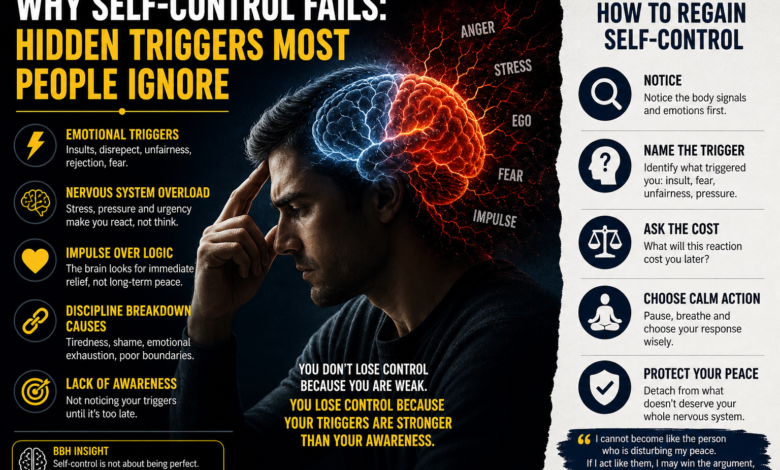
Most people think discipline breaks suddenly, but usually it starts breaking earlier. It begins when stress builds, sleep reduces, emotions remain unprocessed, boundaries become weak, and the person keeps pushing without pause. By the time the visible reaction happens, the inner system was already overloaded.
Some common discipline breakdown causes include emotional exhaustion, shame, unresolved anger, lack of rest, unclear priorities, fear of failure, identity pressure, and nervous system overload.
- A person may call it laziness, but sometimes the body is in shutdown.
- A person may call it anger, but sometimes the deeper trigger is insult or fear.
- A person may call it poor discipline, but sometimes the mind is trying to escape emotional weight.
This is why self-control improves when we stop only blaming the final action and start studying the state that created the action.
👉The question is not only, “Why did I react?”
👉The better question is, “What was happening inside me before I reacted?”
3 Deep Reader Questions
- When you lose self-control, are you truly choosing badly, or are you reacting from emotional overload?
- Which pattern appears most often in your life: anger, overeating, overspending, phone scrolling, procrastination, or over-explaining?
- Before you react, what emotion usually appears first: fear, insult, shame, unfairness, loneliness, or pressure?
Sometimes self-control does not fail in the moment. It fails earlier, when we ignore stress, tiredness, emotional pressure, and the small signals our body was already giving us.
The Hidden Emotional Triggers Behind Loss of Control
Self-control becomes most difficult when a situation touches something deeper than the visible problem.
A person may think they are angry because of money, delay, rejection, food, work pressure, or someone’s behavior. But beneath the surface, the real trigger may be dignity, respect, fairness, fear, shame, or the feeling of being powerless.
This is why emotional triggers and behavior are closely connected. Behavior is not always a direct response to the event.
Many times, behavior is a response to the meaning the mind gives to the event.
- If the mind says, “I am being disrespected,” the body may react with anger.
- If the mind says, “I am trapped,” the body may react with panic.
- If the mind says, “I am losing control,” the nervous system may push for immediate action.
That is where a small situation can suddenly become emotionally big.
Read Also: how detachment helps control emotions
Emotional Triggers and Behavior: Why Small Situations Become Big
A small event does not always stay small inside the nervous system. If it touches an old emotional pattern, the body may react as if something serious is happening. This is one reason why self control fails even when the situation looks minor from outside.
For example, someone raises their voice.
- Practically, it may be only a loud tone.
- Emotionally, the mind may read it as insult, attack, domination, or disrespect.
- Someone delays a reply.
- Practically, it may be busyness.
- Emotionally, the mind may read it as rejection, abandonment, or lack of care.
- Someone questions your work. Practically, it may be feedback. Emotionally, the mind may read it as failure or humiliation.
This is how emotional meaning changes behavior. The body does not react only to facts. It reacts to interpretation, memory, threat, and emotional association.
When the mind attaches identity to a situation, the reaction becomes stronger.
👉The issue is no longer only, “What happened?” It becomes, “What does this say about me?”
Read Also: pause before impulse
A Small Argument Can Become Dangerous When It Touches Dignity
Imagine booking an Uber auto where the app shows one fare, but after reaching the destination, the driver demands extra money. When you question it, he raises his voice. Suddenly, the issue is no longer only about money. It becomes about dignity, fairness, disrespect, and feeling cornered.
- The mind starts racing:
- “How dare he talk to me like this?”
- “Why should I pay extra?”
- “Does he think I am weak?”
- “This is unfair.”
- “I should teach him a lesson.”
At that moment, why impulse control fails becomes very clear. The nervous system is not only calculating the fare. It is calculating respect, safety, and power.
This is where a small conflict becomes emotionally dangerous. The body may feel urgent pressure to shout back, punish, complain, call someone, or prove a point. The person may feel that walking away means losing.
But sometimes the real loss is not money. The real loss is giving the next three hours, your peace, your emotional balance, and your recovery energy to a conflict that does not deserve your whole nervous system.
👉This is also why impulse control fails during conflict. The issue becomes emotional, not only practical.
The Issue Is Not Always the Money
In many conflicts, the visible issue is not the real emotional issue. The money, delay, message, mistake, or disagreement may only be the surface. The deeper wound may be feeling insulted, unheard, used, ignored, or disrespected.
This is why emotional triggers and behavior can feel confusing.
A person may later ask, “Why did I react so strongly?”
The answer is often that the reaction was not only to the event. It was to the emotional meaning behind the event.
When dignity gets touched, the nervous system can turn a small issue into a survival-level response. The body may feel, “I must defend myself now.” That urgency is powerful, but it is not always wisdom.
Why Anger Feels Like Justice in the Moment
Anger often feels morally correct when we believe someone has treated us unfairly.
- The mind says, “I am not wrong.
- They are wrong.
- So my reaction is justified.”
This is one of the strongest discipline breakdown causes in real life. People do not usually lose control while thinking, “I want to behave badly.” They lose control while thinking, “I have a reason.”
That reason may be real. The other person may actually be rude, unfair, manipulative, careless, or disrespectful. But even when the reason is real, the reaction still has a cost.
Anger can feel like justice because it gives temporary power.
- It reduces the feeling of helplessness.
- It tells the body, “You are not weak. Fight back.”
- But if anger controls the action, the person may later feel drained, ashamed, unstable, or mentally stuck.
Justice does not always require emotional explosion. Sometimes justice is calm reporting, firm boundaries, clear refusal, written complaint, or leaving the situation safely.
👉Anger can show that a boundary was touched, but anger should not always become the driver.
Read Also: how detachment reduces anxiety and stress
When the Nervous System Reads Conflict as Threat
When conflict feels threatening, the nervous system may enter fight mode. This can create racing thoughts, body heat, tightness, urgency, pressure in the head, and a strong need to act immediately.
The person may feel, “I cannot let this go,” even if a calmer part of them knows the reaction may create more damage.
This is where self regulation psychology becomes important. Self-regulation is not the same as pretending nothing happened. It is the ability to notice activation before it turns into uncontrolled behavior.
In fight mode, the nervous system wants to restore safety through action. That action may be shouting, arguing, proving, punishing, threatening, or refusing to move. The body believes action will reduce the threat. But sometimes the action keeps the body trapped in the conflict longer.
👉A regulated person can still take action, but not from panic. They can ask, “What is the safest and wisest next step?” This question creates space between trigger and behavior.
The Recovery Cost of Reacting Like the Other Person
One unique reason self-control matters is recovery cost. Many people only think about the moment of reaction. They do not think about how long it will take to recover after reacting.
If someone behaves rudely and you become exactly like them, you may feel powerful for a few minutes. But afterward, your mind may replay the scene again and again.
- Your body may stay tense.
- Your focus may break.
- Your work may suffer.
- Your whole day may become emotionally infected by one person’s behavior.
This is why detachment is powerful. Detachment means you refuse to give your whole nervous system to a small conflict.
It does not mean you accept wrong behavior.
It means you do not allow wrong behavior to take ownership of your inner state.
“I cannot become like the person who is disturbing my peace. If I act like them, I may win the argument, but I will lose myself.”
That is not weakness. That is emotional maturity.
3 Deep Reader Questions
- When someone disrespects you, do you want resolution, or do you want them to feel punished?
- Has a small issue ever become emotionally huge because it touched your dignity or self-respect?
- After reacting strongly, how long does your mind take to recover: minutes, hours, or the full day
I cannot become like the person who is disturbing my peace. If I act like them, I may win the argument, but I will lose myself.
How Self-Regulation and Detachment Restore Control
Self-control becomes stronger when a person learns how to create space between the trigger and the action. This space is not created by force alone. It is created through awareness, nervous system regulation, emotional honesty, and a deeper understanding of cost.
👉When the mind is triggered, it usually wants immediate relief. But when awareness enters, the person can ask, “What will this reaction cost me after this moment is over?”
This is where self-control becomes mature. It is no longer only about stopping yourself. It becomes about protecting your emotional stability, your dignity, your time, your future focus, and your inner identity.
Many people misunderstand self-control as suppression. But real self-control does not mean swallowing pain, accepting disrespect, or pretending nothing happened. It means choosing the right action from a regulated state instead of letting the trigger choose the action for you.
Read Also: Spiritual Psychology
Self Regulation Psychology: How Awareness Restores Choice
Self regulation psychology teaches that emotional control is not only about behavior. It begins with internal awareness. Before a person shouts, overeats, overspends, scrolls, avoids work, or reacts impulsively, something usually happens inside the body first.
- The breath changes.
- Thoughts speed up.
- The chest tightens.
- Heat rises.
- The urge becomes stronger.
- The mind creates a story.
If the person does not notice these early signals, the reaction feels automatic. They may only become aware after the damage is done. But when awareness improves, the person can catch the reaction earlier.
They can say, “I am activated right now. My body wants to fight, escape, numb, prove, or punish.”
That one moment of noticing is powerful. It does not remove the emotion immediately, but it gives the person a choice. Self-control improves when awareness becomes faster than the impulse.
👉This is the deeper answer to why self control fails. It fails when the trigger reaches behavior before awareness reaches the trigger.
Self-Control Is Choosing the Bigger Cost-Benefit View
Self-control is not weakness. It is choosing the bigger cost-benefit view.
👉In a triggered moment, the mind usually calculates only one thing: “How do I feel right now?”
👉But mature awareness calculates more: “What will happen after I react?”
This question changes everything.
- If you shout back, will the conflict end or become bigger?
- If you punish someone, will you feel peaceful or stay mentally trapped?
- If you overeat, overspend, or avoid work, will you feel better tomorrow?
- If you keep arguing, will you protect your dignity or lose your emotional stability?
This is why why impulse control fails is not only a discipline question. Impulse wins when short-term emotion becomes more important than long-term cost.
The bigger view asks about time, energy, peace, identity, work, health, and recovery.
Sometimes the right response is a firm boundary.
Sometimes it is a complaint.
Sometimes it is leaving.
Sometimes it is silence.
But the best response should come from awareness, not emotional injury.
When we understand why impulse control fails, we stop blaming only willpower and start studying the trigger, the body state, and the emotional cost.
Read Also: Detachment & Awareness
Walking Away Is Not Always Weakness
Walking away is often misunderstood. Many people feel that if they leave a conflict, they have lost.
The ego says, “They won.
You looked weak.
You should have answered back.”
But awareness asks a different question: “What did I protect by walking away?”
Sometimes walking away protects your nervous system from hours of activation.
- It protects your mind from replaying the argument all day.
- It protects your work from emotional disturbance.
- It protects your identity from becoming similar to the person who disturbed you.
Walking away is not weakness when you are choosing peace with awareness. It is only weakness when you are avoiding a necessary boundary out of fear. There is a difference between fear-based avoidance and conscious detachment.
👉Conscious detachment says, “This is wrong, but I will not destroy myself to prove it.”
Detachment Means Not Giving Your Whole Nervous System to a Small Conflict
Detachment is not emotional coldness. It is not passivity. It is not allowing people to mistreat you. Detachment means you do not hand your entire inner world to every situation that provokes you.
This is one of the strongest BBH lessons in self-control. A small conflict can demand your attention, anger, time, body, breath, thoughts, and peace. But awareness can interrupt that demand. It can say, “This situation does not deserve my whole nervous system.”
That is why detachment helps with emotional triggers and behavior. It creates distance between what happened and who you are.
- Someone may raise their voice, but you do not have to become their voice.
- Someone may act unfairly, but you do not have to let their unfairness control your identity.
- Someone may provoke you, but you do not have to give them your next three hours.
Detachment does not mean you do nothing. It means you act without becoming emotionally owned by the situation.
“I did not choose peace because I was weak. I chose peace because I refused to give my whole nervous system to a small conflict.”
Practical Steps to Stop Losing Control in Trigger Moments
The practical solution is not to wait until you are perfectly calm. The solution is to create a simple process you can use while you are activated. When the trigger begins, first notice the body reaction.
Ask yourself, “What is happening in my body right now?” This brings awareness back into the moment.
Second, name the trigger. Is it insult, unfairness, fear, shame, disrespect, loneliness, pressure, or loss of control?
Naming the trigger reduces confusion. You are no longer only inside the reaction; you are observing it.
Third, ask the cost question: “What will this reaction cost me?”
This is the turning point. The cost may be emotional stability, time, focus, dignity, sleep, health, or recovery energy.
Fourth, choose a calm action. You may leave, pause, breathe, write the issue down, set a boundary, ask for proof, report later, or respond after regulation. Calm action is not inaction. It is action without self-damage.
This is how you address discipline breakdown causes from the root.
Read Also: Start Here – Your Journey to Mental Clarity & Emotional Healing
Calm Action Is Stronger Than Emotional Revenge
Emotional revenge feels strong in the moment, but it often keeps the nervous system trapped. Calm action may look quieter, but it is usually more powerful. A calm person can report a wrong action, refuse unfair behavior, set a boundary, or walk away without losing their center.
This matters because self-control is not about letting others win. It is about not letting their behavior decide who you become.
- You can still protect yourself.
- You can still take practical action.
- You can still stand for fairness.
- But you do not have to become uncontrolled to prove that something was wrong.
Real strength is not only reacting loudly. Real strength is staying connected to your values when another person invites you into chaos.
That is the deeper meaning of self-control. It is not emotional suppression. It is self-protection with awareness.
3 Deep Reader Questions
- What would change if you measured reactions by emotional cost, not only by right and wrong?
- Where do you need more detachment: conflict, food, money, phone use, relationships, or procrastination?
- What is one situation where choosing peace would protect your future focus?
I did not choose peace because I was weak. I chose peace because I refused to give my whole nervous system to a small conflict.
Conclusion: Self-Control Grows When Awareness Becomes Stronger
Understanding why self control fails helps you stop blaming yourself and start seeing the real pattern behind your reactions. Many people think they lose control because they are weak, but often the nervous system is overloaded, emotions are unprocessed, and the body is searching for quick relief.
This is why impulse control fails during anger, overeating, overspending, scrolling, procrastination, or conflict. The link between emotional triggers and behavior shows that small situations can become big when they touch dignity, fairness, respect, fear, or shame.
Through self regulation psychology, you learn to notice body signals, name the trigger, pause, and ask what the reaction will cost.
Most discipline breakdown causes are not only about poor willpower; they come from stress, emotional overload, and lack of awareness. Self-control is not weakness.
👉It is choosing peace, boundaries, and long-term stability over short-term emotional reaction.
People Also Ask About Why Self-Control Fails?
1. Why does self-control fail so easily?
Self-control fails easily when emotions, stress, fatigue, or nervous system activation become stronger than awareness. In that moment, the brain often looks for immediate relief instead of long-term wisdom.
2. Why do I lose control when I feel disrespected?
Feeling disrespected can trigger the nervous system because the mind may read it as a dignity threat. This can create anger, racing thoughts, and an urgent need to defend yourself.
3. Why does impulse control fail during stress?
Impulse control fails during stress because the brain shifts toward quick relief. Stress can make overeating, overspending, shouting, scrolling, or avoiding work feel temporarily comforting.
4. Is walking away from an argument weakness?
No. Walking away is not weakness when it protects your emotional stability, time, dignity, and nervous system. It becomes strength when you choose peace with awareness.
5. How can I improve self-control?
Improve self-control by noticing body signals, naming the trigger, pausing before action, asking what the reaction will cost, and choosing a calm response instead of emotional revenge.
FAQ About Why Self-Control Fails?
1. What is the main reason self-control fails?
The main reason self-control fails is emotional overload. When stress, anger, shame, fear, or unfairness becomes intense, the nervous system can push a person toward fast relief instead of wise action.
2. Is self-control only about discipline?
No. Self-control is not only discipline. It also depends on emotional awareness, nervous system regulation, stress management, self-regulation psychology, and the ability to pause before reacting.
3. Why do small conflicts feel so big emotionally?
Small conflicts feel big when they touch deeper emotional themes like dignity, respect, fairness, rejection, fear, or feeling unheard. The body may react to the emotional meaning, not only the situation.
4. What is the difference between self-control and suppression?
Self-control means choosing a wise action with awareness. Suppression means hiding or pushing down emotion without understanding it. Healthy self-control allows emotion but does not let emotion control behavior.
5. How does detachment help self-control?
Detachment helps self-control by creating space between the trigger and the reaction. It allows you to protect your nervous system instead of giving your full emotional energy to a small conflict.
External References – Why Self-Control Fails?
- Cleveland Clinic — Fight-or-Flight Response
Use for: nervous system activation, stress response, fight-or-flight explanation. - Mayo Clinic — Chronic Stress Puts Your Health at Risk
Use for: how repeated stress keeps the fight-or-flight response active. - American Psychological Association — The Power of Self-Control
Use for: self-control, willpower, behavior, spending, eating, and effort. - Psychology Today — Self-Control
Use for: self-control habits, willpower, and behavior patterns. - Medical News Today — Emotional Self-Regulation
Use for: emotional regulation, managing emotions and impulses