What Does It Mean to Live Consciously in Real Life
How Conscious Living Changes Your Thoughts, Emotions, Choices, and Daily Habits

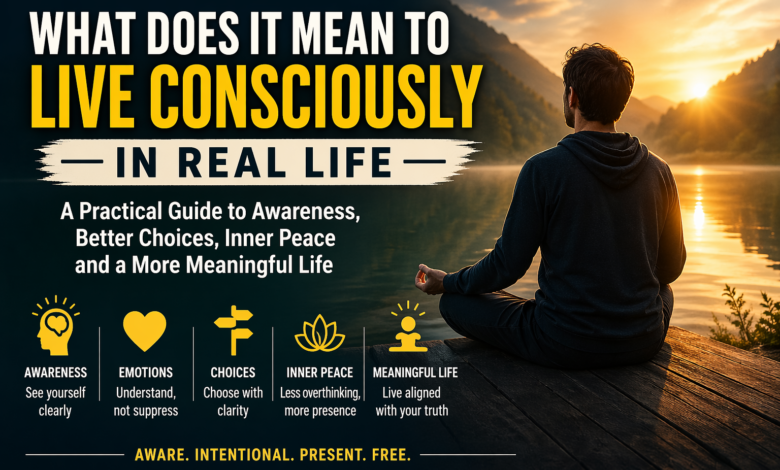
What does it mean to live consciously in real life? It means becoming aware of your thoughts, emotions, reactions, habits, and choices instead of living only through autopilot, fear, and conditioning.
Thank you for reading this post, don't forget to subscribe!👉Many people function every day, but inside they feel disconnected, reactive, mentally restless, and emotionally overwhelmed. They keep repeating the same patterns without fully understanding why. This blog helps break that pattern.
Using the core ideas of what does it mean to live consciously, conscious living meaning, how to live consciously, awareness in daily life, and intentional living psychology, this article explains conscious living in a practical and deeply personal way.
It shows how awareness changes emotional reactions, overthinking, and decision-making in daily life. It also connects psychology with detachment, inner observation, and spiritual understanding so the reader can see conscious living as a real path, not just an inspiring phrase.
This blog is worth reading completely because it does more than define conscious living.
👉It reveals how unconscious living creates suffering, confusion, and emotional impulsiveness, and how awareness can slowly change the way a person responds to life.
By the end, the reader can begin to pause more, react with greater clarity, and build a more stable, meaningful, and self-aware way of living.
What Does It Mean to Live Consciously in Real Life
What Conscious Living Really Means and Why Most People Feel Disconnected
Many people ask what does it mean to live consciously, but the real answer is not small. It is not just about being peaceful, spiritual, or mindful for a few minutes. It is about waking up internally. It is about becoming aware of what is happening inside your mind, emotions, body, habits, and choices while life is happening around you.
This is the true conscious living meaning.
A person can be active, busy, successful, social, and still live unconsciously. Why? Because unconscious living is not about inactivity. It is about lack of awareness. A person may do many things every day, but still remain cut off from their real inner state.
👉They may think automatically, react emotionally, repeat unhealthy patterns, and make decisions from fear without fully seeing what is happening.
That is why how to live consciously has become such an important question. People are not only tired from work or pressure. Many are tired because they are living without connection to themselves.
“Before awareness, I suffered inside every reaction. After awareness, I still felt pain, but I no longer disappeared inside it.”
For broader context, this topic naturally belongs inside your Spiritual Psychology section and especially the Detachment & Awareness path.
What Does It Mean to Live Consciously in Real Life?
If we answer simply, what does it mean to live consciously means living with awareness instead of living only through autopilot, conditioning, fear, and emotional habit.
It means:
- noticing your thoughts before believing all of them
- noticing your emotions before becoming controlled by them
- noticing your habits before calling them your personality
- noticing your reactions before turning them into damage
- noticing your choices before repeating old suffering
This is why the conscious living meaning is deeper than “stay positive” or “be present.” It means becoming inwardly awake.
A conscious life does not mean you never feel pain. It means you start seeing pain clearly. You stop becoming fully lost inside it. That shift changes everything.
Conscious Living Is Not the Same as Looking Calm
Many people misunderstand conscious living. They think a conscious person is always silent, balanced, detached, and emotionally perfect. That is not true.
A conscious person can still feel fear, anger, sadness, confusion, or pressure. The difference is that they begin to see these states while they are happening. They do not completely merge with every feeling.
That is where awareness in daily life becomes powerful. Awareness creates inner space. That space gives choice. And choice changes life.
Conscious Living Means Seeing Yourself While Living
The real test of consciousness is not what you say during peaceful moments. It is what happens when life becomes difficult.
Can you see yourself when you are triggered?
Can you notice panic while it is rising?
Can you feel anger without immediately obeying it?
Can you see overthinking without calling it truth?
That is real intentional living psychology in action. A person starts becoming a participant in their own inner life, not only a victim of it.
Why So Many People Live Unconsciously Without Realizing It
Most people do not wake up and decide to live unconsciously. It happens slowly. It happens through repetition, stress, childhood conditioning, fear, social pressure, attachment, and habit.
After some time, unconscious living starts feeling normal.
You react quickly.
You worry constantly.
You seek approval automatically.
You carry old pain into new situations.
You make choices for relief instead of truth.
You keep moving, but you do not really see yourself.
This is why many people feel disconnected from themselves. They are living, but not fully present in their own life.
Unconscious Living Often Looks Normal on the Outside
This is important to understand.
A person can:
- go to work
- manage family responsibilities
- answer calls
- make money
- complete tasks
- appear “fine”
And still be deeply unconscious inwardly.
Why? Because unconsciousness is not always dramatic. Sometimes it is quiet. Sometimes it looks like normal adult life. But inside, the person is living from stress, old wounds, compulsive thinking, emotional reactivity, and unexamined patterns.
That is why how to live consciously is not only a spiritual question. It is a survival question. It affects emotional health, decision-making, relationships, and meaning itself.
Signs You May Be Living More Unconsciously Than You Think
Here are some real signs:
- you react before understanding what you feel
- you overthink but do not reach clarity
- you keep repeating painful choices
- you feel emotionally exhausted after small events
- you seek peace but stay attached to control
- you feel disconnected even when life seems “okay”
- you act from pressure more than inner truth
- you avoid silence because it reveals too much
These signs do not mean you are broken. They mean awareness is needed.
A strong internal link fits here to What Is Conscious Living? Meaning Explained because that article can support the foundational layer.
Conscious Living Meaning vs Autopilot Living
Sometimes readers understand faster through comparison. So let us make it simple.
| Area | Autopilot Living | Conscious Living |
|---|---|---|
| Thoughts | Automatically believed | Observed before accepted |
| Emotions | Instantly acted on | Felt and understood |
| Habits | Repeated blindly | Examined with awareness |
| Decisions | Driven by fear or pressure | Guided by clarity and values |
| Stress | Becomes identity | Becomes something noticed |
| Relationships | Full of reaction and attachment | More aware, steady, and honest |
This table shows the heart of conscious living meaning. It is not perfection. It is increased awareness before action.
Why Awareness in Daily Life Changes Everything
Awareness in daily life changes life because it interrupts unconscious momentum.
When awareness is absent:
- emotion becomes behavior
- thought becomes truth
- fear becomes decision
- attachment becomes suffering
- stress becomes identity
When awareness is present:
- emotion becomes information
- thought becomes something to examine
- fear becomes something to understand
- attachment becomes visible
- stress becomes manageable
That is not a small difference. That is a completely different way of living.
Why People Feel Disconnected From Themselves
Disconnection from self is one of the biggest hidden pains in modern life.
A person may say:
- “I do not know what I really feel.”
- “I do not know why I react so much.”
- “I do not feel close to myself anymore.”
- “I keep doing things that are not good for me.”
- “I feel lost, but I cannot explain why.”
This inner disconnection often grows when life is lived too externally. A person becomes focused only on outcomes, approval, pressure, roles, duties, and survival. Slowly they stop listening to their inner reality.
Emotional Reactivity Creates Inner Distance
Every time a person reacts blindly, they move further away from self-understanding.
They do not pause long enough to ask:
- What am I really feeling?
- Why did this affect me so much?
- Is this situation painful, or is it activating something older inside me?
Without these questions, life remains surface-level. Pain repeats. Patterns stay hidden. And the person keeps feeling disconnected.
Overthinking Is Not Awareness
This is another crucial point.
Many people confuse overthinking with self-awareness. But overthinking is not awareness. Overthinking is repetitive mental activity without inner resolution. It often creates more confusion, not clarity.
👉 Intentional living psychology teaches that awareness is calmer than overthinking. Awareness observes. Overthinking chases. Awareness sees. Overthinking spirals.
That is why a conscious life requires a shift from mental noise to inner observation.
Three Serious Questions to Ask Yourself Right Now
Before going deeper, the reader should stop and ask:
- Am I truly living, or am I mostly reacting
- Do my daily choices come from clarity, or from emotional pressure, fear, and habit?
- When life becomes hard, do I become aware of myself, or do I disappear into the reaction?
These are not motivational questions. These are awakening questions.
Sometimes growth begins not with a solution, but with a brutally honest observation.
The First Shift Toward Conscious Living
The first step is not becoming wise overnight.
The first step is noticing.
Notice your panic.
Notice your thought loops.
Notice your emotional speed.
Notice your attachment.
Notice your need for control.
Notice how often you live from fear instead of truth.
This is where what does it mean to live consciously starts becoming real. It moves from theory into daily life.
The person who notices their inner pattern has already begun changing. They may still struggle, but they are no longer fully asleep inside the struggle.
“Awareness did not remove my difficult phases. It gave me patience to see them, understand them, and respond more intelligently.”
Where Part 1 Leaves Us
So, what does it mean to live consciously in real life?
It means becoming aware enough to see your thoughts, emotions, reactions, habits, and decisions while they are happening. It means living with more observation and less blind identification. It means reconnecting with yourself after years of autopilot, stress, conditioning, and unconscious emotional movement.
This is the foundation of conscious living meaning.
In Part 2, I will go deeper into why most people remain stuck in unconscious patterns, how fear, attachment, and conditioning shape daily life, and why Gita-based detachment is essential for real conscious growth.
What Does It Mean to Live Consciously in Real Life
Why Most People Stay Unconscious, Emotionally Reactive, and Spiritually Disconnected
Understanding what does it mean to live consciously is only the first layer.
The next layer is harder and more honest.
- Why do so many people stay unconscious even when they want peace, clarity, and growth?
- Why do intelligent people still repeat painful patterns?
- Why do emotionally aware people still get trapped in fear, attachment, panic, and overthinking?
The answer is important.
Most people do not live unconsciously because they are weak. They live unconsciously because conditioning is deep, emotional patterns are fast, and inner awareness is rarely trained properly.
This is why conscious living meaning must include psychology, nervous system understanding, and spiritual truth. If we speak only spiritually, the advice becomes vague. If we speak only psychologically, the deeper soul-level struggle remains incomplete.
That is why how to live consciously must be explained in a way that includes both modern mind patterns and deeper detachment-based wisdom.
“Earlier I thought my suffering was only because life was hard. Later I saw that much of my suffering was coming from unconscious reaction inside hard moments.”
Why Most People Stay Unconscious Even When They Want a Better Life
Many people want peace, but they do not yet understand their patterns. They want a better life, but they are still reacting from old fear. They want clarity, but their inner state is full of noise. This is one of the biggest reasons conscious change feels slow.
👉 A person may sincerely want growth, but if they still live through emotional autopilot, unconscious attachment, and mental impulsiveness, they will keep recreating the same suffering in new forms.
That is why what does it mean to live consciously is not only about desire. It is about training attention. It is about learning to see before reacting.
Unconscious Living Is Built Through Repetition
No one becomes unconscious in one day. It happens through repetition.
Repeated fear becomes a mental habit.
Repeated people-pleasing becomes identity.
Repeated emotional reactivity becomes personality.
Repeated overthinking becomes the normal way of processing life.
Repeated attachment becomes dependence.
Over time, these patterns no longer feel like patterns. They feel like “this is just who I am.” That is where unconscious living becomes dangerous. A person starts mistaking conditioning for identity.
This is why awareness in daily life is essential. It helps separate who you are from what you have repeatedly practiced.
The Mind Chooses Familiar Pain Over Unfamiliar Clarity
One harsh truth of intentional living psychology is this: the mind often stays loyal to what is familiar, even when it hurts.
People stay in mental loops because the loop is known.
They repeat reactive behavior because it feels immediate.
They hold attachment because letting go feels like inner emptiness.
They overcontrol because uncertainty feels unsafe.
This is why conscious living is not only a mindset shift. It is a courage shift. A person must become willing to leave familiar unconsciousness.
How Conditioning, Fear, and Attachment Block Conscious Living
To understand conscious living meaning, we must look at what blocks it. Most people are not blocked by lack of information. They are blocked by conditioning, fear, attachment, and unconscious emotional habits.
These forces shape how a person thinks, feels, and chooses.
Conditioning Makes You React Before You Reflect
Conditioning means you are not responding only to the present moment. You are also responding from old emotional learning. A current event may trigger an older wound. A simple delay may feel like rejection. A disagreement may feel like danger. Uncertainty may feel like collapse.
👉 This is why a person can say, “I know I am overreacting, but I still cannot stop.” The reaction is not coming only from logic. It is coming from learned inner programming.
That is where how to live consciously becomes deeply practical. Conscious living helps a person slow down enough to see that the reaction is real, but it may not fully belong to the current moment.
Fear Makes the Mind Rush Toward Control
Fear is one of the biggest enemies of awareness. Fear speeds everything up. It reduces reflection. It makes the mind choose urgency over truth.
When fear is active:
- thoughts become dramatic
- emotions become exaggerated
- decisions become impulsive
- control feels necessary
- presence disappears
This is why many people lose awareness in daily life during difficult moments. The mind becomes so focused on escape, prediction, or control that it cannot observe clearly.
Attachment Makes the Mind Emotionally Dependent
Attachment is another major block to conscious living. When the mind becomes attached, it does not only care. It clings. It begins to believe peace depends on an outcome, a person, a response, a role, or a result.
This is where suffering deepens.
The more attachment increases, the more clarity decreases. A person begins to react not from inner stability, but from fear of loss, emotional dependence, and identity-based need.
That is why your detachment content matters so much here. Strong internal links fit naturally:
- Why Attachment Causes Emotional Suffering
- Detachment in Relationships: How to Love Without Losing Yourself
- Attachment vs Love: The Truth Most People Misunderstand
Why Emotional Reactivity Keeps People Spiritually and Mentally Stuck
A major reason people do not understand what does it mean to live consciously is because they are still being ruled by emotional reactivity. Reactivity feels natural, but it weakens perception. It creates suffering because the person does not just feel emotion. They become driven by it.
Reactivity Is Fast, Awareness Is Steady
This is one of the clearest ways to understand the difference.
| Inner State | Emotional Reactivity | Conscious Awareness |
|---|---|---|
| Speed | Fast and impulsive | Slower and observant |
| Thought pattern | Dramatic and fused | Clearer and separated |
| Emotional effect | Consuming | Informative |
| Behavior | Immediate reaction | Chosen response |
| Result | Regret, confusion, pain | Clarity, steadiness, dignity |
This is why intentional living psychology is so important. It teaches that awareness is not passivity. Awareness is intelligent delay. It creates enough space for truth to enter before behavior begins.
Overthinking Often Hides Unprocessed Emotion
Many people believe they have a thinking problem. In reality, they often have an emotional processing problem. The mind keeps spinning because the system does not know how to feel safely, release gradually, and remain grounded.
So the mind overworks.
It analyzes.
It predicts.
It replays.
It worries.
It searches for certainty.
This is not deep awareness. This is inner overactivity.
That is why awareness in daily life must go beyond thought management. It must include emotional honesty and nervous system steadiness. Otherwise a person becomes mentally informed but still internally trapped.
A relevant link here would be:
What the Bhagavad Gita Adds to Conscious Living Meaning
This is where the topic becomes more powerful.
Without spiritual depth, conscious living can become only self-improvement language. But the Bhagavad Gita adds something deeper. It teaches that suffering increases when the mind becomes too identified with emotion, outcome, fear, ego, and attachment. It teaches action with awareness, but not slavery to inner chaos.
Gita-Based Conscious Living Means Awareness Without Escaping Duty
The Gita does not teach withdrawal from life. It teaches right relationship with life. It teaches that you can act, care, work, love, decide, and serve without becoming fully psychologically trapped by every emotional wave.
This is a major part of conscious living meaning.
To live consciously is not to avoid life.
It is to stay inwardly aware while participating in life.
This is where detachment becomes essential. Not coldness. Not suppression. Not emotional shutdown. Detachment means reducing unhealthy inner gripping so that awareness can stay active.
Detachment Protects Awareness
A deeply attached mind cannot see clearly. It becomes biased by fear, need, insecurity, and emotional dependence. But a mind with some detachment can observe more truthfully.
That is why how to live consciously and detachment are deeply connected.
Relevant internal links here:
- What Is Detachment and How to Practice Conscious Living (Complete Guide)
- How to Practice Detachment in Daily Life and End Emotional Suffering
- Detachment in Modern Life: Why You Feel Lost and How to Fix It
Three Serious Reader Questions for Part 2
This section should challenge the reader more deeply.
- Are you living from awareness, or mostly from old conditioning that now feels normal?
- How many of your decisions are shaped by truth, and how many are shaped by fear, attachment, and emotional urgency?
- When discomfort appears, do you observe it with patience, or immediately rush into reaction, control, or escape?
These questions matter because awareness grows when self-deception decreases.
The Real Reason Conscious Change Feels Difficult
The reason conscious living feels difficult is not because the path is false. It feels difficult because it asks you to remain aware where you used to disappear. It asks you to stay present where you used to overreact. It asks you to release identification where you used to cling.
That is not easy. But it is powerful.
A person who begins practicing awareness in daily life will slowly notice:
- reactions become more visible
- overthinking loses some power
- emotional pain becomes easier to understand
- choices become less impulsive
- attachment becomes easier to question
- inner life becomes more honest
This is how transformation begins. Not with perfection. With awareness repeated enough times that unconscious living stops feeling acceptable.
“The real shift came when I stopped asking only why life felt hard and started asking how I was meeting life inside my own mind.”
Where Part 2 Leaves Us
So now we can go deeper than definition.
What does it mean to live consciously is not only about awareness in peaceful moments. It is about understanding why unconsciousness keeps returning through conditioning, fear, attachment, emotional reactivity, and mental overactivity. Conscious living meaning becomes real only when a person starts seeing these forces clearly.
This is also why intentional living psychology and Gita-based detachment belong together. Psychology explains the pattern. Detachment weakens the grip. Awareness creates the shift.
In Part 3, I will move into the practical life application:
how conscious living changes emotional reactions, decision-making, overthinking, daily habits, and inner stability, and how a reader can begin practicing it in a real, repeatable way.
How Conscious Living Changes Emotional Reactions, Decisions, Overthinking, and Daily Habits
By now, the question what does it mean to live consciously should feel much more real. It is not just a definition. It is a way of living. It is a shift in how you meet yourself, how you meet emotions, how you make decisions, and how you move through daily life.
But now the practical question begins.
- What actually changes when a person starts living more consciously?
- How does conscious living meaning show up in ordinary life?
- What happens to emotional reactions, overthinking, impulsive choices, and daily suffering?
This is where the topic becomes powerful. Conscious living is not valuable only because it sounds deep. It is valuable because it changes the quality of response. And when response changes, life begins to change.
“Awareness did not make me emotionless. It made me more honest, more patient, and less destructive in the way I reacted.”
How Conscious Living Changes Emotional Reactions
One of the clearest places to see conscious growth is in emotional reaction. Before awareness, many people react instantly. They feel hurt and become the hurt. They feel fear and become the fear. They feel anger and act from it without enough pause.
But when awareness begins, the pattern slowly changes.
You still feel the emotion.
But you do not disappear inside it so quickly.
That is one of the deepest parts of what does it mean to live consciously.
Emotional Awareness Creates Space Before Damage
When a person practices awareness in daily life, they start noticing emotional movement earlier. They begin to sense the reaction before it fully takes over. This is not always dramatic. Sometimes the change is very small.
You notice the tightness in your chest.
You notice your thoughts becoming extreme.
You notice the urge to send the angry message.
You notice panic starting to rise.
That moment of noticing matters.
Because once awareness enters, choice becomes possible. This is why how to live consciously is not only philosophical. It is practical self-protection. Awareness stops many small reactions from becoming large suffering.
Conscious Living Does Not Mean Emotional Suppression
This point is essential. Many readers confuse awareness with control, and control with suppression. But conscious living meaning does not require emotional numbness.
Living consciously means:
- feeling emotion honestly
- naming it clearly
- understanding it without worshipping it
- slowing reaction
- responding with more intelligence
It does not mean:
- pretending you are fine
- forcing spiritual calmness
- avoiding hard feelings
- acting detached while actually shut down
A strong internal link fits naturally here:
- Emotional Detachment vs Emotional Suppression: Key Difference Explained
- How Detachment Helps Control Emotions
What Emotional Change Looks Like in Real Life
A conscious person may still feel:
- rejection
- frustration
- sadness
- insecurity
- pressure
- uncertainty
But the difference is this: they start seeing these states instead of immediately obeying them.
That small inner gap changes the whole emotional direction of life.
| Situation | Unconscious Reaction | Conscious Response |
|---|---|---|
| Someone ignores you | Panic, overthinking, self-blame | Notice trigger, slow story-making |
| Stress increases | Mental chaos, impulsive behavior | Pause, regulate, observe clearly |
| Criticism appears | Defensiveness, shame, anger | Reflect before reacting |
| Uncertainty comes | Need for control, emotional pressure | Accept discomfort, choose steadiness |
This is where intentional living psychology becomes visible. It teaches that emotional maturity is not the absence of feeling. It is the presence of awareness.
How Conscious Living Improves Decision-Making
Another major area of transformation is decision-making. Many bad decisions do not happen because a person lacks intelligence. They happen because the inner state is unstable.
A pressured mind chooses relief.
A fearful mind chooses safety over truth.
An attached mind chooses emotional comfort over clarity.
A confused mind chooses urgency.
That is why conscious living matters so much.
A Conscious Mind Does Not Rush So Easily
When awareness grows, decisions become slower in the right way. Not weak. Not lazy. Just less unconscious.
The person starts asking:
- What is really driving this choice?
- Is this fear speaking, or clarity?
- Am I choosing what is true, or only what feels relieving?
- Will this bring peace later, or only temporary escape now?
This is one of the strongest signs of how to live consciously. You stop making every decision from the loudest emotion of the moment.
Intentional Living Psychology and Better Choices
Intentional living psychology is powerful because it shows that decisions are not just logical events. They are shaped by emotional state, nervous system condition, belief patterns, and attachment.
That is why conscious living improves choices in:
- relationships
- work stress
- boundaries
- habits
- health
- money
- communication
When awareness is weak, a person often chooses what reduces discomfort quickly. When awareness is stronger, the person begins choosing what creates deeper alignment.
Conscious Decision-Making in Daily Life
A conscious decision often looks simple from the outside.
It may be:
- not replying immediately while emotionally flooded
- saying no instead of people-pleasing
- delaying a big decision until the mind becomes clearer
- choosing discipline over emotional impulse
- accepting uncertainty instead of forcing control
- leaving a harmful pattern even when familiarity pulls you back
These are not small changes. These are life-shaping changes.
“Before awareness, I wanted relief. After awareness, I started wanting truth, even when truth asked more from me.”
How Conscious Living Reduces Overthinking and Inner Noise
Overthinking is one of the biggest signs of unconscious inner life. It creates the illusion of control, but usually produces confusion, emotional exhaustion, and more fear.
A mind trapped in overthinking is often trying to:
- predict pain
- avoid uncertainty
- control outcomes
- solve emotional discomfort mentally
- find perfect certainty before acting
But this is not freedom. It is mental bondage.
Awareness in Daily Life Interrupts Thought Loops
Awareness in daily life helps because it changes your relationship to thought. Instead of merging with every thought, you begin observing it.
You start noticing:
- this is fear talking
- this is a repetitive loop
- this thought is making me smaller
- this is not clarity, this is mental spinning
- this is the same pattern again
That recognition is powerful. It weakens automatic identification.
This is one of the strongest practical meanings of what does it mean to live consciously. You stop treating every thought as an instruction.
Overthinking Is Often a Control Strategy
Many readers need to understand this clearly. Overthinking is not always deep thinking. Often it is a strategy to avoid feeling uncertain, helpless, or emotionally exposed.
The mind thinks:
“If I keep thinking, maybe I can prevent pain.”
But most of the time, it only increases suffering.
That is why conscious living meaning includes detachment from thought itself. Not because thought is bad, but because attachment to thought creates mental imprisonment.
What Changes When Awareness Replaces Overthinking
When consciousness grows:
- thoughts become easier to question
- emotional urgency loses some control
- the need for instant certainty softens
- presence becomes more possible
- the mind becomes less noisy
- inner stability increases slowly
This does not mean the mind becomes empty. It means the mind becomes less dominant.
That is a major shift.
How Conscious Living Changes Daily Habits and Patterns
A conscious life is not built only through emotional understanding. It is built through repeated daily choices. Habits matter because habits shape identity. What you repeatedly do becomes the direction of your life.
This is why how to live consciously must eventually become practical and behavioral.
Conscious Living Makes Habits More Honest
When awareness is low, a person often lives through unconscious routines. They scroll automatically. Speak automatically. Eat emotionally. Delay tasks. Escape into distraction. Repeat patterns that damage peace.
But awareness changes the pattern because it exposes the truth.
You start noticing:
- what drains you
- what triggers you
- what weakens your clarity
- what strengthens your mind
- what habits are actually emotional escape
This is where intentional living psychology becomes daily life guidance, not just theory.
Small Conscious Habits Build a Different Inner Life
Living consciously does not require dramatic rituals. It requires consistent awareness.
Some helpful daily conscious practices:
- pause before answering emotionally loaded situations
- ask what you are feeling before asking what to do
- notice your first impulse without instantly following it
- sit quietly for a few minutes without distraction
- question fear-based stories
- practice detachment from outcome, not detachment from effort
- return to the present task when the mind starts spiraling
What Conscious Living Looks Like Spiritually in Real Life
Without spiritual grounding, conscious living can become a self-improvement project with no deeper center. But with spiritual depth, it becomes something more stable.
From a Gita-based lens, conscious living means:
- acting without being ruled by attachment
- staying aware without escaping responsibility
- reducing identification with every emotional wave
- learning patience inside discomfort
- seeing life clearly without inner collapse
Detachment Is Not Distance From Life
This is important. Some readers think spiritual awareness means becoming cold, passive, or detached from care. That is not true.
Real detachment means:
- less unhealthy gripping
- less emotional slavery
- less ego-based urgency
- more inner steadiness
- more truthful action
This is why detachment supports consciousness. It protects awareness from being swallowed by fear, outcome, and emotional overdependence.
A relevant link path here:
- What Is Detachment and How to Practice Conscious Living (Complete Guide)
- Detachment in Modern Life: Why You Feel Lost and How to Fix It
- Why letting go is so hard emotionally?
Conscious Living Is Inner Participation With Awareness
The conscious person still lives fully. They still work, choose, care, love, struggle, and grow. But something inside changes. They no longer hand over their whole inner life to every passing emotion or thought.
That is the real dignity of this path.
A Simple Daily Model for How to Live Consciously
To make this practical, here is a simple flow readers can remember.
Step 1 — Notice
What am I feeling right now?
Step 2 — Name
Is this fear, hurt, panic, attachment, anger, or mental pressure?
Step 3 — Pause
Do not act at the exact speed of the emotion.
Step 4 — See Clearly
What is actually happening, and what is my mind adding to it?
Step 5 — Respond
Choose the next action from clarity, not only from inner noise.
This is a powerful practical answer to what does it mean to live consciously.
Final Truth — What Does It Mean to Live Consciously?
So, after everything, what is the deepest answer to what does it mean to live consciously?
It means living with enough awareness to see your thoughts, emotions, reactions, habits, attachments, and choices while they are happening. It means no longer living only from autopilot, conditioning, panic, and emotional momentum. It means bringing consciousness into daily life, especially where you used to become unconscious.
That is the true conscious living meaning.
It changes emotional reactions by creating space.
It changes decisions by reducing impulsiveness.
It changes overthinking by weakening identification with thought.
It changes habits by exposing unconscious patterns.
It changes spiritual life by reconnecting awareness with detachment and responsibility.
A conscious life does not remove all pain.
But it changes the way pain is carried.
And that changes the way life is lived.
“Life remained hard in many places, but awareness gave me patience, detachment, and the ability to respond without destroying myself inside every moment.”
FAQ Section
1. What does it mean to live consciously?
To live consciously means becoming aware of your thoughts, emotions, habits, and choices instead of living only through autopilot, fear, and conditioning. It is the practice of noticing your inner state while life is happening so you can respond with more clarity, self-awareness, and intention.
2. What is conscious living in simple words?
In simple words, conscious living means living with awareness. It means paying attention to how you think, feel, react, and choose each day so you are not controlled only by old patterns, emotional impulsiveness, or unconscious habits.
3. How do you start living consciously?
You start living consciously by slowing down and observing yourself more honestly. Notice your emotional reactions, question automatic thoughts, pause before impulsive decisions, and ask whether your behavior is coming from awareness or habit. Small daily observation is the beginning of conscious living.
4. Why is awareness in daily life important?
Awareness in daily life is important because it helps you see your patterns before they create suffering. It improves emotional regulation, reduces blind reactions, supports better decision-making, and helps you live with more inner stability and meaning.
5. Is conscious living the same as mindfulness?
Conscious living and mindfulness are connected, but they are not exactly the same. Mindfulness often focuses on present-moment attention, while conscious living includes a wider awareness of habits, emotional patterns, choices, relationships, values, and deeper life direction.
6. How does conscious living change your life?
Conscious living changes life by helping you react less blindly, think more clearly, and understand yourself more deeply. Over time, it can reduce emotional suffering, improve self-control, strengthen decision-making, and create a more peaceful and intentional way of living.
People Also Ask
1. What does it mean to live consciously in real life?
Living consciously in real life means being aware of your thoughts, emotions, reactions, and daily choices instead of operating only from autopilot. It helps you live with more presence, responsibility, and inner clarity.
2. How can I live more consciously every day?
You can live more consciously every day by pausing before reacting, observing your thoughts, naming your emotions clearly, questioning fear-based decisions, and choosing actions that match your deeper values rather than temporary mood.
3. What is the difference between conscious living and unconscious living?
Conscious living means acting with awareness, reflection, and intention. Unconscious living means reacting from habit, fear, emotional conditioning, and mental autopilot without fully seeing what is happening inside you.
4. Why do people feel disconnected from themselves?
People often feel disconnected from themselves when they live under constant stress, emotional reactivity, overthinking, and external pressure without enough self-awareness. This creates distance from their true feelings, needs, and inner clarity.
5. Can conscious living help with overthinking and emotional reactions?
Yes, conscious living can help with overthinking and emotional reactions because awareness creates a gap between feeling and behavior. That gap helps you observe mental patterns, reduce impulsive responses, and respond with more balance.
6. Is conscious living a spiritual or psychological practice?
Conscious living is both a psychological and spiritual practice. Psychologically, it improves self-awareness and emotional regulation. Spiritually, it helps you detach from unconscious identification, ego-based reactions, and attachment-driven suffering.
External references
Mayo Clinic – Meditation: A simple, fast way to reduce stress
https://www.mayoclinic.org/tests-procedures/meditation/in-depth/meditation/art-20045858
Mayo Clinic – Mindfulness exercises
https://www.mayoclinic.org/tests-procedures/meditation/in-depth/mindfulness-exercises/art-20046356
National Institute of Mental Health (NIMH) – Caring for Your Mental Health
https://www.nimh.nih.gov/health/topics/caring-for-your-mental-health
Encyclopaedia Britannica – Bhagavad Gita
https://www.britannica.com/topic/Bhagavad-Gita
Encyclopaedia Britannica – Karma, Samsara, and Moksha
https://www.britannica.com/topic/Hinduism/Karma-samsara-and-moksha