Why Do I Never Feel at Peace? 9 Hidden Reasons
Why Your Mind Still Feels Restless and Unsafe?

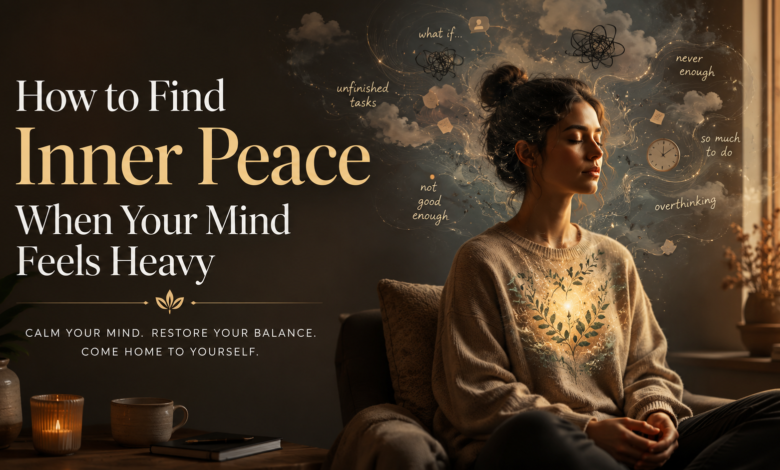
Why do I never feel at peace, even when life looks calm? This blog explains why you may feel emotionally restless, mentally heavy, or unable to relax despite trying to stay positive.
Thank you for reading this post, don't forget to subscribe!It explores how unresolved emotions, emotional suppression, hidden emotional pain, suppressed anger, and emotional numbness can disturb inner balance. You will also learn how nervous system activation can make the body feel unsafe, keep the mind alert, and create constant inner restlessness.
The guide explains how emotional regulation, healthy boundaries, present-moment awareness, and practical calming techniques can help you regain inner balance, calm an overactive nervous system, and feel peaceful inside.
It also answers why you may feel no inner peace, why you are always unsettled, and how to get peace of mind through emotional healing rather than forced silence or avoidance during stress, uncertainty, conflict, and change.
How to Find Inner Peace When Your Mind Feels Heavy
You may look calm on the outside while your mind is still arguing with the past.
You may avoid conflict, stay silent, pray, meditate, think positively, and tell yourself to let go—yet something inside you still feels restless.
A painful conversation keeps replaying. Your body remains tense. You wait for an apology, an answer, reassurance, or a change that never arrives.
Learning how to find inner peace does not mean forcing yourself to stop feeling. Inner peace is the ability to remain connected to yourself while difficult thoughts and emotions move through you.
It grows when you understand what is disturbing you, help your body feel safer, accept what you cannot control, and choose a response that protects your wellbeing.
You do not need to become emotionally numb to feel peaceful. You need a safer relationship with your thoughts, feelings, boundaries, and present reality.
What Does Inner Peace Really Mean?
Inner peace is not a life without disappointment, uncertainty, criticism, loss, or conflict.
It is a growing sense of internal steadiness that allows you to experience emotion without being completely controlled by it. You can feel hurt without losing your identity. You can feel angry without acting destructively. You can face uncertainty without treating every unknown outcome as an emergency.
A peaceful person can still cry, disagree, feel afraid, ask for space, or say no.
The difference is not the absence of emotion. The difference is the ability to notice the emotion, understand it, and respond with greater awareness.
When people ask how to find inner peace, they often imagine a permanent state in which nothing disturbs them. That expectation creates more pressure. Real peace is not permanent emotional perfection. It is the ability to return to yourself after disturbance.
That return may take an hour today, ten minutes next month, and only a few breaths later in life. The return itself is progress.
Why Is Finding Inner Peace So Difficult?
Finding inner peace can feel difficult because many people try to create peace by controlling the outside world.
You may believe you will finally feel okay when:
- someone apologises;
- your family understands you;
- a relationship becomes secure;
- work pressure disappears;
- your future becomes certain;
- people stop judging you;
- the painful memory no longer affects you.
These wishes are understandable. However, when your emotional stability depends entirely on another person or situation changing, peace remains outside your control.
You may also be carrying emotions that were never safely expressed. Perhaps you learned to stay quiet to avoid rejection. Maybe you became strong because nobody made room for your fear or sadness. You may have learned that anger is dangerous, crying is weakness, or asking for care creates conflict.
In that situation, silence may look peaceful while your inner world remains crowded.
Why You Feel Emotionally Restless Even When Life Looks Fine
Sometimes nothing dramatic is happening, but you still cannot settle.
You finish your work, lie down, and suddenly your mind begins reviewing every unfinished problem. A small comment from earlier becomes a long internal conversation. You imagine what you should have said. You predict what may go wrong tomorrow. Your body is resting, but your mind is still protecting you from something.
This does not always mean there is a serious disorder. Emotional restlessness can appear when you are carrying accumulated stress, uncertainty, unresolved hurt, poor sleep, overstimulation, or a long habit of staying alert.
Your mind may be responding not only to what is happening now, but also to what similar situations have meant in the past.
- A delayed reply may feel like rejection.
- A disagreement may feel like abandonment.
- A small mistake may feel like failure.
- A period of silence may feel like punishment.
The current moment becomes emotionally connected to an earlier wound.
That is why telling yourself to “just relax” often does not work. Your reaction may not be responding only to logic. It may be responding to emotional memory.
To understand more about reactions that happen before you can think clearly, read: automatic-emotional-reactions
Why Your Mind Cannot Relax After Emotional Pain
The mind often replays pain because it is searching for certainty, meaning, justice, or protection.
You may keep thinking:
- Why did they treat me that way?
- Did I misunderstand what happened?
- What should I have said?
- Will they do it again?
- Was it my fault?
- What if I lose them?
- How can they be peaceful after hurting me?
These thoughts may feel like problem-solving, but they often become emotional repetition.
The mind believes that one more review will finally create closure. Yet closure does not always arrive through another round of thinking. Sometimes it begins when you accept that you already understand enough to protect yourself.
- You may never receive a satisfying explanation from the person who hurt you.
- You may never hear the apology you deserved.
- You may never understand why someone chose cruelty, silence, avoidance, or manipulation.
Inner peace begins when you stop making your healing wait for information another person may never provide.
How to Find Inner Peace Without Suppressing Your Emotions
You cannot create lasting peace by repeatedly telling yourself that you should not feel what you feel.
Suppressing emotion may reduce visible conflict for a short time, but the emotional energy often remains underneath. It can return as tension, irritation, overthinking, numbness, sudden anger, exhaustion, or withdrawal.
Finding peace does not require you to obey every emotion. It requires you to stop treating emotion as an enemy.
An emotion is information, not always an instruction.
- Anger may reveal a crossed boundary.
- Fear may reveal uncertainty or remembered danger.
- Sadness may reveal loss.
- Jealousy may reveal insecurity or an unmet longing.
- Guilt may reveal either a genuine mistake or an unhealthy habit of blaming yourself.
Your first emotion may not always give you the full truth, but it gives you something important to examine.
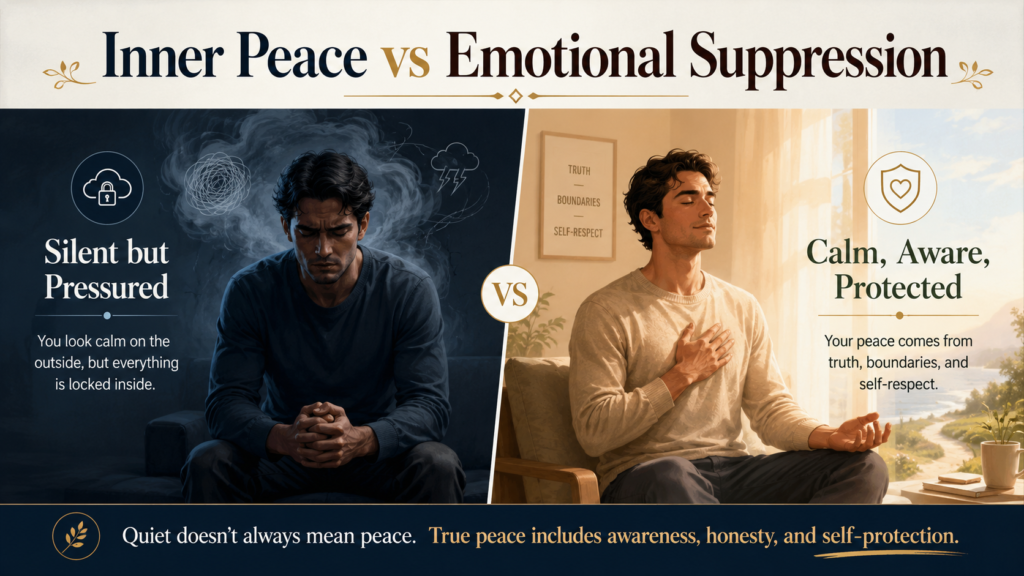
Emotional Suppression Is Not Peace of Mind
There is a difference between a conscious pause and forced silence.
A conscious pause sounds like:
“I am too activated to speak clearly. I will return to this conversation when I feel grounded.”
Forced silence sounds like:
“I must not say anything because my feelings will create trouble, nobody will understand me, or I may be rejected.”
Both may look quiet from the outside. Internally, they are very different.
The first creates space.
The second creates pressure.
You may have believed you were peaceful because you stopped arguing. But perhaps you were exhausted, afraid, emotionally disconnected, or convinced that your needs did not matter.
Real peace does not erase your voice. It helps you use your voice without losing yourself.
Inner Peace Versus Emotional Suppression
| Inner Peace | Emotional Suppression |
|---|---|
| Allows emotion to exist | Pushes emotion away |
| Creates internal clarity | Creates hidden pressure |
| Can include disagreement | Avoids conflict from fear |
| Supports clear boundaries | Tolerates too much to keep others calm |
| Feels grounded and present | Feels heavy, numb, or disconnected |
| Chooses a conscious response | Delays reaction until pressure erupts |
| Accepts reality | Pretends everything is fine |
| Protects dignity | Sacrifices needs for temporary approval |
How Unresolved Emotions Disturb Inner Balance
An unresolved emotion is not simply an emotion that has not disappeared.
It may be an experience that has not yet been understood, accepted, expressed, grieved, or acted upon.
For example, anger may remain because you still have not accepted that the relationship was unfair.
- Sadness may remain because you keep expecting yourself to recover without grieving.
- Fear may remain because you have not created a practical boundary or safety plan.
- Shame may remain because you are carrying responsibility that belongs to someone else.
- Inner peace does not arrive only through breathing exercises. Sometimes it requires a decision.
You may need to:
- stop reopening the same harmful conversation;
- limit access to someone who repeatedly destabilises you;
- admit that a relationship cannot provide what you need;
- stop waiting for approval;
- apologise for your own behaviour;
- allow yourself to grieve what will not change;
- ask for professional support.
Emotional healing becomes more possible when awareness and action work together.
How Your Nervous System Affects Inner Peace
Your thoughts are not the only part of you seeking safety.
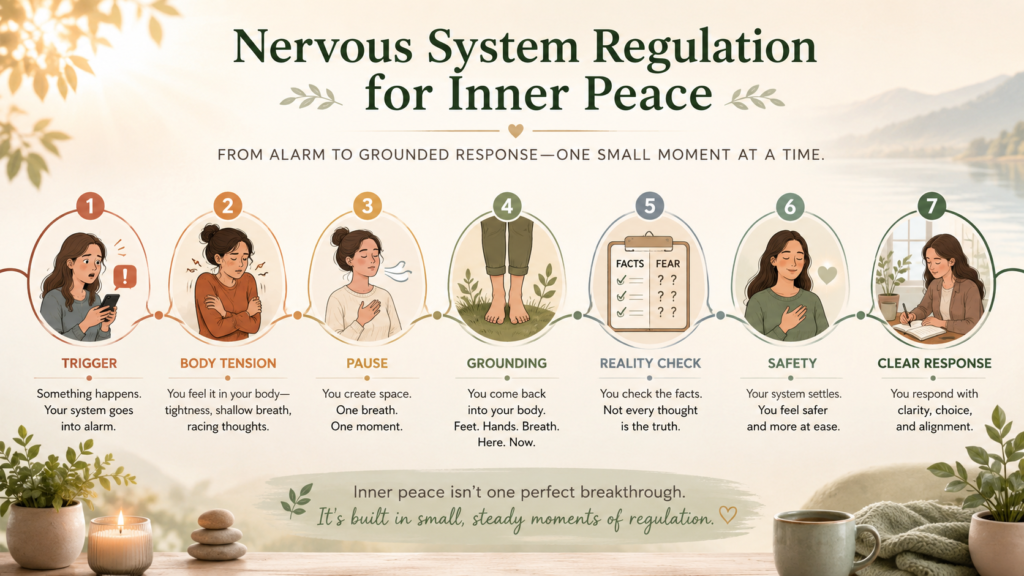
Your body also responds to pressure, conflict, criticism, uncertainty, and remembered danger. You may notice a faster heartbeat, tight chest, clenched jaw, shallow breathing, stomach discomfort, restlessness, or a strong urge to escape or defend yourself.
These reactions can happen before you have consciously decided what the situation means.
This is why how to find inner peace is not only a question of thinking differently. It can also involve helping your body move from alarm toward regulation.
You can read more about when your body reacts before conscious thought here: nervous-system-and-emotions
Why Your Body May Still Feel Unsafe
A person can understand logically that they are safe while their body remains alert.
Perhaps a certain tone of voice reminds you of past criticism.
- A delayed message may remind you of emotional withdrawal.
- Financial uncertainty may remind you of an earlier period when you had no support.
- Being ignored may activate an old belief that you do not matter.
Your nervous system is not trying to ruin your peace. It may be trying to prevent a painful experience from happening again.
The problem is that protection can become overactive. Your body may respond to a possibility as though it is an immediate fact.
Inner peace grows when you learn to say:
“My reaction is real, but I need to check whether the danger is happening now.”
This sentence does not invalidate your feeling. It creates room for reality.
How to Calm an Overactive Nervous System
You do not need to force your body into instant calm.
Begin by reducing the sense of emergency.
Try this:
- Place both feet on the floor.
- Look around and name five things you can see.
- Relax your jaw and shoulders.
- Exhale slightly longer than you inhale.
- Notice where the emotion sits in your body.
- Name the present fact without adding a prediction.
- Choose the smallest safe next action.
For example:
Fact: They have not replied for six hours.
Fear: They are rejecting me and the relationship is ending.
Emotional memory: Silence has been used against me before.
Next action: I will wait until tomorrow, continue my routine, and decide later whether a clear conversation is needed.
This method does not guarantee a pleasant outcome. It prevents an uncertain outcome from taking complete control of the present moment.
Nervous-System Safety Does Not Mean Avoiding Every Trigger
It is understandable to want a life in which nothing activates you.
But complete avoidance can make the world smaller.
Nervous-system regulation is not about designing a life with no discomfort. It is about increasing your ability to remain present, assess reality, and choose a safe response during discomfort.
You may still feel a wave of fear or anger. The goal is not to shame yourself for that wave. The goal is to avoid allowing the wave to make every decision.
How to Get Peace of Mind When You Keep Overthinking
Overthinking often begins as an attempt to gain control.
Your mind believes that if it examines every possibility, you will not be surprised, rejected, embarrassed, or hurt.
But repeated thinking does not always create better decisions. Sometimes it creates mental exhaustion without producing new information.
You may need to ask:
“Is this thought helping me understand the situation, or is it only making me relive the feeling?”
That question creates an important distinction between reflection and rumination.
Reflection produces insight or action.
Rumination repeats pain.
For more support, read how to calm repetitive thoughts without fighting them: how-to-stop-overthinking-and-calm-your-mind-naturally
Separate Facts, Fear, and Emotional Memory
Use three columns when your mind feels heavy:
| Facts | Fear or Prediction | Emotional Memory |
|---|---|---|
| What has objectively happened? | What am I imagining may happen? | What earlier experience does this resemble? |
| What evidence do I have? | What outcome am I afraid of? | What belief is being activated? |
| What can I verify? | What cannot be known yet? | What does my body remember? |
Example:
- Fact: My manager asked to speak with me tomorrow.
- Fear: I am going to lose my job.
- Emotional memory: In childhood, serious conversations usually meant criticism.
When you separate these layers, you do not deny fear. You stop treating fear as confirmed evidence.
Stop Waiting for Another Person to Give You Peace
One of the hardest forms of emotional dependence is waiting for another person to regulate your inner world.
You may wait for:
- a reply;
- reassurance;
- an apology;
- validation;
- permission;
- recognition;
- changed behaviour.
It is human to want these things. Emotional independence does not mean pretending relationships do not matter.
It means refusing to abandon yourself while waiting.
You can say:
- “I want their response, but I will not stop living until it arrives.”
- “I want an apology, but my healing cannot depend entirely on receiving it.”
- “I want clarity, but I can still protect myself while the situation remains unclear.”
Peace returns when your attention moves from “What will they do?” to “What is mine to do now?”
Why Uncertainty Keeps the Mind Alert
Uncertainty can make the mind generate worst-case scenarios because an imagined danger feels more controllable than an unknown future.
However, certainty is rarely complete.
Relationships change. People make unexpected choices. Health, work, money, and family circumstances can shift. Inner peace cannot depend on predicting everything correctly.
It depends on trusting your capacity to respond.
Learn more about why uncertainty keeps the mind alert here: why-your-mind-fears-uncertainty-and-how-to-train-it
You may not know what will happen.
But you can know:
- what values will guide you;
- what behaviour you will not accept;
- who you can contact for support;
- what practical steps are available;
- what you need to do today.
Self-trust does not remove uncertainty. It reduces the belief that uncertainty will destroy you.
How to Find Inner Peace Through Present-Moment Awareness
The present moment is not always comfortable.
Sometimes when you slow down, you notice the very feelings you were avoiding. This is why mindfulness can initially feel difficult. Silence may reveal sadness. Rest may reveal exhaustion. Reduced distraction may reveal fear.
Present-moment awareness does not mean enjoying everything you notice.
It means meeting reality before reacting to your interpretation of it.
You can ask:
- What am I feeling right now?
- Where do I feel it in my body?
- What happened immediately before this feeling?
- What story is my mind adding?
- What do I need: comfort, information, distance, rest, expression, or action?
- What is one response that protects my dignity?
For more insight into why staying present can feel emotionally difficult, read: why-i-cant-stay-present
Meditation Is a Practice, Not an Emotional Test
Some people believe they are failing at meditation because thoughts continue.
But the appearance of thoughts does not mean the practice is useless.
The practice may simply be noticing:
“My mind has returned to the argument.”
Then:
“I am bringing my attention back to breathing, sound, or sensation.”
That return is the exercise.
However, long silent meditation may not suit everyone at every stage. If sitting quietly increases distress, begin with shorter practices, mindful walking, gentle movement, guided breathing, journaling, or support from a qualified professional.
The goal is not to prove that you can tolerate discomfort indefinitely. The goal is to develop safer awareness.
Spirituality Should Not Be Used to Silence Pain
Spiritual understanding can offer meaning, compassion, humility, and a wider view of life.
But spiritual ideas can also be misused.
You may tell yourself:
- “I should forgive immediately.”
- “I should not feel angry.”
- “A spiritual person would not need boundaries.”
- “This pain is only ego.”
- “I must accept everything.”
These beliefs can turn spirituality into another form of self-abandonment.
- Acceptance does not mean approving harmful behaviour.
- Forgiveness does not require renewed access.
- Detachment does not mean emotional numbness.
- Compassion does not mean staying where your dignity is repeatedly damaged.
- A mature spiritual life makes room for truth.
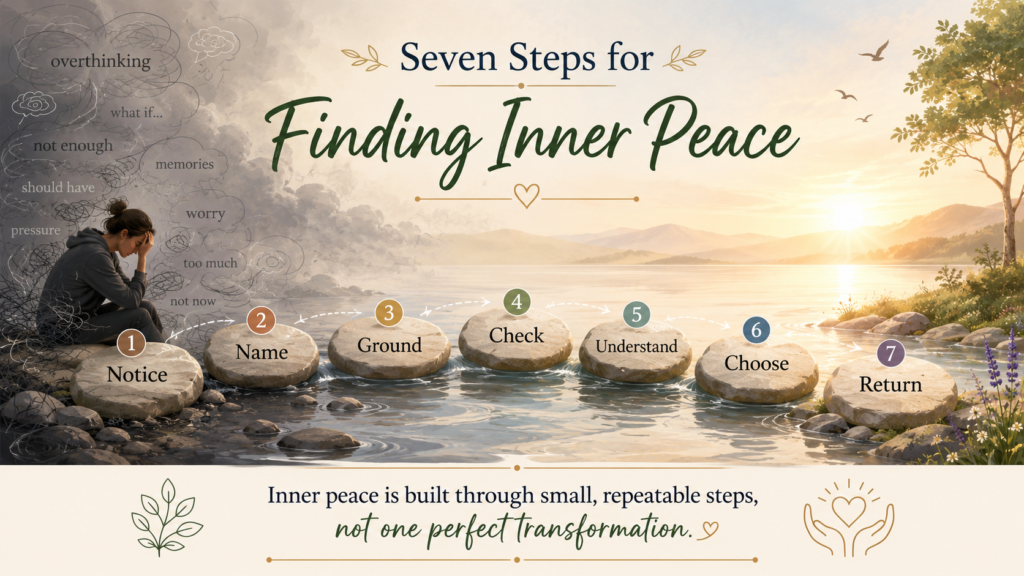
Seven Practical Steps for Finding Inner Peace
You do not need to solve your entire emotional life today.
Use this seven-step process when your mind feels heavy.
Step 1: Notice What Is Happening
Pause before explaining, fixing, blaming, or judging.
Say:
“Something inside me has become activated.”
This creates a small separation between you and the emotional wave.
Step 2: Name the Emotion Clearly
Avoid using only the word “bad.”
Try to identify whether you feel:
- rejected;
- ashamed;
- angry;
- uncertain;
- lonely;
- disappointed;
- threatened;
- powerless;
- jealous;
- exhausted.
A clearly named emotion is easier to understand than a vague sense of distress.
Step 3: Ground Your Body Before Solving the Problem
Relax the jaw.
Lower the shoulders.
Feel your feet.
Take a slower exhale.
Look at your surroundings.
Drink water.
Walk for a few minutes.
You do not need to become perfectly calm. You need enough regulation to think more clearly.
Step 4: Identify the Present Fact
Ask:
“What has actually happened?”
Remove predictions, assumptions, and imagined motives temporarily.
Facts may still be painful, but clarity reduces unnecessary emotional multiplication.
Step 5: Understand the Deeper Need
Your emotion may be protecting a need for:
- safety;
- respect;
- reassurance;
- rest;
- honesty;
- autonomy;
- belonging;
- fairness;
- grief;
- closure.
Not every need can be fulfilled by the person involved. But understanding the need helps you choose a wiser response.
Step 6: Choose One Action Within Your Control
Possible actions include:
- asking one clear question;
- delaying a conversation;
- writing your thoughts privately;
- taking space;
- setting a boundary;
- seeking support;
- finishing one practical task;
- accepting that no action is needed today.
A peaceful response is often smaller than the mind expects.
Step 7: Return Without Self-Attack
You may still become reactive sometimes.
Do not turn one difficult moment into a judgment about your entire character.
Instead of saying:
“I have failed again.”
Try:
“I became overwhelmed. What happened, and what can I practise differently?”
Inner peace grows faster when learning replaces shame.
Seven-Step Inner Peace Reset
Notice → Name → Ground → Check reality → Understand the need → Choose one action → Return with compassion
Real-Life Inner Peace Self-Check
| What You Notice | What May Be Happening | Safer First Step |
|---|---|---|
| You look calm but feel pressure inside | Emotional suppression | Name the emotion honestly |
| Your mind replays a conversation | Unresolved hurt or uncertainty | Separate facts from imagined outcomes |
| You cannot relax during quiet moments | Accumulated stress or body activation | Use movement or grounding before silence |
| You need another person to change | Emotional safety has moved outside you | Identify one boundary or choice you control |
| Meditation increases restlessness | Unprocessed emotion is becoming noticeable | Shorten the practice and use guided support |
| You feel numb rather than peaceful | Emotional shutdown or exhaustion | Reconnect gently through sensation and support |
| You explode after staying silent | Emotional pressure has accumulated | Express concerns earlier and more clearly |
| You fear every uncertain outcome | Your mind is trying to prevent surprise | Focus on the next manageable step |
| You keep seeking reassurance | Self-trust may feel weak | Delay one reassurance-seeking action |
| You feel guilty for having needs | Old conditioning may be active | Treat the need as information, not selfishness |
Can You Achieve Inner Peace While Life Is Still Difficult?
Yes, but inner peace during difficulty does not mean feeling happy about what is happening.
You may still be facing financial pressure, grief, illness, family conflict, uncertainty, loneliness, or betrayal.
Peace in that situation may look like:
- refusing to create additional suffering through constant self-blame;
- accepting what is true today;
- making one responsible decision at a time;
- allowing grief without treating it as permanent defeat;
- protecting your energy from unnecessary conflict;
- continuing your routine while answers remain incomplete;
- asking for help when the burden becomes too heavy.
Inner peace is not a reward given after life becomes fair.
It is a way of remaining emotionally present while life is still unfinished.
Inner Peace Does Not Mean Accepting Disrespect
You do not need to remain available to everyone to prove that you are calm.
A boundary is not automatically aggression.
Distance is not automatically punishment.
Saying no is not automatically selfish.
Leaving a harmful conversation is not automatically avoidance.
Your intention matters.
A boundary created to protect dignity is different from silence used to control another person.
You can say:
- “I am not willing to continue while I am being insulted.”
- “I need time before I respond.”
- “I will discuss the issue, but not in this tone.”
- “I understand your view, but my decision remains the same.”
- “I care about you, but I cannot keep participating in this pattern.”
Sometimes how to find inner peace begins with refusing repeated emotional chaos.
Healthy Boundaries Can Protect Emotional Wellbeing
A boundary cannot guarantee that another person will behave well.
It clarifies what you will do if the behaviour continues.
For example:
A request says:
“Please stop shouting.”
A boundary says:
“If shouting continues, I will end the conversation and return later.”
The second statement places action within your control.
Peace becomes stronger when it is connected to agency.
Read Also: Community Support – Free Zoom Healing Space
People Also Ask About Finding Inner Peace
Why can’t I find inner peace?
You may struggle to find inner peace when your mind is carrying unresolved hurt, uncertainty, emotional pressure, or fear. Looking calm does not always mean feeling safe inside. Peace often begins when you stop fighting your feelings, understand what they are communicating, and choose a healthier response.
How can I find inner peace when my mind will not stop thinking?
Begin by reducing the pressure to stop every thought. Notice the repeated thought, identify the fear beneath it, and return attention to your body or surroundings. Writing down facts, fears, and possible actions can help you separate useful reflection from exhausting mental repetition.
Is inner peace the same as being calm?
No. Calmness may be temporary or external, while inner peace is a deeper ability to remain connected to yourself during emotional discomfort. A person can look calm while suppressing anger or pain. Inner peace allows emotion without letting it control every decision.
Can unresolved trauma make inner peace difficult?
Painful experiences may leave a person more alert to danger, criticism, rejection, or loss. This can contribute to restlessness, repeated thoughts, sleep problems, numbness, or strong reactions. Trauma-sensitive professional support may help when these experiences remain intense or interfere with daily functioning.
How long does it take to develop inner peace?
There is no fixed timeline. Inner peace usually develops through repeated awareness, emotional regulation, healthy boundaries, acceptance, and conscious action. Progress may mean noticing activation earlier, recovering more quickly, or treating yourself with less criticism after a difficult emotional moment.
Read Also: emotional-healing-roadmap
Frequently Asked Questions
Can meditation give me inner peace?
Meditation may support inner peace by helping you observe thoughts, emotions, and physical sensations. However, it should not be used to force emotions away. Some people benefit from beginning with walking, grounding, short guided practices, journaling, or professional support before practising longer periods of silence.
Why do I feel restless even when nothing is wrong?
Your body may remain activated even without an immediate external problem. Accumulated stress, uncertainty, poor sleep, unresolved emotion, and earlier difficult experiences may contribute. Persistent or worsening restlessness should be discussed with a qualified healthcare or mental-health professional.
Is emotional numbness a form of inner peace?
No. Numbness may reduce emotional intensity by disconnecting you from feeling, while inner peace allows you to experience emotion without being completely overwhelmed. Peace tends to feel present and grounded. Numbness often feels empty, distant, heavy, or disconnected.
Can boundaries help me find inner peace?
Yes. Inner peace does not require tolerating disrespect or remaining in repeated emotional chaos. Clear boundaries can reduce confusion and protect emotional stability. A healthy boundary may include saying no, asking for space, limiting contact, or leaving a harmful conversation.
When should I seek professional support?
Consider professional support when anxiety, depression, panic, traumatic memories, numbness, severe restlessness, or sleep disruption continues, worsens, or interferes with work, relationships, safety, or daily life. Self-help practices can support wellbeing but do not replace personalised assessment or treatment.
Read Also : detachment-conscious-living
YMYL Guidance Note
This article provides general educational information about emotional wellbeing and inner peace. It does not diagnose a mental-health condition or replace individual advice from a qualified healthcare or mental-health professional.
Seek professional support if emotional distress is persistent, worsening, or affecting sleep, work, relationships, physical health, safety, or daily functioning. Seek urgent local help if you feel unable to remain safe or are thinking about harming yourself or another person.
Read Also: spiritual-psychology
How to Find Inner Peace and Return to Yourself
Inner peace did not begin when every problem disappeared.
It began when I understood that I could feel pain without allowing pain to decide everything for me.
- I could be hurt without continuing the same argument inside my mind for days.
- I could want an apology without making my entire healing depend on receiving it.
- I could love someone and still recognise that their behaviour was not safe for me.
- I could feel anger without becoming cruel.
- I could feel fear without treating every thought as a prediction.
- I could become disturbed and still return.
That return is what peace means to me now.
You do not need to wait until you become a completely different person.
You do not need to erase every emotional wound before you are allowed to feel okay.
Start with one honest breath, one clearly named emotion, one grounded decision, and one boundary that protects your dignity.
This is how to find inner peace in real life—not by escaping yourself, but by learning how to remain beside yourself when life becomes emotionally difficult.
External References
1. National Institute of Mental Health
Title: I’m So Stressed Out! Fact Sheet
Website: National Institute of Mental Health
URL: https://www.nimh.nih.gov/health/publications/so-stressed-out-fact-sheet
2. National Institute of Mental Health
Title: Coping With Traumatic Events
Website: National Institute of Mental Health
URL: https://www.nimh.nih.gov/health/topics/coping-with-traumatic-events
3. NHS
Title: Five Steps to Mental Wellbeing
Website: National Health Service
URL: https://www.nhs.uk/mental-health/self-help/guides-tools-and-activities/five-steps-to-mental-wellbeing/
4. PubMed Central
Title: Cognitive Reappraisal and Expressive Suppression Strategies in Emotion Regulation
Website: PubMed Central, U.S. National Library of Medicine
URL: https://pmc.ncbi.nlm.nih.gov/articles/PMC4168764/