Why People Make Bad Decisions Even When They Know Better
The Real Psychology Behind Poor Decisions, Emotional Reactions, and Regret

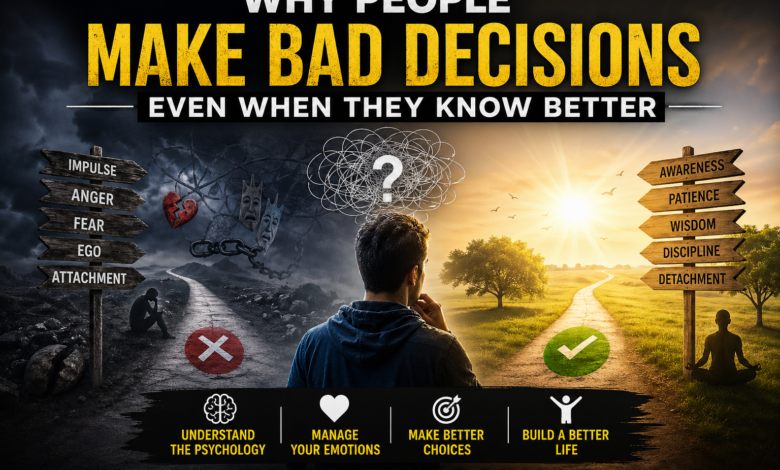
Many people silently ask themselves why people make bad decisions even when they already know the right thing to do.
Thank you for reading this post, don't forget to subscribe!👉This blog is important because it does not blame people as weak, careless, or unintelligent. Instead, it explains the deeper poor decision making psychology behind wrong choices, regret, and repeated patterns.
Sometimes the mind knows the truth, but fear, anger, attachment, pressure, loneliness, or ego becomes stronger than calm judgment. That is where emotional decision making begins. A person may act for quick relief, control, validation, revenge, or escape, and only later realize the cost.
👉This blog will help you understand bad judgment psychology from a human, nervous-system, and awareness-based view. It also shows how attachment, Maya, and unprocessed emotion create decision making mistakes, and how awareness can arrive before reaction.
Why People Make Bad Decisions Even When They Know Better
Many people quietly wonder why people make bad decisions when they already understand what is right, healthy, or logical.
👉They know they should not react in anger, send that message, spend that money, avoid that responsibility, repeat that argument, or return to a situation that already hurt them. Still, in the moment, something inside becomes stronger than wisdom.
This is where the real problem begins.
Bad decisions are not always a sign of low intelligence. Many times, they are a sign of emotional pressure, nervous system activation, unresolved attachment, and lack of inner stability at the exact moment of choice.
A person may know the truth, but if fear, anger, loneliness, ego, shame, pressure, or attachment becomes intense, the mind may stop choosing from clarity and start reacting from survival.
That is why this topic matters. It helps the reader stop asking only, “Why did I do that?” and start asking, “What was happening inside me before I did that?”
Read Also: Why Your Mind Fears Uncertainty (And How to Train It)
Knowledge Is Not the Same as Inner Stability
One of the biggest mistakes people make is believing that knowledge alone should stop wrong action. But knowing what is right and being stable enough to choose it are two different things.
A person may know they should stay calm, but their body may already be in anger.
- They may know they should move on, but attachment may pull them back.
- They may know they should not argue, but the need to be understood may feel stronger than peace.
This is the hidden layer of poor decision making psychology.
- The problem is not always lack of information.
- The problem is that the person is emotionally flooded when the decision appears.
When the inner system is unstable, even good advice becomes difficult to follow. The mind may remember wisdom, but the body may react from old pain.
Bad Decisions Often Begin Before the Action
A bad decision does not begin when the person finally acts. It often begins much earlier, inside the mind and body.
First, thoughts become fast. Then emotion becomes heavy. The body may feel restless, tight, heated, or unsafe. The mind starts repeating one side of the story again and again.
- Anger says, “Do it now.”
- Fear says, “You must protect yourself.”
- Ego says, “You cannot let this go.”
- Attachment says, “You need an answer.”
By the time the action happens, the person may already be under emotional control.
This is why decision making mistakes often feel confusing afterward. Later, when the body becomes calmer, the same person may think, “Why did I say that?” or “Why did I choose that?”
The answer is simple but deep: they acted before awareness arrived.
The Hidden Psychology Behind Poor Decision Making
To understand why people make bad decisions, we have to look deeper than the action. The visible choice is only the final step. Behind it, there may be pressure, fear, emotional hunger, loneliness, insecurity, past wounds, or the need for quick relief.
A person may not be choosing damage consciously. They may be trying to reduce discomfort quickly.
- Someone may fight because silence feels unbearable.
- Someone may message again because abandonment feels too painful.
- Someone may overspend because stress needs escape.
- Someone may avoid work because failure feels threatening.
- Someone may repeat a painful conversation because the heart is still searching for validation.
This is the deeper part of poor decision making psychology. The wrong choice often has an emotional purpose. It may not solve the real problem, but in that moment, it gives temporary relief.
The danger is that temporary relief can create long-term regret.
Read Also: Why I Can’t Stay Present: What Your Mind Is Really Doing
Why Emotion Becomes Louder Than Logic
In calm moments, logic feels simple. A person can say, “Next time, I will not react like that.” But when the same emotional trigger returns, the inner state changes.
This is where emotional decision making becomes powerful. The person is no longer looking at the situation only through facts. They are looking through fear, anger, hurt, shame, or pressure.
- Emotion changes perception.
- Anger makes the other person look fully wrong.
- Fear makes the future look dangerous.
- Shame makes the self feel small.
- Attachment makes one person or one outcome feel like the only source of peace.
When emotion becomes louder than logic, the mind starts justifying the reaction.
👉It says, “This time I have to say something.” It says, “They deserve this.” It says, “I need closure now.”
But emotional urgency is not always truth. Sometimes it is pain asking for relief.
The Moment Relief Becomes More Important Than Truth
Many bad decisions happen at the moment when relief becomes more important than truth.
The person may know that reacting will create more pain, but reaction gives immediate release.
- They may know that arguing will not change the other person, but speaking gives temporary emotional discharge.
- They may know that revenge will damage them, but revenge feels powerful for a moment.
This is a key part of bad judgment psychology. In the moment, the mind does not ask, “What is wise?” It asks, “What will reduce this feeling now?”
That is why many wrong choices feel right while they are happening. They are not truly right. They are emotionally relieving.
But relief is not always healing. Sometimes relief is only the first layer of regret.
Why Bad Judgment Feels Right in the Moment
Bad judgment often feels right because emotion creates a narrow view of reality. The person sees only one angle: their pain, their insult, their fear, their loss, their need, their urgency.
When the mind is emotionally charged, it loses access to the bigger picture.
- It forgets tomorrow.
- It forgets consequences.
- It forgets health.
- It forgets relationships.
- It forgets long-term cost.
This is why bad judgment psychology is so important. Poor judgment is not always random. It often comes from a mind that is trapped inside one emotional version of the situation.
For example, someone may keep returning to the same painful conversation because they want to be understood.
They may already know the answer will not change, but the emotional wound still feels fresh.
- To the other person, the event may feel finished.
- To the hurt person, it may still feel alive inside.
That difference creates repeated reaction.
Read Also: How to Gain Control Over Your Thoughts and Emotions
The Mind Searches for Escape, Not Wisdom
When pain becomes too much, the mind often searches for escape instead of wisdom. It wants to do something quickly so the emotional pressure can reduce.
This is why people make decision making mistakes even after learning lessons from the past. The lesson is there, but the emotional storm is louder.
The mind may choose the quickest path:
It argues to release anger.
It avoids to escape fear.
It controls to reduce insecurity.
It blames to protect ego.
It returns to someone to reduce loneliness.
It makes a harsh decision to feel powerful again.
But quick escape is not the same as a wise choice.
A wise choice needs space.
- It needs pause.
- It needs awareness.
- It needs the ability to see not only what the emotion wants now, but what the whole life may pay later.
That is why the first step toward better decisions is not perfection. It is learning to slow down before reaction becomes action.
Part 1 Closing Reflection
The reason why people make bad decisions is not always because they do not know better. Often, they know better, but they are not emotionally steady enough in that moment to use what they know.
This is the heart of poor decision making psychology. Wrong choices often begin in emotional activation, not logical ignorance.
👉When fear, anger, ego, attachment, shame, or pressure takes over, emotional decision making can feel stronger than calm judgment.
This is why bad judgment psychology must be understood with compassion. A person does not need more shame after every mistake. They need awareness of what happens before the mistake.
Because the real change begins here:
Before the action, there is an emotion.
Before the emotion, there is a wound, fear, or attachment.
Before better decisions, there must be awareness.
And when awareness arrives before reaction, many decision making mistakes can be stopped before they become regret.
How Emotional Decision Making Creates Regret Later
Emotional decision making often feels correct in the moment because the person is not only choosing from thought.
👉They are choosing from pressure, pain, fear, anger, loneliness, ego, or the need for quick relief. That is why many people regret their actions later, even when those same actions felt necessary at the time.
This is one reason why people make bad decisions repeatedly. In the heated moment, the mind does not always measure the long-term cost.
👉It measures the immediate emotional discomfort and asks, “How can I reduce this right now?”
That is how someone may speak harshly, return to a toxic pattern, spend money impulsively, avoid responsibility, or make a promise they cannot keep.
The decision may give relief for a few minutes, but later it can create guilt, shame, damage, distance, or regret.
Read Also: why-habits-dont-stick
Fear, Anger, and Ego Can Distort the Situation
Fear, anger, and ego are powerful because they change how the situation appears. Fear makes everything feel dangerous. Anger makes reaction feel justified. Ego makes silence feel like defeat. Together, they create a mental state where the person cannot see the full reality clearly.
This is a major part of poor decision making psychology. The person may not be intentionally choosing harm. They may be reacting from a distorted emotional lens.
👉For example, anger can make a small insult feel like a major attack.
- Fear can make a delay feel like rejection.
- Ego can make an apology feel like weakness.
- Attachment can make one person’s response feel like the entire meaning of life.
When these inner forces become strong, bad judgment psychology begins. The person sees the situation through emotional survival, not balanced awareness.
Read Also: Why Attachment Causes Emotional Suffering?
Why People React Strongly When They Feel Unheard
Many strong reactions come from the pain of feeling unheard. A person may know that repeating the same conversation will not solve anything, but they still return to it because something inside is asking for validation, closure, or emotional recognition.
👉This is common in family pain, relationship pain, friendship conflict, and old emotional wounds. One person may feel, “This is over. Move on.” But the wounded person may still feel the event as fresh inside.
That difference can create repeated decision making mistakes.
The person is not always trying to create drama. Sometimes they are trying to make the other person understand the depth of their hurt. But when understanding does not come, the pain becomes anger.
Then anger becomes reaction. Then reaction creates more distance.
This is how emotional pain can become a cycle of regret.
Attachment Makes Temporary Relief Look Like the Right Choice
Attachment can make a temporary emotional release look like the correct decision. When a person is attached to a person, result, image, respect, money, revenge, security, or control, they may struggle to see clearly.
- They may know what is wise, but the attachment says, “You cannot lose this.”
- They may know the argument will not help, but attachment says, “You need an answer now.”
- They may know revenge will damage them, but attachment to justice says, “You must prove your pain.”
This is another reason why people make bad decisions when they already know better. Their mind is not only making a choice. It is protecting an attachment.
Attachment narrows awareness. It makes one outcome look like the only way to feel safe. That is why emotional decision making becomes stronger when the person feels they may lose love, respect, control, identity, or security.
Why Attachment Can Trap the Mind in One Situation
Attachment traps the mind by making one situation feel bigger than the whole life. The person keeps replaying the same words, same insult, same disappointment, same fear, or same memory.
This is where poor decision making psychology becomes deeply emotional. The person may not be stuck because they are weak. They may be stuck because their mind is still trying to complete an unfinished emotional process.
They want the apology.
They want the explanation.
They want the truth.
They want the respect.
They want the other person to finally understand.
But sometimes life does not give closure in the way the heart demands it.
When attachment controls the mind, the person may keep acting from the wound. They may call again, argue again, check again, react again, or explain again. The action repeats because the inner pain has not settled.
Read Also: How To Calm Emotions Naturally (Emotions Feel Out of Control)
When the Past Still Feels Fresh Inside
Sometimes the past does not feel like the past. It feels alive in the body, mind, and nervous system.
A person may say, “I have accepted it,” but their emotional system may still react as if the pain is happening now. This is especially true when the wound connects with rejection, humiliation, abandonment, betrayal, family hurt, or long-term emotional neglect.
This creates bad judgment psychology because the present decision is not only responding to the present event. It is also carrying the weight of old pain.
The person may overreact to a small trigger because the trigger touches a deeper memory. Later, they may feel confused by the size of their own reaction.
But the reaction was not random. It came from something unprocessed that still needed awareness, safety, and healing.
Maya and the Illusion of Urgent Action
From a spiritual psychology view, Maya can be understood as unconscious attachment that makes a temporary emotional state look like absolute reality. In decision-making, Maya creates the illusion that a reaction must happen now.
Maya says, “This insult defines you.”
Maya says, “This person must understand you.”
Maya says, “This result is your safety.”
Maya says, “This revenge will give peace.”
Maya says, “This control will remove fear.”
This is why decision making mistakes can feel so convincing in the moment. The mind is caught in illusion, but the emotion feels completely real.
Maya does not always appear as something dramatic. Sometimes it appears as urgency, ego, fear, attachment, comparison, control, or the need to win.
The person may think they are choosing truth, but they may actually be obeying emotional attachment.
Maya Makes Temporary Relief Look Like a Permanent Solution
Maya makes temporary relief look like a permanent solution. That is why a person may believe that one angry message, one revengeful action, one impulsive choice, or one controlling behavior will finally make them feel better.
But temporary relief does not always create real peace.
This is a hidden layer of emotional decision making. The action may reduce pressure for a short time, but it does not heal the emotional root. After the relief fades, the person may face a new problem: guilt, regret, conflict, loss, or deeper self-attack.
For example, revenge may feel powerful for one moment, but later it may damage health, relationships, reputation, or inner peace. Control may feel safe for one moment, but later it may create more anxiety.
Maya hides the cost until after the action is done.
Read Also: Detachment & Conscious Living
Detachment Helps You See the Real Cost
Detachment does not mean becoming cold, numb, careless, or emotionless. Detachment means creating enough inner distance to see the situation clearly before acting.
When detachment enters, the person can ask:
What is this emotion asking me to do?
What will this decision cost me later?
Am I choosing from wisdom or from wound?
Am I reacting for truth or for relief?
Will this matter after five years?
This is how detachment interrupts bad judgment psychology. It does not deny emotion. It simply refuses to let emotion become the only decision-maker.
Detachment gives awareness time to arrive. It helps the person see that not every feeling requires immediate action.
- Some feelings need listening.
- Some need writing.
- Some need rest.
- Some need a trusted conversation.
- Some need time before a decision is made.
That pause can prevent many bad decisions.
Part 2 Closing Reflection
The deeper reason why people make bad decisions is not only poor thinking. It is often emotional pressure, attachment, and Maya working together. The person may know better, but fear, anger, ego, loneliness, or unresolved pain can make the wrong action feel necessary.
This is why poor decision making psychology must include the emotional and spiritual side of human behavior.
👉A person is not just a thinking machine. They carry memories, wounds, attachments, body reactions, family conditioning, social pressure, and the desire for relief.
- When emotional decision making takes over, the mind may call reaction “truth.”
- When attachment takes over, the mind may call control “safety.”
- When Maya takes over, the mind may call temporary relief “solution.”
But awareness changes the pattern.
The moment a person can pause and ask, “What is controlling this choice?” they begin to move from reaction toward wisdom.
Why “Think Before You Act” Is Not Enough
Most people already know they should think before they act, but real life is not always that simple. When emotions are calm, this advice sounds easy. But when fear, anger, pressure, attachment, shame, or ego takes control, the mind does not always pause naturally.
This is why why people make bad decisions cannot be answered only with “use logic.” Logic is useful, but logic becomes weak when the nervous system is overloaded.
A person may know the better choice, but their body may feel unsafe. Their mind may feel rushed. Their heart may want validation. Their ego may want to prove something. Their anger may want release.
👉That is why poor decision making psychology must include emotional regulation. Better decisions do not begin only with better thoughts. They begin with enough inner stability to use those thoughts.
Read Also: spiritual-psychology
A Dysregulated Mind Cannot Always Use Good Advice
Good advice only works when the person has enough inner space to apply it. If the mind is flooded with emotion, even wise advice can feel distant, irritating, or impossible.
This is why someone may hear, “Calm down,” but feel even more angry.
- They may hear, “Let it go,” but feel more misunderstood.
- They may hear, “Think clearly,” but their body may already be reacting from fear or pain.
This is a key reason behind emotional decision making. The person is not choosing from a calm mind. They are choosing from a charged state.
When the nervous system is activated, the brain can move toward protection, defense, escape, or attack.
In that state, the person may not ask, “What is wise?” They ask, “How do I stop this feeling now?”
That is why regulation must come before decision.
Environment and Circle Also Influence Bad Decisions
A person’s environment can either support better choices or increase decision making mistakes. The people around us matter. Some people help us slow down, reflect, and see another perspective. Others add pressure, gossip, fear, ego, comparison, or revenge.
👉Sometimes everyone gives advice when the situation is hot, but when the real consequence comes, those same people step back. Then the person is left alone with the damage.
This is why it is important to choose carefully who gets access to your emotional decisions.
- Not every opinion is guidance.
- Not every confident voice has wisdom.
- Not every suggestion understands your long-term cost.
Before making a serious decision, ask whether the people influencing you are helping you become calmer, clearer, and more responsible — or only making your emotion stronger.
The wrong circle can make bad judgment feel normal.
The 72-Hour Emotional Review Method Before You Decide
One practical way to reduce bad judgment psychology is to delay serious decisions when emotions are intense. This does not mean ignoring the issue. It means giving your mind and body enough time to process the emotion before action becomes regret.
👉The 72-hour emotional review method is simple:
- When something hurts you, do not immediately react if there is no emergency.
- First, write what happened.
- Write what you feel.
- Write what you want to do.
- Write what you fear.
- Write what you wish the other person understood.
- Then wait 72 hours.
After 72 hours, write again about the same situation. You may notice your emotion has changed.
Maybe the anger is lower.
Maybe the fear is clearer.
Maybe the real need is different from what you first thought.
This method helps you see that emotion is real, but it is not always complete truth.
Read Also: Start Here – Your Journey to Mental Clarity & Emotional Healing
Step 1 — Write the Emotion Without Acting on It
The first step is to write the emotion honestly without immediately obeying it. Do not make the writing perfect. Do not try to sound spiritual, mature, or calm. Write the raw truth.
You can write:
“I feel hurt.”
“I feel insulted.”
“I want to react.”
“I feel ignored.”
“I want revenge.”
“I feel unsafe.”
“I want them to understand me.”
This step is powerful because it gives the emotion a place to move without becoming an action.
Many decision making mistakes happen because emotion has no safe outlet. When the emotion is trapped inside, it looks for release through reaction. Writing creates a pause between feeling and behavior.
That pause is where awareness begins.
Step 2 — Review the Same Situation After 72 Hours
After 72 hours, return to the same situation and write again. Do not force yourself to forgive, forget, or suppress anything. Simply observe what has changed.
Ask yourself:
Do I still feel the same intensity?
Is my anger the same or lower?
What was I really needing?
Was I searching for truth, relief, control, or validation?
What action would create peace instead of more damage?
This step helps expose emotional decision making. Often, the first reaction is not the final wisdom. It is only the first wave of pain.
When the body becomes calmer, the mind can see more angles. Maybe the situation is still serious, but the way you respond can become more mature, more grounded, and less destructive.
Time does not solve everything, but time gives awareness a chance.
Step 3 — Compare Your Three Emotional Versions
For deeper clarity, repeat this process three times. Write once when the emotion is fresh. Write again after 72 hours. Then write again after another 72 hours.
Now compare the three versions.
- You may notice that your first writing was full of anger.
- The second version may show sadness.
- The third version may show the real need: respect, safety, closure, distance, boundaries, or acceptance.
This is how the mind learns to see beyond the first reaction.
This method is useful because why people make bad decisions often connects to acting from the first emotional wave. The first wave is usually loud, urgent, and one-sided. Later waves may be more honest.
Do not make permanent decisions from the first storm. Let awareness review the emotion before action decides your future.
Read Also: Emotional Healing Roadmap
How to Make Better Decisions Without Suppressing Emotion
Making better decisions does not mean becoming emotionless. Emotions are information. They show what matters, what hurts, what feels unsafe, and what needs attention.
But emotion should inform the decision, not control the decision.
- The goal is not to suppress anger, fear, sadness, or attachment.
- The goal is to understand them before acting.
- This is the healthier alternative to both emotional explosion and emotional suppression.
If you deny emotion, it may return stronger later. If you obey every emotion, you may create regret. But if you observe emotion with awareness, you can choose with more clarity.
This is the real solution to poor decision making psychology.
👉A better decision does not come from fighting yourself. It comes from slowing down enough to understand what part of you is trying to take control.
Ask: What Emotion Is Controlling This Choice?
Before making a serious choice, ask one direct question:
What emotion is controlling this decision right now?
Is it fear?
Anger?
Loneliness?
Ego?
Shame?
Attachment?
Revenge?
Pressure?
Insecurity?
This question interrupts bad judgment psychology because it separates the emotion from the decision. Once you name the emotion, you are no longer completely inside it.
👉For example, instead of saying, “I must reply now,” you may realize, “My anger wants to reply now.”
👉Instead of saying, “I cannot leave this situation,” you may realize, “My attachment is afraid of loss.”
That small separation creates power.
You are not rejecting the emotion. You are simply refusing to let it drive without awareness.
Ask: What Will This Decision Cost Me After Five Years?
Another powerful question is:
What will this decision cost me after five years?
This question brings the future into the present moment. It helps the mind move beyond immediate relief and see long-term consequences.
Before reacting, ask:
Will this matter after five years?
Will this damage my health?
Will this harm my relationships?
Will this affect my work, money, peace, or reputation?
Will I respect this decision when I am calmer?
This is especially helpful when emotional decision making creates urgency.
The emotion says, “Do it now.”
The five-year question says, “Wait.
What is the real cost?”
Many bad decisions survive only because the person looks at the next five minutes, not the next five years.
Wisdom begins when the future is allowed into the decision.
Read Also: Maya & Illusion
Final Reflection: Awareness Must Arrive Before Reaction
The deeper answer to why people make bad decisions is not that people are always careless or foolish. Many times, they are overwhelmed, emotionally activated, attached, pressured, wounded, or searching for relief.
This is why poor decision making psychology needs compassion and clarity. People do not only need instructions. They need awareness, emotional regulation, better environments, trusted guidance, and the ability to pause before reacting.
Emotional decision making becomes dangerous when the person believes every urgent feeling must become action. Bad judgment psychology becomes stronger when pain, fear, ego, or Maya makes temporary relief look like truth.
But every pattern can change when awareness arrives earlier.
- You may not control every emotion immediately.
- You may not become perfectly calm in every situation.
- But you can learn to delay reaction, write before acting, question the emotion, and see the long-term cost.
That is how decision making mistakes slowly become decision-making awareness.
And that is where real inner maturity begins.
People Also Ask
1. Why do people make bad decisions even when they know better?
People make bad decisions when emotion, fear, pressure, ego, or attachment becomes stronger than calm judgment. The issue is not always intelligence; it is often emotional activation.
2. What is poor decision making psychology?
Poor decision making psychology explains how stress, emotion, bias, past pain, and urgency can affect judgment and push people toward choices they later regret.
3. How does emotional decision making affect choices?
Emotional decision making can make temporary relief feel more important than long-term consequences. This is why a choice may feel right now but painful later.
4. Why does bad judgment feel right in the moment?
Bad judgment feels right because emotion narrows attention. Anger, fear, shame, or attachment can make one side of the situation look like the full truth.
5. How can I stop repeating decision making mistakes?
Pause before acting, write your emotion, wait before serious decisions, ask what emotion is controlling you, and consider the long-term cost before choosing.
FAQ
1. Are bad decisions always caused by lack of logic?
No. Many bad decisions happen even when logic is present. The problem is that emotion, stress, or attachment may overpower logic in the moment.
2. Can stress cause poor decisions?
Yes. Stress can affect how people feel and behave, and research on stress and decision-making shows that stress can influence cognitive processes involved in choices.
3. Is emotional decision making always bad?
No. Emotions can provide useful information, but problems begin when emotion becomes the only guide and the person ignores consequences, reality, or long-term cost.
4. Why do people regret decisions later?
People often regret decisions because the emotional pressure reduces after the action. Once calm returns, they can see the consequences more clearly.
5. What is the best first step before making a difficult decision?
The best first step is to pause and name the emotion controlling the choice. Awareness creates distance between feeling and action.
External References
- American Psychological Association — Stress
Website: APA
URL: https://www.apa.org/topics/stress
Use this for support on how stress affects how people feel and behave. - PubMed — Emotion and Decision Making
Website: PubMed / NIH
URL: https://pubmed.ncbi.nlm.nih.gov/25251484/
Use this for support that emotions are powerful and predictable drivers of decision-making. - Harvard Health — Understanding the Stress Response
Website: Harvard Health Publishing
URL: https://www.health.harvard.edu/healthy-aging-and-longevity/understanding-the-stress-response
Use this for explaining the brain’s stress response, including the amygdala and danger response. - Harvard Health — Protect Your Brain From Stress
Website: Harvard Health Publishing
URL: https://www.health.harvard.edu/mind-and-mood/protect-your-brain-from-stress
Use this for support on stress and its effect on memory and cognitive functioning. - PMC / NCBI — Decision-Making Under Stress
Website: National Library of Medicine / PMC
URL: https://pmc.ncbi.nlm.nih.gov/articles/PMC11061251/
Use this for research support on stress and cognitive processes involved in decision-making.