Grounding Techniques for Panic Attacks: Free AI Tool
When Panic Takes Over, Find One Safe Step

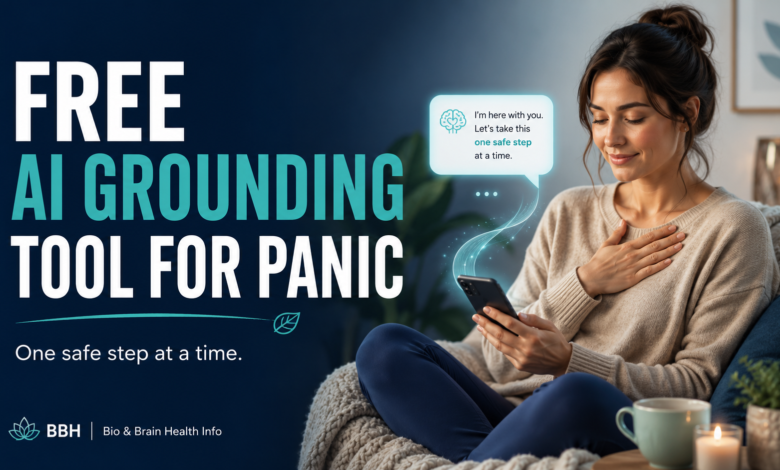
Panic can make your heart race, your chest feel tight, your body shake, and your breathing feel difficult. In that moment, long instructions may be impossible to follow for Panic attack grounding techniques – Try – 5-4-3-2-1 grounding technique.
Thank you for reading this post, don't forget to subscribe!This guide explains practical grounding techniques for panic attacks and gives you a free AI grounding tool that offers one short step at a time. You will learn simple panic attack grounding techniques, including sensory awareness, physical support, and the 5-4-3-2-1 grounding technique.
The article also explains how to ground yourself during panic when your mind feels trapped inside fear, breathlessness, or the belief that something terrible is happening.
A printable worksheet helps you notice body signals, track what helped, and decide when trusted human or medical support may be needed. This blog provides educational support only and does not diagnose panic or replace professional, medical, or emergency care.
Read Also: “AI prompt for panic when your body feels unsafe”
Free AI Grounding Tool for Panic
When Panic Takes Over, Find One Safe Step
Your heart is racing so strongly that it feels impossible to focus on anything else.
There may be pressure in your chest. Your hands may shake. Your breathing may feel empty, blocked, shallow, or unfamiliar. The room may look the same as it did a few minutes ago, yet suddenly it does not feel completely real.
Someone may be speaking to you.
You can see their face. You may hear the sound of their voice. But you cannot properly take in what they are saying because your attention has already moved inside your body.
- Your mind is watching your heartbeat.
- Your mind is watching your breathing.
- Your mind is waiting for the next frightening sensation.
And the thoughts arrive quickly:
My heart may stop.
I cannot breathe properly.
Nobody will help me.
This will never end.
When panic takes over, even helpful instructions may feel impossible to follow. Someone may tell you to breathe slowly, count backwards, drink water, sit down, think positively, or remember a grounding exercise. But your mind cannot hold ten instructions while it is already fighting with the fear that your life may be in danger.
You do not need a long list in that moment. You need one safe step.
This article explains practical grounding techniques for panic attacks and gives you a free AI grounding tool that offers one short instruction at a time. It also teaches the 5-4-3-2-1 grounding technique, a widely used five senses grounding exercise that can help redirect attention towards the present environment.
A printable worksheet is included to help you notice your body signals, record what changed before and after grounding, remember your reason to keep moving towards safety, and decide when human, professional, or medical support may be needed.
This free AI grounding tool provides educational support only. It cannot diagnose panic, rule out a medical condition, or replace qualified professional or emergency care.
What Are Grounding Techniques for Panic Attacks?
Grounding techniques for panic attacks are simple sensory, physical, and present-moment practices that help redirect some attention away from the panic cycle and towards what is happening around you right now.
You may notice:
- one object you can see;
- one texture you can touch;
- one sound outside your body;
- the pressure of your feet against the floor;
- the support of a chair beneath you;
- your current location;
- the movement or warmth of a trusted pet;
- a familiar voice;
- the date or time.
Grounding does not mean pretending that fear is not present. It does not mean forcing your body to calm down instantly. It does not mean telling yourself that every physical sensation is harmless.
The purpose is smaller and more realistic: “I will allow one small part of my attention to reconnect with the present.”
During panic, your heartbeat, breath, chest sensations, dizziness, and fear may receive nearly all of your attention. Grounding introduces other information.
- The floor is still beneath you.
- The chair is supporting your body.
- The wall has a colour.
- The fan is making a sound.
- Your pet is beside you.
Even if only five per cent of your attention moves back towards the room, that can be meaningful.
Grounding is not an exam. It is not something you pass or fail. It is one way to widen awareness when fear has narrowed it.
Use the Free AI Grounding Tool Now
Copy and paste this prompt into ChatGPT or another AI assistant:
- I may be experiencing panic and I am finding it difficult to think clearly. Guide me through a gentle grounding exercise using only one short instruction at a time.
- Begin by asking me to identify one neutral thing I can see. Wait for my response before continuing.
- Then guide me slowly through touch, sound, physical support, and awareness of where I am.
- Do not give me a long list. Do not repeatedly tell me to take deep breaths. Keep your language calm, short, and neutral.
- Let me pause, skip, or change an exercise.
- If I can manage more steps, guide me through the 5-4-3-2-1 grounding technique. If that feels too difficult, use a shorter 1-1-1 version.
- Do not diagnose my symptoms or tell me that they are definitely harmless.
If I mention new or severe chest pain, fainting, significant breathing difficulty, immediate danger, or thoughts of harming myself, tell me to seek urgent medical or crisis support and contact a trusted person immediately.
How to use the prompt
- Paste it into your chosen AI tool.
- Read only the first instruction.
- Answer in one or two words if that is all you can manage.
- Do not rush.
- Skip an exercise if it makes you feel worse.
- Stop using AI when medical, crisis, or emergency support may be needed.
The AI tool is not valuable because it knows a secret technique.
Its value is that it reduces the mental burden.
- Instead of giving you ten instructions, it gives you one.
- Instead of asking you to analyse your whole experience, it asks you to notice one object.
- Instead of expecting you to remember everything, it waits for your response.
Why One Short Instruction May Help More Than a Long Checklist
During an ordinary moment, reading a list of grounding steps may feel easy.
During panic, the same list can feel impossible.
Your attention may be completely occupied by questions such as:
- Is my heart beating too quickly?
- Am I getting enough air?
- What if I faint?
- What if I lose control?
- What if nobody helps me?
- What if this becomes worse?
- What if I cannot return to normal?
A person may already know several coping skills but still be unable to use them during intense panic.
This does not mean the person is refusing support. It does not mean the person is weak. It does not mean the person lacks motivation.
Panic can narrow attention so strongly that outside information becomes difficult to process.
The mind may hear words without understanding them. The body may feel like the only urgent reality. That is why a one-step grounding method can be more realistic.
One object. One sound. One surface. One person. One purpose. One safe action.
What Happens Inside the Body During Panic?
Panic may involve:
- rapid heartbeat;
- chest pressure;
- shaking;
- sweating;
- dizziness;
- nausea;
- breathlessness;
- numbness or tingling;
- feeling detached from the body;
- feeling that the room is unreal;
- fear of dying;
- fear of losing control;
- fear that the episode will never stop.
A sensation may begin the cycle. You notice your heart racing. Your mind interprets the sensation as immediate danger.
Fear increases. The body becomes more activated. The stronger sensation appears to confirm the fear.
The cycle may look like this:
Body sensation → Threat interpretation → Increased fear → Stronger sensation → More body monitoring
When the mind becomes fully focused on heartbeat and breathing, it may stop noticing the rest of the environment.
This is where sensory grounding for panic attacks may help.
The exercise does not say: “Nothing is wrong.”
It says: “Let us notice what else is present.”
The chair is present. The floor is present. The sound outside the window is present. The fabric beneath your hand is present. Your pet is present.
These details give the brain more than one source of information.
For a deeper explanation of body-based emotional reactions, read how the nervous system shapes emotional responses.
Grounding Is Not Forced Calm
Many people turn grounding into another demand.
They think:
- “I must calm down now.”
- “Why is my heart still racing?”
- “The technique is not working.”
- “I should feel better already.”
- “I am doing this wrong.”
- “Other people can manage this, so why can’t I?”
That pressure can add another layer of fear.
Grounding does not require you to feel calm immediately.
- You can still be frightened while noticing the floor.
- You can still shake while naming one object.
- You can still feel chest pressure while hearing one sound.
- You can still feel unreal while saying your name and location.
The first goal is not: “Make every sensation disappear.”
The first goal is: “Allow one small part of my attention to return to the present.”
That is enough for the first step.
A Real Experience of Panic From Inside the Body
During my own panic, my heart raced, my chest felt pressured, my body shook, and my breathing felt empty.
The fear was not only a thought.
- It felt physical.
- It felt urgent.
- It felt as though my heart might stop at any moment.
My mind repeated:
- I cannot breathe.
- My heart may stop.
- Nobody will help me.
- This may never end.
People could speak around me, but I could not properly hear or understand their words.
My attention had gone completely inside my body.
I was struggling with my heart, my breath, and the fear that I could lose my life.
At that moment, I looked at my pets. I thought about what might happen to them if I were no longer there. I felt that nobody would care for them in the way I did. That thought did not instantly remove panic.
But it gave me a reason to keep moving towards life.
- I held them.
- I washed my face.
- I tried to return to the present.
And when I felt that the body experience was too severe or unsafe, I understood that seeking hospital care was not weakness.
- It was action.
- It was responsibility.
- It was choosing to remain alive for the purpose that mattered to me.
“During panic, I could not properly hear anyone’s voice because my full attention had gone inside my body—towards my heart, my breath, and the fear that my life was ending. I looked at my pets and remembered that they needed me. That purpose gave me a reason to hold on, wash my face, and take the next safe step.”
How Grounding Techniques for Panic Attacks Bring Attention Back
Different panic experiences may need different first steps.
Panic Grounding Decision Table
| What you are experiencing | Try this first | What the AI tool can ask |
|---|---|---|
| Racing thoughts | Find one neutral object | “What is one object you can see?” |
| Feeling unreal | Notice physical support | “Where is your body touching the chair or floor?” |
| Shaking | Press both feet down gently | “Can you feel the floor beneath your feet?” |
| Fear of breathing | Move away from breath focus | “What is the nearest sound you can hear?” |
| Unable to remember steps | Use 1-1-1 grounding | “Name one thing you see, feel, and hear.” |
| Panic feels worse alone | Add safe connection | “Who is one person you can contact?” |
| A pet helps you connect | Notice warmth or texture | “What do you feel while gently touching your pet?” |
| Symptoms feel severe or new | Seek medical support | “Please do not assume this is only panic.” |
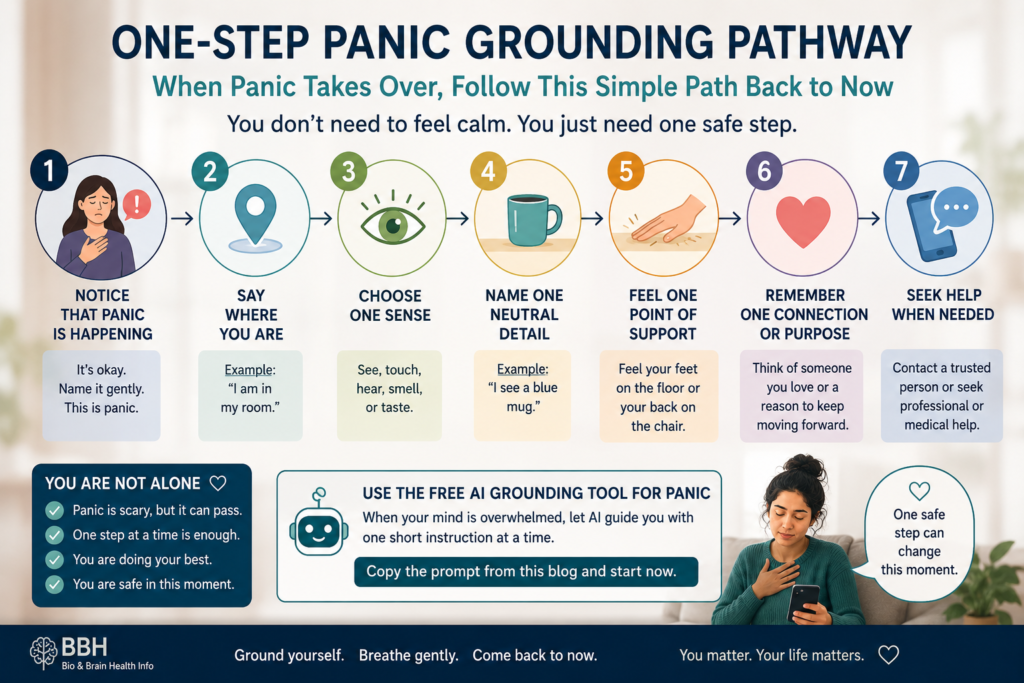
A One-Step Grounding Pathway
This pathway is intentionally short.
- You do not need to explain the whole cause of panic while your body is highly activated.
- You do not need to analyse every relationship.
- You do not need to solve your life.
First, protect the next moment.
Choosing Grounding Techniques for Panic Attacks When Thinking Feels Impossible
1. Name one object
Choose something neutral.
Describe only facts:
- colour;
- shape;
- material;
- size;
- location.
Example: “There is a brown rectangular table near the wall.”
Do not ask whether you feel calmer.
Just describe the object.
2. Feel one point of support
Notice where your body is being held:
- feet on the floor;
- back against the chair;
- hands on your knees;
- legs against the bed;
- shoulder against a wall.
Choose only one point.
3. Wash your face
Water may provide a clear sensory signal.
Notice:
- temperature;
- movement;
- touch;
- sound.
You do not need to analyse the experience. Notice only what is physically happening.
4. Hold a familiar object
You may hold:
- a cushion;
- a blanket;
- a soft cloth;
- a grounding stone;
- a familiar item;
- a pet, when the animal is calm and comfortable.
Describe what you feel.
5. Listen for one external sound
Choose a sound outside your body:
- traffic;
- a fan;
- a clock;
- birds;
- a person’s calm voice;
- your pet moving;
- water running.
You are not trying to block your heartbeat.
You are allowing another sound to exist beside it.
6. Say your name and location
Try:
“My name is ____. I am in ____. Today is ____.”
When this feels too difficult, say only your location.
How to Ground Yourself During Panic Without Forced Breathing
Breathing exercises help many people.
However, focusing closely on the breath can increase fear for others.
You may begin monitoring every inhale.
You may worry that your breath is not deep enough.
You may attempt to take a very large breath and feel that it still does not satisfy the body.
When breath itself becomes the source of fear, choose an external grounding action first.
Try:
- finding three blue objects;
- reading a nearby label;
- touching a textured surface;
- feeling both feet on the floor;
- washing your hands;
- looking at your pet;
- counting doors or windows;
- listening for a distant sound.
When breathing practice does feel helpful, keep it gentle.
Do not force a very deep breath.
Do not make the breath another test.
You are allowed to use a non-breathing technique.
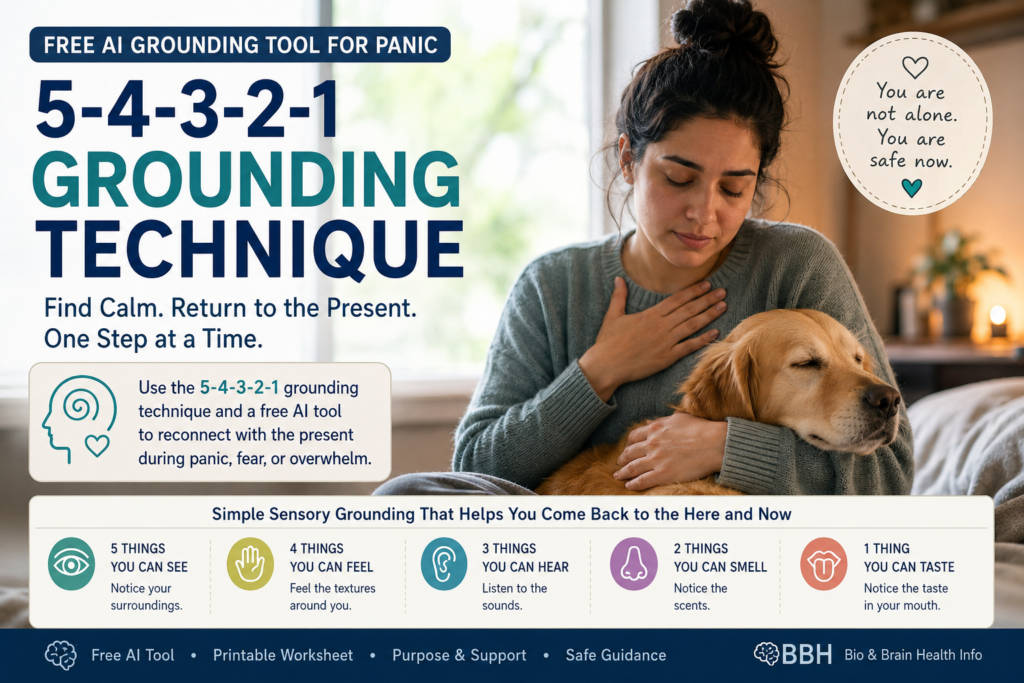
How to Use the 5-4-3-2-1 Grounding Technique
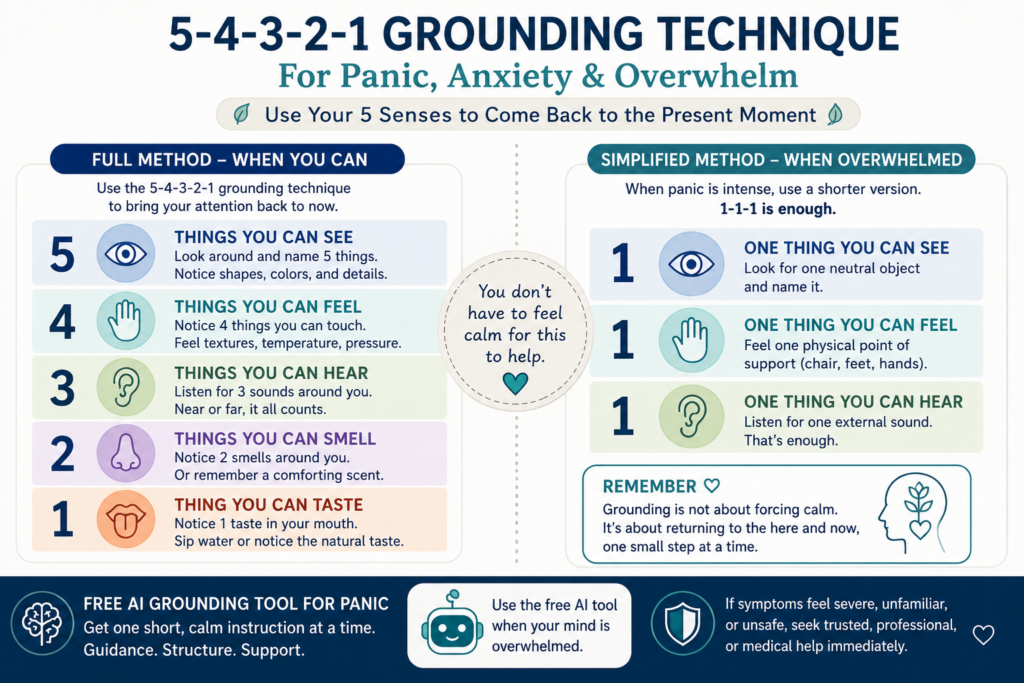
The 5-4-3-2-1 grounding technique is a structured sensory exercise that uses sight, touch, sound, smell, and taste.
It is also known as a 5 senses grounding exercise, the 54321 method for panic attacks, and a five senses panic grounding method.
The steps are:
- 5 things you can see
- 4 things you can feel
- 3 things you can hear
- 2 things you can smell
- 1 thing you can taste
Five things you can see
Look around and name five visible objects.
For example:
- a window;
- a chair;
- a cup;
- a light;
- a door.
Four things you can feel
Notice four points of touch.
For example:
- your feet inside your shoes;
- fabric against your arm;
- the chair beneath you;
- the phone in your hand.
Three things you can hear
Listen for three sounds.
For example:
- a fan;
- traffic;
- a bird.
Two things you can smell
Notice two smells.
For example:
- soap;
- tea;
- fabric;
- room air;
- food.
One thing you can taste
Notice one taste.
For example:
- water;
- tea;
- toothpaste;
- the natural taste in your mouth.
The 5-4-3-2-1 grounding technique works by giving attention a clear sensory structure.
But the structure is not a rule.
- You do not need perfect answers.
- You do not need to finish every stage.
- You do not need to force smell or taste when they are unavailable.
- You may stop after sight and touch.
- You may use only sound.
- You may shorten the sequence.
The purpose is grounding, not completion.
When the 5-4-3-2-1 Grounding Technique Feels Too Difficult
The full method can feel too long during intense panic.
This is common.
Use 1-1-1 grounding instead:
- one thing you can see;
- one thing you can feel;
- one thing you can hear.
That is enough.
You may reduce it even further:
- one colour;
- one surface;
- one sound.
Full and simplified grounding comparison
| When concentration is available | When panic is intense |
|---|---|
| Use 5-4-3-2-1 | Use 1-1-1 |
| Notice five senses | Choose one to three senses |
| Describe several details | Name one simple fact |
| Continue while helpful | Stop when it feels demanding |
| Use as a full exercise | Use as an immediate first step |
The shorter version is not inferior.
It is adapted to the capacity available in that moment.
The Psychology and Attachment Layer
Panic may feel worse when you believe nobody will help you.
The fear becomes more than: “What is happening inside my body?”
It becomes: “What if I have to face this alone?”
Some people have experienced little dependable support during difficult moments.
They may have learned to manage distress alone, hide fear, remain strong, or care for others while receiving little care themselves.
When panic comes, the body may feel both physical danger and emotional isolation.
This does not mean every panic attack comes from attachment trauma.
It means that the presence or absence of safe support can influence how alone the person feels during fear.
The free AI grounding tool may provide temporary structure.
But AI is not true co-regulation.
It cannot replace:
- a trusted person staying nearby;
- a doctor assessing physical symptoms;
- a therapist understanding your history;
- emergency services responding to danger;
- a crisis professional helping you remain safe.
Digital support should guide you towards safety, not become the only source of safety.
Read more about using AI mental-health tools with responsible boundaries.
Remember One Purpose During Panic
For me, my pets became a reason to move towards life.
I thought: “They need me. I cannot leave them alone.”
Purpose may be:
- caring for a pet;
- protecting a child;
- seeing a loved one;
- completing meaningful work;
- practising faith;
- keeping a promise;
- reaching the next morning;
- giving yourself a chance to receive help.
Purpose should not be used as guilt.
It should not sound like: “Other people need you, so you are not allowed to struggle.”
That can increase pressure. Purpose should sound like: “Something beyond this fear matters to me. I can take one safe step towards it.”
That safe step may be grounding.
- It may be calling someone.
- It may be visiting a hospital.
- It may be seeking professional support.
AI & CBT — Discover responsible AI prompts, worksheets, and structured tools for anxiety, overthinking, and emotional clarity.
What If Grounding Does Not Work Immediately?
A grounding exercise may help quickly.
- It may help gradually.
- It may create only a small change.
- It may not help in that moment.
- None of these outcomes means you failed.
Try:
- Stop checking whether you are calm every few seconds.
- Reduce the exercise to one detail.
- Change from breathing to external senses.
- Move somewhere physically safer or quieter.
- Contact a trusted person.
- Follow the care plan created with your healthcare professional.
- Seek medical support when symptoms are severe, unfamiliar, or concerning.
You may later use the free Fact vs Fear tool to separate confirmed facts from anxious predictions.
Do not use cognitive exercises to dismiss symptoms that may need medical evaluation.
What the Free AI Grounding Tool Can and Cannot Do
It may help you:
- begin when you cannot remember a coping skill;
- receive one instruction at a time;
- notice your environment;
- reduce mental overload;
- name a body sensation;
- choose one next step;
- create a grounding plan when calm;
- prepare questions for a healthcare professional.
It cannot:
- diagnose a panic attack;
- determine why your heart is racing;
- confirm that chest pain is harmless;
- measure oxygen or blood pressure;
- replace a doctor or therapist;
- provide emergency care;
- contact help for you;
- guarantee that panic will stop.
AI can organise information. It cannot examine your body. That boundary must remain clear.
You may also explore free ChatGPT prompts for anxiety when you are calm enough to reflect.
Build a Panic Grounding Plan Before the Next Episode
During a calm period, write down the following.
My earliest warning signs
- Does my heart begin racing?
- Does my chest feel tight?
- Do I feel unreal?
- Do I monitor breathing?
- Do I search repeatedly for reassurance?
- Do I fear being alone?
My two simplest grounding actions
Choose only two.
Examples:
- wash my face;
- feel my feet;
- hold my pet;
- name one sound;
- look at one object;
- say my location.
What makes panic harder
Examples:
- too many people speaking;
- being told to relax;
- forced breathing;
- symptom searching;
- being left alone;
- receiving long instructions;
- pressure to explain everything.
My safe contacts
Write down:
- one trusted person;
- doctor or therapist;
- nearby medical service;
- local emergency number;
- crisis support number.
My reason to protect the next moment
Complete: “I want to take the next safe step because __________.”
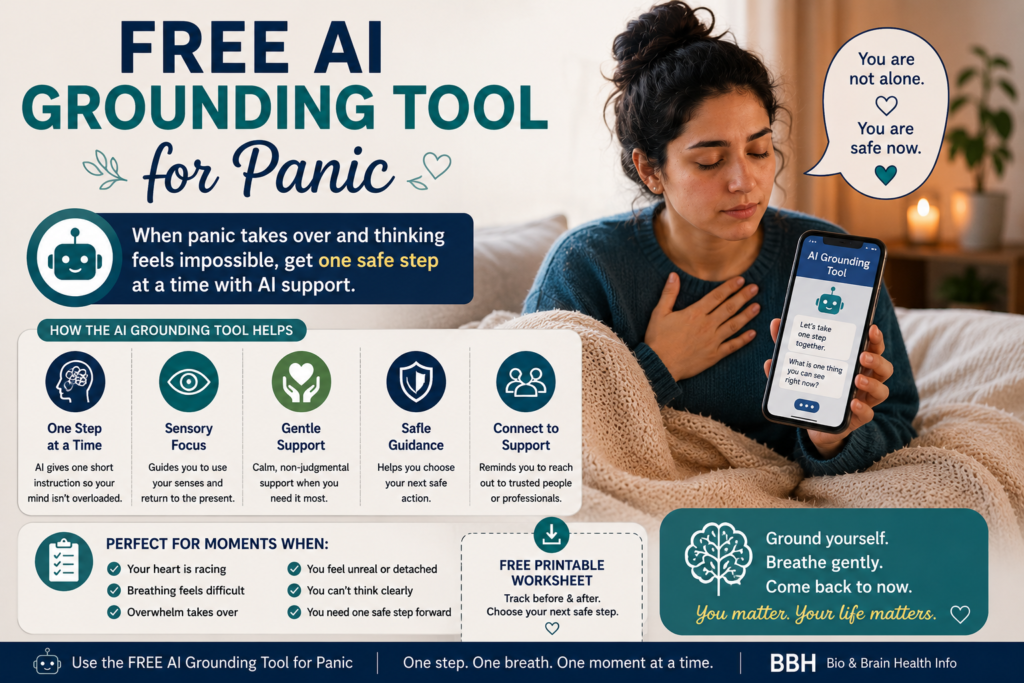
Download the Free BBH Panic Grounding Worksheet
The BBH One-Step Panic Grounding and SOS Check-In Worksheet helps you record:
- panic level before grounding;
- strongest physical sensation;
- main fear thought;
- one thing you see;
- one thing you feel;
- one thing you hear;
- grounding action used;
- panic level afterwards;
- personal purpose or connection;
- trusted support needed;
- next ten-minute safety plan.
📥 Download Free PDF : BBH One-Step Panic Grounding and SOS Worksheet
Supporting line: Use this printable worksheet to reconnect with the present, record what changed, and choose the next safe action.
This worksheet is educational and reflective. It is not a diagnostic tool.
Read Also: ai-therapy-tools
Continue With the Full BBH Book – Calm Your Anxious Mind With AI
101 Safe Prompts, Worksheets & Trackers for Daily Life Anxiety, Panic, Work Stress, Relationships, Sleep Worry and Emotional Calm
Series: BBH™ Clarity AI Prompt Guides for Mental Wellness — Volume 1
Author: Shubhangi Halande
Publisher/Brand: Bio & Brain Health Info
The book is designed to help readers use AI more safely and purposefully for self-reflection.
It includes support for:
- anxiety patterns;
- panic sensations;
- fear thoughts;
- work stress;
- relationship worry;
- sleep anxiety;
- emotional overwhelm;
- grounding plans;
- safety boundaries;
- daily tracking.
The book does not present AI as therapy. It does not replace medical, psychological, or crisis care.
Amazon purchase link: Add after publication.
Suggested purchase button: Get Calm Your Anxious Mind With AI
When Should You Seek Professional Help?
Consider speaking with a healthcare or mental-health professional when panic attacks:
- happen repeatedly;
- create fear of another attack;
- lead to avoidance;
- interfere with work or sleep;
- affect relationships;
- make you afraid to leave home;
- make you afraid to remain alone;
- are becoming more intense.
Seek urgent medical help when:
- chest pain is new or severe;
- you faint;
- breathing difficulty is significant;
- symptoms follow injury or substance use;
- symptoms feel different from your usual experience;
- you are unsure whether a physical condition may be involved.
Contact emergency or crisis support immediately if you may harm yourself, cannot remain safe, or are in immediate danger.
Do not continue using AI when urgent human intervention is needed.
Read Also: Community Support – Free Zoom Healing Space
People Also Ask
1. What are the best grounding techniques for panic attacks?
Useful options include naming one object, feeling your feet on the floor, noticing one external sound, washing your face, holding a safe object, or using the 5-4-3-2-1 grounding technique. Begin with the simplest action you can manage.
2. How do you ground yourself during a panic attack?
Say where you are, notice one neutral detail, and feel one physical point of support. You do not need to complete a long exercise. The aim is to reconnect a small amount of attention with the present.
3. What is the 5-4-3-2-1 grounding technique?
The 5-4-3-2-1 grounding technique asks you to notice five things you see, four you feel, three you hear, two you smell, and one you taste. It is a structured sensory grounding exercise.
4. Can grounding stop panic immediately?
Grounding may reduce overwhelm or improve present-moment awareness, but it cannot guarantee immediate relief. Its effect varies between people and episodes.
5. Can AI help during panic?
AI may offer short grounding prompts, but it cannot diagnose symptoms, assess medical risk, or provide emergency care. Use it as optional support, not as a replacement for people or professionals.
Frequently Asked Questions
1. What if breathing exercises make panic worse?
Stop forcing the breath. Shift to an external sense. Notice a colour, texture, sound, or point of physical support.
2. What if I cannot remember 5-4-3-2-1?
Use 1-1-1: one thing you see, one thing you feel, and one thing you hear.
3. Why does the room feel unreal during panic?
Some people experience detachment or unreality during intense anxiety. Sensory grounding may help, but persistent or unfamiliar symptoms should be professionally assessed.
4. Should I use the AI tool every time?
It can be one part of your support plan, but it should not become your only source of safety.
5. When should I seek help?
Seek professional support when panic repeatedly disrupts daily life. Seek urgent medical care for severe, new, or unfamiliar physical symptoms.
Personal Note
Panic can reduce the whole world to one point: the heart, the breath, the fear that time is running out.
In that state, I could not process long explanations.
I could not properly hear what people were saying.
My attention was fighting inside my body. What helped me begin returning was connection. I looked at my pets and remembered that I wanted to remain alive for them.
They depended on me.
That purpose gave me enough strength to hold them, wash my face, focus on one next action, and seek hospital care when my body did not feel safe.
I believe purpose can sometimes help us move towards life during panic.
But purpose should never be used to dismiss serious symptoms.
My lesson is simple: When balance disappears, return to one reason, one grounding action, and one safe decision.
You do not have to solve your whole life during panic.
Protect the next moment.
External References
National Institute of Mental Health — Panic Disorder: What You Need to Know
https://www.nimh.nih.gov/health/publications/panic-disorder-when-fear-overwhelms
National Institute of Mental Health — Panic Disorder: The Symptoms
https://www.nimh.nih.gov/news/media/2022/panic-disorder-the-symptoms
Royal Berkshire NHS Foundation Trust — Grounding Techniques to Help With Anxiety
https://www.royalberkshire.nhs.uk/leaflets/grounding-techniques-to-help-with-anxiety
NHS — Breathing Exercises for Stress
https://www.nhs.uk/mental-health/self-help/guides-tools-and-activities/breathing-exercises-for-stress/
Related BBH Reading
Read about safer use of AI mental-health tools.
Explore free ChatGPT prompts for anxiety.
Use the Fact vs Fear tool.
Learn about nervous-system regulation for anxiety.
Understand how the nervous system influences emotional reactions