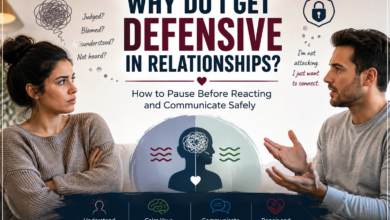
How to Stop Getting Defensive When Conversations Trigger You
Secure Communication for Emotional Triggers


Most advice on how to stop getting defensive tells you to stay calm, listen better, or use “I statements.” But many people already know that and still react when a conversation feels emotionally unsafe.
Thank you for reading this post, don't forget to subscribe!This blog goes deeper. It explains defensive communication through the nervous system, attachment wounds, and real body reactions.
You will learn why relationship conflict can activate old pain, how emotional triggers affect your words, and how secure communication can help you speak without attacking, shutting down, or abandoning yourself.
This is not only communication advice. It is a repair path for people who want connection, respect, and care.
Quick Answer:
To stop getting defensive, pause before reacting, notice your body response, name the feeling underneath the reaction, and speak with observation, feeling, need, and request instead of blame.
Defensiveness reduces when the nervous system feels safe enough to listen, repair, and express pain without attacking.
Why This Matters Before the Conversation Gets Worse
Defensiveness can damage a conversation quickly because it moves the focus away from understanding and toward protection. One person may feel blamed, while the other feels unheard.
This is why learning how to stop getting defensive matters before the conflict becomes bigger than the original issue.
The Real Pain Is Often Not the Words
Many emotional triggers are not only about what someone said. They are about what the words made you feel: judged, dismissed, blamed, unseen, or unsafe.
When the deeper pain is “No one cares about my side,” the body may react before the mind can explain.
The Goal Is Repair, Not Perfect Communication
Secure communication does not mean you never feel hurt, angry, or overwhelmed. It means you learn to pause, understand your reaction, and speak in a way that protects both your truth and the relationship.
There are moments when you do not enter a conversation wanting to fight. You may only want connection, respect, care, and the chance to explain your side fully before being judged.
But the moment the other person questions you, corrects you, ignores your pain, or speaks in a sharp tone, something inside your body changes before your mind can organize your words.
Your chest may become tight. Your thoughts may become fast. Anger may rise suddenly. Tears may come before you know how to explain them.
You may become silent, panicked, shaky, frozen, or emotionally flooded.
- Some people start over-explaining.
- Some people speak loudly.
- Some people leave the conversation.
- Some people go quiet and later curse themselves for everything.
How to stop getting defensive ?
This is why learning how to stop getting defensive is not only about using better communication skills. It is also about understanding what happens inside the nervous system when conflict feels like emotional danger.
Many people think defensiveness means ego, immaturity, attitude, or lack of self-control. Sometimes defensiveness can create harm, and it does need responsibility. But often, defensiveness begins from a much deeper emotional wound: “No one cares about my side.”
When that wound is touched, a person may not be trying to attack. They may be trying to protect the part of themselves that feels unheard, unseen, blamed, dismissed, or emotionally abandoned.
This is also why some people experience strong emotional attachment pain even when the relationship itself feels confusing or unsafe. If this pattern feels familiar, you may also want to read about why attachment causes emotional suffering.
Secure communication helps you speak from that pain without letting the pain control the whole conversation. It helps you express hurt without blame, ask for care without control, listen without collapsing, and protect your self-respect without becoming harsh.
“I understood that sometimes my body was not trying to create conflict. It was trying to protect a pain I had not yet named.”
This article will explain why defensiveness happens, how words affect the nervous system, why attachment wounds can make relationship conflict feel unsafe, and what practical steps can help you communicate with more calm, honesty, and emotional safety.

What Does Defensiveness Mean in Conversations?
Defensiveness happens when a person feels attacked, blamed, criticized, misunderstood, rejected, or emotionally unsafe and responds by protecting themselves.
This protection can look different in different people. One person may argue.
- Another may explain too much.
- Another may deny everything.
- Another may blame back.
- Another may become silent and emotionally disappear.
- Another may cry, panic, or shut down.
Defensiveness often sounds like:
- “I did not do anything wrong.”
- “You are blaming me again.”
- “You never understand me.”
- “Why are you attacking me?”
- “I cannot say anything to you.”
- “Forget it, nothing matters.”
Underneath those words, the deeper feeling may be:
- “I feel judged.”
- “I feel unsafe.”
- “I feel misunderstood.”
- “I feel like my side does not matter.”
- “I feel like I have to protect myself.”
If you want to understand how to stop getting defensive, the first step is not self-hatred. The first step is honest awareness. Shame does not make communication better. Shame usually makes the nervous system more defensive.
Defensiveness becomes a problem when it blocks listening, accountability, repair, or emotional connection. But the way to change defensiveness is not to attack yourself for having it. The way to change it is to pause, understand what it is protecting, and choose a safer response.
A secure inner sentence can be:
“I am feeling defensive right now, but I still want to understand what is happening.”
That sentence does not excuse the reaction. It creates space between the reaction and the next words.
Read Also : understand what happens beneath the reaction
Why Relationship Conflict Feels Threatening to the Nervous System
Words do not only communicate ideas. Words can also send safety or threat signals to the nervous system.
- A calm tone can help the body soften.
- A blaming tone can make the body prepare for attack.
- A cold silence can feel like abandonment.
- A sarcastic sentence can feel like humiliation.
- A sudden accusation can make the body move into defense before the mind has time to think clearly.
This is why communication is not only verbal. It is biological.
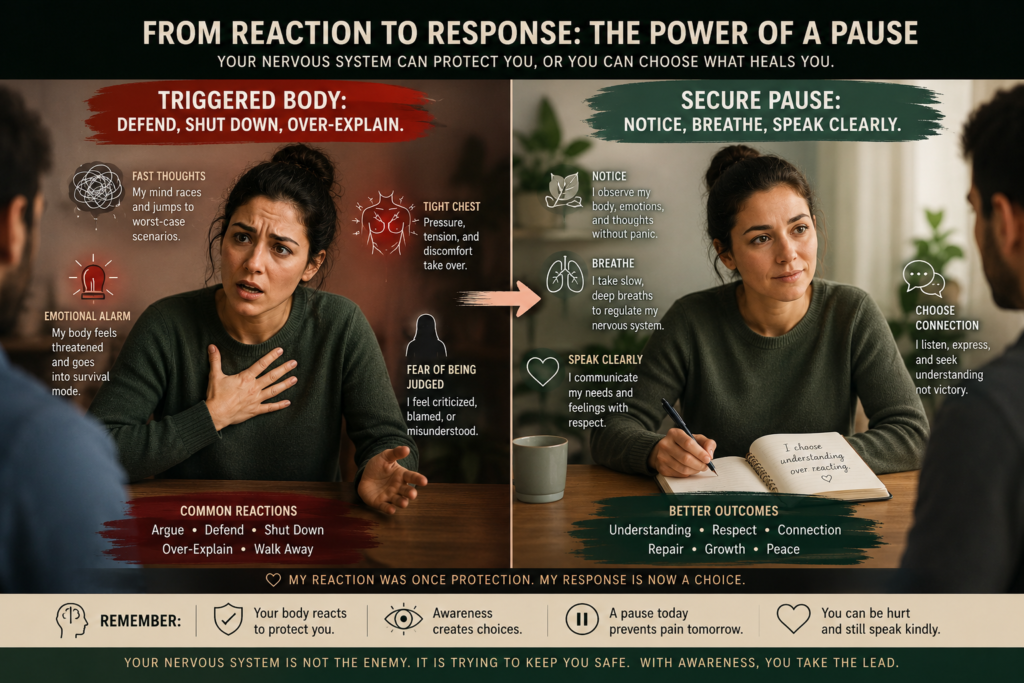
When the nervous system senses emotional danger, the body may move into fight, flight, freeze, or shutdown.
- Fight may look like anger, arguing, interrupting, raising your voice, or trying to prove your point strongly.
- Flight may look like leaving the room, avoiding the topic, changing the subject, or wanting to escape.
- Freeze may feel like going blank, numb, confused, or unable to respond.
- Shutdown may look like silence, distance, collapse, or emotional disconnection.
This is why emotional triggers matter so much during relationship conflict. A triggered person may not be choosing their clearest words. They may be speaking from a body that feels unsafe.
That does not mean hurtful words are acceptable. It means the solution must include regulation, not only advice like “just speak calmly.” For readers who want a deeper body-based healing explanation, somatic experiencing for emotional regulation can help them understand why the body needs safety before the mind can respond clearly.
If the body is in threat mode, calm communication becomes difficult. The person may know what is right but still react from protection. This is why how to stop getting defensive must include the nervous system.
Before asking, “What should I say?” it may be more helpful to ask:
“What state is my body in before I speak?”
If your body is already in fight mode, your words may sound attacking. If your body is in freeze mode, your silence may feel like withdrawal. If your body is in panic, your explanation may become too long, too intense, or too urgent.
Secure communication begins when you notice the body before trusting the reaction.
Read Also : “how defensiveness shows up in relationships”
The Emotional Neglect Wound Behind Defensive Communication
One of the deepest pains behind defensive communication is this feeling:
“No one cares about my side.”
This pain can come from many experiences: being ignored, blamed, dismissed, misunderstood, emotionally unsupported, criticized, or expected to stay quiet while others judge you. When someone has carried this pain for a long time, even a small disagreement can touch something much deeper.
The present conversation may be about one comment, one delayed reply, one misunderstanding, one tone, or one decision. But the body may react as if an old emotional wound is being reopened.
This is why secure communication must include attachment awareness. In attachment wounds, the fear is often not only about the current words. The fear is about losing connection, losing safety, losing dignity, or again being treated as if your emotions do not matter.
A person may look angry, but underneath they may be asking:
“Will you listen to me?”
“Will you care about my side?”
“Will you judge me before understanding me?”
“Will you leave me alone with this pain again?”
“Will I have to fight just to be heard?”
When defensiveness comes from this wound, the person may feel ashamed after reacting. They may cry, curse themselves, or think, “Why did I say that? Why did I become like that?” But self-attack does not heal the wound. It usually deepens it.
This same emotional confusion can also appear when someone feels attached to a painful relationship or keeps seeking understanding from someone who has hurt them.
In that case, the article on why you miss someone who emotionally abused you may help readers understand the attachment bond behind emotional pain.
The healing question is:
“What pain was my body trying to protect?”
Sometimes the answer is not ego. Sometimes the answer is grief. Sometimes it is loneliness. Sometimes it is the need for respect, care, and emotional acknowledgment.
This understanding helps soften the shame around defensiveness while still keeping responsibility.
You can say:
“My reaction came from pain, but I am still responsible for how I communicate that pain.”
That is the foundation of secure communication.
Read Also : when a simple correction feels like rejection
Sometimes Silence Is Not Peace
Many people believe silence is always mature. Sometimes silence is wise. It can prevent escalation, give the body time to regulate, and stop hurtful words from being spoken.
But silence is not always peace.
Sometimes silence becomes self-abandonment.
If you stop speaking because you genuinely need time to calm your body, that can be healthy. But if you stop speaking because you believe your side will never matter anyway, that silence may be emotional defeat.
It may be a learned survival response.
You may say, “It is okay,” when it is not okay.
You may say, “Forget it,” when your heart is still hurting.
You may stay quiet because speaking feels useless.
You may avoid conflict because being honest feels unsafe.
This is not secure communication. This is self-protection through disappearance.
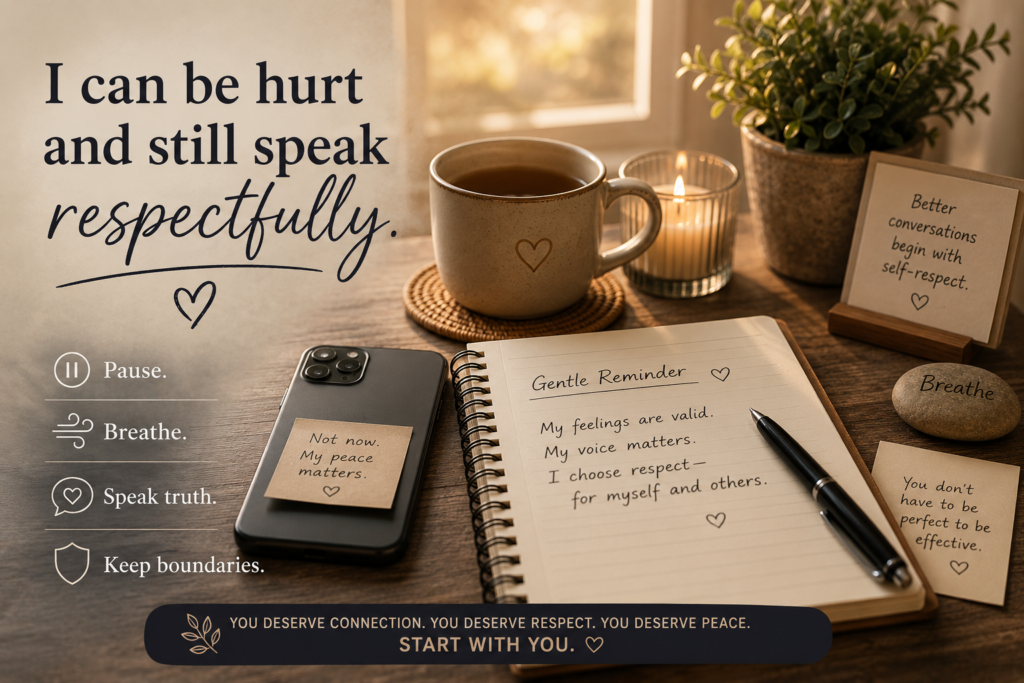
A powerful line for healing is:
“I can be hurt and still speak respectfully.”
This sentence protects both truth and dignity. It does not give permission to attack. It also does not ask you to erase yourself.
Secure communication does not mean saying every thought. It means not abandoning the truth that matters.
Quick Summary: The Three Layers of Defensiveness
Defensiveness usually has three layers: the visible reaction, the body’s threat response, and the deeper need to feel heard, respected, or safe.
Real communication repair begins when you work with all three layers, not only the words.
| Layer | What It Looks Like | What It May Need |
|---|---|---|
| Visible reaction | Anger, silence, over-explaining, crying | A pause before response |
| Body threat response | Tight chest, fast thoughts, panic, shutdown | Nervous system regulation |
| Deeper emotional need | “No one cares about my side” | Respect, listening, clarity, care |
This is why secure communication is not only about being polite. It is about creating enough inner safety to speak truth without attacking or disappearing.
The Real Solution: How to Stop Getting Defensive
The real solution is not to force yourself to become calm while your body feels unsafe. The real solution is to create a small pause between the trigger and the response.
That pause gives your nervous system time to come out of protection mode. It gives your mind time to organize words. It gives your heart time to speak without attacking.
This is the practical BBH secure communication method.
Step 1: Notice the Body Before You Answer
Before responding, ask:
“What is happening in my body right now?”
You may notice tight chest, heat in the face, fast thoughts, stomach tension, shaking, crying, numbness, heaviness, or pressure to prove yourself.
This matters because defensiveness often starts in the body before it becomes a sentence.
Try this inner sentence:
“My body feels threatened, but I do not have to speak from threat.”
This is one of the most important first steps in how to stop getting defensive.
Do not wait until you are perfectly calm. Just notice enough to slow the reaction.
Step 2: Name the Protective Pattern
Ask yourself:
“Am I fighting, fleeing, freezing, shutting down, over-explaining, or blaming myself?”
Naming the pattern creates distance from it.
Instead of saying:
“I am terrible. I ruined everything.”
Try:
“My nervous system is protecting me. I need to slow down and choose my next words.”
This does not remove responsibility. It removes shame so responsibility becomes possible.
When you identify the pattern, you can choose a better response.
Step 3: Use the 10-Second Regulation Pause
When emotional triggers appear, take a short pause before speaking. This pause does not need to be dramatic. It can be simple.
Try this:
Unclench your jaw.
Place both feet on the ground.
Exhale slowly.
Relax your shoulders.
Look at one stable object in the room.
Say internally, “Pause before proof.”
Many defensive reactions come from the urge to prove your side immediately. But proof spoken from panic may sound like attack.
The 10-second pause helps you return to choice.
Step 4: Separate the Current Conversation From the Old Wound
Ask:
“Is this only about what happened now, or is this touching an old pain?”
This question is powerful because sometimes the body reacts to two things at once: the present relationship conflict and the old emotional wound.
For example, the current issue may be:
“They interrupted me.”
But the deeper wound may be:
“No one listens to me fully before judging me.”
The current issue may be:
“They did not reply.”
But the deeper wound may be:
“I feel forgotten and unimportant.”
This is why relationship conflict can become difficult. The words may be small, but the wound underneath may be large. This also connects with digital attachment patterns, where delayed replies, seen messages, or short responses can activate old fears. Readers can go deeper through texting anxiety and attachment patterns.
When you can separate the present from the past, your response becomes clearer.
You can say:
“This moment is painful, but it may also be touching something older. I need to respond carefully.”
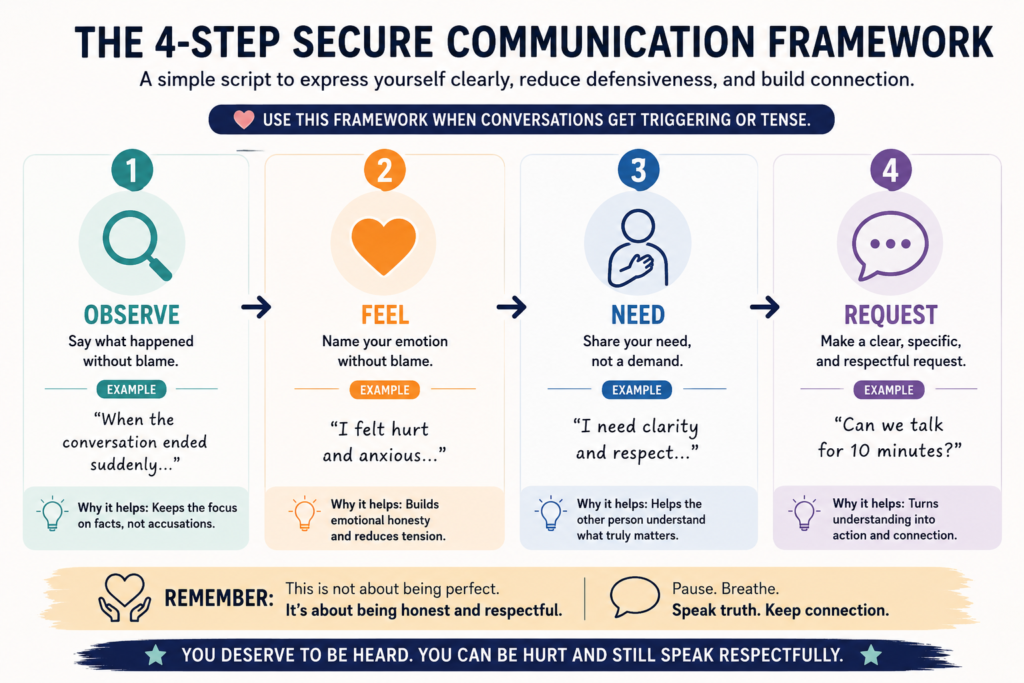
Step 5: Use Observation, Feeling, Need, and Request
A secure communication framework can follow four steps:
Observation → Feeling → Need → Request
This is connected to the spirit of nonviolent communication, where the goal is to reduce blame and increase clarity.
Observation Without Accusation
Observation means saying what happened without attacking the person’s whole character.
Instead of:
“You never listen to me.”
Try:
“When I was speaking and the topic changed, I felt unheard.”
Feeling Without Blame
Feeling means naming your emotional experience without turning the other person into the enemy.
Instead of:
“You made me feel terrible.”
Try:
“I felt hurt and anxious after that conversation.”
This is a key part of reducing defensive communication because it turns attack into clarity.
Need Without Demand
Need means naming what matters to you without forcing the other person to obey.
Instead of:
“You must fix this now.”
Try:
“I need clarity, respect, and a calmer way to discuss this.”
Request Without Control
Request means asking for a specific action without controlling the other person.
Instead of:
“You have to talk to me right now.”
Try:
“Would you be open to talking for ten minutes after dinner?”
This framework gives your pain a safe structure.
Step 6: Use Secure Conflict Scripts
When your body is triggered, the mind may go blank. Scripts help because they give your nervous system a prepared path.
Script for Feeling Hurt
“When that happened, I felt hurt and disconnected. I do not want to fight, but I do want to understand what happened.”
Script for Feeling Defensive
“I notice I am becoming defensive. I think I feel misunderstood, but I want to slow down and hear you properly.”
Script for Needing Space
“I care about this conversation, but my body feels overwhelmed. I need 20 minutes to regulate before I respond properly.”
Script for Wanting to Be Heard
“Please listen to me fully before judging me. I am not trying to attack you. I am trying to explain what hurt.”
Script for Repair After Conflict
“I realize my tone became sharp. I am sorry for that. What I was trying to say is that I need more respect and clarity.”
Script for Boundary
“I want to communicate respectfully, but I cannot continue if the conversation becomes insulting, threatening, or humiliating.”
These scripts are not magic sentences. They are bridges. They help you move from reaction to repair.
Read Also: relationship
Step 7: Repair After Defensiveness Without Self-Attack
If you became defensive, angry, silent, or overwhelmed, repair does not begin with self-hatred. It begins with responsibility.
You can say:
“I became defensive because I felt misunderstood, but I understand that my tone may have hurt you.”
This sentence does three things:
It names your inner state.
It takes responsibility.
It keeps the door open for repair.
Many people either over-blame themselves or blame the other person completely. Secure communication avoids both extremes.
Try this repair formula:
“I noticed…”
“I felt…”
“I reacted by…”
“I understand that it may have affected you…”
“What I want to do differently is…”
Example:
“I noticed I became sharp when I felt judged. I reacted by defending myself instead of listening. I understand that may have made the conversation harder. What I want to do differently is pause and explain my feeling more clearly.”
This is how repair becomes real.
If the conflict creates deep confusion, guilt, or mixed emotions, the article on cognitive dissonance after narcissistic abuse may help readers understand why the mind can feel divided between pain, hope, fear, and self-blame.
Triggered Communication Repair Chart
| Trigger | Automatic Reaction | Hidden Pain | Secure Response |
|---|---|---|---|
| Someone criticizes your tone | Anger, explaining, arguing | “I am being judged unfairly.” | “I want to understand, but I need us to slow down.” |
| You feel ignored | Panic, repeated messages, blaming | “I do not matter.” | “When I did not feel heard, I felt anxious. Can we talk about what happened?” |
| You feel misunderstood | Defensiveness, proving, long explanations | “No one cares about my side.” | “I think I am trying to protect myself right now. Let me restart.” |
| Conflict becomes intense | Silence, shutdown, numbness | “This is too much.” | “I need 20 minutes to calm my body. I will come back to this.” |
| You hurt someone with your words | Shame, avoidance, self-attack | “I am bad.” | “I realize my tone became sharp. I am sorry. What I meant was…” |
| You feel judged before being heard | Crying, anger, collapse | “Please understand me first.” | “Please listen to me fully before judging me.” |
This chart matters because many people are not defensive because they do not care. They become defensive because they care and feel threatened at the same time.
What To Do Before, During, and After a Difficult Conversation
Before the Conversation
Before you start, ask yourself:
“What is the one thing I want to communicate?”
This prevents over-explaining.
Then ask:
“What do I need: clarity, apology, reassurance, respect, space, or boundary?”
If you do not know what you need, the conversation may become emotional chaos.
A good preparation sentence is:
“The main thing I want to say is…”
This keeps your message focused.
During the Conversation
During the conversation, watch your body. If your voice becomes sharp, your chest becomes tight, or your thoughts become too fast, slow down.
You can say:
“I want to continue, but I need to slow down.”
This is not weakness. It is regulation.
If you feel the urge to prove everything, pause and ask:
“Am I trying to be understood, or am I trying to win safety through proof?”
Proof may not create safety if the other person is not listening.
After the Conversation
After the conversation, do not immediately attack yourself. Reflect gently.
Ask:
“What triggered me?”
“What did I need?”
“What did I communicate well?”
“What do I need to repair?”
“What boundary do I need next time?”
This turns conflict into learning instead of shame.
Read Also: attachment-and-connection
Secure Communication Without Self-Abandonment
Secure communication does not mean pleasing people. It does not mean accepting disrespect. It does not mean staying silent so others feel comfortable.
True secure communication includes connection and boundaries.
You can say:
“I care about this relationship.”
And also:
“I cannot accept being spoken to with contempt.”
You can say:
“I want to understand your side.”
And also:
“My side matters too.”
You can say:
“I am sorry for my tone.”
And also:
“The pain I was trying to express is still real.”
This balance is important. If you only focus on staying calm, you may abandon yourself. If you only focus on proving your pain, you may attack. Secure communication asks for a third path: honest, regulated, respectful, and boundaried.
This is the heart of how to stop getting defensive. You are not learning to erase your pain. You are learning to express it without letting it become harm.
BBH Insight: The Goal Is Not Perfect Communication
Secure communication is not perfect speech. It is the ability to stay honest without attacking, stay connected without collapsing, and protect yourself without becoming harsh.
The goal is not to never feel triggered. The goal is to notice when you are triggered and choose a safer next step.
Sometimes the most secure sentence is not a perfect explanation. Sometimes it is:
“I need a pause.”
“I want to understand.”
“My body feels overwhelmed.”
“I am hurt, but I do not want to attack.”
“I need respect for this conversation to continue.”
These are small sentences, but they can change the direction of a conflict.
One YMYL Safety Note
Secure communication can support healthier repair, but it cannot replace safety, boundaries, or professional help when abuse, coercion, humiliation, or fear is present.
If every conversation leaves you feeling afraid, controlled, threatened, or emotionally harmed, the issue may not be communication skill alone. In that case, support from a qualified mental health professional, trusted support person, or safety resource may be important.
Read Also : Emotional -healing-roadmap
People Also Ask
1. Why do I get defensive so easily?
You may get defensive because your nervous system feels criticized, blamed, misunderstood, or emotionally unsafe. Defensiveness is often a protective response, especially when shame, fear, or attachment wounds are activated.
2. How do I communicate when emotional triggers come up?
Pause before responding, notice your body, and use clear language. You can say, “I feel triggered right now, but I want to understand. Can we slow this conversation down?”
3. How can I reduce defensive communication?
Start by noticing your body reaction, naming the feeling, and using observation instead of accusation. Defensive communication reduces when the conversation feels safer and more specific.
4. What is secure communication?
Secure communication means expressing feelings, needs, boundaries, and concerns honestly without attacking, withdrawing, manipulating, or abandoning yourself.
5. Can relationship conflict trigger old wounds?
Yes. Relationship conflict can activate old wounds when a person feels dismissed, judged, blamed, ignored, or emotionally unsafe. The present issue may feel larger because it touches past pain.
FAQ
1. What is the best way to stop getting defensive?
The best way is to slow down before reacting. Notice your body, name the feeling, and respond with one clear sentence instead of explaining, attacking, or shutting down.
2. Can secure communication fix relationship conflict?
Secure communication can support healthier repair, but it cannot fix every relationship problem. If there is emotional abuse, fear, manipulation, or repeated humiliation, boundaries and professional support may be more important.
3. What should I say when I feel attacked?
You can say, “I want to understand you, but I am starting to feel defensive. Can we slow down and speak one point at a time?”
4. Why do I shut down during conflict?
Shutdown can happen when the nervous system feels overwhelmed. The body may move into freeze or withdrawal because the conversation feels too intense, unsafe, or emotionally confusing.
5. How do I repair after becoming defensive?
Start with responsibility, not self-attack. You can say, “I realize I became defensive. I think I was trying to protect myself, but I still want to understand what you were saying.”
BBH Support Resource
Want a simple tool to practice this?
Download the BBH Secure Communication Worksheet to reflect on your trigger, body reaction, hidden need, and safer words for next time.
Email Request Note:
Email info@bioandbrainhealthinfo.com and write: “Send me the Secure Communication Worksheet.”
Conclusion: You Can Be Hurt and Still Speak Respectfully
Learning how to stop getting defensive does not mean becoming emotionless. It does not mean letting people judge you, ignore your side, or disrespect your boundaries. It means learning how to notice the moment your body begins protecting you, so your pain does not have to speak through anger, silence, over-explaining, or self-blame.
Secure communication is the practice of saying:
“I am hurt, but I can still speak respectfully.”
“I want connection, but I will not abandon myself.”
“I want to understand you, but my side matters too.”
“I need care, respect, and honesty, not control or attack.”
The goal is not to win every conversation. The goal is to become safe enough inside yourself to speak from truth instead of threat.
Personal Note:
I understood that sometimes my body was not trying to create conflict. It was trying to protect a pain I had not yet named. My healing became clearer when I learned that I can be hurt and still speak respectfully.
Author Note
This article is written for emotional education and self-reflection. It is not a replacement for therapy, medical care, crisis support, or professional relationship guidance. Secure communication can support healthier repair, but safety, boundaries, and qualified support matter when fear, coercion, abuse, humiliation, or emotional harm is present.
External References
- Center for Nonviolent Communication — The Center for Nonviolent Communication
https://www.cnvc.org/ - The Gottman Institute — The Four Horsemen: Criticism, Contempt, Defensiveness, and Stonewalling
https://www.gottman.com/blog/the-four-horsemen-recognizing-criticism-contempt-defensiveness-and-stonewalling/ - Cleveland Clinic — Attachment Styles: Causes, What They Mean
https://my.clevelandclinic.org/health/articles/25170-attachment-styles - Cleveland Clinic Health Essentials — Understanding Attachment Theory and Its Stages
https://health.clevelandclinic.org/attachment-theory - Psychology Today — Attachment
https://www.psychologytoday.com/us/basics/attachment