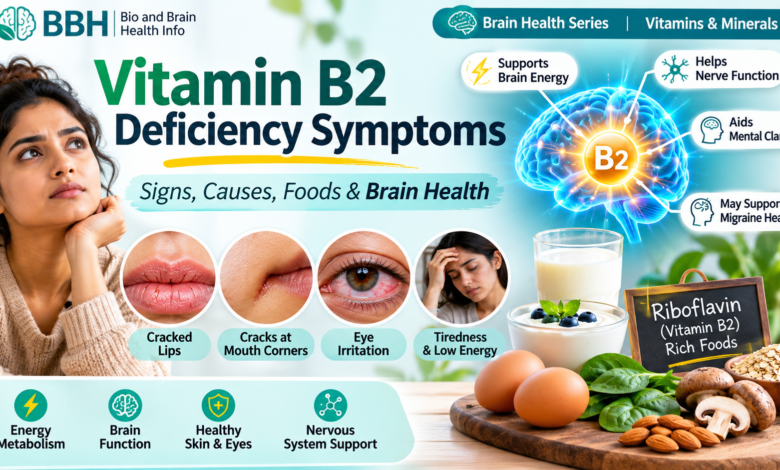
ou notice painful cracks at the corners of your mouth. Your eyes feel irritated, and your energy is lower than usual. Is it simply stress, a skincare problem, or something missing from your diet?
Thank you for reading this post, don't forget to subscribe!These changes deserve attention, but they do not automatically mean you have a vitamin deficiency. Understanding vitamin B2 deficiency symptoms can help you ask better questions and avoid guessing about supplements.
Quick Answer: What Are Vitamin B2 Deficiency Symptoms?
Vitamin B2 deficiency symptoms may include cracked lips, painful sores at the corners of the mouth,
sore throat, eye irritation, and skin changes. Riboflavin (vitamin B2) supports normal energy metabolism
and nervous system function.
Severe or prolonged deficiency may contribute to anemia and neurological complications. However, these symptoms can have several causes and cannot confirm a deficiency without appropriate medical evaluation.
Vitamin B2 Deficiency Symptoms: Early and Severe Signs
Clinical context: The NIH describes deficiency as uncommon in the United States. Mouth lesions, skin irritation and eye symptoms are not specific to riboflavin; a clinician may need to consider infections, other vitamin deficiencies and non-nutritional causes. NIH professional fact sheet.
Riboflavin deficiency, also called ariboflavinosis, most often becomes noticeable through changes around the mouth, throat, skin or eyes. The NIH notes that these signs can occur alongside deficiencies of other nutrients.
Vitamin B2 Deficiency Symptoms: Common Signs
Vitamin B2 deficiency symptoms may affect the mouth, lips, eyes, and skin. Some people may also experience fatigue or weakness, particularly when anemia or other nutritional deficiencies are present. These signs are not specific to riboflavin deficiency.
Early Signs of Riboflavin Deficiency
| Possible Sign | What You May Notice | Important Alternative Explanations |
|---|---|---|
| Angular mouth sores | Cracks or painful irritation at the corners of the mouth | Local irritation, infection, iron or other B-vitamin deficiencies |
| Inflamed lips or throat | Swollen or cracked lips, sore throat | Dryness, infection, allergy, other nutritional problems |
| Eye irritation | Redness or itching | Dry eyes, allergy, infection |
| Skin changes | Irritation or rash-like changes | Dermatitis, other skin conditions |
| Fatigue or weakness | Lower stamina, especially with anemia | Sleep problems, anemia from other causes, thyroid or glucose issues |
Medical safety note: These symptoms have multiple possible causes. A symptom checklist cannot diagnose vitamin B2
deficiency. Persistent or worsening symptomsn should be assessed by a qualified healthcare professional.Research reference: NIH Office of Dietary Supplements — Riboflavin * Health Professional Fact Sheet
When symptoms persist or worsen, seek an assessment. Looking at the pattern matters more than matching yourself to a checklist.
Vitamin B2 and Brain Health: What Research Shows
Does vitamin B2 deficiency cause brain fog?
Brain fog is not a specific diagnostic sign of riboflavin deficiency. The body’s need for riboflavin in normal energy metabolism does not mean riboflavin supplements improve cognition in people with adequate intake. Persistent cognitive changes should be assessed in context, including sleep, medicines, mood, anemia and metabolic conditions.
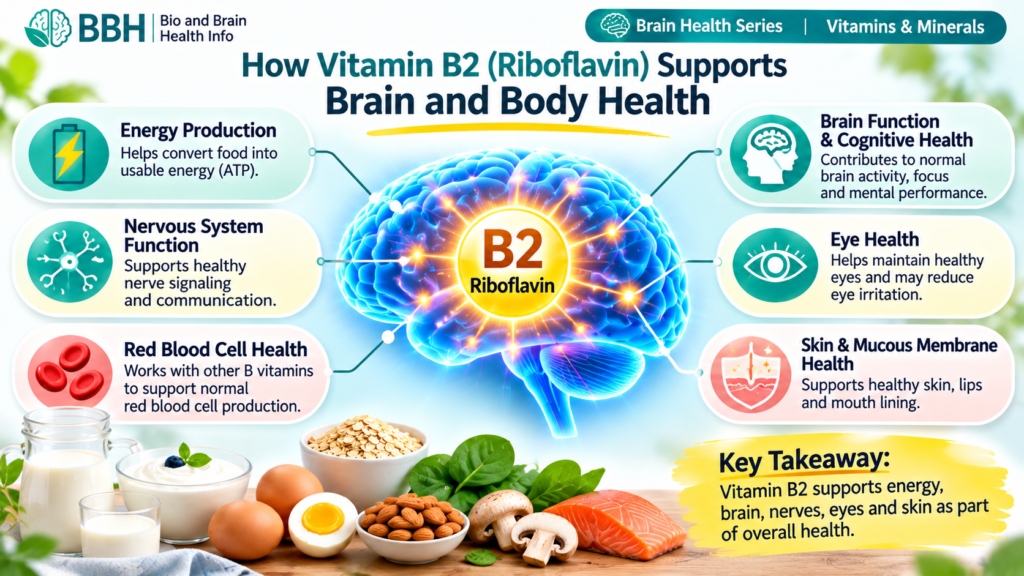
Vitamin B2 helps form two coenzymes, FAD and FMN, that support normal cellular energy metabolism. Brain and nerve cells depend on these metabolic pathways, but that does not mean extra riboflavin improves focus in people who already get enough.
Severe, prolonged deficiency can be associated with nervous-system complications. A rare inherited riboflavin transporter disorder is a different medical condition requiring specialist care. Brain fog alone is not a reliable sign of low vitamin B2.
What about migraine?
Riboflavin has been studied for migraine prevention, with some evidence of benefit. Doses studied for migraine are much higher than normal dietary requirements; they should not be copied as self-treatment.
A clinician can discuss whether this option belongs in an individual migraine plan.
Riboflavin Research: Migraine Trials and Evidence Quality
Riboflavin is needed to form flavin mononucleotide (FMN) and flavin adenine dinucleotide (FAD). These coenzymes participate in normal cellular energy reactions.
This biochemical role is well established; it does not prove that additional B2 improves concentration or memory in people who already obtain enough.
What did the randomized riboflavin migraine trial find?
In a 1998 randomized placebo-controlled trial published in Neurology, 55 adults with migraine received either 400 mg riboflavin daily or placebo over three months.
The riboflavin group experienced statistically significant reductions in attack frequency and headache days. This was a relatively small study of migraine prevention, not a trial of treating vitamin deficiency or brain fog. Read the trial on PubMed.
What do systematic reviews say?
A systematic review of 11 clinical trials found generally encouraging results in adults but mixed findings in children and combination-treatment studies.
A later dose-response meta-analysis covering 12 trials and 749 participants reported reduced migraine frequency and duration, although trial differences and the evidence base still require careful interpretation.
These findings do not establish riboflavin as a replacement for individualized migraine care. 2017 systematic review · Meta-analysis on PubMed.
Vitamin B2 Deficiency Causes and Risk Factors
Who may be at higher risk of low riboflavin?
People who avoid milk and other animal-derived foods without suitable alternatives, those with highly restricted dietary intake, and people with certain endocrine or inherited riboflavin transport disorders may warrant closer dietary review. Pregnancy and breastfeeding increase requirements. Risk does not establish deficiency.
Can other deficiencies occur at the same time?
Yes. NIH notes that riboflavin deficiency often coexists with other nutrient deficiencies. This is one reason that a symptom checklist cannot identify a single missing vitamin reliably.
Vitamin B2 deficiency symptoms may develop with inadequate intake or certain medical conditions. Risk can be higher among people who avoid dairy and eggs without suitable alternatives, have highly restricted diets, or have conditions affecting nutrient use. Pregnancy and breastfeeding can also increase nutritional needs.
In the United States, frank riboflavin deficiency is uncommon. A risk factor is a reason to review nutrition, not proof of a deficiency.
Foods High in Riboflavin: Vitamin B2 Nutrition Data
How to build a practical riboflavin-containing meal
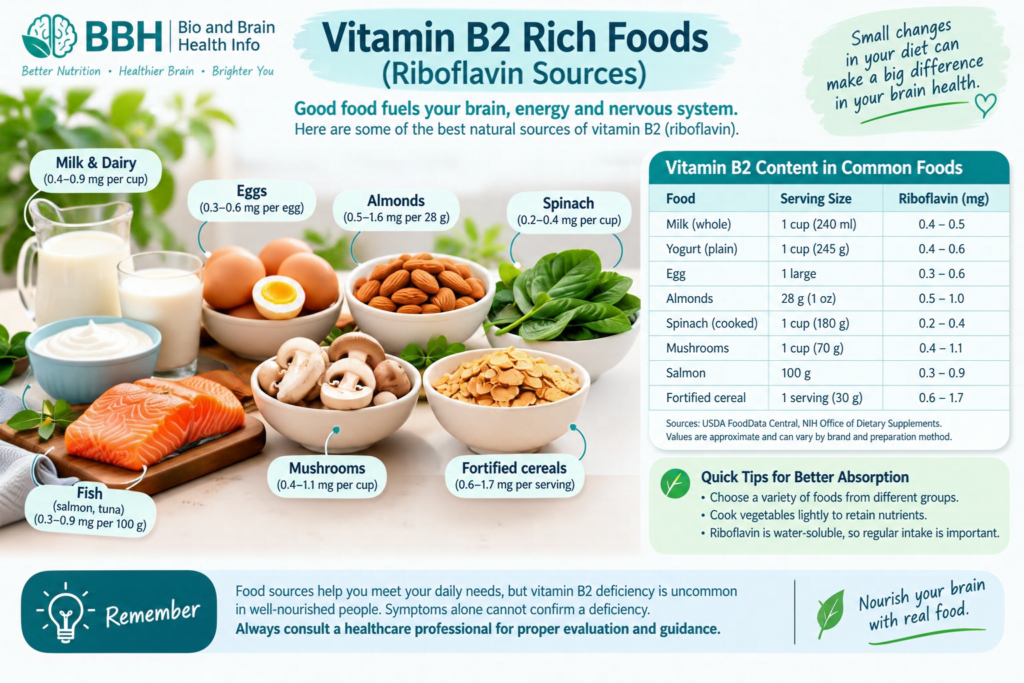
A breakfast of yogurt and fortified cereal, or eggs alongside other varied foods, may contribute riboflavin. For plant-based eating, fortified foods, almonds, mushrooms and leafy greens can contribute, although amounts vary. Food composition tables describe approximate amounts, not a personal prescription.
Does cooking reduce riboflavin?
Riboflavin can be lost into boiling water. NIH notes that losses into cooking water are greater when foods are boiled than when steamed or microwaved. Avoid prolonged light exposure for foods where riboflavin preservation matters.
For most people, a varied diet is the practical foundation. The table below uses approximate amounts from the NIH Office of Dietary Supplements.
Foods High in Riboflavin: Vitamin B2 Food Sources
Eating a variety of foods high in riboflavin can help support adequate vitamin B2 intake. Riboflavin contributes to normal energy metabolism, cellular function, and nervous system health. Dairy products, eggs, nuts, mushrooms, and leafy vegetables are among the dietary sources of vitamin B2.
Vitamin B2 Rich Foods and Riboflavin per Serving
| Food | Serving | Approx. Vitamin B2 |
|---|---|---|
| Plain fat-free yogurt | 1 cup | 0.6 mg |
| Milk, 2% fat | 1 cup | 0.5 mg |
| Dry-roasted almonds | 1 oz (28 g) | 0.3 mg |
| Grilled portabella mushrooms | ½ cup | 0.2 mg |
| Scrambled egg | 1 large | 0.2 mg |
| Raw spinach | 1 cup | 0.1 mg |
Nutrition note:
Riboflavin values are approximate and may vary by brand, preparation method, and serving size. A balanced diet containing several vitamin B2 sources can help meet daily nutritional needs. Source: NIH Office of Dietary Supplements — Riboflavin Fact Sheet
Other options include lean meats, organ meats, and some enriched or fortified grains. Vegetarian readers can combine dairy or suitable fortified alternatives with nuts, vegetables and varied meals. Check fortified-food labels, as amounts differ by country and brand.
5. How much vitamin B2 do adults need?
US recommended daily allowances are 1.3 mg for adult men and 1.1 mg for adult women; 1.4 mg during pregnancy and 1.6 mg while breastfeeding. Requirements differ by life stage. A healthcare professional can advise when medical circumstances change nutritional needs.
6. Testing, treatment and supplement safety
There is no single symptom that confirms deficiency. A clinician may review dietary intake, medications, digestive or endocrine conditions, and other nutrient deficiencies. Specialized riboflavin status testing exists but is not routinely needed for everyone.
Confirmed deficiency may be addressed with diet and, when appropriate, oral supplements. A formal upper intake limit has not been established, but that is not proof that arbitrarily high doses are safe or useful. Avoid starting high-dose products or injections without a medical reason.
7. A practical next-step plan
Vitamin B2 Deficiency Symptoms: What to Do Next
If you notice possible vitamin B2 deficiency symptoms, your next step depends on the symptoms, their
duration, and your overall health. Riboflavin deficiency cannot be diagnosed from symptoms alone.
Practical Action Plan for Riboflavin Deficiency Concerns
| If You Notice… | Reasonable Next Step |
|---|---|
| Occasional low dietary variety | Review your food patterns and add varied riboflavin sources such as dairy products, eggs, almonds, mushrooms, or leafy vegetables. |
| Persistent mouth, eye, or skin symptoms | Seek clinical assessment rather than self-diagnosing a vitamin deficiency. |
| Fatigue with other symptoms | Discuss the full picture with a healthcare professional, including sleep, diet, medications, and possible anemia. |
| Considering high-dose vitamin B2 for migraine | Discuss potential benefits, evidence limitations, dosing, and suitability with a qualified clinician before starting. |
| Sudden severe neurological symptoms | Seek emergency medical attention immediately, particularly for sudden weakness, facial drooping, speech difficulty, severe confusion, or sudden vision loss. |
BBH Medical Safety Reminder:
Symptoms such as fatigue, cracked lips, andneye irritation can have many explanations.nDietary improvements may support nutritional adequacy, but they do not replace appropriate medical evaluation or treatment.
Further reading: NIH Office of Dietary Supplements Riboflavin
8. People Also Ask: Vitamin B2 Deficiency Symptoms
These commonly asked questions explain vitamin B2 deficiency symptoms, possible effects on energy and eye health, dietary sources, and who may be at risk.
1. What is the first sign of vitamin B2 deficiency?
There is no single first sign of vitamin B2 deficiency. Early symptoms may include cracked lips, painful sores at the corners of the mouth, a sore throat, or inflammation of the tongue. These changes may also
result from infections, irritation, or other nutritional deficiencies.
2. Can low vitamin B2 cause tiredness?
Riboflavin helps the body convert food into usable energy. Severe or prolonged deficiency may contribute
to anemia, which can cause tiredness and weakness. However, fatigue alone does not indicate low vitamin B2. Sleep problems, other nutritional deficiencies, thyroid conditions, and many other health issues
can also cause fatigue.
3. Can vitamin B2 deficiency affect the eyes?
Yes. Riboflavin deficiency can be associated with eye irritation, redness, itching, and other ocular
changes. However, these symptoms are more commonly explained by conditions such as dry eyes, allergies, or infections. Persistent eye discomfort should be assessed by a healthcare professional.
Sudden vision loss requires emergency care.
4. Which foods contain the most riboflavin?
Rich dietary sources of vitamin B2 include organ meats, dairy products, eggs, almonds, mushrooms,
and fortified cereals. For example, one cup of plain fat-free yogurt provides approximately 0.6 mg of riboflavin, while one cup of 2% milk provides approximately 0.5 mg. Actual amounts
vary by product and preparation.
5. Is vitamin B2 deficiency common?
Riboflavin deficiency is relatively uncommon in countries where diets are varied and foods are
frequently fortified. However, inadequate intake or increased nutritional needs can occur in certain
groups, including people with restricted diets, some pregnant or breastfeeding individuals, and people with conditions affecting nutrient absorption. Risk varies by population and dietary circumstances.
BBH Medical Note:
Possible riboflavin deficiency symptoms are not sufficient for diagnosis. If symptoms persist,
seek medical evaluation rather than relying on self-diagnosis or high-dose supplements.
Scientific reference: NIH Office of Dietary Supplements — Riboflavin Fact Sheet
9. Frequently Asked Questions About Vitamin B2
These frequently asked questions explain vitamin B2 deficiency symptoms, riboflavin supplements, dietary sources, brain fog, and medical testing.
1. Is riboflavin the same as vitamin B2?
Yes. Riboflavin is another name for vitamin B2, a water-soluble vitamin that helps the body release energy
from food. It also supports normal cellular function and the metabolism of other nutrients.
Because the body stores only limited amounts, regular dietary intake is important.
2. Can vitamin B2 supplements cure brain fog?
There is insufficient evidence that vitamin B2 supplements cure brain fog in people without
riboflavin deficiency. Riboflavin contributes to normal energy metabolism, but difficulties with concentration or mental clarity can have many causes, including poor sleep, medication effects, anemia, and other medical conditions. Correcting a confirmed deficiency may help deficiency-related symptoms, but supplements are not a universal treatment for brain fog.
3. Can vegans meet riboflavin needs?
Yes. A well-planned vegan diet can provide sufficient riboflavin through foods such as almonds, mushrooms, spinach, fortified breakfast cereals, and fortified plant milks. Riboflavin content varies between products, so checking nutrition labels is useful. People following restrictive diets may benefit
from discussing overall nutrient adequacy with a registered dietitian.
4. Does cooking reduce vitamin B2?
Some riboflavin can be lost during food preparation, particularly when cooking water is discarded. Riboflavin is relatively stable under ordinary cooking heat but is sensitive to light exposure. Steaming,
microwaving with minimal water, and appropriate food storage may help preserve riboflavin content.
5. Should I request vitamin B2 testing?
If you have persistent mouth or skin symptoms, unexplained fatigue, restricted dietary intake, or a condition affecting nutrient absorption, discuss your concerns with a healthcare professional. Routine riboflavin testing is not necessary for everyone, and specialized tests may not be widely available. A clinician can review your symptoms, diet, medical history, and whether nutritional or other investigations
are appropriate.
BBH Medical Safety Note:
This information is educational and does not diagnose or treat vitamin deficiencies. Symptoms alone cannot establish riboflavin deficiency. Consult a qualified healthcare professional before starting high-dose
supplements or requesting specialized testing.
Scientific reference: NIH Office of Dietary Supplements — Riboflavin Fact Sheet for Health Professionals
10. BBH Support Resource — Free Vitamin B2 PDF
Download the BBH Vitamin B2 Food & Symptom Tracker
Download the free BBH Vitamin B2 Food & Symptom Tracker, a seven-day printable worksheet designed to help you record your dietary variety, possible vitamin B2 deficiency symptoms, and questions for your healthcare professional.
Use this worksheet to organize your observations and prepare for a more informed conversation with a qualified healthcare professional. It is not a diagnostic test.
Download Free Vitamin B2 Tracker (PDF)
Free printable seven-day worksheet | Bio and Brain Health Info (BBH)
Prefer to Request the Tracker by Email?
Email info@bioandbrainhealthinfo.com with the subject Send Me the Vitamin B2 Tracker.
Medical disclaimer:
This worksheet is for educational observation only. It cannot diagnose vitamin B2 deficiency, determine the cause of symptoms, or replace professional medical advice.
- NIH Office of Dietary Supplements — Riboflavin: Health Professional Fact Sheet.
- NIH Office of Dietary Supplements — Riboflavin: Consumer Fact Sheet.
- NHS — B vitamins and folic acid.
- Schoenen J, Jacquy J, Lenaerts M. Effectiveness of high-dose riboflavin in migraine prophylaxis: randomized controlled trial (Neurology, 1998)
- Thompson DF, Saluja HS. Prophylaxis of migraine headaches with riboflavin: systematic review (2017)
- Systematic review and dose-response meta-analysis of riboflavin migraine trials (PubMed)
- NCCIH — 7 Things To Know About Complementary Health Approaches for Headache and Migraine
Medical Safety & Editorial Disclaimer
Medical safety note: This article is for general health education and cannot diagnose or treat vitamin B2 deficiency. Seek urgent medical attention for sudden weakness, confusion, severe neurological changes, or breathing difficulty. Do not delay medical care to try supplements.
Individual nutritional needs vary according to medications, medical conditions, pregnancy, and other personal health factors. Consult a qualified healthcare professional for individualized advice.
Written by:
Shubhangi Halande Published by: Bio and Brain Health Info (BBH)
Category:
Brain Health → Vitamins & Minerals
Evidence review updated: 6 November 2026
Clinical review: No clinical review is implied.
This content is general health education, not individualized medical advice.