DSM-5 NPD Criteria: Is It More Than Narcissism?
DSM-5 NPD Signs: Traits or a Real Diagnosis?

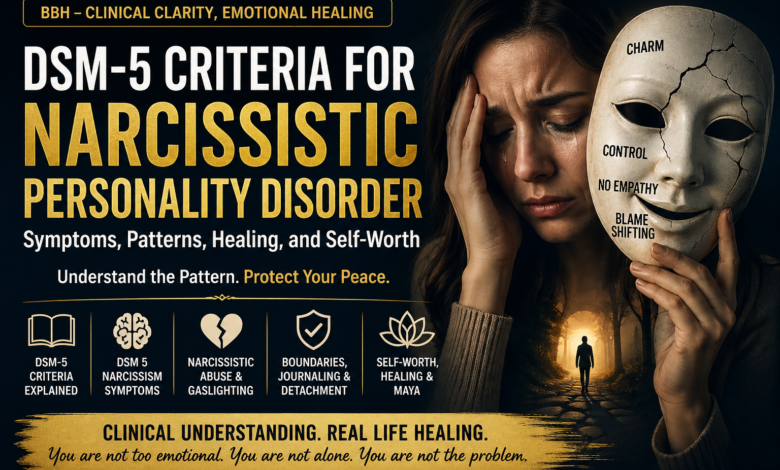
You may be searching for the DSM-5 narcissistic personality disorder criteria because someone’s behaviour has left you confused, emotionally drained, or unsure whether you are seeing ordinary selfishness or something more serious.
Thank you for reading this post, don't forget to subscribe!This guide explains the main narcissistic personality disorder signs, how clinicians understand DSM-5 NPD symptoms, and why a few painful behaviours do not automatically confirm a disorder.
You will also learn the difference between narcissistic traits vs NPD, what a professional narcissistic personality disorder diagnosis involves, and which patterns may affect relationships, empathy, entitlement, admiration, and accountability.
The goal is not to help you label another person. It is to give you clear, responsible, and practical information so you can understand repeated behaviour, recognise emotional impact, and decide what support or boundaries may be needed for your wellbeing.
DSM-5 Narcissistic Personality Disorder Criteria: Signs, Diagnosis, and What the DSM Actually Means
You may be reading about the DSM-5 narcissistic personality disorder criteria because someone’s behaviour has left you deeply confused.
Perhaps they expect constant praise but rarely recognise your needs. They may react strongly to criticism, exaggerate their importance, dismiss your feelings or make every disagreement return to their pain, status or reputation. After enough emotionally disorienting experiences, it is understandable to search for a name that might explain what has been happening.
But seeing painful narcissistic traits is not the same as establishing a diagnosis of narcissistic personality disorder.
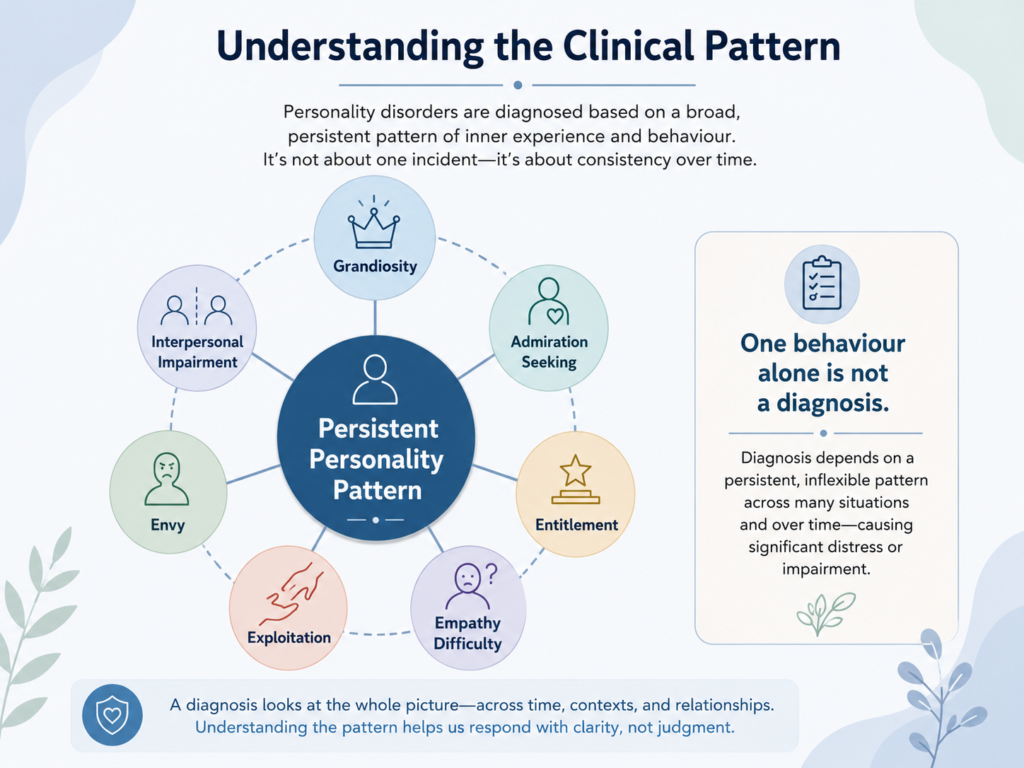
Narcissistic personality disorder, commonly called NPD, is a recognised mental-health condition involving a persistent pattern of grandiosity, need for admiration, entitlement, empathy difficulties and impaired interpersonal functioning. The pattern is not based on one argument, a selfish phase or a few unpleasant behaviours. It must be long-standing, appear across different situations and be serious enough to affect relationships, work or other important areas of life.
The DSM-5 narcissistic personality disorder criteria provide a clinical framework for qualified professionals. They are not intended to function as an online checklist through which a reader can diagnose a partner, parent, colleague or former partner.
This article explains the diagnostic areas in clear, original language, explores narcissistic traits vs NPD, describes how a narcissistic personality disorder diagnosis is made and helps you decide what you can do when someone’s behaviour is harming your emotional health.
Clinical safety note: This article provides general mental-health education and cannot diagnose you or another person. Only a qualified mental-health professional can determine whether someone meets the criteria for narcissistic personality disorder.
What Is Narcissistic Personality Disorder?
Narcissistic personality disorder is more than confidence, ambition, vanity or occasional self-centred behaviour.
It is a broad and enduring personality pattern that can affect how a person understands themselves, interprets other people, handles criticism and behaves in close relationships.
A person with NPD may appear certain of their superiority, yet their self-esteem may be less stable than it appears. Approval can become emotionally important because admiration helps protect the person’s preferred self-image. Criticism, rejection or failure may therefore produce intense defensiveness, anger, contempt, withdrawal or attempts to restore control.
This does not mean every person who dislikes criticism has NPD. Most people become defensive sometimes. The clinical question is whether the behaviour forms a persistent and inflexible pattern that repeatedly damages functioning and relationships.
Commonly discussed narcissistic personality disorder signs include:
- an exaggerated sense of importance;
- an intense need for admiration;
- expectations of special treatment;
- fantasies of exceptional success, beauty, power or ideal love;
- difficulty recognising other people’s emotional needs;
- exploitative relationship behaviour;
- envy and social comparison;
- arrogant or dismissive attitudes;
- strong reactions when the person’s self-image is challenged.
No single sign proves that someone has narcissistic personality disorder.
What Do the DSM-5 Narcissistic Personality Disorder Criteria Mean?
The DSM framework describes nine diagnostic areas associated with narcissistic personality disorder. A clinician does not simply count behaviours seen during one conflict. The professional considers how persistent, pervasive and impairing the overall pattern is.
The descriptions below paraphrase the clinical ideas in educational language. They do not reproduce the DSM text.
1. An Inflated Sense of Personal Importance
A person may consistently overestimate their abilities, impact, status or achievements. They may present themselves as more talented, influential or deserving than the available evidence supports.
This is different from healthy pride.
Healthy confidence allows a person to recognise both strengths and limitations. Inflated self-importance may require others to continually confirm the person’s superiority. When that confirmation is not given, the person may feel insulted, ignored or unfairly diminished.
In relationships, this can appear as:
- dominating conversations;
- exaggerating personal accomplishments;
- treating ordinary responsibilities as exceptional sacrifices;
- expecting praise for minimal contributions;
- minimising another person’s achievements;
- becoming resentful when attention moves elsewhere.
2. Persistent Fantasies of Exceptional Success or Ideal Status
The person may spend significant emotional energy imagining unlimited achievement, influence, brilliance, attractiveness or perfect love.
Dreams and ambitions are not disorders. Many psychologically healthy people imagine successful futures.
The concern is the role these fantasies play. They may become a defence against shame, limitation or ordinary human vulnerability. The person may feel that normal work, mutual compromise or gradual progress is beneath them because they believe they are destined for something exceptional.
In relationships, idealisation can also appear. A person may initially imagine a partner as perfect, extraordinary or capable of completing their life. When the real human partner inevitably has needs, boundaries and limitations, admiration can turn into disappointment or devaluation.
Related reading: understanding repeated idealisation and devaluation.
3. A Belief That They Are Uniquely Special
A person may believe that only highly successful, powerful or “special” people can understand them.
This belief can create rigid social hierarchies. People may be evaluated according to status, usefulness, attractiveness, wealth, professional influence or the admiration they provide.
Someone who is considered impressive may receive intense attention. Someone viewed as ordinary or no longer useful may be ignored, criticised or treated with contempt.
The emotional pain for partners and family members often comes from feeling valued conditionally. They may sense that their worth rises when they support the person’s image and falls when they express independent needs.
4. A Strong and Repeated Need for Admiration
Most people enjoy appreciation. In NPD, admiration may function less like a pleasant experience and more like emotional fuel that stabilises self-worth.
The person may repeatedly seek compliments, public recognition, attention or reassurance of superiority. They may become restless or resentful when others are praised.
This can create an exhausting relationship dynamic. The people around them may learn to monitor the person’s mood and offer admiration to avoid conflict. Genuine connection is then replaced by emotional management.
The partner may quietly begin asking:
- Did I praise them enough?
- Will my success make them angry?
- Can I express disappointment safely?
- Do my needs matter when they feel criticised?
- Am I responsible for repairing their self-esteem?
These questions do not diagnose NPD, but they reveal the emotional cost of an unbalanced relationship.
5. A Persistent Sense of Entitlement
Entitlement means expecting special treatment, automatic compliance or exceptions from ordinary rules.
A person may assume that their needs should be prioritised without recognising the impact on others. They may become angry when someone says no, requests fairness or establishes a boundary.
Entitlement can appear in subtle ways:
- expecting immediate replies;
- assuming others will rearrange plans;
- demanding emotional availability while offering little in return;
- treating boundaries as personal rejection;
- expecting forgiveness without meaningful repair;
- believing their stress excuses behaviour that would be unacceptable from others.
A sense of entitlement is especially damaging when it turns another person’s consent, time or emotional energy into something the entitled person believes they own.
6. Using Other People to Meet Personal Goals
Interpersonal exploitation occurs when another person is treated primarily as a resource rather than as a separate human being.
This does not always appear as an obvious plan to manipulate. It can take the form of repeated one-sided behaviour in which the person benefits while showing little concern for the emotional, financial or practical cost to someone else.
Examples may include:
- using another person’s contacts or money;
- accepting extensive support without reciprocity;
- pressuring someone through guilt;
- rewriting events to avoid accountability;
- appearing caring mainly when something is wanted;
- abandoning people after they are no longer useful.
The key issue is the continuing pattern of instrumental relationships: people are valued for what they provide.
7. Difficulty Recognising or Responding to Other People’s Feelings
Empathy difficulty is frequently discussed among DSM-5 NPD symptoms, but it must be understood carefully.
Empathy is not a simple switch that is either present or absent. A person may correctly recognise what another individual feels but still fail to care, respond or allow that feeling to influence their behaviour. Another person may show empathy in selected situations but withdraw it when accountability threatens their self-image.
In a painful relationship, this may sound like:
- “You are too sensitive.”
- “That never happened.”
- “You are making me look bad.”
- “What about everything I have been through?”
- “You should be grateful.”
- “Your feelings are the real problem.”
The conversation moves away from the hurt and toward protecting the other person’s image.
Learn more about difficulty responding to another person’s emotions.
8. Envy and Persistent Social Comparison
A person may feel intense envy or assume that other people envy them.
Envy can be difficult to recognise because it may be expressed through criticism rather than openly admitted. Someone else’s achievement may be dismissed, reinterpreted as luck or followed by an attempt to regain superiority.
Examples can include:
- minimising another person’s success;
- finding faults immediately after offering praise;
- competing in situations that do not require competition;
- believing criticism is caused by jealousy;
- resenting attention given to another person;
- imitating someone while simultaneously devaluing them.
A relationship becomes emotionally unsafe when one person cannot celebrate the other without experiencing their growth as a threat.
9. Arrogant, Dismissive or Contemptuous Behaviour
Arrogance can appear through words, tone, facial expressions or repeated treatment of others as intellectually, socially or morally inferior.
The person may speak condescendingly, mock vulnerability or act as though ordinary rules do not apply to them.
Contempt is particularly harmful in close relationships because it communicates that the other person is not merely mistaken but fundamentally beneath respect.
However, arrogance alone does not confirm NPD. It must be considered as part of the larger, enduring personality pattern.
Does a Person Need to Show Every DSM-5 NPD Symptom?
No. A person does not need to display every possible feature.
Under the conventional diagnostic framework, a clinician looks for a required threshold among the nine areas, together with the broader requirements applied to personality disorders. The professional must consider whether the pattern is enduring, inflexible, present across contexts and associated with clinically significant distress or impairment.
This distinction matters.
A reader might recognise entitlement and low empathy in a partner but have no information about how that person functions at work, with friends, across previous relationships or over time. A clinician gathers a much wider history.
Diagnosis is therefore not simply:
“I recognised several traits, so this person definitely has NPD.”
It is closer to:
“Does a sufficiently broad, persistent and impairing personality pattern remain after alternative explanations, context and history have been carefully considered?”
Narcissistic Traits vs NPD
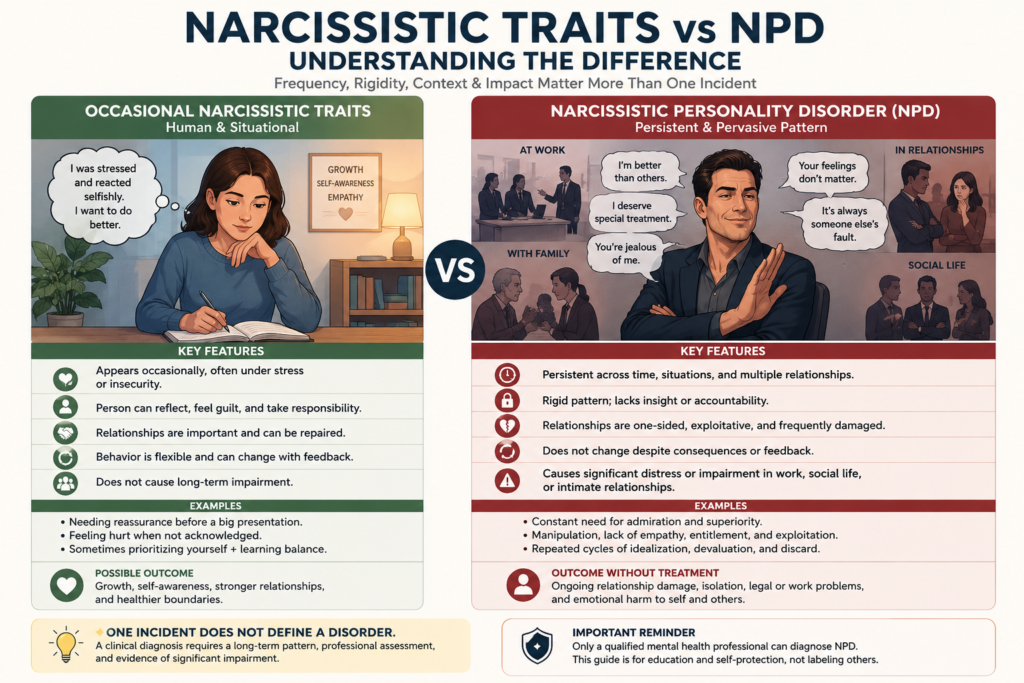
Narcissistic traits exist on a spectrum. A person can behave selfishly, seek validation or become defensive without meeting the requirements for a personality disorder.
The following table provides a practical comparison.
| Narcissistic Traits | Narcissistic Personality Disorder |
|---|---|
| May appear occasionally | Forms a persistent, enduring pattern |
| May occur mainly under stress | Appears across multiple situations |
| Person may later reflect and apologise | Accountability and repair may remain substantially impaired |
| Behaviour may be flexible | Pattern tends to be rigid and difficult to change |
| Does not necessarily impair functioning | Causes meaningful relational, social or occupational impairment |
| Can coexist with healthy empathy | Empathy difficulties may be central to the pattern |
| May improve through insight and feedback | Usually requires structured professional treatment |
| Does not justify a clinical label | Requires qualified clinical assessment |
Understanding narcissistic traits vs NPD prevents two common errors.
The first is overdiagnosis: labelling every arrogant, emotionally immature or abusive person as having NPD.
The second is underestimating harm: assuming you must prove a diagnosis before taking damaging behaviour seriously.
You do not need a psychiatric label to recognise that repeated humiliation, coercion, dishonesty, exploitation or fear is harmful.
“Sometimes we search for a diagnosis because we are trying to give a name to the confusion. But a label cannot replace the more important question: how is this behaviour affecting your safety, clarity and emotional health?”
How Is Narcissistic Personality Disorder Diagnosed?
A narcissistic personality disorder diagnosis should be made by a qualified mental-health professional after a comprehensive assessment.
There is no blood test, brain scan or single online questionnaire that can confirm NPD.
An assessment may include:
- detailed clinical interviews;
- developmental and relationship history;
- patterns in work and social functioning;
- the person’s understanding of themselves;
- emotional responses to criticism, rejection or failure;
- the stability of behaviour across time;
- possible co-occurring mental-health conditions;
- cultural and situational context;
- information from previous treatment, when available and appropriate.
A clinician also considers whether symptoms may be better explained by another condition, substance use, a medical issue, a temporary crisis or a mood episode.
This is one reason diagnosing someone from a partner’s description alone is not reliable. The partner’s experience is important and deserves support, but it cannot replace a direct clinical evaluation.
Why Self-Report Can Be Complicated
Personality assessment can be challenging because a person may not recognise their own patterns in the same way that others experience them.
Some people seek treatment because of depression, relationship loss, work problems or a crisis rather than because they believe their personality style is causing difficulty. Others may describe conflicts primarily in terms of how unfairly they have been treated.
This does not mean clinicians simply distrust the person. It means diagnosis requires thoughtful interpretation of history, behaviour, self-perception and functioning.
Can You Diagnose a Partner, Parent or Colleague?
No. Reading the DSM-5 narcissistic personality disorder criteria can improve understanding, but it does not qualify someone to make a clinical diagnosis.
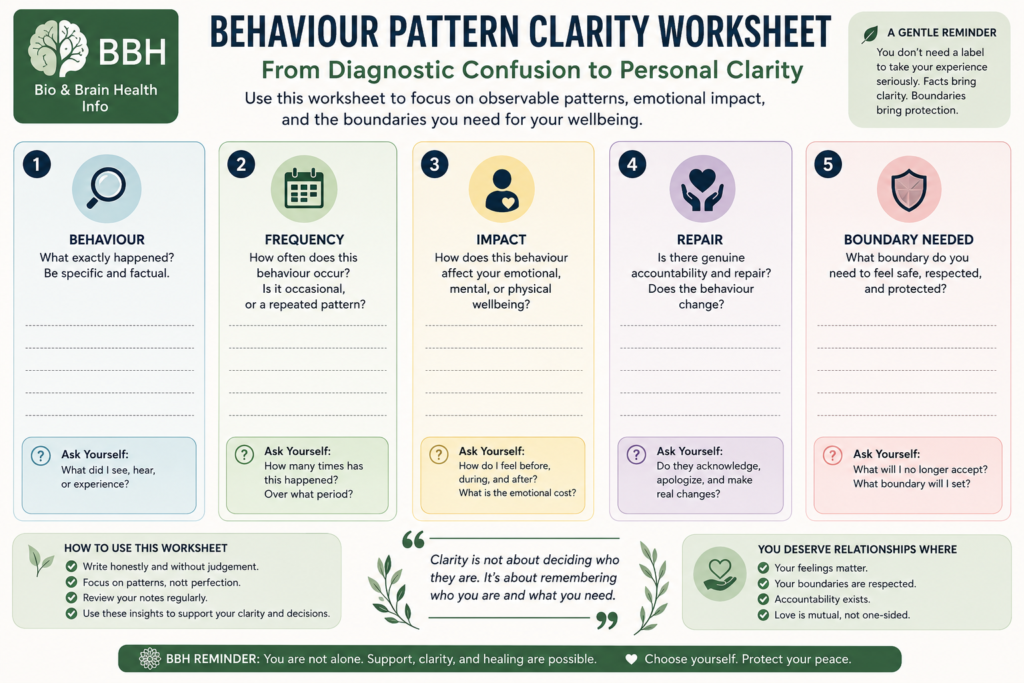
Online descriptions also create confirmation bias. Once you suspect NPD, every selfish act may begin to look like proof. Context and contradictory evidence may receive less attention.
A more useful approach is to document observable behaviour:
- What happened?
- How often does it happen?
- What boundary was crossed?
- Was responsibility accepted?
- Was repair attempted?
- Did the behaviour genuinely change?
- How did the interaction affect your physical and emotional wellbeing?
This shifts attention from proving a diagnosis to understanding the reality of the relationship.
You may not know whether someone has NPD, but you can still know:
- I feel afraid to speak honestly.
- My boundaries are repeatedly punished.
- My memories are constantly challenged.
- I am expected to provide care without reciprocity.
- Apologies are followed by the same behaviour.
- I am becoming emotionally and physically depleted.
Those observations are meaningful even without a label.
Related reading: recognising repeated blame-shifting behaviour.
What Is the Difference Between Grandiose and Vulnerable Narcissistic Presentations?
Narcissistic personality disorder does not always look like loud bragging.
A grandiose presentation may be more visible. The person may appear dominant, charming, competitive, entitled or openly certain of their superiority.
A vulnerable presentation may involve shame sensitivity, resentment, withdrawal, defensiveness, hidden fantasies of recognition or intense reactions to feeling overlooked.
Both presentations can involve self-esteem regulation difficulties and interpersonal problems, but they may look different on the surface.
“Covert narcissism” is a popular non-clinical term often used to describe more vulnerable or hidden narcissistic features. It is not a separate official DSM diagnosis.
This distinction is important because quietness, insecurity or social withdrawal alone do not indicate narcissism. Vulnerability can occur in depression, anxiety, trauma, attachment insecurity and many other conditions.
Read more about how covert narcissistic patterns may appear.
Why Criticism Can Trigger Such Strong Reactions
Apparent superiority can coexist with fragile self-esteem.
When a person’s identity depends heavily on being exceptional, right or admired, ordinary feedback may feel like a threat to the entire self rather than information about one behaviour.
The reaction may involve:
- anger;
- contempt;
- denial;
- blame shifting;
- withdrawal;
- retaliatory criticism;
- attempts to discredit the person giving feedback.
From the outside, the intensity may seem disproportionate. From inside the person’s psychological system, criticism may activate shame, humiliation or fear of being exposed as inadequate.
Understanding this dynamic does not excuse harmful behaviour.
An explanation is not the same as permission.
A person remains responsible for how they respond to distress, especially when their response frightens, controls or repeatedly injures other people.
Related reading: clinical signs of grandiose behaviour.
Read Also : healing-resources-hub
What Conditions Can Resemble Parts of NPD?
Several conditions or situations can overlap with individual narcissistic personality disorder signs. This does not make them identical.
Bipolar Mood Episodes
During a manic or hypomanic episode, a person may show inflated self-esteem, increased confidence or grandiose ideas. The episodic nature and the presence of other mood symptoms help clinicians distinguish a mood episode from a long-term personality pattern.
Borderline Personality Disorder
Both conditions can involve relationship instability and strong reactions to rejection. However, borderline personality disorder is often associated with intense fear of abandonment, rapidly changing self-image, emotional instability and impulsivity. Careful assessment is needed because overlap can occur.
Antisocial Personality Disorder
Exploitation and reduced concern for others can occur in antisocial personality disorder, but its diagnostic pattern includes broader disregard for social rules and the rights of others. Similar-looking behaviours may arise from different psychological structures.
Histrionic Personality Disorder
Attention seeking may occur in both conditions. Histrionic patterns are generally organised more around emotional expression and attention, whereas narcissistic patterns more strongly involve superiority, status, entitlement and admiration.
Trauma and Attachment Injuries
Trauma can produce defensiveness, emotional withdrawal, mistrust or difficulties with intimacy. These reactions should not automatically be interpreted as NPD.
Ordinary Emotional Immaturity
Some people struggle with accountability, empathy and conflict because they lack emotional skills. Immaturity can cause real harm, but it is not automatically a personality disorder.
Cultural and Environmental Factors
Communication style, family expectations, status norms and cultural values influence how confidence, hierarchy and emotional expression appear. Clinicians must consider context instead of interpreting behaviour in isolation.
Read Also: trauma-recovery-start-your-healing-journey-today
What Causes Narcissistic Personality Disorder?
There is no single established cause of NPD.
Personality development is complex and may reflect interactions among temperament, biology, childhood environment, attachment experiences, cultural influences and learned relationship patterns.
Possible developmental factors discussed in clinical literature include:
- excessive praise disconnected from reality;
- severe or unpredictable criticism;
- emotional neglect;
- conditional approval;
- overvaluation or idealisation;
- trauma or instability;
- modelling of entitled or exploitative behaviour.
These are possible contributors, not simple formulas.
Many people experience criticism, trauma or emotional neglect and do not develop NPD. Similarly, it would be inaccurate to assume that every person diagnosed with NPD had one specific type of childhood.
A responsible explanation should avoid blaming parents, blaming children or presenting one developmental theory as proven fact.
Can Narcissistic Personality Disorder Be Treated?
Treatment is possible, although progress can be difficult and often requires time, motivation and consistency.
Psychotherapy is the central treatment approach. Therapy may help a person:
- understand patterns in relationships;
- develop more realistic self-assessment;
- tolerate criticism and disappointment;
- recognise other people’s emotions and perspectives;
- regulate shame, anger and defensiveness;
- build more reciprocal relationships;
- take responsibility without psychological collapse;
- reduce exploitative or entitled behaviour.
There is no medication specifically approved to change narcissistic personality structure. Medication may be used when other conditions, such as depression or anxiety, are also present.
The possibility of treatment does not guarantee change.
Sustainable change requires more than promises after a crisis. It generally involves:
- recognition of the pattern;
- willingness to remain in treatment;
- acceptance of responsibility;
- behavioural change over time;
- respect for other people’s boundaries;
- repair that does not demand immediate forgiveness.
A partner cannot perform this psychological work on someone else’s behalf.
Read more about whether long-term behavioural change is possible.
What Should You Do When Someone’s Behaviour Is Hurting You?
You do not need to win a diagnostic argument.
Your first task is to become clear about what is happening and what you need.
1. Record Patterns, Not Only Emotional Conclusions
Instead of writing “They are definitely a narcissist,” record:
- the exact behaviour;
- the date or situation;
- what was said;
- how you responded;
- whether accountability followed;
- whether the pattern repeated.
Facts help protect clarity, especially when conversations leave you doubting your memory.
2. Separate Intent From Impact
You may never know exactly why the person acted as they did.
Ask instead:
- What was the impact?
- Is the behaviour continuing?
- Is honest discussion possible?
- Do I feel emotionally or physically safe?
- Is repair mutual?
3. Use Specific Boundaries
A boundary is not an attempt to control another person. It describes what you will do to protect your wellbeing.
Examples include:
- “I will end the conversation if insults begin.”
- “I will not lend more money.”
- “I need decisions affecting me to include my consent.”
- “I will discuss this when we can both speak respectfully.”
- “I will not continue defending events I clearly remember.”
4. Watch Behaviour After the Boundary
The response to a reasonable boundary can reveal more than a promise.
Look for:
- respect;
- negotiation;
- sustained behavioural change;
- punishment;
- ridicule;
- threats;
- guilt;
- silent withdrawal;
- temporary compliance followed by repetition.
5. Seek Outside Perspective
Emotional isolation can make unhealthy patterns harder to evaluate.
A therapist, trusted friend, support service or healthcare professional may help you review the situation without forcing a diagnosis.
6. Prioritise Safety
When coercion, stalking, threats, financial control, sexual pressure or physical violence is present, the issue is not communication quality alone. Seek appropriate local professional, legal or emergency support.
Practical Pattern-Clarity Table
| What to Observe | Questions to Ask Yourself | What a Healthier Response May Look Like |
|---|---|---|
| Reaction to feedback | Can they hear one concern without attacking my character? | Listening, clarification and accountability |
| Empathy | Do they acknowledge my feelings even when they disagree? | Emotional recognition without immediate self-defence |
| Boundaries | Are reasonable limits respected? | Negotiation without punishment |
| Repair | Does behaviour change after an apology? | Consistent follow-through |
| Reciprocity | Do both people’s needs matter? | Balanced giving and receiving |
| Responsibility | Can they name their part without blaming me? | Specific ownership |
| Conflict | Do I feel safe speaking honestly? | Disagreement without humiliation or fear |
| Pattern over time | Is change stable or temporary? | Improvement maintained across months |
This table cannot diagnose NPD. Its purpose is to help you assess relationship health.
Read Also: understanding-narcissism
People Also Ask
1. What are the DSM-5 criteria for narcissistic personality disorder?
The framework describes nine areas involving inflated importance, fantasies of exceptional success, specialness, need for admiration, entitlement, exploitation, empathy difficulties, envy and arrogance. Diagnosis also depends on a persistent, pervasive pattern and meaningful impairment. A qualified professional must perform the assessment.
2. How many NPD criteria are needed for diagnosis?
The conventional DSM approach requires a specified threshold among the nine areas, but counting traits alone is not enough. The clinician must also determine whether the pattern is enduring, inflexible, present across contexts and associated with clinically significant problems.
3. Can someone have narcissistic traits without NPD?
Yes. Narcissistic traits can occur without a personality disorder. People may become self-focused, defensive or approval-seeking under stress. NPD involves a broader, more persistent and impairing pattern.
4. Can covert narcissism be diagnosed using the DSM-5?
“Covert narcissism” is not a separate DSM diagnosis. Clinicians may recognise vulnerable narcissistic features, but any formal diagnosis would still require assessment under the recognised framework and consideration of alternative explanations.
5. Can a therapist diagnose someone they have never met?
A therapist can help a client understand harmful relationship patterns, but ethically reliable diagnosis usually requires direct assessment of the person being diagnosed. A professional should not treat a partner’s report as sufficient proof of another person’s disorder.
Read Also: narcissism
Frequently Asked Questions
1. Is lack of empathy enough to diagnose narcissistic personality disorder?
No. Empathy difficulty can arise for many reasons, and people differ in how they recognise and express emotion. NPD requires a larger pattern involving several diagnostic areas, persistence and impairment.
2. Are all people with NPD abusive?
No. A diagnosis and abusive behaviour are not identical concepts. A person can have NPD without committing every form of abuse, and a person can be abusive without having NPD. Harmful behaviour should be addressed based on what occurred, not solely on a diagnostic label.
3. Do people with NPD know that they are hurting others?
Awareness varies. Some people may recognise another person’s distress but prioritise protecting their own self-image. Others may minimise the impact or interpret feedback as an attack. Regardless of awareness, repeated harm still requires boundaries and accountability.
4. Can narcissistic personality disorder improve?
Improvement is possible through sustained psychotherapy, insight and motivation. Progress is more credible when it appears as consistent behavioural change, increased accountability and greater respect for other people—not only promises or temporary improvement after consequences.
5. Should I confront someone by telling them they have NPD?
Directly assigning a diagnosis may escalate conflict and rarely creates insight. It is usually more effective to address specific behaviour and boundaries: what happened, what you will not accept and what action you will take if the behaviour continues.
A Personal Note
Sometimes the search for DSM-5 NPD symptoms begins after months or years of emotional confusion.
You may be trying to understand why every conversation becomes circular, why apologies do not produce change or why expressing your pain somehow ends with you comforting the person who hurt you.
Seeking information is not foolish. Naming patterns can restore a sense of reality.
But you do not need complete diagnostic certainty before taking your own emotional experience seriously.
A diagnosis belongs to a clinician. Your boundaries belong to you.
You are allowed to recognise that a relationship is exhausting, frightening or one-sided. You are allowed to seek support. You are allowed to stop arguing about whether your pain is legitimate.
Clinical clarity should not become another reason to remain trapped.
Let the information help you understand the pattern, but let your lived reality help you decide what protection, distance, support or repair you need.
BBH Support Resource
Want a Simple Tool to Separate Incidents From Patterns?
Download the BBH Behaviour Pattern Clarity Worksheet to record:
- what happened;
- how often it occurred;
- how it affected you;
- whether genuine repair followed;
- what boundary may now be needed.
Email info@bioandbrainhealthinfo.com and write:
“Send me the Behaviour Pattern Clarity Worksheet.”
Final Takeaway
The DSM-5 narcissistic personality disorder criteria describe a persistent clinical pattern—not a label for every selfish, arrogant or hurtful person.
Narcissistic personality disorder signs must be understood in context. A professional diagnosis considers history, consistency, impairment, alternative explanations and the person’s functioning across different areas of life.
Learning about narcissistic traits vs NPD can help you think more accurately, but you do not need to diagnose someone to recognise repeated harm.
The most useful questions are often not:
“Can I prove this person has NPD?”
They are:
“What pattern am I living with?”
“Is meaningful repair happening?”
“Do I feel safe and respected?”
“What support or boundary do I need now?”
Understanding the diagnosis can provide clarity. Protecting your wellbeing turns that clarity into action.
External References
- American Psychiatric Association — What Is Narcissistic Personality Disorder?
https://www.psychiatry.org/news-room/apa-blogs/what-is-narcissistic-personality-disorder - American Psychiatric Association — What Are Personality Disorders?
https://www.psychiatry.org/patients-families/personality-disorders/what-are-personality-disorders - Mayo Clinic — Narcissistic Personality Disorder: Symptoms and Causes
https://www.mayoclinic.org/diseases-conditions/narcissistic-personality-disorder/symptoms-causes/syc-20366662 - Mayo Clinic — Narcissistic Personality Disorder: Diagnosis and Treatment
https://www.mayoclinic.org/diseases-conditions/narcissistic-personality-disorder/diagnosis-treatment/drc-20366690 - MedlinePlus — Narcissistic Personality Disorder
https://medlineplus.gov/ency/article/000934.htm - NCBI Bookshelf, StatPearls — Narcissistic Personality Disorder
https://www.ncbi.nlm.nih.gov/books/NBK556001/